
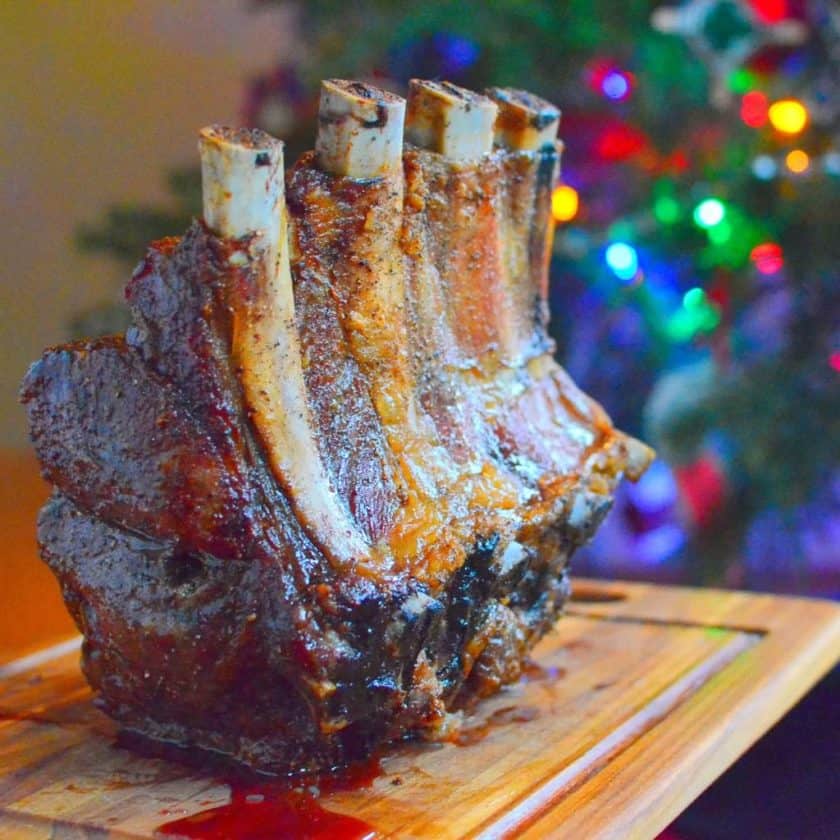
Today, we're cooking a big rib roast on my gas grill's rotisserie.
Big means four bones or more of the prime rib - up to the entire seven bone rib section.
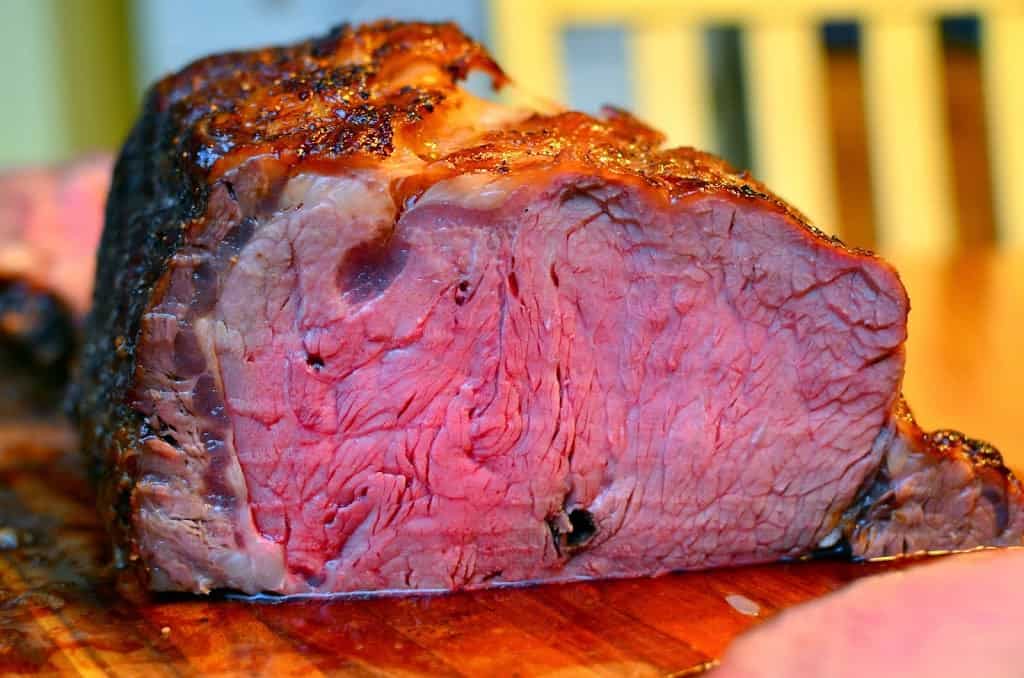
We're going to use a trick that all good food scientists recommend - the reverse sear. We cook the roast low and slow to 110°F, then finish with a blast of heat, bringing the roast to medium-rare and giving it a browned, crisp crust. The reverse sear gives us a perfectly cooked roast, medium rare all the way through, and keeps the juices in the roast where they belong.
Why? If you're interested, see my long-winded post about it earlier this week.
Would you like to save this recipe?
A gas grill makes this easy - especially one with an infrared rotisserie burner. Set the grill up for indirect low heat, with a drip pan in the middle, and the outer burners set for a grill temperature of 250°F. Cook the roast to 110°F (or as close as you can get), then turn the outer burners to high, turn the rotisserie burner to high, and blast the roast with heat for fifteen minutes, until it has a beautiful browned crust and reaches an internal temperature of 120°F. Rest for 15 minutes, carve, serve, and wow your guests with a perfect, medium-rare prime rib.
My "Prime Rib" disclaimer
Technically, this is a beef rib roast, not prime rib. That is, unless you can afford to pay for USDA Prime graded beef. I did this - once - and it was fabulous. It also cost $16.99 a pound for a five bone roast, weighing 16 pounds. (My wallet still screams thinking about it). Since then, I look for Choice rib roasts with a lot of small streaks of fat inside the muscle (aka "well marbled"). I can usually find them between $6.99 and $9.99 a pound.
Special thanks to my butcher, Mike at Sherman Provision. He put up with multiple roast requests because I had to test this technique against a "high and fast" roast. And, for the record, his roasts are both well marbled and inexpensive.
Equipment
- Grill with Rotisserie attachment (I use a Weber Summit with an infrared rotisserie burner. Here is the current version of my grill.)
- Aluminum foil drip pan (9"x13", or whatever fits your grill. I use an enameled steel roasting pan.)
- Butchers twine
- Instant Read Thermometer
Notes
- You can reverse sear on a charcoal grill - start the grill out low and slow, then add a chimney full of lit charcoal at the end for the blast of high heat. I wouldn't bother, if I were you. Charcoal burndown gives you low and slow naturally, starting high, then cooling off as it burns, and finishing the roast on low heat. It's not quite the food scientist approved method, but it's close enough, and it is less fussy. Check out my Rotisserie Prime Rib Roast recipe for charcoal grill setup.
- About cooking times. The weight of the roast doesn't matter - the thickest part of the meat determines how long it will cook. Butchers size rib roasts by the number of bones you want; an entire rib roast has seven bones. Below two bones is a thick steak, so we won't talk about that here. Two bone roasts, about 4 pounds, are taller than they are wide - they cook more from the heat on the sides of the roast, and take less time to cook - start checking their temperature at 30 minutes, and expect them to take about an hour to get to 110°F. Three bone roasts are about as wide as they are tall, and cook from all directions. Start checking after 45 minutes, and expect them to take an hour and a half to get to 110°F. 4 bone or larger roasts, up to the entire seven bone rib roast, all cook in about the same time - the roast is now wider than it is tall, the heat has to work its way in from the sides, and adding extra width will not slow that down. They take about 2 ½ hours to cook to 110°F. (All timings are approximations. Please use an instant read thermometer to be sure, because if you're going to go through all this effort, don't you want to know what's going on in that roast?)
📖 Recipe Card
Rotisserie Prime Rib Roast, Reverse Seared on a Gas Grill
- Total Time: 3 hours 30 minutes
- Yield: 8-12 1x
Description
Rotisserie Prime Rib, perfectly medium-rare edge to edge.
Ingredients
- 4 bone (10 pound) semi-boneless beef rib roast (semi-boneless means ask the butcher to cut off the chine bone, but leave the rib bones.)
- 2 tablespoons Diamond Crystal kosher salt or 1 ½ tablespoons Maldon kosher salt
- 2 teaspoons coarse ground black pepper
Instructions
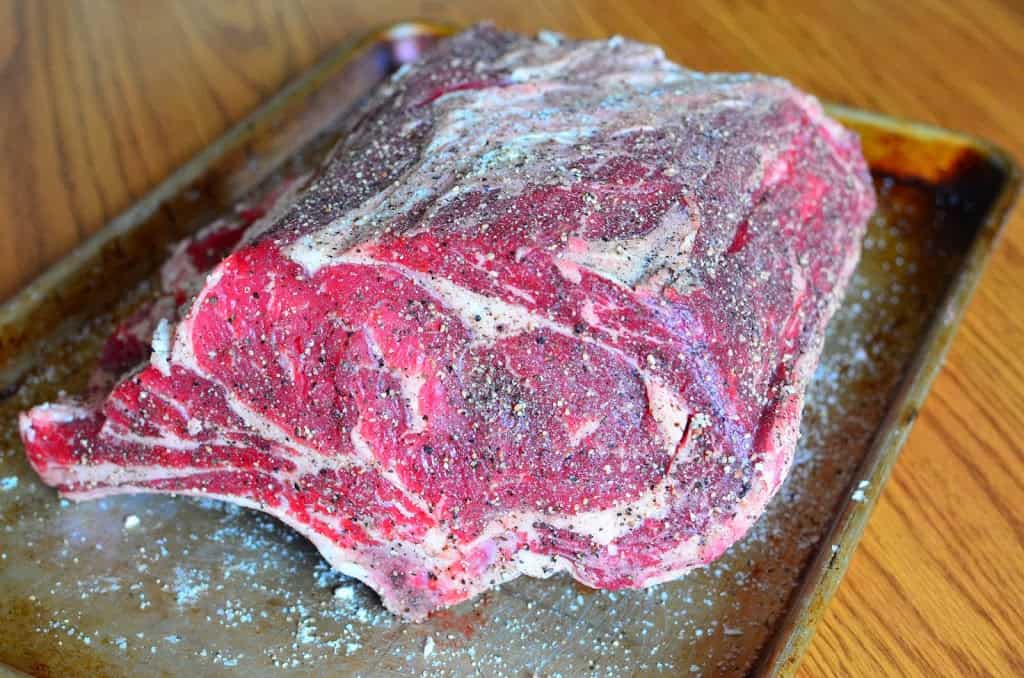
- Dry brine the roast: The night before cooking, season the roast with the salt and pepper. Put the roast in a baking dish, using the bones as a rack to lift it off the bottom of the dish, and refrigerate overnight. One hour before cooking, remove the roast from the refrigerator.
- Prepare the grill: Set the grill up for rotisserie cooking at low heat (250°F). For my Weber Summit, this means removing the grates, turning the two outer burners (burners 1 and 6) to medium, and leaving the infrared rotisserie burner off. Then I put my drip pan in the middle, over the unlit burners, and let the grill preheat for ten to fifteen minutes.
- Spit the roast: While the grill is preheating, truss and spit the roast. Truss the roast in between each of the bones, pulling it into into a tight cylinder. Run the spit through the center of the roast, slightly towards the bone side to balance out the bones. Secure the roast to the spit with the spit forks.
- Cook the roast: Put the spit on the rotisserie and start it spinning. We're cooking the roast until it reaches an internal temperature of 110°F for medium-rare. (Cook to 100°F for rare, 120°F for medium.) This will take about 2 ½ hours, but the time will vary - go by temperature, not by time. Check the temperature of the roast after 1 hour of cooking (it should be about 50°F , then again after 2 hours of cooking (it should be about 90°F). At that point, start checking every fifteen minutes - you want to get as close to 110°F as you can, without going over (I quit at 108°F - close enough). As soon as the roast reaches 110°F, turn the grill to high heat. On my Summit, I turn the outer burners up to high, then light the infrared rotisserie burner and set it to high. Sear the roast on high for 15 to 30 minutes, until it is well browned on the outside, and the internal temperature measures 120°F for medium-rare. (115°F for rare, 130°F for medium).
- Rest, carve and serve: Remove the spit from the grill. Be careful - the spit is rocket hot. Immediately remove the roast from the spit, transfer to a platter, and remove the twine. Cover the roast with foil and rest the roast for 15 to 30 minutes before carving. To carve, cut the bones away from the roast (I save them for myself - chef's treat). Slice the roast into ½ inch thick slices and serve.
Notes
If you don't have time to salt the roast overnight, you have two choices:
1. Salt at least one hour before cooking: Salt the roast one to two hours before cooking, and rest at room temperature until it is time to grill. An hour will give you enough time to get a bit of the dry brine effect.
2. Salt right before cooking: If you're within an hour of cooking, salt the roast right before you truss and spit it for the grill.
- Prep Time: 30 minutes
- Cook Time: 3 hours
- Category: Rotisserie
- Cuisine: American
What do you think?
Questions? Other ideas? Leave them in the comments section below.
Related Posts
Rotisserie Prime Rib Roast (Charcoal grill setup)
Rotisserie Beef Tenderloin with Shallot Herb Butter and Horseradish Sauce (Use the horseradish sauce with any beef recipe)
Rotisserie Boneless Ribeye Roast with Garlic Crust
Click here for my other rotisserie recipes
*Enjoyed this post? Want to help out DadCooksDinner? Subscribe to DadCooksDinner using the RSS or Email options on the right, recommend DadCooksDinner to your friends, buy something from Amazon.com

Sally says
The prime rib was delicious. Both my husband and I ate way more than we should have. I was thinking of reheating slices in the SV. Do you think this is the best method? If so, any recommendation on temperature and time? We cooked the prime rib to medium rare.
Ellie says
I've used this recipe several times (adjusted for smaller roasts/1-3 ribs)... My family loves it, including my mother who is a biased steak-eater from OKC (salt and pepper only!). I don't always have the time for the overnight dry-brine (if we don't thaw it in time), but the 1-2 hours works just fine for a smaller roast. And thanks, Mike, for helping our family move out from under the "cook it until it's gray" rock, into the modern culinary light!
dan lemp says
How do you sear the prime rib without a sear heat pad on the back of the bbq? We will rotisserie the roast on a gas grill.
Mike V says
Crank all the burners in the grill as high as they will go.
Ken Carlile says
Will this only work with a big rib roast? The one I have is only 2 bone.
Mike V says
It will work, but the timing is a little tighter. You might want to just grill it: https://www.dadcooksdinner.com/grilled-cowboy-chop-double-cut-ribeye-reverse-seared/
Ken Carlile says
I assume then I'd need to cut it in half... if I can!