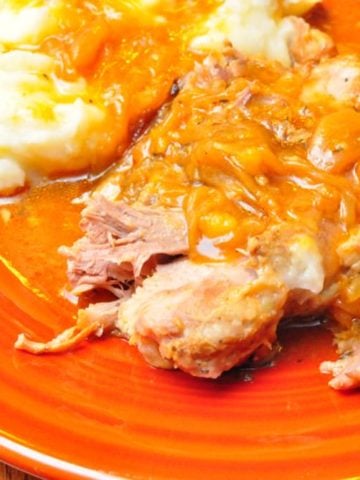
Slow Cooker Pork and Sauerkraut


Pork and sauerkraut is a New Year's tradition in my wife's family. She remembers the tradition fondly.  Or at least, she does now.  When she was growing up, she wasn't a big fan.  (Sauerkraut?  Eeew!) Her grandma would always hound the kids to eat at least one strand of sauerkraut, "because it brings good luck in the new year". Needless to say, the grandkids weren't convinced.

I grew up loving sauerkraut; I have fond memories of hot dog carts in downtown Cleveland, dogs loaded with everything, where the highlight was the sauerkraut. My love of these hot dogs was a turn-off to Diane when we were dating; she couldn't believe I loved those "smelly dogs" so much. I was thrilled with her family's New Year's sauerkraut tradition. I had to work on Diane, thought; she ate her sauerkraut out of obligation, not because she wanted to. Eventually I was able to find some sauerkraut recipes that she didn't hate. In fact...she kind of likes this one.
*And! Now we I get to torture our kids with sauerkraut on New Years Eve. "Come on, kids, you have to eat one strand. Great Grandma Perchinske is watching you!"

Jackie, Diane's sister, is hosting our New Year's Eve celebration this year. (Thank you, Jackie!)  She asked me for a slow cooker pork and sauerkraut recipe, so I sprang into action in my test kitchen.* I loved the result; the key to this meal is the sauerkraut, and it is flavored with bacon, spices, apples, and wine.
*My test kitchen is more commonly known as Tuesday night dinner.

Want to guarantee good luck in the new year? Have some pork and sauerkraut! You can only have one strand if you have to. But I'll bet, once you taste it, that you'll have more than that.

Recipe: Slow Cooker Pork and Sauerkraut

Slow Cooker Turkey Thighs with Beer and Onions


Did you get what you wanted for Christmas this year? I did! There was an All Clad deluxe slow cooker with nonstick aluminum insert under my tree.
*Hey, we can't all want an official Red Ryder carbine action 200 shot range model air rifle for Christmas. And I'm much less likely to shoot my eye out.  But more likely to burn myself, so I guess that's a wash.

Turkey thighs are perfect for the slow cooker. They have enough fat and connective tissue to make them hard to overcook. Even better, turkey thighs have a big, meaty flavor to match the sweet beer and onion sauce.
*Hard to overcook is the key to slow cooking, because it means simmering for hours on end. I cringe when I see a slow cooker recipe with lean protien, like pork loin or chicken breasts. All I can think of is dry, dry meat.

I pull the skin off the thighs before cooking, a trick I learned from Cooks Illustrated. Turkey skin doesn't add anything to the recipe. Or at least, not anything good. After the long, slow cooking the skin comes out flabby and chewy. All it does is add extra fat to the sauce, which I don't want anyhow.

The final trick is to keep the liquid to a miniumum. There isn't much evaporation in slow cooking, so watery sauces are a real danger. I add a quarter cup of flour to thicken the sauce as it cooks, and only one bottle of beer for liquid. The turkey and onions give up more than enough liquid while they slow cook, and the result is a thick, creamy sauce of beer and onions.

If you are a dark meat fan (like me!), this recipe should be in your arsenal.

Recipe: Slow Cooker Turkey Thighs with Beer and Onions

Beating the Winter Farmers Market Blues


This time of year, "Buy local" gets interesting in Northeastern Ohio. It seems like all there is to buy is root vegetables. Anyone want more potatoes? Anyone?
*And what in the world do you do with celeriac? Help!

But! If you have a winter farmers market, make the trip. You'll be surprised by the abundance our farmers have for us at this time of year. Between storage vegetables, high tunnels, and cold frames, they provide a surprising variety of produce.

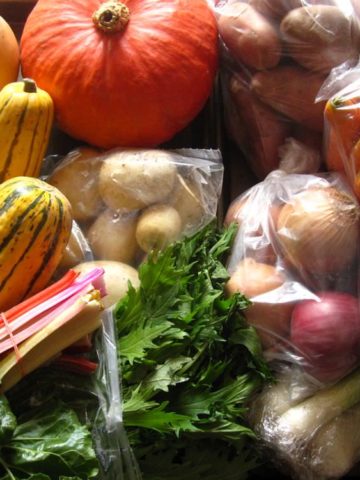
For example, here's the list of vegetables that were in my Christmas CSA box from Crown Point:
  • Beets
  • Butternut squash
  • Carrots
  • Daikon radish
  • Watermelon radish (looks like a turnip to me)
  • Cabbage
  • Sweet Potatoes
  • Lettuce mix
  • Garlic
  • Parsnips
  • Celeriac (What do I do? This is a serious cry for help!)
  • Eggs
  • and lots and lots of Potatoes, of course

*Tim Knorr, who runs my CSA, apologized for giving us dirty root vegetables. The root crop washer "works with water, not ice", he explained. We have a foot of snow on the ground, last week's high was 22*F, and you gave me enough (locally grown) vegetables to strain my back as I carry them to the car. I don't mind if the root vegetables are a little dirty!

Even if the vegetable selection isn't quite the same as the middle of August, I still want to visit my winter market. Before Christmas, I saw locally grown eggs, lamb, pork, beef, chicken, and even buffalo. (Can you tell I loaded up my freezer?)

Sure, buying local is easiest in the middle of the summer. But, even in the deep midwinter, it is worth the effort. Find your winter farmers market. You'll thank me!

What do you think? What do you buy at the winter farmers market? Any good recipes for celeriac?  Tell us about it in the comments section below.

Inspired by:
My CSA: Crown Point CSA
My local farmers market: Cuyahoga Valley Countryside Conservancy Farmers Market
Thank you all for your hard work this year!

*Enjoyed this post?  Want to help out DadCooksDinner?  Subscribe using your RSS reader or by Email, recommend DadCooksDinner to your friends, or buy something from Amazon.com through the links on this site.  Thank you!

Merry Christmas!


Scrooge was better than his word. He did it all, and infinitely more; and to Tiny Tim, who did not die, he was a second father. He became as good a friend, as good a master, and as good a man, as the good old city knew, or any other good old city, town, or borough, in the good old world. Some people laughed to see the alteration in him, but he let them laugh, and little heeded them; for he was wise enough to know that nothing ever happened on this globe, for good, at which some people did not have their fill of laughter in the outset; and knowing that such as these would be blind anyway, he thought it quite as well that they should wrinkle up their eyes in grins, as have the malady in less attractive forms. His own heart laughed: and that was quite enough for him.

He had no further intercourse with Spirits, but lived upon the Total Abstinence Principle, ever afterwards; and it was always said of him, that he knew how to keep Christmas well, if any man alive possessed the knowledge. May that be truly said of us, and all of us! And so, as Tiny Tim observed, God bless Us, Every One!
[Charles Dickens, A Christmas Carol]
A Christmas Carol

Merry Christmas, everyone!

Mike Vrobel
DadCooksDinner.com

Pressure Cooker Turkey Chili with Chorizo and Pinto Beans


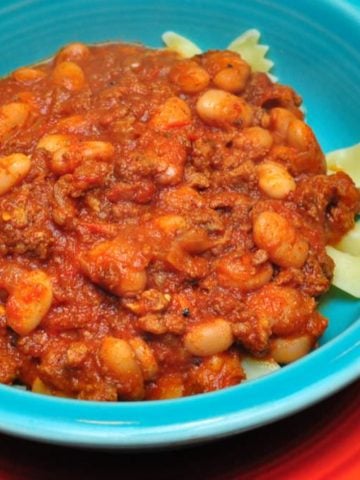
How does a pressure cooker help get dinner on the table on a weeknight? Here's a perfect example. I wanted a hearty turkey and bean chili for a cold winter night. This recipe came together from my pantry and freezer; all the ingredients are things I keep on hand, just in case.

I have fallen head over heels in love with pre-soaked beans from my pressure cooker. In the past, I couldn't be bothered to pre-soak my beans. I have to think ahead to pre-soak beans; it too much effort. *The thinking is the effort, not the sorting. Sorting beans for pre-soaking takes five minutes. I would just not remember at all, get home, and say "darn it!"

But then, I tried the Cooks Illustrated suggestion of brining my beans while they pre-soak. While testing that approach, I found out how quickly the beans are done cooking when pre-soaked; instead of thirty to forty minutes, they're done in ten to twelve. That meant I could cook the beans with my other ingredients, and have a bean stew ready in under a half an hour of cooking time. And the brined beans had a depth of flavor that I couldn't seem to get, no matter how much salt I added at the end of cooking. Since I put these ideas together a few months back, I have remembered to soak my beans.  The results have been good enough for me to overcome my inherent laziness!  Now I make bean soups, stews, and chilis about once a week. They are the perfect dinners for fall and winter.

This recipe was inspired by the recent "Our Favorite Chili" recipe in Cooks Illustrated, where they brine their beans and add cocoa powder to the spice blend to add an earthy depth to the chili. I didn't go with their full-on version (chunks of beef, spice paste made of dried chiles instead of chili powder) because this was a Tuesday night dinner, and it needed to be done quickly.
*I need to try the spice paste made out of dried chiles. Both CI and Kenji Alt have recommended it. But again, Tuesday dinner. Not the time to go whole hog.

Do you have a pressure cooker, and the presence of mind to soak beans before you leave for work? Here's a weeknight chili recipe for you.

Recipe: Pressure Cooker Turkey Chili with Chorizo and Pinto Beans

Pressure Cooker Red Pozole


In the week leading up to Thanksgiving, I found myself on a Mexican food kick. I was cleansing my palate with spicy food.  I hungered for something different than the Turkey with all the fixings I make on the big day.
*If you've been wondering why this blog seems Tex-Mex themed recently...there you go.

Pozole is a pork and hominy stew served throughout Mexico. It has been a staple of Mexican cuisine since pre-Columbian times.

Hominy is the name we picked up from Native Americans for corn that has been treated with lime, in the process called nixtamalization. In Mexico, it is called pozole, posole, or nixtamal; the dish picked up its name from the main ingredient. And yes, the corn is the main ingredient; the meat is supposed to be a supporting player.

I'm taking the easy way out and making this pozole with canned hominy. I wanted to make dried hominy in the pressure cooker, but I also wanted a weeknight meal. When I read it would take an hour and a half to cook dried hominy, even with the speed of the pressure cooker, I reluctantly went back to canned hominy.
*This is the kind of trade off I make as a weeknight cook. I'm going to revisit pozole in the future, so I can try out dried hominy in the pressure cooker.
**Dont' have a pressure cooker?  No worries.  Check out the Variations section below the recipe...

Recipe: Pressure Cooker Red Pozole

Top Cookbooks of 2010

Here are my favorite cookbooks from 2010, as chosen by my various cooking personalities.
*Yes, I am afflicted with multiple cooking personality disorder.

Planet Barbecue!: 309 Recipes, 60 Countries
For the grilling fanatic:
Steven Raichlen Planet Barbecue!: 309 Recipes, 60 Countries inspired more of my posts than any other book I read this year.
(Honorable mention: Robb Walsh The Tex-Mex Grill and Backyard Barbacoa Cookbook)

Perfect One-Dish Dinners: All You Need for Easy Get-Togethers
For the home cook:
Pam Anderson Perfect One-Dish Dinners: All You Need for Easy Get-Togethers reminded me that I don't have to kill myself in the kitchen to have people over.
(Honorable mention: I have a tie between J.M. Hirsch High Flavor, Low Labor: Reinventing Weeknight Cooking and Lorna Sass's update of Cooking Under Pressure (20th Anniversary Edition))

Keys to Good Cooking: A Guide to Making the Best of Foods and Recipes
For the geek who wants to understand what's going on while they're cooking:
Harold McGee Keys to Good Cooking: A Guide to Making the Best of Foods and Recipes explains how to become a better cook through science.
(Honorable mention: Jeff Potter Cooking for Geeks: Real Science, Great Hacks, and Good Food)

Fiesta at Rick's: Fabulous Food for Great Times with Friends
For the adventurous cook:
Rick Bayless Fiesta at Rick's: Fabulous Food for Great Times with Friends encouraged me with great Mexican party ideas, and the food to go with them.
(Honorable mention: Grace Young Stir-Frying to the Sky's Edge: The Ultimate Guide to Mastery, with Authentic Recipes and Stories)

Four Fish: The Future of the Last Wild Food
For the concerned environmentalist cook:
Paul Greenberg Four Fish: The Future of the Last Wild Food opened my eyes to the complexity behind eating seafood.
(Honorable mention: Mark Bittman The Food Matters Cookbook: 500 Revolutionary Recipes for Better Living)

Around My French Table: More Than 300 Recipes from My Home to Yours
For my inner 7 year old on Christmas morning (If I've been good):
I haven't read these yet, but I hope to soon.  (Hint, hint...)
Dorie Greenspan Around My French Table: More Than 300 Recipes from My Home to Yours
David Tanis Heart of the Artichoke and Other Kitchen Journeys

What do you think? Any other votes for best cookbook? Leave them in the comments section below.

*Enjoyed this post?  Want to help out DadCooksDinner?  Subscribe using your RSS reader or by Email, recommend DadCooksDinner to your friends, or buy something from Amazon.com through the links on this site.  Thank you!

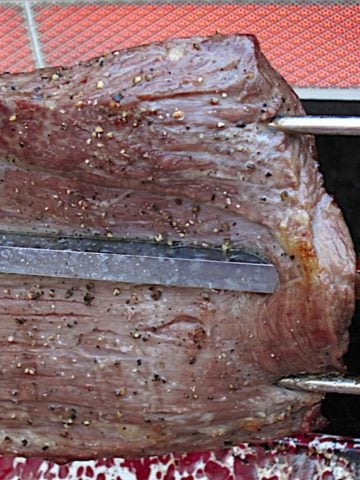
Rotisserie Strip Loin Roast

I wanted a different rotisserie beef roast for Christmas this year. I found a winner. The hardest part? Figuring out what it's called.

My local grocery store sells this cut of meat as the Strip Loin Roast. The Cattlemen's Beef Board calls it Top Loin Roast. I think of it as New York strip, because every steakhouse I've been to cuts it into steak and calls it that. Except, allegedly, in New York City, where the steakhouses call it a Kansas City Strip.
*Allegedly, because I've read this in a number of places. But when I went looking through the menus of New York City steakhouses, I couldn't find a single one with a Kansas City strip steak on the menu.

Whatever it is called, it is the cut of meat opposite the tenderloin on a short loin. Picture a porterhouse - that's a cross cut of the short loin. On one side of the T bone is the tenderloin, on the other is the New York strip steak.

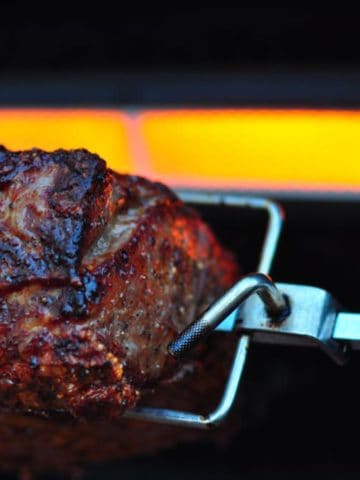
New York strip is one of my favorite cuts of beef; tender, full of flavor, and well marbled with fat. I often use it for steaks, but I've never cooked it as a roast before. I used my standard rotisserie roast technique; salt early (at least 2 hours before cooking), go simple (only salt and pepper), let the rotisserie work its magic (amazing browned crust in 45 minutes).

The results made me wonder why this cut isn't more popular as a roast. It is the perfect middle point between a prime rib roast and a tenderloin roast. It has big, beefy flavor of a rib roast, in a leaner, boneless roast like a tenderloin. Looking for a great roast for the holidays? Give this recipe a try.

Recipe: Rotisserie Strip Loin Roast

Rotisserie Pan Smashed Potatoes


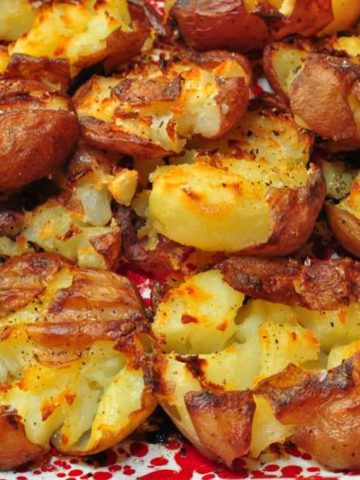
An eagle eyed reader spotted these in the background my rotisserie flank steak recipe, and asked about them. Anonymous, here you go: my recipe for Rotisserie Pan Smashed Potatoes.

When I saw Ree Drummond's recipe for smashed red-skin potatoes on The Pioneer Woman, I had to try them. Smashing the potatoes* gives them lots of nooks and crannies to brown and crisp, turning them into extra thick potato chips. Or whole food tater tots. Either way, I can't stop eating them.
*Good name for a band..."Smashing the potatoes".

Since my motto is "everything tastes better on the rotisserie"*, I cook my smashed potatoes in the drip pan while my main ingredient spins above them. The high heat of the grill crisps the potatoes while they soak up the drippings and fat from the main ingredient.
*If you follow this blog, you're probably thinking: now he figures out his motto? What took him so long?

Recipe: Rotisserie Pan Smashed Potatoes

Things I Love: Unicorn Magnum Plus Pepper Grinder


The key to cooking is properly seasoning food. When a recipe ends with the instruction season to taste, I reach for salt and pepper. I use them in just about everything that comes out of my kitchen.

Pre-ground pepper is flat and lifeless. It has a little heat, nothing more. Fresh ground pepper is sharp, spicy, and bursting with flavor. Why use pre-ground? All it takes to improve your cooking is a good pepper mill, so why wouldn't you use one? Well, because some pepper mills are a pain. They're hard to fill, hard to turn, and only grind a tiny amount of pepper.

The Unicorn Magnum pepper mill is the best pepper grinder around; it solves all those problems, and makes fresh ground pepper easy.
*I love this pepper grinder in spite of the name. Every time I say it, I have to bite my tongue to not follow with: "The most powerful pepper mill in the world."

The Magnum has a very large grinding mechanism, which produces a huge shower of ground pepper with each twist of the knob.
*15 twists of the top give me 1 teaspoon of pepper, which is a very large amount. I usually start with 7 twists, or a half teaspoon of pepper, when seasoning to taste.

The Magnum has a wide range of grinds, adjusted by turning a small knob in the business end of the mill. The grinds range from a fine powder (my favorite for soups and stews) up to very coarse (perfect for topping a steak).
Coarse grind on the left; fine grind on the right

Finally, it is easy to fill. There is a big loading hole in the side, hidden behind a twisting collar just under the grinding knob. You don't have to remove any of the grinder to fill it; twist the collar, pour in the pepper, then twist it shut.

This loading collar is, unfortunately, the only problem I have with the design. The loading collar is directly under the knob. Sometimes, when I'm grinding, I accidentally grab the loading collar along with the knob. This opens up the loading hole, and if the mill is full enough, I get a spray of whole peppercorns bouncing out. I've learned to keep my fingers off the collar when I'm grinding. And, after all the other, really awful loading mechanisms I've dealt with, I'm willing to alter my grinding grip to have the easy loading.

I own the giant Magnum Plus model, which is 9 inches tall and holds almost one cup of peppercorns; the regular sized Magnum model is 6 inches tall and holds a half cup of peppercorns. Both have identical grind mechanisms, so they have all the benefits I list above. They also come in any color you like...as long as it's black.
*Everyone who reviews it makes a reference to Darth Vader. It's the pepper mill that finds your lack of faith...disturbing.
**Sorry, had to do it.

Want to own the best pepper mill? Get yourself a Magnum.

Disclaimer: This month I'm writing about essential kitchen tools. As with all my "Things I Love" posts, I am not receiving anything from the manufacturer, and I bought all the items with my own money. I use these tools every day in the kitchen, and I would hate to live without them. I thought, with Christmas coming, you might need a few gift ideas for the cook in your life. And, as always, if you buy something through the Amazon.com links on my site I get a small commission from the purchase. Thank you!
(OK, I'm good with the FCC now.)

Unicorn Magnum Plus Pepper Mill 9-in.
Magnum Peppermill - 6-Inch

*Enjoyed this post?  Want to help out DadCooksDinner?  Subscribe using your RSS reader or by Email, recommend DadCooksDinner to your friends, or buy something from Amazon.com through the links on this site.  Thank you!

Pressure Cooker Turkey Stock Revisited


This post is dedicated to loyal reader Jason. Jason asked me what I thought of this recipe for "Perfect" Pressure Cooker Chicken Stock, from Kyle Connaughton by way of Heston Blumenthal's test kitchen.
Perfect Pressure Cooker Chicken Stock [saveur.com]

My initial reaction was mixed. They were not bragging when they said "Perfect". This is an attempt to make the ultimate stock.  I found myself asking: "Why so fussy?" Why buy specific ingredients to make stock, like chicken wings and ground chicken? My goal with pressure cooker stock is to use things up. I take scraps and leftovers, add a few aromatics, and turn them into a delicious base for future meals. *Making stock feels like culinary sleight of hand. I use scraps that would normally be discarded, and turn them into a stock far better than any of that "broth" they sell in a can at the grocery store.

Even though his recipe looked finicky, I was intrigued by Mr. Connaughton's explanations. Why does a pressure cooker makes such good stock?  Why did he make specific choices in the ingredients and technique? He explains it all. By the time I was done reading, I wanted to try some of the tricks in Mr. Connaughton's recipe. Making stock from my leftover Thanksgiving turkey was the perfect opportunity.
*Also, I wanted to try out my Kuhn Rikon Family Stockpot with a whole turkey carcass. It swallowed it easily, with enough room to spare to squeeze a second carcass in if I wanted to. Wow. Every other pressure cooker I've owned needed the turkey carcass broken up to fit in the pot. I'm loving the Kuhn Rikon more and more.

The first trick I wanted to use is thin-slicing the aromatics. Mr. Connaughton says thin slicing increases the surface area, which helps extract more flavor from the aromatics.
*He uses chicken wings in his stock for the same reason - smaller bones mean better flavor extraction.

The second trick is adding a cup of white wine to the pot. I've done this in the past; I learned my turkey stock recipe from Cooks Illustrated, and they always added white wine to their turkey stock. I stopped doing it when I went to the pressure cooker method; I assumed the wine flavor would get lost under pressure. Also, I didn't want to open a bottle of wine just to make stock. According to Mr. Connaughton, I was making a mistake. Wine was going back into the recipe.
*Even better, I had a half bottle of white wine left over from Thanksgiving. No wasted wine!

These two simple tricks were worth the effort. The wine adds a hint of fruit and acid to the turkey flavor in the stock. I used the stock in a simple turkey noodle soup, and I re-filled my bowl three times.
*Okay, maybe four times.

I know I'm adding some extra steps here. One of the advantages to my original recipe is its simplicity. But, if you have leftover turkey bones and want to make the ultimate pressure cooker stock, this is the technique to use.
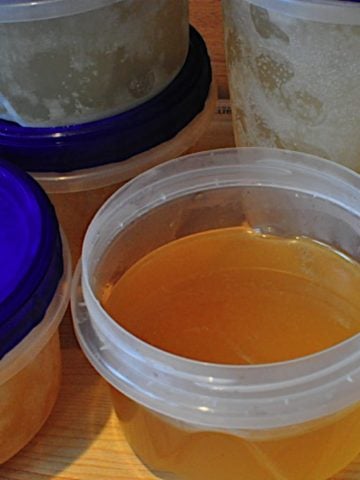
*And yes, I will eventually try the Perfect Pressure Cooker Chicken Stock recipe as written. But right now, I'm set with stock. I had two turkey carcasses left over.  I made twelve quarts of stock. I'm out of freezer containers!

Recipe: Pressure Cooker Turkey Stock, Updated

Pork Tenderloin with Tomatillo Salsa and White Beans


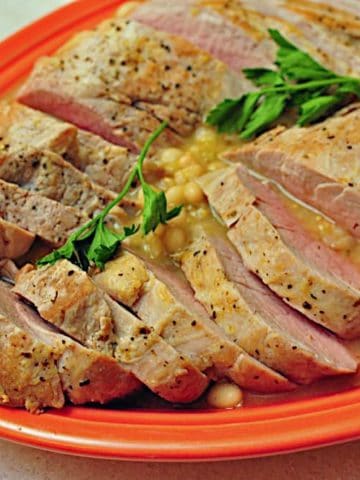
In Rick Bayless's Salsas That Cook, there is a Sunday dinner worthy recipe for roast pork loin simmered in a tomatillo salsa and white bean sauce. The flavors are a revelation; the meaty pork loin, spicy tomatillo salsa, and creamy white beans are a brilliant combination.

I love that recipe, but I never make it anymore. My adapted version is this quick weeknight recipe. Instead of long-cooking pork loin, I use pork tenderloin. The tomatillo salsa and white beans make a quick pan sauce, and the whole thing finishes in the oven.

When I'm prepared, and my freezer is stocked, this is a homemade recipe. I'll have homemade tomatillo salsa and beans in the freezer. When my stock of homemade ingredients is dwindling, canned beans and store bought tomatillo salsa* come to the rescue. Either way, this is a remarkably easy recipe - brown the pork, dump the can of salsa and the drained beans, heat through, and it is ready to eat.
*My preference is for Rick's Frontera Tomatillo Salsa, out of loyalty to the original recipe.

Looking for a weeknight Mexican recipe, one with a different flavor profile than the usual taco night? Give this recipe a try.

Recipe: Pork Tenderloin with Tomatillo Salsa and White Beans

Things I Love: Victorinox Paring Knives


I have two workhorse knives in my kitchen. My chef's knife does eighty percent of the cutting work. The remaining twenty percent is done by my paring knife.
*Well, other than a "Less than 1%" category that falls to my bread knife and my boning knife.

I own a bunch of different paring knives. I have expensive paring knives from Germany and Japan, cheap paring knives from Switzerland and Brazil. I even own an Alton's Angle paring knife, because I had to try out the angle to see if it was worth it.


*Yes, I have a knife buying issue. I've kept a tight watch on my purchases, because my knife block is overflowing. Once I get a bigger block, watch out...

**Now, I would be curious to try out a Sheep's Foot paring knife, as recommended by Kenji Alt.

***Arrgh. There I go again.


Normally, I'm a fan of the "buy the best, and only cry once" approach. My chef's knife is embarassingly expensive, and I love it. But...well...see that array of paring knives up there? I laid them out from least to most expensive, left to right. Which one do you think I reach for every time?

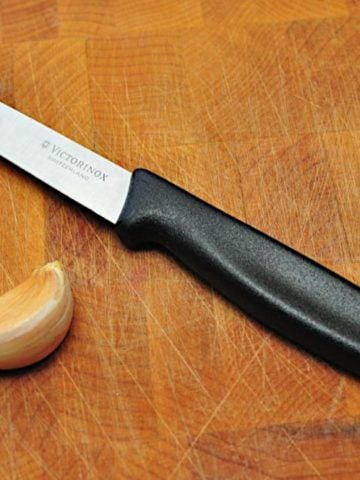
The Victorinox paring knife, second from the left, is my favorite. It's sharp, light, and effortless to use.  With a chef's knife, I want some weight, some heft, so the knife does the work.  With a paring knife, that extra weight makes it feel heavy and slow.  The Victorinox feels light and swift in my hand.

I use it when I want a really fine mince. (Shallots, usually). I use it to trim meat, because it is so inexpensive I don't feel guilty throwing it in the dishwasher. It is my free-handed cutting utensil; when I need to core an apple, or trim the ends off an onion to throw in the stock pot, it leaps from the block into my hand.
*Yes, I know, shame on me for trimming an onion free-handed. Sometimes I don't feel like cleaning off the cutting board...

How much would you pay for such a versatile tool? Thirty dollars?  Forty?  Sixty? Here's the best part. It costs $5. That's right - five dollars. Can you pass up such a bargain? (Checks Amazon)...wait, what? They upped the price to eight dollars? What a rip off! That's robbery! That's...well, that's still a great price for such a good knife. If you have space in your knife block, grab one of these today. As you can see in the picture, I have two. I would get depressed when I reached for it and it was in the dishwasher.

*All joking aside, Victorinox knives are a great deal.  If I was just starting out, outfitting my kitchen, the first two things I would buy are the Victorinox Chef's knife and this paring knife.  Later on I would add their boning knife and bread knife.  That's all you really need.

*Beyond that...God help you if you become a knife addict like me.  But have you seen this knife? I'm in love.

Disclaimer: This month I'm writing about essential kitchen tools. As with all my "Things I Love" posts, I am not receiving anything from the manufacturer, and I bought all the items with my own money. I use these tools every day in the kitchen, and I would hate to live without them. I thought, with Christmas coming, you might need a few gift ideas for the cook in your life. And, as always, if you buy something through the Amazon.com links on my site I get a small commission from the purchase. Thank you!
(OK, I'm good with the FCC now.)

Victorinox 47508 3-1/4-Inch Paring Knife


*Enjoyed this post?  Want to help out DadCooksDinner?  Subscribe using your RSS reader or by Email, recommend DadCooksDinner to your friends, or buy something from Amazon.com through the links on this site.  Thank you!