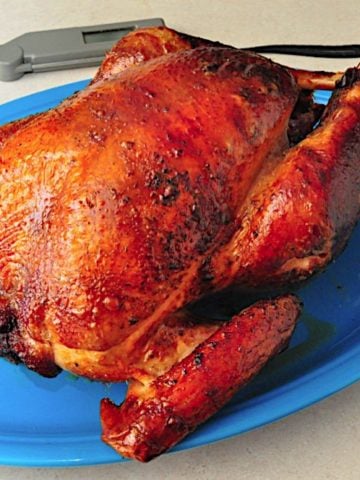
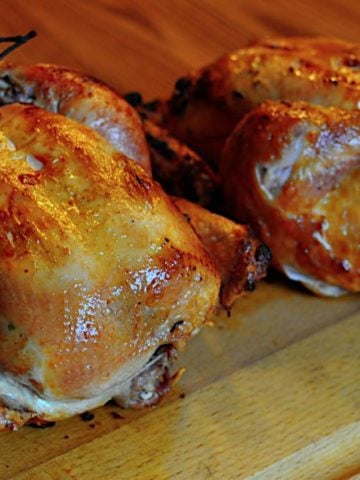
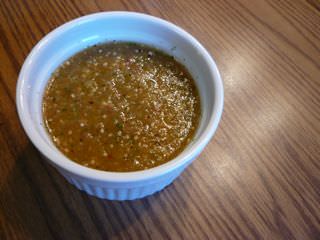
: light a full chimney of charcoal, wait until it is just covered with ash, and then set up for "indirect" cooking by putting the aluminum drip pan in the middle of the charcoal grate, and pouring the charcoal in even piles on both sides of the pan. (A fist sized, soaked chunk of smoking wood on the charcoal is good as well.)
*For a gas grill with 3 or more burners (like a Weber genesis with the
Weber Gas Grill Rotisserie
attachment): Set up for indirect cooking by turning the outside burners on the grill to high, and leaving the inner ones off. Put the aluminum drip pan over the middle of the grill, over the unlit burners. My Weber Genesis had 3 burners, so I would turn burners 1 & 3 to high, and leave burner 2 off. If you had 4 burners, you'd have 1&4 on, 2&3 off. And so on.
*For a gas grill with an infrared rotisserie burner (like my
Weber Summit 650
): Light the infrared burner by turning knob to "light", and once it catches, hold down the knob for 20 seconds, to let the burner get glowing hot. Leave the infrared burner on high. Then, set up the regular burners for indirect heat like you would with a regular gas grill. On my Weber summit 650, that means turning burners 1 and 6 to high.
For any grill, your goal is high indirect heat, with temperatures in the grill between 400*F to 500*F. If your grill can't at least get to 350*F doing indirect heat, it's not powerful enough for rotisserie cooking. On a gas grill, if you need to, adjust the burners that are on to get in that temperature range. On a charcoal grill, that's where you should be with a full chimney of charcoal.
Don't forget the aluminum foil pan in the "indirect" part of the grill; you will get a lot of dripping fat and you need something to catch it. Remember - no grates on the grill for this method - you need the space for the spinning birds.
*Special note about setting up a grill for turkey: Because a turkey is so large, you can use directional heat to cook the legs faster than the breast. (This is a good thing, as you'll see below - you want the legs cooked more than the breast.) Try to concentrate the heat around the drumstick end of the turkey. In my charcoal grill, I make a "U" of charcoal on one side of the grill, put the drip pan inside the U, and point the breast towards the open end of the U. For my Weber Summit, I turn my smoker burner and burner 1 to high, leave the infrared rotisserie burner on medium, and leave the rest of the burners off. Then I spit the turkey so the breast is facing burner 6, and the legs are facing the lit burners. (If you don't have the smoker burner, go with burners 1 and 2. If you have a Weber Genesis, with burners that run the length of the grill, you'll have to live with even heat.
5. Start cooking: Put the skewer in the mounting bracket, seating the point end in the motor, and turn on the motor. Make sure the bird is spinning freely, then adjust your drip pan to make sure it is under the bird(s). Close the lid - you want to trap the heat in the grill, so it roasts from the trapped heat as well as browns from the direct heat of the flames.
6. Cook the bird. It takes 45 minutes to an hour for a 4 lb chicken, and 2 to 2.5 hours for a 12 pound turkey - adjust the times up or down based on the weight of your bird. Rotisserie cooking tends to be faster than "regular" grill roasting, so start checking if the bird is done at the early end of time frame. I use an
instant read thermometer
to check for doneness. I'm looking for 155*F to 160*F in the breast, measured at the thickest part of the meat. At that point, the thickest part of the leg should be about 170*F to 180*F, and we're done cooking.
7. Remove and serve. Remove the spit from the grill. Make absolutely sure you are wearing gloves or use oven mitts - the spit will be a branding iron at this point. I get the birds off the skewer as soon as I can, so the hot skewer doesn't keep cooking them. Remember, the knobs on the forks are going to be hot as well! Don't try to turn them without your gloves on, or use pliers or a fork. Let the poultry rest for 15 minutes (at least - 30 would be better), then carve and serve!
Equipment:
I'm a Weber loyalist, so I think these are the best options:
I've owned all three of these, and #1 and #3 are what I currently own and use. I really prefer to use charcoal for rotisserie cooking. There's something about the results over a live fire that I can't seem to duplicate on a gas grill.
When I had the Weber Genesis, I would use the rotisserie with it, but the results were never as good as the charcoal grill. Once I upgraded to the infrared rotisserie burner on the Weber Summit*, I found an acceptable substitute for charcoal. It's not quite as good, but it's pretty darn close. And, since it's December right now, you're going to see a lot of pictures of #3 for the next few months.
*The Summit 650 is also a monster - it's huge! I've cooked 3 chickens simultaneously, and it felt like I could have squeezed on another one if I needed to.
Notes:
*Brining. As I say above, I use the fast brine for everything up to the size of a chicken, and the slow brine for turkey. That being said, you can slow brine chicken (buy 4lbs+ chickens and brine them for 8 hours), and fast brine turkey (12lbs turkey, no more than 8 hours - the concentrated brine might make the bird too salty if you wait longer than that). I've brined chicken for as little as an hour with the fast brine, and had good results, but I prefer the results with 4 hours in the brine. I would brine cornish hens for 1-2 hours, and duck for 1-4 hours.
*Brine ingredients - Usually, I use table salt (non-iodized) and brown sugar. Kosher salt and regular, granulated sugar work as well. If you use Kosher salt in the brine, double the quantity - kosher salt is less dense when measured by volume, so you need to use twice as much.
*Hot spit. Be careful! Please, learn from my mistake on this one - I think I burned the fingerprints off my left pointer finger and thumb. I could have been a two-fingered cat burglar, and no policeman could have figured out it was me!