DadCooksDinner

  • Home
  • Rotisserie
  • Recipes
  • Tools
  • Books
  • Merch
menu icon
go to homepage
  • Recipes
  • Books
  • Tools
  • Merch
  • About
subscribe
search icon
Homepage link
  • Recipes
  • Books
  • Tools
  • Merch
  • About
×
Home » Recipes

Grilled Mini Sweet Peppers

June 6, 2013 by Mike Vrobel 4 Comments

Baseball is our busy season. With three kids, we're almost guaranteed a game every night. We have to be at the field at 5:30 (for warm ups) and the game ends at 8. Family dinners are whatever we can scrounge when we get home.

I have a new secret weapon for these rushed dinners. Mini sweet peppers. They're a gift for time-pressed cooks, because there's no preparation - they taste great raw. Drop the bag on the table, and dig in. My wife and I are going through a two pound bag a week, and even the kids will eat them on occasion.
I don't have a mini sweet pepper problem. I can quit anytime I want.

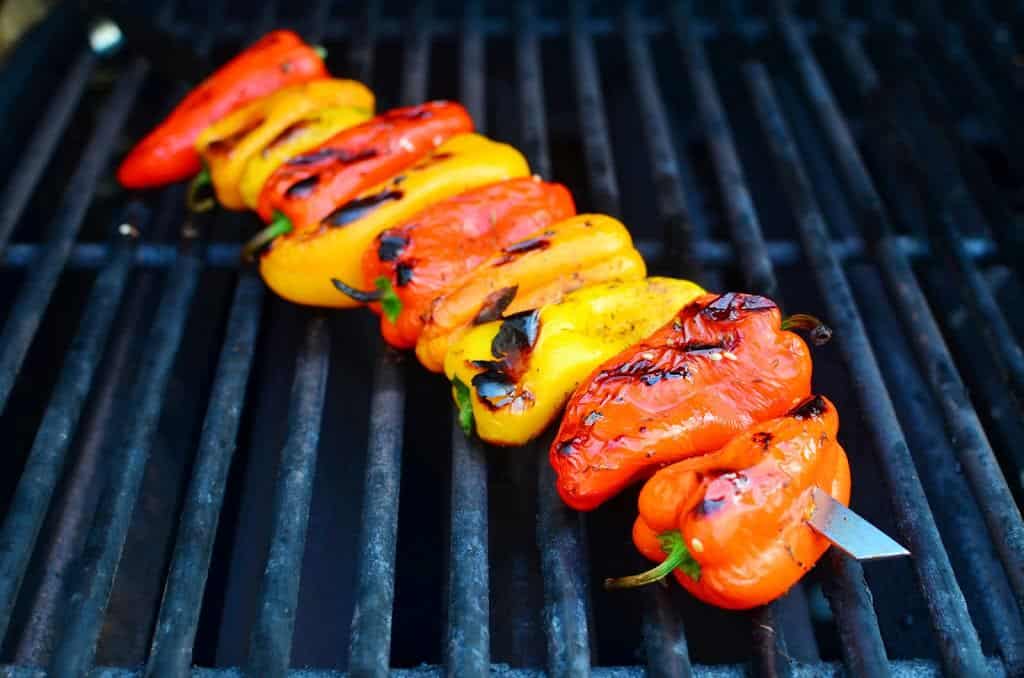
As much as I love them raw, I've been wondering - what if I cooked them? The other day, I was paging through Cooking Light magazine while I waiting for a haircut. I saw a skewer of mini sweets on the grill, and I nearly dropped the magazine. Why didn't I think of that?

Roasting mini sweets on the grill adds to the sweet flavor, and softens up the seed pod enough that I can eat it with the rest of the pepper - all that's left is the green stem.

Recipe: Grilled Mini Sweet Peppers


Adapted From: Cooking Light Magazine

Cooking time: 8 minutes

Equipment

  • Grill (I love my Weber Summit)
  • Skewers (I used extra wide skewers, but any size will work)

Ingredients

  • 1 pound mini sweet peppers
  • 1 tablespoon olive oil
  • ½ teaspoon zatar seasoning (or your favorite dried herb seasoning)
  • ½ teaspoon kosher salt

Directions

1. Set the grill for direct medium heat

Preheat the grill, brush it clean, then set it up for direct medium heat. For my Weber gas grill, I preheat it with all burners on high for 15 minutes, brush the grate clean with a grill brush, and turn the burners down to medium.
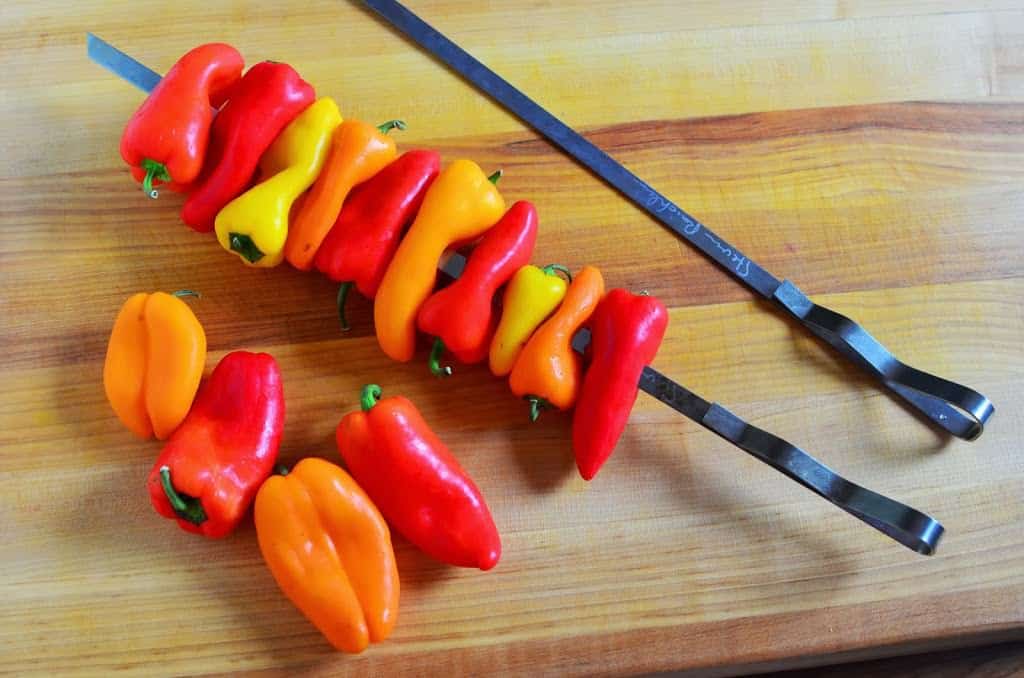
2. Skewer the peppers

While the grill is preheating, skewer the peppers. Brush both sides of the peppers with a thin coat of olive oil and sprinkle with the zatar seasoning and salt.
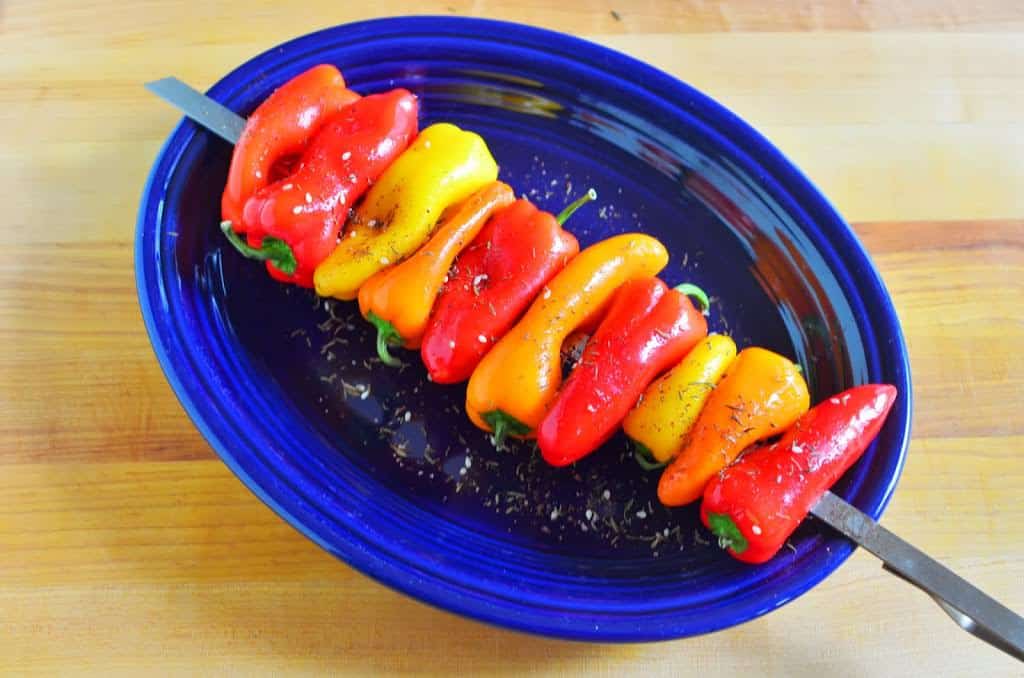
3. Grill the peppers

Put the pepper skewers on the grill over direct medium heat. Grill with the lid closed until the peppers are blackened in spots on the bottom, about 4 minutes. Flip the skewers, and grill the other side until blackened in spots, about 4 more minutes. Remove to a platter.
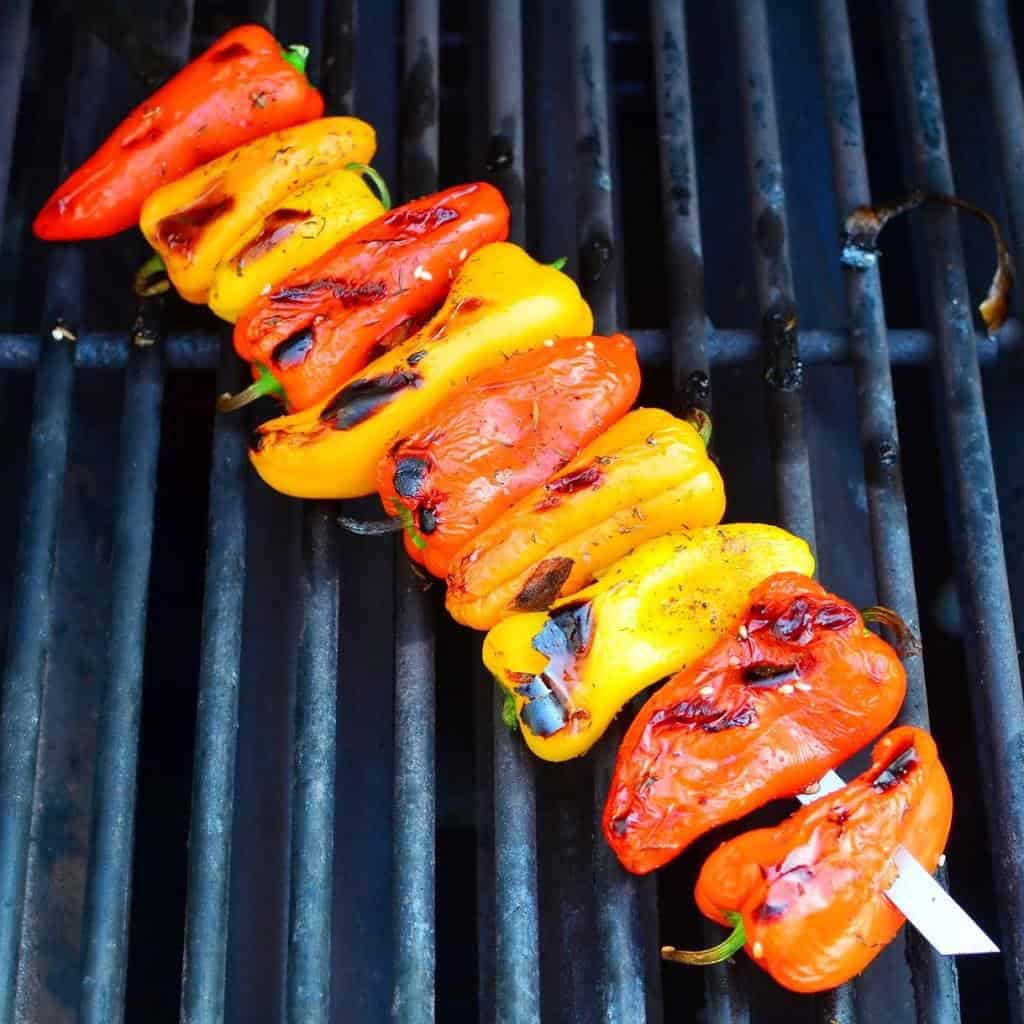
4. Serve

Remove the peppers from the skewers and serve. (Grab them by the stem end and bite in. I eat around the seed pod in the middle; my wife eats everything except the stem.)
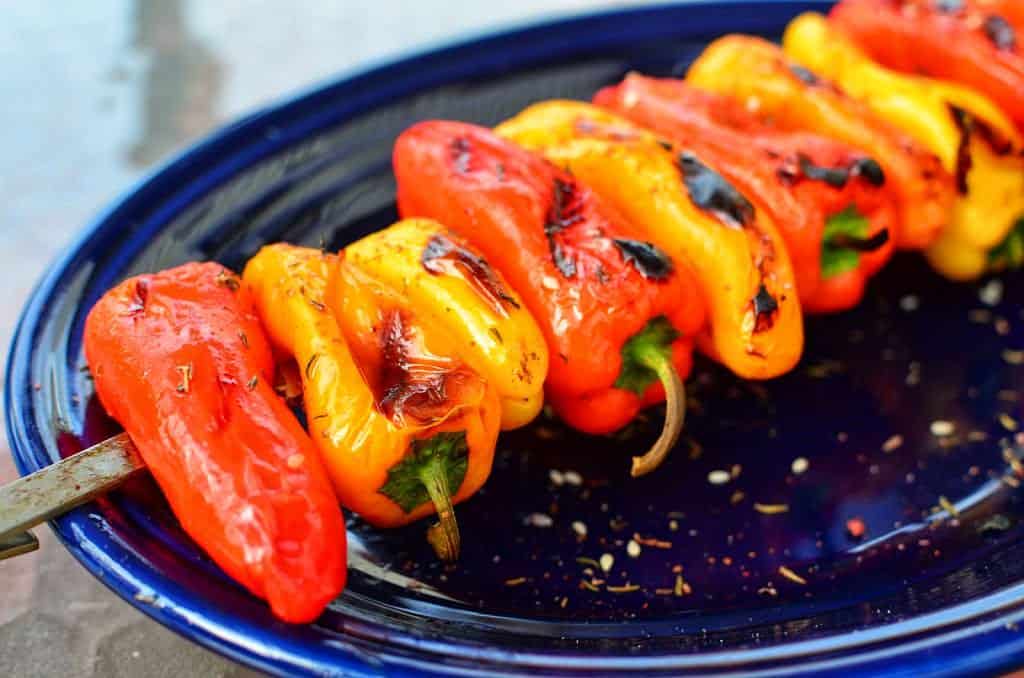
Notes

  • Extra wide skewers hold the peppers in place when you flip. If you use regular skewers, grab them lengthwise with your tongs, to keep the peppers from rotating in place while you try to flip them.
  • I sprinkled the peppers with zatar seasoning because that's what I had in my spice cabinet. Any seasoning blend will work - Italian seasoning, herbes de Provence, or Montreal seasoning come to mind - or skip the dried herbs and cook the peppers with a sprinkle of salt.
Inside Blogging: I take a bunch of pictures with slightly different framing and focus, then pick the one I prefer, and delete the rest.  This time, though, I accidentally uploaded a bunch of very similar shots. Picasa thought this was a burst of photos, and stitched them into a GIF animation. I thought the result was better than any one photo. Serendipity!

What do you think? Questions? Other ideas? Leave them in the comments section below.

Related Posts:

Grilled Peppers and Onions
Grilled Stuffed Jalapenos
Grilled Shishito Peppers

*Enjoyed this post? Want to help out DadCooksDinner? Subscribe to DadCooksDinner using the RSS or Email options on the right, recommend DadCooksDinner to your friends, buy something from Amazon.com through the links on this site, or donate through my tip jar. Thank you.
My Cutting Board Smells Like Onions and Garlic

June 4, 2013 by Mike Vrobel 2 Comments

I bought myself a cutting board for Christmas. I wanted a thicker board, because my counter tops are low for someone my height (6' 3"). I needed to raise my  cutting surface. I bought an extra thick Boos block - 2 ¼ inches - and I love it.

Except…

I didn't oil the board regularly. It got dry, and started to absorb flavors. Now everything I cut on it picks up an onion and garlic smell.
Sure, that seems like a good thing. Who wouldn't like some extra flavor? Until I carved a pineapple on the board. Ick.

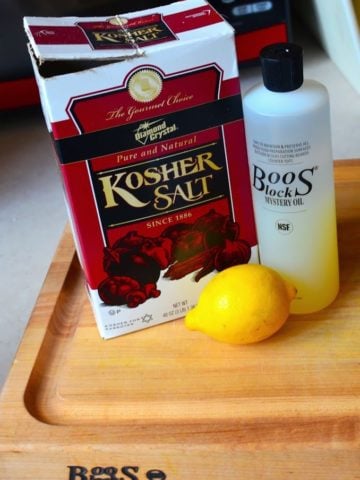
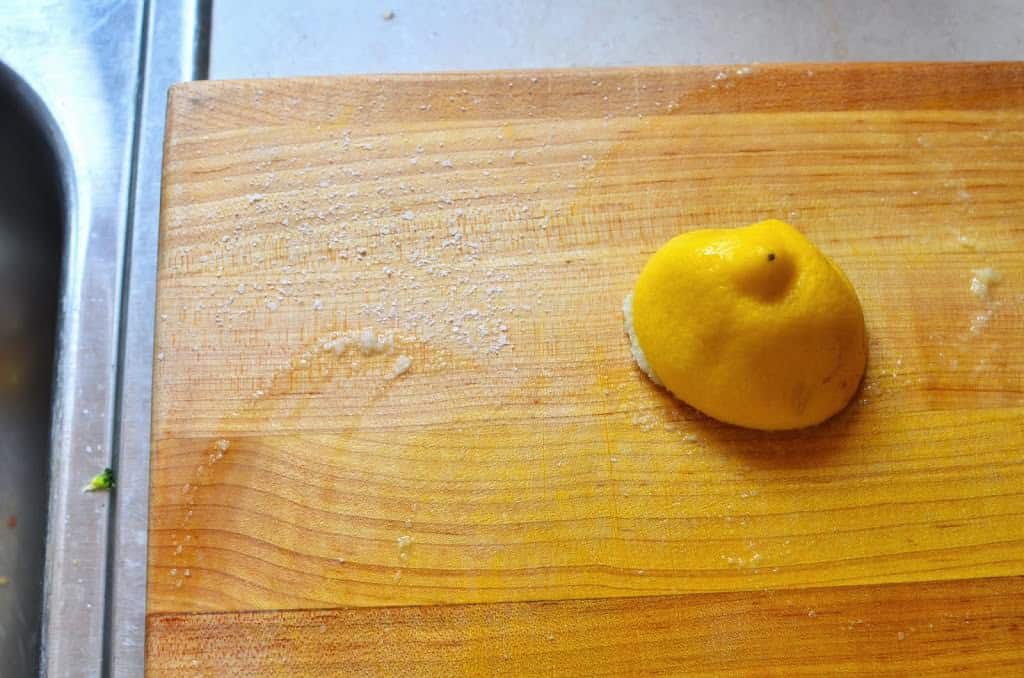
How do you get rid of that smell? There are countless home remedies, most using salt and lemon. Sprinkle the board with salt and scrub the salt into the board with the cut side of a half a lemon. The salt acts as an abrasive, scraping the surface clean; the acidic lemon juice soaks into the board, acting as a disinfectant and cleaner.

How to Clean a Cutting Board

Adapted from: Cutting Board Care & Maintenance [JohnBoos.com]

"Ingredients"

  • Salt (I use kosher salt, because it's easy to sprinkle by hand)
  • 1 lemon, halved
  • Paper towels
  • Mineral oil (or other food safe cutting board oil. I use Boos Mystery Oil )

Directions

  1. Sprinkle the board with salt
  2. Scrub the salt into the board with the cut half of the lemon, squeezing the juice out of the lemon and onto the board as you go.
  3. Flip the board and repeat on the other side
  4. Let the salt and lemon sit on the board for 5 minutes
  5. Rinse with hot water, then wipe the board dry with paper towels.
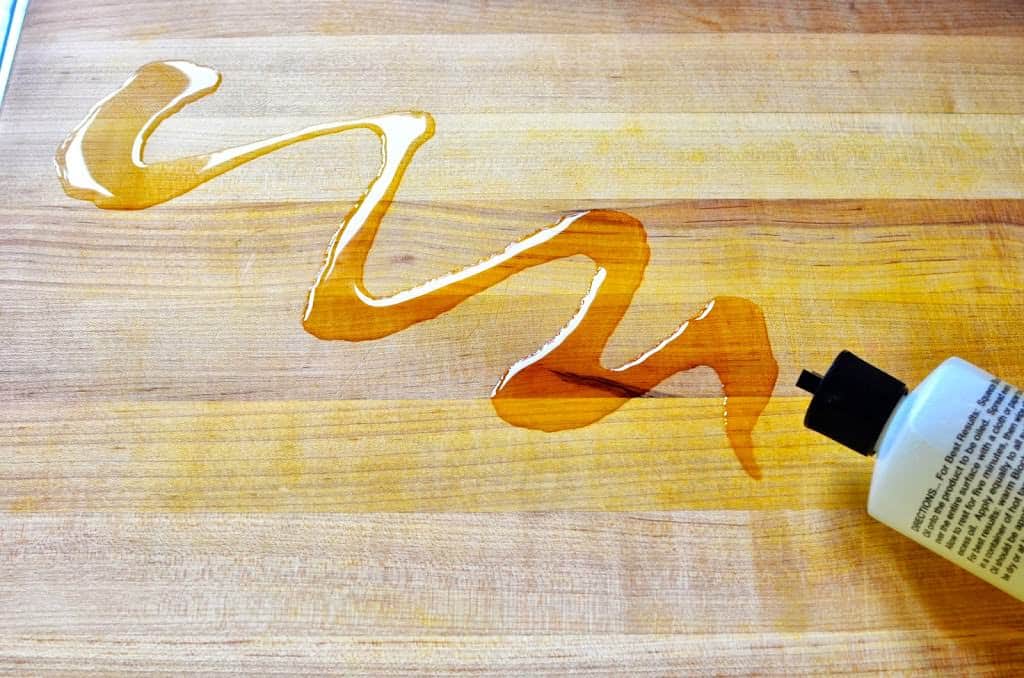
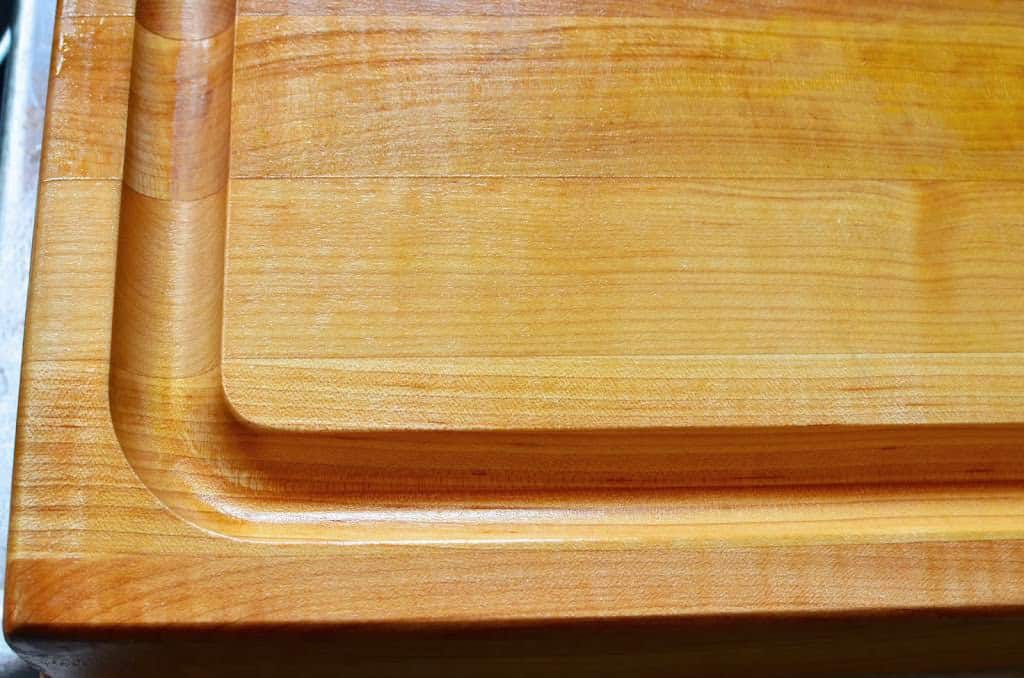
  6. Rub the entire board with mineral oil, working the oil into the board. Keep adding oil until the entire surface of the board looks glossy.
  7. Let the board rest overnight, and add another coat of oil if the wood looks dry.
  8. Remember to oil the board more often.

Notes

  • Step 8 is the important one - keep ahead of the smell by oiling the board more often. (Or at all…shame on me.) Rubbing the board with mineral oil once a month - or whenever the wood looks thirsty - means I won't need the lemon-salt scrub. But, since I'm a lazy cook, I have a feeling I'll be re-reading this post down the road.

Related posts

Things I Love: Heavy Wooden Cutting Boards

*Enjoyed this post? Want to help out DadCooksDinner? Subscribe to DadCooksDinner using the RSS or Email options on the right, recommend DadCooksDinner to your friends, buy something from Amazon.com through the links on this site, or donate through my tip jar. Thank you.

Sous Vide Grilled Chicken Breasts With Japanese Glaze and Dipping Sauce

May 30, 2013 by Mike Vrobel 7 Comments

140°F chicken? This is madness!

Juicy, juicy madness…

Heston Blumenthal's 140°F sous vide chicken was high on my "sous vide must be magic" list. Now, I know it's safe - the USDA says that Chicken is safe to eat after 15 minutes at 140°F, and with a sous vide water bath, I can keep it there for hours. USDA's 165°F recommendation, the one you always hear for poultry, kills salmonella after 15 seconds.

Why 140°F? It cooks the chicken to medium - cooked all the way through, not looking pink and underdone - and the temperature is low enough to keep the chicken juices in the meat. These breasts are the exact opposite of overcooked, dry as dust white meat. They're moist, and tender enough to cut with a butter knife. But don't use a butter knife - it can cut the meat, but the skin is too tough.

The downside to sous vide is no browning. A quick sear on the grill takes care of that.
Sure, I can use a frypan to sear the chicken. But why would I do that when I have a grill on a beautiful spring day?

I'm reading Matthew Amster-Burton's Pretty Good Number One: An American Family Eats Tokyo, and the yakitori chapter inspired me to make the chicken with a Japanese style glaze and dipping sauce. I fortified the sauce with the liquid from the sous vide bags, capturing the last bit of chicken flavor that was trying to escape.

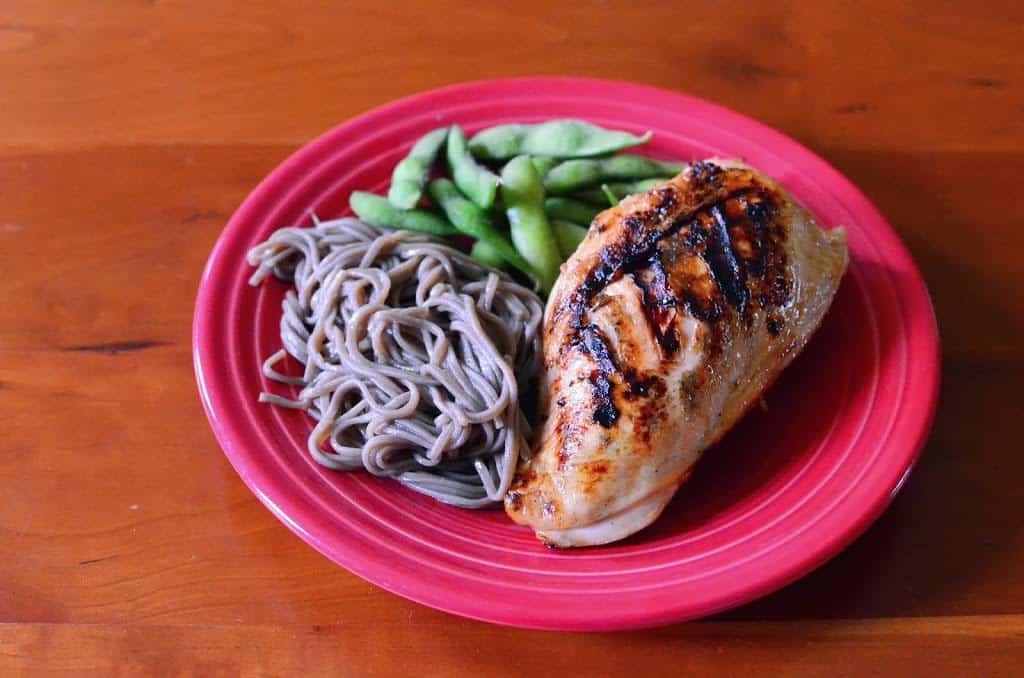
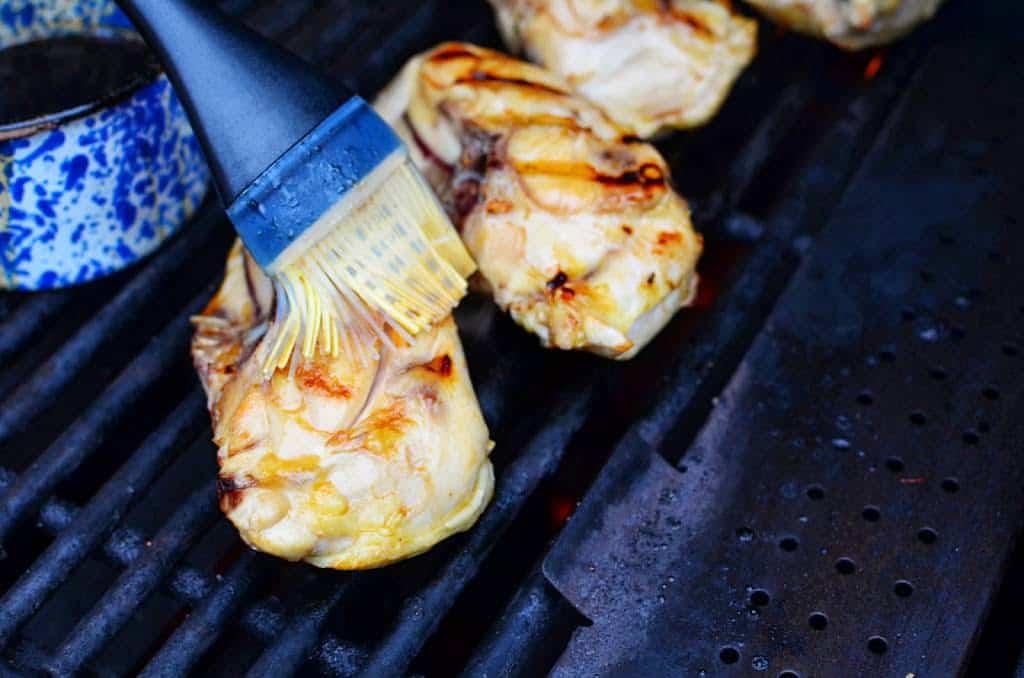
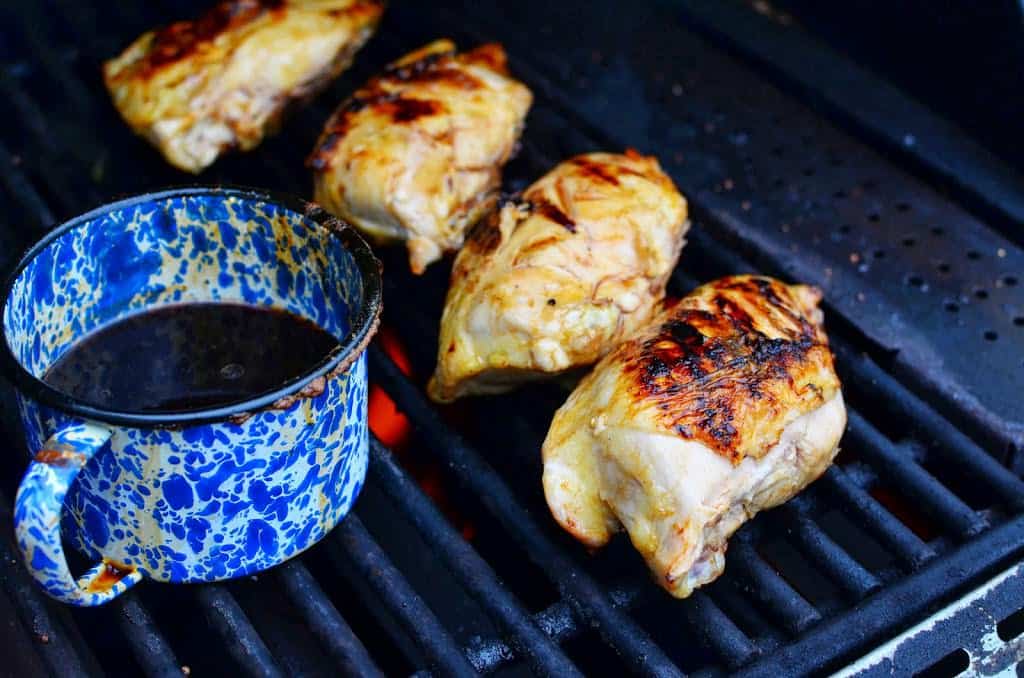
The grill did a great job of crisping up the chicken skin, and the basting sauce adds a browned glaze to the bird. I pass the rest of the sauce at the table, so my family can dip pieces of tender chicken in the sweet, salty sauce.

If you have a sous vide water bath, you have to try 140°F chicken. (Or, as Mr. Blumenthal would call it, 60°C chicken.) No sous vide water bath? No worries…sort of. You can improvise a water bath with a beer cooler and hot water. Make sure to start around 145°F, and add hot water as needed to keep the temperature above 140°F .

Recipe: Sous Vide Grilled Chicken Breasts With Japanese Glaze and Dipping Sauce


Adapted From: Heston Blumenthal's 140°F sous vide chicken

Cooking time: 2 hours, 4 minutes

Equipment

  • Sous Vide water bath (I used a SousVide Supreme Demi, but you can improvise one with a beer cooler)
  • Vacuum sealer
  • Grill (I use a Weber Summit. Here is the current version of my grill.)

Ingredients:

  • 4 bone in, skin on chicken breasts, ribs trimmed
  • 2 teaspoons kosher salt

Sauce

  • ½ cup soy sauce
  • ½ cup mirin (Japanese sweetened rice wine, or substitute sweet sherry)
  • ¼ cup sake (Japanese brewed rice wine, or substitute dry sherry)
  • chicken juices from the sous vide bags

Directions

1. Sous vide the chicken breasts

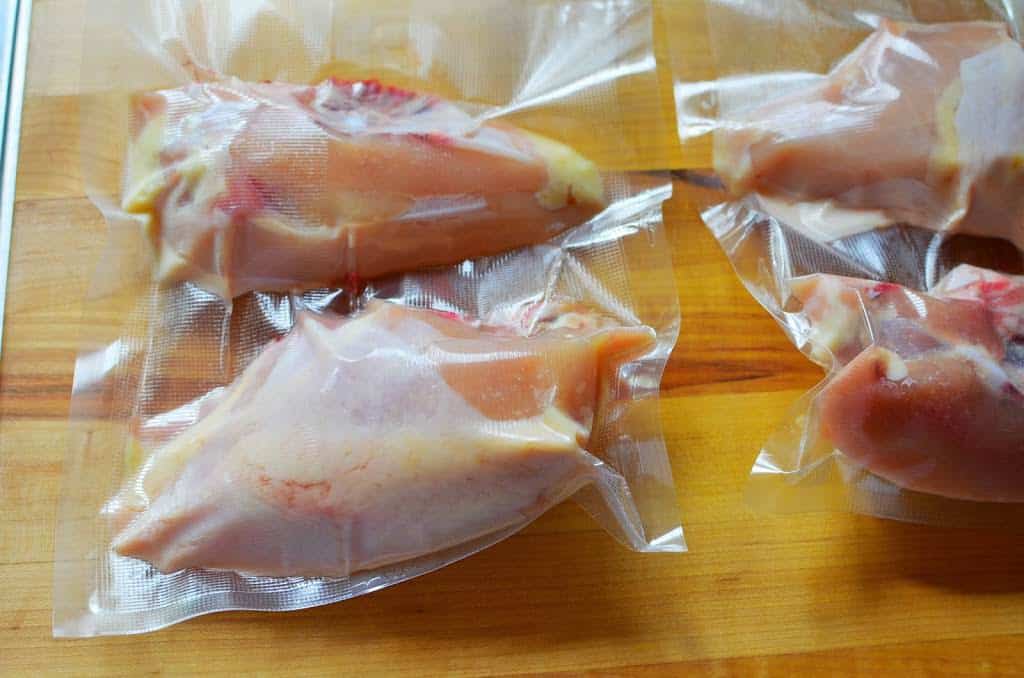
Sprinkle the chicken breasts with the kosher salt, seal in vacuum bags. Cook at 140°F for 2 hours, or up to 6 hours.

2. Preheat the grill for direct high heat

Set the grill up for cooking on direct high heat, and clean the grill grate. For my gas grill, I preheat with all the burners on high for 15 minutes, then brush the grate clean with my grill brush.

3. Dry the chicken, prepare the sauce

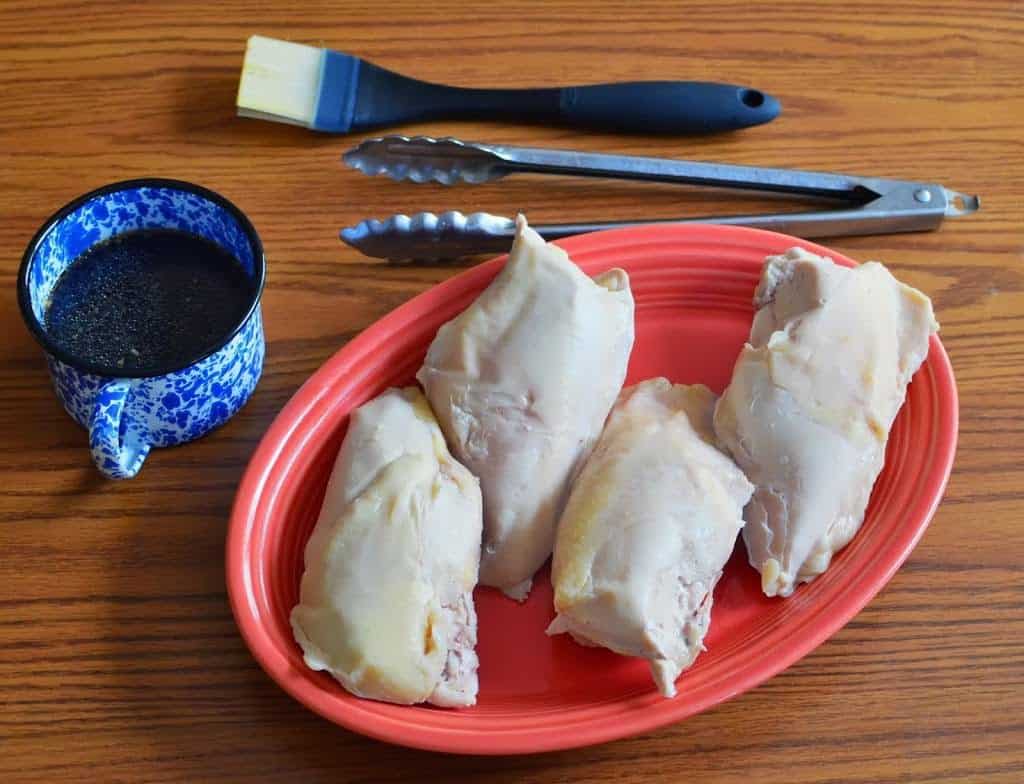
While the grill is preheating: Remove the chicken from the sous vide oven and cut open the vacuum bags. Put the chicken on a platter and pour any juice in the bags into a small pot. Pat the chicken dry with paper towels. Add the rest of the sauce ingredients to the pot with the chicken juices and bring to a simmer on the stove (or the side burner of your grill). Let the sauce simmer gently while the grill finishes preheating.

4. Grill the chicken

Put the chicken on the grill over direct high heat. Sear the chicken, flipping and basting with the sauce every minute, until it is browned and the skin is crispy, about 4 minutes. Immediately move the chicken back to the serving platter.

5. Serve

Divide the remaining sauce into small bowls for dipping, and serve with the chicken.

Notes

  • If you have a sear burner or infrared burner, this is the time to use it - you want the grill as hot as possible. That way, you brown the outside of the chicken without cooking into the (already perfectly cooked) center of the meat.
  • There should be a little flaring from the fat dripping on the grill - it helps with browning - but turn the chicken often to keep it from turning into a grease fire. And, when first turning the chicken, work it carefully from the grill grates, to keep the skin from tearing.
  • Next time I'll seal some slices of garlic, ginger, and green onions in with the chicken, for an extra hit of flavor. (Discard these before grilling if you try it.)
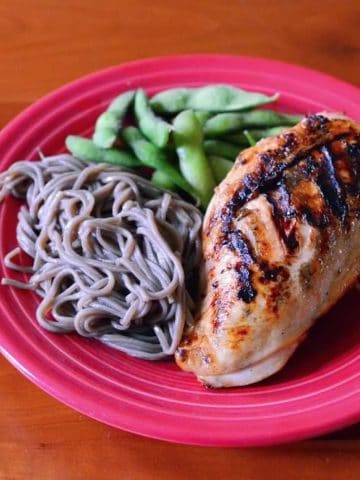
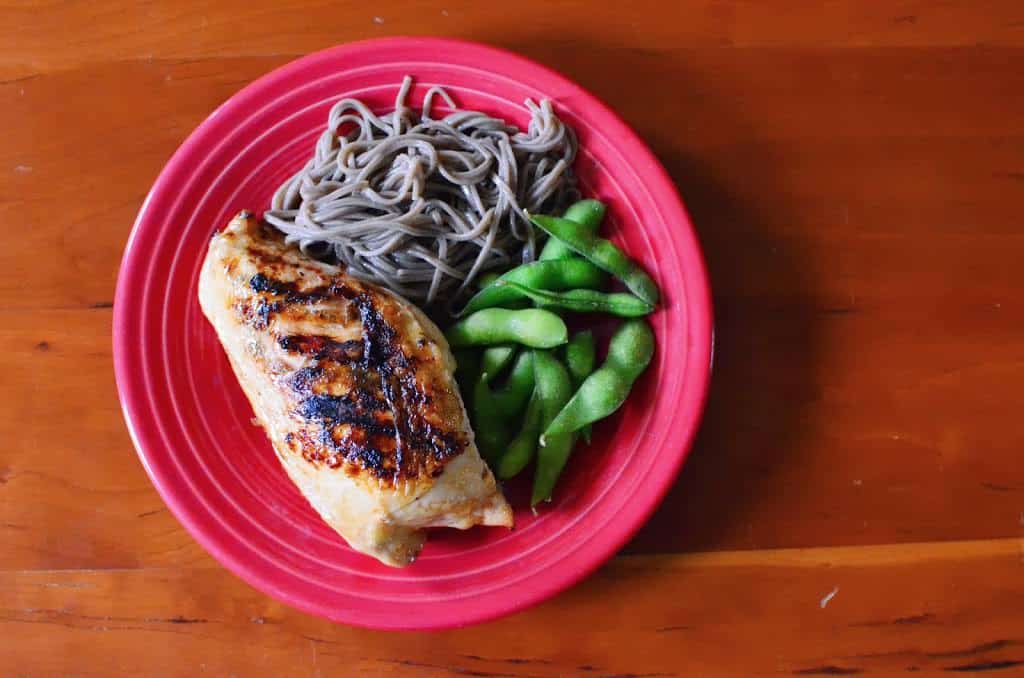
  • I served the chicken with soba noodles tossed with sesame oil and edamame. Rice and an Asian stir fried vegetable (like bok choy) are also good suggestions for side dishes.

What do you think? Questions? Other ideas? Leave them in the comments section below.

Related posts

Beer Cooler Sous Vide Grilled Lamb Loin Chops
Sous Vide Grilled New York Strip Steaks with Herbs (and SousVide Supreme Demi test run)

*Enjoyed this post? Want to help out DadCooksDinner? Subscribe to DadCooksDinner using the RSS or Email options on the right, recommend DadCooksDinner to your friends, buy something from Amazon.com through the links on this site, or donate through my tip jar. Thank you.

Sous Vide Grilled New York Strip Steaks with Herbs (and first impressions of the SousVide Supreme Demi)

May 28, 2013 by Mike Vrobel 6 Comments

The Sous Vide Supreme folks asked me to be part of their Sous Vide BBQ recipe contest. My thoughts were:

  1. There's no way I'll win. My recipes are too basic for a cooking competition.
  2. Wait, they'll loan me a SousVide Supreme and a vacuum sealer for a month? Yes! I'm in!

I'll be shamelessly asking for your vote on June 25th. You're all willing to stuff the ballot box for me, right? Um…right? Anyone? Mom?

I enjoy my Bubba Sous Vide experiments, but a beer cooler full of water is a hassle, and doesn't have the precise temperature control of a true sous vide water bath. And there are so many Sous Vide recipes I want to try:

  • Momofuku 60°C (140°F) eggs [fitbomb.com]
  • Thomas Keller's 72 hour short ribs [ruhlman.com]
  • Heston Blumenthal's 140°F chicken [seriouseats.com]
  • Kenji Alt's 130°F steak [seriouseats.com]
  • Modernist Cuisine at Home - almost every chapter has sous vide in it

UPS (aka The Big Brown Truck of Joy) dropped off the SousVide Supreme Demi last night.

It's 24 hours later. I'm sous vide obsessed.

I've sous vided eggs (soft boiled, breakfast), a New York strip (with thyme and parsley, grilled to sear, lunch), and chicken breast (Grilled to sear, painted with Japanese tare sauce, dinner). And I'm 2 hours into the 72 hour short ribs, to serve on Memorial Day. And, I'm testing out different times for short ribs. I have three separate vacuum bags: one will cook for 72 hours, one for 48 hours, and one for 24 hours.

The wife and kids are giving me the hairy eyeball. They're worried I'm going to start vacuum sealing random stuff around the house, just to see how it cooks in the water bath.

General impressions

Now, I've only had the Demi for a day. But…

Oh, man, is this so easy. Here's how I made lunch: season a steak, vacuum seal it, fill the cooker with hot water, and set the temperature. I read for an hour, then preheat the grill. Once the grill is ready, I pull the bag out of the cooker, and cut it open. The steaks are perfectly medium-rare - a quick sear on the grill and I'm ready to eat.

Eggs were even easier - they go directly in the water bath, in the shell, and cook for at least 45 minutes. Crack them open and out drops a perfect soft boiled egg.
At least, I thought it was perfect. The wife and kids thought it was too soupy. I was cooking 60°C eggs; I'll have to try 62°C next time. Supposedly that will give me a poached egg, with a set white and a runny yolk.

I'm having so much fun with the Demi. I have material for three or four posts about Sous Vide cooking already, and I'm only a day in. So, I'm apologizing in advance. Readers: I'm a gadget maniac, and I love playing with a new toy in the kitchen. If you want to follow along, and you don't have a sous vide water bath, check out my Bubba Sous Vide posts for the cheap, improvised version; if you like the results, I highly recommend looking into a SousVide Supreme.

To start off, here is a recipe for:

Recipe: Sous Vide Grilled New York Strip Steaks with Herbs


Adapted From: Kenji Alt Sous Vide 101 - How to Sous Vide Steak [SeriousEats.com]

Cooking time: 1 hour 4 minutes

Equipment

  • Sous Vide water bath (I used a SousVide Supreme Demi, but you can improvise one with a beer cooler)
  • Vacuum sealer
  • Grill (I use a Weber Summit. Here is the current version of my grill.)

Ingredients

  • 2 (1 ¼ inch thick) New York Strip steaks
  • 1 teaspoon kosher salt
  • ½ teaspoon fresh ground peppercorn blend (or black pepper)
  • 4 sprigs thyme
  • 2 sprigs parsley
  • Pinch of coarse sea salt (optional)

Directions

1. Sous Vide the steaks

Sprinkle the steaks evenly with the salt and pepper. Put the steaks in a small (quart) vacuum pouch, and top each steak with 2 sprigs of thyme and 1 sprig of parsley. Vacuum seal the bag and sous vide at 130°F/54.5°C for at least 1 hour, up to 6 hours.

2. Set the grill for direct high heat

Set the grill up for cooking on direct high heat, and clean the grill grate. For my gas grill, I preheat with all the burners on high for 15 minutes, then brush the grate clean with my grill brush.

3. Sear the steaks over direct high heat

Remove the steaks from the bag. Pick the herbs off of the steaks and discard. Pat the steaks dry with paper towels, then put the steaks on the grill over direct high heat. Sear, flipping every minute or two, until the steaks are well browned on both sides, about 4 minutes total.

5. Serve

Sprinkle the steaks with a pinch of coarse salt and serve.

Notes

  • Again, the hotter you can get the grill, the better. I put the steaks on the back right corner of my grill, because I know that's the hottest spot in there. If you have a sear burner or infrared burner, this is the time to use it - you want the grill as hot as possible.
  • The vacuum sealed thyme and parsley transfer a lot of flavor to the beef. It tastes like an herb paste was used…even though I discard the herbs before grilling.
Cooked to medium-rare; need to remove herbs before grilling.

What do you think? Questions? Other ideas? Leave them in the comments section below.

Related Posts:

Sous Vide Flat Iron Steak
Sous Vide Grilled Chicken Breast with Japanese Glaze and Dipping Sauce
Beer Cooler Sous Vide Grilled New York Strip Steaks
Beer Cooler Sous Vide Grilled Salmon with Fennel Salad
Sous Vide Pork Steaks
Sous Vide Porterhouse Recipe

*Enjoyed this post? Want to help out DadCooksDinner? Subscribe to DadCooksDinner using the RSS or Email options on the right, recommend DadCooksDinner to your friends, buy something from Amazon.com through the links on this site, or donate through my tip jar. Thank you.
Rotisserie Baby Back Apple Ribs

May 23, 2013 by Mike Vrobel 2 Comments

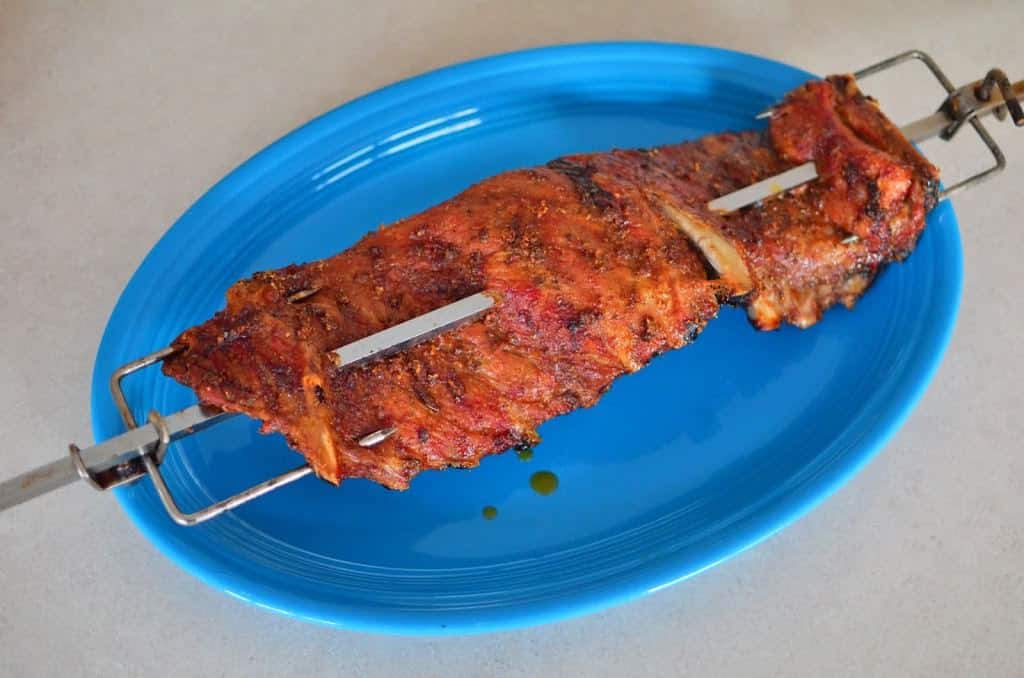
Rotisserie Baby Back Apple Ribs

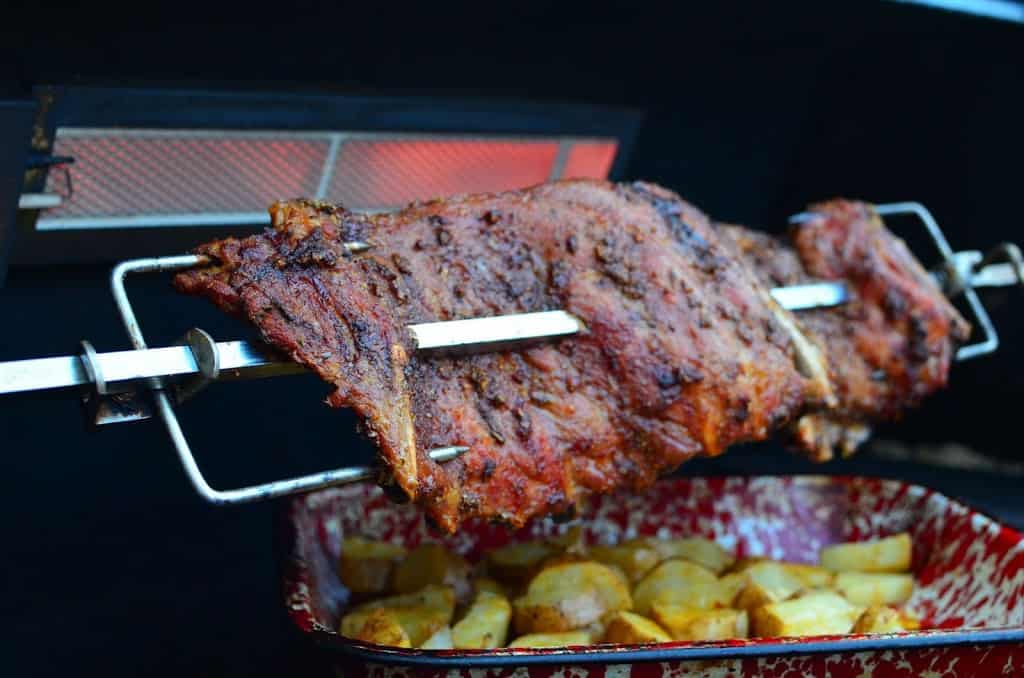
Pork chops with applesauce are a comfort meal from my youth. When my kids asked for ribs the other day, pork and apples went through my head, quickly followed by the memory of Mike Mills' recipe for apple baby back ribs.

Mr. Mills layers the apple flavor into his award winning ribs - they're smoked with apple wood, sprayed with apple juice, and the barbecue sauce contains grated apples. I'm not following the recipe faithfully - rotisserie ribs are sacrilegious in the world of low-and-slow barbecue.

Nor am I apologizing for my heresy. I love the bark I get with the rotisserie, slowly spinning the ribs, basting them in their own juices. I'm borrowing layers of apple flavor, that's all.

I was surprised how easy it was to get two slabs of ribs onto the Weber kettle rotisserie spit. If you're feeding a lot of big eaters, people who polish off a slab of ribs as an appetizer, this is not the recipe for you. But then, if you feed ribs to that kind of a crowd, I'm sure you already own a catering sized smoking rig.

Recipe: Rotisserie Baby Back Apple Ribs


Inspired by: Mike Mills Peace, Love and Barbecue

Cooking time: 120 minutes

Equipment:

  • Grill with Rotisserie attachment (I use a Weber kettle grill with the rotisserie attachment)
  • 9 by 13 Drip Pan (or whatever fits your grill)
  • Spray bottle


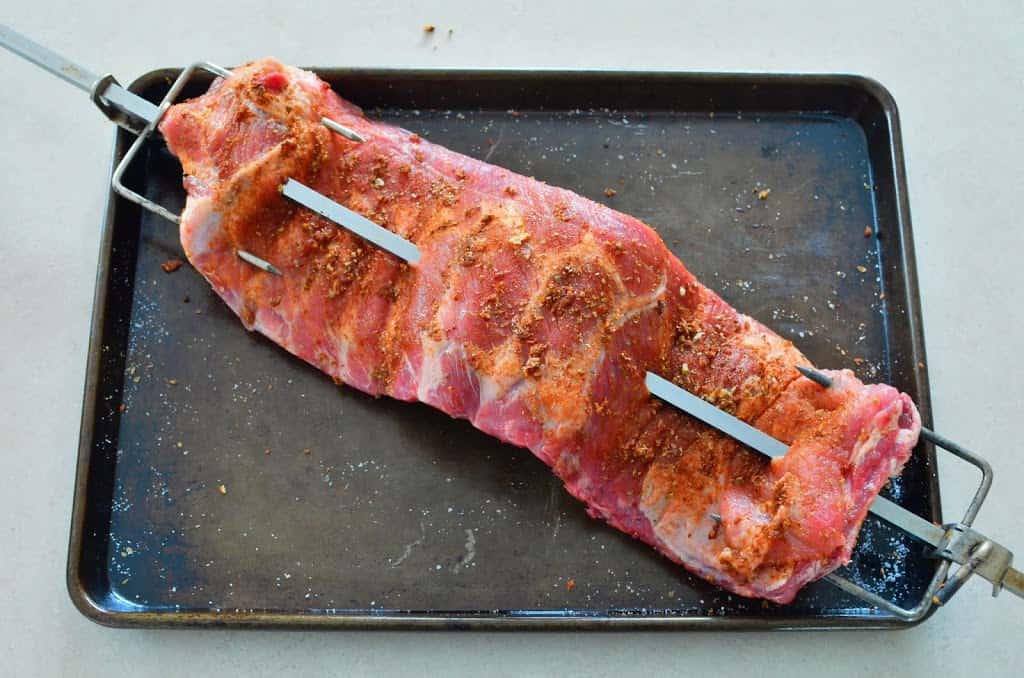
Sprinkle ribs with the rub


Skewer the ribs in an "S" shape


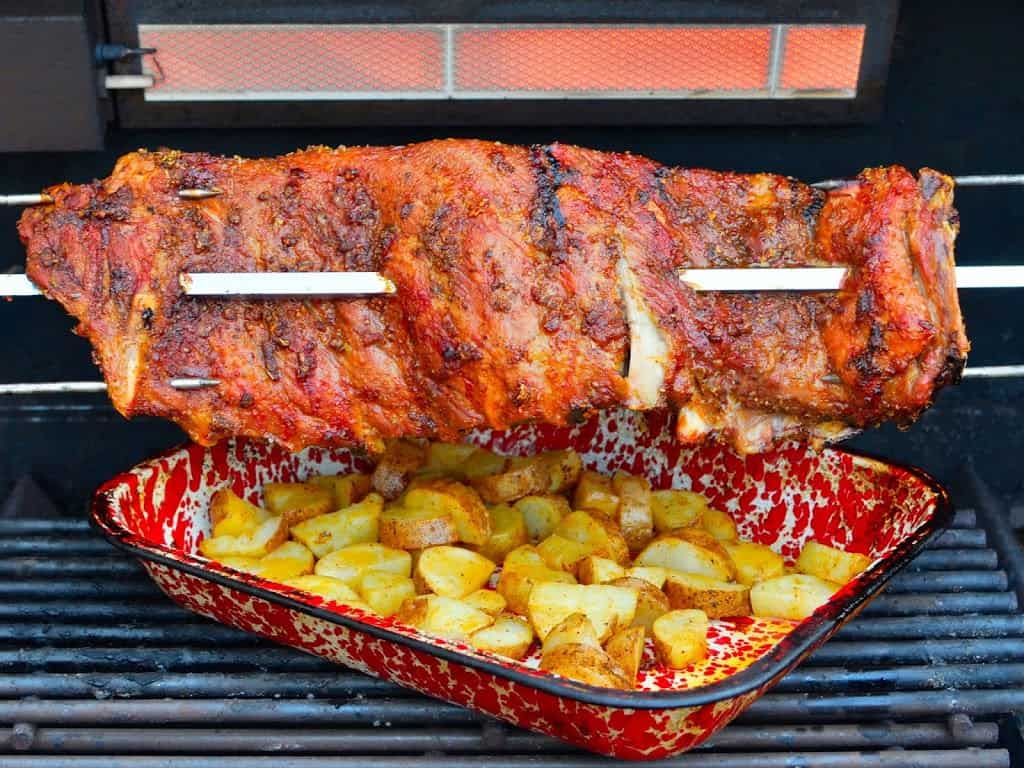
Ribs on the grill
Ribs on the grill


Spraying the ribs with apple juice


Brush with sacue
Brush with sacue


Notes

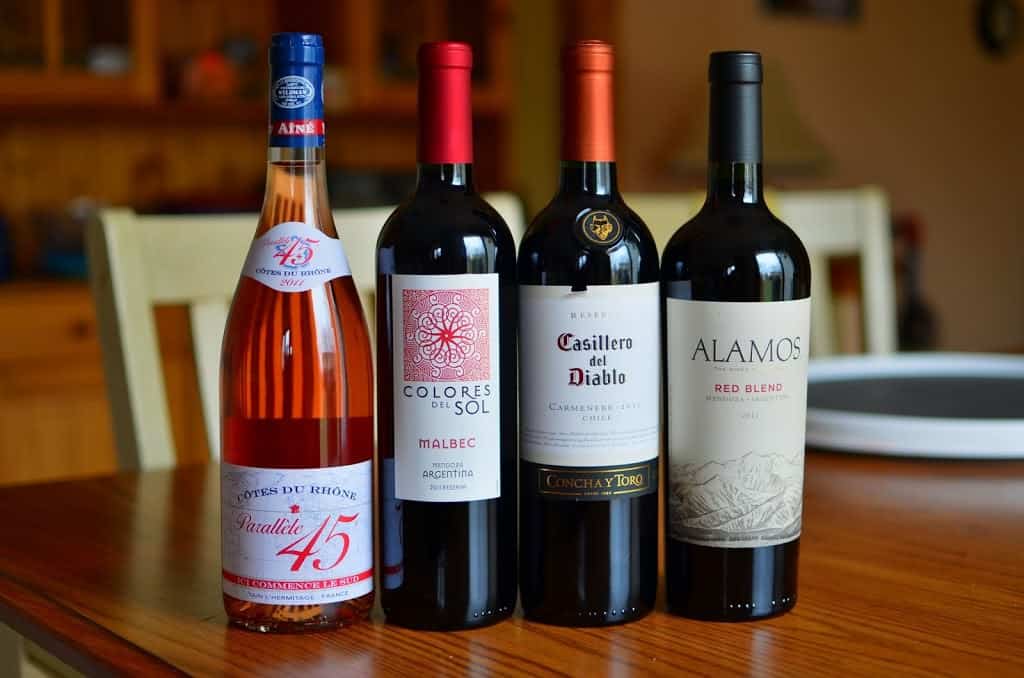
  • What should you drink with this? Beer, of course. Or a dry French style Rose. If you really want to go all-in with the apple theme, try some hard apple cider.
  • Watch out for shiners on your baby back ribs - ribs where they were cut so close that all the meat is gone, and you can see the shiny ribs poking through. My local grocery store started carrying "extra meaty" baby back ribs a year or two back, and I love them.
  • No rotisserie? No worries. Set your grill up for indirect medium-low heat as directed, then put the grill grate back on the grill, and a rib rack on the grate, above the drip pan. Put the ribs in the rib rack, and cook as directed. It might take longer (2 to 3 hours) without the heat convection from the rotisserie, but the ribs will come out just about as good.
Apple juice in the spray bottle

What do you think?

Questions? Other ideas? Leave them in the comments section below.

Related Posts

Rotisserie Rack of Pork, Apple Cider Brined
Rotisserie BBQ Baby Back Ribs
Rotisserie Spareribs with Garlic, Oregano and Paprika rub
Rotisserie Drip Pan Sweet Potatoes


Check out my cookbook, Rotisserie Grilling.

Everything you could ask about the rotisserie,
plus 50 (mostly) new recipes to get you cooking.

It's a Kindle e-book, so you can download it and start reading immediately!


*Enjoyed this post? Want to help out DadCooksDinner? Subscribe to DadCooksDinner using the RSS or Email options on the right, recommend DadCooksDinner to your friends, buy something from Amazon.com through the links on this site, or donate through my tip jar. Thank you.
Espresso Chipotle Barbecue Sauce

May 21, 2013 by Mike Vrobel 4 Comments

Barbecue sauce is easy to make at home. The basic flavor profile is:

  • 4 parts ketchup
  • 1 part vinegar (usually cider vinegar)
  • 1 part sweetener (molasses, brown sugar, honey, or a mix)
  • spices and seasonings

The spices and seasonings are where you can make the sauce your own. Pull out a bottle of your "secret recipe" barbecue sauce, and your friends will think you're a barbecue savant. 1My problem? My secret recipes never stay secret. I can't help myself. I have to share the ingredients, even if you're just feigning interest to be polite. Is it any wonder I have a food blog?

So, what is my secret ingredient? A shot of espresso.2I need my espresso in the morning. NEED. And I'm not up to grinding and tamping first thing in the morning. I want my 2 shots of espresso, and I want them now. That's why I use a Nespresso. No muss, no fuss, and surprisingly good espresso. I know the pods are expensive. I know the pods are not environmentally friendly. Though Nespresso is working on that. This is one of my extravagances, and I try to make up for with the rest of my (admittedly typical suburban dad) life.

Oh, and I add chipotle en adobo to the sauce, for a hint of smoke and heat. Not too much; this is barbecue sauce, not hot sauce.

Recipe: Espresso Chipotle Barbecue Sauce

Inspired by: Paul Kirk's Championship Barbecue Sauces

Brewing the espresso
Ingredients
Ingredients
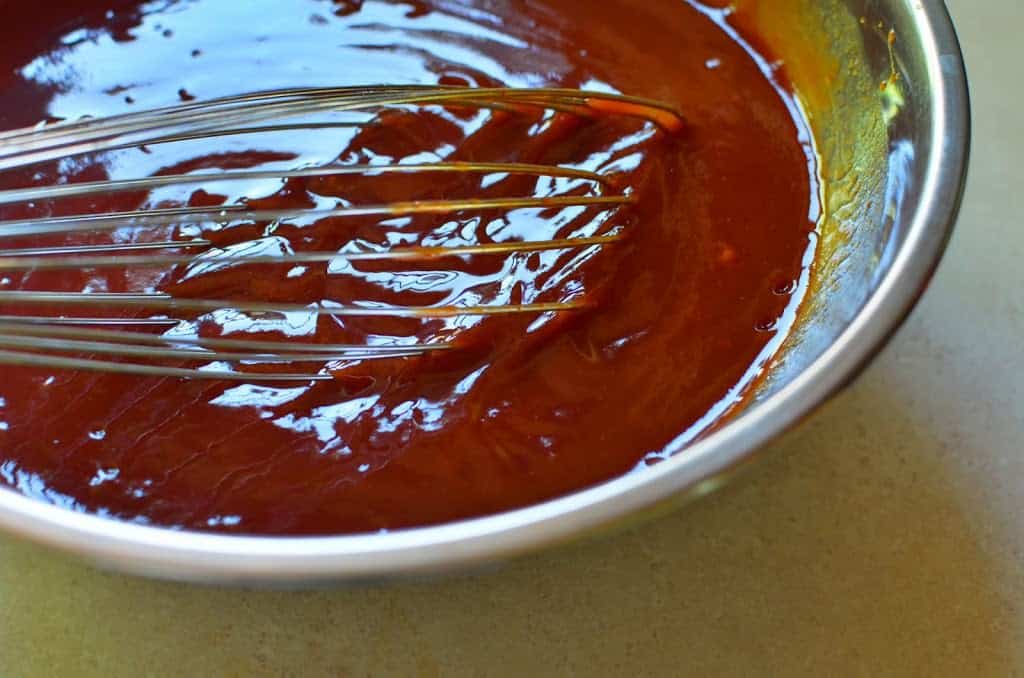
...whisked until smooth

Notes

  • Storage: I have a little squirt bottle for BBQ sauce, but it only holds a couple of cups. I pour the rest of the sauce back into the ketchup bottle for long term storage. I write "BBQ Sauce" all over it with a sharpie, to try to avoid confusion, but the kids have learned that they need to check the color of the bottle before they assume it's ketchup.
  • More sauce: This recipe scales up easily; double or triple the recipe if you have a larger bottle of ketchup.
  • If you don't care about high fructose corn syrup, go ahead and get regular ketchup. It will taste the same.

What do you think? Questions? Other ideas? Leave them in the comments section below.

Related Posts:

My Basic Barbecue Sauce, if you want an even simpler recipe.
Easy Horseradish Sauce
Cajun Rub Recipe

*Enjoyed this post? Want to help out DadCooksDinner? Subscribe to DadCooksDinner using the RSS or Email options on the right, recommend DadCooksDinner to your friends, buy something from Amazon.com through the links on this site, or donate through my tip jar. Thank you.
Grilled Asparagus with Whole Grain Mustard Vinaigrette

May 16, 2013 by Mike Vrobel 4 Comments

When you're in a CSA, spring is the toughest season. The weather has finally turned, green leaves are appearing everywhere…but mother nature is teasing. There's nothing for the CSA box yet. It's too soon.

The first CSA box of spring is kind of sad. Sure, there are a couple of big bags of mixed greens. And turnip greens, and beet greens, and maybe some radishes or green onions. I appreciate them after a winter of storage vegetables. But they rattle around in the bottom of a box that will be overflowing come July.

When is spring really here? When the asparagus appears. Suddenly, I don't care what else is in the box; the star of spring vegetables has arrived.

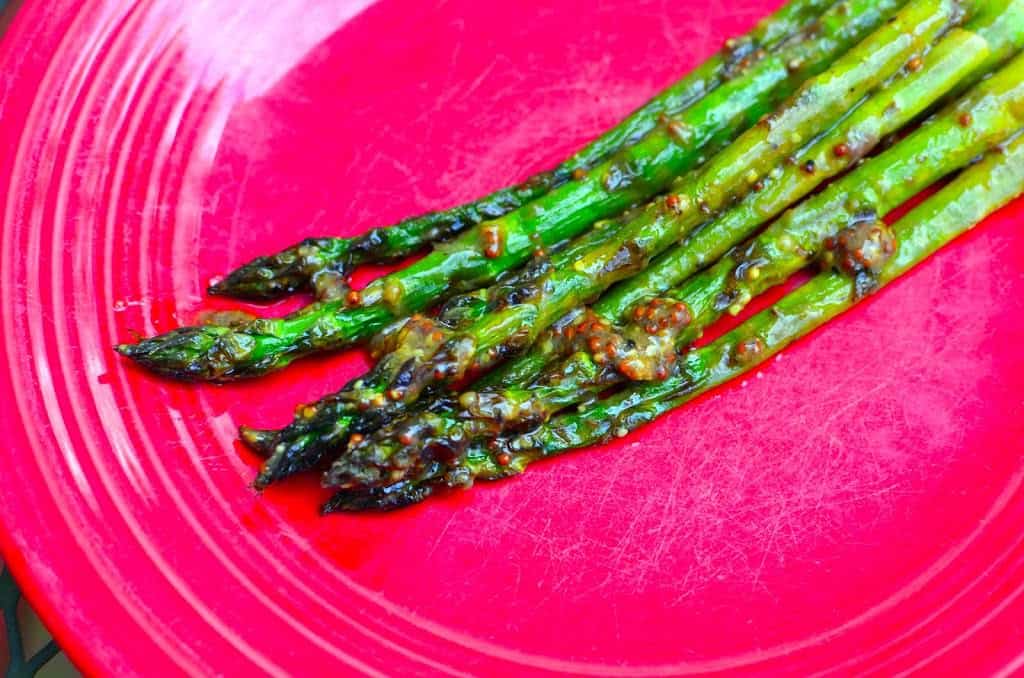
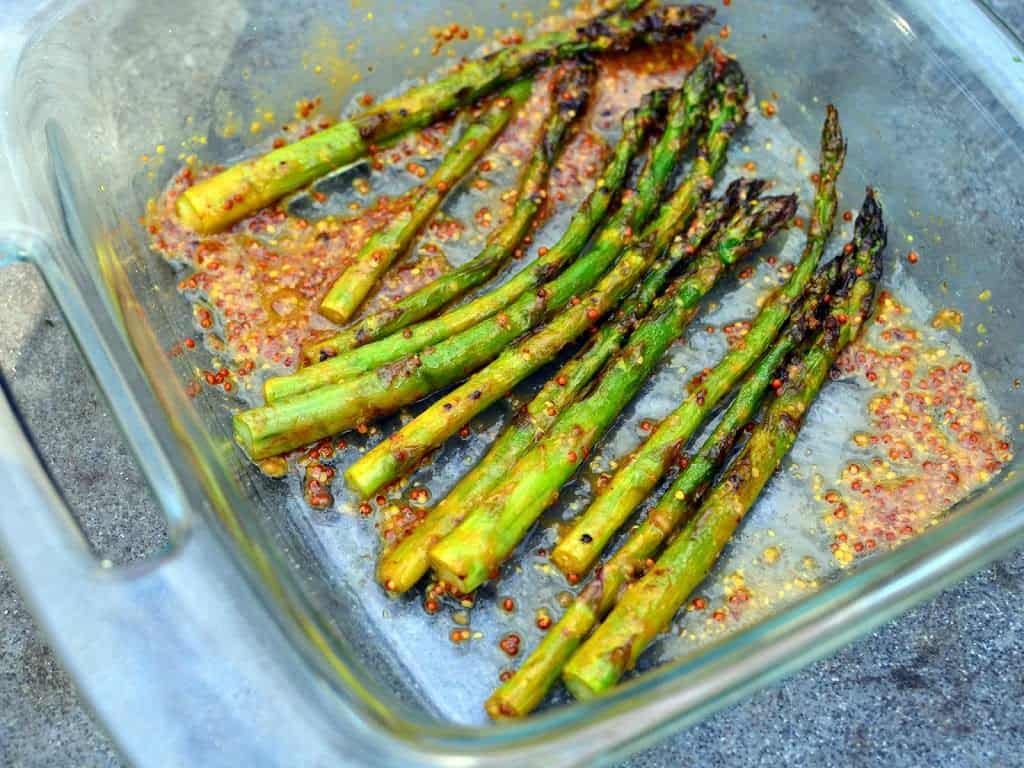
Here's my favorite way to cook asparagus - grilling. (Of course.) I toss the asparagus in a whole grain mustard vinaigrette, both before and after it's cooked. The grains of mustard cling to the asparagus, and add little bursts of flavor and heat.

Special thanks to Amy, Liz, Nate, Nikki, Hyungmo, and Alysha, my farmers at the Crown Point CSA, for the wonderful asparagus.

Recipe: Grilled Asparagus with Whole Grain Mustard Vinaigrette

Cooking time: 8 minutes

Equipment:

  • Grill (I use my Weber kettle )

Ingredients

  • 1 pound asparagus

Grainy Mustard Vinaigrette

  • 1 tablespoon whole grain mustard (aka "stone ground mustard")
  • 1 tablespoon sherry vinegar
  • pinch salt
  • ¼ cup extra virgin olive oil

Directions

1. Prep the asparagus

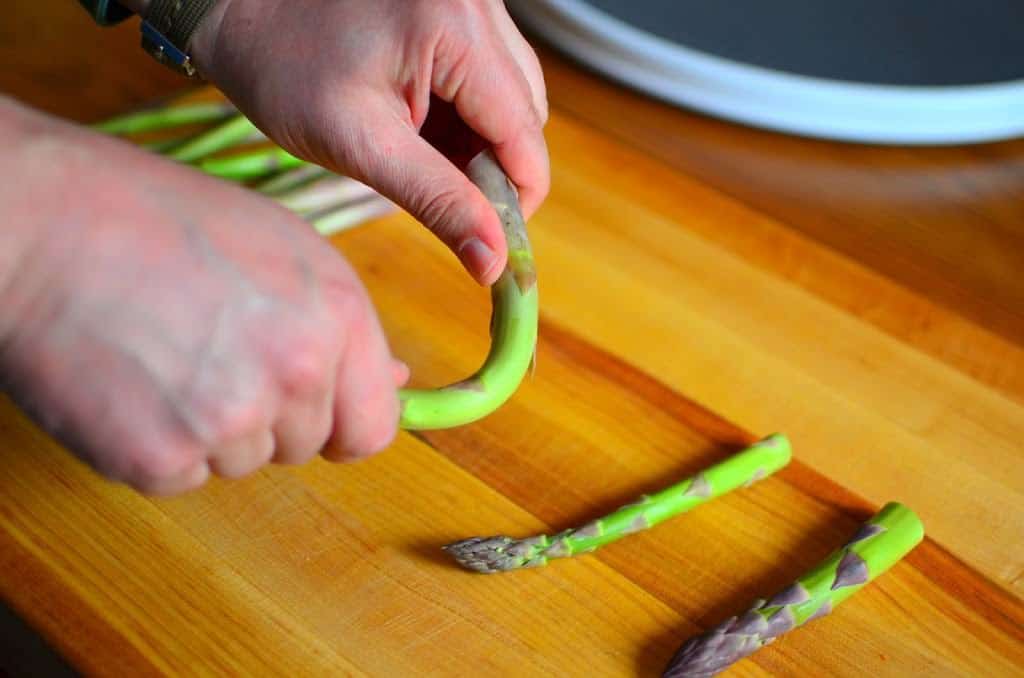
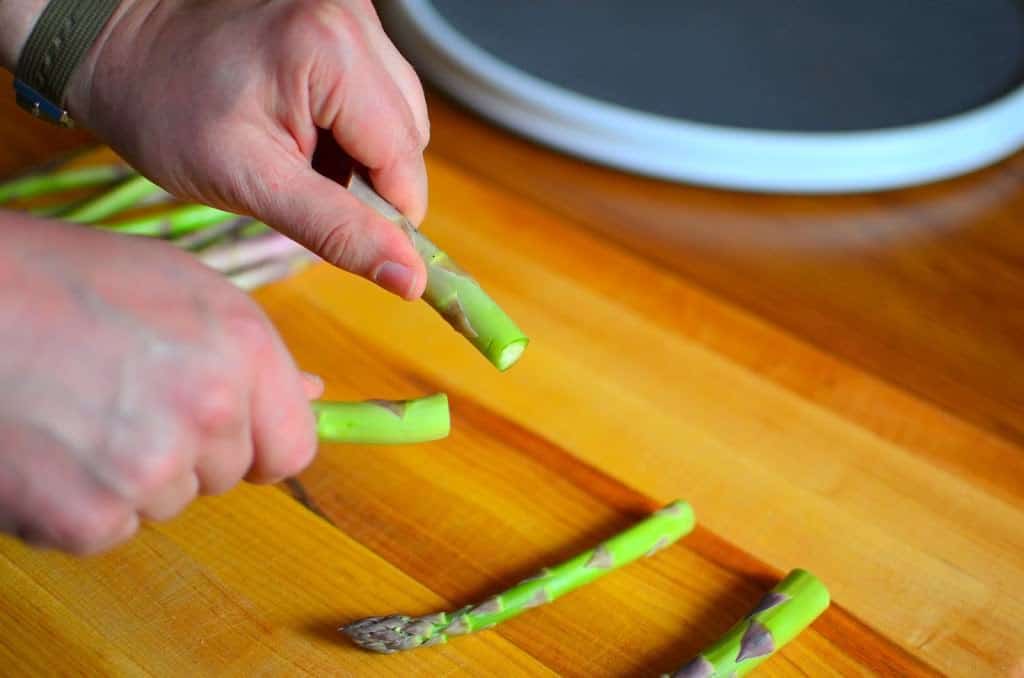
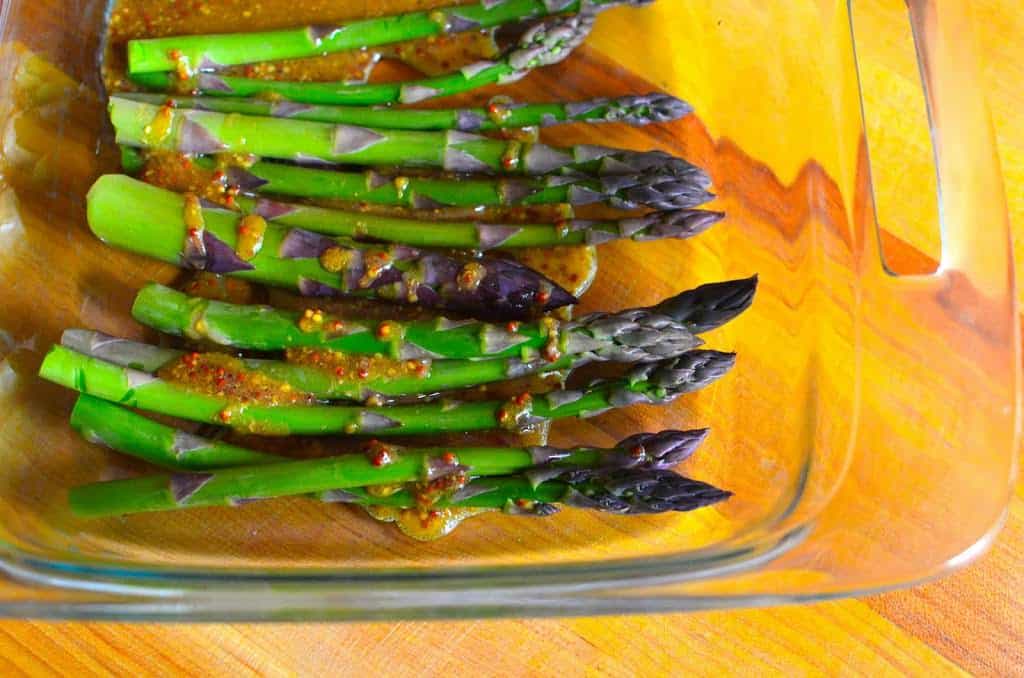
Snap off or trim the tough ends from the asparagus, then put in a baking dish. Whisk the mustard vinaigrette ingredients and pour over the asparagus. Gently toss the spears in the dish until they are coated with vinaigrette.

2. Preheat the grill to medium

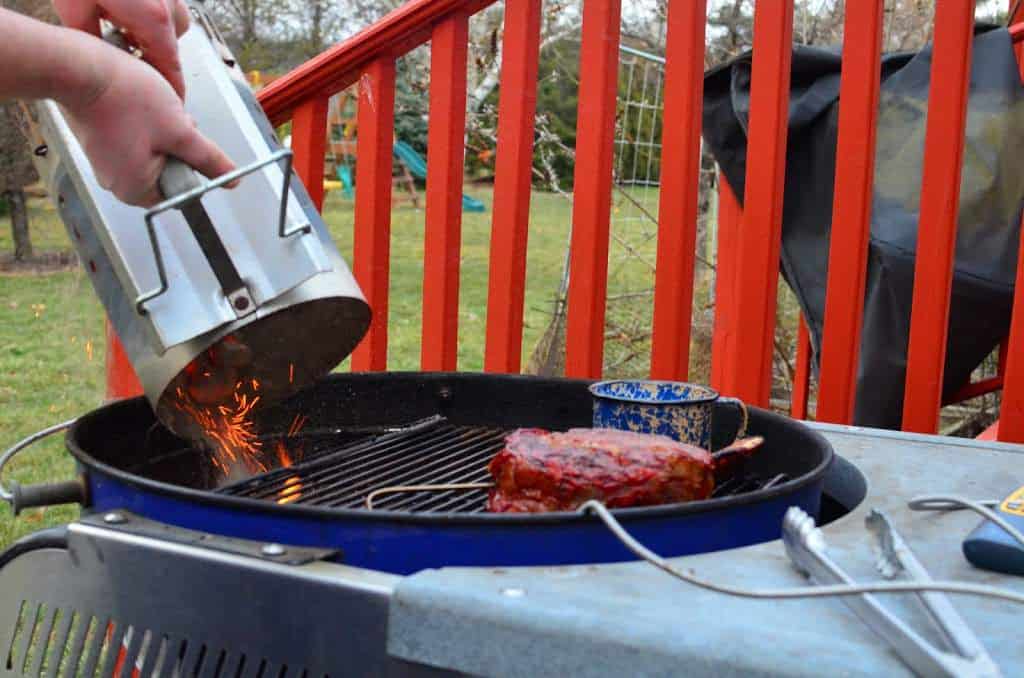
Set the grill up for direct medium heat. For my Weber kettle, I set the grill up for medium high heat on half the grill (¾ chimney full of charcoal, lit, wait until all coals are covered with gray ash, and spread over half the charcoal grate in a tightly packed single layer). Then I brush the grate clean and grill the main course first. By the time the main course is done, the coals will burn down to medium heat, and will be ready to cook the asparagus.
*I recommend the Weber Chimney Starter, because it is larger than most chimney starters. It holds 5 quarts of charcoal, the perfect size for this recipe.

3. Grill the asparagus

Quick summary:
Grill the asparagus spears over direct medium heat for about 8 minutes, rolling every two minutes, until the thickest spears are cooked through. Toss in the vinaigrette left in the dish.

Details:
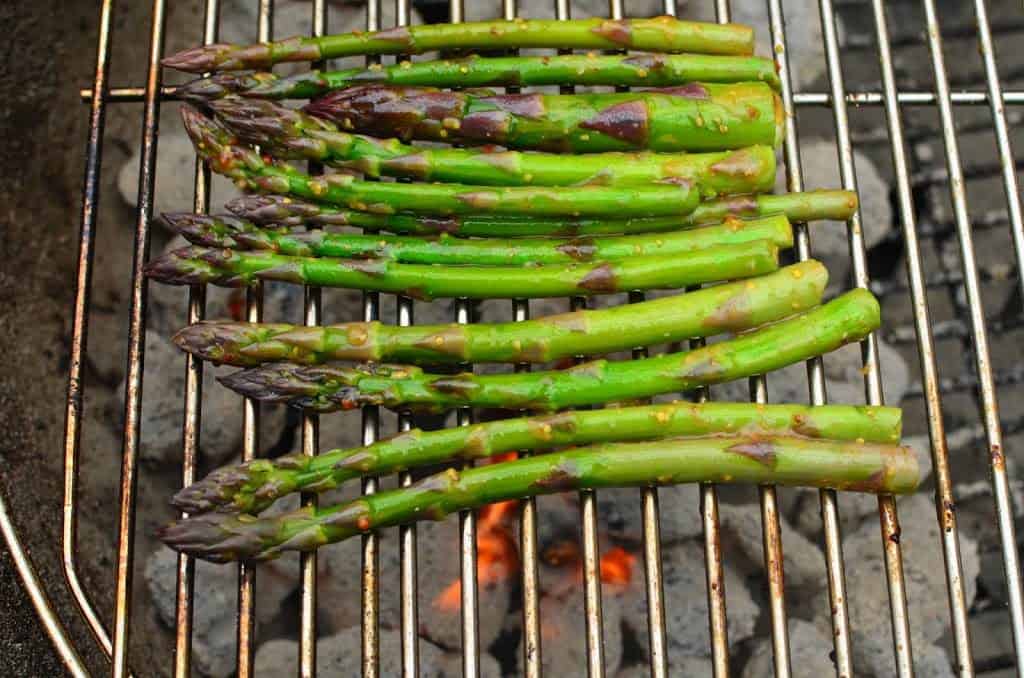
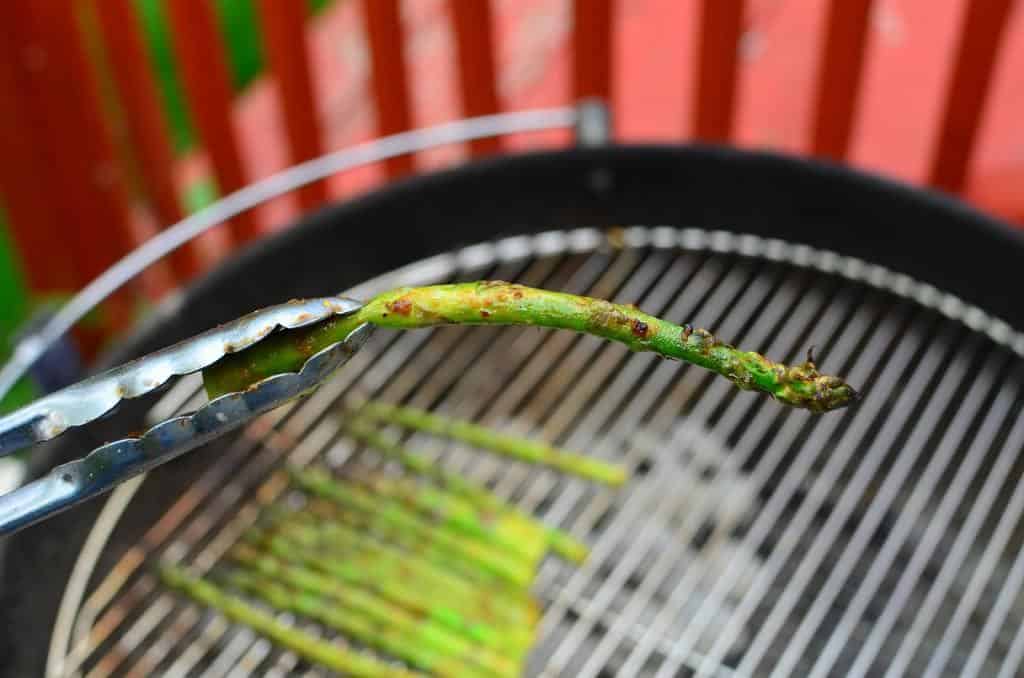
Remove the asparagus spears from the vinaigrette, letting any excess drip back into the dish. Put the asparagus on the grill, perpendicular to the grill grate, over direct medium heat. Cook the asparagus, rolling the spears on the grate every couple of minutes and moving them around if there are hot spots.

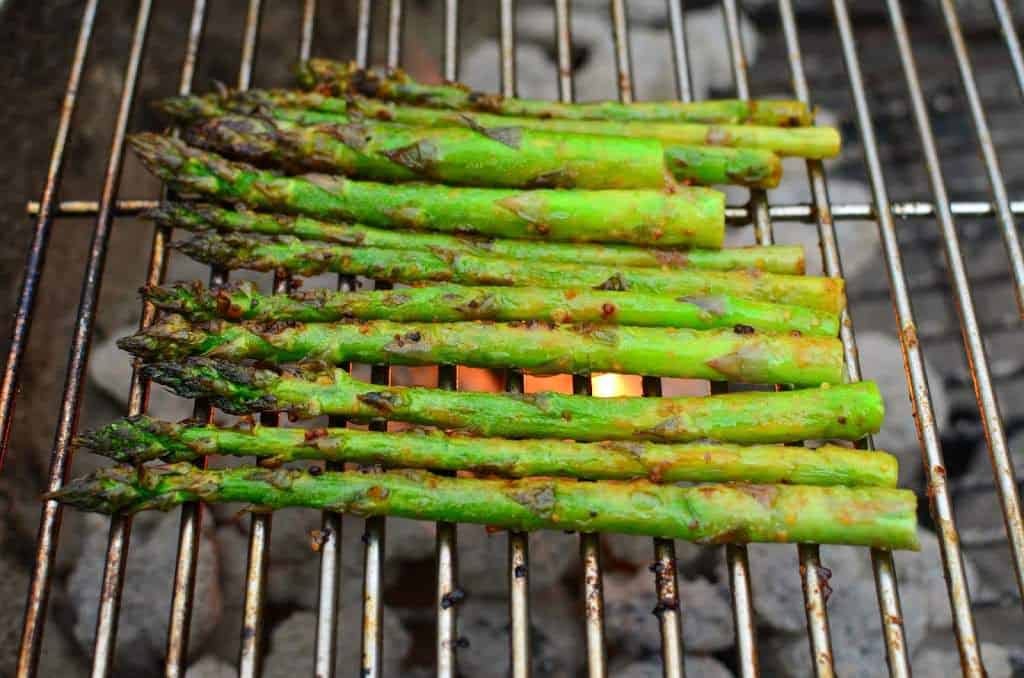
Cook until the spears are browned and cooked through, about 8 minutes. I check the spears two ways. First is the flop test. I pick up a spear with my tongs, and wiggle it up and down. If the spear doesn't bend, it's not done yet. If it's soft and floppy, then I move on to the taste test. I bite into the spear, checking if it is cooked through.

Once the asparagus is done, move it back to the baking dish and toss to coat it with the vinaigrette again. It is good hot or at room temperature, so serve it immediately or let it rest while you finish the rest of dinner.

Notes

  • The trick to cooking asparagus on the grill is to be gentle, but decisive. Keep the spears perpendicular to the grate, and if you grab some with your tongs, make sure they are flipped all the way over before setting them back down on the grate. But, don't sweat it too much - I always lose a spear or two through the grate.
  • Don't want to cook a main course first? Set the grill up for medium heat by lighting half a chimney of charcoal, and spreading it into a loose single layer over half the charcoal grate.
  • This is actually easier to cook on a gas grill - charcoal burns hotter, and the asparagus is always on the edge of burning. Gas gives you some margin for error. Make sure to cook with the lid closed if you're using gas.

What do you think? Questions? Other ideas? Leave them in the comments section below.

Related Posts:

Grilled Asparagus
Shaved Asparagus and Parmesan Salad
Air Fryer Asparagus

*Enjoyed this post? Want to help out DadCooksDinner? Subscribe to DadCooksDinner using the RSS or Email options on the right, recommend DadCooksDinner to your friends, buy something from Amazon.com through the links on this site, or donate through my tip jar. Thank you.
Spring Grill Cleaning 2013

May 14, 2013 by Mike Vrobel 4 Comments

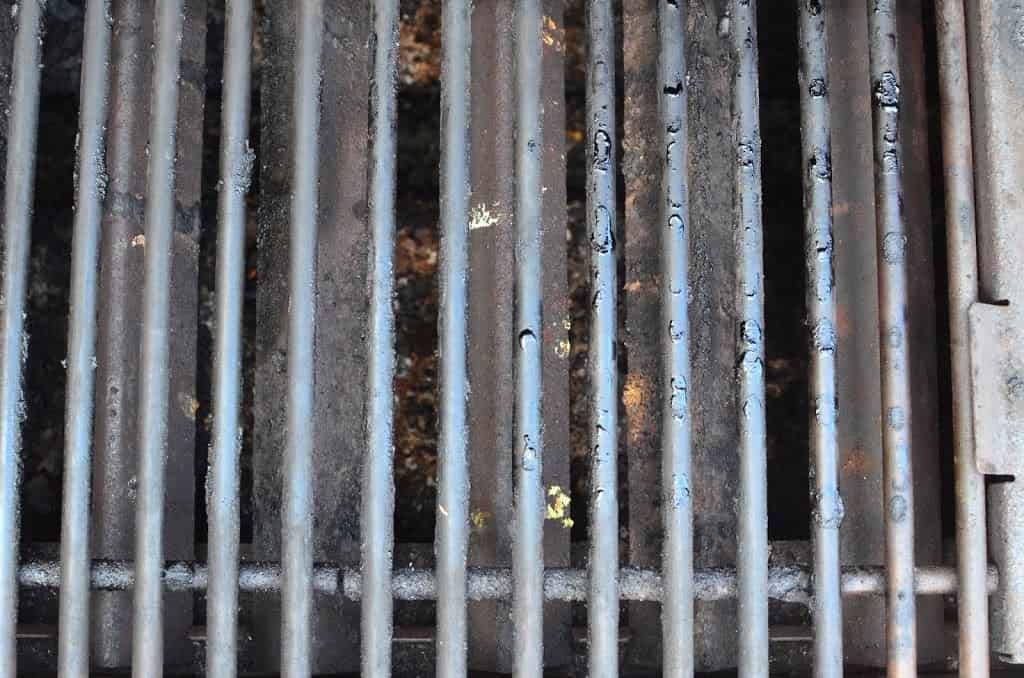
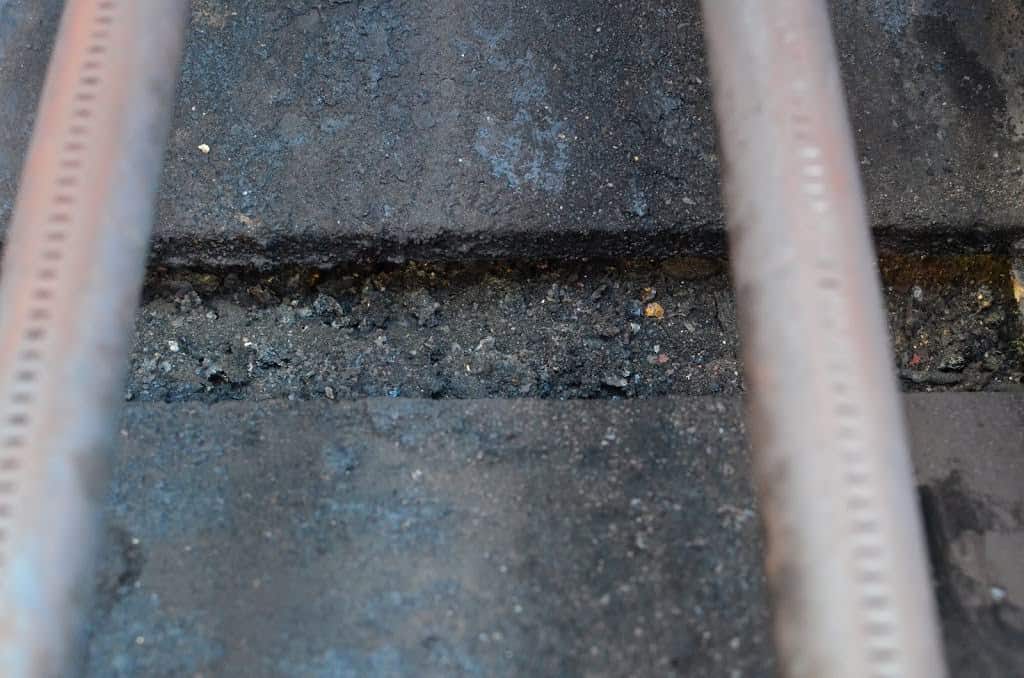
The inside of my grill. Yikes.

A question from a reader:

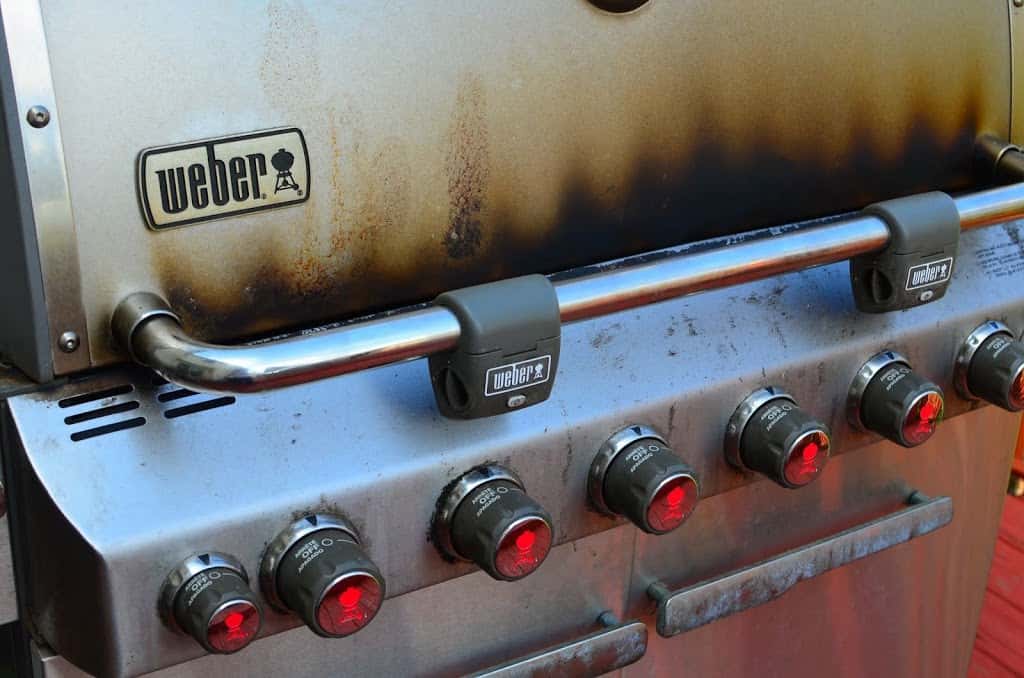
Do you have any tips on cleaning your Weber Summit 650? I have the 450 version, and it looks pretty gross, but still works like the day I got it 5 years ago. The smoker leaves some pretty nasty brown stains on the front lid.

For day to day cleaning, I clean the grill grate part of my preheating routine. I turn the grill to high, let it heat up for 15 minutes, then scrub off the charred remains of my last dinner with a grill brush. I use the grill often enough that a post-grilling burn off isn't necessary, unless I made something really, really messy.
Like, say, cheeseburgers that dripped cheese into the bottom of the grill. But I'm getting ahead of myself.

Once a year, in the spring, I do a deep cleaning. I buy a new grill brush, a pair of cleaning gloves, and a nylon paint scraper. Then I mix up a bucket of soapy water, get some garbage bags, and spend an afternoon going after the gunk in my grill. It's amazing how much better it seems to work after a thorough cleaning.

...

OK, I have to confess. I'm a grill slob. I forgot to clean my grill last year. My excuse is my rotisserie cookbook - I was still working on it when I usually clean my grill. I put off grill cleaning to work on recipe testing. Then pictures. Then came summer vacation. Pretty soon the leaves were turning, suddenly it was snowing, and a year had slipped by.

I got away with it for a while...but the lack of maintenance was catching up to me. I've had more dripping grease catching fire than usual. I tried to cook last week's butterflied chicken recipe using indirect high heat. It was medium at best. It was time to clean the grill.

Here's what I thought:

Great! At least I'll get a blog post out of it - a pictorial on cleaning a grill. Let's get started, and...oh my goodness. There are drifts of greasy, carbonized stuff on the bottom of the grill. Those look like...onions? Is that a runaway asparagus spear? And, what's that smell - oh, yuck, the grease pan is growing fuzz.

I gave up on the pictorial the moment I saw the bottom of the grill. I had too much work to do.

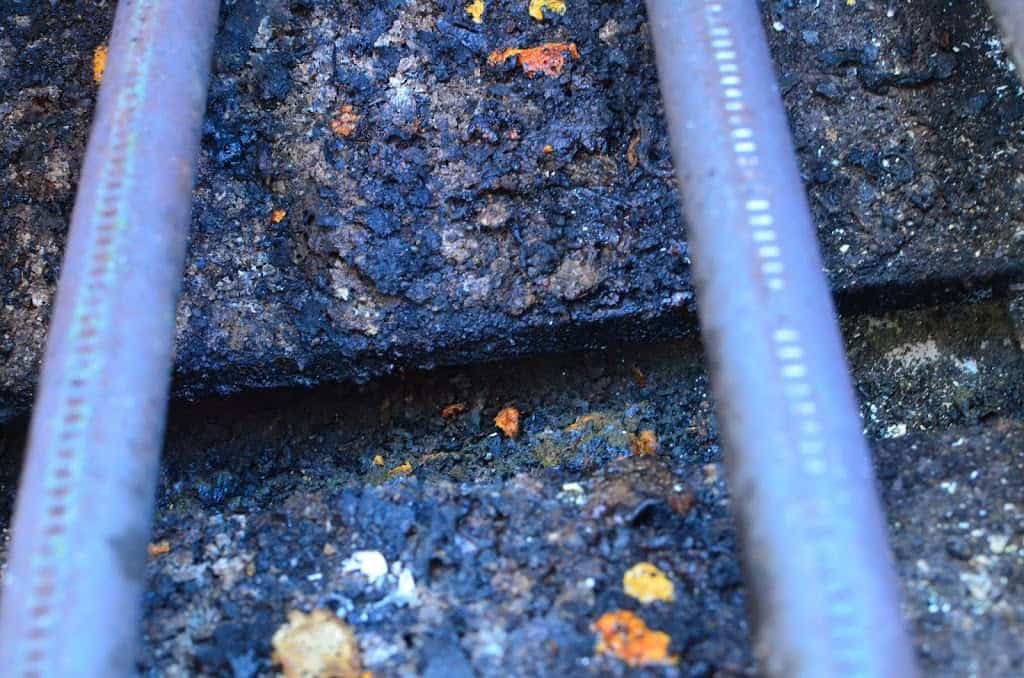
That's the bottom of my grill,
not the mouth of an active volcano.

So, what do I do when my Weber Summit is a real mess? (With commentary.)

  1. Make a trip to the hardware store. Pick up:
    1. "Reusable" kitchen gloves (Only using once, but I need the thick ones)
    2. Narrow nylon paint scraper
    3. New grill brush
    4. Bottle of cleaner
    5. Paper towels
  2. Start on the outside: spray the outside of the grill with a grease cleaner, and wipe it clean with paper towels. (Repeat three times, then give up on the grease stains that are left, with a plan of coming back with serious cleaning products, like Bar Keeper's Friend. Or maybe napalm.)
  3. Clean the inside of the grill, working from the top to the bottom:
    1. Use a nylon putty knife to scrape lose the flakes of soot that accumulate on the top of the lid, letting them fall into the bottom of the grill.
    2. Brush the grill grate clean with my old grill brush - this is the one time of year I flip the grates over and brush the underside. Remove the grates. (Regret cooking cheeseburgers the night before cleaning the grill. Mental note: do a burn the night before cleaning the grill.)
    3. Brush the flavorizer bars (burner covers) with my old grill brush. Brush them over the grill, so anything that comes loose drops into the pan for later cleaning. Once a flavorizer bar is clean, put it back and move on to the next one, and work over the other burner covers, not the uncovered burner - we don't want the stuff coming off the covers from clogging the burners. Once all the flavorizer bars are clean, remove them to get at the burners. (There is stuff on the underside of the flavorizer bars that needs to be brushed off. How in the world did it get UNDER v-shaped bars?)
    4. Brush the burners, using the brand-new grill brush for the first time. Brush across the burners, so anything worked loose doesn't just move to a different burner opening. (Keep brushing and brushing on a burner hole - why won't that stuff in there work loose?)
    5. Scrape the bottom of the grill with the nylon paint scraper. Scrape top to bottom, left to right, pushing everything into the drip pan in the bottom of the grill. (Holy cow, this stuff is at least a half an inch thick. No wonder I had grease fires. Is that an orange peel? No, can't be. Maybe it's an onion skin. Yuck.)
    6. Slide the drip pan full of debris from below the grill, put the opening for the grease pan over a garbage bag, and scrape the debris through the hole and into the garbage. (There's so much carbonized food in here...No, I'm wrong. It's half grease, half carbon. How is that even possible?)
    7. Remove the aluminum foil pan from the grease pan holder, discard, and replace with a new one. (DETAILS REDACTED - potential biohazard.)
    8. Reassemble the grill. Slide the drip pan back under the grill, put the flavorizer bars in place, and put the grates back. Discard the old grill brush, hang the new one from the hook on my grill, and I'm done. The grill looks like new. (Like new? No, but at least it's clean...ish. The burner tubes are clear, and I can almost see the metal on the inside of the grill.)
The bottom of my grill, after scraping everything down into the drip pan.
I couldn't work any more of the burnt stuff off the body of the grill (top and bottom of the pic).


Pictures and Videos

Since I got distracted by the actual cleaning, here is a pictorial from my friend Mike at Another Pint Please, using the exact grill I own:

  • The Spring Cleaning Grill Workout, AnotherPintPlease.com

And here are cleaning videos from Kevin Kolman, Weber's Grill Master.
Yes, that's Kevin's job title, "Grill Master". I talked with him last year; his job is traveling the country, demonstrating how to use Weber grills. Forget what I said in the grilling cookbooks post a few days ago; I have a new dream job. If Kevin wasn't such a nice guy, I'd be jealous.

Spring Grill Cleaning, [Weber.com/blog]

Don't have a Weber grill? These instructions are useful for any grill, but check if your manufacturer has specific instructions for your brand. And have I mentioned recently that customer support is one of the reasons I always recommend Weber grills?

The outside of my grill. Again, yikes.


Weber Cleaners

Weber is looking out for me again - they introduced a range of grill cleaning products this year. They have grate cleaner and degreaser, grill exterior cleaner, a stubborn stain remover, and stainless steel cleaner. I used the exterior cleaner on the outside of the grill, then followed up with the grate cleaner as a degreaser for the tough spots. It cut through most of the mess on the outside of my grill, but I think I need a bottle of the stainless steel cleaner to get the soot stains off of the hood, and the stubborn stain remover for the burnt on grease around the edge of the grill.

Here's a link to the Weber Cleaners website. [WeberCleaners.com]

FTC Note - this post was not sponsored by Weber, no matter how much I gush about them. If you buy something through my Amazon links, I get a small commission. Thank you. And, buying something or not, get out there and clean your grill!

What do you think?

How often do you clean out your grill? Questions? Leave them in the comments section, below.

*Enjoyed this post? Want to help out DadCooksDinner? Subscribe to DadCooksDinner using the RSS or Email options on the right, recommend DadCooksDinner to your friends, buy something from Amazon.com through the links on this site, or donate through my tip jar. Thank you.
Happy Mother's Day 2013

May 12, 2013 by Mike Vrobel Leave a Comment

Happy Mother's day, sweetie!

My hometown newspaper interviewed me! They were asking for tips for a Dad cooking for Mom on Mother's Day. (See tips 6 and 8 in the article).

Ten ways to keep Mom off kitchen duty on her day [Lisa Abraham, Ohio.com]

Happy Mother's Day to all the moms out there!

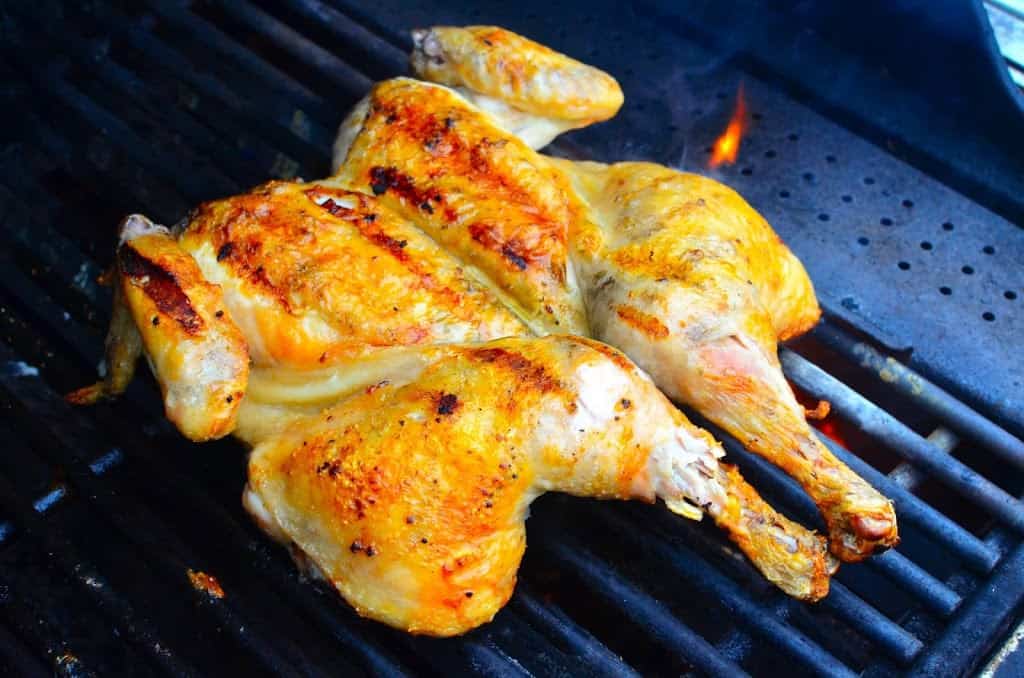
Grilled Butterflied Chicken with Garlic Butter

May 9, 2013 by Mike Vrobel 10 Comments

Grilled Butterflied Chicken with Garlic Butter

How do I grill a chicken if I don't have a rotisserie?

Friends and family ask me this all the time. They enjoy their grilling, but they're not fanatics like me. They don't want to spend time futzing around with a rotisserie.

When I need a quick roast chicken, I butterfly. A few snips with poultry shears and the backbone is out. Then I live out my comic book fantasies, mutter "It's Clobbering Time" under my breath, and squash the chicken flat.3My little brother was more of a Hulk fan. He says he only quit stomping around the house, growling "Hulk Smash!", because I sat on him and refused to get up until he stopped. Yes, I was an evil older brother.

Why butterfly, if I want to save time? Why not just throw the whole chicken on the grill? Because removing the backbone cuts fifteen minutes from the cooking time. A butterflied chicken is opened up to the heat of the grill, which cooks the breast and (more importantly) the thighs quicker.

I love a straightforward roast chicken; this one is based on a recipe from Julia Child, where she rubs the chicken with butter before roasting it. I add a clove of garlic to the butter because, well, because I love garlic butter.

Recipe: Grilled Butterflied Chicken with Garlic Butter

Inspired By: Julia Child, Julia and Jacques Cooking at Home

Equipment:

  • Grill (I use a Weber Summit. Here is the current version of my grill.)
  • Poultry shears
  • Instant Read Thermometer
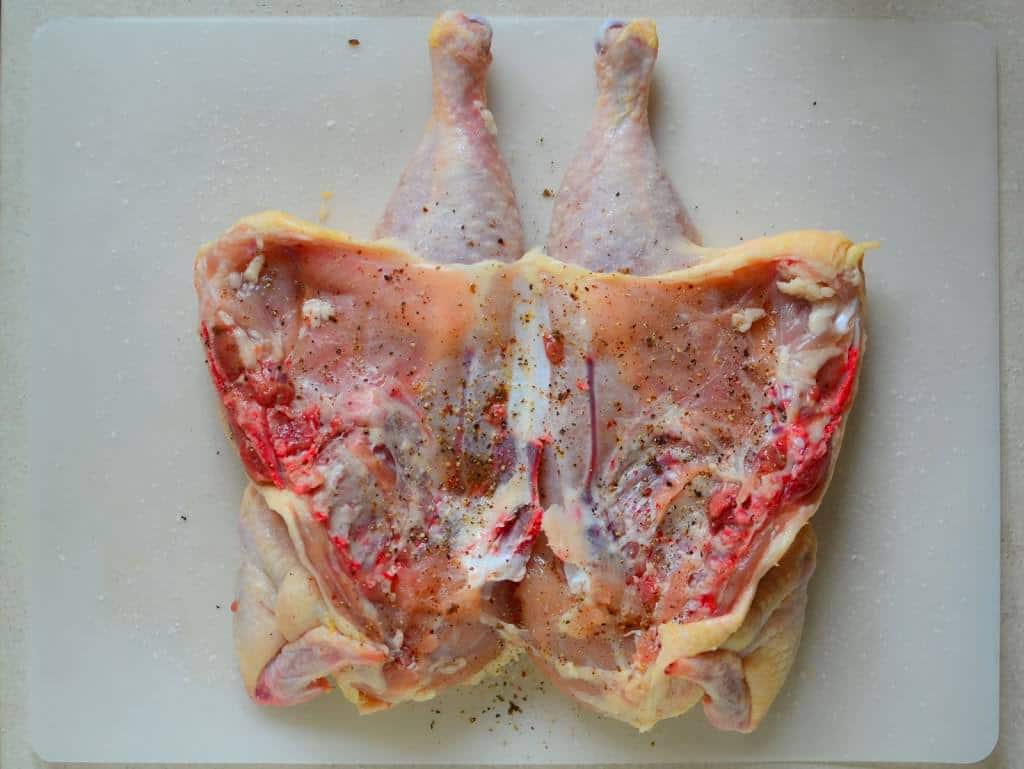
Butterflied and salted
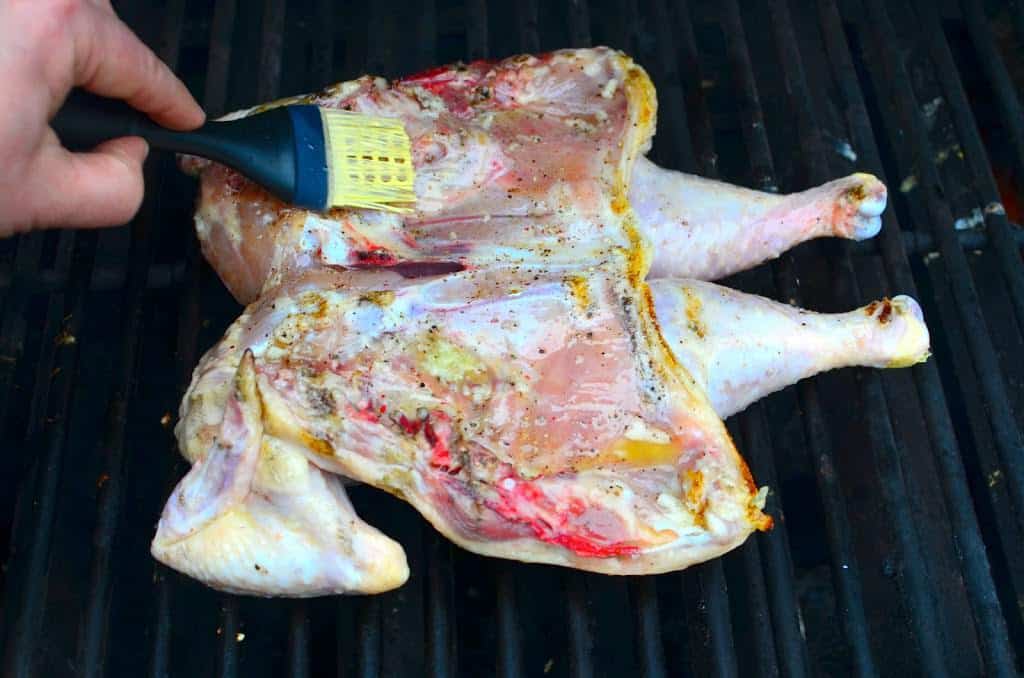
Brushing with garlic butter
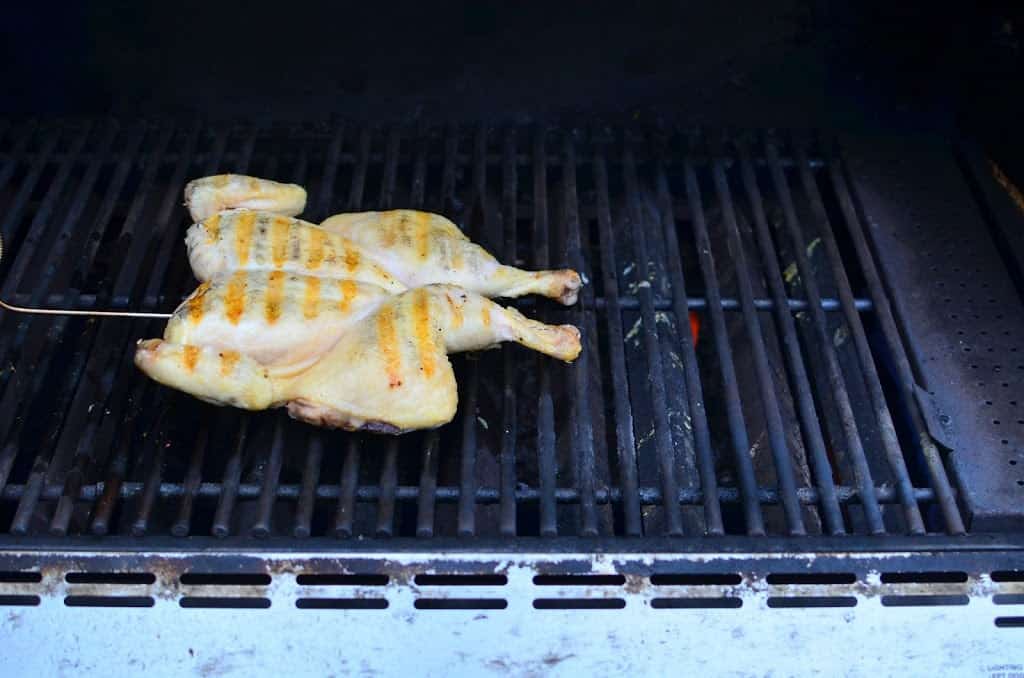
Indirect heat - lit burners are on the right
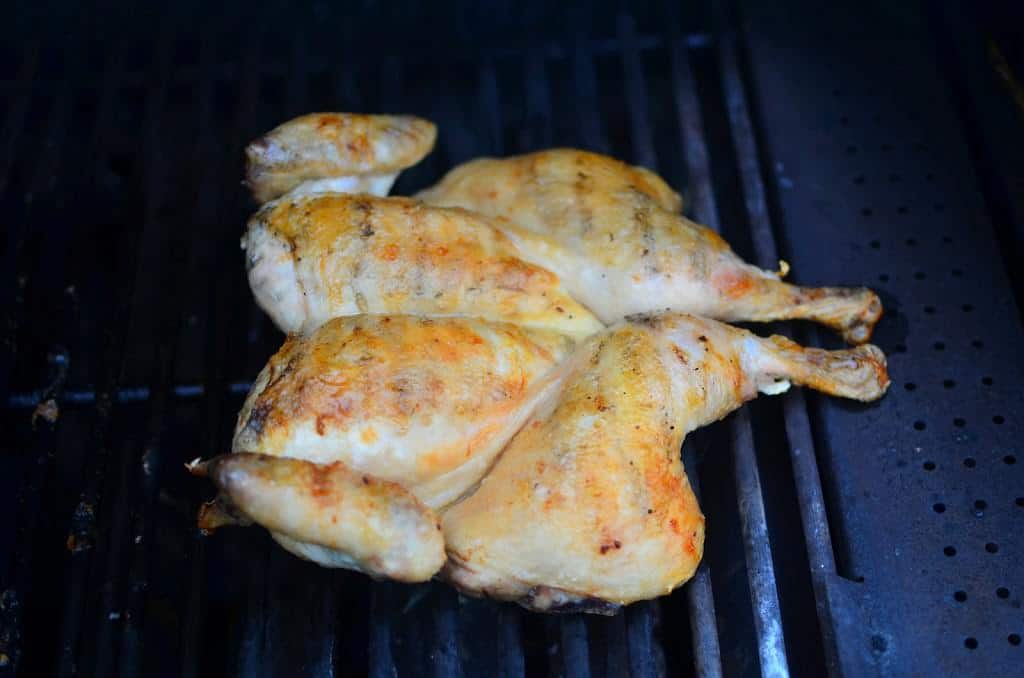
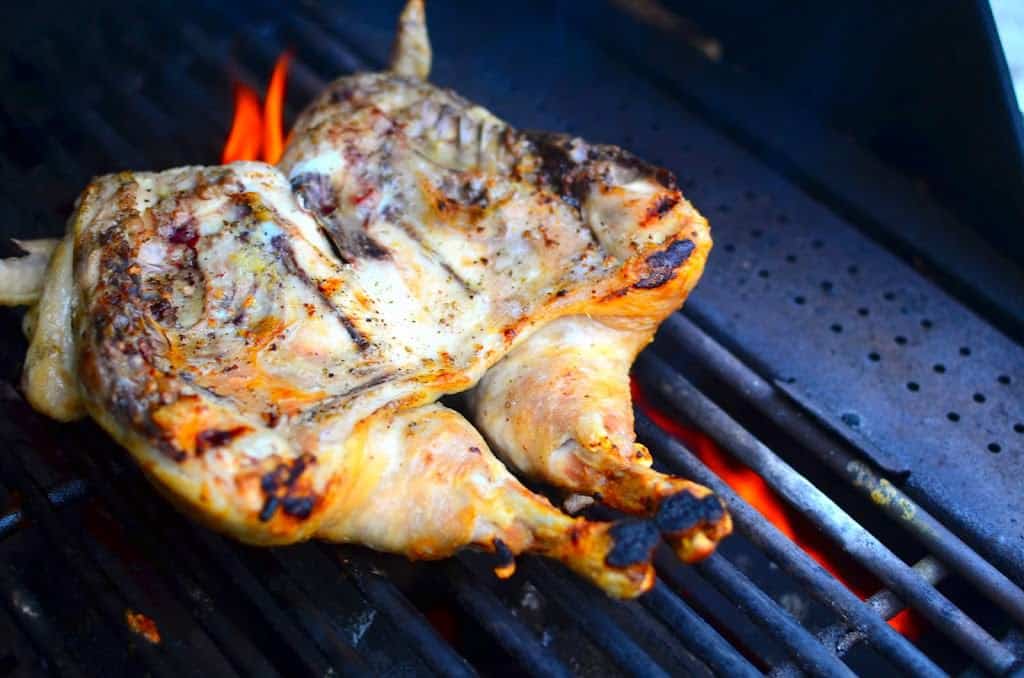
Cooked through, but not browned enough...
...so I move it to the direct heat part of the grill to crisp it up.
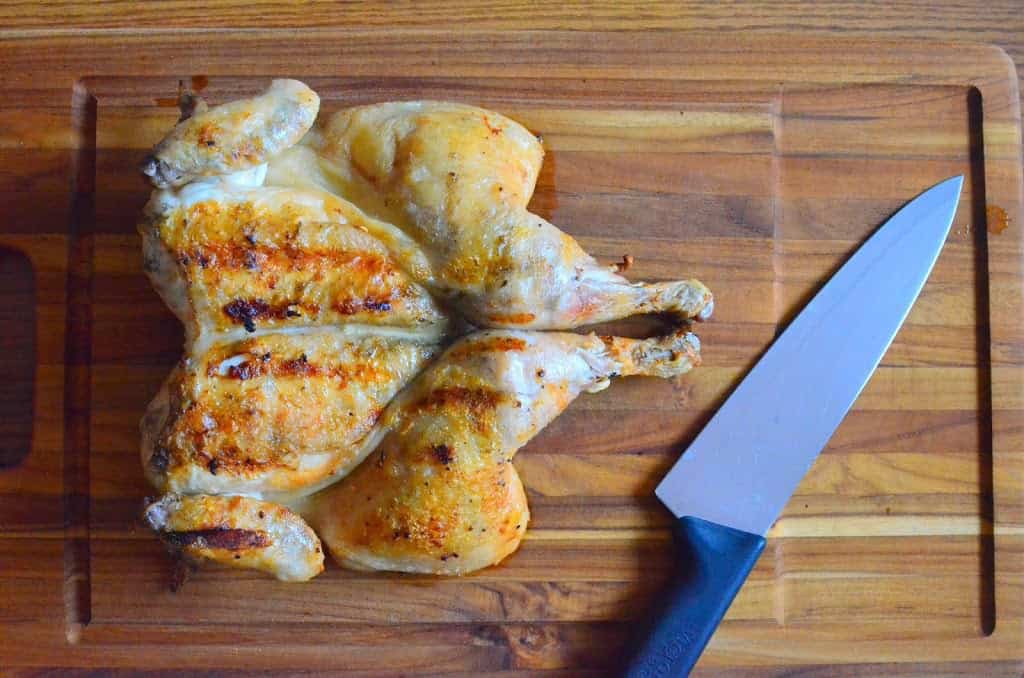
Resting...
Resting...
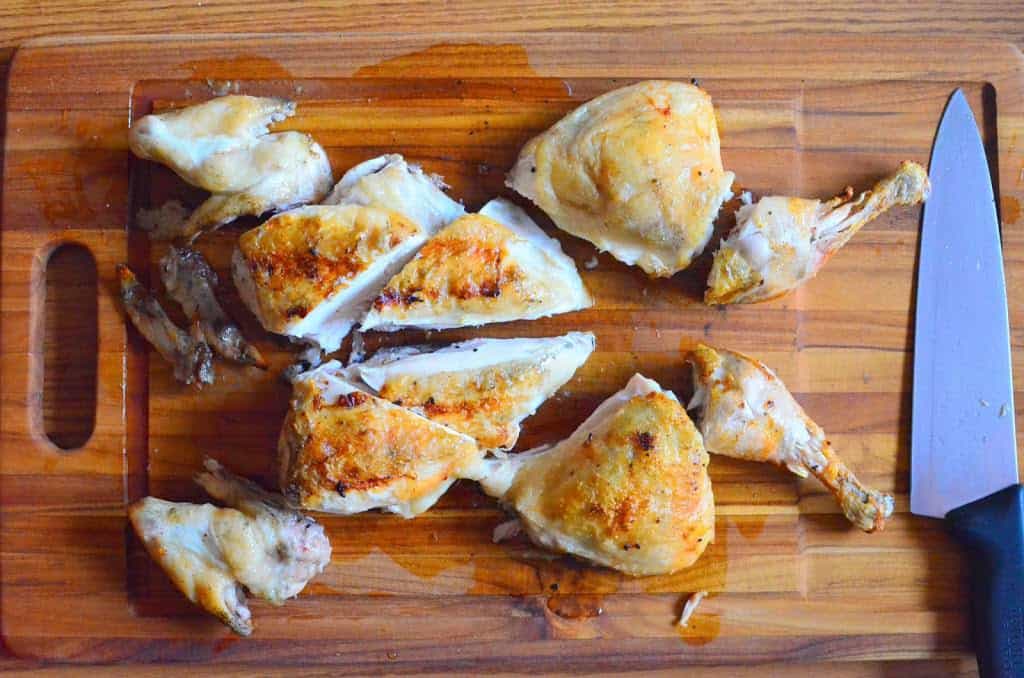
...and cut into pieces.

Notes

  • Have a charcoal grill? Here's a similar recipe using my Weber Kettle: Grilled Butterflied Chicken, Dry Brined
  • I suggest pointing the chicken so the legs are towards the heat, so they cook quicker. You want the dark meat to cook more than the breast meat; the legs should register 170°F or higher when the breast reaches 160°F. Butterflying helps cook the dark meat faster by by exposing the thighs to the heat - if you leave the chicken whole, the cavity is shielding the inside of the thighs.
  • Writing the phrase "exposing thighs to the heat" makes me worry I'm going to get blocked by a mature content filter. I'm cooking over here, OK? Over a live fire? Darn…I'm not helping my cause.
  • Save that backbone in the freezer, you'll want to use it with Homemade Chicken Stock

What do you think? Questions? Other ideas? Leave them in the comments section below.

Related Posts:

Grilled Butterflied Chicken with Dry Brine
Grilled Butterflied Chicken with Thai Marinade
Grilled Split Cornish Game Hens
Grilled BBQ Chicken Thighs

*Enjoyed this post? Want to help out DadCooksDinner? Subscribe to DadCooksDinner using the RSS or Email options on the right, recommend DadCooksDinner to your friends, buy something from Amazon.com through the links on this site, or donate through my tip jar. Thank you.
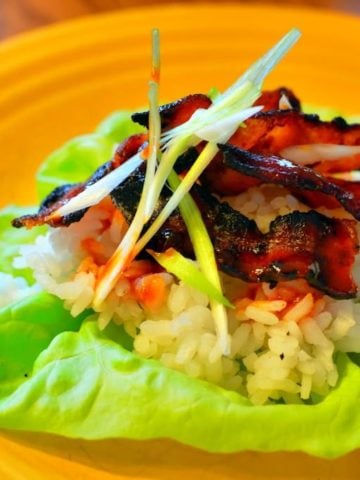
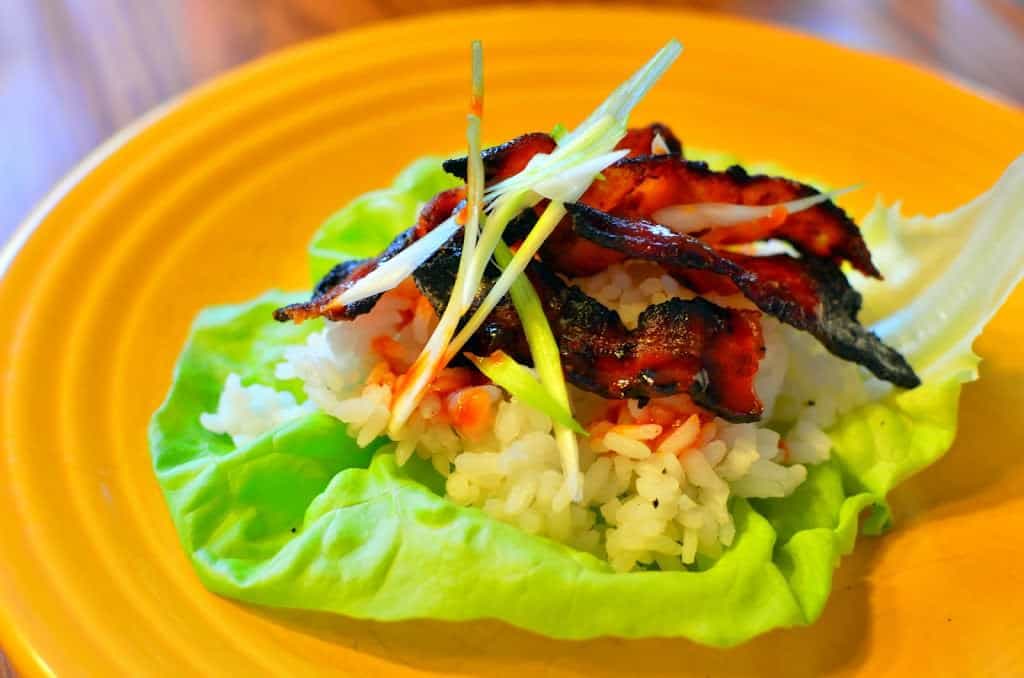
Grilled Korean Pork Belly Lettuce Wraps (Daeji Bulgogi)

May 2, 2013 by Mike Vrobel 2 Comments

Gochujang is Korean red pepper paste. It has the color of ketchup, spreads like tomato paste, and has a fiery afterburn. I tasted it, then had to restrain myself from eating it straight out of the tub.
If you like trendy ingredients, get in on Gochujang now. I think it is going to be the next big breakout flavor, like chipotles in adobo, or sriracha.

Gochujang is the main ingredient in Korean barbecue's spicy marinades, and their accompanying dipping sauces. It can be found at most Asian markets. (Or on the internet, of course.) I hear Sunchang brand mentioned a lot, but my experience is limited to the one tub I'm slowly using up.

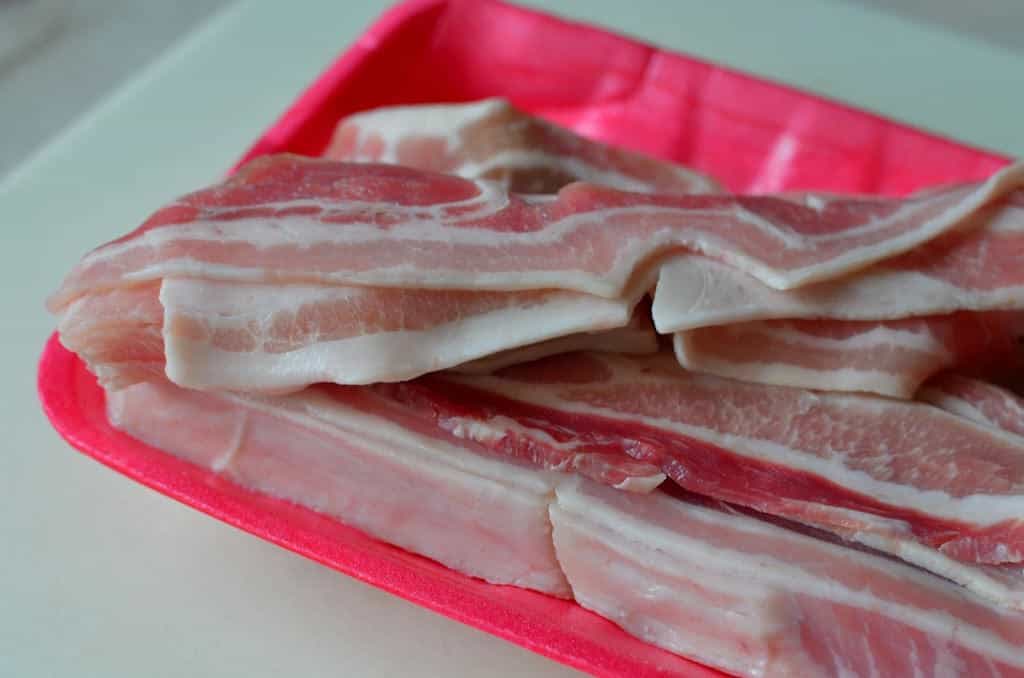
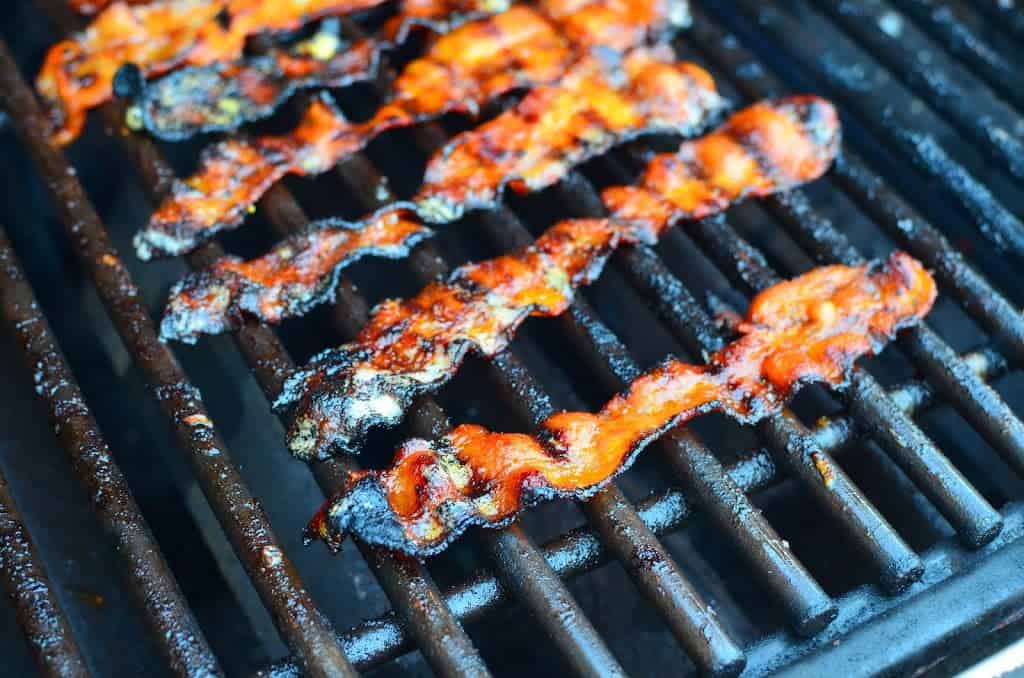
Pork Belly is traditional in Korea's Daeji Bulgogi. Get thin sliced pork belly from your Asian market, or give your local butcher a call. My Asian market had ultra-thin sliced pork belly in the freezer case. It was cut like bacon, about 1/16th of an inch thick…which was a pain. I had to be careful to keep it from tearing as I worked with it on the grill. Next time I'm going to ask my butcher to slice pork belly for me, cutting it thicker - like thick cut bacon - between ⅛th and ¼th of an inch thick.
Call your butcher ahead of time for thin cut meat. They need to put the pork belly in the freezer to firm it up before they slice it.

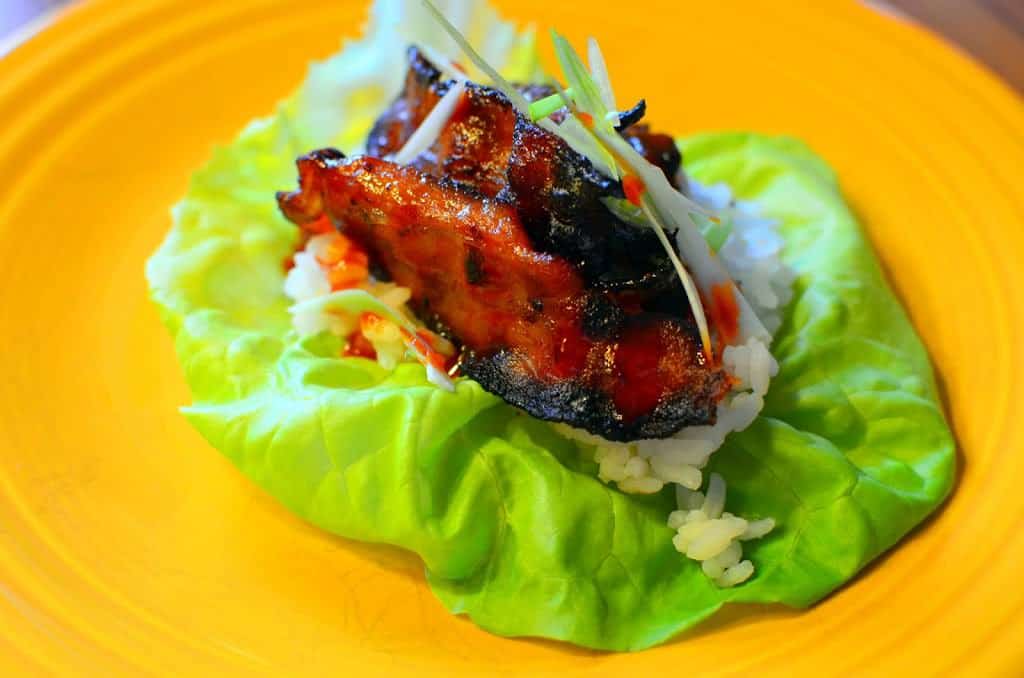
If you can't find pork belly, thin-sliced boneless pork shoulder is an acceptable substitute. But pork belly is worth hunting for - doesn't sweet, spicy grilled bacon sound like a good idea? Either way, get some lettuce for wrapping, make rice for stuffing, shred some scallions, and fire up the grill. Korean barbecue is a short step away!

Recipe: Grilled Korean Pork Belly Lettuce Wraps (Daeji Bulgogi)


Inspired by: Joshua Bousel Grilling Daeji Bulgogi, SeriousEats.com

Cooking time: 10 minutes

Equipment:

  • Grill (I use a Weber Summit. Here is the current version of my grill.)

Ingredients

  • 2 pounds thin-sliced pork belly (1/16th of an inch to ¼ of an inch thick.)

Marinade/Dipping sauce

  • ½ cup gochujang (Korean red pepper paste. Sunchang brand is usually recommended.)
  • ¼ cup soy sauce
  • ¼ cup mirin (or rice wine vinegar, plus 1 teaspoon sugar)
  • ¼ cup pear juice
  • 2 tablespoons sesame oil
  • 2 tablespoons brown sugar

Accompaniments

  • 1 head bibb lettuce, separated into individual leaves
  • white rice
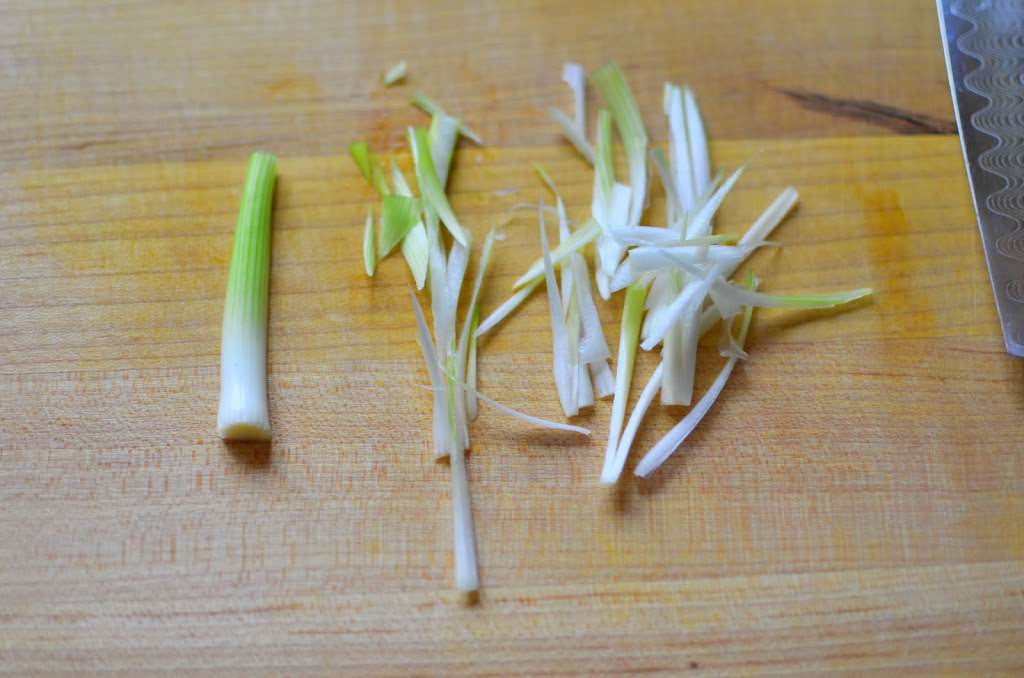
  • shredded scallions (cut into 3 inch long strips, cut the strips in half, then slice the halves lengthwise as finely as you can)
  • Kimchi (Korean spicy pickled cabbage)

Directions

1. Marinate the pork belly

Put the pork belly in a gallon zip-top bag. Whisk the marinade ingredients until completely combined. Reserve one cup of the marinade as a dipping sauce, then pour the rest into the bag with the pork belly. Gently massage the sauce onto the pork through the bag. Seal the bag and refrigerate. Let the pork marinate for at least 1 hour, up to overnight, turning occasionally to redistribute the marinade.

2. Prepare the grill

Set the grill up for grilling on direct medium heat. On my Weber Summit, I preheat with all burners set to high for 15 minutes, brush the grill grate clean, then turn the burners down to medium.

3. Prep the accompaniments

While the grill is preheating: separate the head of bibb lettuce into individual leaves and cook the rice. Next, shred the scallions. Trim off the roots, and cut away the dark green leaves. Cut the remaining white and light green part into 3 inch lengths. Split each piece in half lengthwise, then slice lengthwise as thin as possible.
Or, take the easy way out and use a scallion cutter.

4. Grill the pork belly

Grill the pork over direct medium heat, flipping every two minutes, until the pork is browned and crispy. This will take one or two flips for really thin pork; up to four or five flips for thicker cut pork. Don't leave your station at the grill - pork belly is full of fat, so there will be flare-ups. (It's only ten minutes. You can hold out. Bring a tasty beverage to pass the time.)

5. Serve the lettuce wraps

Serve everything at the table separately, so diners can assemble their own lettuce wraps. Pour the reserved marinade into small bowls and serve as a dipping sauce.

Notes

  • Don't like spicy? Skip the gochujang and use the rest of the marinade.
  • Of all the obscure ingredients in this recipe, pear juice was the hardest one for me to find. I've heard that apple juice makes an acceptable substitute, but pear is traditional in Korean cooking, and I wanted the real thing. I forgot to get it from the Asian market, so I figured I'd buy some at my local grocery store. Mistake. I searched the refrigerated section and the fruit juice aisle, with no luck. Then I flashed back to when the kids were infants, and checked the baby food aisle. So, if you're looking for pear juice, think baby food.

What do you think? Questions? Other ideas? Leave them in the comments section below.

Related Posts:

Kalbi - Korean grilled beef short ribs
Bulgogi - Korean grilled beef lettuce wraps

*Enjoyed this post? Want to help out DadCooksDinner? Subscribe to DadCooksDinner using the RSS or Email options on the right, recommend DadCooksDinner to your friends, buy something from Amazon.com through the links on this site, or donate through my tip jar. Thank you.
Pressure Cooker Beef Shank and Anasazi Beans

April 25, 2013 by Mike Vrobel 19 Comments

Pressure Cooker Beef Shank and Anasazi Beans | DadCooksDinner.com

I'm horrified that pressure cookers were used in the attacks at the Boston Marathon. How dare they use my favorite pot for such evil? I almost skipped this recipe. It's hard to reconcile comfort food with such terrible news. I had to remember, this is what the perpetrators want - to change the way we go about our daily lives. This post is dedicated to the brave people of Boston.

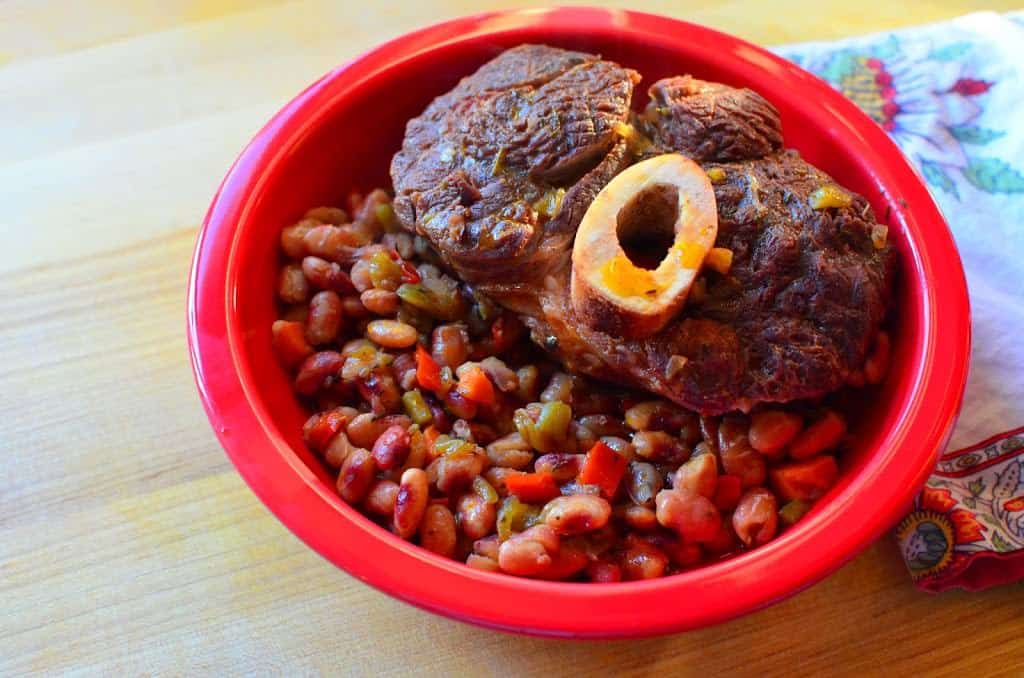
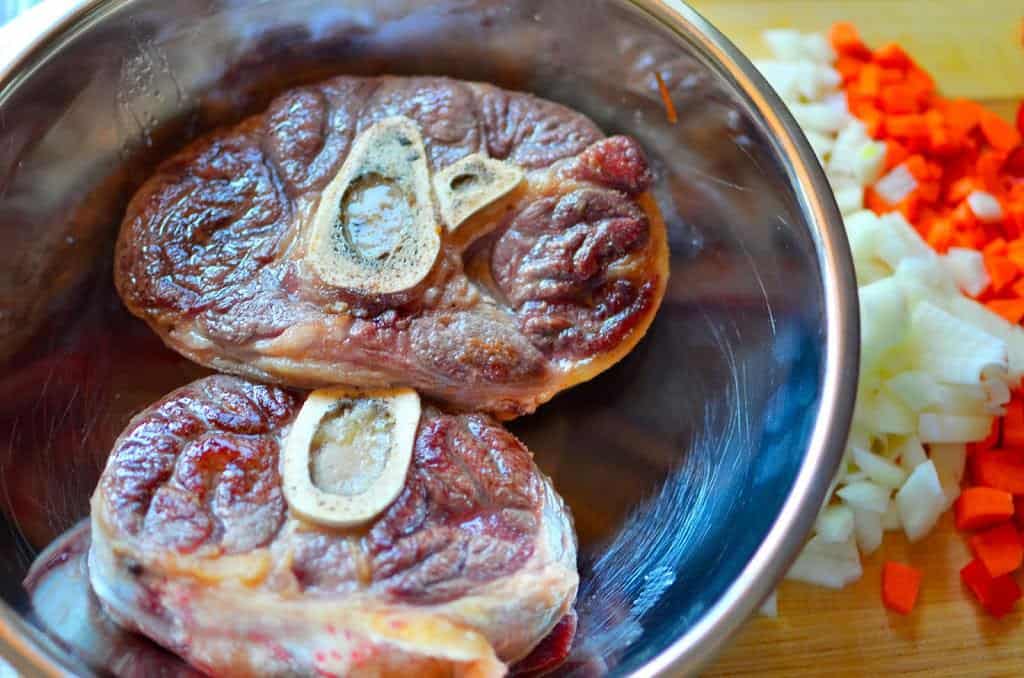
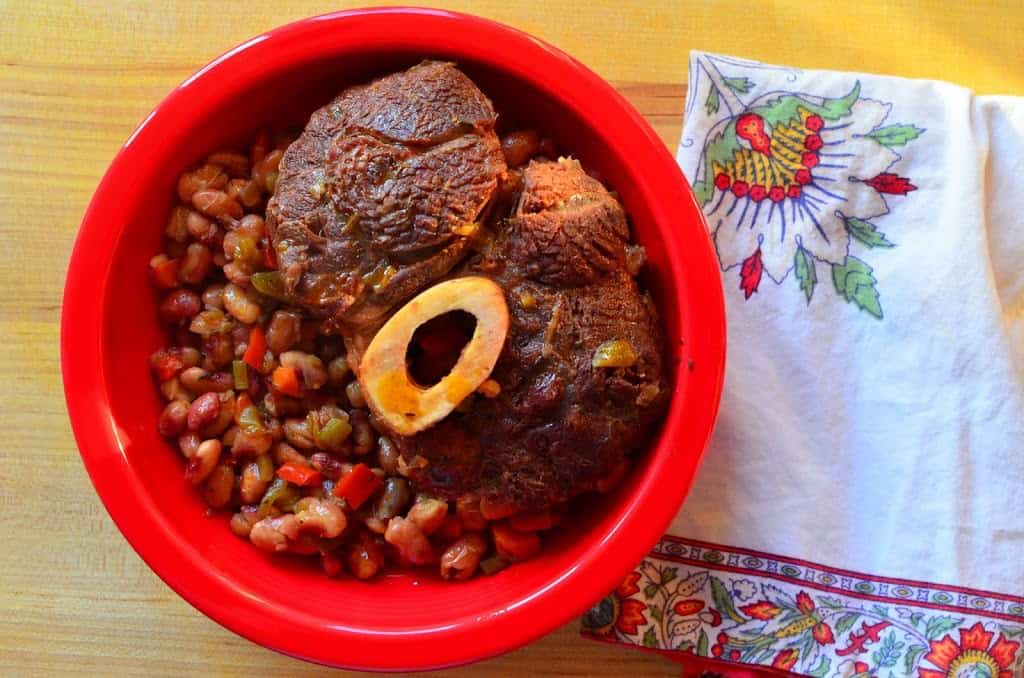
I'm using the spoils of my recent trip to the West Side Market - beef shanks and a big bag of dried Anasazi beans. I didn't plan this recipe, I just put the beans and beef shanks on the counter and pulled items out of the pantry to go with them. The result a big donut of meat, with a wonderful nugget of marrow in the middle, on a bed of brothy beans. Why didn't I try this sooner?

I'm also cheating - instead of browning all the shanks, I'm browning one batch, on one side. This gives me browned fond on the bottom of the pot to build flavor, without taking twenty minutes to brown all the shanks. You won't miss the extra browning - there's enough fond developed in one batch of browning to flavor the pot.

Don't have a pressure cooker? No worries. See the Notes section for standard cooking instructions.

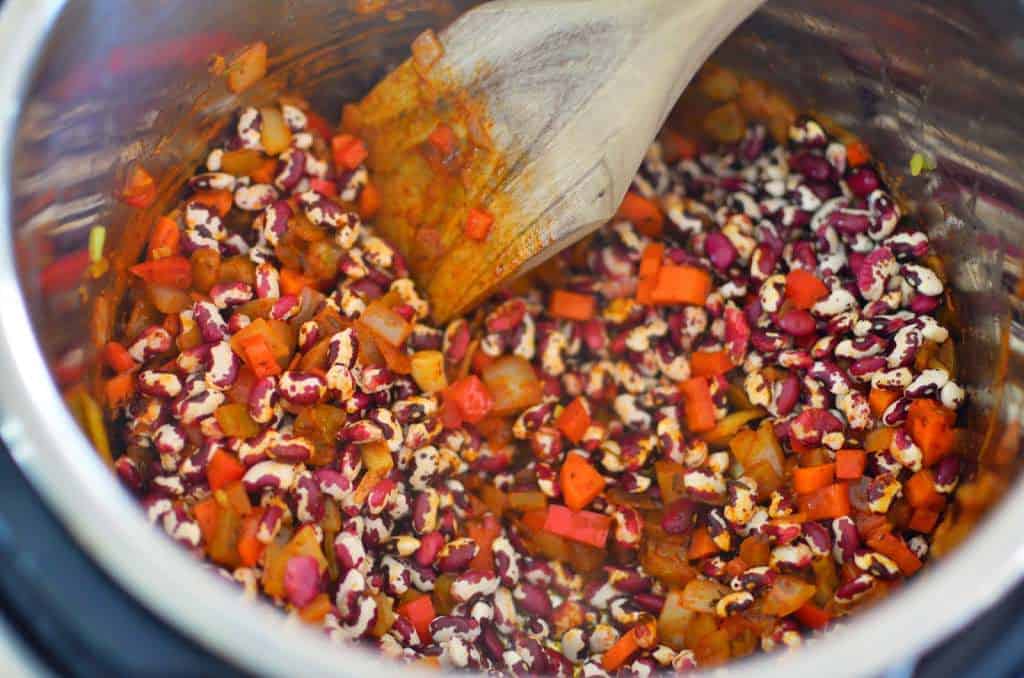
Anasazi beans? They're like their close relative, pinto beans. They have a deeper, meatier taste, and they look a lot cooler, with a neat cow spotted effect. (Until you cook them, that is - the cow spots fade as the beans simmer.)

Recipe: Pressure Cooker Beef Shank and Anasazi Beans


Inspired by: Lorna Sass Pressure Perfect

Cooking time: 60 minutes

Equipment

  • Pressure Cooker, 6 quarts or larger (I used an Instant Pot Electric PC)

Ingredients

Beef

  • 1 tablespoon vegetable oil
  • 4 large beef shanks (1 ½ inches thick, about 2 pounds total)
  • 2 teaspoons kosher salt (about ½ teaspoon per shank)
  • 1 teaspoon fresh ground black pepper

Aromatics and spices

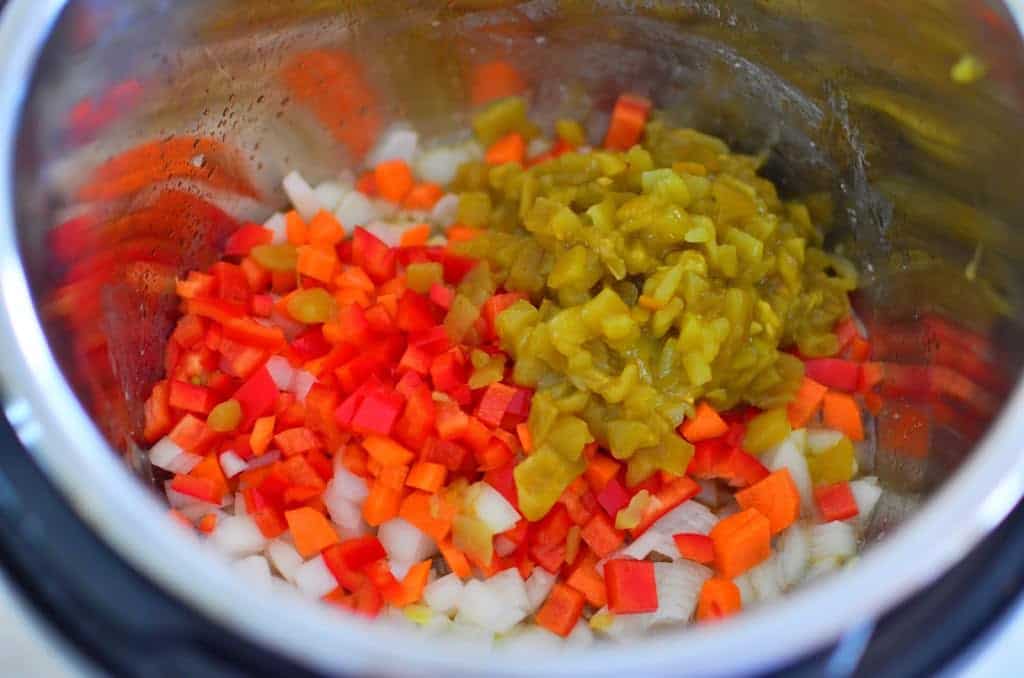
  • 1 large onion, diced
  • 1 red bell pepper, seeded and diced
  • 1 (4 ounce) can diced green chiles (or 1 green (Anaheim) chile, seeded and diced)
  • 2 cloves garlic, crushed
  • ½ teaspoon kosher salt
  • 2 tablespoons chili powder blend (or ancho chile powder)
  • 1 teaspoon dried thyme

Beans and liquid

  • 1 pound Anasazi beans, sorted and rinsed
  • 4 cups homemade chicken stock (or store bought broth, or water)
  • 2 cups water
  • 1 teaspoon kosher salt
  • ½ teaspoon baking soda
  • 2 bay leaves

Second dump of spices (optional)

  • 1 teaspoon chili powder
  • ½ teaspoon dried thyme
  • ½ teaspoon kosher salt
  • 1 clove garlic, minced
  • More salt and pepper to taste

Directions

1. Brown the beef shanks

Heat the vegetable oil in the pressure cooker pot over medium-high heat until the oil is shimmering. While the oil is heating, sprinkle the shanks with 2 teaspoons of salt and the black pepper. Add a single layer of shanks to the pan and brown them on one side, about 5 minutes. Transfer the browned shanks to a bowl with the rest of the uncooked shanks and set aside.

2. Saute the aromatics and toast the spices

Add the onion, bell pepper, green chile, garlic, and ½ teaspoon of salt to the pot. Stir to coat with oil, then saute, scraping the browned meat from the bottom of the pot, until the onions are softened, about 5 minutes. Make a hole in the center of the onions and add 2 tablespoons of chili powder and 1 teaspoon of dried thyme. Let the spices sit until you smell them frying, about 1 minute, then stir them into the onions and peppers.

3. Beans, liquid, and beef into the pot

Stir in the rinsed Anasazi beans, coating with the onions and spices. Add the chicken stock, water, bay leaves, 1 teaspoon kosher salt, baking soda, and bay leaves. Stir to mix, then add the beef shanks and any juices from the bowl. Nestle the beef shanks into the beans and liquid, submerging them as much as possible.

4. Pressure cook on high pressure for 30 minutes (36 minutes for electric PC)

Lock the lid on the pressure cooker and bring it up to high pressure. Cook at high pressure for 30 minutes (36 minutes in an electric pressure cooker), then turn off the heat and let the pressure come down naturally for 15 minutes. Quick release any remaining pressure.

5. Season and serve

Stir in the second dump of spices, then taste for seasoning. If you used homemade chicken broth or water, you will need more salt - I usually add close to a tablespoon of kosher salt for this much liquid. Simmer for 5 minutes, then serve.
How do I serve this? I gently transfer the beef shanks to a platter. Using a slotted spoon, I scoop out a bowlful of beans for each diner. I add enough bean liquid to moisten, but not cover, the beans, then put a beef shank on top. Done.

Notes

  • No pressure cooker? No worries. Use a heavy bottomed dutch oven with a lid, and increase the amount of water to 4 cups. Follow the instructions until step 4, "Pressure cook on high...". Then, instead of pressure cooking, bring the pot to a boil, and cover with the lid. Move the pot to a preheated 350*F oven and bake for 2 hours, until the beef shanks and beans are tender. Continue with step 5, "Season and serve".
  • Beef and beans make amazing leftovers. Shred the beef (discard the bones) and stir into the beans. I freeze it in two cup containers for quick-grab lunches.
  • What's it like to be a pressure cooker fan over the last two weeks? Sigh. Check out these stories with Lorna Sass and Laura at the HipPressureCooking forum.

What do you think? Questions? Other ideas? Leave them in the comments section below.

Related Posts

Pressure Cooker Osso Bucco
Pressure Cooker Refried Pinto Beans
Click here for my other pressure cooker recipes.

*Enjoyed this post? Want to help out DadCooksDinner? Subscribe to DadCooksDinner using the RSS or Email options on the right, recommend DadCooksDinner to your friends, buy something from Amazon.com through the links on this site, or donate through my tip jar. Thank you.
Road Trip: West Side Market

April 23, 2013 by Mike Vrobel 3 Comments

Cleveland's West Side Market, on the corner of West 25th and Lorain Avenue, is one of the few public markets that remained open during the dark days when grocery store giants roamed the land, crushing everything in their…ahem, sorry, got carried away there.

The West Side Market opened in 1912, and celebrated its 100th anniversary last year. My own history with the market goes back to high school…when I ignored it every day as I trudged by.

But I'm not here to talk about history. I'm here to talk about food. And, oh, my, this is a food paradise. The market is made up of more than 100 small businesses. There are butchers and bakers, produce vendors, cheese sellers, and seafood markets, all in the same building. If I lived any closer, I'd be visiting every week, but the market is just a little too far away for regular shopping. I make a trip up every few months, to visit and stock up on things I can't find locally.

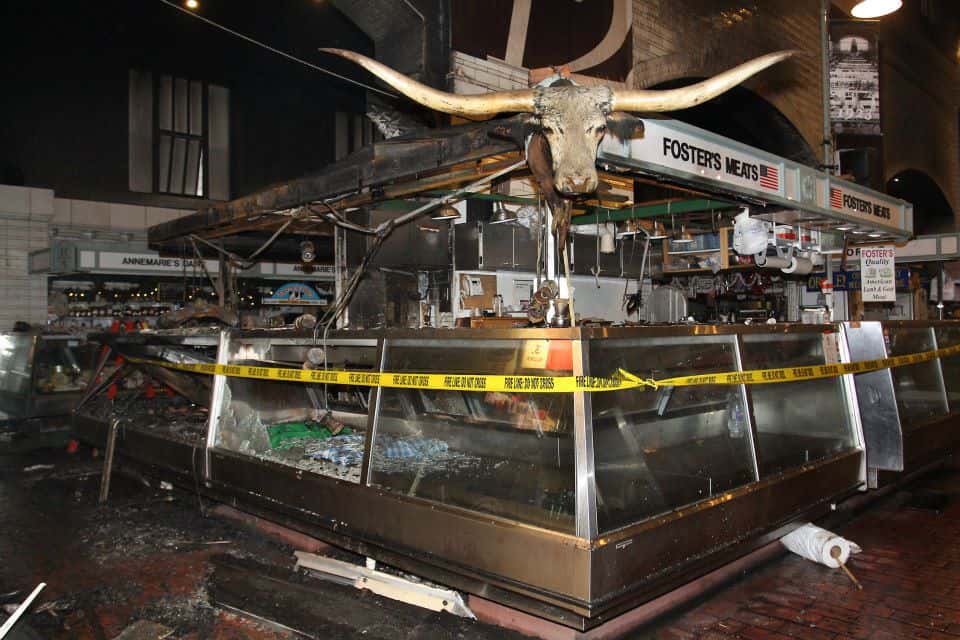
The market had a fire a few months back, but they're open again, and good as new. Reading about the market after the fire showed me how little I knew, so I signed up for a New Shopper Tour, held on the last Saturday of every month. Armed with a fistful of Market Bonds, I made the trip up to Ohio City.

Special thanks to Amanda, our informative and friendly tour guide. And, a word to the wise - don't take the tour on the Saturday before Easter. I've never seen the market this crowded. It was tough to move. Other than that, the tour is highly recommended.

Not from Cleveland? Too far away to visit the West Side Market? Look in your own back yard. I'll bet you can find Ethnic Markets and local butchers of your own.

Butchers

I'm a devoted carnivore. My first stop at the market is always a butcher. Which one? It depends. Lamb from Turczyky's, beef from Fosters. Ohio chicken from DW Whitaker, duck from Kaufmann Poultry. Fresh brats from Frank's Bratwurst, and sausages, everywhere you look, sausages. I can always find the odd cuts I love, like lamb shoulder, beef shanks and duck legs. On the larger side, my brother buys entire hogs for his pig roasts from the market.
Matt, when you read this, let me know which vendor you use? Thanks.

Ethnic specialties

Cleveland represents America's melting pot. It started with migration from Eastern Europe - Polish, Slovak, Slovene - and has been continuing ever since. All this cultural history is on display at the West Side Market. From Hungarian to halal, sauerkraut to tamales, pierogies to falafels, cannoli to strudel. If there's an ethnic food you want to try, keep looking. There's a vendor that specializes in the next aisle.

Produce

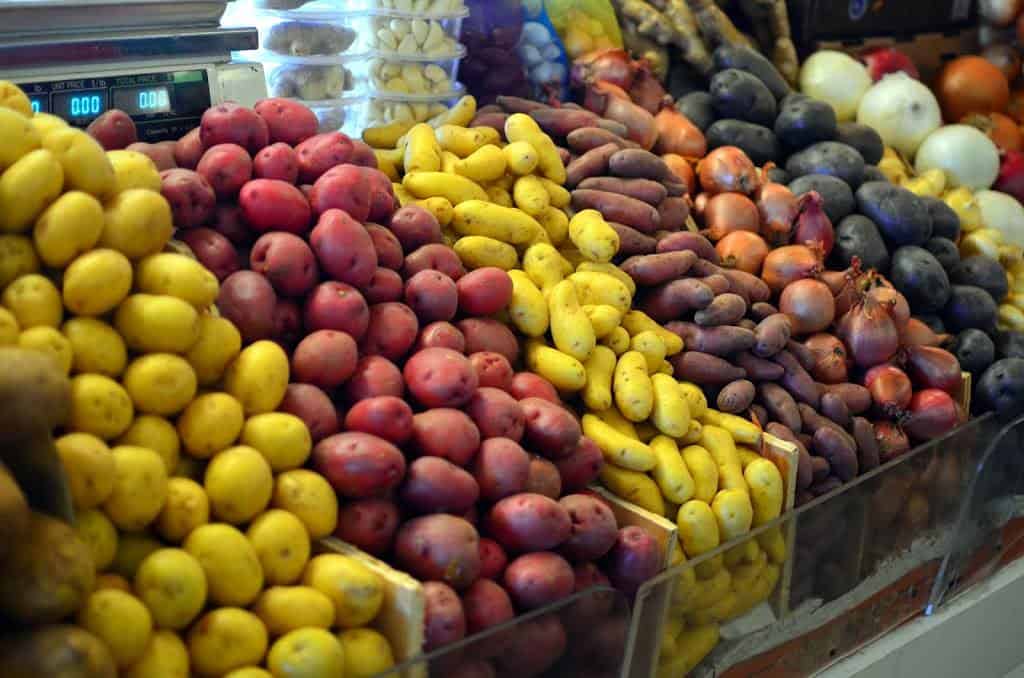
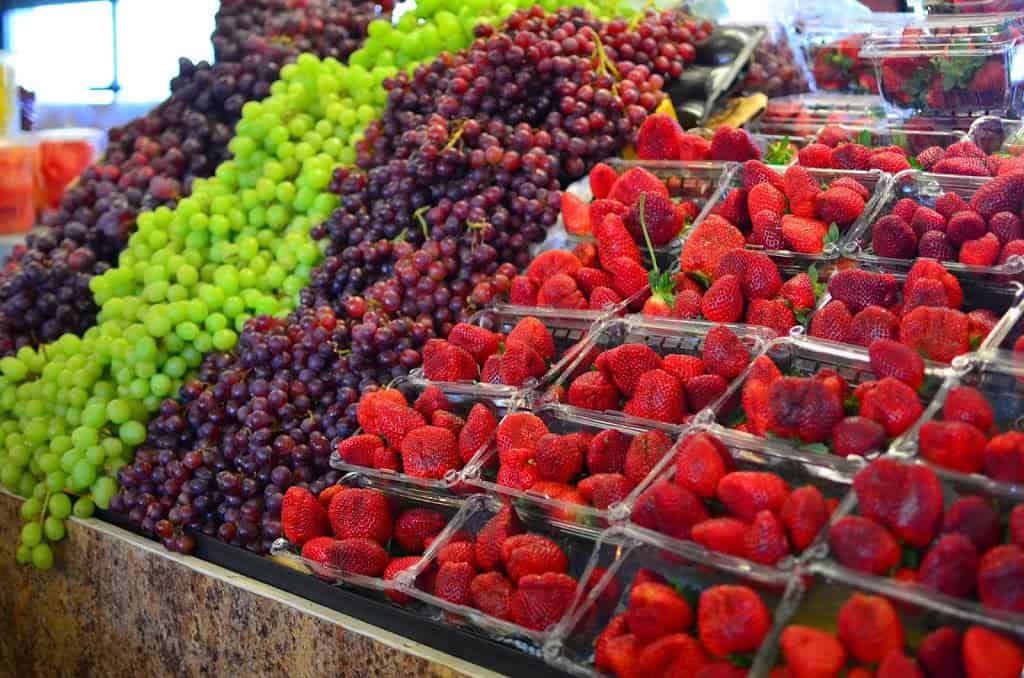
The market consists of a main building, with a produce arcade wrapping around the north and east sides of the building. The produce arcade is lined with dozens of stands, one after the other, with an amazing array of fruit and vegetables. Amanda said they may all look alike, with beautiful piles of produce, but  pay attention and you'll start to see what the different vendors specialize in.

Other

What else should you check out?

  • Stuffed olives from Rita's
  • Smoked salts from Urban Herbs
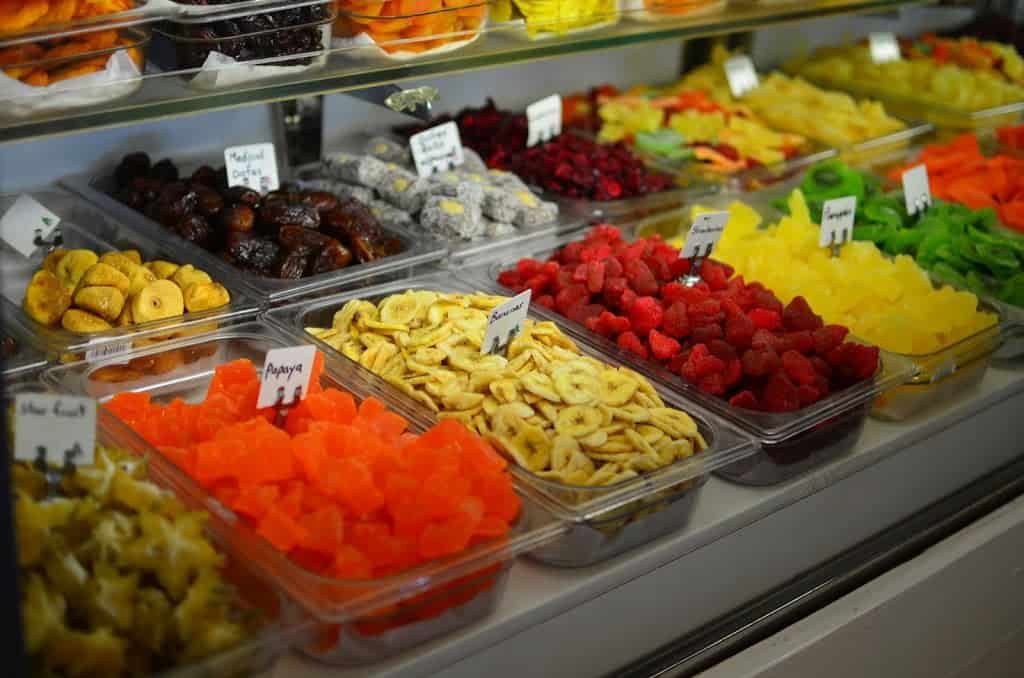
  • Dried fruit at Mena's (pictured above)
  • Fresh ravioli from Ohio City Pasta
  • Dichotomy corn from Campbell's Popcorn Shop
  • And, really, anything else that catches your eye...

Visit!

I'm just scratching the surface - every time I visit the market, I overspend my food budget, and then notice yet another stand that I must check out the next time.

If you live in Northeastern Ohio, you have to visit the West Side Market. It's a jewel - our culinary history and the future of food, all rolled into one.

Tours

If you want a guided tour, the New Shopper Tour is held on the last Saturday of every month. Sign up here: New Shopper Tour

If you want a more in-depth tour, and you live in the Akron area, check out my friend Tami's market tour schedule: Dine In Diva: West Side Market Tours

You don't have to have a tour, though - just show up, wander around, and bask in the incredible variety  of foods.

What do you think?

Ever visit the West Side Market? Who are your must-see vendors? Do you have a local market that's must-see? Tell us about it in the comments.

Resources

West Side Market
West Side Market Centennial

*Enjoyed this post? Want to help out DadCooksDinner? Subscribe to DadCooksDinner using the RSS or Email options on the right, recommend DadCooksDinner to your friends, buy something from Amazon.com through the links on this site, or donate through my tip jar. Thank you.
Sichuan Roasted Pepper Salt

April 18, 2013 by Mike Vrobel 1 Comment

Sichuan Roasted Pepper Salt | DadCooksDinner.com
Sichuan Roasted Pepper Salt

I'm trying to lose weight. I start every day with a high protein breakfast - which means lots of hard boiled eggs. They're quick, easy, portable…and boring.

Or, at least, they were boring. Then, one morning, I had enough of boring. I went looking through my pantry, and noticed my jar of Sichuan pepper salt. I use it often when I stir fry, but on eggs? It was a revelation. The flavors in the Sichuan pepper make all the difference - now I look forward to hard boiled eggs every day.

When I used up the jar I bought at Penzeys, I decided to make my own, following the extremely simple recipe in Barbara Tropp's China Moon cookbook.

But first - Sichuan pepper? Or Szechuan? Maybe Szechwan? The confusion comes from converting the Chinese pronunciation into English letters. (Kind of like Peking duck coming from Beijing.) Sichuan is the pinyin spelling of the Chinese province. Pinyin was chosen in 1982 as the international standard for converting Chinese characters to English. Before then, the Szechuan spelling was used, and it's stuck, especially when referring to the region's cuisine. I trust Fuschia Dunlop, who knows more about Sichuan cooking than I ever will. If she spells it Sichuan, then so do I.

Another digression - when I first got Barbara Tropp's cookbook, Sichuan pepper was hard to find. Why? Citrus canker. Sichuan peppercorns harbor this disease, which is harmless to humans, but nasty for citrus trees. The United States banned the import of Sichuan peppercorns between 1968 and 2005. Nowadays, the peppercorns are baked before shipment, which kills the citrus canker bacteria.

Sorry, kind of wandered off subject there...

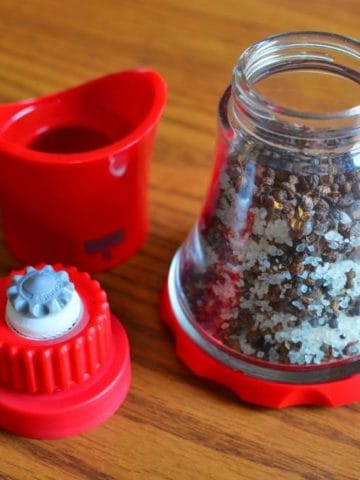
Barbara suggests grinding the salt, then storing it in an airtight container. I bought a salt grinder so I can grind the pepper when I need it. This keeps the aromatic oils in the peppercorns until the last minute, and preserves the flavor of the pepper.

Sichuan peppercorns can be found at your local Asian market, or on Amazon. But, if you can't find them, or you don't want to spend the time to roast your own, get a jar of Penzeys Szechuan pepper-salt. You'll love it.

Recipe: Sichuan Roasted Pepper Salt

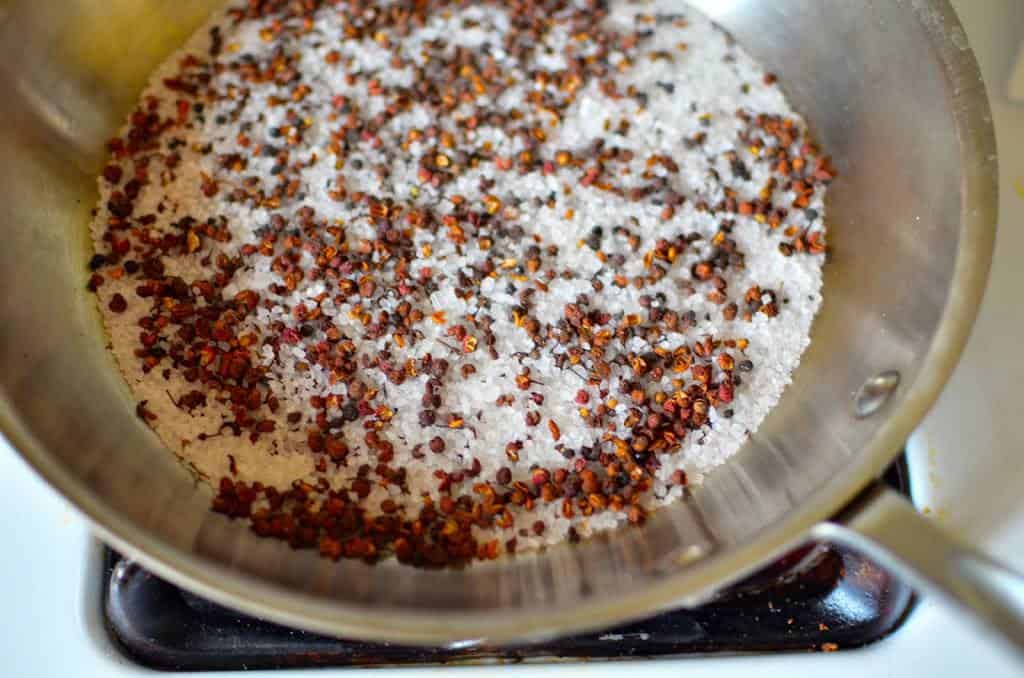
Sichuan Roasted Pepper Salt in pan just starting | DadCooksDinner.com
When it first goes into the pan, the salt will be pure white
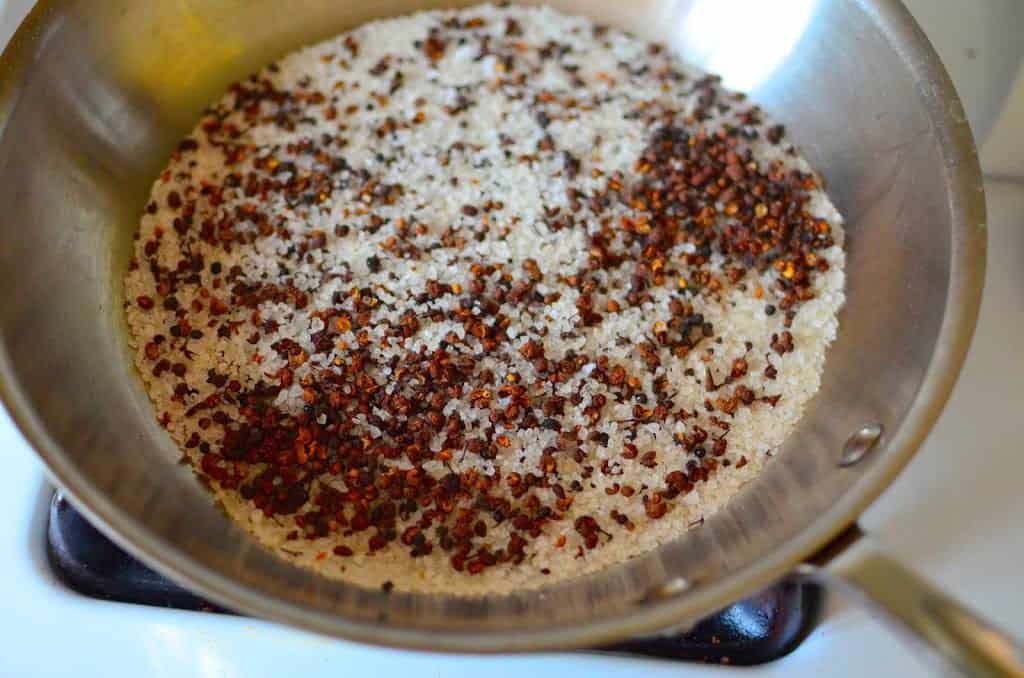
Sichuan Roasted Pepper-Salt done - salt turning grey | DadCooksDinner.com
…when done, the salt will be turning tan or gray.
Look at the color in the bottom right of the pan, near the handle. (Not shown – copious amounts of smoke from the
peppercorns.)

What do you think? Questions? Other ideas? Leave them in the comments section below.

Related Posts:

Sichuan pepper salt goes really well with stir fried Bok Choy
Coriander, Fennel, and Garlic seasoning

*Enjoyed this post? Want to help out DadCooksDinner? Subscribe to DadCooksDinner using the RSS or Email options on the right, recommend DadCooksDinner to your friends, buy something from Amazon.com through the links on this site, or donate through my tip jar. Thank you.
Five Fun Food Finds April 2013

April 16, 2013 by Mike Vrobel 9 Comments

Spring grilling - need a few more coals on the fire.

(I wrote this last week. Today, my thoughts and prayers are with the people of Boston.)

Every spring, grilling fever strikes. I'm tired of snow, cold, gray days. I want to be outside...cooking every meal over live fire. I'm scanning the weather for days with less than a 50 percent chance of rain. (Fifty percent...that means I still have a chance!)

While I wait for the showers to pass, here are five fun food finds from across the web.

1. American meat industry moving to uniform, simplified naming standard

...what once was called pork butt - and actually does not come from the pig's nether region - will now be called a Boston roast and be described as a bone-in pork shoulder.
[J.M. Hirsch, AP News: Meat industry to reboot labels to help consumers. h/t Lisa Abraham, Ohio.com]

I'm sad my beloved Boston butt is going away. "Boston roast" doesn't make me giggle like an eight year old have the same ring to it.

But, this also means a t-bone now describes the same cut of meat from a cow, a pig, or a lamb. It makes too much sense.
Of course, expecting this to jump-start meat sales seems like a reach.


2. Maggi seasoning

Suddenly, Maggi seasoning! Sure, I'd see it at my local Asian grocery stores, but it was a once in a while thing. Then Charlie at the Ingredient List mentioned it on his blog. Now, every time I turn around, I see a bottle. I bought one the other day; still haven't used it. I'm waiting for a soup that needs extra umami.
[h/t Charlie, TheIngredientList.com]

3. Weber Gourmet BBQ System - Korean Barbecue insert

Weber made new inserts for their Gourmet BBQ system. The Ebelskiver Pan seems like an insert too far - do I really want to grill Danish pancakes?

The Poultry Roaster looks good, if you want to roast a chicken beer butt style. It's wide, stable, with solid handles - there's a lot less chance of the chicken flopping over and dumping beer everywhere. Even so, I'd rather use a beer can. I can fit two beer butt birds on the grill, maybe three if I squeeze them in there. What can I say? I like to live dangerously.
And? I told you I like saying "butt". I'm really going to miss my butt roasts. giggle.

Then there's the Korean Barbecue insert. It's styled after the domed charcoal braziers used at Korean barbecue restaurants, where diners cook thin slices of meat at the table. This one fits in the the middle of the Gourmet BBQ system grill grate. Do I need this for Korean barbecue? No, of course not; I can grill it on the regular grate. But it is intriguing enough to be on my wish list.
[Source: Weber.com]


4. The iSpoon

Speaking of silly...

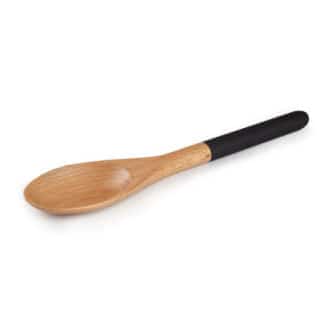
I use my iPad all the time in the kitchen, to check recipes and play some tunes while I cook. Someone had the bright idea of replacing the handle of a wooden spoon with a tablet stylus. When I first saw this, I laughed. Would I buy one? Of course not.

And yet...and yet...every time I have to clean my hands to swipe the iPad, I think about it. If they made it with a flat edge, I'd be in trouble...
[h/t Charlie Sorrel, CultOfMac.com]

5. It's Hard out there for an Individual Blogger

I still have to accept a fundamental truth: my traffic stats and my ability to reach new readers is increasingly out of my hands.
[Dan Koontz, The Current State of Individual Blogging, CasualKitchen.blogspot.com]

Preach it, brother! Sometimes, writing a one person blog feels like the scene in Van Halen's Right Now video - "Right now, forces are aligning against you."

So, what have you found recently? Share your food finds in the comments, below.

Enjoyed this post? Want to help out DadCooksDinner? Subscribe to DadCooksDinner using the RSS or Email options on the right, link to this post from your blog, recommend DadCooksDinner to your friends, or buy something from Amazon.com through the links on this site. Thank you.
Book Review: Pressure Cooking Perfection

April 9, 2013 by Mike Vrobel 12 Comments

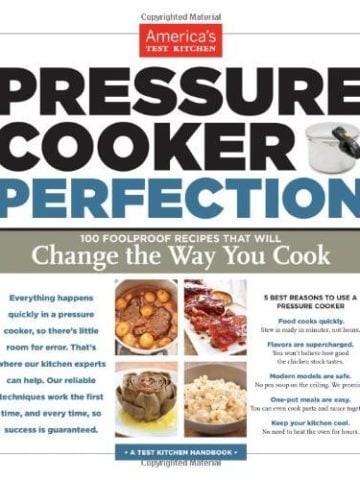
I've been waiting for this book for ten years. I'm a loyal Cook's Illustrated subscriber, and I bought my first pressure cooker in 2003, based on their review. Cook's trickled out a pressure cooker recipes over the years, but not that many. I wanted to see what Cook's ultra-analytical style would bring to pressure cooking.

But that title - perfection? That's a strong claim. I know it was probably the editor, unable to resist the alliterative P in the title. But still. And then the introduction made me sit up:

In the many months of testing, we did come across an interesting fact. Almost all the times listed for basic pressure cooker recipes (vegetables, grains, etc.) were incorrect. We spent weeks testing the basics, getting the timing right, and we have included reliable charts so that you can use the pressure cooker as a useful cooking tool day in and day out.

Was this it? The book I've been waiting for?

Um…no.

Now that I have it in my hands, I'm disappointed. I believe them when they said they took months to test all the recipes. It's what they do. But…

The Good, The Bad, and The Weird. A three part review of Pressure Cooking Perfection.

The Bad: Confusing the pressure indicator with high pressure.

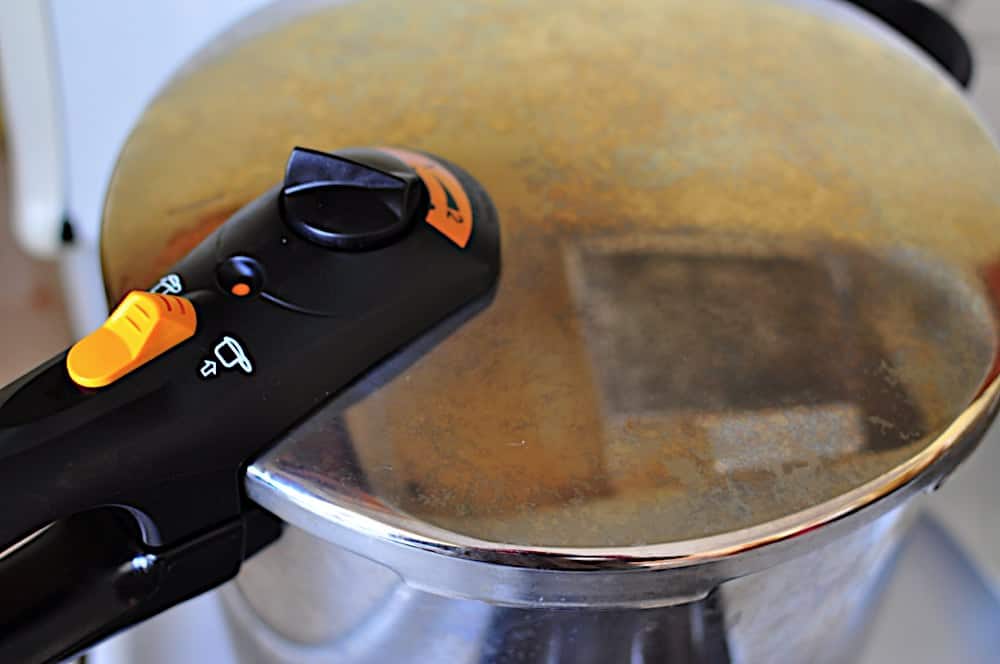
The Fagor Duo is their best buy pressure cooker. It is on the cover, and in all the pictures in the book. (They have a different "best" cooker, but you never see it other than in their equipment review section.) I owned a Duo for years, and it's a great cooker; I passed it on to a friend, and she's still using it.

My trusty Fagor Duo 10 quart pressure cooker

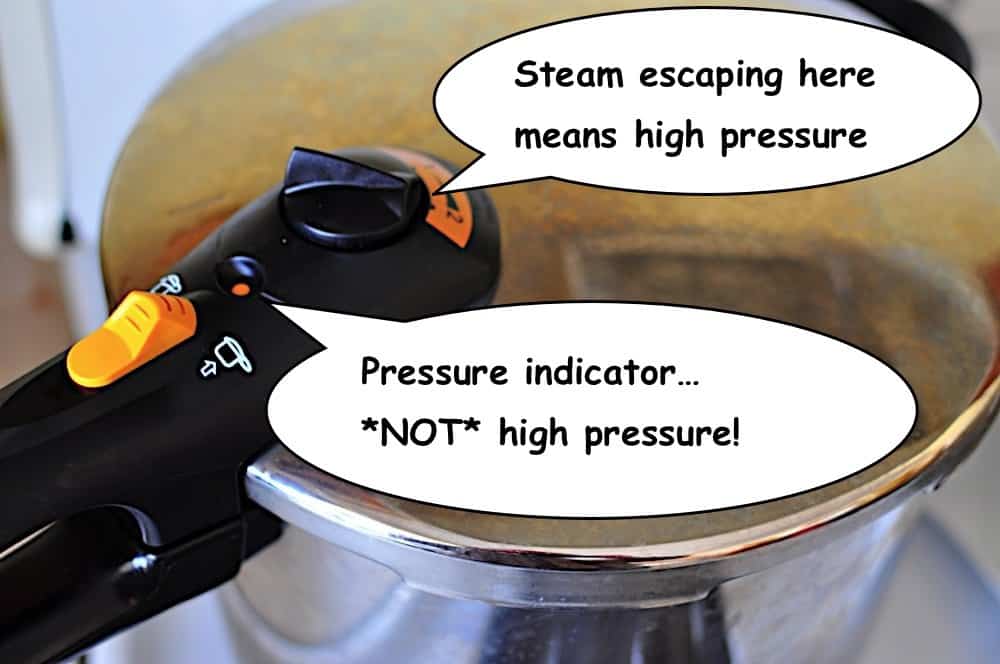
But the Duo doesn't work the way the book says.

From Pressure Cooking Perfection:

Some pots have a knob that you turn to low or high (called 1 or I and 2 or II on some pots), which allows you to indicate your target pressure level before you start to bring the pot up to pressure. The pressure indicator will rise when that pressure level has been reached. [Emphasis mine]

and

Once the lid is in place, heat the pot over medium-high heat until the pressure indicator signifies that you have reached the desired pressure level. On some pressure cookers, you have a knob that allows you to select high or low pressure and you simply wait for the pressure indicator to signify your chosen pressure level has been reached [Emphasis mine]. On other pots, the pressure indicator will have markings for low and high pressure that you have to watch for.

For comparison, here's what the Fagor manual says about coming up to pressure:

When the pressure indicator has risen and steam starts to come out of the operating valve for first time [Emphasis mine], lower the heat to maintain a gentle, steady stream of steam. At this moment, the COOKING TIME STARTS and you have to start timing you [sic] recipe.

See the difference? Pressure Cooking Perfection is mistaking the pressure indicator for high pressure. The pressure indicator just means the cooker has some pressure, but it pops up as soon as the water in the pot is boiling. It means pressure is starting to build, not that high pressure is reached. The pot is at high pressure when it reaches 15 psi (roughly 1 bar), and there is enough pressure to push the spring in the pressure valve slightly open. The escaping steam tells you the pot is at high pressure. This is a big deal for any pot with a separate pressure indicator and pressure valve, like the Fagor Duo.

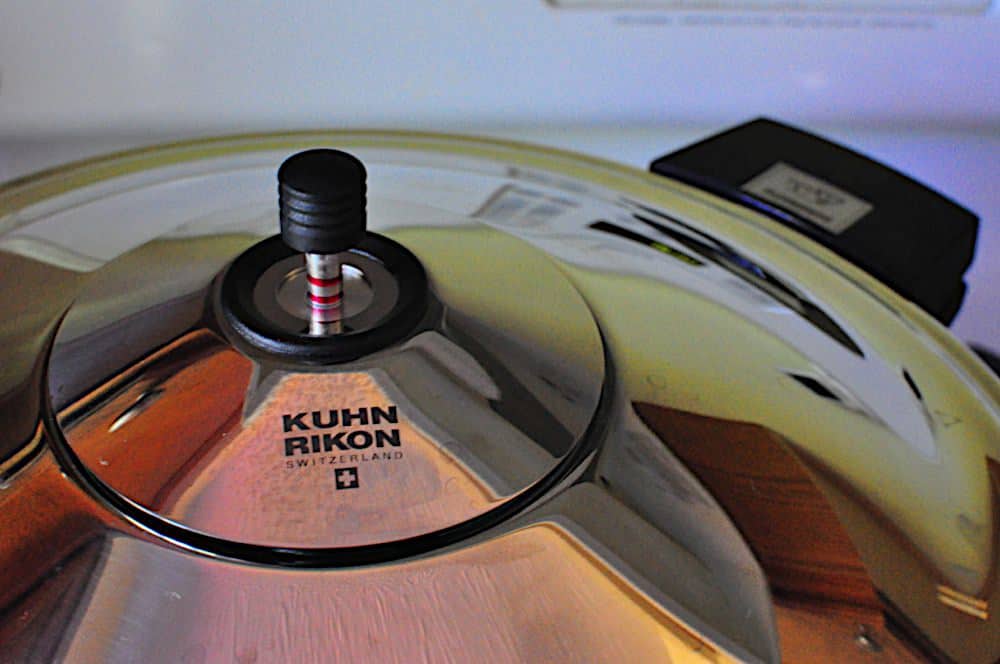
They do get it right with "other pots" - on some cookers, like my Kuhn Rikon, the pressure indicator doesn't work like an on/off switch. It slowly rises, and the indicator has markings for low and high pressure.

Second red ring on the pressure indicator means high pressure.

Why am I so worried about this? Recipe timing is critical with pressure cooker recipes, because the lid locks once it comes up to pressure. (Which is what the pressure indicator actually shows - that the cooker is locked.) Once the lid locks, you have to trust the recipe's timing.

The Fagor looks like the cooker they used, from all the pictures in the book. And they're starting their timer before the pot is up to high pressure, according to Fagor's own manual. Less than a dozen pages in, and I'm suspicious of all the timings in the book.

That quote from the introduction, about "incorrect times"? There's a reason their times don't match anyone else's - and it's not because everyone else is wrong.

And then? They make the same mistake with electric pressure cookers.

From the book:

There is a lag between the time the electric pots come up to pressure and when the timer starts, which led to overcooked food when preparing recipes with short cooking times.

Again - electric pots do know when they are at high pressure. They have sensors that detect when the pot has reached high pressure and start their timer. The book is making the same mistake, confusing the pressure indicator with reaching high pressure.

I went from thrilled to have the book to highly suspicious of their results…and I hadn't reached the first recipe yet.

The Weird: Dried bean timings - so short they look like misprints

I've spent a lot of time trying to get pressure cooker beans right. Most pressure cooker cookbooks underestimate bean cooking time. The dried bean chart was the first thing I checked - I hoped their thorough testing would lead to better bean cooking times.

Then I got the next curveball - the bean cooking times were short. Really, really short. According to their table, soaked pinto beans should cook for three minutes at high pressure, with a natural pressure release. Garbanzo beans and kidney beans? Five minutes.
And, after their pressure indicator issue, I assumed the timings would be extra long, not short.

Every other pressure cookbook says it should take ten to twelve minutes to cook soaked beans at high pressure. (Including the manuals that came with the cookers). My experience is it's more like fifteen minutes. Maybe twenty with a batch of older beans.

Why the different times? Pressure Cooking Perfection calls for 4 quarts (16 cups) of water to cook 1 pound of beans. Other pressure cooking cookbooks (and the manuals that came with my pressure cookers) call for 6 to 8 cups of water. That's a whole lot of extra water. Maybe they figured out how to deal with older beans, and had better results with more water?

I tested this technique with pinto beans (because I had a big bag in the pantry). I followed their soaking instructions: dissolve 2 tablespoons of salt in 4 quarts of water, then soak one pound of beans overnight. I cooked the beans at high pressure for 3 minutes, let the pressure release naturally for 15 minutes, then quick released the rest.

That's when I figured out why they only cooked for 3 minutes under pressure. It takes forever to get 16 cups of water to boil. I did an old way/new way test. The book's technique (4 quarts of water/1 pound of beans/3 minutes high pressure) took longer than the the traditional technique (2 quarts of water/1 pound of beans/10 minutes under high pressure). Total cooking time was seven minutes longer for the Pressure Cooking Perfection technique, even with the shorter time under pressure.

And the beans? I have to admit - I went into the test with bias in my heart. I was sure three minutes under pressure wouldn't cook the beans. But, much to my surprise, the beans turned out OK.

I had some tough floaters, like I always do when I buy a bag of beans from my grocery store. The rest of the beans were cooked properly. Maybe a little on the underdone side, but not bad.

But, the beans tasted watery; the bean cooking liquid was diluted by all the extra water. The "old way" beans tasted better.
Both batches of beans were brined and drained; the only difference was the amount of water used to cook them.

The other problem with this technique: too much water for a smaller cooker. 1 pound (2 ½ cups) of beans plus 4 quarts of water takes a 6 quart pressure cooker over the "max fill" line - you can only use their technique with a 8 quart or larger cooker.

So, beans were inconclusive - much to my surprise, their method worked. But it seemed like change for change's sake; it didn't actually improve the beans.

Note: I emailed America's Test Kitchen, asking if the bean timings were misprints. They never responded. The rest of the book's timing charts, for meat and vegetables, look reasonable. A little on the long side, but that's what I expected with the pressure indicator issue.

[Update 2013-04-09: An editor from Cooks Illustrated contacted me, and forwarded my question on to the book department. Stay tuned for what they have to say.]

The Good: Finally, the recipes

By this point, I was prepared for disappointment. Then the book surprised me again. But this time, it was a good surprise.

The book is full of solid recipes. The timings all look good - maybe a little on the long side, but not completely out of range with my own findings.

The following recipes went on my "must make for dinner" list:

  • Farmhouse Chicken Noodle Soup (using a whole chicken in the pot)
  • Sirloin Beef Roast with Mushrooms
  • Chickpea and Artichoke Tagine
  • Macaroni and Cheese

The pressure cooker pasta technique is a winner. They suggest cooking pasta like risotto, with just enough water to cook the noodles. This makes Macaroni and Cheese a one pot meal - no separate boiling step, just stir in the milk and cheese once the noodles are cooked.
My version of their recipe for Mac and Cheese is coming Thursday.

Luckily, recipes with dried beans ignore the bean timing chart and the massive amounts of water. Chickpea Tagine cooks for 25 minutes at high pressure, not the 5 minutes suggested in the chart. Cuban black beans also take 25 minutes under pressure, with a natural pressure release, and some extra simmering at the end.

All the recipes I've tried have worked well. I think their testing time was spent working on the recipes, and it shows.

So, what does it all mean?

I wanted to love this cookbook, I really did. But I was disappointed. I have a lot of respect for Cooks Illustrated; they taught me a lot of what I know about cooking. This book doesn't live up to their standards.

If you're new to pressure cooking, don't start with this book - you need a better basic reference. Get either Lorna Sass or Miss Vickie for your first pressure cooking book. This one is good for later, once you know how to use your pressure cooker, and need some new recipe ideas.

Recommended with Reservations.

*FCC Disclosure - I did not receive any compensation for this post, and purchased Pressure Cooking Perfection with my own money. If you buy a copy through my Amazon links, or anything else for that matter, I get a small sales commission. Thank you!

Related posts

Things I Love: Pressure Cookers
Review: Kuhn Rikon 12 Quart Family Stockpot Pressure Cooker
Review: Cuisinart 6 Quart Electric Pressure Cooker
My Pressure Cooker Recipes

Grilled Cowboy Chop (Double Cut Ribeye, Reverse Seared)

April 4, 2013 by Mike Vrobel 15 Comments

When I saw the picture of the cowboy chop, I fell out of my chair. I was on the phone to my butcher immediately. I had to grill one. Had to!

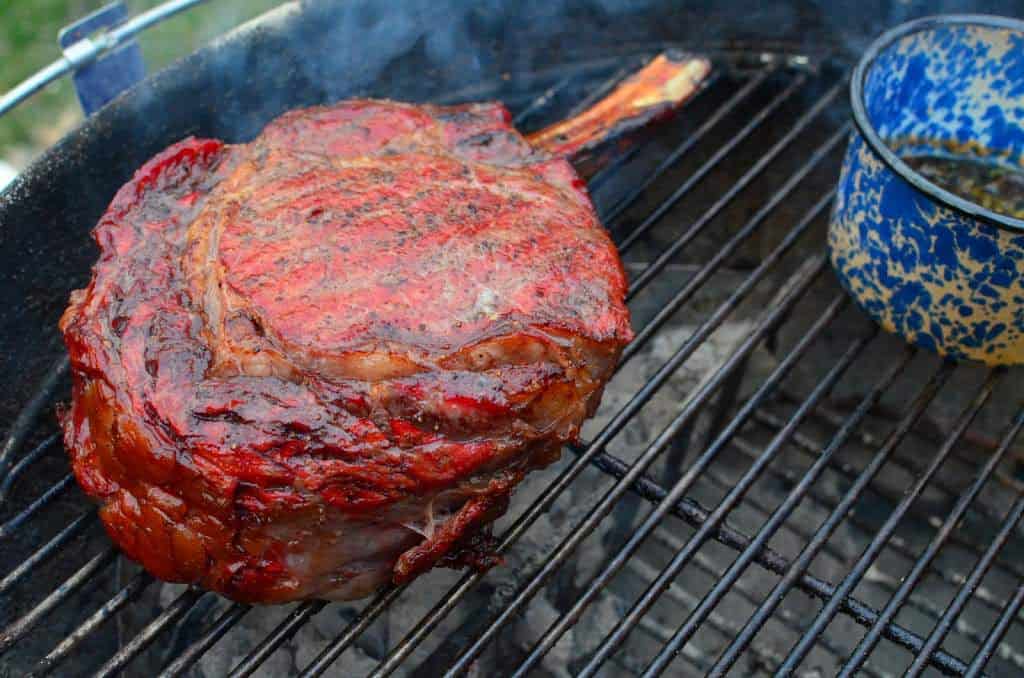
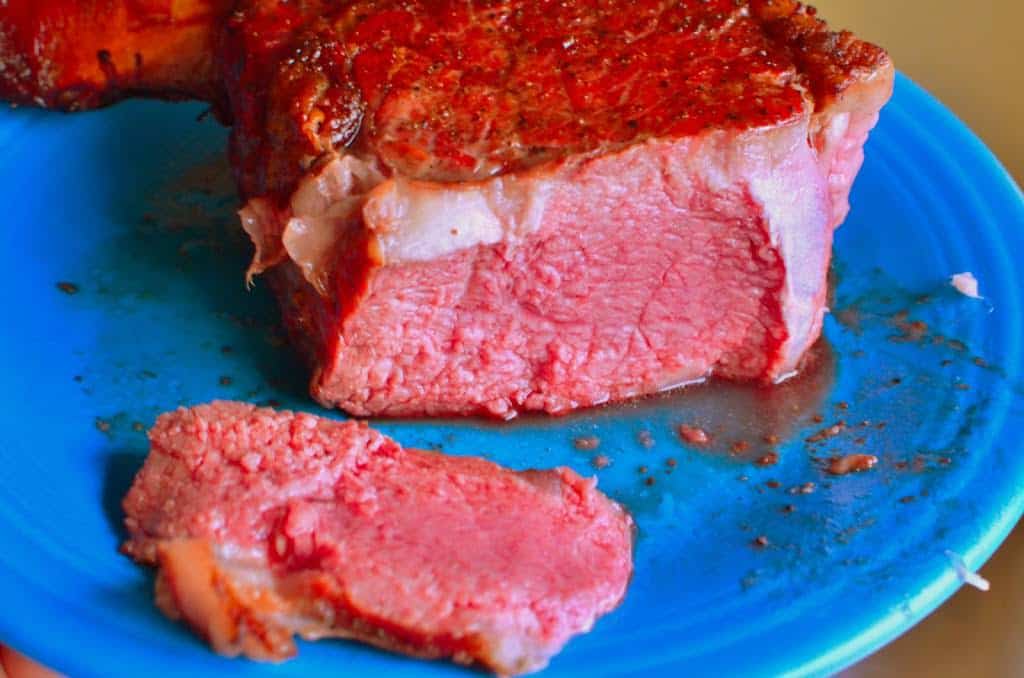
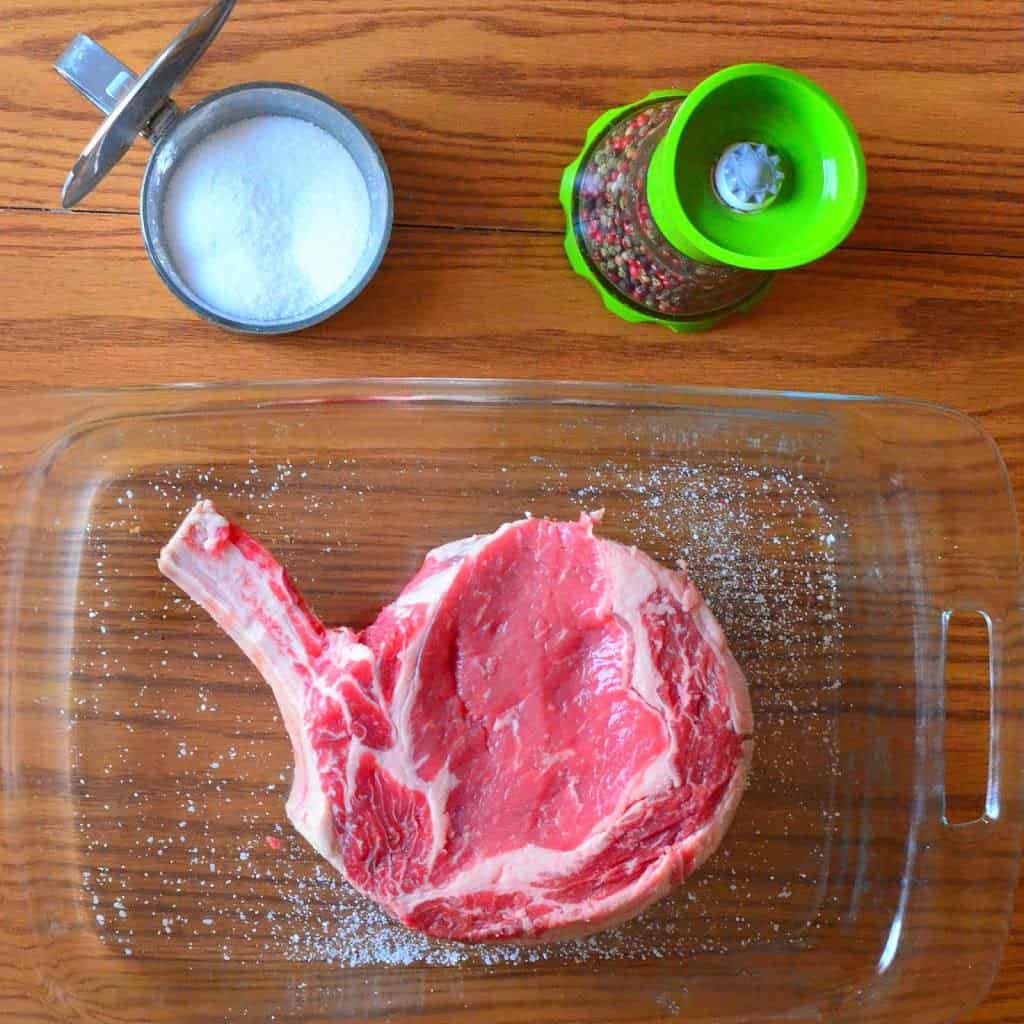
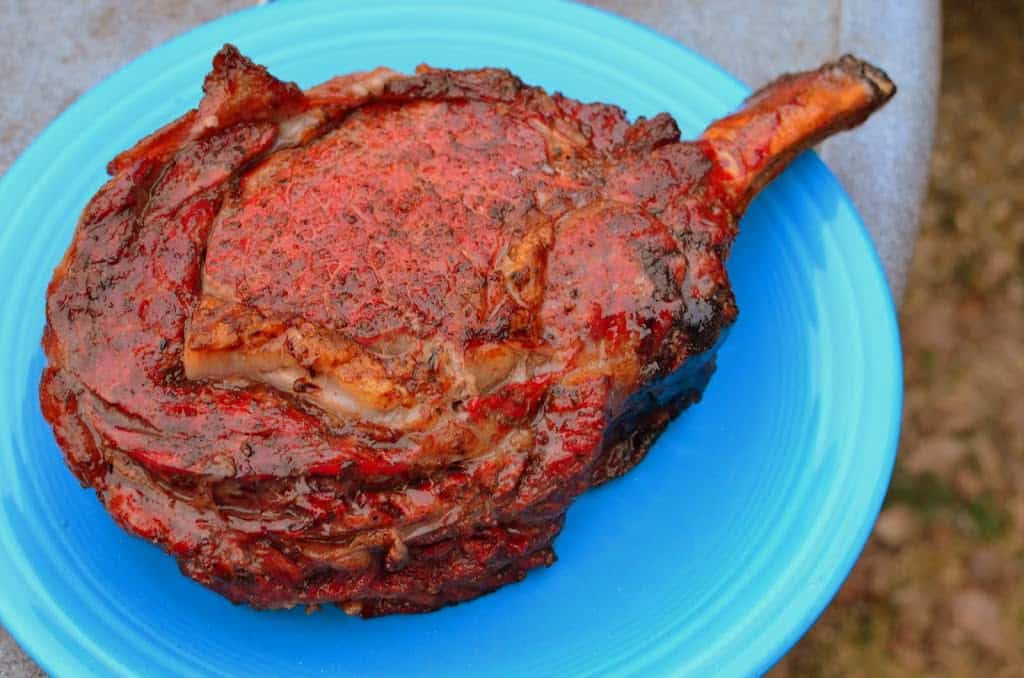
The cowboy chop is a monster ribeye steak. 2 ½ inches of beef, trimmed, with the bone cleaned off so it looks like a large comma. This one steak fed my family of five, with leftovers for a steak sandwich during the week. Because, really, this isn't a steak. It's a small rib roast. I mean, look at that thing.

Now, how to cook this gigantic piece of meat? I've always been a sear and move guy. Sear the steak first, then slide it over to the cool side of the grill and let the temperature come up slowly.

The problem is, all my food science heroes say I'm doing it backwards. Reverse sear is the way to go - start over low heat, gently bring the meat up to temperature, then finish it with a blast of heat to brown it. Alton Brown, Shirley Corriher, Nathan Myhrvold, Kenji Alt, and Meathead Goldwyn all recommend this approach.
Of course, their "low and slow" method varies, from a low oven in Alton's case, to freezing the steak in Modernist Cuisine at Home. I'm sticking with a grill-only method, recommended by Kenji Alt, even though bubba sous vide was a tempting alternative.

Why does the reverse sear work better? Two reasons:

  1. The slower cooking means the muscle fibers in the beef don't squeeze out quite as much liquid. Saving the sear to the end means juicier meat.
  2. The beef spends more time at temperatures between 40°F and 122°F. At those temperatures, enzymes in the meat are tenderizing the protein as it cooks. The higher the temperature, the more the enzymes tenderize…until the temperature reaches 122°F and the enzymes stop working. Keeping the beef below 122°F for as long as possible results in more tender meat.

In spite of knowing all this, the reverse sear scared me. It's different from the cooking method I've always trusted, and I didn't want to mess up this gorgeous piece of beef.
Special thanks to Sherman Provision, my local butcher. This was a special order, and Michael let me come back and pester him about how to cut it.

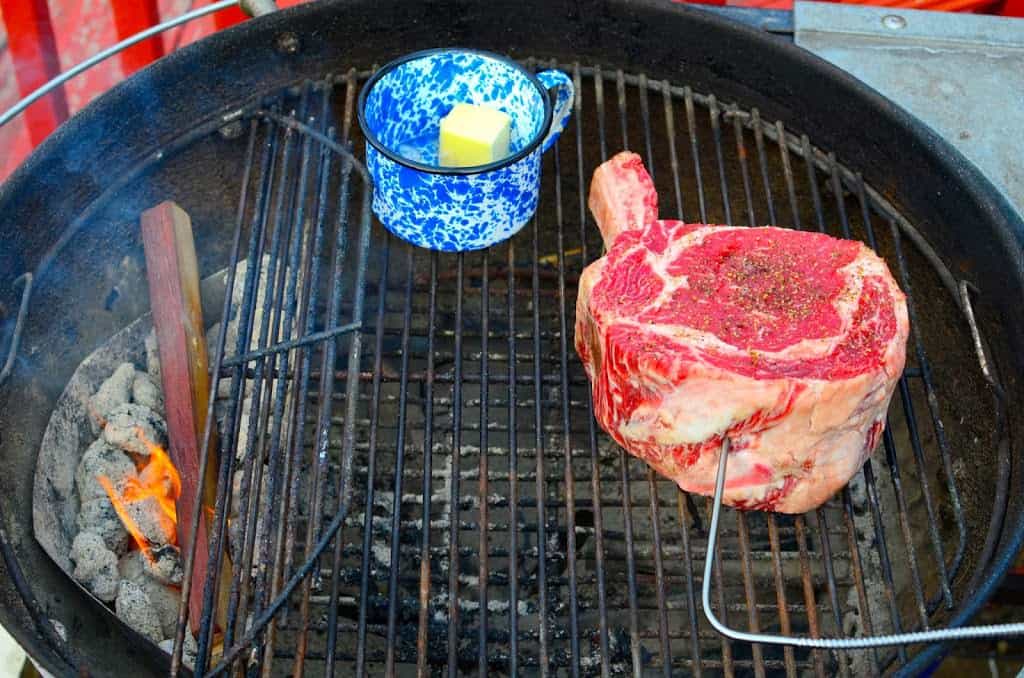
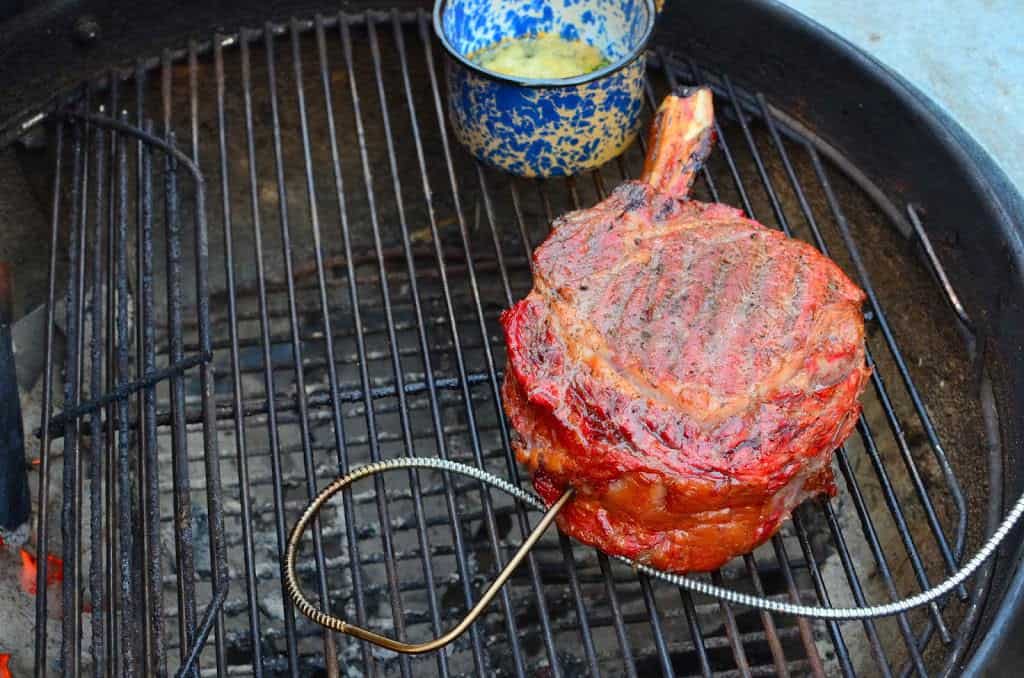
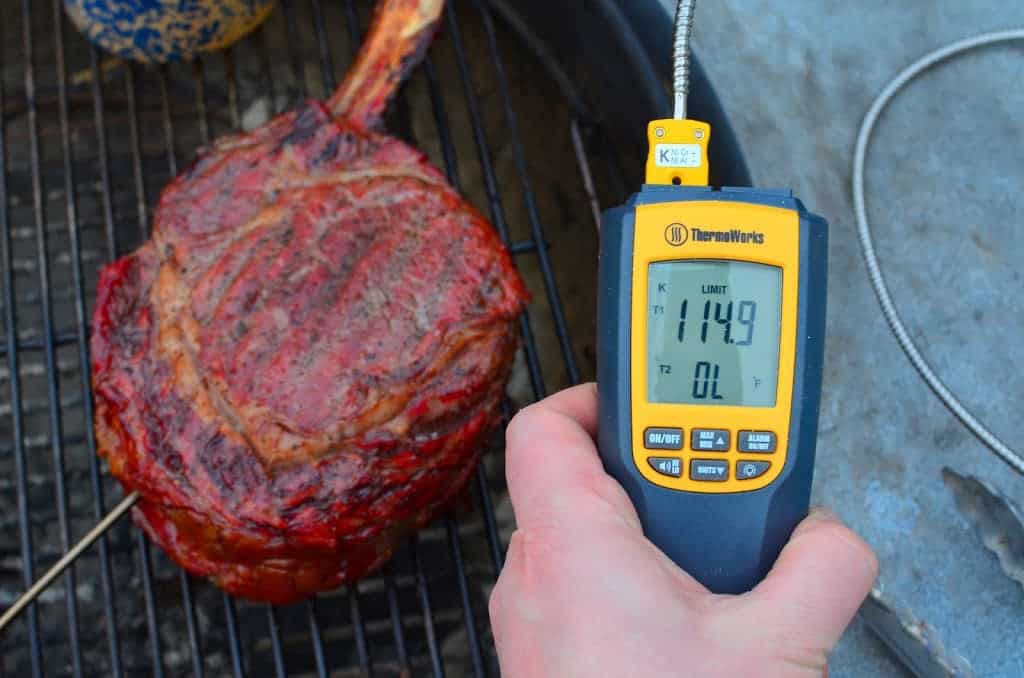
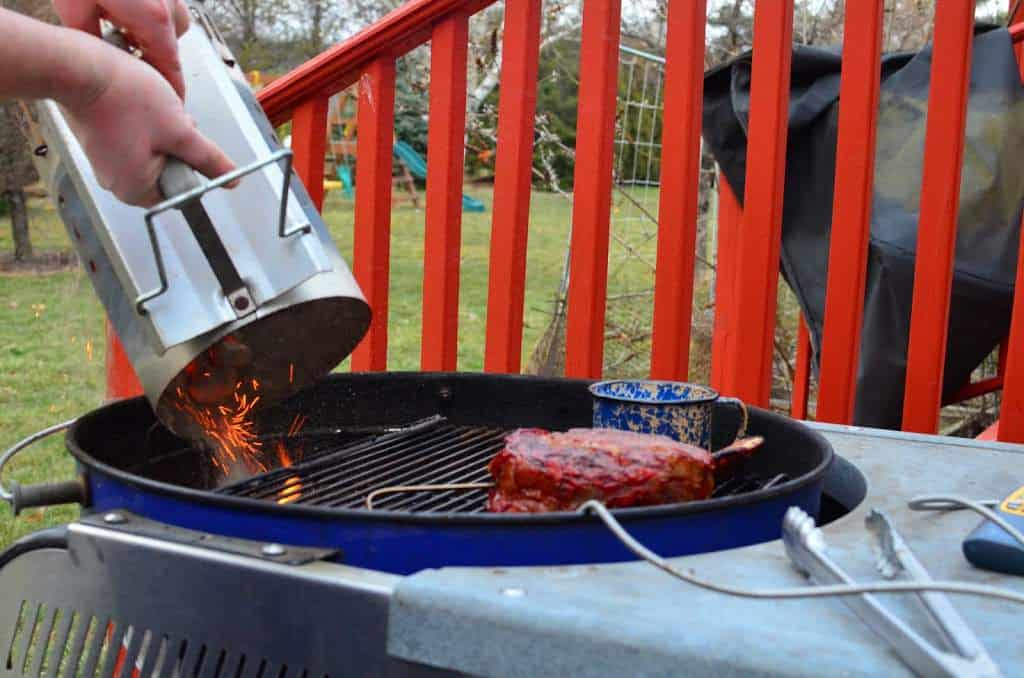
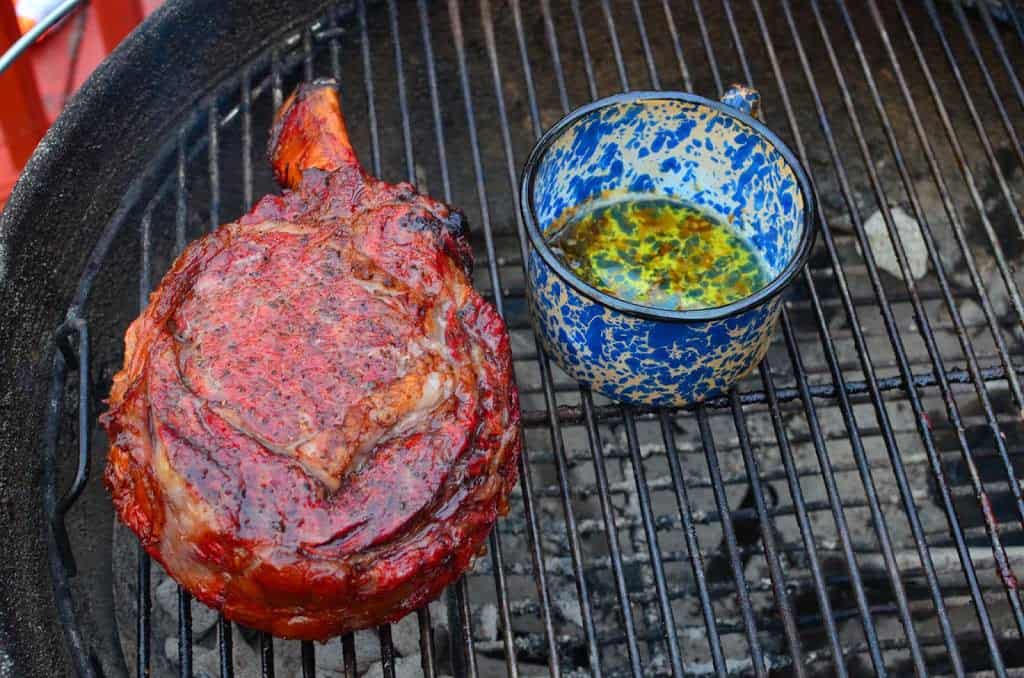
The reverse sear instructions are easy - bank the coals to one side and start the steak on the other side away from the heat. Cook the steak with the lid closed, flipping often, until the temperature is ten degrees lower than the final temperature. (115°F for medium rare). Then, move the steak directly over the lit coals to give it a final sear.

I did have to display adaptability as I was cooking. I had a couple of problems during my reverse sear:

  1. The heat drops as the coals burn down. I started out with a half a chimney of charcoal and a grill temperature of 300°F; by the time the steak was ready to sear, about an hour later, the grill was down to about 250°F, and the coals were just about spent. I poured in an extra half chimney of coals that I lit about fifteen minutes into the cooking time to build the fire back up.
  2. Low and slow was lower and slower than I expected. I thought it would take a half an hour to get the steak up to 115°F, so I could start the sear; it took a little over an hour for that huge hunk of meat to warm up. This was a problem, because my wife expected dinner a half an hour earlier. She gets a little peckish when dinner is late. The keys are patience and a instant read thermometer. This is perfect for probe thermometers, with a wire leading to the main unit; leave the probe in the steak, and it will tell you exactly when to continue cooking.

Even with those problems, I'm going to use this technique again. The beef was pink from edge to edge. No gray ring of overcooked beef between the crust and the core, just medium-rare deliciousness. And the low and slow cooking results in extra tender meat; this ribeye chewed like beef tenderloin.

I mean, look at that - that's perfectly pink.

I'm going to play around with this technique some more; it should work great with thick cut steaks, even if they aren't as cartoonishly thick as the cowboy cut.

If you have carnivores in your life, call your butcher and special order a cowboy chop. They'll love you for it.
That is - your butcher and your carnivores will love you.

Recipe: Grilled Cowboy Chop (Double Cut Ribeye, Reverse Seared)


Adapted from The Food Lab's Perfect Grilled Ribeye Steaks | Serious Eats : Recipes

Cooking time: 65 minutes

Equipment:

  • Grill (I use my trusty Weber kettle)
  • Charcoal chimney (for the extra batch of coals)
  • Probe thermometer and/or an instant read thermometer

Ingredients

  • 1 "Cowboy Chop" - a double cut bone-in ribeye steak, 2 ½ inches thick, about 2 pounds
  • 2 teaspoons kosher salt
  • 1 teaspoon fresh ground black pepper
  • 2 fist sized chunks smoking wood (or 1 oak wine barrel stave)

Butter baste

  • 4 tablespoons butter
  • 1 small shallot, minced
  • leaves from 1 sprig of thyme

Directions

1. Season the steak

Two hours before grilling, remove the steak from the refrigerator. Season it liberally with the salt and pepper. Let it rest at room temperature until it is time to grill.

2. Set up the grill

Set the grill up for indirect medium-low heat, 300°F. On a charcoal grill, light half a chimney of charcoal (50 coals), wait for the coals to be mostly covered with gray ash, then pour them on one side of the grill. Add the smoking wood to the pile of coals.

3. Start the steak on indirect medium-low

Put the steak on the grill over indirect heat, away from the lit coals. Close the lid, and position the air holes directly over the steak to pull the smoke towards it. Cook the steak, flipping every five minutes, keeping the lid closed as much as possible. The steak is ready for searing when it reaches 115°F internal in the thickest part, somewhere between 30 minutes and 1 hour. (115°F is medium rare. Cook to 105°F to 110°F for rare, 125°F for medium. Beyond that…buy a thinner steak.)

Start another half a chimney of charcoal (another 50 coals) for the searing step after the steak has been cooking for 15 minutes, or when it reaches an internal temperature of 80°F. (Do this on a heat safe surface. I used my other charcoal grill - doesn't everyone have two kettles?)

4. Melt the butter baste

While the steak is cooking slow and low: Put the butter, shallot, and thyme in a small, grill safe pot. (I use an enameled steel drinking cup.) Put the pot over the coals when you start the steak in step 3. Check the butter every time you flip the steak - once the butter is melted and the shallots are sizzling, slide the pot to the indirect side of the grill to keep warm.

(If you don't have a grill safe pot, heat the butter baste on the stove over medium heat, or put everything in a Pyrex measuring cup and microwave. Heat the baste until the butter melts and the shallots sizzle.)

5. Sear the steak

By now, the second chimney of charcoal should be covered with gray ash. Add it to the coals already in the grill, pouring carefully so the steak doesn't get covered with ashes. Brush the steak with a thin coat of butter, then slide it directly over the lit coals. Sear the steak with the lid open, flipping and basting with the butter every minute or two, until there is a gorgeous brown crust on the steak. This should take about five minutes, at which point the steak should measure 125°F internal for medium rare, 115°F for rare, or 135°F for medium.

6. Rest and serve

Remove the steak to a platter and baste it one last time with the butter. Let the steak rest for fifteen minutes, then slice and serve.

Notes

  • This recipe was invented for probe thermometers. I wouldn't cook without one, though you could get away with an instant read thermometer, and a check every time you flip the steak.
  • I'm still working out the timing on this recipe - it took a really long time for that thick hunk of beef to come up to temperature. It seemed to be stuck at 53°F for the first twenty minutes of cooking time. Then it started to ramp up, and it moved quickly after that. But it didn't seem like it - I had to go in the house and say "I told you dinner was at 6:30, but the steak's only at 80 degrees. Have another glass of wine…"
  • If you have a gas grill, this is easier to cook, but you don't get as good of a sear at the end. Set the grill up for indirect medium-low heat by setting one burner to high, and leaving the others off. Cook with the lid closed as much as possible, and adjust that one burner to keep the temperature at 300°F. When the steak is ready, crank up all the burners to high, and put the steak over the burner that's been lit the whole time. Oh, and replace the wood chunks with a cup of wood chips, soaked for 1 hour, then wrapped in a foil envelope and placed on the burner cover over the lit burner.
  • The "flip every five minutes" seemed excessive, but it sure worked in evening out the temperature. This steak was as evenly cooked as my bubba sous vide steaks. I didn't think I could do that entirely on a charcoal grill. I mean, look at that pink center one more time:

References

The Food Lab's Perfect Grilled Ribeye Steaks | Serious Eats : Recipes
How To Grill a Gigantic Rib-Eye Steak | Serious Eats
Cooking Temps: When To Cook Hot & Fast, When To Cook Low & Slow, And When To Do Both (Reverse Sear)

What do you think? Questions? Other ideas? Leave them in the comments section below.

Related Posts:

My award winning Grilled Ribeye with Mediterranean Herb Butter
Beer Cooler Sous Vide Grilled New York Strip Steaks

*Enjoyed this post? Want to help out DadCooksDinner? Subscribe to DadCooksDinner using the RSS or Email options on the right, link to this post from your blog, recommend DadCooksDinner to your friends, or buy something from Amazon.com through the links on this site. Thank you.
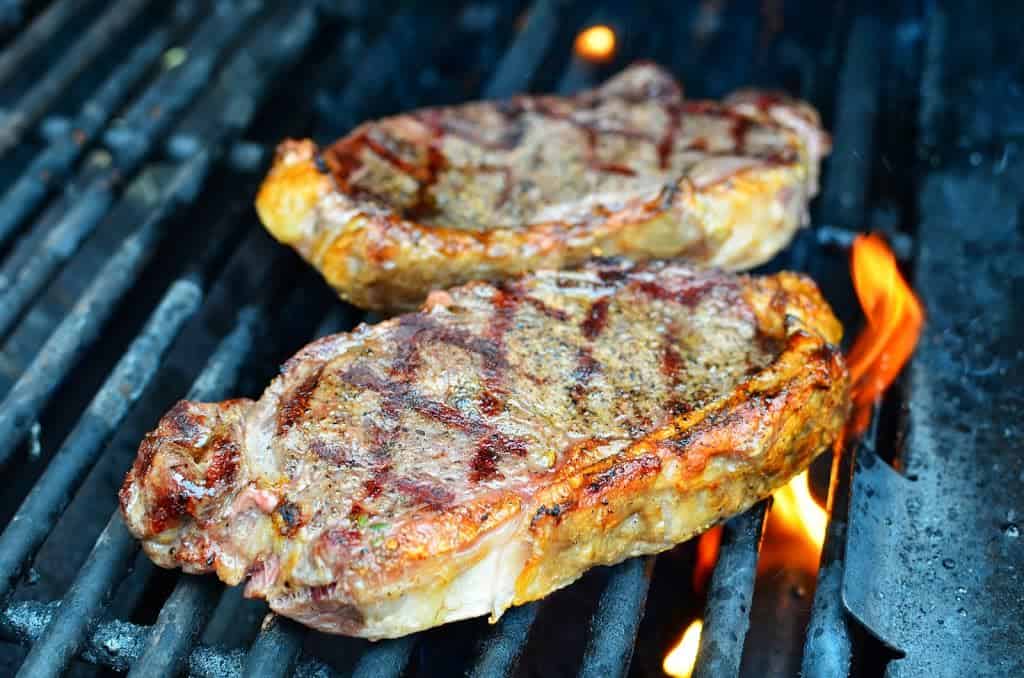
Facebook Feedback

April 3, 2013 by Mike Vrobel 6 Comments

"Housekeeping Week" continues on DadCooksDinner. I have a list of non-food topics to discuss. Rather than trickling them out, I'm publishing them all this week...kind of like ripping off a band-aid. Thursday will be back to normal, with a recipe post.

TL;DR version: Do you follow DadCooksDinner through Facebook? Do you see all my posts? (Or, any of my posts?). Help me understand what's going on by leaving a comment. (Not a Facebook person? This is not the post you're looking for, please move along...)

...Still here? OK, here we go...

My brother-in-law is a big Facebook user. We were chatting at my niece's birthday party, and he said "So, you started on the blog again?"

I asked him what he meant. He said this was the first post he's seen in months on Facebook; he assumed I was on an extended blog vacation, and just started writing again. I frowned and told him I've been here all along, posting two to three times a week.

I thought something like this was happening. Late last year, I think Facecbook changed the way Pages (like my blog page) are shown to followers. I have 700+ followers; according to Facebook's tracking, new posts reach 150 to 200 of them. This is a noticeable drop; early last year, I would reach 250 to 300 people with each post, and that was with fewer followers.

Around this time, Facebook started asking if I'd like to pay for "promoted posts". I'm sure this is a complete coincidence.

Nice blog you've got there…it would be a shame if it disappeared…

But…I'll be the first to admit that I don't get Facebook. I could be missing the point. I don't use my personal Facebook account; I go directly to the DadCooksDinner page to see if there are any comments to answer.

That's where I get even more confused. There are a group of people who regularly like and comment on my Facebook posts. So, I haven't disappeared from Facebook - I just don't get seen by as many people, somehow.

So, I'm reaching out to my readers. If you follow me on Facebook, can you explain what's going on?

1. What do you see? And where do you see it?

Can you explain how you find my posts on your Facebook page? I post every Tuesday and Thursday - Do you see everything I post? Or do you only see some posts? Or a post once in a blue moon?

Do you have to go somewhere special to see my posts, or do they show up in your news section?

2. Do you only follow through Facebook?

If you're following me through Facebook, is that the only way you follow me? Or do you use one of my other subscription methods as well (RSS, Email, Twitter?)

Finally…

If you're following me on Facebook, and you're wondering where I went (like my brother-in-law), maybe you should subscribe via Email or through a RSS reader. You'll get to read all of my posts that way.

Of course, according to my conspiracy theory, Facebook followers will only see this post if I pay Facebook to promote it. Oh, the irony…

Let me know what you think. Leave a comment in the comments below. Oh, or on my Facebook page, of course.

Working for Tips

April 2, 2013 by Mike Vrobel 4 Comments

"Housekeeping Week" continues on DadCooksDinner. I have a list of non-food topics to discuss. Rather than trickling them out, I'm publishing them all this week...kind of like ripping off a band-aid. Thursday will be back to normal, with a recipe post.

TL;DR version: If you follow DadCooksDinner, and you want to support me directly (instead of buying my cookbook or buying something through my Amazon links), you can now send me money through my tip jar.

Want details, including financial info for this blog? Keep reading.

...Still here? OK, here we go...

Email from a reader:

Just bought a rotisserie grill and stumbled upon your site for recipes. I plan to use a few over the next few weeks. It's a shame that I (and others) cannot compensate you (in a an easy way) for your valuable information. I don't own a Kindle so I won't be buying your book and I'm too lazy to deal with the Apple bookstore.

BUT, if you set up a link to Paypal, and continue to do what you do, I can send you $5 as my way of saying, thanks bro. (No, this is not a scam and I don't work for Paypal.)

Suggestion from a reader in Austin, TX, edited to protect the innocent.

Can I work for tips? Should I?

I had a Paypal tip jar set up years ago, before anyone actually read my blog. In six months, no one ever used it. So I took it down.
I had the analytics to prove no one was reading. Except family members. (Hi mom! Thanks for reading!)

It's time to try again. As an experiment, I'm adding tip jar and subscription buttons to DadCooksDinner. If you want to support the work that goes into this blog, make a one-time donation or small monthly subscription through this link:

Since I'm shamelessly asking for money, The least I can do is share the finances of a a mid-level food blog.
And I mean that. It's impossible for me to do less.

Blog Economics

Income

Here's my blog income breakdown.

Book sales: 45% of my income

The moment I published it, my cookbook became my highest source of income. Thank you, everyone, for buying my cookbook!

Amazon Affiliate payments: 35% of my income

If you click through one of my many Amazon links, and buy something before you close your browser, I get a sales commission.

Personally, I like this approach to supporting blogs, If I'm buying something from Amazon, I go to a site I like and click through one of their Amazon links. Amazon will send a small commission to the blogger, and I don't pay any extra, because Amazon charges the same prices either way.
The only downside is...Amazon addiction. I'm trying to cut back, but it's hard. So, so hard.

Advertising: 20%

I have BlogHer and Google ads. This used to be a major source of income for me, but it is falling fast. I think Internet advertising is in a race to the bottom, cost wise, and my payments are dropping because of it. My blog traffic roughly doubles every year, but my advertising income has stayed about the same.

I stick with BlogHer because I like their community and the support they offer. I stick with Google because of their analytics, because they host my blog on Blogger.com, and because they provide the ads for the occasional YouTube video.

Sponsored Posts: 0% to 5%

Occasionally, I write a sponsored post through BlogHer. I keep editorial control, and the sponsor pays to have an ad and links on that post. Sponsored posts pay reasonably well, but they're rare. I get one every six months or so.

I'm going to start selling sponsored posts on my own…I think. If you know of a business that's a good fit as a sponsor, tell them to contact me.

The problem with sponsored posts is the quality of the sponsor. I get some offers for sponsored posts, but most of them are kind of shady - people asking to write paid guest posts on topics that aren't related to home cooking. Thanks, but no thanks.
It happen often enough that I saved a "not interested" keyboard macro. It gets used every couple of weeks. And don't get me started about requests to write for free so I can get "exposure" on their sites...

Expenses

I don't track expenses as carefully as I should. The blog itself isn't very expensive - I pay a few dollars a year for the domain name, and a few more for my RSS/Email feed. I'm hosted on Google's blogger.com, so I get free hosting until I use up the 10GB of space they gave me. At my current rate of growth, I've got a few years to go before I have to pay for extra storage.

The real expenses are food costs. And, to a lesser extent, kitchen gadgets. When I have an expensive purchase, if I remember to get a separate receipt, I can expense it on my taxes, and offset some of my earnings. But, usually, my costs are rolled up in my weekly grocery bill.
I have to eat those costs. Get it? Eat? Bwahaha!

Effort

I average fifteen hours a week on the blog. That includes writing, cooking, recipe testing, photography, formatting posts, email, and comments.
I spend at least an hour on weekdays, and more on weekends.

Then comes indirect time - reading books, magazines, and other blogs; visiting specialty food stores; trying out new recipes and techniques. Food is my hobby, so this " research" is what I do for fun. I'd do it even without the blog.

This time fills what's left after shuttling three kids to events and convincing my wife I didn't forget about her.
Where do I find the time? I don't watch TV. At all. Only the occasional live sporting event, mainly Browns games in the fall. And, after the last few years, I should skip the Browns. I'd have less heartburn on Sundays.

Totals

How much money am I making? I'm too shy to give an exact dollar amount. But…after four plus years of blogging, my income is almost enough to pay for groceries for my family of five. Still not enough to make a house payment, though.
To narrow it down even further, our grocery bill falls between the "low cost" and "moderate cost" weekly averages according to the USDA.

That's gross income, not net - like I said, this is my hobby. I ignore taxes and expenses; when I get a check from the blog, I spend it. Usually on a cookbook, or another kitchen gadget.
Then, when April 15th rolls around, I regret that I ignored taxes and expenses.

Take my income, subtract the expenses, and divide by fifteen hours a week and I make…yikes. I'm not quitting my day job any time soon. I can always dream about "retiring", and blogging full time - but then I look at college costs. With three kids, I'll be lucky if I can EVER retire, even if I live to be 99.

Thank you for reading. If you want to support the work that goes into DadCooksDinner, here's the link to the tip jar again:

Inspired By

Farnam Street Blog, Content Economics

Why My RSS Feed is Moving

April 1, 2013 by Mike Vrobel 12 Comments


Welcome to "Housekeeping Week" on DadCooksDinner. I have a list of non-food topics to discuss. Rather than trickling them out, I'm publishing them all this week...kind of like ripping off a band-aid. Thursday will be back to normal, with a recipe post.

TL;DR version: If you follow DadCooksDinner through a RSS reader, my feed is moving to feeds.feedblitz.com/DadCooksDinner.

Don't know what an RSS reader is? We're done here, you can move along.

...Still reading? OK, here we go...

Google Reader? No. No! Anything but that...

A moment of silence for the demise of Google Reader, my front page to the web. I have hundreds of feeds in it: food and technology, sports and politics, news and humor. Everything I follow on the web I follow through my RSS reader - and for years, that has been Google Reader. No more.
Why? Why?!? WHY?!?!? deep breath. OK, I think I can continue.

Beyond my addiction to Google Reader, I have concerns directly related to DadCooksDinner.

FeedBurner is Doomed. Dooooomed!

I depend on Google. A lot. DadCooksDinner.com is hosted on Blogger, google's blog publishing site; Blogger is also my blog editing software. My email is through Gmail. I think both of those are safe.

But, my RSS feed and email subscriptions run through FeedBurner, and I can see the writing on the wall. Feedburner will be the next to go. Google shut down advertising on FeedBurner, the analytics have been crashing intermittently. Feedburner is not being supported. It's just a matter of time before it gets the axe.

I moved my blog feed. If you follow me through email, you've probably noticed a change in formatting - that's my new feed service. If you read through RSS, you have to subscribe to my new feed:

feeds.feedblitz.com/DadCooksDinner

Tomorrow, I'm going to flip the switch to start forcing people from my old feed to the new one. Please update the feed in your RSS reader if you want to continue reading.
For my readers who have no idea what an RSS feed is, don't worry. If you don't know what it is, you don't have to worry about it.

What about me, and other small bloggers?

Half of my subscribers follow my blog through Google Reader. What is this going to mean for my blog traffic?

Google Reader is how I track smaller blogs, ones that post a few times a week or month, instead of a few times an hour. I can't be the only one who does this - what's going to happen when it's more difficult to follow smaller blogs?

Enough whining. What am I doing about this?

I'm a Mac guy, so I've been using Reeder on my iPad. It synced with Google Reader, and I love their iPad interface. The Mac version of the software is nice, and they've promised to come up with a replacement for Google Reader before it shuts down. My problem is, while I'm a Mac guy at home, I'm a PC guy at work. I need a reader with a web front end, that syncs across multiple platforms and computers.

I switched to Feedly. They made migration easy, and I love their web reader's list mode.

But the iPad version of Feedly doesn't have list mode. It only works in this awful magazine layout mode, with different sizes for different posts. I can't flip through each post, scanning the headline one at a time, like I could with Reeder. Feedly has multiple posts scattered across the page, and it slows me down to have to scan each of them.

I'm still looking for an ideal solution. So a question for my readers:

If you're a RSS addict (like me), what are you switching to? Talk about it in the comments section, below.

And don't forget the new feed:
http://feeds.feedblitz.com/DadCooksDinner

Rotisserie Ham with Orange and Honey Glaze

March 28, 2013 by Mike Vrobel 12 Comments

What do you have for Easter? Ham or lamb?

I come from a ham family. The kids would search for their Easter baskets, followed by a late breakfast. (Which, as a kid, was 80% peeps, 10% jelly beans and 10% chocolate bunny ears). Then we'd head over to Grandma's house for another round of Easter baskets.

Rotisserie Ham with Orange and Honey Glaze
[feast_advanced_jump_to]

Then I married into a ham-crazy family. My in-laws believe in ham for every holiday. Easter, Christmas, New Year's, Arbor Day...name a holiday, and they're wondering when the ham will be ready.

So, for both sides of my family, here's a rotisserie ham. Happy Easter, everyone!

Special thanks to Sherman Provision for the fabulous ham. Ohio raised, double smoked in their own smokehouse. It was magnificent.

Ingredients

  • 1 bone in ham, butt half (10 to 12 pounds, "with natural juices" if at all possible)

Orange Honey Glaze

  • ½ cup honey
  • Juice and zest of 1 orange
  • 4 tablespoons butter
  • 2 tablespoons Dijon mustard
  • 1 large sprig fresh thyme

How to make Rotisserie Ham

Score and spit the ham

One hour before cooking, remove the ham from its wrapper and pat dry with paper towels. Cut the rind of the ham in a 1 inch diamond pattern, cutting about ¼ inch deep. Skewer the ham on the rotisserie spit, securing it with the spit forks. Let the ham rest at room temperature until it is time to grill.

Make the glaze

Simmer the glaze ingredients over medium heat, stirring often, until the butter melts. Remove the glaze from the heat and set it aside until it is time to glaze the ham. Reheat the glaze right before using.

Set up the grill for indirect medium-low heat (300°F)

Set the grill up for indirect medium-low heat (300°F) with the drip pan in the middle of the grill. For my Weber kettle I light a half-full chimney starter of charcoal, about 50 coals. When the coals are covered with gray ash, I pour the charcoal in two equal piles on the sides of the grill, and put the drip pan in the middle, between the piles.

Rotisserie cook the ham to 135°F

Put the spit on the grill, start the motor spinning, and make sure the drip pan is centered beneath the ham. Close the lid and cook the ham until it reaches 135°F in its thickest part, about 3 hours for a 10 pound ham. (It should take about 18 minutes per pound of ham, but thickness matters more than weight, so check the temperature every hour.) During the last half hour of cooking, brush the ham with the reheated glaze every ten minutes. If you are cooking with charcoal, add 14 fresh coals every hour, splitting them between the two piles of lit charcoal.

Serve

Remove the ham from the rotisserie spit. Be careful - the spit and forks are blazing hot. Let the ham rest for 15 minutes, then carve and serve.

Why cook a ham on the rotisserie?

Because you get a fantastic crust on the outside. If you don't have a rotisserie, or don't want to mess with trying to run a spit through a bone-in ham, you can just grill the ham instead: Grilled Ham with Honey Bourbon Glaze.

Equipment

  • Grill with Rotisserie attachment (I use a Weber Summit with an infrared rotisserie burner. Here is the current version of my grill.)
  • Aluminum foil drip pan (9"x13", or whatever fits your grill. I use an enameled steel roasting pan.)
  • Butchers twine
  • Instant Read Thermometer
Rotisserie Grilling by Mike Vrobel

I wrote a cookbook!

Rotisserie Grilling Cookbook

New to your rotisserie and need help with the basics? Love your rotisserie and looking for new ideas? Grab a copy of Rotisserie Grilling! You'll get 50 of my favorite rotisserie recipes and expert tips on how to set up and use your rotisserie.

Click here to buy →
Score the ham
Score the ham
On the spit
On the spit
Make the glaze
Make the glaze
Set the grill for indirect heat, with a drip pan in the center
Ham on the rotisserie
Crisping up nicely
Crisping up nicely

Notes

  • I always have problems carving a bone-in ham. One side of the ham is easy to remove from the bone - I cut that piece off, then slice it for serving. The other half of the ham, though, usually involves carving around the bone, and it comes off in smaller chunks. If I'm feeding a crowd, I slice those as well, but that half of a ham is usually destined for lunches later in the week.
  • Save the ham bone for ham and bean soup! Recipe coming…someday. When I get around to it. I'm still working on the leftover ham. (Ham loaf! Ham salad! Ham and cheese sandwiches!)
  • This ham was beautifully smoked. If you get a ham that needs extra smoke, like a grocery store ham (especially a "ham with water added"), put a fist sized chunk of hickory on the coals before you add the ham.

What do you think? Questions? Other ideas? Leave them in the comments section below.

Related Posts:

Rotisserie Ham, Barbecue Style
Rotisserie Whole Leg of Lamb with Orange and Fennel Dry Brine
Click here for my other rotisserie recipes.

*Enjoyed this post? Want to help out DadCooksDinner? Subscribe to DadCooksDinner using the RSS or Email options on the right, link to this post from your blog, recommend DadCooksDinner to your friends, or buy something from Amazon.com through the links on this site. Thank you.
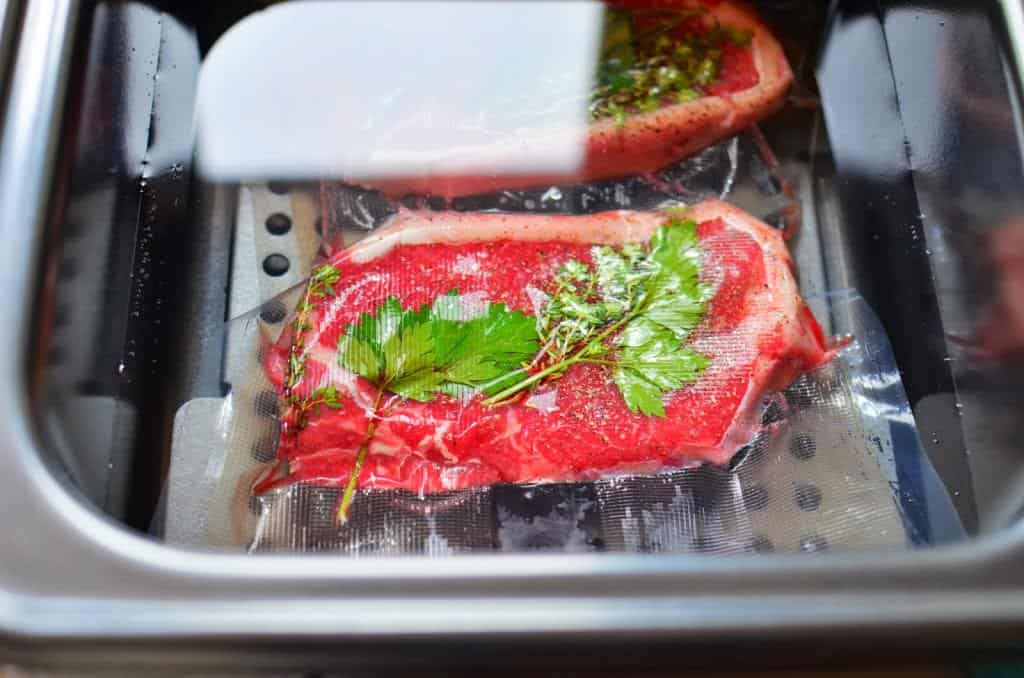
Road Trip: Food Warehouses

March 26, 2013 by Mike Vrobel 1 Comment

GFS food warehouse haul
Part of my haul from the food warehouse

A GFS Marketplace just opened in my neighborhood. I’m excited; this means I don’t have to make a cross-town trip to stock up my kitchen.

Now, I’m a buy local kind of guy. I try to support the food businesses around me. I shop at my local farmers market, and I’m a member of a CSA. I’m the kind of person who worries about sustainable seafood and food miles.

But I’m also trying to balance my food budget with a family of five. I make an occasional trip to a warehouse store to stock up on bulk items. It helps keep my costs down. That is, as long as I don’t have impulse purchases. Like Chris Rock’s famous “five gallons of mayonnaise!”, I can be lured in by a deal that I later regret.

GFS is the store that opened near me; they’re a food warehouse that is open to the public. Traditional warehouse stores (Sam’s Club, Costco, and BJ’s) carry some of these items some of the time. Costco in particular has a reputation for cheap gourmet items, but I’ve never been in one. Restaurant supply stores are also worth a look, especially for kitchen tools.

What do I stock up on?

1. Kitchen consumables
I love jumbo rolls of aluminum foil and plastic wrap. They're cheaper, and I think the bigger rolls (with their large cutters) are easier to use. I also keep an eye out for paper towels and aluminum foil drip pans.

2. Professional kitchen tools
Pro tools assume they’ll be used hard, and replaced when they wear out. They’re about maximum function for minimal price.

Now, don’t assume professional tools are better than the home versions. For basic items - silicon spatulas, metal turners, and half sheet pans - I prefer the cheap, functional pro versions. But I spend money where I think it matters. For example: a great chef’s knife, microplane zesters, or OXO peelers.
I especially like professional turners with holes in them. The hole pattern reminds me of whiffle balls.

3. Spices
I like to buy spices in bulk. Especially when they're things I use a lot, like chili powder, paprika, black peppercorns, and kosher salt. I try to be selective about bulk spice purchases, though. I won’t buy 16 ounces of ground cloves; I use a quarter teaspoon once or twice a year.
A great source for spices in small amounts is the bulk aisle of your local grocery or health food store. You can scoop out a couple of tablespoons if that's all you need.

4. Pantry basicsAll purpose flour, sugar, dried fruit, nuts, mustard, and other basic ingredients - all are cheaper in large sizes. Again, I only buy stuff with a high turnover in my kitchen, and that lasts for a long time before it goes bad. I had a jumbo pouch of hazelnuts sitting in my pantry for years. I don’t want to go through that again.

Watch out…

Be sure to shop carefully. These stores can be a great source of supplies…or a money sink. Look out for:

1. Prepared food
Pre-made foods frighten me. I make fun of barbecue purists and chili traditionalists from time to time, but a bag of “barbecued pulled pork”, vacuum packed and pre-cooked? Suddenly, I’m one of those purists, railing against dumbed down cooking.

2. Meat
Meat can be a great deal at these stores, but tend to I stay away from it. I’d rather buy better quality, locally raised meat. I will occasionally give in, though, especially for a large party - that catering package of Johnsonville brats is always tempting around the 4th of July. Beware of enhanced meat at all costs. Read the labels, looking for enhanced, basted, brined, or marinated. In other words, the meat has been pumped up with saline. I’d rather brine it myself. It tastes better, and I don’t pay an extra 15 percent for water weight. And the yard long tube of ground beef? That’s…that’s…I don’t know what that is. Other than terrifying.

3. Bulk doesn't necessarily mean a deal
Keep track of the prices at local stores. Sometimes there’s a big savings in buying in bulk. Other times, buying in bulk just means getting more, not necessarily a better price. And, don't forget - it’s only a deal if you’re going to use it before it goes bad.

What do you think? Questions? Other ideas? Leave them in the comments section below.

*Enjoyed this post? Want to help out DadCooksDinner? Subscribe to DadCooksDinner using the RSS or Email options on the right, link to this post from your blog, recommend DadCooksDinner to your friends, or buy something from Amazon.com through the links on this site. Thank you.
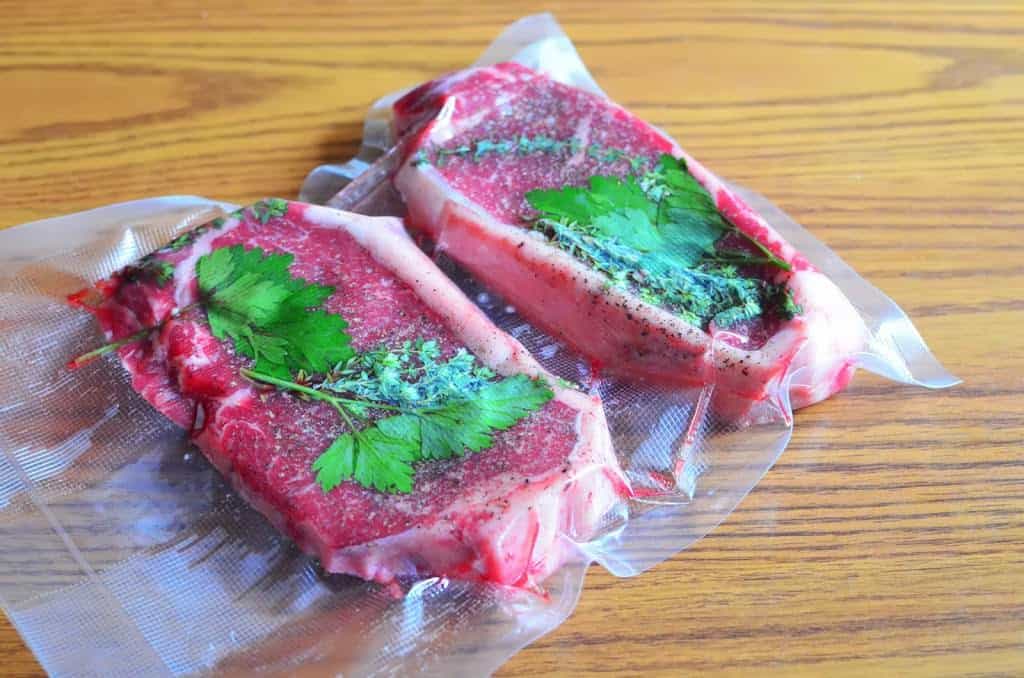
DadCooksDinner - RSS Feed Moving

March 24, 2013 by Mike Vrobel Leave a Comment

The RSS feed for DadCooksDinner is moving to:

feeds.feedblitz.com/DadCooksDinner

If you follow DadCooksDinner through a feed reader, and want to continue reading, please update the feed address.

Thank you!

(If you follow me via Email, Facebook, Twitter, or Google+, you shouldn't notice this change, and I'm sorry for wasting your time.)

600

March 19, 2013 by Mike Vrobel 23 Comments

Today's post is a celebration of a big, round number. This is the 600th post on Dad Cooks Dinner. When I saw that number in the Blogger dashboard, I was shocked. 600 posts? How long have I been doing this?

I've been doing this since August of 2008. Not that anyone noticed. The first six months were the digital equivalent of crickets chirping in the distance…but even the crickets weren't paying attention. The only readers were family members, and they only read when I sent out emails begging them to visit.
*And I wasn't above begging back then. Or now, for that matter…

Then, in April of 2009, it happened - my post about Rotisserie Cornish Game hens was ranked by Google. I started to get a trickle of traffic. Since then, it's been a slow, steady climb; In 2012, I averaged more readers per month than I did for the entire year of 2009.

Thank you to everyone who's stuck with me through the years. And for those of you who have gone back and read most of what I wrote, I apologize for all the flip-flopping. I'm writing these posts almost real-time, and sharing what I figure out in the kitchen. It kills me when someone leaves a comment asking why I said one thing in 2010, then another in 2012. I'm sorry! My cooking is evolving right along with the blog. I promise to keep you up to date with what I'm learning.

That's the fun thing about writing this blog - I keep learning new things. Something else is always coming up, be it technology, photography, writing. Or, of course, cooking. And don't get me started about kitchen equipment. I know I'm gadget obsessed. I try to live up to Alton Brown's "Death to Unitaskers" standard, but there's always another shiny new gizmo I have to try.
What's that? A flat gravy whisk? Oooh! I have to have one!

So, what important life lessons have I learned in 600 posts?

  • Food is fun! Anyone who tells you otherwise is selling something. Probably a diet.
  • If you write with an open heart, readers will respond. There are a lot of good people out there, especially in the world of food. But...if the response is from a tone deaf Internet troll, it's a waste of effort arguing with them - block 'em and move on.
  • Write about what you care about. I didn't write about rotisserie grilling because I thought it would be popular; I wrote about it because I couldn't find information to help me out. Some of my favorite posts are ideas that kept pestering me until I let them out. Go where the motivation leads you.
  • Write what other people want to read. This is the flip side of the previous thought. You've heard of cooking with the seasons? Food writing doesn't follow seasons, it leads seasons. I celebrate every holiday twice. I cook a Thanksgiving turkey around Halloween, then again on Thanksgiving. There's a Super Bowl chili in early January, then again in February. There's an Easter ham…oh, crap, Easter is early this year! I'm behind schedule!
  • To be a better writer, write. I cringe when I look back at my earliest posts. But then, I cringe when I look back on what I wrote last month. I could always use yet another pass through for editing.
  • No matter how many times I proofread my own work, I always miss something. Until I post it and everyone can read it. Then the typo in the first paragraph jumps out at me. (A special thanks to readers who let me know about typos, missing ingredients, or instructions that don't make sense - I appreciate the help, and I can always use a second set of eyes.)
  • Persistence is everything. There are days I don't feel like writing, when it's an effort to start typing. Some days it's a slog; it doesn't get easier. Other days, the words start flowing. Suddenly, hours have passed, and I've got a lot of to share. The difference between those two days? Beats me. They both seem pretty miserable when I start. But if I put my butt in the chair and start writing, more often than not, good things happen.

Thank you for reading. I hope you're still here when I get to post 1000!

Update: Uh, oh…this is actually post 601. Darn it! I thought I had the count right, but my Sunday "pic of the week" threw me off. Sigh.

What do you think? Questions? Favorite posts from the past? Leave them in the comments section below.

*Enjoyed this post? Want to help out DadCooksDinner? Subscribe to DadCooksDinner using the RSS or Email options on the right, link to this post from your blog, recommend DadCooksDinner to your friends, or buy something from Amazon.com through the links on this site. Thank you.
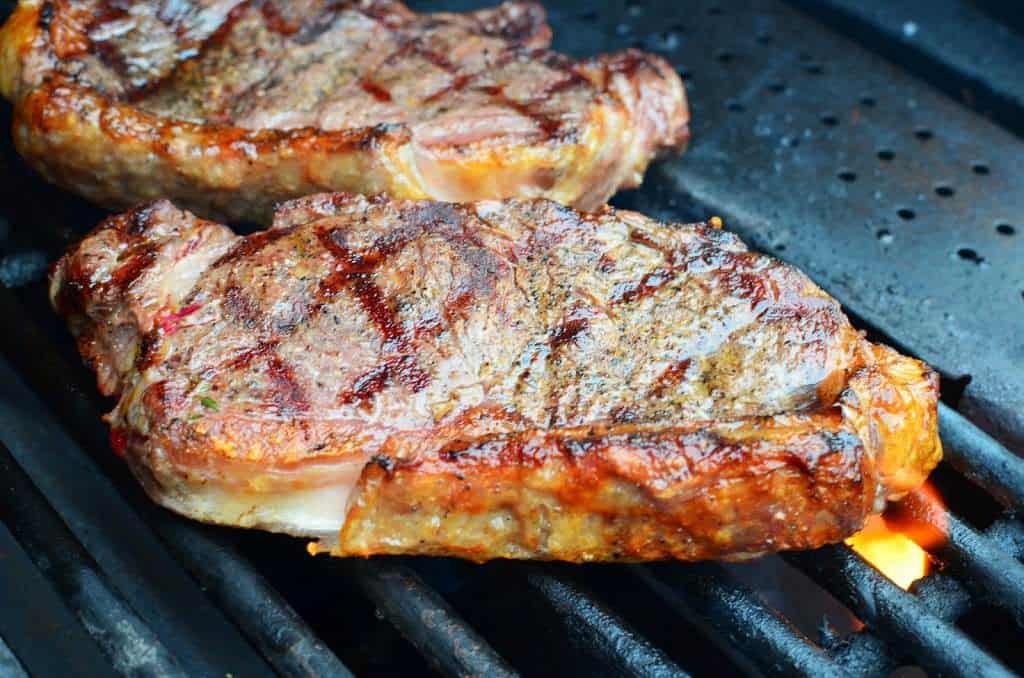
Pressure Cooker Champ (Irish Mashed Potatoes with Green Onions)

March 14, 2013 by Mike Vrobel 22 Comments

Pressure Cooker Champ - Irish Mashed Potatoes | DadCooksDinner.com

Pressure Cooker Champ - Irish Mashed Potatoes | DadCooksDinner.com
Pressure Cooker Champ - Irish Mashed Potatoes

Irish and potatoes - they just go together. Champ is an Irish mash of spuds and spring onions. I serve it on St. Patrick's day - the perfect starchy side dish with corned beef or lamb stew.

When I bought my second electric pressure cooker, my wife asked "What, did the other one break?" I mumbled an excuse about reviewing it for the blog. I bought it because I liked the look of the stainless steel insert, and I felt guilty about the extravagance. But, now that I have two cookers, I can't imagine having only one - I use the second cooker for side dishes all the time.

Like, say, champ. (You knew that was coming, didn't you?)

Most champ recipes work like traditional mashed potatoes - use the pressure cooker to boil the potatoes, drain, then mash with the milk, butter, and green onions.

But I saw online hints about a one-pot mashed potato recipe - potatoes with a small amount of milk. No draining, no separate heating of the milk, butter, and onions. But I couldn't find details, and I wasn't sure if a no-boiling method would work. It was time for recipe testing.

I made two batches of champ, side by side. One was the traditional way - boil, drain, mash. The other followed the vegetable technique from Modernist Cuisine at Home - melt the butter, toss the vegetables to coat, add a little liquid (in this case, the milk), and pressure cook everything at once.

When I was done, the traditional way looked great - fluffy mashed potatoes, with flecks of green onion. And it tasted good, too - like mashed potatoes with green onions mixed in.

When I opened the pot, The Modernist approach looked like a train wreck. The milk had curdled under pressure. I was sure I was doomed.

I forged ahead and mashed the potatoes, curds and all. The curds melted into the potatoes, and the end result looked fine. How did it taste? Better than the traditional approach. There was a stronger potato flavor to the mash. Even better, the one pot potatoes cooked quicker, took less steps, and there was only the one pot to clean up. We have a new mashed potato champion!

No pressure cooker? No worries. See the Notes section for stovetop instructions.

Recipe: Pressure Cooker Champ (Irish Mashed Potatoes with Green Onions)

Inspired by: Modernist Cuisine at Home, Nathan Myhrvold and Maxime Bilet

Equipment:

  • Pressure Cooker (I love my Instant Pot electric pressure cooker)

Pressure Cooker Champ - Irish Mashed Potatoes | DadCooksDinner.com

Pressure Cooker Champ - Irish Mashed Potatoes | DadCooksDinner.com

Pressure Cooker Champ - Irish Mashed Potatoes | DadCooksDinner.com

Pressure Cooker Champ - Irish Mashed Potatoes | DadCooksDinner.com

What do you think? Questions? Other ideas? Leave them in the comments section below.

Related Posts:

Pressure Cooker Roasted Sweet Potato Puree
Pressure Cooker Corned Beef and Cabbage
Easy Instant Pot Cabbage Recipe
Instant Pot Irish Beef Stew
Instant Pot Colcannon (Irish Mashed Potatoes and Kale)
Instant Pot Irish Lamb Shanks
Click here for my other pressure cooker recipes.

*Enjoyed this post? Want to help out DadCooksDinner? Subscribe to DadCooksDinner using the RSS or Email options on the right, link to this post from your blog, recommend DadCooksDinner to your friends, or buy something from Amazon.com through the links on this site. Thank you.
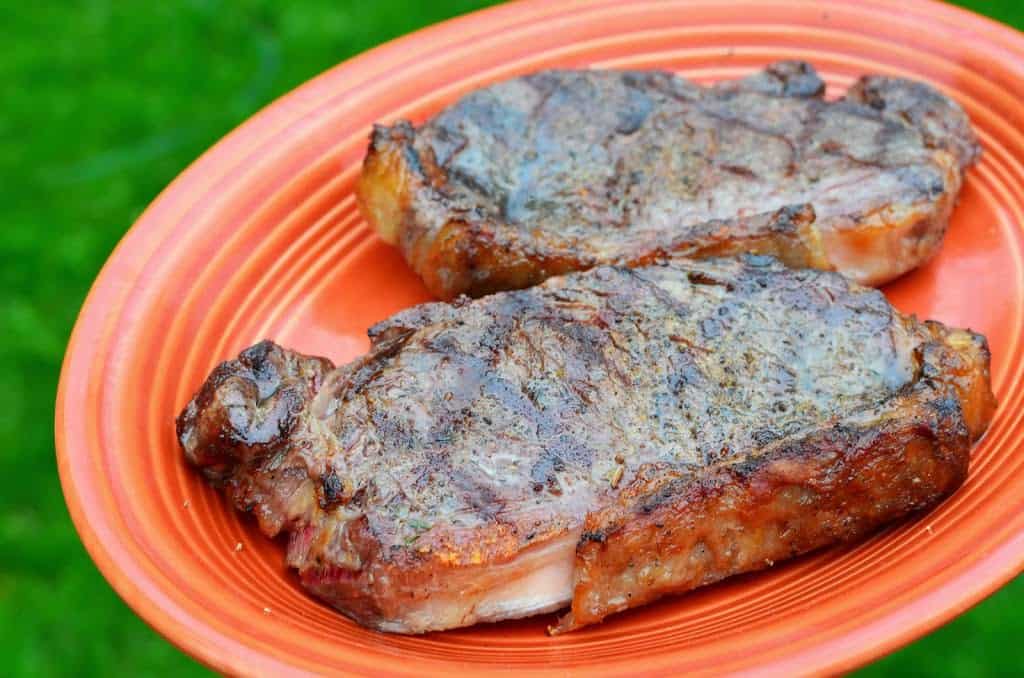
Grilled Lamb Loin Chops with Garlic, Mustard, and Green Onion Marinade

March 12, 2013 by Mike Vrobel 6 Comments

As a food blogger, I have to cook ahead of the curve. My family is getting used to early holidays. I need to test the (fill in the blank: Thanksgiving turkey, Chinese New Year stir fry, Christmas roast beast) recipe so I can post it ahead of time.

Also, as a food blogger, I write because I love it, not because I'm raking in the mad cash. I have to keep my day job to pay for my blogging habit.

Every now and again, these two collide. I had grand plans for a St. Patrick's day feast, probably involving a lamb stew. Then the project I've worked on for a year installed over the weekend. The install went about as well as I could have hoped, but there were a string of minor issues and unrelated problems that kept me working from Friday morning until slightly after Midnight on Sunday morning.
Not to mention juggling sick kids all week. Is it just me, or has this been a particularly bad winter for colds?

My grand plans of a slow cooker stew went out the window. It was Sunday morning, I was crushed by my sleep deficit, the kids had an event scheduled for the afternoon, and I still had to do the grocery shopping.
We're out of milk and eggs - a bad sign.

My long, slow cooked dinner became a quickie St. Patrick's day stand in. Just add Guinness.
If your week has been like mine, add a shot of Irish whiskey. You deserve it.

The only saving grace was the sudden appearance of Spring. Lamb stew became grilled lamb chops, so I could sit on the deck, sip my early Guinness, and enjoy the 60°F weather.

Recipe: Grilled Lamb Loin Chops with Garlic, Mustard, and Green Onion Marinade


Grilling time: 8 minutes

Equipment:

  • Grill (I use a Weber Summit. Here is the current version of my grill.)

Ingredients

  • 6 Lamb Loin Chops (Lamb T-Bones), each roughly 1 ¼ inches thick.

Marinade

  • 2 teaspoons kosher salt
  • 4 cloves garlic, minced
  • 2 green onions, trimmed, green and white parts minced
  • 2 tablespoons honey mustard
  • ¼ cup vegetable oil

Directions

1. Marinate the lamb chops
Whisk the marinade ingredients in a medium bowl until they form a thick paste. Remove 2 tablespoons of the marinade and save for later. Add the lamb chops to the bowl with the rest of the marinade and toss to coat. Marinate the lamb for at least 30 minutes, preferably 1 to 2 hours, tossing occasionally to coat.
Or: Put the marinade ingredients in a zip-top bag, zip the bag closed, then squish the bag to combine the ingredients. Reserve 2 tablespoons, then add the lamb to the bag. Squeeze the air out of the bag and zip closed. Marinate, flipping occasionally to coat the lamb with the marinade.

2. Preheat the grill
Set the grill up for cooking with direct high heat. I preheat the grill for 15 minutes with all the burners on high then , brush the grill grate clean.

3. Grill the lamb
Remove the lamb chops from the marinade, letting excess marinade drip back into the bowl, and put the chops on the grill over direct high heat. Grill the chops until they are well browned on both sides and reach an internal temperature of 130°F for medium, about 8 minutes.

I use a three flip approach (or a 2-2-2-2 pattern) to get a crosshatch of grill marks. Grill the chops with the lid closed until they have a good set of grill marks on the bottom, about 2 minutes, then flip them and grill until the other side is marked, about 2 more minutes. Flip the chops again, rotating them 90 degrees as you flip, so the next set of marks forms a cross. Grill until browned, about 2 minutes, then flip them one last time and grill for a final 2 minutes.

On the grill
Flip 1 - good grill marks
After third flip, with crosshatch of grill marks.
Note that the chops are rotated, now pointing Northeast.

4. Glaze and serve the lamb
Remove the lamb chops to a platter and immediately brush them on both sides with the reserved 2 tablespoons of the marinade. Let the chops rest for ten minutes, then serve.

Notes

  • This marinade is very oily. This has a good side and a bad side. The good side is it helps brown the lamb. The bad side is grill flareups. If your grill is prone to grease fires, pat the lamb chops with paper towels before putting them on the grill. This will remove a lot of the marinade, but that's OK - the final glaze of marinade will add the flavor back to the lamb.

What do you think? Questions? Other ideas? Leave them in the comments section below.

Related Posts:

Grilled Lamb Loin Chops, Michael Symon Style
Grilled Rack of Lamb
Grilled Butterflied Leg of Lamb

*Enjoyed this post? Want to help out DadCooksDinner? Subscribe to DadCooksDinner using the RSS or Email options on the right, link to this post from your blog, recommend DadCooksDinner to your friends, or buy something from Amazon.com through the links on this site. Thank you.
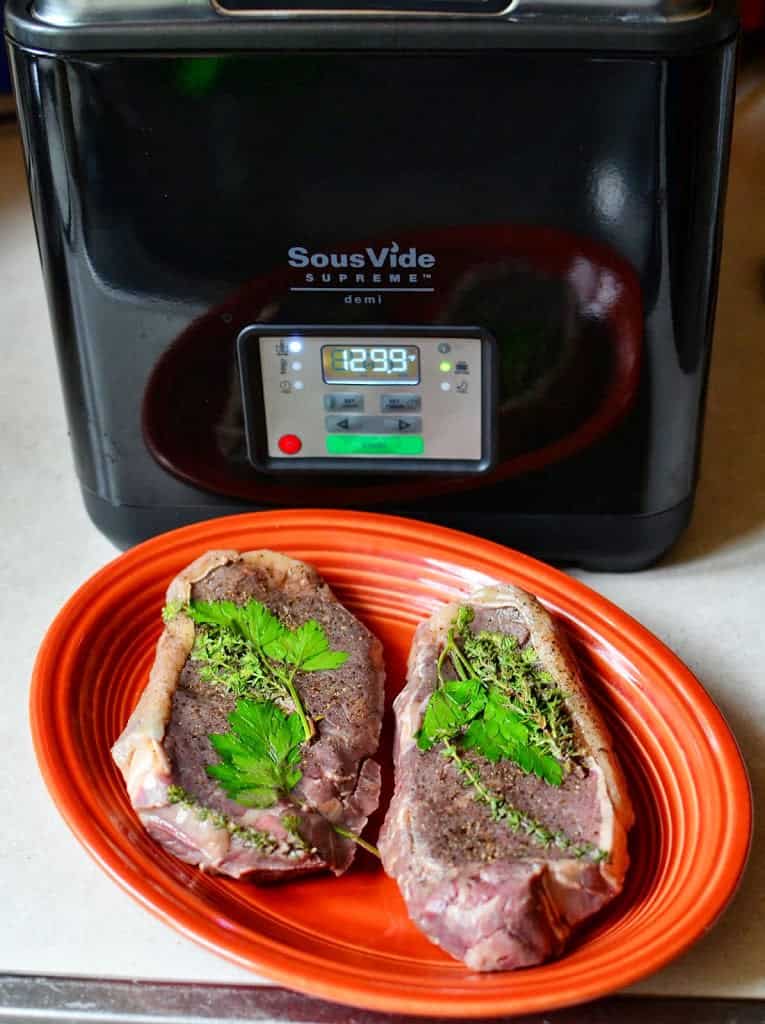
Things I Love: Oxo 4 Piece Mini Measuring Beaker Set

March 5, 2013 by Mike Vrobel 12 Comments

When I saw these colorful mini beakers, I had to have them. I wasn't the only one. As I was opening the Amazon box, my wife and daughter walked into the room.

ArtisticDaughter and MomTeachesScience [In unison]: What's that?

DadCooksDinner: It's my mini beaker set.

ArtisticDaughter: They're so colorful! Can I have them?

DadCooksDinner: No, I got them for the kitchen.

MomTeachesScience: Those are great. I could really use them at school.

DadCooksDinner [Clutching them to his breast]: They're for me! For the kitchen!

ArtisticDaughter and MomTeachesScience [In unison]: Can you get me one? How much are they?

I've had them for a week, and I use them every day. They're like pinch bowls for liquids, perfect for measuring small amounts. Yellow is one teaspoon, blue is one tablespoon, green is one ounce, and red is two ounces (a quarter cup).

If you enjoy adult beverages, they make a great replacement for imprecise jiggers and shot glasses.

Most importantly, they're cute! I always like an extra splash of color in my kitchen, and they make me smile whenever I see them.

Disclaimer: "Things I Love" are tools I bought. I use them every day in the kitchen, and I would hate to live without them. I am not receiving anything from the manufacturer. If you buy something through the Amazon.com links on my site I get a small commission from the purchase. Thank you!
(OK, I'm good with the FCC now.)

Oxo 4 Piece Mini Measuring Beaker Set

*Enjoyed this post? Want to help out DadCooksDinner? Subscribe to DadCooksDinner using the RSS or Email options on the right, link to this post from your blog, recommend DadCooksDinner to your friends, or buy something from Amazon.com through the links on this site. Thank you.
Wine for Cheapskates

February 26, 2013 by Mike Vrobel 15 Comments

A few cheap finds

I used to be a wine snob. Then I had kids.

My love of food is intertwined with my love of wine. Wine and food just go together, and I believe a glass of wine should accompany almost every dinner. My favorites were expensive wines from famous wine regions, especially ones I have visited. Napa Cabernet. Sonoma Zinfandel. Oregon Pinot Noir. As Napoleon said, I celebrate victories with Champagne, and need it after defeats.
*When I went to France, I had to take the TGV to visit Reims, home of Champagne. Had to!

When we were DINKs, that was fine. We could afford it. Once the kids started to arrive, expensive wine turned into a luxury, saved for special occasions. Did I give up wine? No. But I had to find cheap wine that I loved.

Except...cheap wine can be awful.

Allegedly, I'm just being a snob, and I can't taste the difference. It's all in my head, I'm being influenced by the labels, the price. It's all psychology, not taste.

In spite of all the studies, I know I can taste the difference.

That jug of Yellowtail, or bottle of Three Buck Chuck? Fruit bombs, with nothing interesting going on. I'd rather have water. (Or a beer - but that's another post.) I wish I could get all wine snobby and explain why - "they lack astringency, and the finish is too short" - but I don't have the words.

The best I can do is: good wines are balanced. Wine should have both fruit and structure. It should be buttery and acidic. It should have a balance of oak and tannins. Cheap wine tends to be the first (fruity, buttery, oaky) without the balance (structure, acid, tannins).

Now, I'm not against cheap wine, I'm against bad wine. The key to cheap AND good wine? Buy wine from off the beaten path. Look to South America and Spain in particular. And, try some new grapes, not the traditional Cabernet, Merlot, or Pinot Noir. If there is a local specialty, it has to be good to stand up to the classics.

Now, for some humble suggestions. I won't mention specific brands; wine laws are erratic, and distribution is spotty, so I have no idea what you can find. Trust the wine experts at your local stores - they'll have suggestions in all these categories.
Ohio has draconian wine laws. Whenever I visit Chicago, sparkling wine is much, much cheaper. I always buy a case of real Champagne, because it seems like such a deal. That's right, I'm a bubbly bootlegger in my suburban minivan.

Reds

  • Spain - Tempranillo or Garnancha
  • Argentina - Malbec
  • Chile - Carmenere
  • South Africa - Pinotage
  • Southern France - Cote du Rhône (stick with the village blends; high end Chateauneuf du Pape or Hermitage are great, and expensive)
  • California - Syrah/Shiraz, Petite Sirah

I drink big wine with some structure to it, and these wines all fit the bill. Again, I wish I could give you the wine snob play-by-play about each of these - "tastes like currants, tobacco, with a glassy edge and a hint of acid" - but my flavor memory isn't that good. These wines are in two groups - regional specialties from under appreciated wine regions (Spain, Argentina, Chile, South Africa), or under appreciated grapes from well known wine regions (Cote du Rhone, California Syrah or Petite Sirah).
Australia normally gets a mention here, but I'm not a fan of cheap Australian wine - I like it when it gets a little more expensive, in the $10 to $20 dollar range, and if you can find a good Australian Shiraz on sale, grab it. But the cheap Australian stuff doesn't do it for me.

Whites

  • South Africa - Rhone-style white blends
  • Italy - Pinot Grigio
  • America - Pinot Gris
  • Everywhere - Sauvignon Blanc (except, unfortunately, New Zealand)

As long as you stay away from Chardonnay, cheap white wine tends to be better than cheap red wine. Now, don't get me wrong, I love a good chardonnay, but it seems like I have to spend a lot of money to get a good one. New Zealand Sauvignon Blanc would be on this list, except everyone figured out how good it is, so the price jumped. Now I'm lucky if I can find a bottle for under $15. Pinot Grigio and Pinot Gris can be pretty bland, but they're perfect on a hot summer day, when I want something cold and acidic.

Pink

  • French - Rosé (usually Provence, Rhone, or Languedoc)

Rosé is meant to be cold, crisp, and cheap. It is my favorite summer wine. And fall. And winter. Oh, and spring, for that matter. Luckily, it's not that popular here in the US (I think it's fallout from White Zinfandel) so it can be found with reasonable prices. There are some other regions making rose in the French style; South Africa and California are making some good, cheap versions, so keep an eye out.

Bubbly

  • Spain - Cava
  • Portugal - Vinho Verde

I drink a lot of bubbly. Spanish Cava is the real thing, and is a good substitute for Champagne or Napa sparklers. Vinho verde is a tart, slightly bubbly white wine; I almost put it in the white section, but it sparkles just enough to qualify here. It is another great summer wine.

Cooking

  • Spain - Tempranillo/Garnacha blends
  • France - Cote du Rhone
  • Australia - GSM blends

When I use a wine for cooking, I want it to be cheap, a blend of grapes, and (usually) have some grenache in the blend. (If I'm putting a cup or two of the wine in a stew, I'm even cheaper than usual.) Cote du Rhone wines are the best example of these blends, but can get pricey, so I look to other regions for a really cheap ($7 or $8) bottle. This is where I break my "avoid Australia" rule; they make a number of inexpensive GSM (grenache, shiraz, mouvedre) blends. And, if I'm using half the bottle in a stew, I want cheap. I might even stoop to Three Buck Chuck.

Box Wines

I want to like box wines. I really do. I hate when I forget about a half a bottle of wine, and find it a couple of days later, when it's already gone.
The box wine concept should work; seal three bottles worth of wine in a plastic bag, keeping oxygen away so the wine can't oxidize.
The problem? The wine they put in the bags. Ugh. Even the newer "high end" boxes don't really do it for me - all the ones I've tried are fruit bombs, like I mentioned above. I keep trying them, hoping I'll find one I like, but so far I've been disappointed.

Final Notes

  • I don't mean to talk trash about your favorite wine. If you're a fan of Black Box Cabernet, or love Yellowtail chardonnay and drink it by the jug, more power to you. I wish I could enjoy it as much as you do. (Or, at least, my wallet wishes I could…)
  • How do you find what you like? Taste a lot of wine! If your local wine shop has a tasting, visit it. If your grocery store is giving out samples, try them. If you're in wine country, visit wineries. Then, if you find something you like, and the price is right, buy some.
  • Local wine shops love to make recommendations. Give them your price range - don't worry about seeming cheap - and they'll be happy to work with you. And, if they're not? Move on to the next store. High end grocery stores often specialize in wine, and they'll have someone on staff who will happily make recommendations. Ask for a mixed case - you'll get 10% off the total price - and see if you like the recommendations.
  • Take what they recommend, buy the case, go home and drink it. (This is research.) If you liked their suggestions, keep going back and giving that person your business. And if one of the wines was a particular favorite, go back and buy a case!
  • And, when you're asking for help, don't worry about wine snobs. The vast majority of people who work in wine shops do it because they love wine, and want to share. They're looking to create new wine lovers, not lord over you with their knowledge. And if you do run into a snob? Like I said, move on to the next store. Odds are, they'll be happy to help you out.

What do you think? Questions? Cheap wines you love? Leave them in the comments section below.

*Enjoyed this post? Want to help out DadCooksDinner? Subscribe to DadCooksDinner using the RSS or Email options on the right, link to this post from your blog, recommend DadCooksDinner to your friends, or buy something from Amazon.com through the links on this site. Thank you.
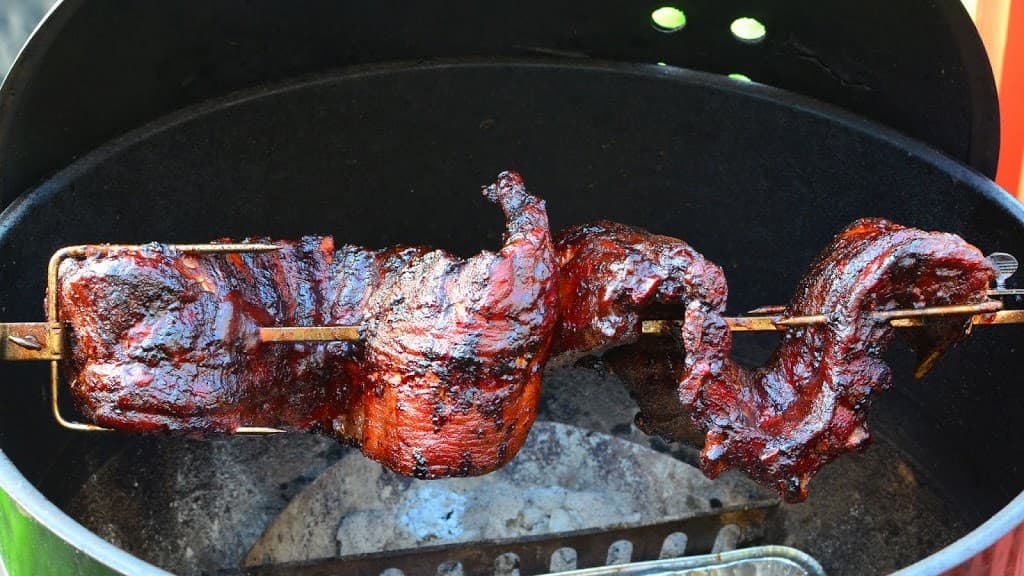
Rotisserie Spareribs with Garlic, Oregano, and Paprika Rub

February 21, 2013 by Mike Vrobel 16 Comments

Rotisserie Spare Ribs with Garlic, Oregano and Spanish Paprika Rub

Rotisserie Spare Ribs with Garlic, Oregano and Spanish Paprika Rub

I wanted a new idea for rotisserie spareribs. I thought Brazilian churrascaria would be the answer, but somehow I wound up in Spain, not Brazil.

Galician churrasco, to be exact. Galicia is the section of Spain that sits right above Portugal. Their version of churrasco is slow grilled pork ribs, rubbed with garlic and oregano. That's it! Exactly what I was looking for.

If I'm cooking from Spain, I'm adding pimenton de la Vera - Spanish smoked paprika. It's probably not authentic for this recipe. The pictures I can find of of Galician churrasco ribs look pretty pale. But I love the smoky flavor it adds.

St. Louis cut spareribs, rib tips removed, are perfect for the rotisserie. The St. Louis cut gives you larger ribs than baby backs, and there's more meat on the bones. By removing the rib tips from the slab of spareribs, I don't have to cook the ribs low and slow for four hours to make them tender.

You have to cook drip pan potatoes with these ribs. I made mine patatas bravas style, sprinkling them with salt and more of the pimenton. Pork fat potatoes with smoked paprika? Yes, please.
*I mean it. If I catch you wasting the delicious pork drippings, we're going to have words.

DSC_0654

Recipe: Rotisserie Spareribs with Garlic, Oregano, and Paprika Rub

Cooking time: 2 hours

Equipment:

  • Grill with Rotisserie attachment (I used a Weber Summit with an infrared rotisserie burner. Here is the current version of my grill.)
  • Aluminum foil drip pan (11"x13")


DSC_0663

Notes

  • No, you don't need barbecue sauce with these ribs. The paprika, oregano, and crisped garlic gives them a lot of flavor. No, really. Put down that bottle of barbecue sauce. Try some ribs where you can taste the pork.
  • Fresh garlic is a pain to sprinkle. It clumps up, so some of the slab has big pieces of garlic, and some has none at all. I rubbed the garlic around on the ribs to spread it out. But if you wanted to substitute 1 teaspoon of garlic powder for the fresh garlic, I wouldn't hold it against you.
  • The potatoes? I'm serious. Don't forget them. I'll be very disappointed in you.

DSC_0666


What do you think? Questions? Other ideas? Leave them in the comments section below.

Related Posts:

OK, OK, if you really want barbecue sauce: Rotisserie BBQ Baby Back Ribs
Rotisserie Spareribs with Dry Rub

Click here for my other rotisserie recipes.


Check out my cookbook, Rotisserie Grilling.

Everything you could ask about the rotisserie,
plus 50 (mostly) new recipes to get you cooking.

It's a Kindle e-book, so you can download it and start reading immediately!


*Enjoyed this post? Want to help out DadCooksDinner? Subscribe to DadCooksDinner using the RSS or Email options on the right, link to this post from your blog, recommend DadCooksDinner to your friends, or buy something from Amazon.com through the links on this site. Thank you.
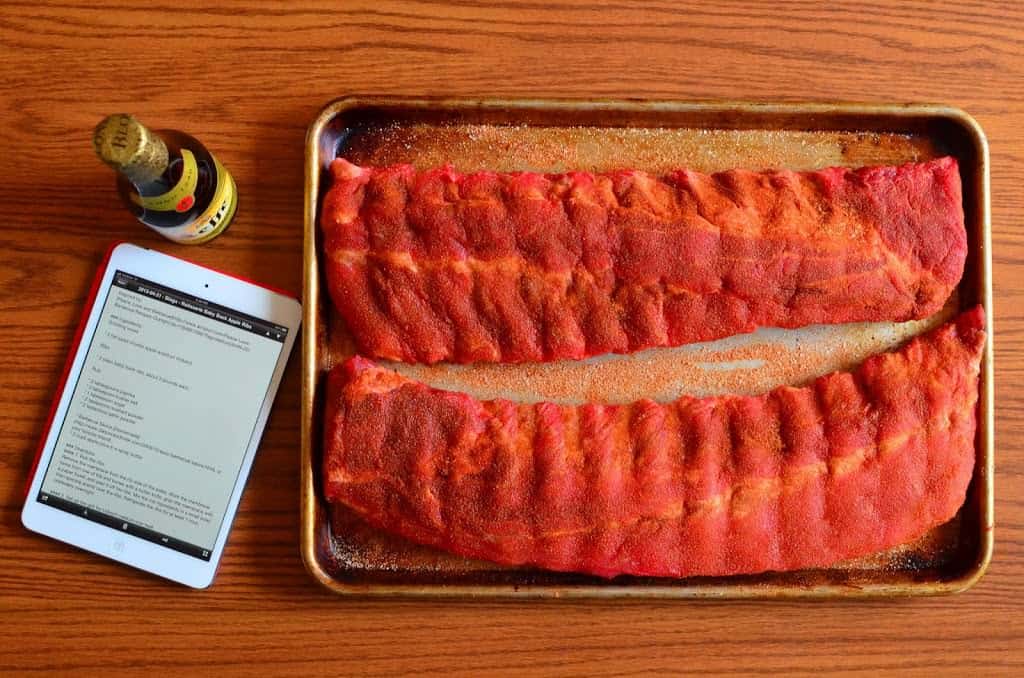
West Side Market Relief Fund

February 19, 2013 by Mike Vrobel Leave a Comment

[Image by City of Cleveland]

[Update: Well, better late than never. Welcome back West Side Market! I wrote this post last week...and the market re-opened yesterday. So, the best way to help is giving them business. Please visit the market!]

Cleveland's West Side Market is a block away from my old high school. I walked by every weekday for four long years. I would stop for an occasional egg sandwich at the diner on the southwest corner, but I wasn't brave enough to venture into the main part of the market. I walked through once, quickly, and it was full of weird stuff - sausages hanging from hooks, alien looking fish, and a stuffed goat head mounted over one of the stalls.
I thought the height of cuisine was a Polish Boy with everything from one of the hot dog carts downtown. Those dogs warmed me on many RTA rides home.

I grew up, moved to Akron, and my love for cooking blossomed. I realized what I was ignoring all those years. I started making the trips to the market, especially for the lamb vendors.
My favorite? The stall with the goat head mounted over it. So scary back then. Now it pulls me in.

All the lamb in my rotisserie cookbook came from the West Side Market, and so did a few of the ducks.

I was horrified to hear about the electrical fire in one of the stalls, and even more horrified to see the picture, the one at the top of the page. Foster's Meats, one of those lamb vendors, was right in the center of the fire.

Luckily, the fire wasn't large, and only burned up a handful of stalls. But the smoke damage was extensive. The market has been closed since January 30th, while they clean and disinfect everything.

I'm asking for your help. Insurance will fix the building, but the vendors need help make up for the lost inventory, sales, and to pay their employees.

Here are three ways you can help out the West Side Market:

  1. Donate to the Market Vendor Relief fund.

Michael Symon launched this charity to help support the vendors of the West Side Market.

  1. Buy the Support The Market T-Shirt

CLE Clothing is selling West Side Market T-shirts, and donating all the proceeds to the Vendor Relief fund.
[Update: SOLD OUT. Darn, I didn't have a chance to get one. They may re-stock, so keep an eye on the page if you're interested.]

  1. Buy the West Side Market Bond

Buy a $40 West Side Market bond, get a $50 West Side Market gift certificate. The extra $10 is donated by the sponsors of the West Side Market Centennial, and it gives you extra money to spend once the market is open. (The extra $10 offer expires after 750 people buy these bonds, so hurry if you want one.)

Most important: if you live in the Cleveland area, stop by -once the market is open- and give them your business. This will help the small businesses in the market, even when they're not facing an emergency.

[Update: Again, the market just re-opened. Get out there and buy something!]

Thank you!

Kale Salad with Pomegranate, Candied Walnuts, and Lemon Zatar Dressing

February 14, 2013 by Mike Vrobel 2 Comments

The real omnivore's dilemma - what do I do with all this kale from my CSA box?

Raw kale salad is the hot recipe on the Internet.

  • Kenji Alt - Kale and Chickpea Salad with Sumac and Onions
  • 101 Recipes - Tuscan Kale Salad
  • Pam Anderson - Quinoa Kale Salad with Kefir-Cumin Dressing

I'm late to the party. I scoffed when I first saw this recipe. Kale is a tough green, something that needs to be cooked before you eat it. Raw kale? That will never work.

What I missed was the marinade massage. You have to get your hands messy and rub the dressing all over the raw kale. Then it rests for at least a half hour before serving. Kenji Alt explains what happens in this post - the oil in the dressing removes the cuticle that protects the leaves, allowing the dressing to penetrate and break down the tough kale.
*Have you guys had enough of my man-crush on Kenji yet? Well, hang on, because his two-volume "The Food Lab: Better Home Cooking Through Science" is coming later this year. I can't wait.

The other kale salad advantage? Leftovers. Kale salad will keep in the refrigerator for days after the kale is massaged with the dressing. The tough kale leaves won't wilt, unlike lettuce, where the leaves turn soggy overnight. I make extra large batches of kale salad and save some for lunches later in the week.

Recipe: Kale Salad with Pomegranate, Candied Walnuts, and Lemon Zatar Dressing


Adapted from Kenji Alt Marinated Kale and Chickpea Salad, along with the other recipes listed above.

Marinating time: 60 minutes

Ingredients

  • 1 bunch (12 ounces) kale, leaves chopped into thin strips and stems discarded
  • ¼ cup extra virgin olive oil
  • 1 teaspoon kosher salt
  • ½ teaspoon zatar seasoning (or substitute 1 teaspoon fresh thyme leaves)
  • Juice from 1 lemon
  • 1 shallot, thinly sliced
  • pomegranate arils (arils from half a pomegranate)
  • ½ cup candied walnuts

Instructions:

1. Massage and marinate the kale
In a large bowl, rub the olive oil onto the kale leaves until all the leaves are coated with oil. Let rest at room temperature for at least a half hour, or up to five days covered in the refrigerator.

2. Dress the salad
Sprinkle the salt and zatar over the kale, add the lemon juice and sliced shallot, and toss until everything is well mixed. Sprinkle the pomegranate arils and candied walnuts on top, then serve.

Notes:

  • I got slightly more tender kale by rubbing with the oil first, then saving the rest of the dressing for later. If you want to make this a one step salad, whisk the oil with the salt, zatar, and lemon juice before massaging the salad, and add the shallots and pomegranate to the kale immediately.

What do you think? Questions? Other ideas? Leave them in the comments section below.

Related Posts:

Baked Kale Chips
Lemon Herb Dressing

*Enjoyed this post? Want to help out DadCooksDinner? Subscribe to DadCooksDinner using the RSS or Email options on the right, link to this post from your blog, recommend DadCooksDinner to your friends, or buy something from Amazon.com through the links on this site. Thank you.
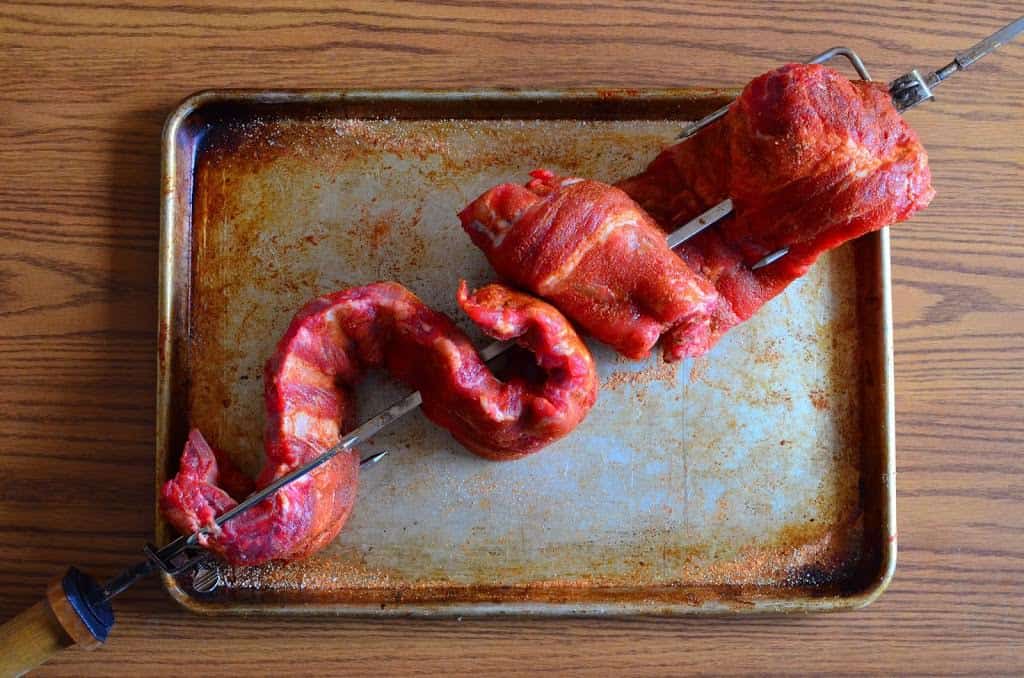
Things I Love: Kitchen Timers

February 12, 2013 by Mike Vrobel 5 Comments

I like to think I can multitask. In the kitchen, it's the only way to be efficient. Professionals can spend the time to get their mise en place before they cook, because they need to cook many meals at the same time. As a home cook, I try to fit my prep work into the down time between steps.

For example, making a stew. I heat the oil in the pot while I cube the meat, then mince the onions while the meat browns, then prep the veggie side while the onions sauté, then work on the starch while the stew cooks.
The only time I don't do this is with a stir fry - I want all my prep work done before anything hits the hot wok. But even then, I'm cooking the rice on the side, and marinating the meat while I prep the vegetables.

The problem is, I'm terrible at multitasking. If it's something I don't have to think about any more (dicing an onion), I'm fine, but if I have to engage my brain, that's all I can pay attention to. I can keep an entire meal going in my head…until someone distracts me. And I have three kids - life is all about distractions.
My wife likes to tease me about how focused I get when I'm cooking, and how hard it is for me to snap out of it and pay attention to something else.

So, how do I make sure that browning beef doesn't burn when I get a question about homework while I'm trying to dice onions?

Countdown timers are my salvation. When I start something that can overcook, I set a timer. I've got a bunch of timers that are in constant use. Here are my favorites.
*Plus a couple of tricks I've learned for unfamiliar kitchens.

Polder Clock/Timer/Stopwatch

(That's it in the picture at the top of the page)

This timer hangs around my neck on a strap, a real plus when I'm grilling. I can't leave the timer inside when I go outside, or vice versa - it's hanging from my neck. I don't have to find someplace near the grill to put it down - I let go, and it swings to the end of the lanyard.

I also depend on this timer when I'm hosting a party. A lively conversation, a couple of drinks (gotta keep the cook lubricated), and I won't hear a timer across the room. But it is hard to ignore when it is hanging from my neck.

Polder Probe Thermometer

I use this as a timer a lot more than I use it as a thermometer. Magnets on the base stick it to the backsplash on my stove, right where I can reach it while I'm simmering or searing. I love this particular model because the timer is so easy to set. (Unlike my stove's "kitchen timer" setting - see below.) Push both buttons to reset to zero, hold down the hours or minutes button to get the time, then hit start.

One downside to this timer/thermometer - I've gone through three polders in the last ten years. The flip-up display eventually breaks, and lies flat - then I can't see the time. I've bought a couple different probe thermometers as replacements, but their complicated settings get in the way. I eventual switch back to this model, and live with the fact that I have to replace it every few years.

Oven Timer

Here's a trick for cooking in an unfamiliar kitchen - if the oven has digital controls, it has a built-in kitchen timer. The trick is figuring out how to set it. Every oven is different, and some are far from obvious. Look for the "Timer" setting, then some sort of plus and minus buttons. (Of course, if you're in your kitchen, learn how to set the timer on the stove. It's great to have a timer that is always right there in front of you.

Now, be careful, and don't confuse the Timed Cooking setting with the Timer setting. Timed Cooking controls the oven itself, and cuts off the heat when the time is up. If I'm baking or roasting in the oven, I always use Timed Cooking. I get a built-in timer, and the oven shuts itself off when it's done. (Of course, when I cook temperature critical things like roast chicken or turkey, I use a thermometer to check for doneness. But I still set Timed Cooking…so I don't forget to turn the oven off.)

Microwave Timer

This is the other timer that you'll find in every kitchen. For some reason, I have an easier time figuring out the timer setting on microwaves than I do on ovens. In an unfamiliar kitchen, it's nice to have two options, because one of them will usually make sense, and the other one will be designed by sadists.
*Like this one, from my Mom's kitchen: "Wait, what did I just do? I didn't push start….why did the oven turn on? I just want to know when ten minutes are up and I can drain the spaghetti!" I really need to buy mom a kitchen timer.

What do you think? Questions? Other ideas? Leave them in the comments section below.

Related Posts:

Using Five Senses in the Kitchen
Review: Splash-Proof Thermapen ThermometerFive Dollar Challenge

*Enjoyed this post? Want to help out DadCooksDinner? Subscribe to DadCooksDinner using the RSS or Email options on the right, link to this post from your blog, recommend DadCooksDinner to your friends, or buy something from Amazon.com through the links on this site. Thank you.
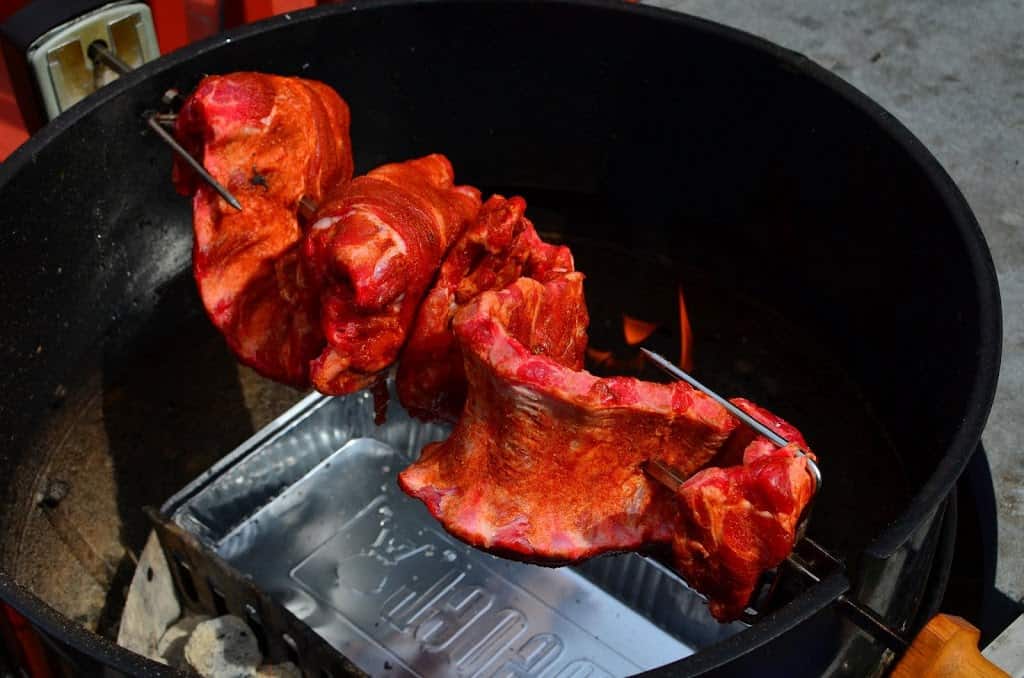
Baked Italian Meatballs

February 7, 2013 by Mike Vrobel 14 Comments

My Grandmother made the most amazing meatballs. They were huge, about the size of a baseball. (Or so they seemed back when I was 10 years old.) One meatball on top of spaghetti with some tomato sauce, and I was set for dinner.

My Grandmother wasn't Italian. I don't know where she got her recipe. And, unfortunately, she passed away long before I learned to cook. I asked around the family; no one knew the recipe, or where they came from.

Pam Anderson to the rescue.

My recipe is based on Pam's recipe in CookSmart, with an assist by Alton Brown for the baking instructions.

Now that I'm older, a baseball sized meatball seems a little too extravagant.
*Sigh. Being a grownup is no fun. It's all about portion control. 

I make my meatballs golf ball sized. A large cookie scoop helps me size properly - when I do them entirely by hand, they wind up between ping pong ball and golf ball sized.

(Looking for an Instant Pot or Pressure Cooker version of this recipe? See my Instant Pot Meatballs post.)

Recipe: Baked Italian Meatballs


Adapted From: Pam Anderson CookSmart

Cooking time: 25 minutes

Ingredients:

  • 2 ½ pounds meatloaf mix (1 ½ pounds ground beef, 1 pound ground pork)
  • ½ cup bread crumbs (I use panko style bread crumbs)
  • ½ cup grated Parmesan cheese
  • 1 medium onion, grated or finely minced
  • 3 large cloves garlic, grated or finely minced
  • 3 eggs, beaten
  • 1 tablespoon kosher salt (1 ½ teaspoons table salt)
  • 1 teaspoon fresh ground black pepper
  • 1 tablespoon dried Italian herb mix (or 1 teaspoon dried basil, 1 teaspoon dried oregano, and 1 teaspoon dried thyme, or ¼ cup minced fresh parsley and 1 teaspoon minced fresh rosemary)
  • 1 teaspoon red pepper flakes (optional)

Directions:

1. Mix and shape the meatballs
Preheat the oven to 400°F. Stir all the ingredients in a large bowl until everything is evenly mixed. Roll the mix into golf ball sized meatballs, each about ¼ cup. I make my meatballs with a heaping 3 tablespoon scoop, and get about 20 meatballs. Spread the meatballs evenly on a half sheet pan (a 13 by 18 inch baking pan with a rim).

2. Bake meatballs
When the oven is up to temperature, put the pan of meatballs in the oven and cook until they reach an internal temperature of 155°F, about 25 minutes. Remove the pan from the oven and let the meatballs rest on the pan for ten minutes, then serve.

Notes:

  • For easy cleanup, line the pan with a sheet of parchment paper, aluminum foil, or a Silpat.
  • Need some sauce for your meatballs? Try my Weeknight Tomato Sauce
  • These meatballs freeze well. Pop them back in the oven, or simmer in the batch of tomato sauce until they're heated through.
  • It's stuck in my head. I can't get it out. I have to sing! "On top of spaghetti, all covered with cheese, I lost my poor meatball…".

What do you think? Questions? Other ideas? Leave them in the comments section below.

Related Posts:

Weeknight Tomato Sauce
Slow Cooker Bolognese Ragu
Instant Pot Meatballs with Tomato Sauce
Instant Pot BBQ Meatballs

*Enjoyed this post? Want to help out DadCooksDinner? Subscribe to DadCooksDinner using the RSS or Email options on the right, link to this post from your blog, recommend DadCooksDinner to your friends, or buy something from Amazon.com through the links on this site. Thank you.
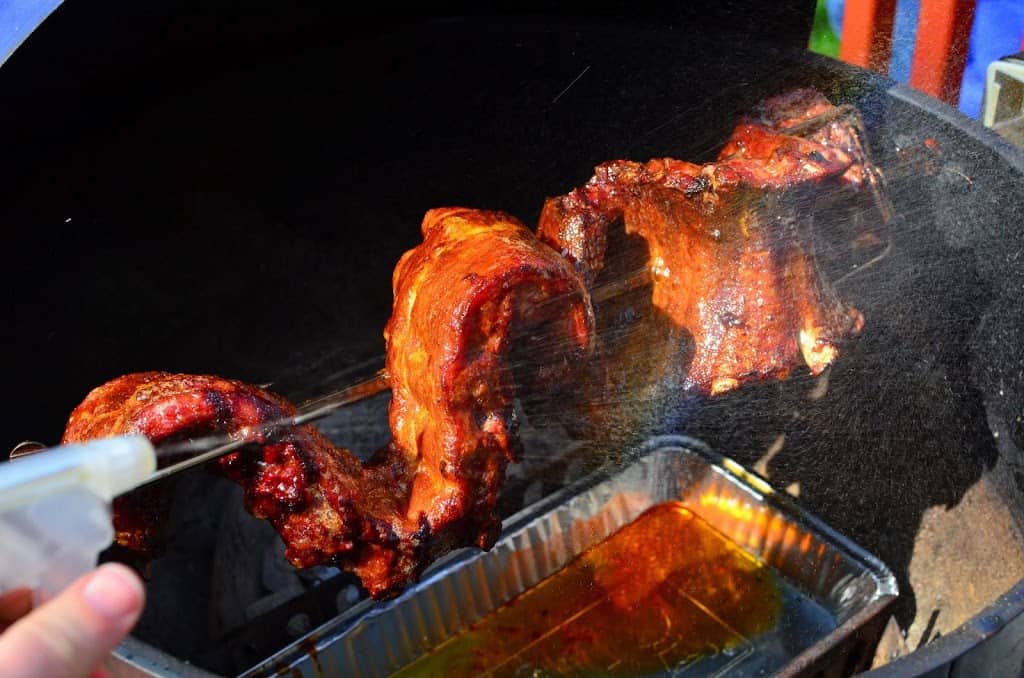
Five Fun Food Finds February 2013

February 5, 2013 by Mike Vrobel 1 Comment

What did I do last week, with temperatures in the single digits? I huddled under a blanket and did some food reading. Here's what I found:

  1. Consider the Fork by Bee Wilson

This history of cooking tools is a delight. Bee talks about the evolution of kitchen technology, from pots and pans to stoves and heat management. I enjoyed the difference between fork and chopstick cultures, and how it affects the rest of their cooking tools. The section on Britain's history of spit roasting - my favorite cooking method - has changed my culinary travel plans. Now I need to visit England for Ivan Day's traditional spit roasting classes.

  1. Weber Grills - 2013 Sneak Peek [2013sneakpeek.weber.com]

Weber updated the my charcoal grill, the Performer. The Performer Silver, with a fold-down side table, looks like a great idea for a smaller space. I'm lusting after the Performer Platinum in brick red, but my (blue) Performer is still chugging along. And I like that they re-released the Jumbo Joe kettle, with an 18 ½ inch diameter grate. It's portable…if you've got strong arms.

  1. Michael Ruhlman - Schmaltz iPad app

It's an iPad cookbook app, entirely about chicken fat, from Michael Ruhlman. And the chicken liver pâté recipe is amazing.

[Pic via what-if.xkcd.com]
  1. XKCD What If? - Steak Drop

Randall Munroe branched out from his gloriously geeky comic, XKCD, into a weekly, longer Q&A about strange science questions at what-if.xkcd.com. He finally did one about cooking, so I have an excuse to share it here. The "What If?" question: If you drop a steak from outer space, does the heat of re-entry cook it before it hits the ground?

  1. Hip Pressure Cooking Infographic

Laura at HipPressureCooking.com made this cute infographic about the basics of pressure cooking. I had to share.

What do you think? Questions? Other fun finds you want to share? Leave them in the comments section below.

*Enjoyed this post? Want to help out DadCooksDinner? Subscribe to DadCooksDinner using the RSS or Email options on the right, link to this post from your blog, recommend DadCooksDinner to your friends, or buy something from Amazon.com through the links on this site. Thank you.
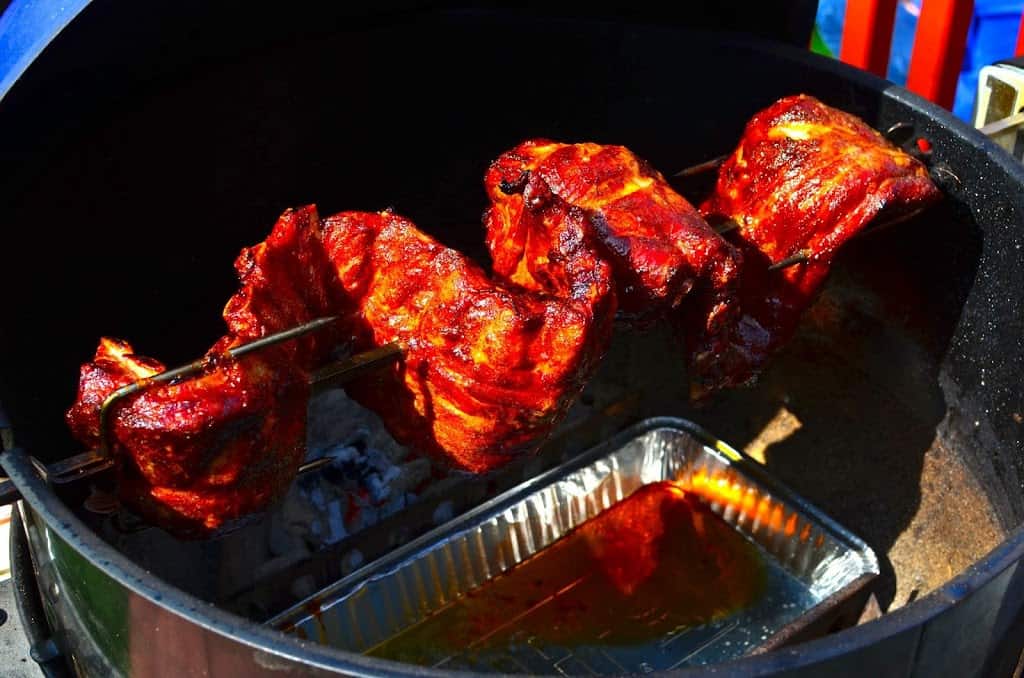
Pressure Cooker White Chili with Chicken

January 31, 2013 by Mike Vrobel 13 Comments

Pressure Cooker White Chili with Chicken

Pressure Cooker White Chili with Chicken

Talking to myself about White Chicken Chili as I get ready for my super bowl party...

What's that in the pressure cooker?

White chili.

White chili? What does that mean?

White chili means no red allowed. No red beans, no red chilies, no chili powder, no tomatoes.

No red? That's crazy talk. What's in it?

Chicken, white beans, spices, chicken stock, and lots of green chilies.

What in tarnation? Chicken? You call that mess chili! Reach for your iron, you lily livered, kale eating son of a donkey!

Whoa! Hey! Easy there, Tex. Here, try some.

Sorry, I get a little cranky when I'm hungry. I should eat something...oh, all right, pass it over. Hey! This tastes great! Do you have any more?

Here's a bowl. Stir in a few shakes of chipotle sauce, it adds a nice, smoky heat.

Now, wait just a darned minute! You said no red stuff!

I did, didn't I. Well, try some green habanero sauce instead. That is, if you can stand the heat.

You calling me a wimp? Give me that bottle.

Here's a napkin. You're dribbling.

Thanks.

Recipe: Pressure Cooker White Chili with Chicken


Equipment

  • 6 quart or larger pressure cooker (I used my Instant Pot electric PC)

Brining the beans
Brining the beans

Cubing the chicken
Cubing the chicken

Aromatics cooked, adding the spices

Everything in the pot

Serve with a tasty beverage

Notes

  • Apologies to Terry Pluto for borrowing his "Talking to myself" style.
  • Thanks to Kenji Alt for the brown half the cubes on one side technique.
  • Depending on the age of the beans, I will get some "floaters" - shriveled beans that float on top of the liquid and don't soften while cooking. I scoop them from the top of the chili and discard. (This happens less with beans from my local health food store, where they have a good turnover in their bulk section.)
  • I don't have many choices here in Ohio when it comes to green chiles. If you can find fire roasted canned chiles, or Hatch chiles, get them. I've heard that fire roasted chiles are sold in the fee ezer case out West. If you can get them, use them instead of canned.
  • No pressure cooker? No worries. Cook the recipe in a dutch oven instead of a pressure cooker. The ingredients are the same, but increase the water in the liquids section to 4 cups. Instead of the "pressure cook the chili" step, bring the chili to a boil, reduce the heat to a simmer, then cook for 1 ½ hours, partially covered. Add the second batch of spices, then simmer until the beans are tender, about 15 more minutes.
  • No time to brine the beans? Sort and rinse the beans, then add them to the pot, pressure cook on high for 35 minutes, and quick release the pressure. The chicken will be a bit overcooked, and fall apart in the chili, but it still tastes great.

What do you think? Questions? Other ideas? Leave them in the comments section below.

Related Posts

Pressure Cooker Turkey Chili with Chorizo and Pinto Beans
Pressure Cooker Pork Chili with Beans
My Other Pressure Cooker Recipes

*Enjoyed this post? Want to help out DadCooksDinner? Subscribe to DadCooksDinner using the RSS or Email options on the right, link to this post from your blog, recommend DadCooksDinner to your friends, or buy something from Amazon.com through the links on this site. Thank you.
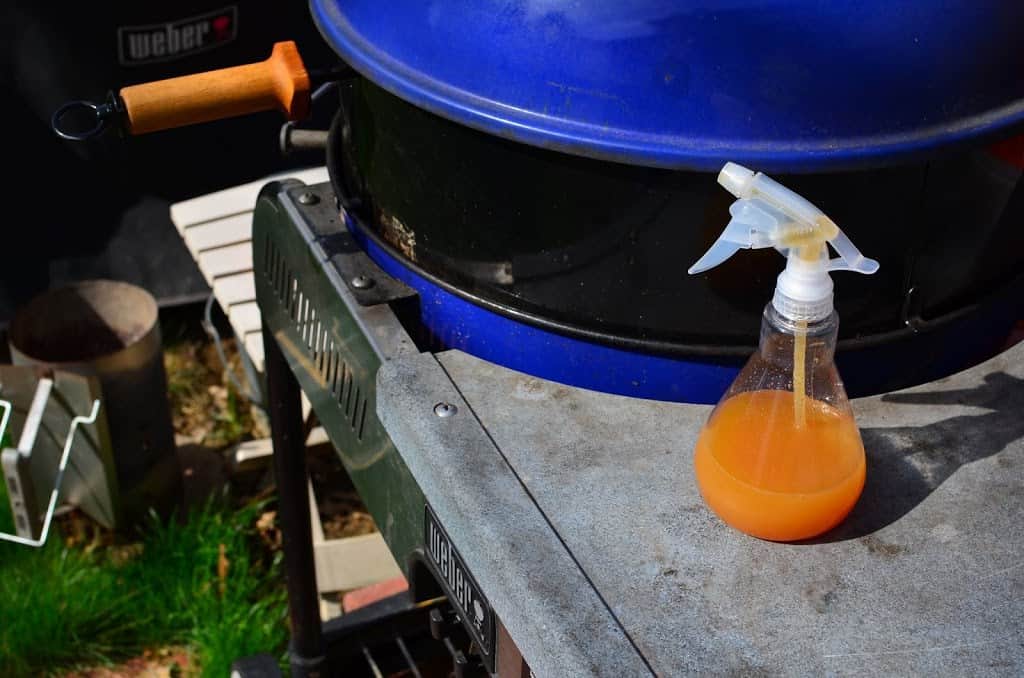
Slow Cooker Texas Red Chili

January 29, 2013 by Mike Vrobel 16 Comments

Super Bowl week...time for Chili!

No, I'm not from Texas.

Please don't tell my anyone. This simple bowl of Texas Red is why everyone in Ohio thinks I can really cook.
Here in Ohio, chili without beans is still exotic.

I've shared this recipe before, in a stove-top version. But, nowadays, I cook it in the slow cooker. Chili is my go-to pot luck dish, and I use the slow cooker at the pot luck to keep the chili warm. Why get a pot dirty when I'm going to use the slow cooker anyhow?

There is one big change from my other recipe. The Second Batch Of Spices.
Yes, all caps. You'll see why.

I learned how to make Texas chili by cooking the International Chili Society's winning recipes (between 1989 and 1993). A lot of them use a second batch of spices, adding a fresh hit of chili powder right before serving.

As time went on, I started making my own version of Texas Chili. I made the classic mistake - that something worth doing is worth over-doing. I added more and more chili powder in the second batch. It got out of hand - I was making the chili gritty and unpleasant.

I went cold turkey, and cut out the second batch of spices entirely. It was still good chili, but people who tasted my earliest versions asked me what was wrong - without the second batch of spices, the chili was missing something.

So, the second batch is back in the recipe. Now I have enough to balance out the flavor, but not so much that you can feel the chili powder on your tongue.

I'm also borrowing a trick from Kenji Alt - brown half the beef on one side. I've tried to skip browning, to speed up the recipe, but the result is weak flavor. By searing one batch of the beef, and only browning it on one side, you get the best balance between depth of flavor and tender meat. (And, more to the point, it only takes four minutes to sear one side, versus sixteen minutes to sear both sides of both batches. I love saving time.)

Recipe: Slow Cooker Texas Red Chili


Inspired By: International Chili Society winning recipes (between 1989 and 1993)

Cooking time: 10 hours

Equipment:

  • 6 quart or larger slow cooker (Crock Pot brand is fine, but I like my fancy one from All-Clad)

Ingredients

Beef

  • 1 tablespoon vegetable oil
  • 5 pounds boneless beef chuck roast cut into 1 ½ inch cubes
  • 2 ½ teaspoons kosher salt
  • 1 teaspoon fresh ground black pepper

Aromatics

  • 2 medium onions, minced
  • 6 cloves garlic, minced
  • ⅓ cup tomato paste (half of a 6 ounce can)
  • 1 teaspoon kosher salt

1st batch of spices

  • ½ cup chili powder
  • 1 tablespoon ground cumin
  • 1 tablespoon ground coriander
  • 1 tablespoon dried oregano
  • 1 tablespoon chipotle en adobo puree

Liquids

  • ½ cup beer (preferably an amber ale - use the rest of the bottle to fortify the cook)
  • 16 ounce can tomato sauce
  • 2 cups chicken broth (preferably homemade)

2nd batch of spices

  • 1 tablespoons chili powder
  • 1 teaspoon ground cumin
  • 1 teaspoon brown sugar
  • ½ teaspoon kosher salt
  • 1 teaspoon chipotle en adobo puree
  • Juice of 1 lime

Directions

1. Brown the beef
Season the beef with 2 ½ teaspoons of salt and the pepper. Heat the vegetable oil in a large fry pan over medium-high heat until shimmering. Split the beef into two batches, and put one batch into the slow cooker crock. Put the second batch of beef in the fry pan in a single, loose layer, and put any pieces that don't fit into the slow cooker. Let the beef in the fry pan sit until it is well browned on the bottom, about 4 minutes. Using a slotted spoon, transfer the browned beef into the slow cooker pot with the rest of the beef.

2. Saute the aromatics and toast the spices
Add the onions, garlic, and tomato paste to the fry pan, sprinkle with 1 teaspoon of salt, and saute until the onions soften and the tomato paste darkens, about 5 minutes. Make a hole in the middle of the onions and add the first batch of spices. Cook until you smell the spices toasting, about 1 minute, then stir the spices into the onions. Add the onions and spices to the crock pot, and stir to coat the beef. Put the fry pan back on the stove, turn the heat to high, and pour in the beer. Bring the beer to a simmer and use a wooden spoon to scrape the browned bits loose from the bottom of the pan. Pour the beer into the slow cooker crock, add the tomato sauce and chicken broth, and stir to coat the beef.

3. Slow cook the chili
Cover the slow cooker and cook the chili on low for 10 hours or high for 5 hours.

4. Finish the chili
½ hour before serving the chili, stir in the second batch of spices. Put the lid back on and let the spices simmer. When the chili is done, taste for seasoning, and add more salt or lime juice if needed. Serve.

Notes:

  • Stove top safe crock instructions: As you can see in the pictures, my All-Clad slow cooker has a stove top safe crock. I do all the browning, sauteing, and boiling steps directly in the crock. The only change to the instructions is, in step 1, move the beef to a bowl after it is brown, and in step 2, stir it back into the crock when the onions and spices are done toasting.
  • "I'm in a hurry" instructions: Skip step 1 - browning the beef - and put it straight into the crock. Saute the onions and toast the spices, then rinse the pan out with beer and pour everything in the slow cooker. Skip the second batch of spices, but make sure to add extra salt if it's needed when you taste for seasoning. You won't get the same depth of flavor, but you cut a lot of the active time out of the cooking
  • No slow cooker? No worries. Here is the stove top version of the recipe.

What do you think? Questions? Other ideas? Leave them in the comments section below.

Related Posts:

Texas Red Chili (stove top version)
Slow Cooker Chili with Ground Beef and Beans
My other slow cooker recipes.

*Enjoyed this post? Want to help out DadCooksDinner? Subscribe to DadCooksDinner using the RSS or Email options on the right, link to this post from your blog, recommend DadCooksDinner to your friends, or buy something from Amazon.com through the links on this site. Thank you.

Video: Rotisserie Grilling Two Chickens

January 24, 2013 by Mike Vrobel 5 Comments

Do you want a walkthrough of how to grill two rotisserie chickens? I have a video just for you:

Video link: Rotisserie Grilling Two Chickens - [YouTube.com]

*I had the hardest time saying "spit fork". Kind of important for this video. I just couldn't...spit it out.

Recipe:

Here is the recipe that goes with the video:
Rotisserie Chicken with Fennel, Coriander, and Red Pepper Rub

Related Posts:

Video: How to Truss and Spit a Turkey for the Rotisserie
Video: Rotisserie Turkey Legs
Click here for my other rotisserie recipes.


Check out my cookbook, Rotisserie Grilling.

Everything you could ask about the rotisserie,
plus 50 (mostly) new recipes to get you cooking.

Available in paperback, or as a Kindle e-book so you can download it and start reading immediately!


*Enjoyed this post? Want to help out DadCooksDinner? Subscribe to DadCooksDinner using the RSS or Email options on the right, link to this post from your blog, recommend DadCooksDinner to your friends, or buy something from Amazon.com through the links on this site. Thank you!
Rotisserie Chicken With Fennel, Coriander, and Red Pepper Spice Rub

January 22, 2013 by Mike Vrobel 5 Comments

Rotisserie Chicken with Fennel, Coriander, and Red Pepper Spice Rub

Rotisserie Chicken With Fennel, Coriander, and Red Pepper Spice Rub

A reader emailed me a question from my Rotisserie Grilling cookbook.
*You know about the cookbook, right? Available in e-book and paperback editions? Just checking.She loved the rotisserie chicken…except for getting it off the spit. Her question was - how do I handle two chickens? What do I do to get them off the spit without making a complete mess?

I started to reply: "Look at how I do it in the video." Then I remembered…I don't have a video of that.

The video is taking longer to edit than I thought; it should be posted in a couple of days. To entertain you while you wait, here's the rotisserie chicken recipe from the video.

This is a simple chicken, rubbed with my current favorite spice rub. The rub is an Italian mix of coarsely ground fennel and coriander, with black pepper and a pinch of hot pepper flakes to give it some kick.

I know it's January, I know it's cold, and I know I was whiny about shoveling my deck last weekend. (Sorry about the whiny bit.) That doesn't mean you shouldn't grill this weekend - get out there and fire something up!

Equipment

  • Grill with Rotisserie attachment (I used a Weber Summit with an infrared rotisserie burner. Here is the current version of my grill.)
  • Aluminum foil drip pan (9"x13", or whatever fits your grill. I use an enameled steel roasting pan or Weber Extra-Large aluminum foil drip pans.)
  • Butchers twine
  • Instant Read Thermometer
  • Spice grinder or mortar and pestle

Seasoned, trussed, and spit

Ready for the grill
Ready for the grill

Done, ready to carve and serve

Notes:

  • If you have the time, use the spice rub as a dry brine. Rub the chickens the night before cooking, and refrigerate overnight. One hour before cooking, remove the chickens from the refrigerator, and continue with trussing and spitting them.
  • No rotisserie? No worries. Set your grill up for indirect high heat, put the drip pan under the grill grate, put the grate back on the grill, then put the chickens breast side down over the drip pan. Grill with the lid closed for 30 minutes, then open the lid, flip the chickens breast side up, and grill for another 30 minutes, or until they reach 160°F internal temperature in the breast.
  • This recipe was originally titled "...with Rosemary, Fennel, and Coriander Rub. That is, until I forgot the rosemary. It's a good addition - add a teaspoon of fresh rosemary leaves, and grind them up with the other spices in the spice grinder.

What do you think? Questions? Other ideas? Leave them in the comments section below.

Related Posts:

Video: Rotisserie Grilling: Two Chickens
List of my other rotisserie recipes


Check out my cookbook, Rotisserie Grilling.

Everything you could ask about the rotisserie,
plus 50 (mostly) new recipes to get you cooking.

Available in paperback, or as a Kindle e-book so you can download it and start reading immediately!


*Enjoyed this post? Want to help out DadCooksDinner? Subscribe to DadCooksDinner using the RSS or Email options on the right, link to this post from your blog, recommend DadCooksDinner to your friends, or buy something from Amazon.com through the links on this site. Thank you.
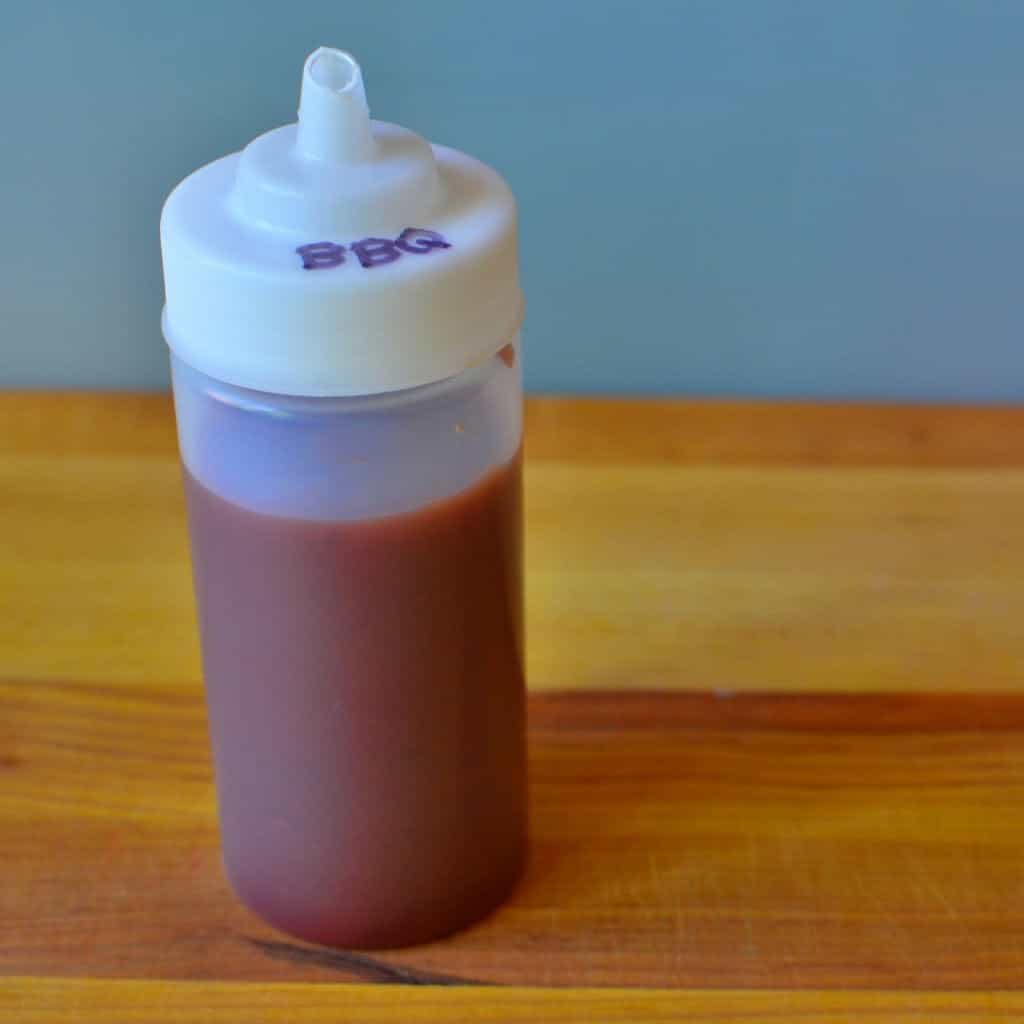
Pressure Cooker Tortellini en Brodo

January 17, 2013 by Mike Vrobel 8 Comments

A white bowl with tortellini in broth on a reddish-brown wood background
A white bowl of tortellini in broth, on a wooden table
Instant Pot Tortellini en Brodo

Sorry about the heavy rotation of pressure cooker recipes. The stomach flu flattened us. A simple broth and pasta soup is all I can handle right now.

When I make soup, more is better. Everything goes in the pot. What do I have in the refrigerator and pantry? Onions, celery, carrots, peppers, cabbage; noodles, rice, leftover chicken, beans, some sausage. Add it all to the soup pot. Throw in some herbs and spices for good measure. Simmer until the flavors mingle, taste for seasoning, then serve.

Tortellini en Brodo is minimalist soup. Clear broth and noodles stuffed with cheese, it is as simple as soup gets.

Simple doesn't leave any place to hide. The broth has to be good for this soup to have any chance. And homemade broth is so far from canned broth that you can see the curve of the horizon.

That's where my pressure cooker comes in. It gives me great brodo in about an hour. A mix of beef and chicken adds depth to the simple broth, and a parmesan rind gives it a hint of funk. The ground beef? It acts like the raft does in a consomme, clarifying the broth while it cooks.

For the tortellini, homemade would be best…but I've never learned rolling skills, and don't have an Italian grandmother to teach me.

So, next best is from your local Italian market. They'll have tortellini, probably homemade by someone's Nonna, frozen and ready for you.

If you're stuck, grocery store tortellini is acceptable. I like Barilla dried tortellini, or Butioni fresh tortellini. Homemade broth makes up for average tortellini.

No pressure cooker? No worries. See the notes section for stovetop and slow cooker broth instructions.

Recipe: Pressure Cooker Tortellini en Brodo

Everything in the pot
A white bowl with tortellini in broth on a reddish-brown wood background
Pressure Cooker Tortellini en Brodo

What do you think? Questions? Other ideas? Leave them in the comments section below.

Related Posts:

Pressure Cooker Chicken Broth
Pressure Cooker Pasta and Beans
Pressure Cooker Pho Bo

*Enjoyed this post? Want to help out DadCooksDinner? Subscribe to DadCooksDinner using the RSS or Email options on the right, link to this post from your blog, recommend DadCooksDinner to your friends, or buy something from Amazon.com through the links on this site. Thank you.

The Loneliness of the Midwinter Blogger

January 15, 2013 by Mike Vrobel 16 Comments

I'm feeling sorry for myself.

  • I just got over the stomach flu. It wiped us out for about a week, and my stomach is still uneasy. I'm cooking based on how easy it is to get dinner done, not how excited I am about eating.
  • The grill is covered with snow. On a deck covered with snow, that I don't want to shovel.
  • The sun sets at 5PM, making all my blog pictures look awful, because I need to use artificial light. And that's on the one day a week when I get to see the sun, and it's not gray and overcast.
  • Seasonal affective disorder is setting in. The excitement of the holidays, and a white Christmas - it's gone. Now it's just cold and dark.
  • My new cookbook isn't flowing. I'm way behind schedule. It's a grilling cookbook, and the grill covered with snow is holding my recipe testing back…but not as much as my own procrastination. I'm supposed to get up at 5:30AM every morning, so I can get my writing in. I keep turning off the alarm clock, rolling over, and going back to sleep.
  • I'm trying to lose weight, and the diet is boring me already. I want starch, potatoes, fatty food, even though I know I shouldn't. (Though this is the only good part of the stomach flu - losing weight was easy for a couple of days.)

I'm overwhelmed. I want to crawl under the covers and hibernate until spring. And I feel guilty about feeling sorry for myself, so it is a cycle that feeds on itself.

I know these are all first world problems. I appreciate all of you, reading what I write, leaving comments, sending me email. It keeps me going.

But, man, I hate this time of year.

How about you? How are you surviving the winter? Talk about it in the comments, below.

Enjoyed this post? Want to help out DadCooksDinner? Subscribe to DadCooksDinner using the RSS or Email options on the right, link to this post from your blog, recommend DadCooksDinner to your friends, or buy something from Amazon.com through the links on this site. Thank you.
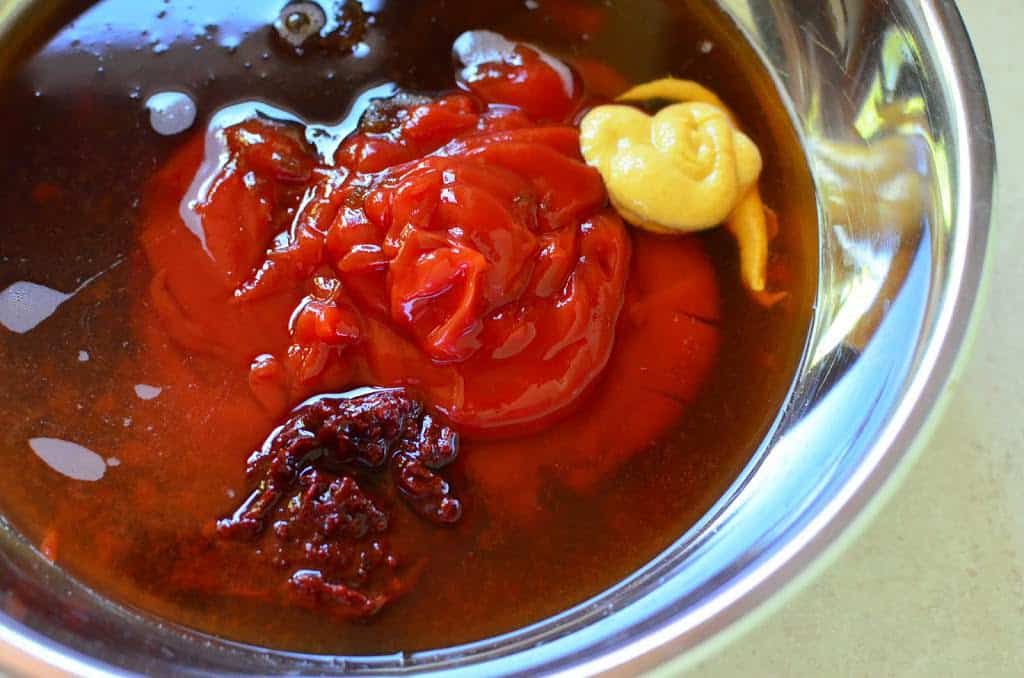

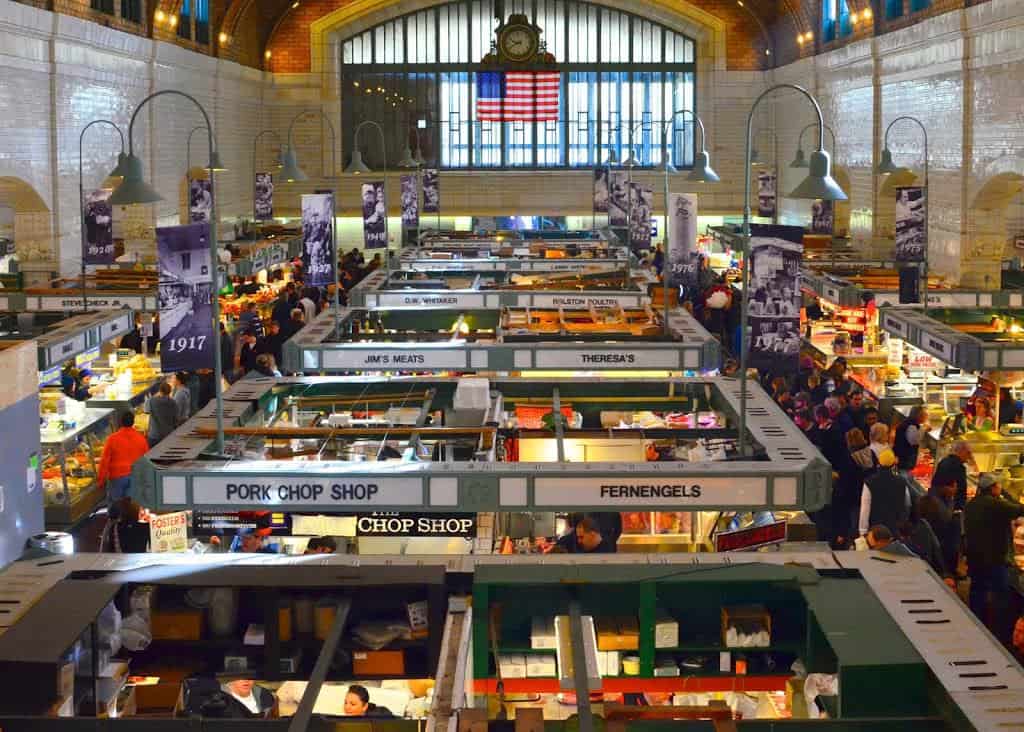
  • « Previous Page
  • 1
  • …
  • 22
  • 23
  • 24
  • 25
  • 26
  • …
  • 37
  • Next Page »

Welcome to Dad Cooks Dinner!

I'm Mike Vrobel, a dad who cooks dinner every night. I'm an enthusiastic home cook, and I write about pressure cooking, rotisserie grilling, and other food topics that grab my attention.

More About Me →

Popular

  • Three bowls of cooked Pinto Beans on a wood table
    Instant Pot Pinto Beans (No Soaking)
  • Pressure Cooker Beef Shank (Osso Bucco)
  • Pressure Cooker 7 Hour Leg of Lamb (in 90 minutes)
    Pressure Cooker 7 Hour Leg of Lamb (in 90 minutes)
  • Pressure Cooker Brown Jasmine Rice
  • Grilled Tomahawk Steak (Long Bone Ribeye, Reverse Seared)
    Grilled Tomahawk Steak (Long Bone Ribeye, Reverse Seared)
  • A green bowl full of chicken noodle soup
    Instant Pot Rotisserie Chicken Noodle Soup

Seasonal

  • A bowl of asparagus risotto
    Instant Pot Asparagus Risotto (Pressure Cooker Recipe)
  • Grilled Butterflied Chicken with Garlic Butter
  • Sous Vide rack of lamb sliced into chops
    Sous Vide Rack of Lamb with Dijon Bread Crumb Crust
  • A bowl of beef stew with asparagus, carrots, and radishes.
    Instant Pot Spring Vegetable Beef Stew
  • A Rotisserie Chicken (Pollo Asado)on a platter of shredded cabbage
    Rotisserie Chicken Pollo Asado
  • Rotisserie Pork Shoulder Roast with Carolina Mustard BBQ Sauce
    Rotisserie Pork Shoulder with South Carolina Mustard Barbecue Sauce

Footer

↑ back to top

About

  • Privacy Policy

Newsletter

  • Sign Up! for emails and updates

Contact

  • Contact

Copyright © 2025 Dad Cooks Dinner