DadCooksDinner

  • Home
  • Rotisserie
  • Recipes
  • Tools
  • Books
  • Merch
menu icon
go to homepage
  • Recipes
  • Books
  • Tools
  • Merch
  • About
subscribe
search icon
Homepage link
  • Recipes
  • Books
  • Tools
  • Merch
  • About
×
Home » Recipes

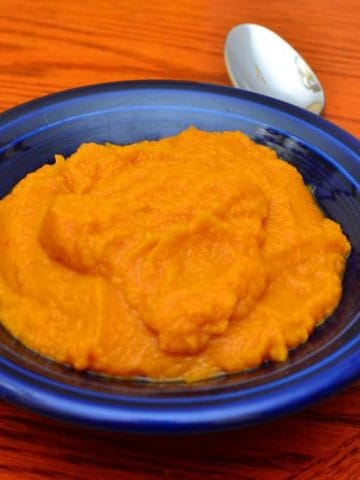
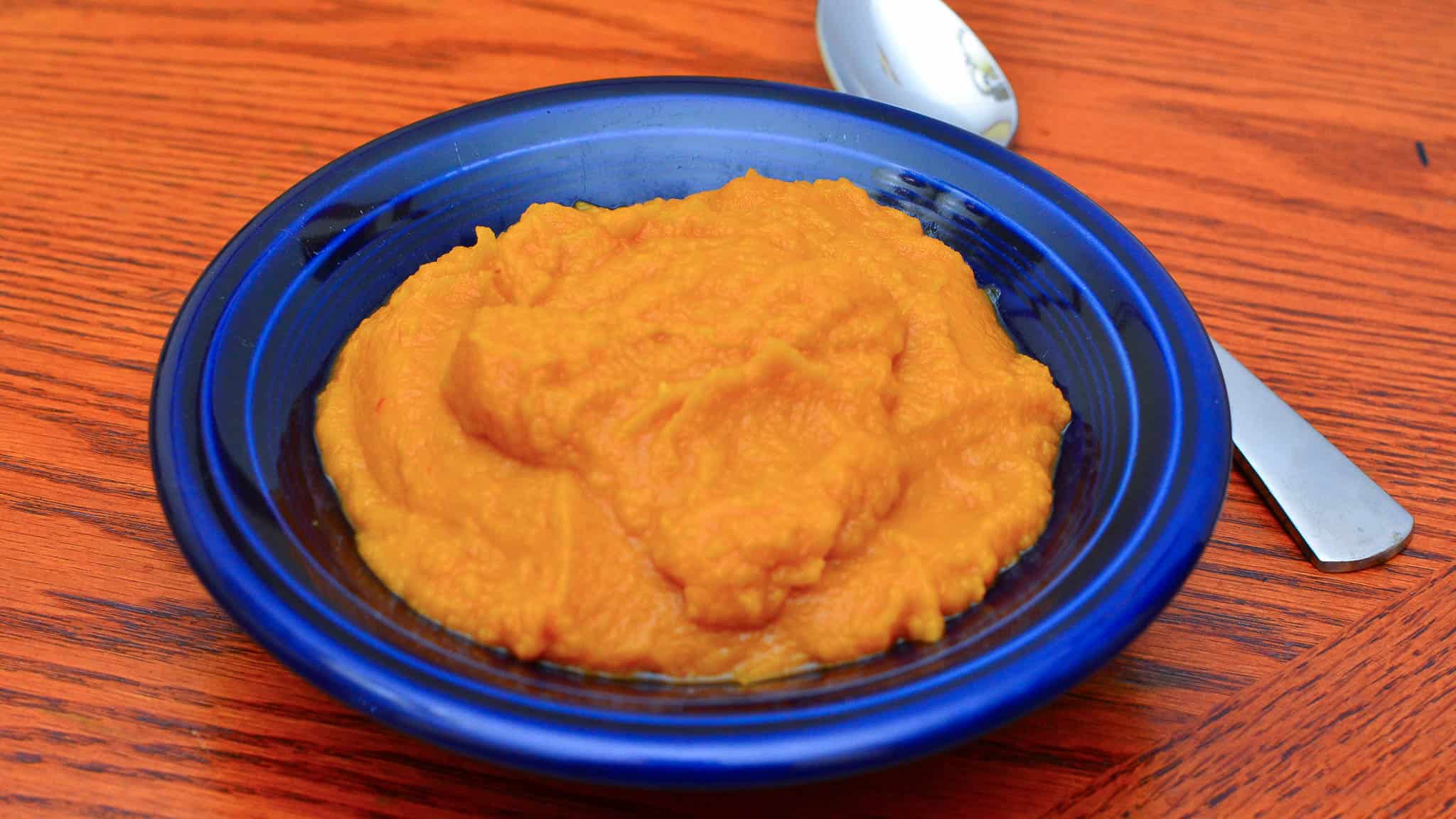
Pressure Cooker Sweet Potato Puree

January 10, 2013 by Mike Vrobel 16 Comments

Pressure Cooker Sweet Potato Puree

Roasted sweet potato puree in a half an hour, with most of that being hands off time. Sounds like a miracle? It's not a miracle, it's science!

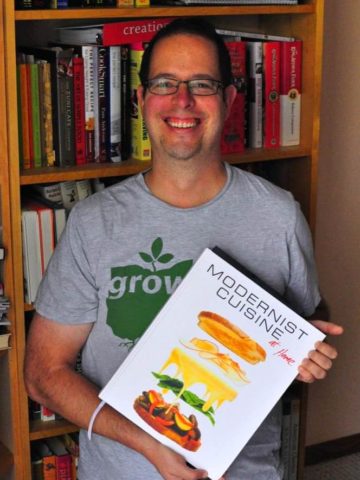
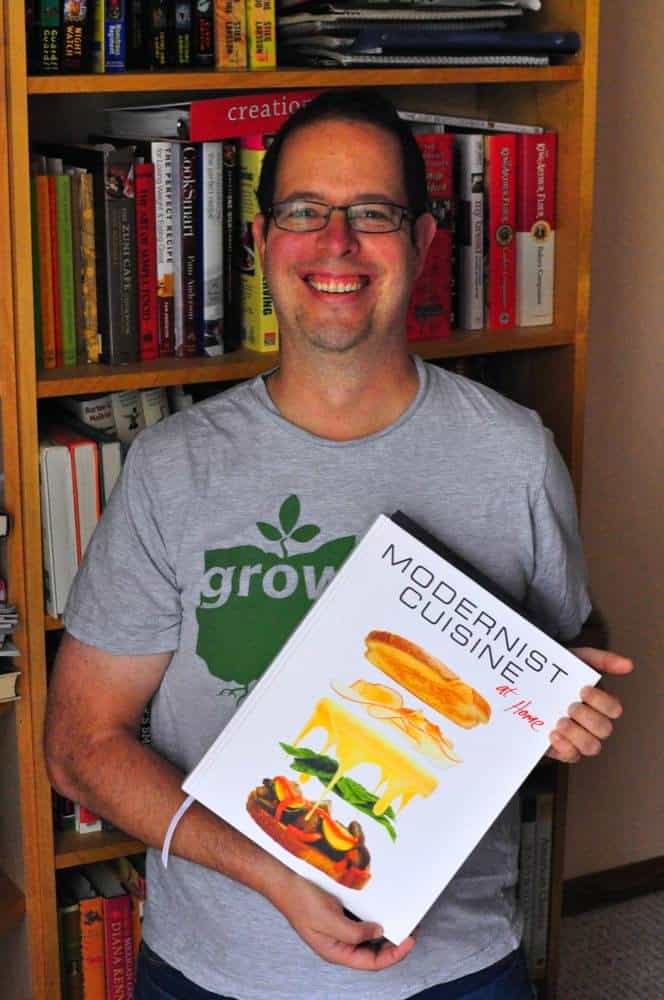
This is one of the neatest tricks I learned from Modernist Cuisine at Home. Browning occurs at much lower temperatures in an alkaline environment. The Maillard reaction normally occurs at temperatures above 350°F. According to MC@H, browning occurs at 230°F in an alkaline environment. We can easily reach that temperature in a pressure cooker, and the result is sweet potatoes that are browned all the way through.
I'm using this technique with sweet potatoes, but it works with almost any vegetable. I've used it with carrots (via ModernistCuisine.com) and winter squash (via SeattleWeekly.com and Seattle Food Geek). In the book (MC@H) they make a range of vegetables - from leek and potato onion soup to roasted red pepper puree.

Now, one question I had - Modernist Cuisine pressure cooks the vegetables for 20 min. Everyone else (for example, my Cuisinart Electric PC) recommends 6 minutes, max. Why the extra time? To give the vegetables time to brown all the way through. Yes, that's right, the interior of the vegetables will brown as well as the exterior.

If you own a Pressure Cooker, you need to try this technique out.

Adapted From: Modernist Cuisine at Home

Equipment

  • 6 quart or larger pressure cooker (I use an Instant Pot electric PC)
  • Potato masher (or food processor)
  • The silicone mini-mitts from the video

Notes

  • No pressure cooker? You won't get the roasted flavor that the pressure cooker offers, but you can do a regular sweet potato puree. Skip the baking soda, and using a regular pot, follow the instructions to "lock the lid of the pressure cooker." Then, cover the pot, bring to a simmer, and simmer for 30 minutes, or until the sweet potatoes can be easily pierced with a paring knife. Continue with "puree the sweet potatoes".
  • This recipe scales up easily; use ½ teaspoon baking soda per 2 pounds of vegetables. That's the right proportion to get the alkaline environment for pressure browning.

What do you think? Questions? Other ideas? Leave them in the comments section below.

Related Posts:

Book Review: Modernist Cuisine at Home
Grilled Version: Grilled Mashed Sweet PotatoesClick here for my other pressure cooker recipes.

*Enjoyed this post? Want to help out DadCooksDinner? Subscribe to DadCooksDinner using the RSS or Email options on the right, link to this post from your blog, recommend DadCooksDinner to your friends, or buy something from Amazon.com through the links on this site. Thank you.
Slow Cooker Braised Chicken Thighs

January 3, 2013 by Mike Vrobel 13 Comments

I am a fan of the Dark Side…of the chicken.
When you look at the dark side, careful you must be. For the dark side looks back.

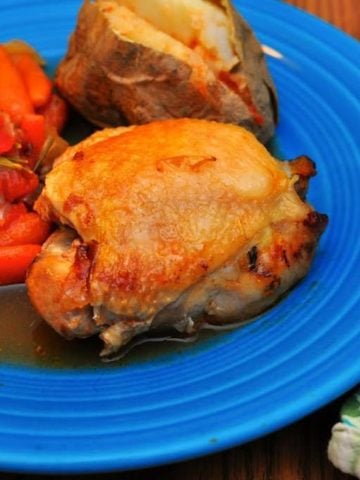
This is a good thing for slow cooker chicken. Slow cookers plus chicken breasts equal dry, stringy meat. But chicken thighs...oh, glorious dark meat, falling off the bone.

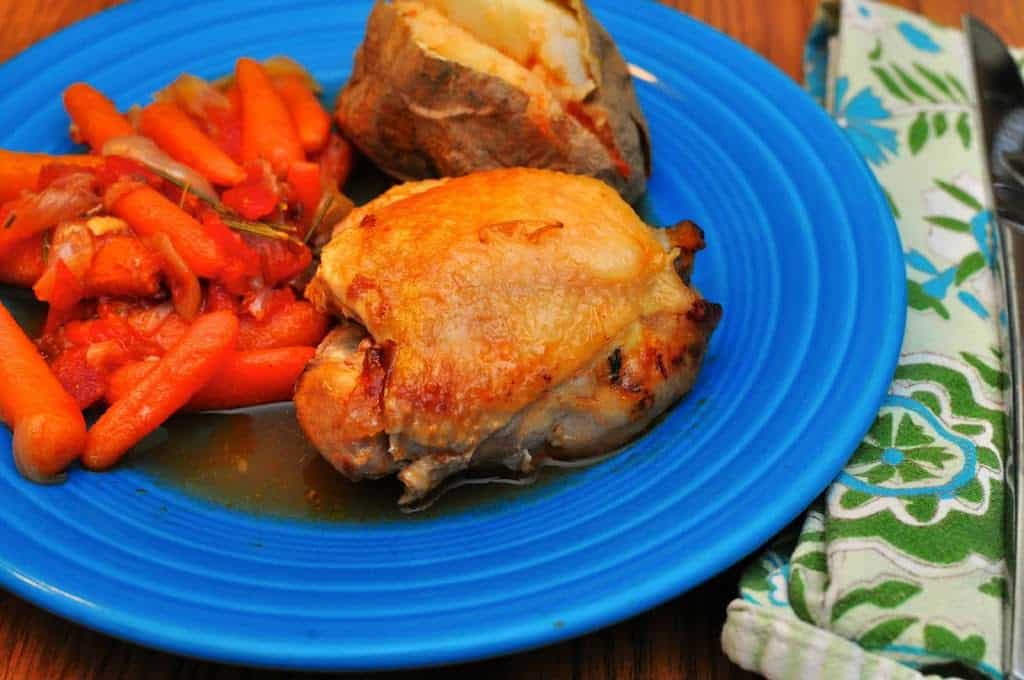
Here is a straightforward chicken braise, based on a recipe from Alice Waters. A few aromatics, some tomatoes for sweetness, a little wine to perk it up with acidity. And lots of chicken thighs.

The liquid that comes out of the crock pot is almost as good as the chicken. Serve with baked potatoes, mashed potatoes, rice, noodles, or dinner rolls, and smother them with the chicken juices.

Recipe: Slow Cooker Braised Chicken Thighs


Adapted From: Alice Waters The Art of Simple Food

Cooking time: 6 hours

Equipment:

  • Slow Cooker 6 quart or larger. I love my All-Clad with the stove top safe crock. I can brown the chicken and saute the aromatics in one pot.

Ingredients

  • 1 teaspoon vegetable oil
  • 3 pounds chicken thighs (about 8)
  • 2 teaspoons kosher salt
  • ½ teaspoon fresh ground black pepper
  • 1 large onion, sliced
  • 1 pound baby carrots
  • 2 cloves garlic, crushed
  • 1 tablespoon tomato paste
  • 1 teaspoon kosher salt
  • ½ cup dry white wine (I used Riesling)
  • 15 ounce can of diced tomatoes
  • 1 sprig fresh rosemary
  • 2 sprigs fresh thyme

Directions

1. Brown the chicken thighs
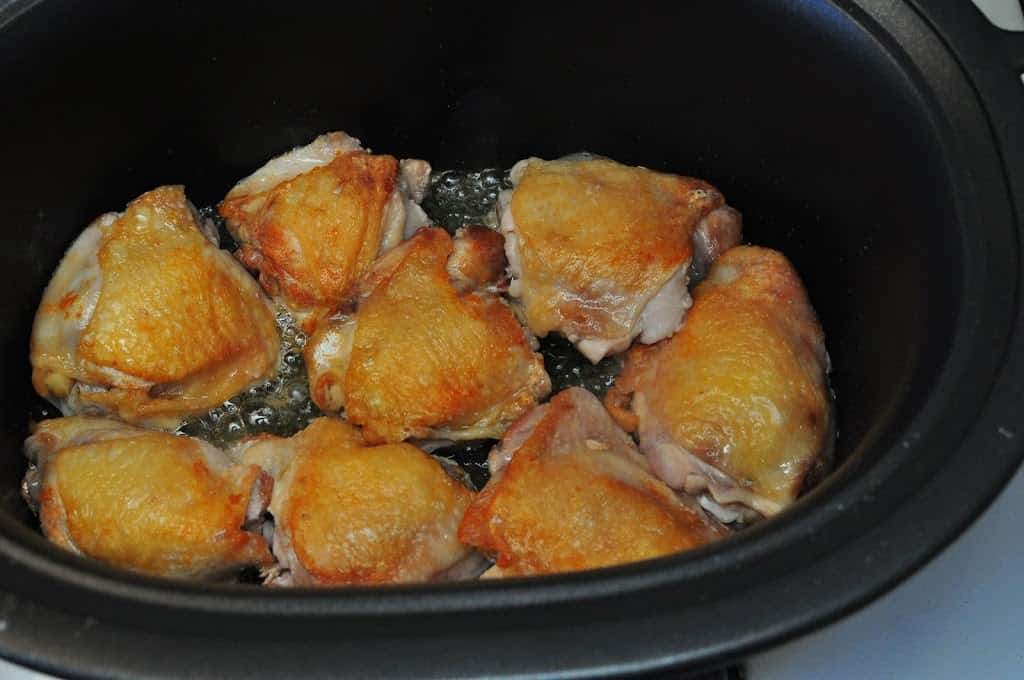
Sprinkle the chicken thighs evenly with two teaspoons of salt and pepper. In a large fry pan (or a stove top safe slow cooker insert), heat the teaspoon of oil over medium high heat until shimmering. Add the chicken thighs, skin side down, and cook until the chicken skin is golden brown, about 8 minutes. Remove the chicken to a bowl.

2. Saute the aromatics
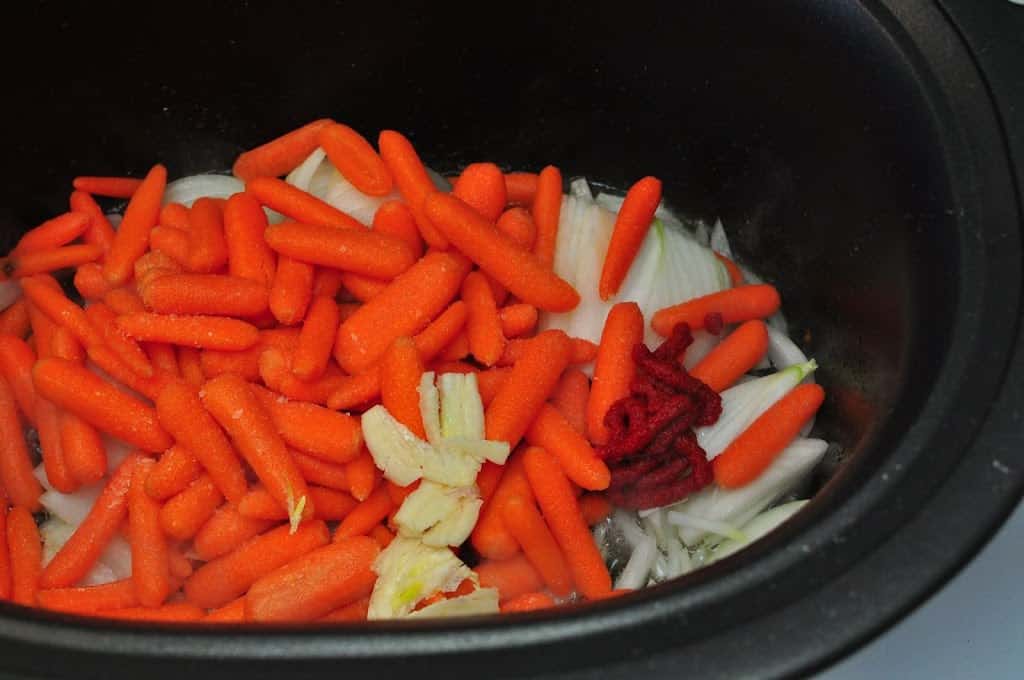
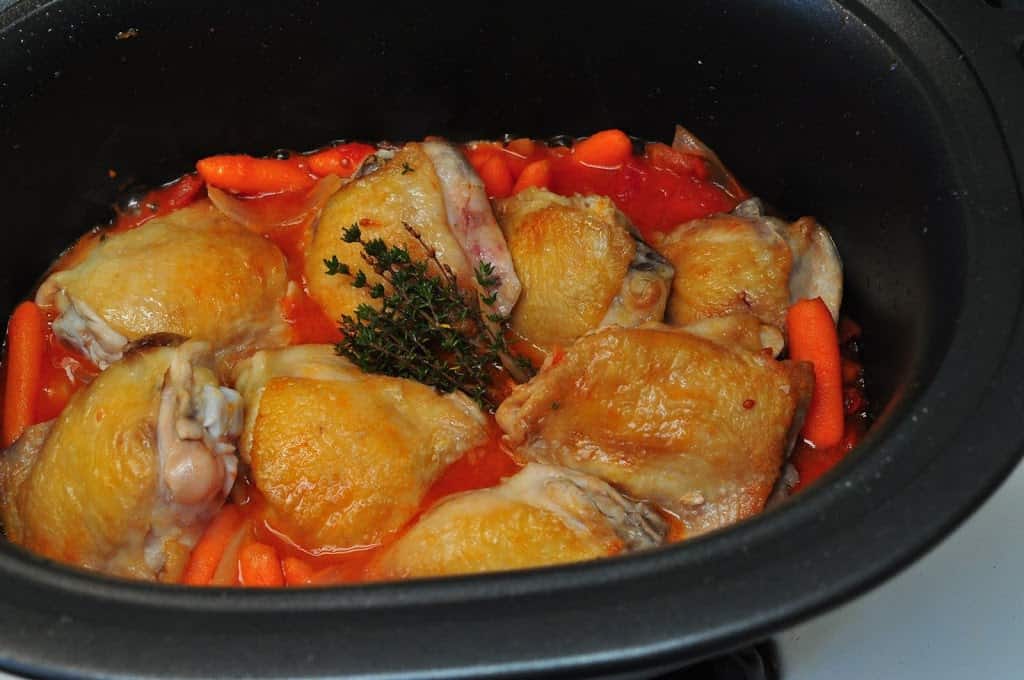
Pour out all but a tablespoon of the chicken fat in the pan, then add the onions, carrots, garlic, and tomato paste. Sprinkle with one teaspoon kosher salt, and saute until the onions are softened and lightly browned on the edges, about five minutes. Add the white wine to the pan, bring to a boil, and scrape any browned bits from the bottom of the pan. Stir in the diced tomatoes, rosemary, and thyme. Pour the contents of the pan into the slow cooker, then nestle the chicken thighs into the vegetables.

3. Slow cook the chicken
Cook the chicken on low heat for 6 hours, or high heat for 3 hours.

4. Serve
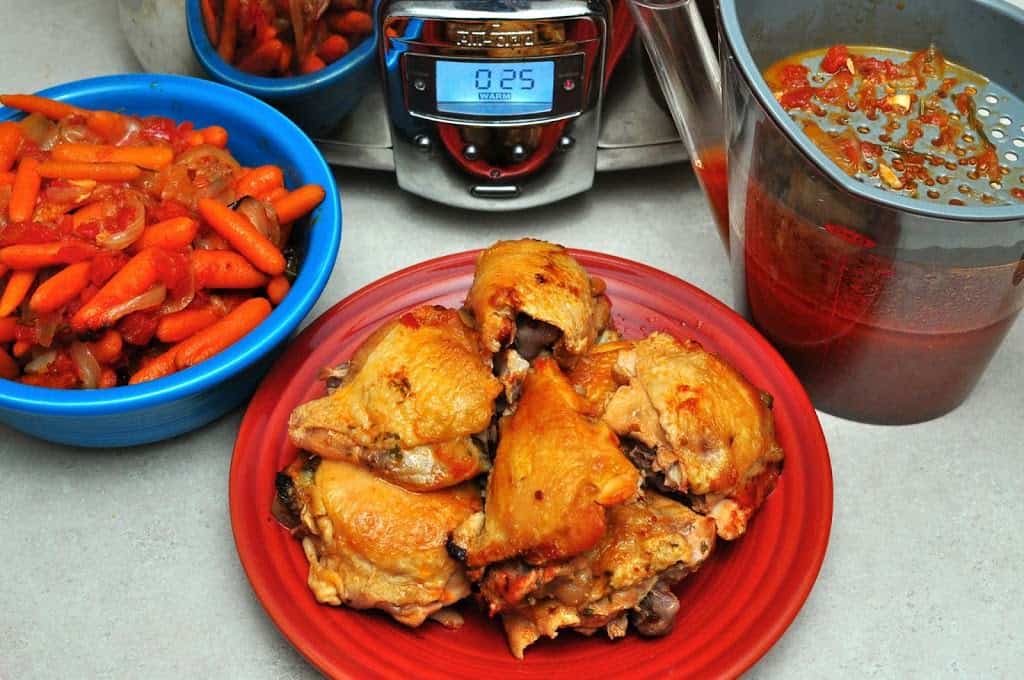
Scoop the chicken thighs, onions, carrots and tomatoes out of the slow cooker with a slotted spoon, and transfer to a platter. Degrease the liquid in the crock with a fat separator, then pour some of it over the chicken, and pass the rest at the table.

Notes

  • No slow cooker? No problem. Instead of pouring everything into the the slow cooker, nestle the chicken pieces in the fry pan, add a cup of water, then move the entire fry pan into a 350*F oven for one hour. (If your fry pan doesn't have an oven safe handle, transfer everything to a dutch oven before moving it into the oven.)
  • Chicken thighs (or legs) are also a good deal. You can usually get them for less than two dollars a pound, even if they are locally grown, organic chicken. Which you should - there's no sense in being penny wise and pound foolish, and saving money on chicken thighs. Get the good ones.
  • Now if only I would listen to my own advice, and not give in to the siren song of $0.69 cent chicken legs at the grocery store.

What do you think? Questions? Other ideas? Leave them in the comments section below.

Related Posts:

Slow Cooker Pork Pot Roast
Slow Cooker Chicken Legs with Herb Rub
Slow Cooker Chinese Red Cooked Chicken Thighs

Adapted from:

Alice Waters The Art of Simple Food

*Enjoyed this post? Want to help out DadCooksDinner? Subscribe to DadCooksDinner using the RSS or Email options on the right, link to this post from your blog, recommend DadCooksDinner to your friends, or buy something from Amazon.com through the links on this site. Thank you.
New Year's Resolutions 2013

January 1, 2013 by Mike Vrobel 6 Comments

Here's to a prosperous 2013

Finish my next book
My next book is coming along. Slowly. After I finished the last book, I relaxed, and I haven't made as much progress as I should. I need to get back in the groove, getting up early and writing every day.

Lose weight
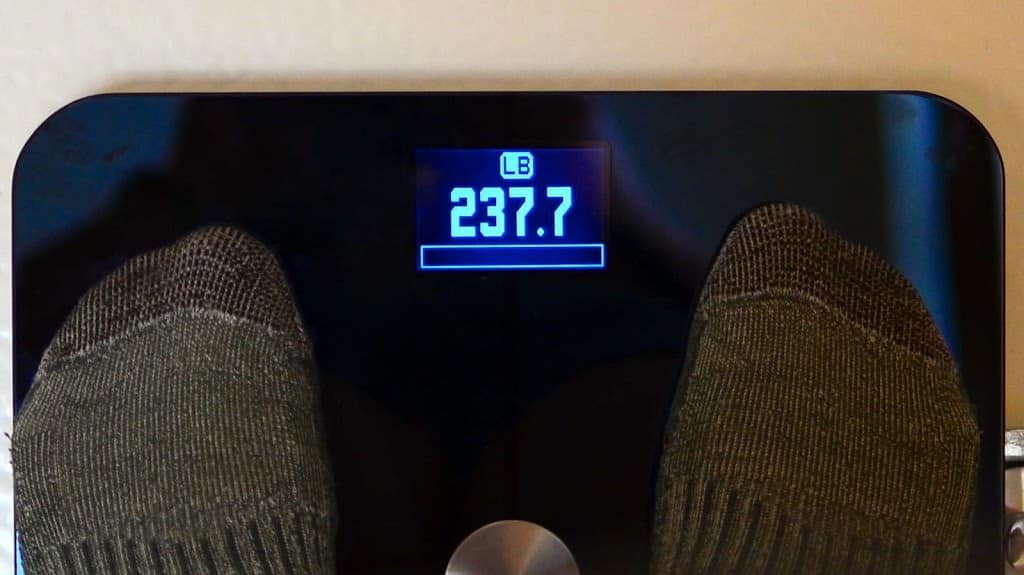
One of the few downsides to food blogging - my weight keeps creeping up. And up. It's up to…to…I'm embarrassed by what it's up to.

Yikes

What am I going to do about that? It's time to start counting calories again. Oh, and in a related subject…

More vegetable posts
I apologize for how meat-heavy the blog has been. I need to do more posts with vegetables. It's just that the main dish meat courses are fun to write about. Kale…not so much. But, I cook vegetables all the time, shop at my farmers market, get my CSA box every other week...I need to share those experiences in the blog.

Read the cookbooks I have before I buy new ones
My stack of unread cookbooks keeps getting larger. I need to read them before I start buying new ones. And spring is coming, with all the new grilling cookbooks - I better get reading.

Happy new year, everyone!

What do you think? What are your new year's resolutions? Leave them in the comments section below.

*Enjoyed this post? Want to help out DadCooksDinner? Subscribe to DadCooksDinner using the RSS or Email options on the right, link to this post from your blog, recommend DadCooksDinner to your friends, or buy something from Amazon.com through the links on this site. Thank you.
Merry Christmas 2012

December 25, 2012 by Mike Vrobel 4 Comments

Dad: Did you have a nice Christmas?

Ralphie: Yeah, pretty nice.

Dad: Did you get everything you wanted?

Ralphie: Well, almost.

Dad: Almost? Well, that's life. Well, there's always next Christmas... That's funny. What's that over there behind the desk?

Ralphie: Where?

Dad: Behind the desk, against the wall over there. Why don't you go check it out?

Merry Christmas, everyone!

Rotisserie Capon with Chestnut Stuffing

December 20, 2012 by Mike Vrobel 4 Comments

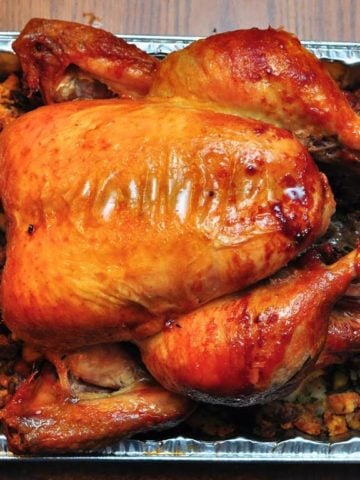
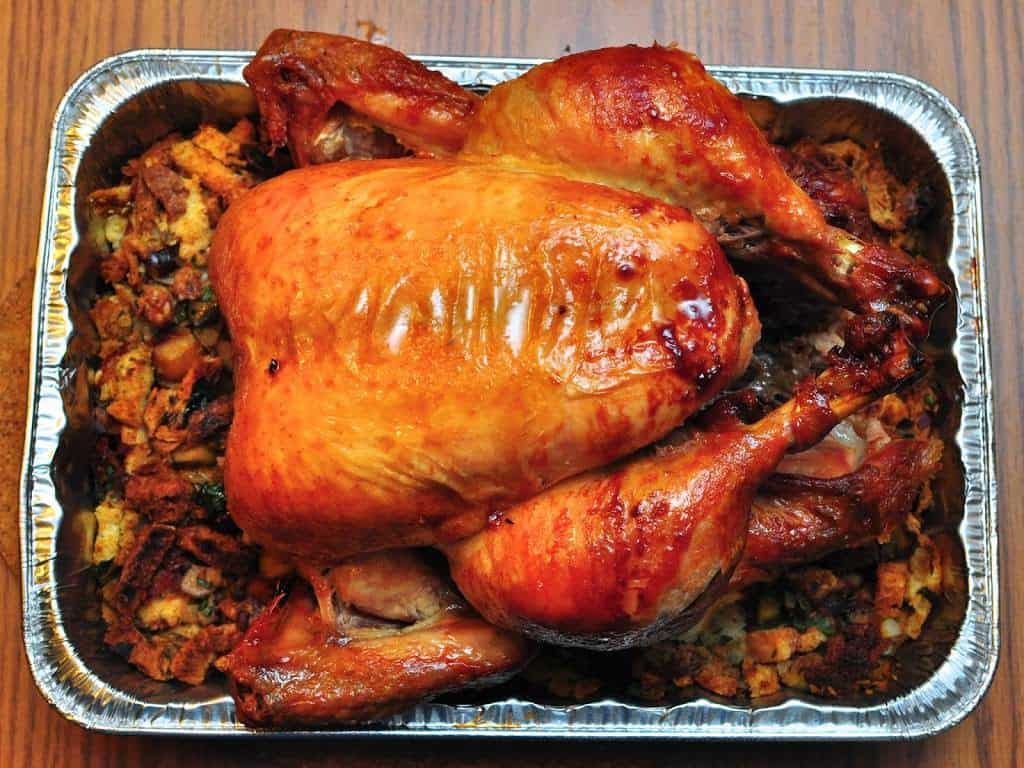
Rotisserie capons with chestnut stuffing. It just sounds like Christmas, doesn't it? When I saw it mentioned in Canal House Cooking, I knew what I was making for the holidays this year.

Now, I've never cooked a capon before. Capons are roosters that are…um…fixed, as a veterinarian would say. The result is a big, lazy bird that grows nice and plump - the average size of a capon is eight pounds. It's the right size bird if you need something larger than a chicken, but smaller than a turkey.

Now, for the stuffing. My hero, Alton Brown, said that stuffing a bird is evil. By the time the stuffing is cooked to a safe temperature, the bird around the stuffing is wildly overcooked. I solved this with a trick from Cooks Illustrated - preheat the stuffing in the microwave. The stuffing is hot when it goes into the bird, and the meat doesn't overcook.

Then came my next problem. Rotisseries and stuffing are not a good combination. I stuffed the bird, trussed it tight, and turned on the rotisserie. As the bird rotated, the stuffing worked its way out of the cavity and fell into the drip pan. The result was an empty bird and a pan full of burned stuffing.

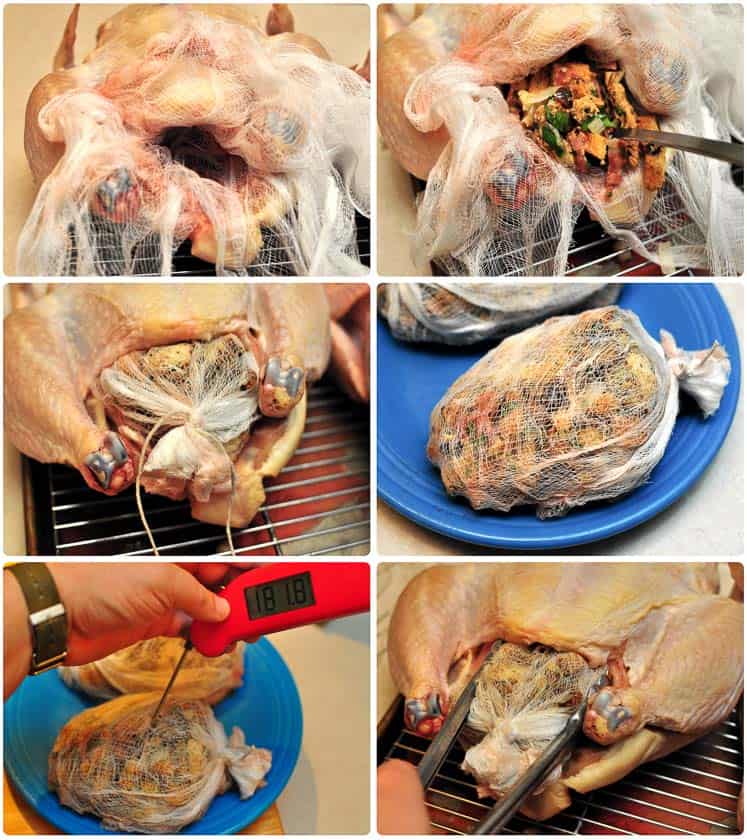
I thought of trying a stuffing bag, but I didn't think I'd be able to get the rotisserie spit through the tough cotton. Then I saw Kenji Alt's idea of using cheesecloth to make a stuffing bag. Perfect! Cheesecloth has a very loose weave, leaving gaps for the point of the rotisserie spit to push through. As a bonus, the bag of stuffing is easy to pull out of the bird and pop in the microwave for pre-heating.

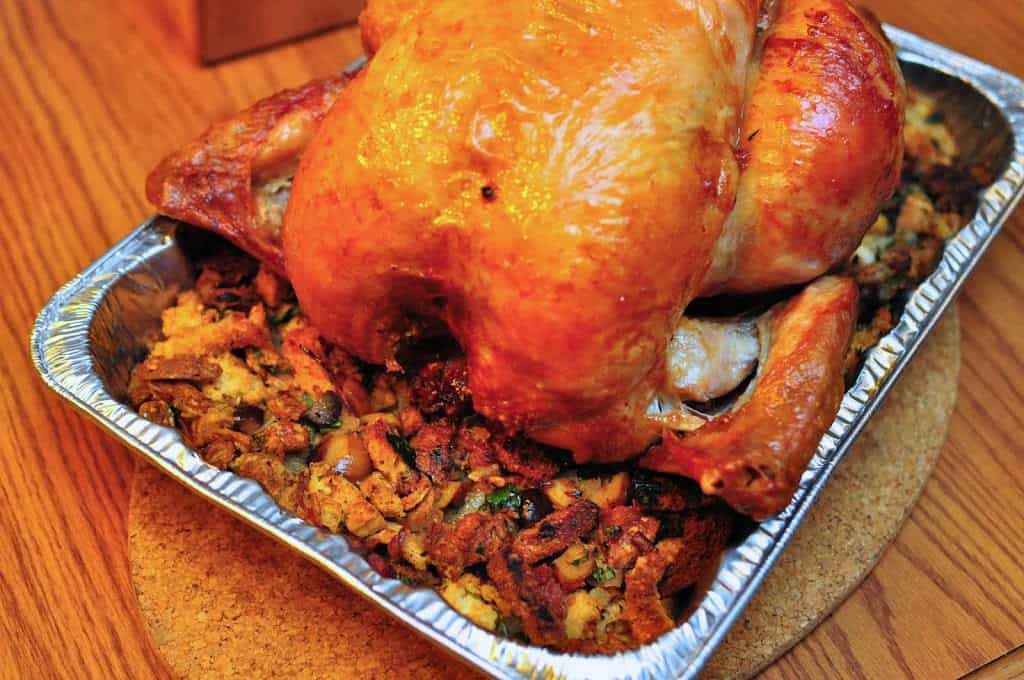
Now, a stuffed bird doesn't hold enough for a crowd. I could only get a few cups of stuffing in the cavity. No worries - I made a batch of stuffing, filled the bird with as much as I could, and put the rest in a spare drip pan. I cover the pan with foil so the stuffing steams as it cooks; I cut slits in the foil so the drippings can flavor the stuffing. When everything is done cooking, I mix the stuffing that was absorbing the capon juices from the cavity with the stuffing in the pan, so everyone gets a taste.

Recipe: Rotisserie Capon with Chestnut Stuffing

Adapted From: Canal House Cooking Vol 7, La Dolce Vita

Stuffing a capon for the rotisserie, step by step pictures | DadCooksDinner.com
Stuffing a capon for the rotisserie, step by step pictures
Rotisserie Capon with Chestnut Stuffing | DadCooksDinner.com
Rotisserie Capon with Chestnut Stuffing

What do you think? Questions? Other ideas? Leave them in the comments section below.

Related Posts:

Rotisserie Pan Bread Stuffing with Cranberries and Apples
Rotisserie Chicken, Dry Brined with Rosemary and Lemon
Click here for my other rotisserie recipes.


*Enjoyed this post? Want to help out DadCooksDinner? Subscribe to DadCooksDinner using the RSS or Email options on the right, link to this post from your blog, recommend DadCooksDinner to your friends, or buy something from Amazon.com through the links on this site. Thank you.
Favorite Links, December 2012

December 18, 2012 by Mike Vrobel 4 Comments

*My heart goes out to the families in Newtown, CT. I have three young children, my wife is a teacher, and I can only imagine what they're going through. You're in our prayers.

Christmas time is here, happiness and cheer...and running around like a caffeinated three year old, trying to get all the presents organized.

Here are five favorite food links from the past few months, to entertain you while I try to dig the wrapping paper out of the crawl space in the basement...

1. On Hospitality - Pam Anderson, ThreeManyCooks.com
Pam's key to a good party? "Working hard, then letting go." I need this reminder before every holiday, so I don't go overboard on the party.

2. Chewing the Fat - Alton Brown and Kenji Alt, SeriousEats.com [Video]
My hero, Alton Brown, talking about recipe writing with Kenji Alt. Is this heaven? It must be heaven.  Three videos so far, with more to come. Here's a video about Alton's famous brined turkey recipe:

Bonus video: Alton Brown on Mythbusters. My inner food nerd is jumping for joy.

3. Passing on a Love of Cooking - Beth Knorr, Countryside Conservancy
Beth is the manager at my local farmers market. She has just started teaching her daughter to cook, and has some wise things to say about it. (I just started doing the same with my kids, but I'm having a harder time letting go and letting them do the work. I keep hovering.)

4. Soup, Salt, Acid, Heat - Helen Rennie, BeyondSalmon.com
I've talked about seasoning to taste before. Helen's explanation of how, when, and why to season soup is much better than mine. And it sent me on a search for Piment d'Espelette.

5. It's Getting Hot out Here - Mike Lang, AnotherPintPlease.com
Mike's a fellow Ohio griller, and he's reacting to our incredibly mild start to winter the same way I am - more grilling!  I mean, grilling a Thanksgiving turkey in 60
F temperatures? I'm supposed to suffer, not need sunscreen. And the real reason I'm sharing this one is the gorgeous sunset picture over Mike's kamado grill.

*Enjoyed this post? Want to help out DadCooksDinner? Subscribe to DadCooksDinner using the RSS or Email options on the right, link to this post from your blog, recommend DadCooksDinner to your friends, or buy something from Amazon.com through the links on this site. Thank you.
Pressure Cooker Risotto with Goat Cheese

December 13, 2012 by Mike Vrobel 7 Comments

Pressure Cooker Risotto with Goat Cheese | DadCooksDinner.com
Pressure Cooker Risotto with Goat Cheese

Or, as my kids call it, Cheesy Rice.

Traditional risotto takes twenty minutes of constant stirring. Or, I can toss everything in my pressure cooker, lock on the lid, and cook it under pressure for six minutes.

Pressure Cooker Risotto with Goat Cheese | DadCooksDinner.com
Rice coated with butter and oil...
Pressure Cooker Risotto with Goat Cheese | DadCooksDinner.com
...and after it has been toasted

On a busy weeknight, which one should I choose? Well, duh, the six minute version. With an electric pressure cooker it's even easier. I can lock the lid, set the timer (eight minutes, due to the lower pressure), and work on the rest of dinner. When it beeps at me, I quick release the pressure, stir in some cheese, and it's done.

Why goat cheese risotto? I thought I had a wedge of Parmesan in the fridge, but I was wrong. I had to improvise, and it worked out for the best. Goat cheese adds a tart edge to the rice, and a more complex flavor than the traditional Parmesan cheese.

Recipe: Pressure Cooker Risotto with Goat Cheese

Adapted From: Lorna Sass Pressure Perfect

Equipment:

  • Pressure Cooker (I used an Instant Pot electric pressure cooker)

Notes:

  • If you want a traditional risotto, substitute shredded Parmesan for the goat cheese. Or, if you want buttery instead of cheesy, substitute 3 tablespoons of butter for the cheese.
  • Risotto is the king of add-ins. Leftover peas? Baby spinach? Mushrooms? Saute them with the onion, and you'll have a risotto worth serving as a main course.

What do you think? Questions? Other ideas? Leave them in the comments section below.

Related Posts:

Pressure Cooker Beef Shank Osso Bucco
Instant Pot Radicchio Risotto

*Enjoyed this post? Want to help out DadCooksDinner? Subscribe to DadCooksDinner using the RSS or Email options on the right, link to this post from your blog, recommend DadCooksDinner to your friends, or buy something from Amazon.com through the links on this site. Thank you.
Lasagna with Sausage Sauce

December 6, 2012 by Mike Vrobel 18 Comments

Lasagna is my emergency backup plan.

When I make lasagna, I always double the recipe, make two pans, and freeze the second one. Need a Sunday dinner for a crowd? Lasagna. Housewarming gift? Lasagna. New baby in the family? Lasagna, plus a loaf of garlic bread and a bag of salad. I've given an entire meal to the new parents.

I cook these lasagnas in my old standby: three quart Pyrex baking dishes.
*Lasagnae? Lasagnaes? My high school Latin is rusty. What's the vocative plural of lasagna?

Pyrex. I know, I'm a risk taker. Exploding Pyrex videos are impressive, but I've used it for too long to worry about it. The key to Pyrex is avoiding sudden temperature changes. Thermal shock is what cracks Pyrex.

What causes a sudden temperature change? Usually, water. When a heated Pyrex dish is set down on a small puddle of water, the area of the dish touching the water cools quickly, and the difference in heat between the cool and hot sections shatters the glass. Never put a heated Pyrex pan on a wet counter, or a wet towel.
*Other suggestions from Pyrex: Don't use Pyrex over open flame, or for broiling. Don't use a Pyrex pan with dry ingredients that don't fill the pan; uneven heating can cause problems. Also, Pyrex can go from the freezer to the oven, but only if the oven is pre-heated. Some ovens use their broilers when pre-heating, which exposes the Pyrex to direct flame. Flame = bad for Pyrex.
**And no, this post wasn't sponsored by Pyrex. I started reading about thermal shock and got on a roll.

After all these warnings, why Pyrex? It's always worked for me. It's safe to pull straight from the freezer and put in the oven. And…well…I'm cheap. If I'm going to give away a lasagna, I want it to be in a $10 Pyrex, not a $50 ceramic baking dish. That way, I don't have to worry about getting the pan back. New parents already have enough to worry about.
*If you want a safer, but more expensive pan, look at Le Creuset's bakeware. I have a few pieces, and I really like them.

Recipe: Lasagna with Sausage Sauce


Adapted From: Pam Anderson CookSmart

Cooking time: 60 minutes

Equipment:

  • 9"x13" baking dish (I use this one - I like the handles.)

Ingredients:

  • 1 tablespoon olive oil
  • 1 large onion, minced
  • 4 cloves garlic, minced
  • ½ teaspoon red pepper flakes
  • ½ teaspoon kosher salt
  • 1 teaspoon Italian seasoning (or ¼ cup minced fresh basil)
  • 1 pound sweet Italian sausage
  • 2 (28 ounce) cans crushed tomatoes
  • 15 ounces Ricotta
  • 4 ounces Parmesan, grated (about 1 cup)
  • 16 ounces Mozzarella, shredded (about 4 cups)
  • 16 no-boil lasagna noodles

Directions:

1. Make the sauce: Heat the olive oil in a large pot over medium-high heat until the oil is shimmering. Add the onion, garlic, red pepper flakes, kosher salt, and Italian seasoning. Saute until the onion softens, about 5 minutes. Add the sausage and cook for five minutes, stirring and breaking up the sausage until it loses its pink color, about 5 minutes. Add the crushed tomatoes and bring to a simmer. Remove from the heat and let cool for 10 minutes. Set aside 1 ½ cups of sauce (the "plain sauce"). Stir the ricotta into the remaining sauce (the "ricotta sauce").

Simmering the sauce
Reserved 1 ½ cups, added the ricotta

2. Build the lasagna: Turn oven to 400°F. Coat a 13x9 inch baking dish with nonstick spray. Spread ½ cup of the plain sauce on the bottom of the dish. Cover with four of the noodles, slightly overlapping if necessary. Spread 2 cups of the ricotta sauce on top of the noodles, then sprinkle with 1 cup of the mozzarella and ¼ cup of parmesan. Repeat with another layer of noodles, 2 cups of ricotta sauce, 1 cup of mozarella, and ¼ cup parmesan. Repeat for a third time: another layer of noodles, the remaining ricotta sauce, 1 cup of mozarella, and ¼ cup parmesan. Add one last layer of four noodles, spread the remaining cup of plain sauce on top, and sprinkle with the remaining mozarella and parmesan. Tear a sheet of heavy duty aluminum foil to fit the top of the baking dish, and spray the underside with nonstick spray. Wrap the foil tightly over the top of the baking dish.

A base of plain sauce
First: a layer of noodles
Second: a layer of sauce
Third: a layer of cheese

...repeat for three more layers, then add the final layer...

Last layer of noodles
Top with remaining plain sauce, and remaining cheese

3. Cook the lasagna: Bake for 30 minutes, then remove the foil and bake for another 15-20 minutes, until the edges are bubbling and the cheese is lighty browned. Let cool for at least 15 minutes before serving.

Variations:

  • Freezer lasagna: Follow the recipe through step 2. After the lasagna is built and covered with the nonstick sprayed foil, wrap tightly with plastic wrap, then again with another layer of aluminum foil. To cook the lasagna, remove the outer aluminum foil layer and the plastic wrap, leaving lasagna covered with the foil sprayed with nonstick spray. Put the frozen lasagna directly into an oven preheated to 350°F, and cook for 1 hour and 30 minutes. Remove the foil and cook for another 15-20 minutes, until the edges are bubbling and the cheese is lightly browned. Let cool for 15 minutes before serving.
My work crew

Notes:

  • As I said in the opening, I always double this recipe when I'm making it, and freeze the second lasagna. The work is in assembling. Why not make a second lasagna for later?
  • This recipe serves my family of five with enough leftovers for a second meal for most of us, or lunches for most of the week. So, if you're cooking for less people, cut the recipe in half, and use an 8x8 pan. Or, even better, use the full recipe, make two 8x8 pans, and freeze one of them for later.
  • If you freeze the lasagna, make sure to remove the plastic wrap layer before cooking! This is a mistake that I won't make agai…um, I mean a mistake that I've heard that freinds make...
  • Also, when I know I'm going to give a frozen lasgana away, I write the cooking instructions on the outer foil wrapper with a permanent marker.

What do you think? Questions? Other ideas? Leave them in the comments section below.

Related Posts:

Weeknight Tomato Sauce
Walnut Vinaigrette (for a salad)
Instant Pot Baked Ziti Recipe

*Enjoyed this post? Want to help out DadCooksDinner? Subscribe to DadCooksDinner using the RSS or Email options on the right, link to this post from your blog, recommend DadCooksDinner to your friends, or buy something from Amazon.com through the links on this site. Thank you.

Stocking Stuffers for Home Cooks

December 4, 2012 by Mike Vrobel Leave a Comment

Christmas time is here, and I spend way more time than I should trying to pick out perfect gifts for my family.
Or, at least ones that don't get a "Oh...that's great. Thanks." while they check the box to make sure I included the receipt.

How about you? Looking for an inexpensive gift your favorite home cook will actually use? Here are five kitchen gadgets that I've picked up in the last year or so.
Plus a plug for my favorite Japanese wine comic book. Had to throw that one in there.


1. Collapsible mini strainer
It doesn't seem like a big deal - a small, collapsible silicone strainer. But it's perfect for all the little jobs in the kitchen that need a quick rinse and drain. My favorite use for it is soaking minced onion that I plan on using raw, like in a salsa. The water rinses away some of the strong onion flavor.


2. Bird's beak paring knife
I know I'm supposed to cut directly on a cutting board. But, every now and again, I just want to trim something free-handed. If you're the kind of person who laughs in the face of danger, you want one of these knives. The slight curve to the blade makes it perfect for pinching between your cutting hand and thumb.


3. Non- pressure lid for a pressure cooker
The regular, non-pressure lid for a pressure cooker is a useful accessory. It lets me use my pressure cooker as a regular pot on the stove top. My 12 quart PC is the biggest pot I own. I use it when I am canning, and need a huge pot of boiling water. Also, I like to put stews in the refrigerator overnight, letting the fat float to the top and solidify, and allowing the stew's flavors to mingle. I want to keep the pot covered when I do that, and I don't want to use the locking pressure lid to do it.


4. Progressive International Canning Funnel
It looks like nothing more than a sturdy, wide mouthed canning funnel. But the big improvement is the measurement lines on the funnel itself. You can tell at a glance how much head space is left in the jar. It's a simple thing, but it makes canning that much easier.


5. Wine Barrel Wood Staves
Here is my favorite smoking wood - foot long pieces of oak from used wine barrels. When they burn, they give off the fermenting aroma of a winery to go with the wood smoke. They take me back to all the winery tours I've taken over the years, looking out over the wine barrels and fermenting tanks.


6. Drops of God
Wine manga. Yes, a Japanese comic book about wine tasting. This comic had a huge influence on wine sales in Japan when it was published. These are the English translation, and I love them. Not so much for the specific wines, but for the whole attitude about wine, how to find it, why it is worth obsessing over. The comic started out very French wine-centric, and I get the impression the English translation wasn't selling as well as they hoped. The Japanese rights owner demanded the publisher skip ahead in the story to the California wine edition.  I bought my copy, but I'm sitting on it, and not planning on reading it until the intervening issues are released. If they are released...I'm holding my breath, because I really want to know how the story ends.

And...have I mentioned my rotisserie grilling cookbook recently? It makes a great gift for the grilling fanatic in your life.

Disclaimer: I am not receiving any compensation from the manufacturer(s) for this post. I bought all the items with my own money, and I use these tools every day in the kitchen. I would hate to live without them. If you buy something through the Amazon.com links on my site I get a small commission from the purchase. Thank you!
(OK, I'm good with the FCC now.)

What do you think? Questions? Other ideas? Leave them in the comments section below.

*Enjoyed this post? Want to help out DadCooksDinner? Subscribe to DadCooksDinner using the RSS or Email options on the right, link to this post from your blog, recommend DadCooksDinner to your friends, or buy something from Amazon.com through the links on this site. Thank you.
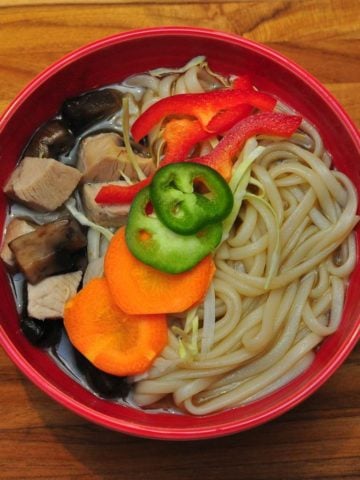
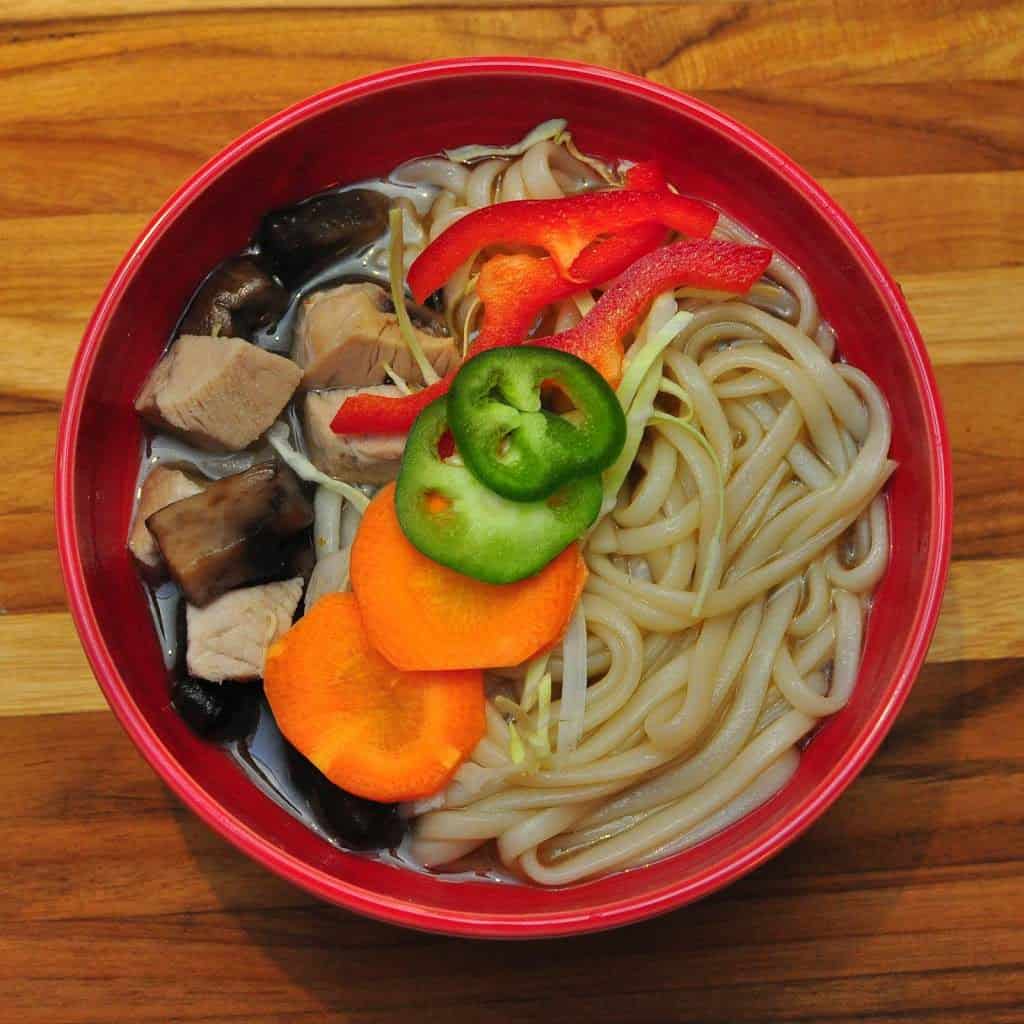
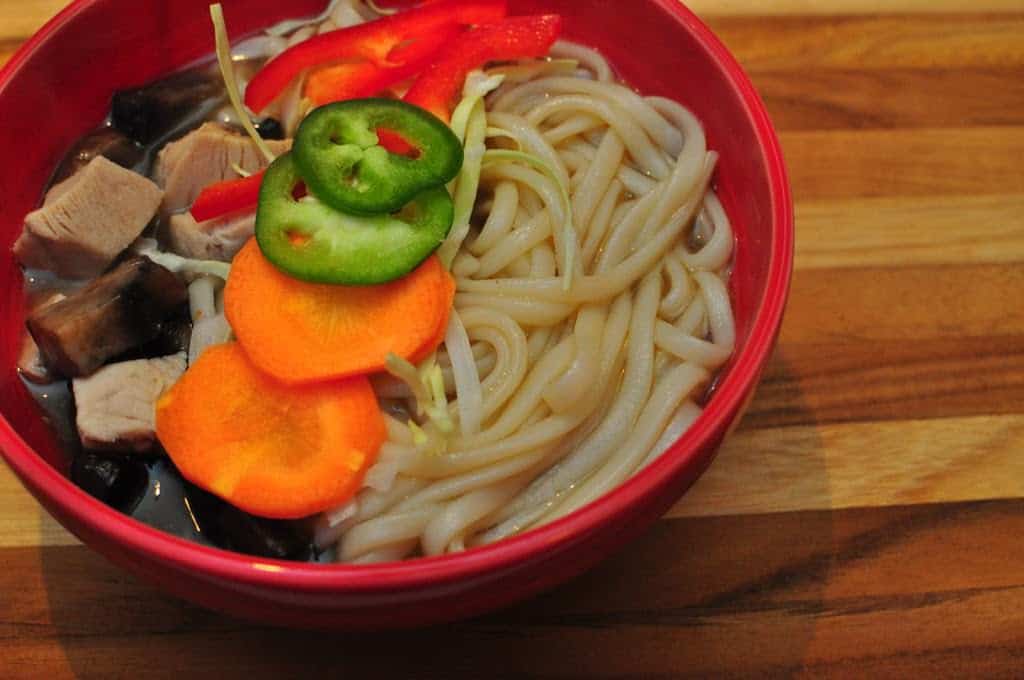
Turkey Miso Noodle Soup

November 29, 2012 by Mike Vrobel Leave a Comment

Every year I ask you, my readers, to make turkey stock with the bones from your Thanksgiving turkey.

"OK", you say, "I made turkey stock from my twenty pound bird. Six quarts of stock are filling up my freezer. There's no room for the ice cream. Now what?"

It's time to make soup, of course.

Japanese miso soup, to be exact, with udon noodles. It's a great way to use up the last of the turkey, and some of that tasty stock you made.

You can find miso, a thick, fermented soybean paste, in tubs in the refrigerator section of well stocked grocery stores. (Or, of course, any Asian markets in your area.) Miso is a fabulous flavor enhancer, adding depth and body to anything it is used in.

Miso paste clumps up if you add it directly to the soup. Stir it with a little of the turkey broth first to make a miso slurry, then stir that into the soup.
*If you can find Miso and Easy, a bottle of liquid miso, buy it. It's a quick way to add miso whenever you need a little extra umami.

Looking for another Japanese soup? Try chanko nabe - my Instant Pot Japanese chicken meatball soup.

Recipe: Turkey Miso Noodle Soup

Cooking time: 25 minutes

Ingredients

  • 8 ounces dried udon noodles (or 12 ounces fresh)
  • 1 tablespoon vegetable oil
  • 1 large leek, dark green leaves trimmed, rinsed, sliced thin (or substitute a medium onion, peeled and sliced thin)
  • 1 clove garlic, crushed
  • 8 ounces shitake or portobello mushrooms, sliced
  • 2 quarts turkey stock (homemade from your thanksgiving turkey carcass, or substitute chicken stock)
  • 2 cups of cubed, cooked turkey breast (about ½ a breast)
  • 2 tablespoons miso paste
  • salt to taste (about 1 tablespoon kosher)
  • ½ of a small head of cabbage, sliced thin
  • 1 large carrot, peeled and sliced thin
  • 1 red bell pepper, sliced thin
  • 1 serrano or jalapeño pepper, sliced thin
  • 2 green onions, trimmed and sliced thin

Directions

1. Cook the udon noodles
Cook the udon noodles according to the package directions, drain, and rinse with cold water.

2. Cook the soup
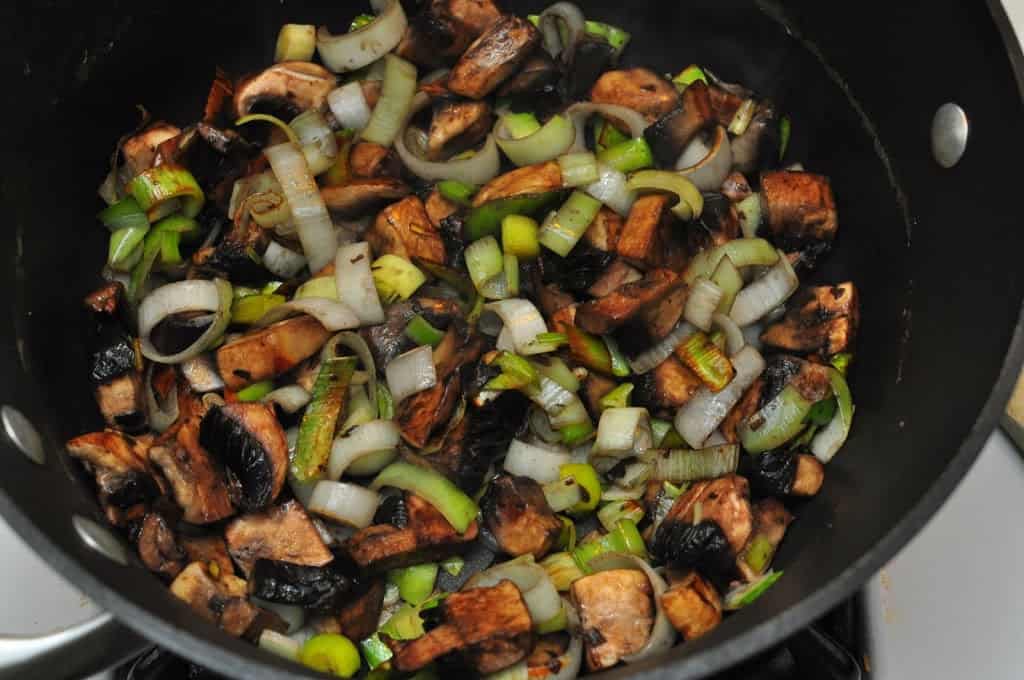
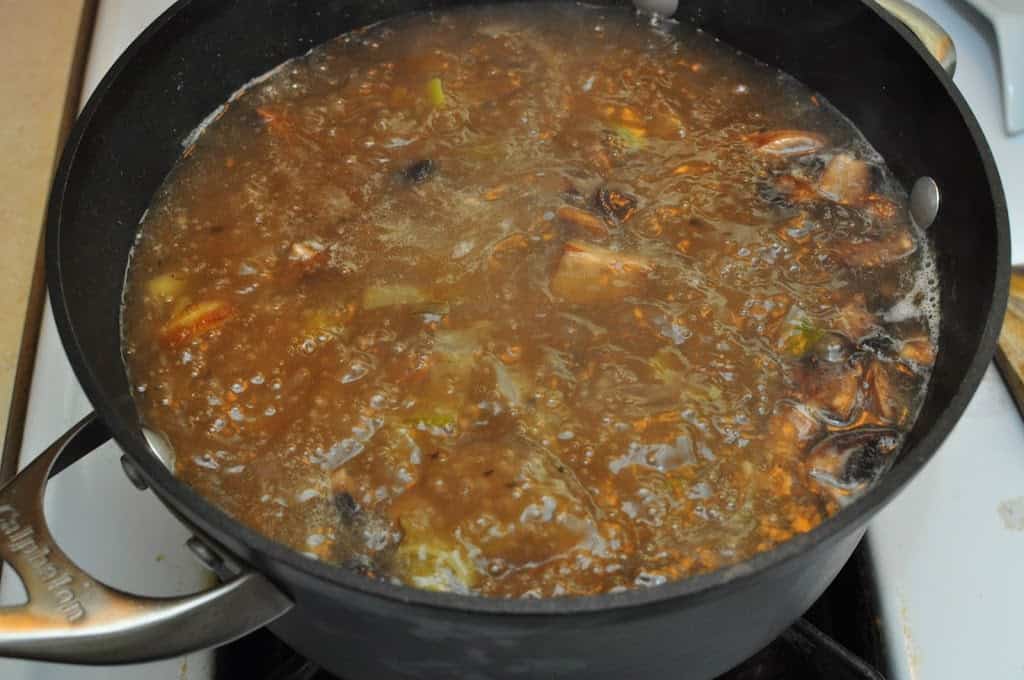
While the udon noodles are cooking, make the soup. In a large pot, heat the oil over medium-high heat until the oil is shimmering. Add the leeks, garlic, and mushrooms, and cook until the leeks are softened and just starting to brown, about five minutes. Add the turkey stock, bring to a boil, then reduce heat and simmer for ten minutes. Add the turkey cubes and simmer until the turkey is reheated, about another five minutes. Stir in the noodles, then turn the heat off under the soup.

Sauteing the leeks and mushrooms

3. Add the miso
Put the miso paste in a small bowl and ladle in a cup of the turkey broth. Whisk the miso and broth until the miso is completely dissolved, then stir it into the soup. Taste and add salt as needed. (I added an additional 2 teaspoons of kosher salt.)

4. Serve
Serve the soup with the shredded cabbage, carrots, peppers, and green onions on the side, for diners to add to their bowl of soup as necessary.

Notes:

  • If you can't find the miso paste at your local store, substitute 1 tablespoon of soy sauce. It won't have the extra flavor of the fermented soybeans, but it will improve the soup.
  • If you can't find udon noodles at your local store, substitute 2 packages of ramen noodles. (Throw away the spice packet - you just want the noodles.) Don't pre-cook the noodles - add them to the broth with the turkey cubes, so they simmer for five minutes, then serve.

What do you think? Questions? Other ideas? Leave them in the comments section below.

Related Posts:

Southwestern Turkey and Black Bean Soup
Turkey Ramen Soup
Turkey, Chickpea and Vegetable Soup

Pressure Cooker Turkey Stock
Stovetop/Oven Turkey Stock
Slow Cooker Turkey Stock

*Enjoyed this post? Want to help out DadCooksDinner? Subscribe to DadCooksDinner using the RSS or Email options on the right, link to this post from your blog, recommend DadCooksDinner to your friends, or buy something from Amazon.com through the links on this site. Thank you.

Slow Cooker Turkey Stock

November 27, 2012 by Mike Vrobel 1 Comment

Thanksgiving night.
Exhausted.

Too much turkey.
Too much wine.
Too much stuffing.

Ready to collapse.

One last thing to do: make turkey stock.
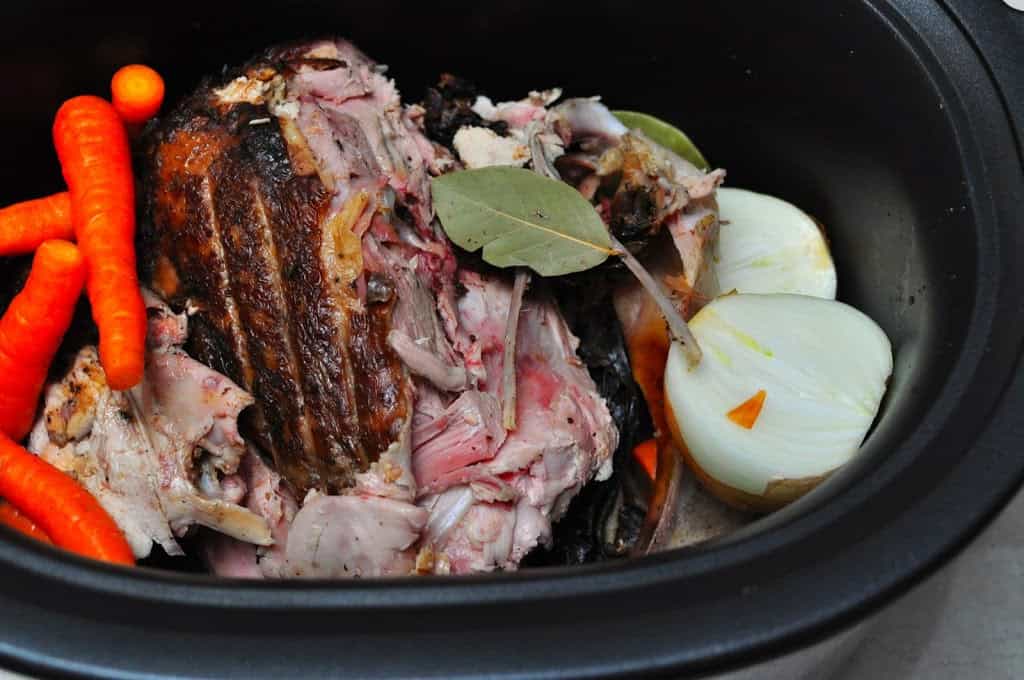
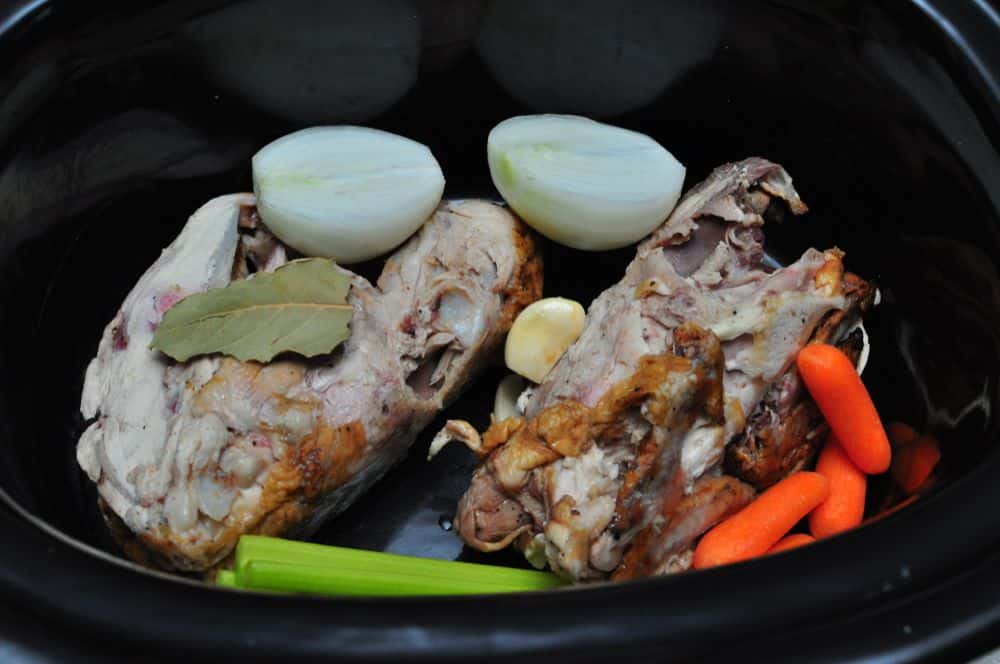
Break up turkey carcass to fit in the slow cooker.
Add an onion, a carrot, a celery rib, and bay leaves.
Cover with cold water.
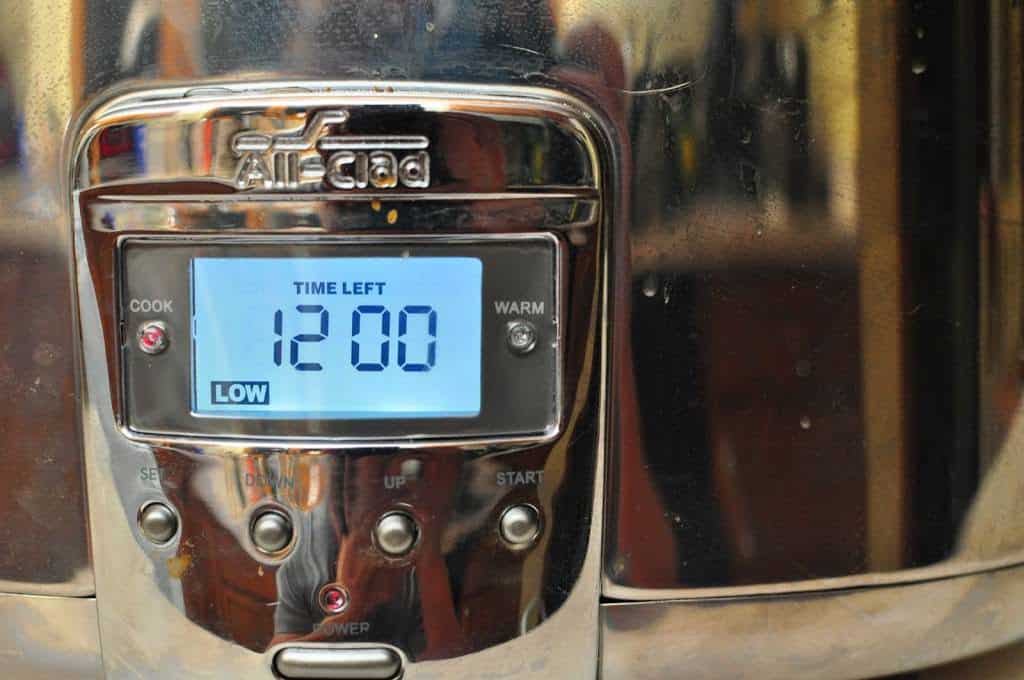
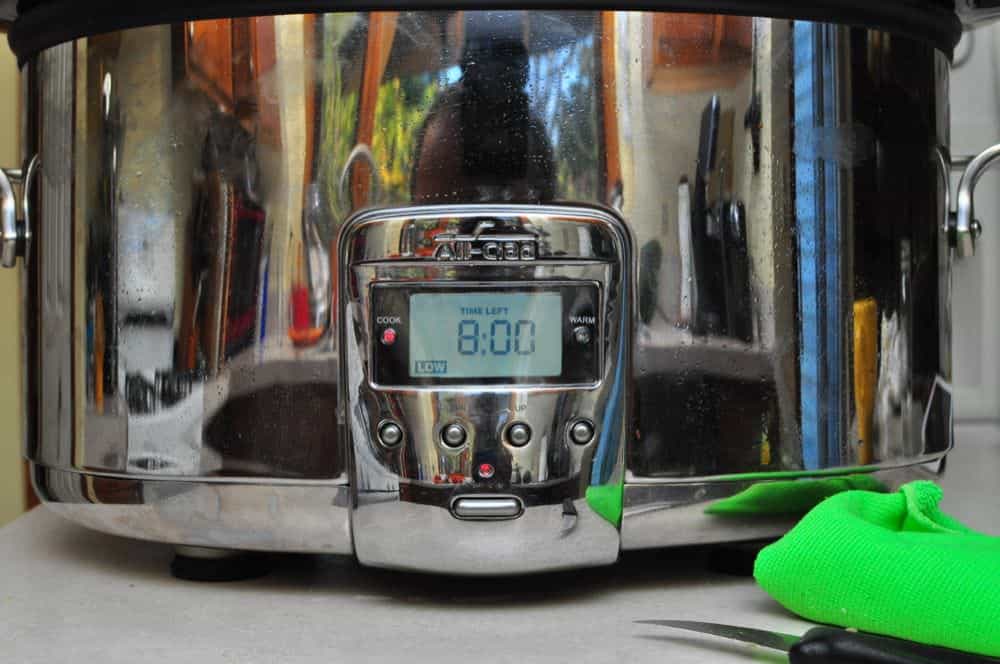
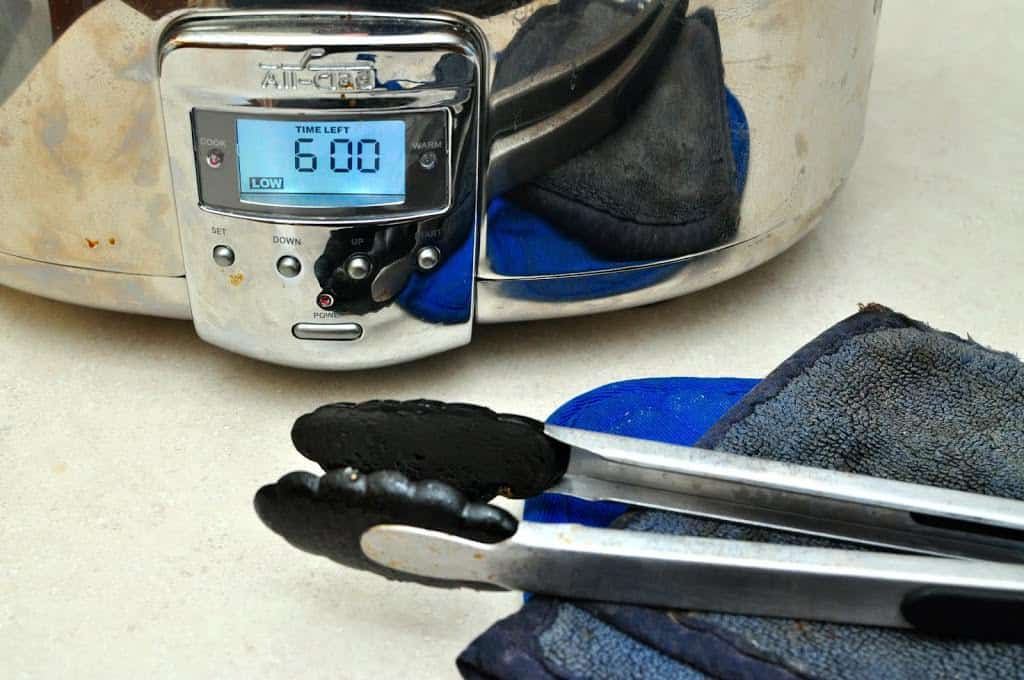
Set cooker on low for 12 hours.

Stumble to my bedroom and sleep for 12 hours.

Wake up the next morning to the smell of turkey soup.

What could be a better way to spend the day after Thanksgiving?

Recipe: Slow Cooker Turkey Stock


Cooking time: 12 hours

Equipment:

  • 6 quart or larger slow cooker (Preferably with a removable insert. I love my All-Clad, but I hear good things about this Crock Pot model.)

Ingredients

  • Carcass from a roast turkey, broken into pieces so it will fit in your slow cooker
  • 1 large onion, trimmed and halved
  • 1 large carrot, scrubbed and halved
  • 1 celery rib, halved
  • 2 bay leaves
  • Water to cover (about 4 quarts)

Directions

1. Slow cook the stock
Put everything in the slow cooker and add the water to cover. Slow cook on low for 10 to 12 hours.

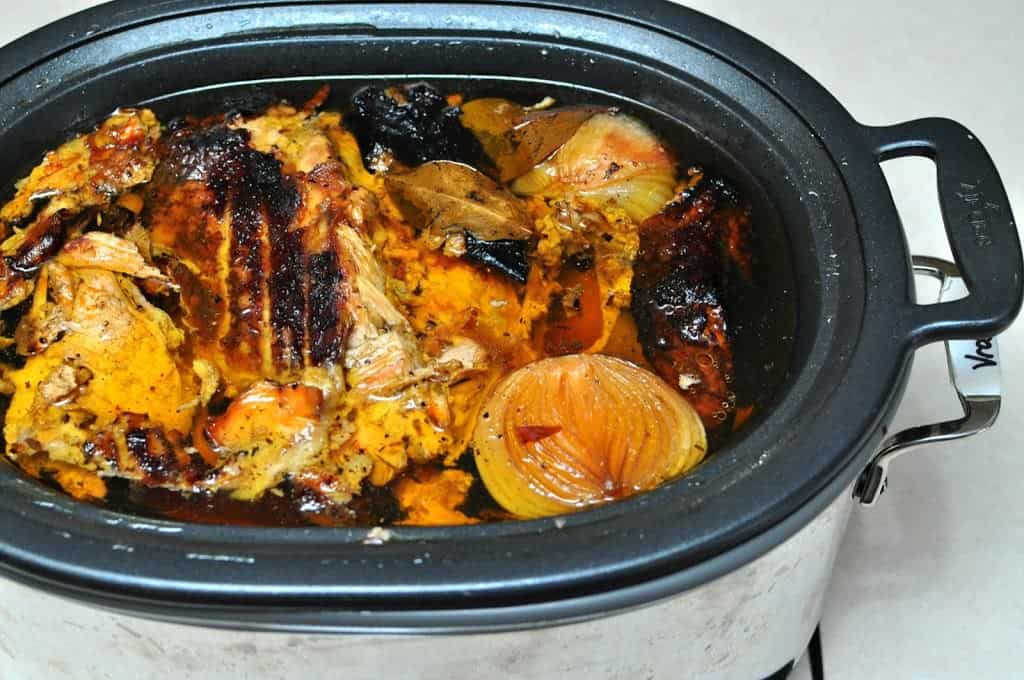
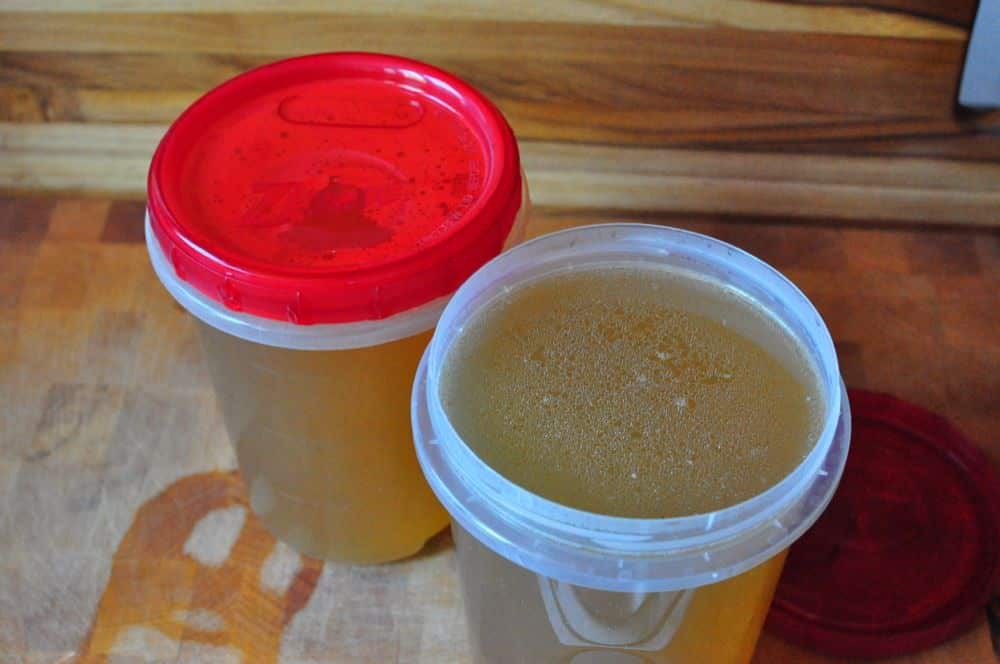
Everything in the pot
Low for 12 hours

2. Strain the stock
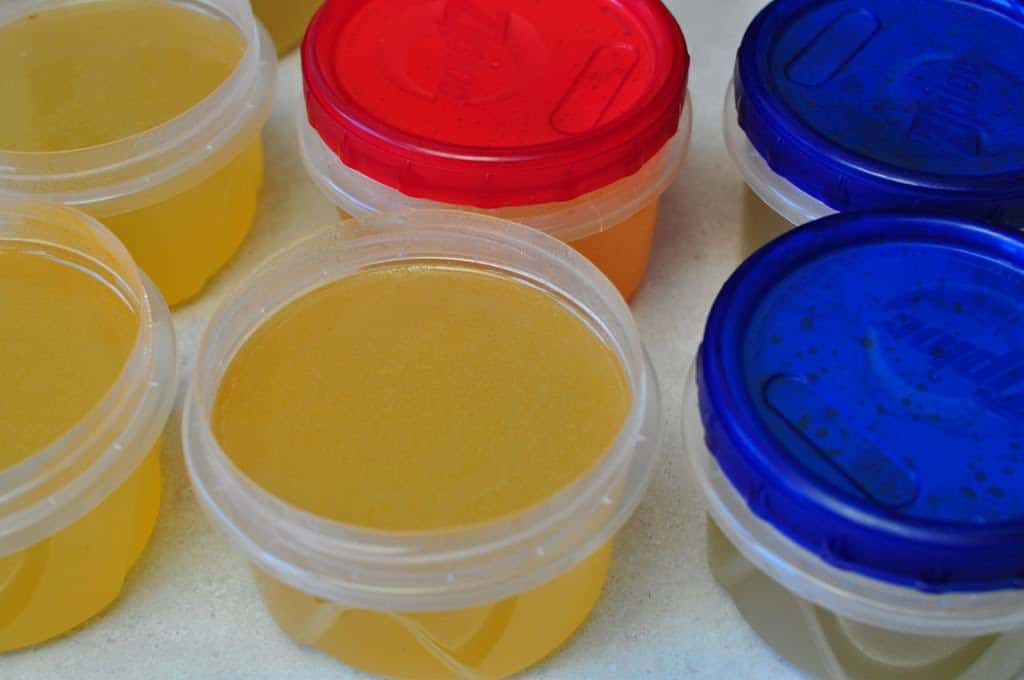
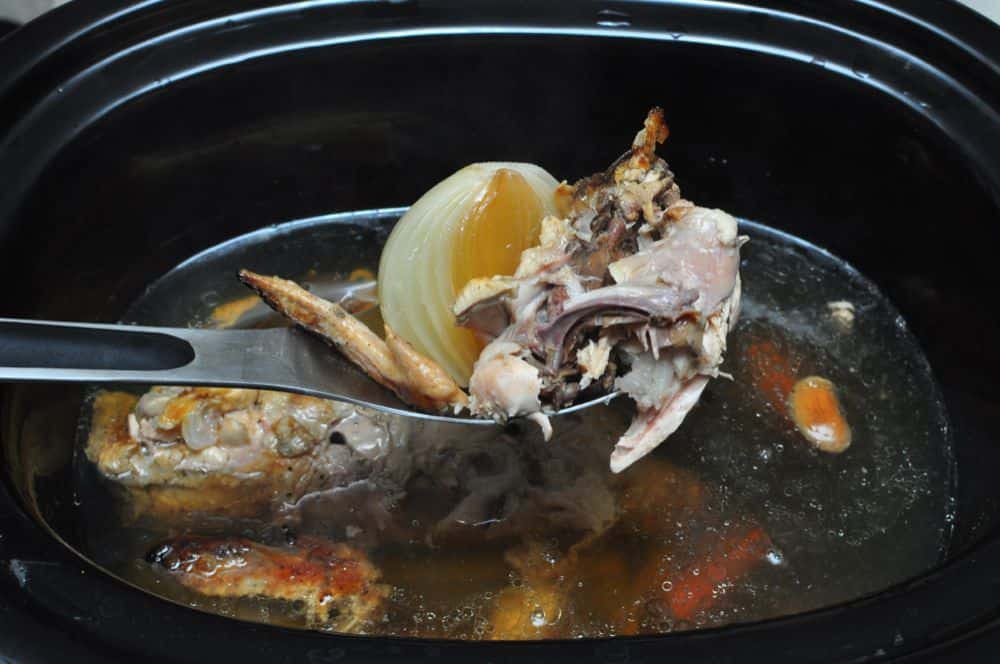
Remove the solids from the cooker using a slotted spoon and discard. Strain the liquid through a fine mesh strainer, then refrigerate for up to 4 days or freeze for later use.

Done!
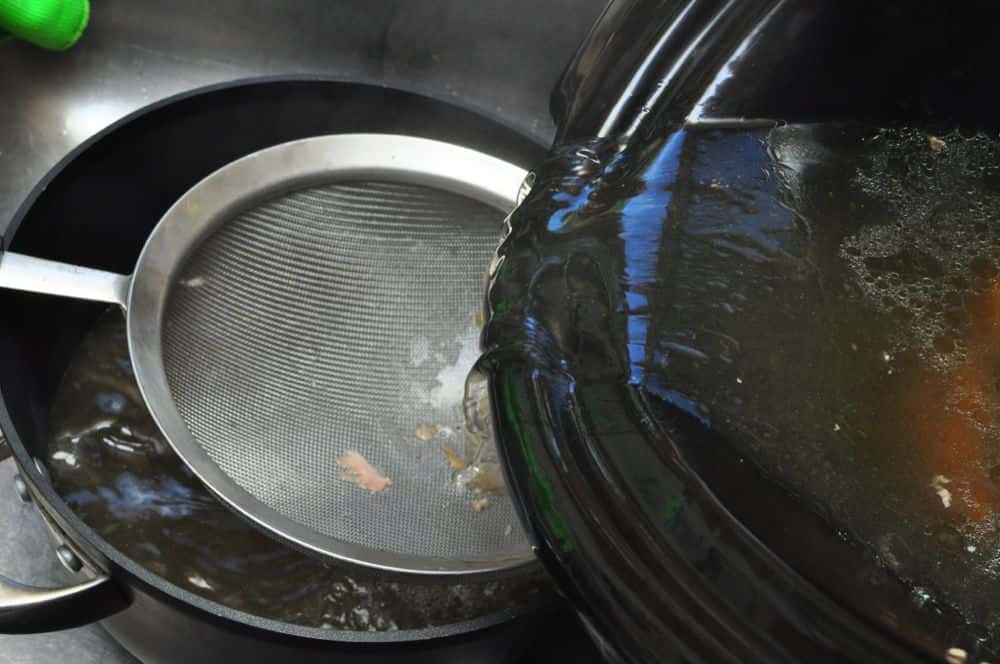
Pouring through a fine mesh strainer

Notes

  • This recipe needs a large (6 quart or larger) slow cooker. I add as much water as I can without overflowing the slow cooker.
  • It helps to have a slow cooker with a removable insert - it is easier to lift out and pour the stock through a fine mesh strainer. If you don't have a removable insert, use a ladle to remove the stock.
  • The necessary ingredients are the turkey and the onion. No carrot? Skip it and add another onion. No celery? Skip it and add another onion. No bay leaves? Skip them. No worries. Sure, they're nice to have, and add a variety of flavors to the stock. But if the option is no stock at all, go with the stripped down version.
  • What's my favorite turkey stock? I prefer my "revisited" pressure cooker turkey stock. But any of the turkey stock recipes I've published will give you stock that is light years better than the stuff they sell in cans in the grocery store. Use the stock method that works best for you. And, I have to say, this one is dead easy.

What do you think? Questions? Other ideas? Leave them in the comments section below.

Related Posts:

What do you use turkey stock for? Turkey soup, of course:

Southwestern Turkey and Black Bean Soup
Turkey Ramen Soup
Turkey, Chickpea and Vegetable Soup

*Enjoyed this post? Want to help out DadCooksDinner? Subscribe to DadCooksDinner using the RSS or Email options on the right, link to this post from your blog, recommend DadCooksDinner to your friends, or buy something from Amazon.com through the links on this site. Thank you.

Giving Thanks 2012

November 22, 2012 by Mike Vrobel Leave a Comment

I'm thankful for my family, especially my wife and kids.

I'm thankful we made it through this year in one piece. I know a number of you were affected by major storms. You are in our thoughts and prayers.

I'm thankful for my readers. It keeps me writing, knowing that you're out there, reading my blog, buying my book, and leaving comments. Thank you for sharing another year with me.

And, don't forget to make stock with your leftover turkey carcass. Make some soup to serve with the turkey leftovers, and freeze the rest for later.

  • Pressure Cooker Turkey Stock (the recipe I use all the time)
  • Stovetop/Oven Turkey Stock (the Ruhlman method)
  • Slow Cooker Turkey Stock (OK, the recipe is for chicken stock. Use turkey bones instead.)

How should you use the turkey broth? My recipe for Turkey Miso Noodle Soup is coming next week...

Happy Thanksgiving, Everyone!

If you were as fortunate as I was this year, please consider a donation to one of the worthy causes below.

Bread Stuffing with Cranberries and Apples (in the Oven or a Rotisserie Drip Pan)

November 20, 2012 by Mike Vrobel Leave a Comment

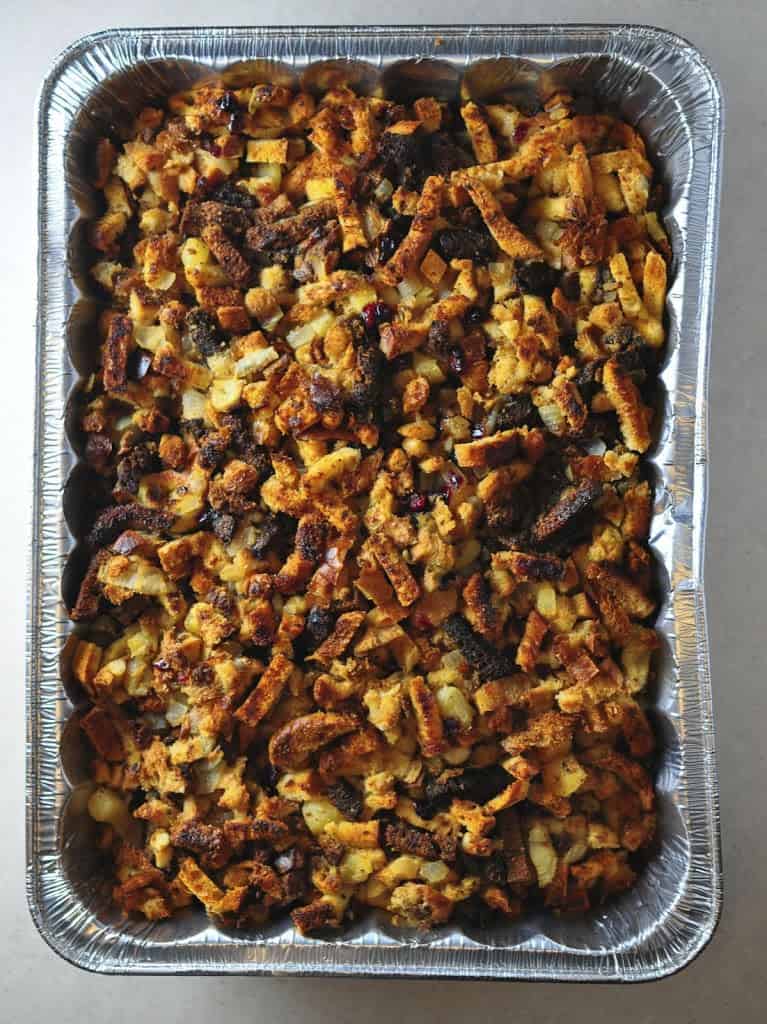
A pan of stuffing with cranberries and apples

Stuffing with Cranberries and Apples. This is the classic stuffing recipe I make every Thanksgiving and one of the must-have recipes for my family's Thanksgiving dinner.

A pan of stuffing with cranberries and apples
Rotisserie Pan Bread Stuffing with Apples and Cranberries
[feast_advanced_jump_to]

I need four things on Thanksgiving.

  1. Turkey
  2. Gravy
  3. Mashed potatoes
  4. Stuffing.

Oh, and a glass of wine or two. Everything else is nice; those four are mandatory, or it's just not Thanksgiving.

Here is the simple stuffing recipe I use every year, loosely based on a recipe from Pam Anderson. When I hear "stuffing," this is what I expect; more important, it's what my family demands at the table.

I have rotisserie "drip pan cooking" instructions because I always cook a rotisserie Thanksgiving turkey. I use the grill to free up space in my oven for all the other sides. I slide the pan of stuffing under the turkey when it has about an hour to cook. If you're not as obsessed with rotisserie cooking as I am, ignore the rotisserie instructions and jump to the oven instructions in the recipe.

Ingredients

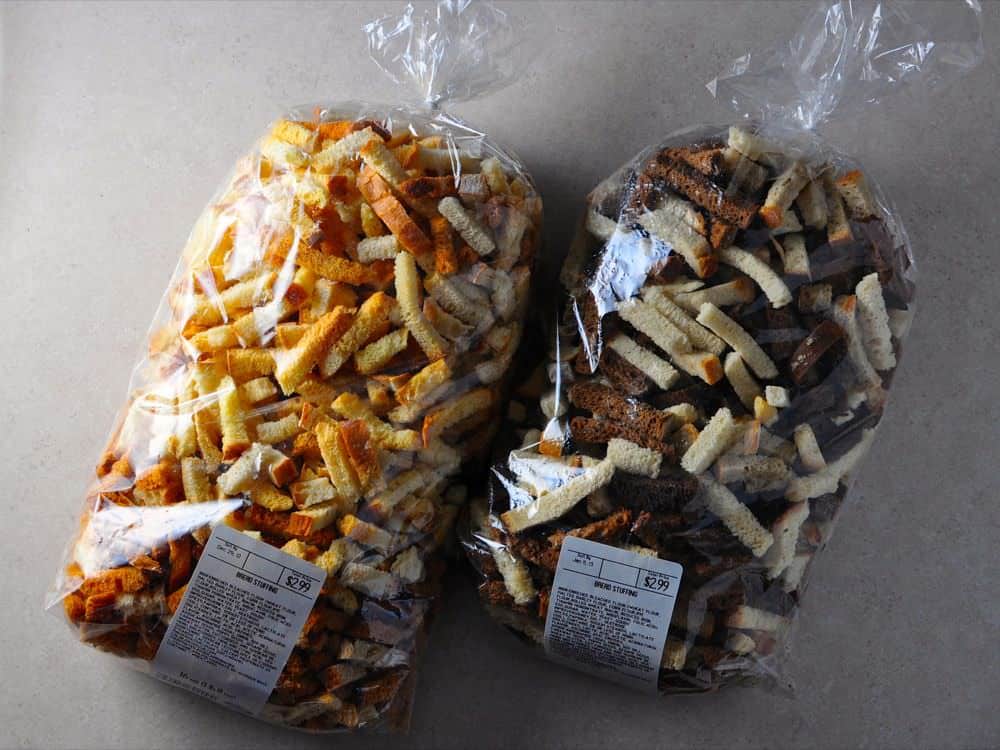
Bags of dried bread cubes
  • Butter
  • Onions
  • Celery
  • Granny Smith apples
  • Garlic
  • Fine Sea Salt
  • Fresh thyme leaves
  • Fresh sage leaves
  • Dry bread cubes
  • Dried cranberries
  • Chicken or Turkey broth
  • Fresh ground black pepper
  • Eggs

Instructions

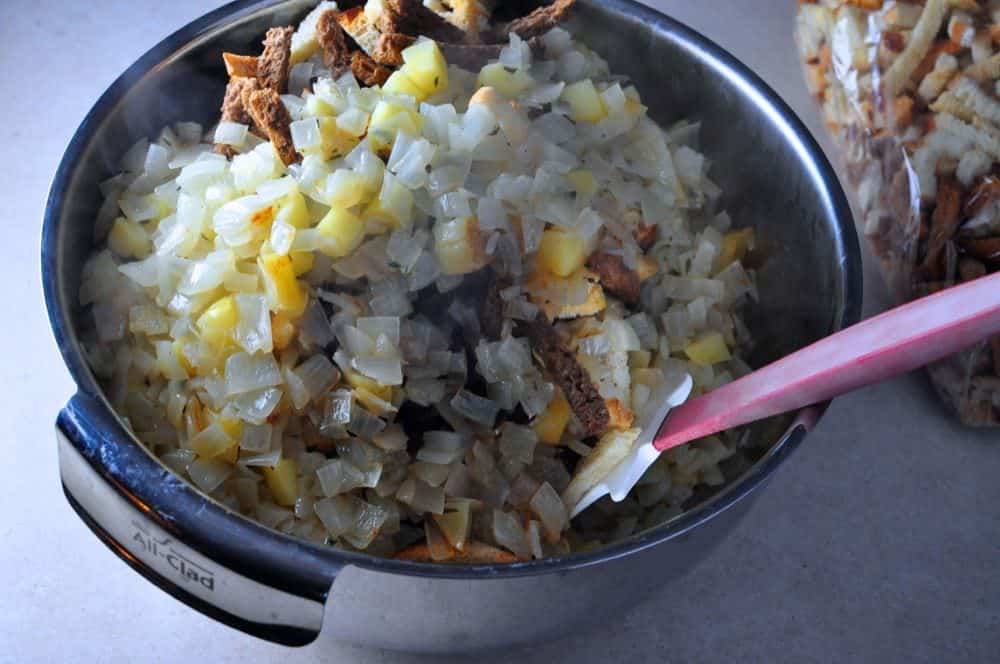
Sautéed onions and apples
Sautéed onions and apples on the bread

Sauté the onions and apples: Melt the butter in a large frypan over medium-high heat. Add the diced onion, celery, and apples. Stir in the garlic, fine sea salt, thyme, and sage. Sauté, stirring often, until the onions soften, about 8 minutes.

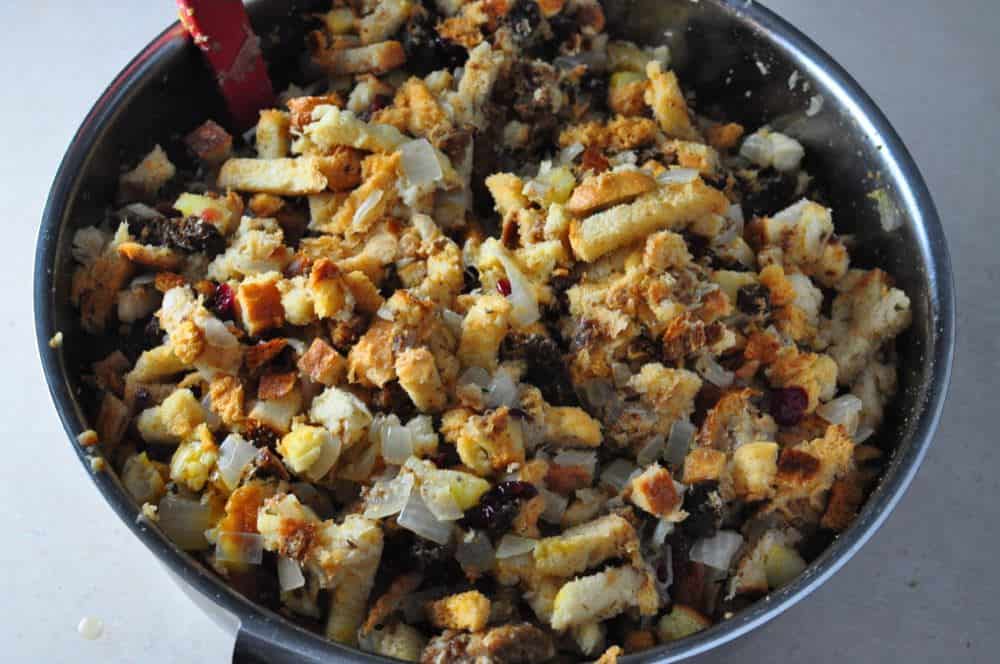
A bowl of mixed stuffing
Mixing the stuffing

Mix the stuffing: Pour half the bread crumbs into your largest mixing bowl. Pour the contents of the frypan over the top, add the dried cranberries, and stir until everything is mixed. Sprinkle with salt (if using homemade broth) and pepper, and pour in half the broth. Stir until everything starts to compact, then add the remaining bread and broth in batches, stirring until everything compacts enough to fit it in the bowl. Stir in the beaten eggs.

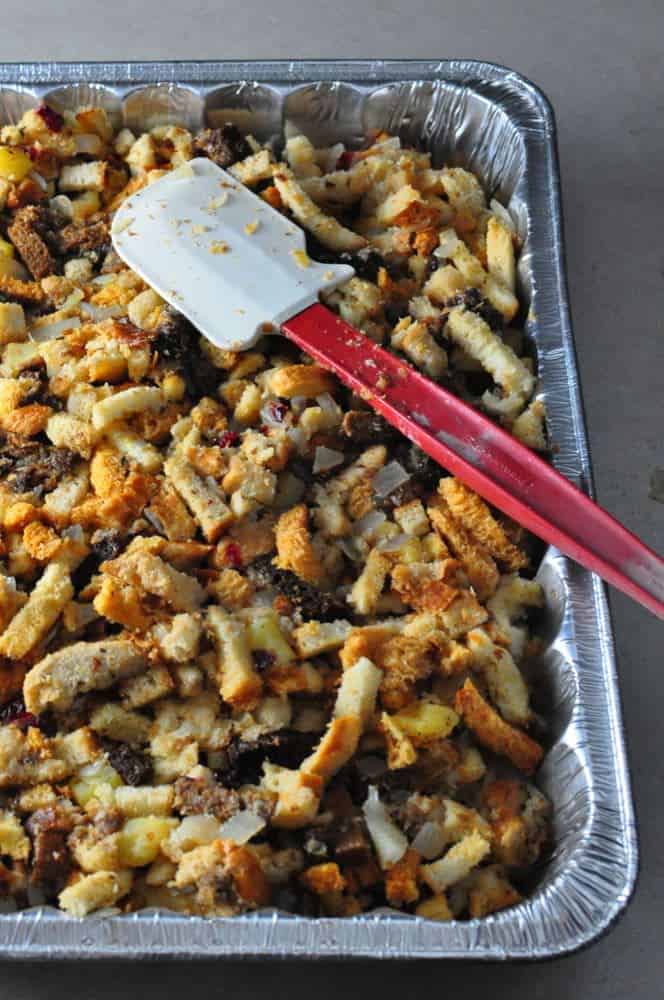
Foil pan packed with stuffing
Packed and ready to cook

Fill the pan: Pack the stuffing into the foil baking pan. It will look like too much stuffing, but you can pack it all in there. Cover the pan with a sheet of aluminum foil and crimp it on to make a lid.

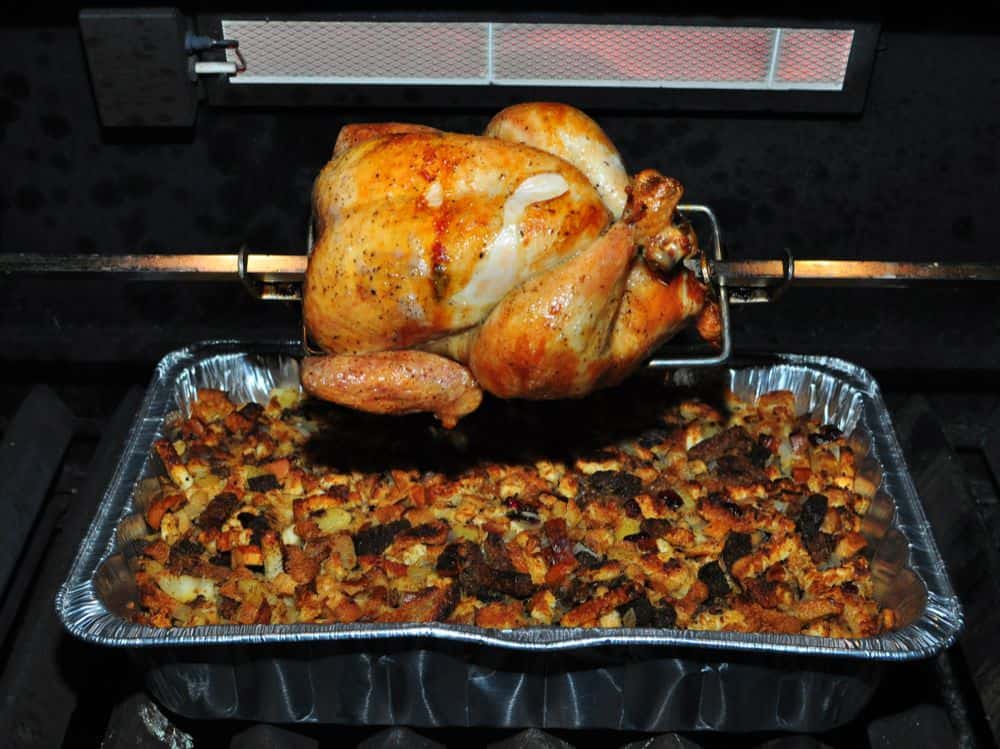
A rotisserie chicken over a pan of stuffing
Stuffing under the rotisserie bird

Cook the stuffing (grill): If using a rotisserie grill, cut a few 2-inch slits in the foil cover to catch the turkey drippings, then put the stuffing under the rotisserie turkey with an hour left to cook. Cook the stuffing for 45 minutes, then remove the foil cover and cook for another 15 minutes, or until the stuffing starts to brown and measures 150°F.

OR: Cook the stuffing (oven): If cooking in the oven, preheat to 350°F. Cook the stuffing for 45 minutes, then remove the foil cover and cook for another 15 minutes, or until the stuffing starts to brown and measures 150°F.

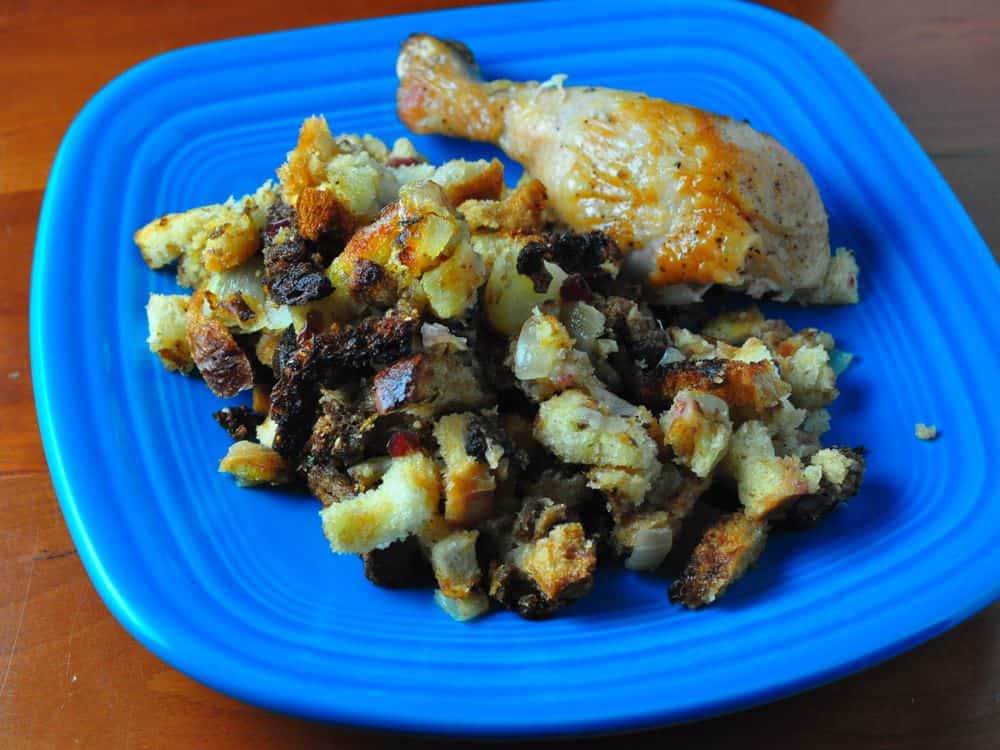
A plate of stuffing and a chicken leg
Serve and enjoy!

Serve: Scoop the stuffing into a serving bowl, serve, and enjoy!

Top Tip

I'm a charcoal snob, but this recipe works better on a gas grill. The even heat of the gas makes a great oven substitute. The charcoal grill tends to burn the stuffing around the edges and undercook the stuffing in the middle.

Equipment

  • 11" by 15" foil pan (or 12" by 16" oval turkey roasting pan)


Adapted from: Pam Anderson, Sharon's Favorite Stuffing

Notes

  • Don't want to cook it in your drip pan? No worries, cook it in the oven. Put it in a regular baking dish instead of a foil pan, then replace step 3 with: Cover the pan with foil, but don't cut the slits into the foil. Put the pan in a preheated 350°F oven and cook for 45 minutes, remove the foil and cook until browned on top, about 15 more minutes.
  • This stuffing for a crowd. If you are serving eight people or less, you'll want to make a smaller batch of stuffing. Halve the ingredients and cook in a 9 by 13 pan. Cook covered with foil for 30 minutes, then 15 minutes uncovered.
  • You need a really big bowl for step 2. If your bowl isn't big enough to hold all the bread at once, start with enough bread to fill the bowl ¾ of the way full, stir in the sautéed aromatics, then stir in a couple cups of the chicken broth. Continue to add more bread and chicken broth as the mixture settles, until all the bread and broth are added.
  • I buy dried bead in the bakery section of my local grocery store. They run old bread through their bread slicer and bag it up. I look for bags with a mix of different breads - white, wheat, pumpernickel - to get a blend of color.
  • If you want to get really adventurous, you can swap multiple drip pans underneath the turkey during the two hour cooking time. Start with rotisserie sweet potatoes, remove them at the one hour mark, and replace with the pan full of stuffing.

What do you think? Questions? Other ideas? Leave them in the comments section below.

*Enjoyed this post? Want to help out DadCooksDinner? Subscribe to DadCooksDinner using the RSS or Email options on the right, link to this post from your blog, recommend DadCooksDinner to your friends, or buy something from Amazon.com through the links on this site. Thank you.
Dad Cooks Thanksgiving Dinner 2012

November 19, 2012 by Mike Vrobel Leave a Comment


The day of turkey reckoning is coming. Are you ready for Thanksgiving?

Last week, I posted Rotisserie Turkey Wrapped With Bacon recipe and my research on how big of a turkey I could fit on my rotisserie.

Here is my annual Thanksgiving advice:

  • Grill your Thanksgiving Turkey
  • ...on the rotisserie, if you have one. How to Truss and Spit a Turkey for the Rotisserie [Video]
  • Cook your turkey to 150°F to 155°F
  • Save the carcass and make turkey stock for the best soup you've ever made.

My favorite Thanksgiving recipes on DadCooksDinner

  • Rotisserie Turkey Dry Brined with Orange and Spices on my Weber kettle
    • Rotisserie Turkey with Cajun Dry Brine on my Weber Summit
    • Rotisserie Turkey in Basic Brine
    • Rotisserie Turkey Breast with a basic Dry Brine
  • Drip Pan Sweet Potatoes - if you have the turkey on the rotisserie, don't let the drippings go to waste.
  • Drip Pan Stuffing - coming Tuesday
  • Pressure Cooker Giblet Gravy, though a pressure cooker isn't absolutely necessary.

*What? I don't have a mashed potato recipe? But my favorite part of Thanksgiving dinner is mashed potatoes, smothered in gravy! Oh, well, maybe next year.

Thanksgiving Question:

My question of the year (so far) has been variations on the cooking method:

I want to do your [choose one: Turkey with Orange and Spice Dry brine, Turkey with Cajun Dry Brine] on the [gas grill | charcoal grill]. Will it work?

Of course! Dry brines are a great idea, whether you're rotisserie grilling on charcoal or gas. In general, set the grill up for indirect medium heat (325°F to 350°F), concentrating the heat on the leg side of the bird if possible, and cook until the turkey reaches 155°F in the breast and 175°F  in the leg.

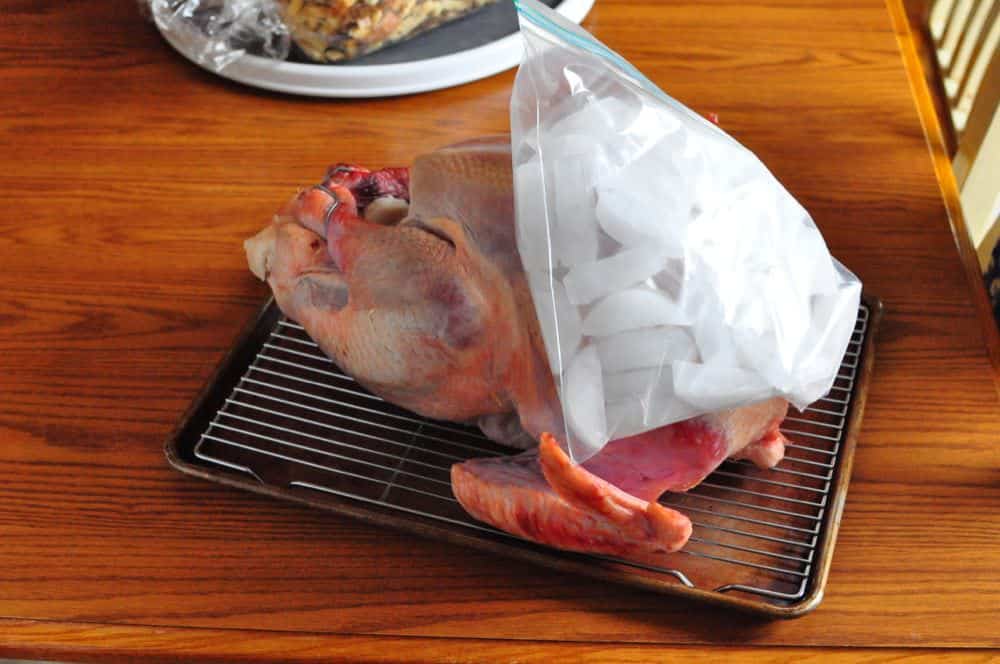
It helps if you take the turkey out of the refrigerator an hour or two before cooking and put a zip-top bag full of ice on the breast. This lets the legs warm up while chilling the breast, so the white meat stays juicy and the dark meat is well cooked.


Thanksgiving Meme 2012 - Butterflied Turkey

Butterflied turkey is the "it bird" this year. Everyone is doing it. Even me. I'm cooking at my sister-in-law's house this year, and my brother-in-law wants to cook a turkey in his smoker. So, I get to make the "normal, in the oven" turkey. Of course, I'm using my dry brine with orange and spices...
*And, this will be the first Thanksgiving in...wow, in a long while...where I haven't been in the back yard grilling a turkey. I hope I don't go into withdrawal.

Mark Bittman/NYTimes.com - Split Roast Turkey
Kenji Alt/SeriousEats.com - How to Cook a Spatchcocked Turkey
The Kitchn - Flatten that Bird

Thanksgiving Planning on the Web:

A successful Thanksgiving is one part cooking skill, one part adaptability, one part wine (keep the chef lubricated), and 97 parts logistics. If you have a good plan, everything else falls into place. Here are the best thanksgiving plans on the internet this year. (And yes, some of them start six weeks ago. Darn it, I'm already five weeks behind schedule!)

Kenji Alt - The Food Lab's Complete Guide to a Stress Free Thanksgiving
Cooks Illustrated - Thanksgiving Survival Guide - Schedule Planner
Epicurious - Thanksgiving Planning Checklist

Good luck with Thanksgiving, everyone!

What do you think? Questions? Other ideas? Leave them in the comments section below.

*Enjoyed this post? Want to help out DadCooksDinner? Subscribe using your RSS reader or by Email, recommend DadCooksDinner to your friends, or buy something from Amazon.com through the links on this site. Thank you!

Rotisserie Turkey Wrapped with Bacon

November 15, 2012 by Mike Vrobel 11 Comments

Rotisserie Turkey Wrapped with Bacon - because everything tastes better with bacon, especially if you're cooking a big, 20-24 pound turkey.

Last year, an interviewer asked Christopher Kimball what his favorite turkey was. His answer? Turkey larded with bacon. The moment I heard that answer, I knew what I was cooking for thanksgiving this year.

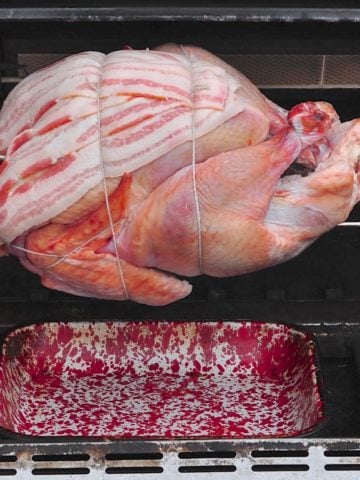
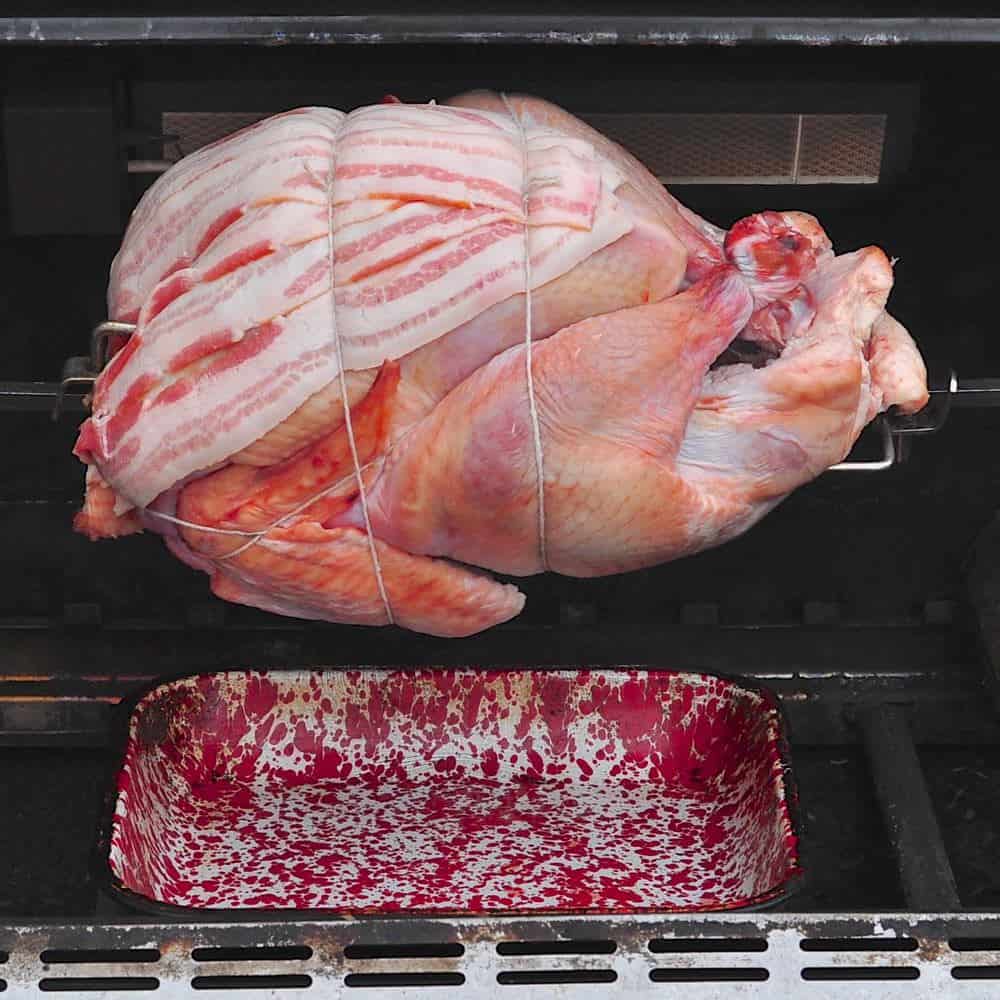
A turkey with bacon tied to the breast, in a grill, on a rotisserie spit
[feast_advanced_jump_to]

Why Bacon?

Bacon? What does bacon do for a turkey? Turkey breast is very lean, so basting the turkey with bacon fat will help keep the breast moist while the turkey cooks. It adds a hint of salty, smoky flavor to the breast, which helps if you are cooking on a gas grill. I think the extra layer of bacon slows down the cooking on the breast, which is a good thing - the drumsticks need extra time to cook. And, not least, the layer of crisped bacon on the skin adds extra flavor to the relatively bland white meat.

Now, is bacon essential to turkey? No. My favorite turkey is still my Dry Brined with Orange and Spices recipe. But, if you want a subtle improvement to a traditional turkey, bacon on the breast is a nice addition.

(Of course, if you're the kind of person who wants to blow away your guests, adding a bacon wrap to your turkey is another weapon in your arsenal. Not that I am that kind of cook know anyone like that, oh no, not me.)

No rotisserie? No worries. It's a great idea on the grill (though I would get a smaller, 12 pound turkey), or in the oven. See the Tips and Tricks section for cooking non-rotisserie cooking instructions.

Will a 20+ pound turkey fit in a Weber with the Rotisserie?

From my Rotisserie Grilling the Big Turkey post: The 23 pound turkey fit in both the Weber kettle and the Weber Summit grills. The Weber Kettle had lots of clearance, and I'd guess I could go as large as 30 pounds. The Weber Summit was a close fit. I would guess I could go to 24, maybe 25 pounds, but no larger. For a Weber Genesis, anything larger than 14 pounds would worry me.

(See my Rotisserie Grilling the Big Turkey post for more details.)

Ingredients

  • 1 Turkey (20-24 pounds)
  • ½ cup kosher salt (I used Diamond Crystal kosher salt; reduce to 6 tablespoons if using Mortons kosher, because it is denser)
    • (Cut back to 1 tablespoon of salt if the turkey is "enhanced with a natural solution" of more than 6 percent)
  • 6 strips hickory-smoked bacon

How to Rotisserie Grill a Bacon-Wrapped Turkey

Dry brine the turkey

Sprinkle the turkey with the salt, inside and out. Gently work your fingers under the skin on the breast, then rub some of the salt directly onto the breast meat. Refrigerate at least overnight, preferably two to three days. If dry brining more than a day in advance, cover the turkey with plastic wrap until the night before cooking, then remove the plastic wrap to let the skin dry out overnight.
(If the turkey says "enhanced with a (percentage) solution" on the packaging, cut the salt back to 1 tablespoon. Enhanced means the turkey is pre-brined; you don't want to over salt it.)

Turkey after dry brining, with bag of ice on the breast.

Truss and spit the turkey

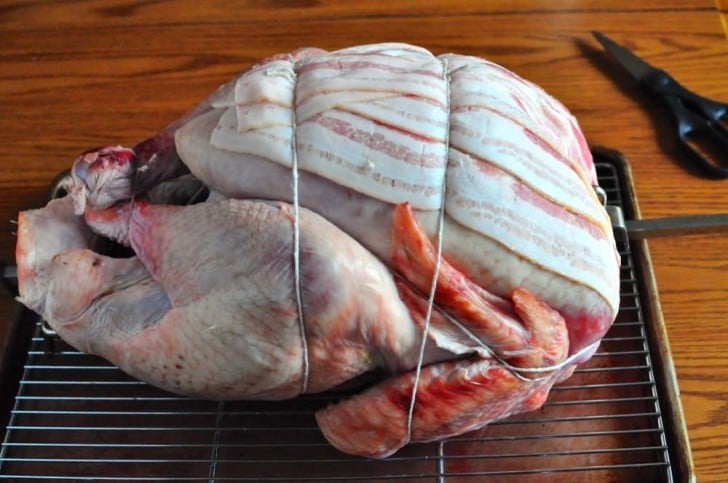
Two hours before cooking, remove the turkey from the refrigerator. Truss the turkey, following the instructions in my How to Truss and Spit a Turkey post. If the turkey is larger than 18 pounds, un-fold the turkey wings and tuck them under the trussing string, as shown in my Rotisserie Big Turkey post. Skewer the turkey on the rotisserie spit, securing it with the spit forks. Fill a gallon zip-top bag with ice, and rest the bag on the breast of the turkey to keep the breast colder than the drumsticks.

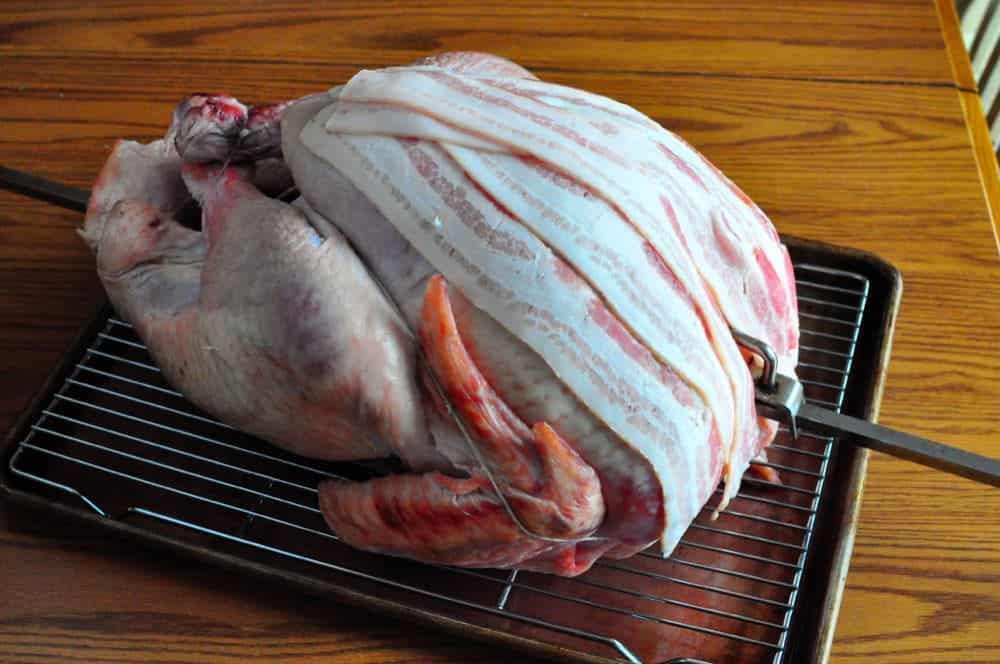
Turkey on a rotisserie spit with bacon on its breast

Wrap the breast in bacon

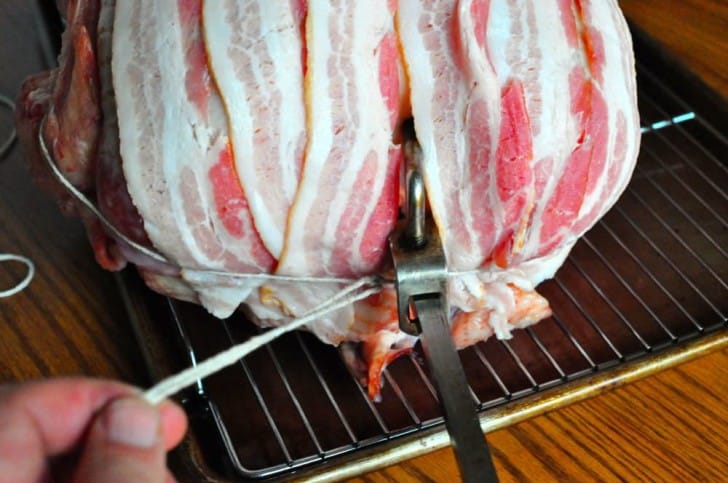
Discard the bag full of ice. Lay the bacon over the turkey breast, as shown in the picture above. Tie the bacon down onto the turkey. Loop a length of twine under the turkey and behind the wings, then around the front of the breast to tie down the edge of the bacon strips near the turkey neck. Next, loop a length of twine under the turkey, around the drumsticks, and over the top of the breast to tie down the other edge of the bacon strips. Finally, tie a third loop of twine around the middle of the turkey to hold the bacon down in the middle. Make sure to tie the twine tight at the edges, or the bacon will work loose as the turkey rotates.

Bacon trussed to the turkey
Trussing the bacon at the neck of the bird - get it tight!

Set up the grill (Charcoal Grill)

Set the grill up for indirect medium heat (325°F to 350°F) with the drip pan in the middle of the grill. Set up all the heat in the grill on one side, facing the turkey legs. For my Weber Kettle, I light a charcoal chimney ¾ full of charcoal and wait until it is covered with gray ash. Then I make a U of charcoal, on one side of the grill. I set the pan in the middle of the U, and put the spit on the grill with the breast facing the open part of the U.

Set up the grill (Gas Grill)

With a gas grill, if possible, turn on two burners on one side of the grill instead of one burner on each side. On my Weber Summit, I set burner #6 and my smoker burner to high.
If your gas grill has an an infrared rotisserie burner, start cooking with the infrared burner set to medium. Once the turkey and the bacon are browning well, about a half an hour, shut off the IR burner and let the  turkey finish cooking from the heat in the main part of the grill.

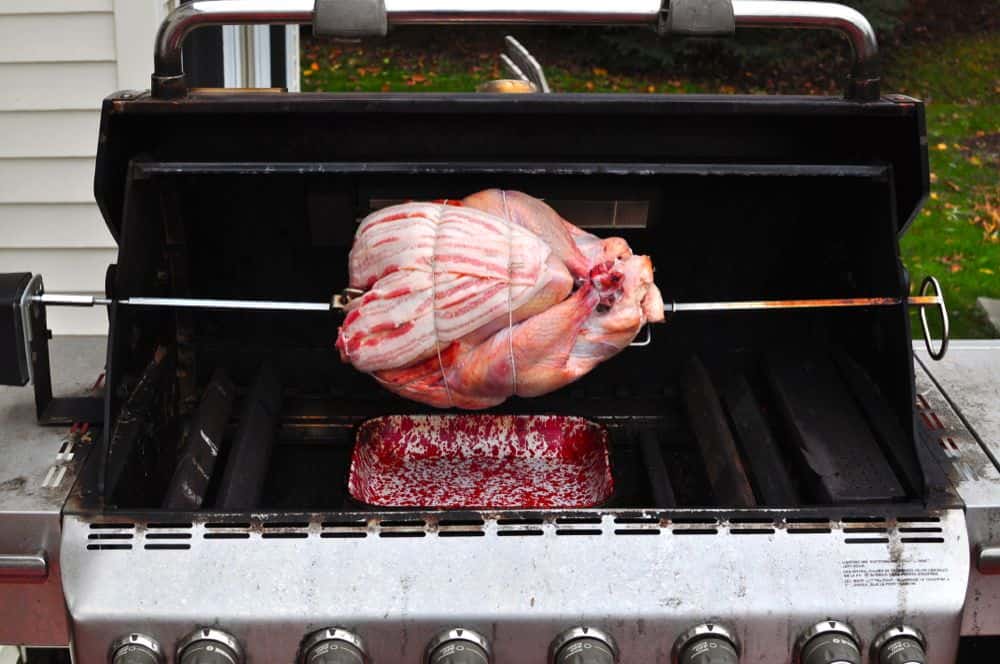
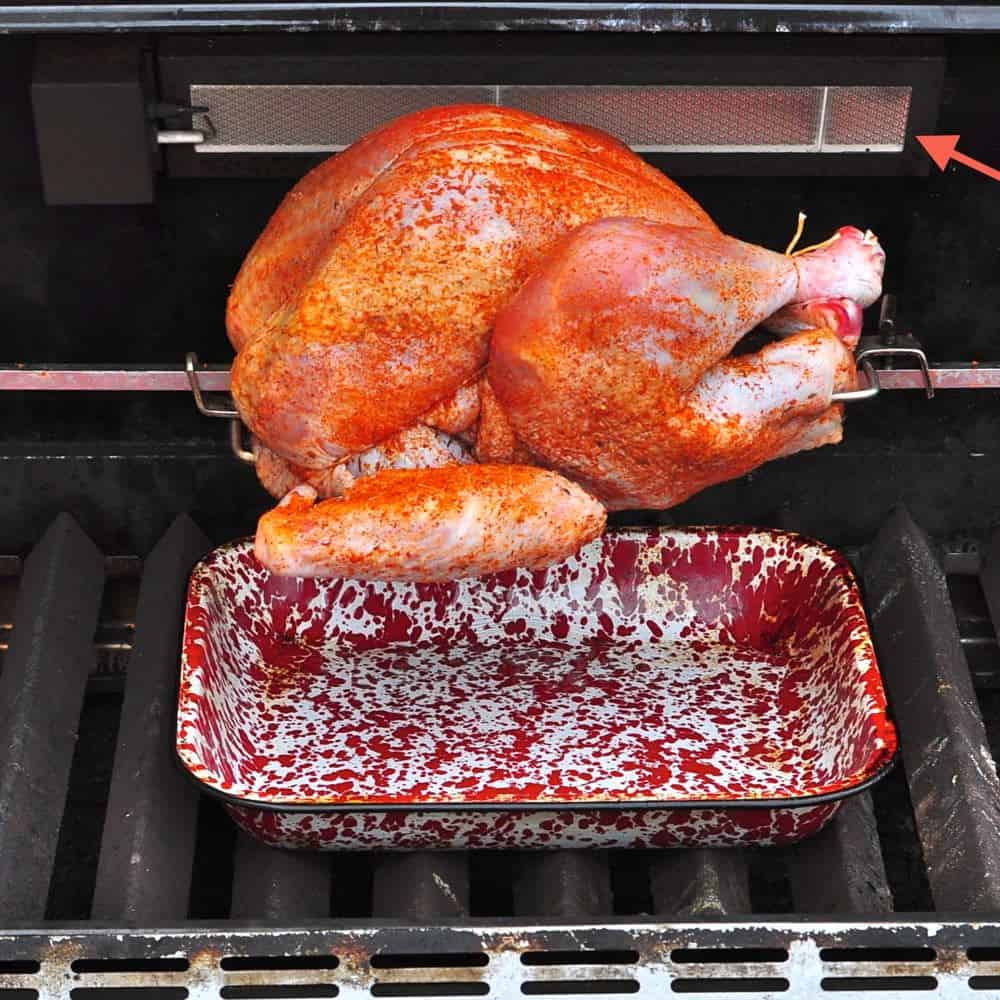
Turkey ready to rotisserie grill in a gas grill - on the spit with a drip pan underneath.

Rotisserie cook the turkey

Put the spit on the grill, start the motor spinning, and make sure the drip pan is centered beneath the turkey. Close the lid and cook until the turkey reaches 160°F in the thickest part of the breast, about 3 hours for a 24 pound bird. If you are cooking on a charcoal grill, add 24 coals to the fire every hour to keep the heat going.

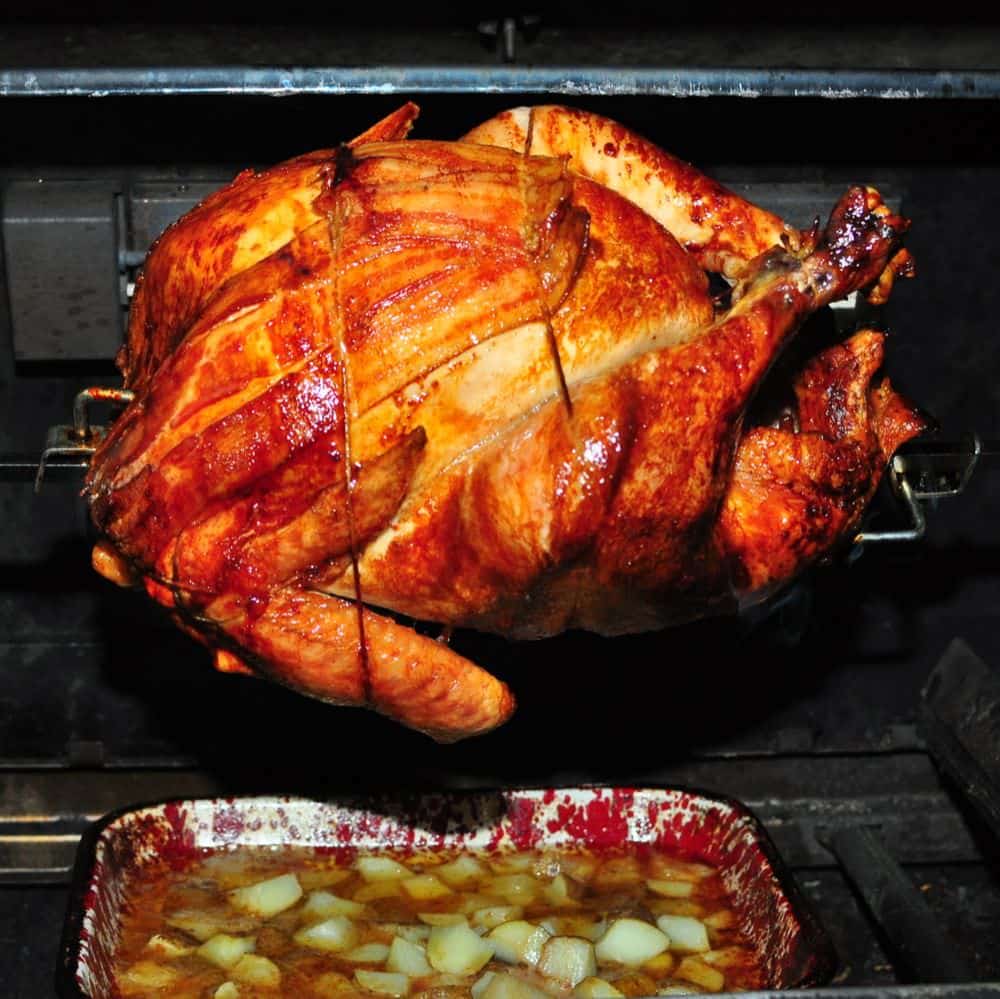
Rotisserie turkey with bacon, browned and ready to take off the grill

Serve

Remove the turkey from the rotisserie spit and remove the twine trussing the turkey. Be very careful - the spit and forks are blazing hot. Let the turkey rest for 15 to 30 minutes, then carve and serve.

Equipment

  • Grill with Rotisserie attachment (I used a Weber Summit with an infrared rotisserie burner. Here is the current version of my grill.)
  • Aluminum foil drip pan (Get an oval turkey roaster style pan)
  • Butcher's twine
  • Instant Read Thermometer - the key to juicy turkey

Tips and Tricks

  • No rotisserie? No worries. Set the grill up as described and put the turkey on top of the grill grate over indirect heat. (See my Grilled Turkey (Grilling Basics) recipe.)
  • No grill? No worries. Cook the turkey in a 350°F oven.
  • I used a simple dry brine in this recipe; if you want to use a fancier dry brine with a bacon wrapped turkey, go for it. Try my Dry Brine with Orange and Spices, Cajun Dry Brine, or one of the other dry brines from my book.
  • A drip pan full of bacon fat and turkey drippings is perfect for Rotisserie Pan Potatoes.
  • The bacon will try to work its way loose from the edges of the string. If it does, that's OK. Let it flop around until the heat of the grill has cooked it a bit, about a half an hour, then tear it loose. Eat it, of course - this is a cook's treat.
  • Cooking a smaller turkey? I recommend a 12 pound turkey

Want Juicy White Meat? Cook to 160°F and No Further

The trick to juicy turkey is not overcooking the breast. the USDA recommends cooking the turkey to at least 165°F, measured in the deepest part of the breast. This is a little too much for me, so I recommend 160°F...or lower, if you have a precise Instant Read Thermometer and a timer. Read on...

The USDA recommends 165°F because that's when Salmonella is killed instantly. But, according to their time/temperature tables, at 150°F, salmonella is killed after 3.8 minutes. So, as long as you keep the turkey on the grill for at least 4 minutes after reaching 150°F, the turkey is safe.

But, 150°F leaves the dark meat a little undercooked for my tastes - dark meat needs to cook to a higher temperature to tenderize it. So, 160°F is my compromise. (Or, 155°F if I ice the breast in my bird.)

Now, my Samoan Attorney recommends that I say: if you are cooking for infants, or anyone with a compromised immune system, follow the USDA guidelines and cook to 165°F.

For more information, see my Turkey Temperature, or the 150°F question post.

What do you think? Questions? Other ideas? Leave them in the comments section below.

Related Posts

Rotisserie Turkey - The Big Turkey
Rotisserie Turkey, Dry Brined with Orange and Spices
Rotisserie Turkey with Cajun Dry Brine
Rotisserie Turkey Breast with Basic Dry Brine
Rotisserie Turkey Breast with Honey Bourbon Glaze
Click here for my other rotisserie recipes


Check out my cookbook, Rotisserie Grilling.

Everything you could ask about the rotisserie,
plus 50 (mostly) new recipes to get you cooking.

It's a Kindle e-book, so you can download it and start reading immediately!


*Enjoyed this post? Want to help out DadCooksDinner? Subscribe to DadCooksDinner using the RSS or Email options on the right, link to this post from your blog, recommend DadCooksDinner to your friends, or buy something from Amazon.com through the links on this site. Thank you.

Rotisserie Grilling - The Big Turkey

November 13, 2012 by Mike Vrobel 42 Comments

I get a asked every year, right before thanksgiving:

How big of a turkey can I cook on my grill's rotisserie?

Now, I usually cook two 12 to 14 pound turkeys, one in my charcoal grill, one in my gas grill. I think the meat in the smaller bird is a little more tender, and it cooks quicker and more evenly. It doesn't hurt that I'm an obsessed cook. I want to do two different styles of bird, instead of just one. Cooking two birds lets me do a "regular" bird for the purists, and an exotic bird for my own satisfaction.

Most people aren't grilling fanatics. They don't own two rotisseries. But they want to serve a crowd with a rotisserie turkey. The rule of thumb is one pound of turkey per person, so they want to cook a monster bird.
*I love turkey leftovers, so I always wind up cooking lots more than a pound a person. Two pounds, maybe. But, like I said, I'm crazy.

So, to help out my readers, it was time for a test. I bought the biggest bird I could find at my local grocery store. It was the turkey off-season, so the biggest bird was just shy of 23 pounds. It was huge, about twice the size of the birds I usually cook.
*Thanksgiving turkey sales started this weekend, so I went back and checked. The largest bird I found was 25 ½ pounds. I've heard of 30 pound turkeys. My goodness, those must be enormous.

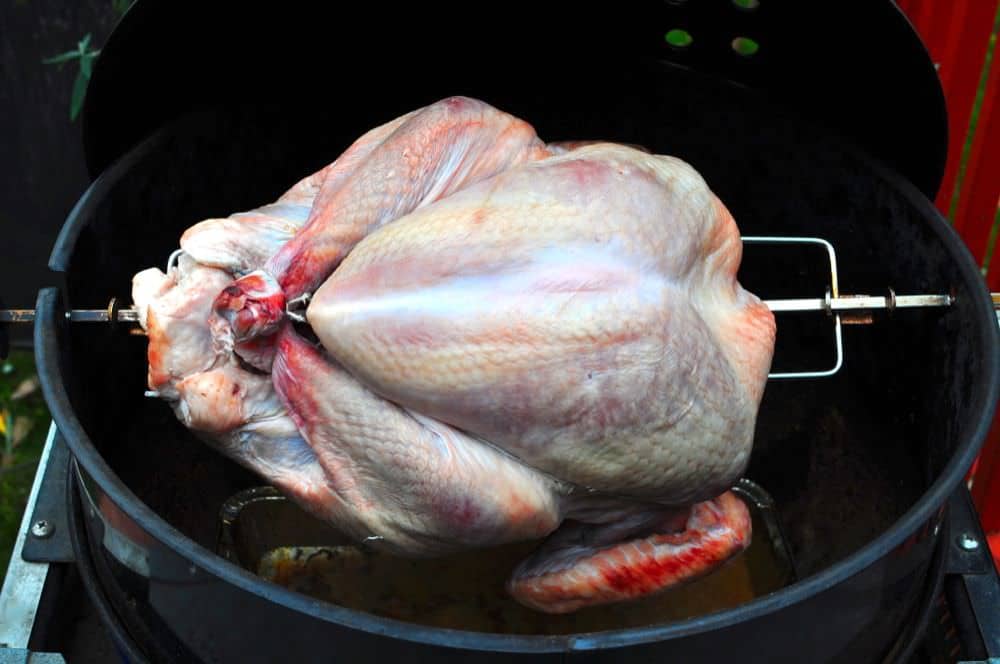
Did it fit in the kettle grill?

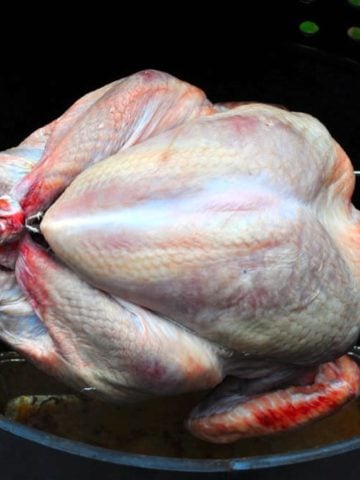
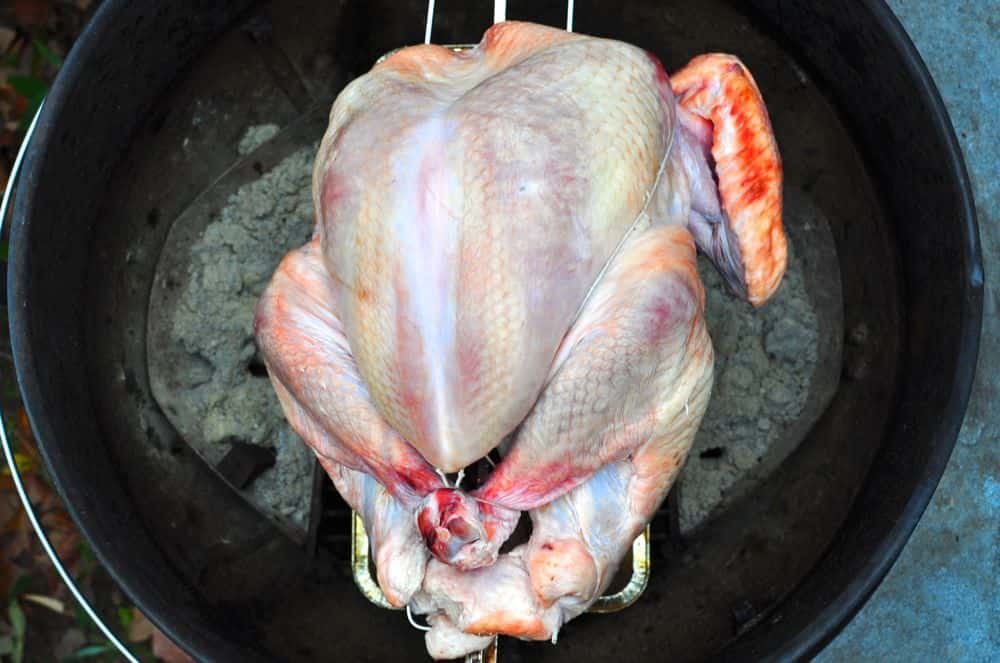
Big turkey in kettle grill
Little turkey in kettle grill

Easily. There was plenty of room to spare in a Weber kettle with a rotisserie ring. I'll bet I could fit a giant 30 pound turkey in the kettle. Score one for charcoal!

Did it fit in the Weber Summit gas grill?

Big turkey in gas grill
Little turkey in gas grill

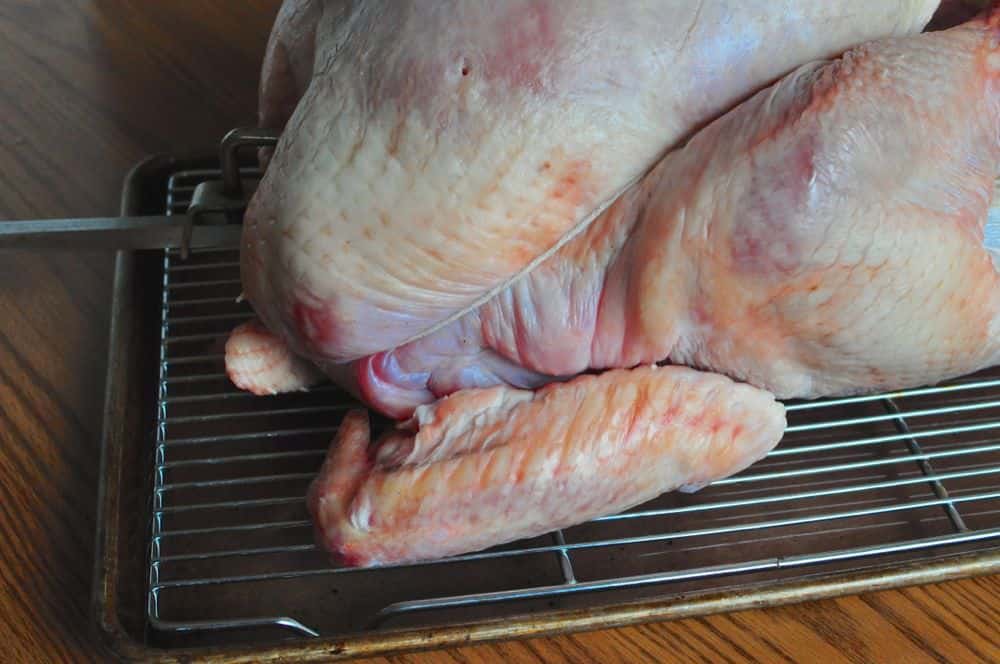
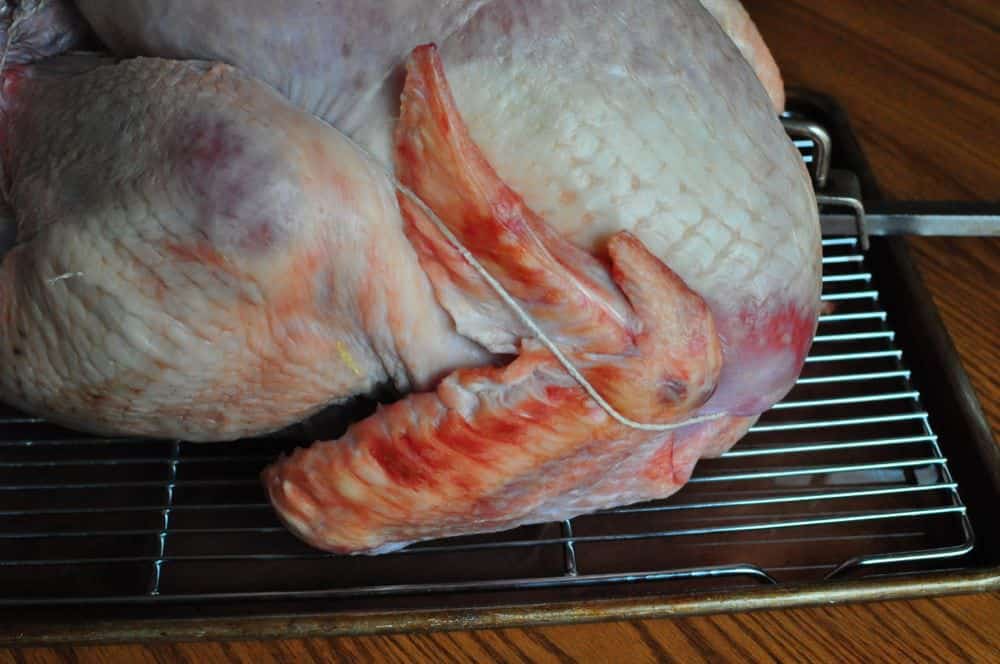
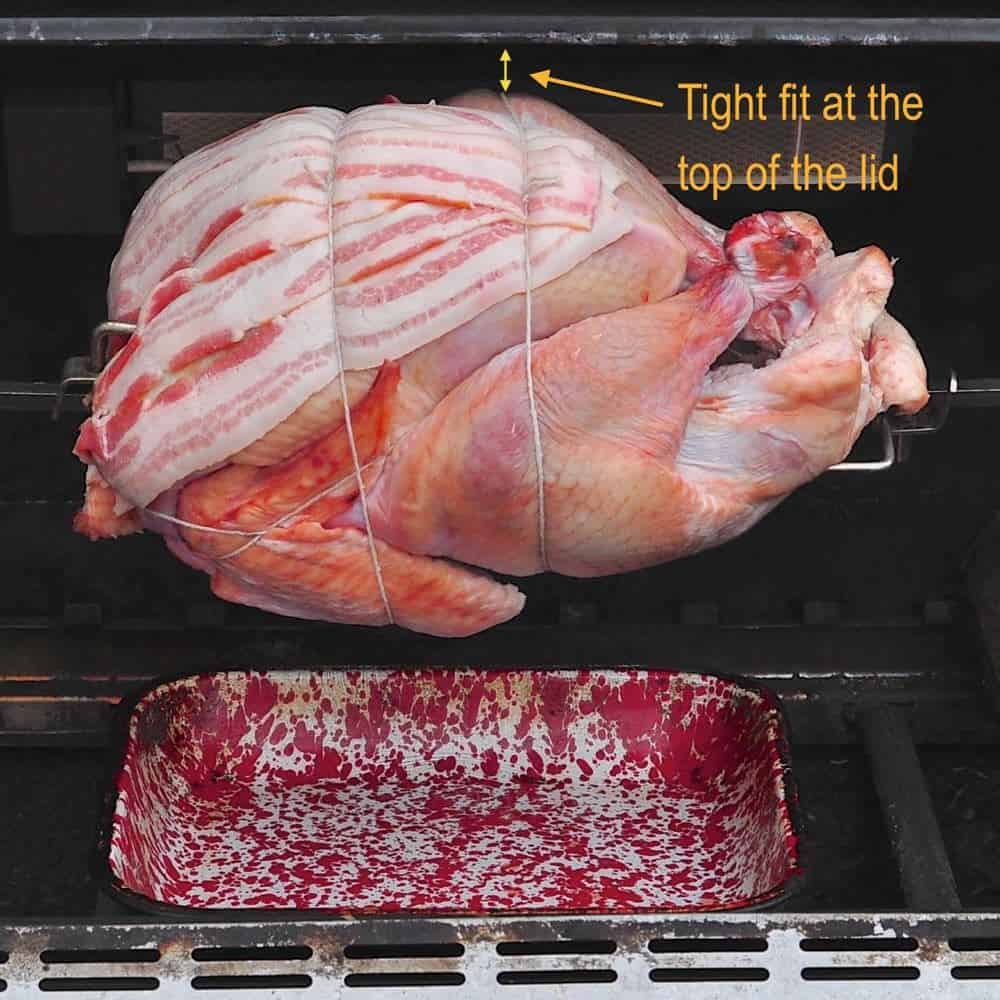
It was a tight fit in my Weber summit. I had to change my usual trussing approach to get the bird to fit. Normally I tuck the wings underneath the bird, but this forces the knobs of the wings stick out. There wasn't enough clearance in the grill - the turkey caught on the top of the grill instead of rotating. So, after trussing the bird, I untucked the wings, and slid the wingtip under the trussing string that runs along the edge of the breast. This trusses the wing against the breast and leaves enough room for the turkey to spin.

Wing tucked under the bird
Wing trussed to the breast
Trussed on the left, tucked on the right.

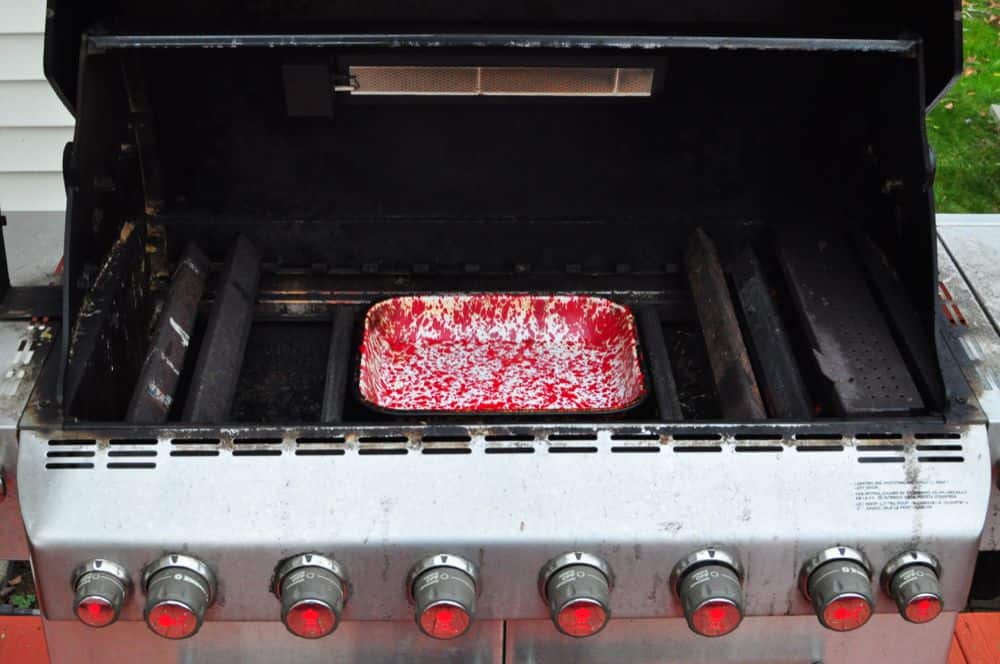
Also, I had to remove the burner covers to have enough clearance at the bottom of the grill. I set my drip pan directly on the burners, so it's a good thing I am cooking with indirect heat and leave those burners off.

So, how big a bird could I have fit? The top of the grill was my problem - I had two inches, maybe, between the drumsticks and the top of the lid in my Weber Summit. I could have squeezed in a slightly larger turkey, maybe as much as 25 pounds. I don't think anything bigger would fit.

What about a Weber Genesis?

I cooked a couple of turkeys in the 12 to 14 pound rage in my old Weber Genesis Silver. It was a tight fit, and I had to remove the burner covers and wedge the drip pan in on top of the middle burner, but it worked. I don't think a larger bird would fit...but I never tried, and the Weber Genesis now lives at my sister-in-law's house.

TL;DR Version

The 23 pound turkey fit in both the Weber kettle and the Weber Summit grills. The Weber Kettle had lots of clearance, and I'd guess I could go as large as 30 pounds. The Weber Summit was a close fit. I would guess I could go to 24, maybe 25 pounds, but no larger. For a Weber Genesis, anything larger than 14 pounds would worry me.

How about you?

How big of a bird have you cooked on your grill's rotisserie? I would especially like to hear from you if you use the rotisserie in a Weber Genesis. I may visiting my old Genesis Silver at my sister-in-law's house this year, and I would like to do a larger bird.  If you've tried a bird larger than 12 pounds in the Weber Genesis, or on any other grill, let me know in the comments below.

Related Posts

Rotisserie Turkey Wrapped with Bacon
Rotisserie Turkey, Dry Brined with Orange and Spices
Rotisserie Turkey with Cajun Dry Brine
Basic Rotisserie Turkey
Rotisserie Turkey Breast with Basic Dry Brine
Rotisserie Turkey Breast with Honey Bourbon Glaze


Check out my cookbook, Rotisserie Grilling.

Everything you could ask about the rotisserie,
plus 50 (mostly) new recipes to get you cooking.

It's a Kindle e-book, so you can download it and start reading immediately!


*Enjoyed this post? Want to help out DadCooksDinner? Subscribe to DadCooksDinner using the RSS or Email options on the right, link to this post from your blog, recommend DadCooksDinner to your friends, or buy something from Amazon.com through the links on this site. Thank you.

Pressure Cooker Beef Stew with Mushrooms

November 8, 2012 by Mike Vrobel 24 Comments

Pressure Cooker Beef Stew with Mushrooms | DadCooksDinner.com

Pressure Cooker Beef Stew with Mushrooms | DadCooksDinner.com
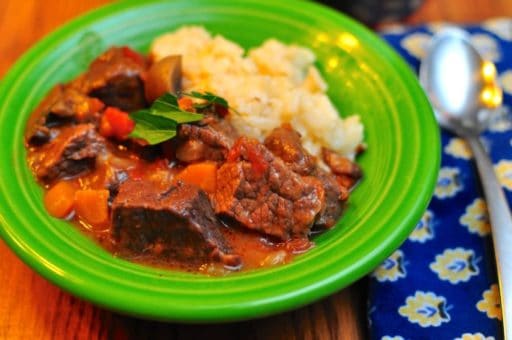
Pressure Cooker Beef Stew with Mushrooms

I'm exhausted. I had a work call late last night, and I didn't get to bed until after 2 A.M. And I had to be up at 6 this morning to get the kids off to school.

Luckily, the plan for tonight's dinner is beef stew. Simple and straightforward, this is one of my most comforting comfort meals.

If you've made any of my other pressure cooker braise recipes, this is going to look awfully familiar. My braises all follow the same pattern. Brown the meat, saute the aromatics, deglaze the browned bits on the bottom of the pan. Add the meat, some stock, and (in this case) tomatoes. Lock the lid on the pressure cooker, bring to high pressure, cook until the meat is done, then let the pressure come down naturally. Serve with a starch to soak up the liquid.

Now, familiar doesn't mean boring. It may not have the star power of a chili, but a simple beef stew is a classic. Having a rough day? Try this stew. It will bring a smile to your face.

Recipe: Pressure Cooker Beef Stew with Mushrooms

Inspired by: Robert Farrar Capon, The Supper of the Lamb

Video


Pressure Cooker Beef Stew with Mushrooms - Time Lapse [YouTube.com]

Equipment

  • 6 quart or larger pressure cooker (I use an Instant Pot electric pressure cooker)

Pressure Cooker Beef Stew with Mushrooms | DadCooksDinner.com
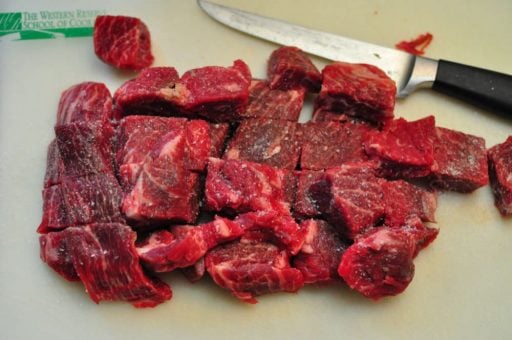
Beef cut into 2 inch cubes

Pressure Cooker Beef Stew with Mushrooms | DadCooksDinner.com
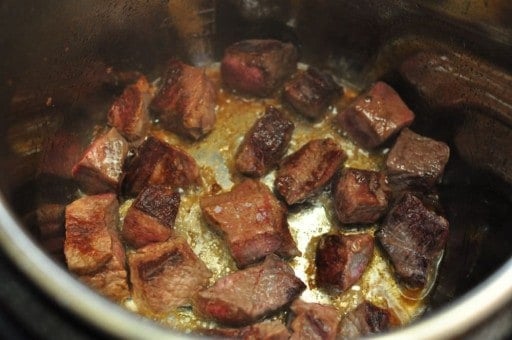
Browning the beef

Pressure Cooker Beef Stew with Mushrooms | DadCooksDinner.com
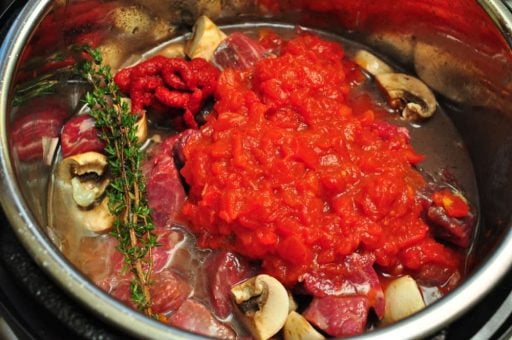
Everything in the pot

Notes

  • Serve the stew with a starch to soak up the juices - I went with risotto, but use your favorite.
  • Don't have a pressure cooker? No worries. Use a heavy bottomed dutch oven with a lid, and increase the amount of chicken stock to 2 cups. Follow the instructions right up until "lock the lid". Then, instead of pressure cooking, bring the pot to a boil, and cover with the lid. Move the pot to a preheated 350*F oven and bake for 2 hours, until the beef is tender.

What do you think? Questions? Other ideas? Leave them in the comments section below.

Related Posts:

Click here for my other rotisserie recipes.

Adapted from:

Pressure Cooker Beef Shank Osso Bucco
Pressure Cooker Short Ribs with Mexican Flavors

*Enjoyed this post? Want to help out DadCooksDinner? Subscribe to DadCooksDinner using the RSS or Email options on the right, link to this post from your blog, recommend DadCooksDinner to your friends, or buy something from Amazon.com through the links on this site. Thank you.

Christopher Kimball, What Were You Thinking?

November 6, 2012 by Mike Vrobel 4 Comments


Before I start on today's topic, I want to say two things. 

First, get out and vote today!

Second, I want to send prayers and good wishes to the friends, readers, and fellow bloggers on the East coast who are still digging out from Hurricane Sandy. We're all pulling for you.

If you want to do more than send good wishes, please donate to Red Cross Disaster Relief.

Christopher Kimball, publisher of the Cooks Illustrated empire, can be abrasive. Like when he dismisses all food blogs as lacking true expertise. (Ahem.) But this piece in the New York Times Magazine - Cooking Isn't Creative, and it Isn't Easy - was shocking. It felt like a character assassination.

Why do I give Mr. Kimball the benefit of the doubt, after reading this? Here's why, quoted from the article:

Editor after editor at C.I. recounts stories of readers, a surprising number of whom turn out be white, middle-aged men, who've approached them at public events to offer thanks for "teaching me how to cook," voices froggy with emotion. Kimball views his bond with home cooks as a solemn responsibility.

I'm one of those emotional middle-aged men. Pam Anderson, Mark Bittman, John Willoughby, and Kenji Alt, all alumni of Cooks Illustrated, have taught me a good chunk of what I know about cooking, and made me want to go find out more on my own. I've read every issue of Cooks Illustrated - ten years ago, I got the hardbound set of their entire back issue run. The data driven approach that CI uses, explaining what they tried and how it worked, helps me more than the actual recipes. And I trust their equipment research more than everyone else's added together.

I watch Mr. Kimball on TV all the time, and listen to him on the radio whenever I get a chance. I feel like I know him, even though I don't really know him. I met him once, as an assistant at a cooking class he was teaching. While we were doing the prep work, he was gruff and exacting. I was peeling shrimp for one of the recipes he was going to demonstrate. He demanded that I weigh the shrimp. He wanted to make sure it was exactly 1 ½ pounds, like the recipe called for. I said something like "I don't know where the scale is…but it's 21-25 count shrimp, so I counted out 35 shrimp, which should be right." He thought about this for a second, then turned away. I didn't get the satisfaction of him saying "yes, that's right", just…he had his answer, and was moving on to other things.

So, I was surprised at how much fun Mr. Kimball was while he taught the class. He bantered with the students, quizzed them on how sharp their knives were at home, then ran a mini-taste test so they could compare results among themselves. He teased us about what we say versus what we actually do. Cooks Illustrated has a very data driven approach, with lots of surveys of home cooks. But, he said, we don't answer the surveys honestly. We ask for fish and vegetable recipes. But when they publish a cookbook, we only buy the ones with beef or chocolate on the cover.

He particularly enjoyed reading us a batch of viewer emails from the America's Test Kitchen show. His favorite was the one asking them to "dump the geek in the glasses and the bow tie."

"It's my show", he smiled above the bow tie, straightening his glasses. "You can't get rid of me."

I don't think Mr. Kimball is joyless about food as the New York Times article makes him out to be. When I read Fanny's Last Supper, I could feel the fun he had trying to reproduce a late 19th century dinner in 21st century America.

I think he cares about home cooking, and takes it seriously. He recognizes the difficulty that novice cooks face in the kitchen. Cooking dinner every night is more about organization than it is creativity, which gets lost in the translation in a lot of cookbooks. Mr. Kimball isn't making that mistake.

I think Pam Anderson and Mark Bittman have better ideas about what it takes to get dinner on the table every night. Cooks Illustrated is so specific that it can be paralyzing. Close enough is good enough for weeknight dinners. That said, I still appreciate everything Mr. Kimball has done and is still doing for home cooking. There is fun and creativity in cooking, once you know what you're doing, and get some basic techniques under your belt. There is the satisfaction of a job well done, the love of feeding your family, and the joy of tasting something delicious and thinking "wow...I made that." And I think that comes out in Mr. Kimball's writing.

What do you think? Have your say in the comment section below.

Recommended Reading

Cooks Illustrated just published The Science of Good Cooking, a book that takes what they've learned in their twenty years in the test kitchen, and distills it down to the key points. I just got my copy, and I can't wait to dig in.

*Enjoyed this post? Want to help out DadCooksDinner? Subscribe to DadCooksDinner using the RSS or Email options on the right, link to this post from your blog, recommend DadCooksDinner to your friends, or buy something from Amazon.com through the links on this site. Thank you.
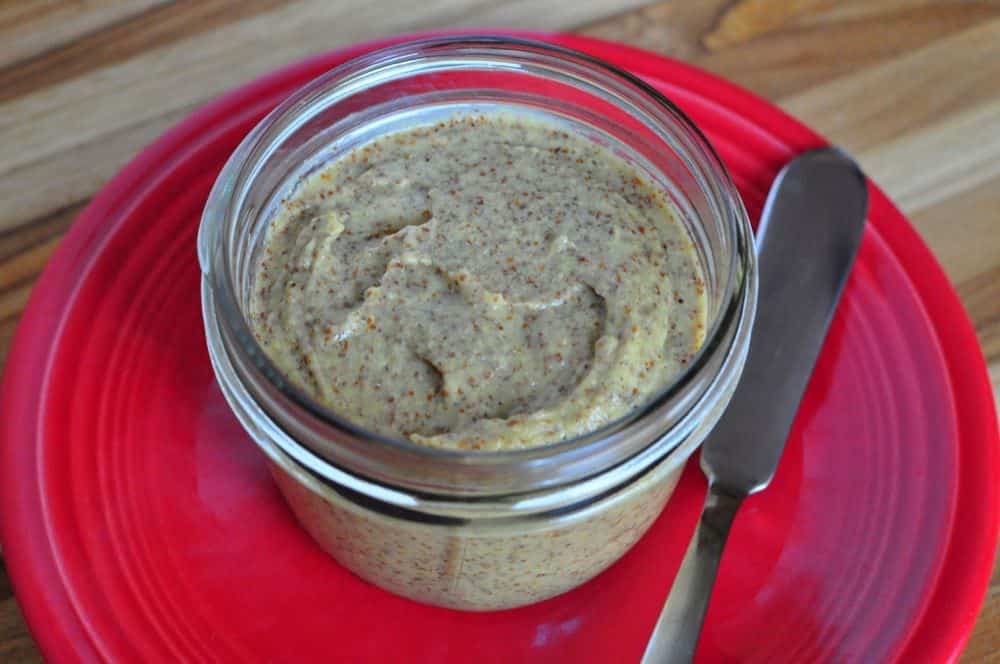
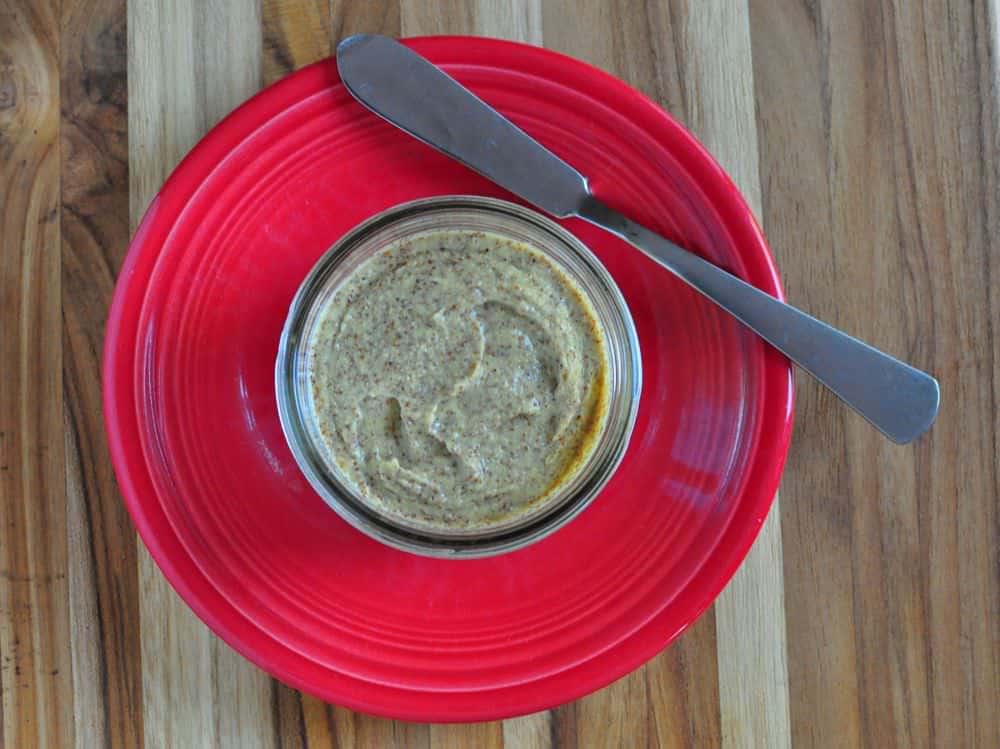
Homemade Honey Mustard

November 1, 2012 by Mike Vrobel 6 Comments

Homemade mustard? That's crazy talk. Why would I make my own mustard?

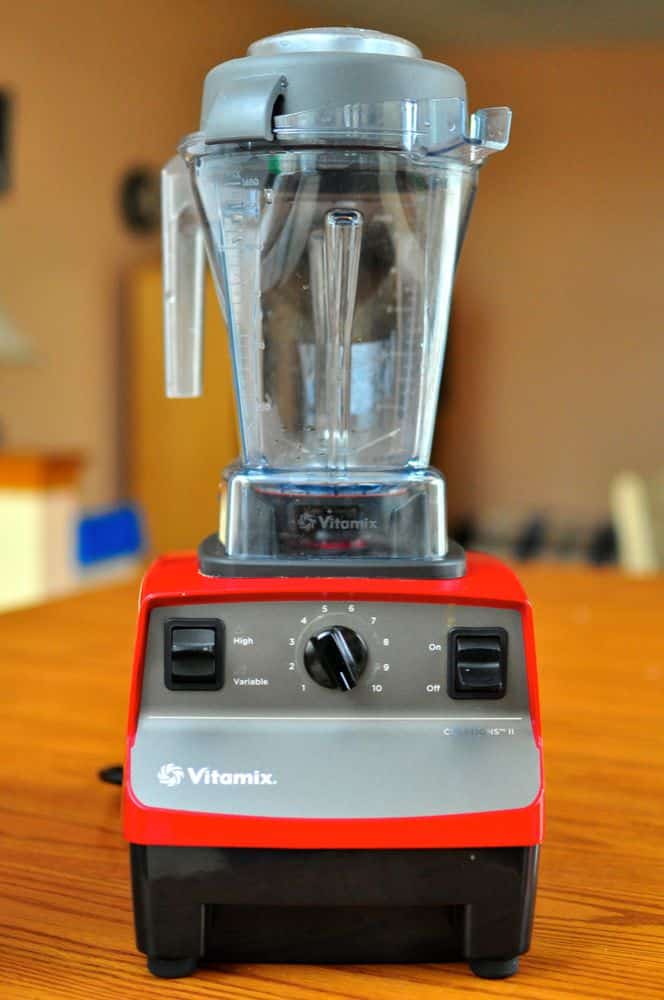
Because it's there. Because my son is a mustard fiend. And, mainly, because I just bought a Vitamix blender. My new toy needed a test.

My oldest son has a serious mustard addiction. I tried to get him involved in making this recipe. It worked - halfway. Help make the mustard? Not interested. He kept trying to sneak away to play with his friends. But then, once the mustard was done blending, he couldn't wait. He wanted to taste it right away. The overnight resting time to letting the flavors mingle almost killed him. I made a 16 ounce jar, and it is almost empty. It was on every sandwich he made this week, and he talks about how much he loves the mustard "we" made.

Recipe: Homemade Honey Mustard

Adapted From: Keith Dresser, How To Make Whole Grain Mustard, America's Test Kitchen

"Cooking" time: 1 minute

Equipment

  • Blender (I love my Vitamix)


Ingredients

  • ¼ cup yellow mustard seeds
  • ¼ cup brown mustard seeds
  • ½ cup cider vinegar
  • ¼ cup white wine (I used a dry riesling)
  • ¼ cup water
  • 2 tablespoons brown sugar
  • 2 tablespoons honey
  • 1 teaspoon kosher salt (or ½ teaspoon table salt)

Directions

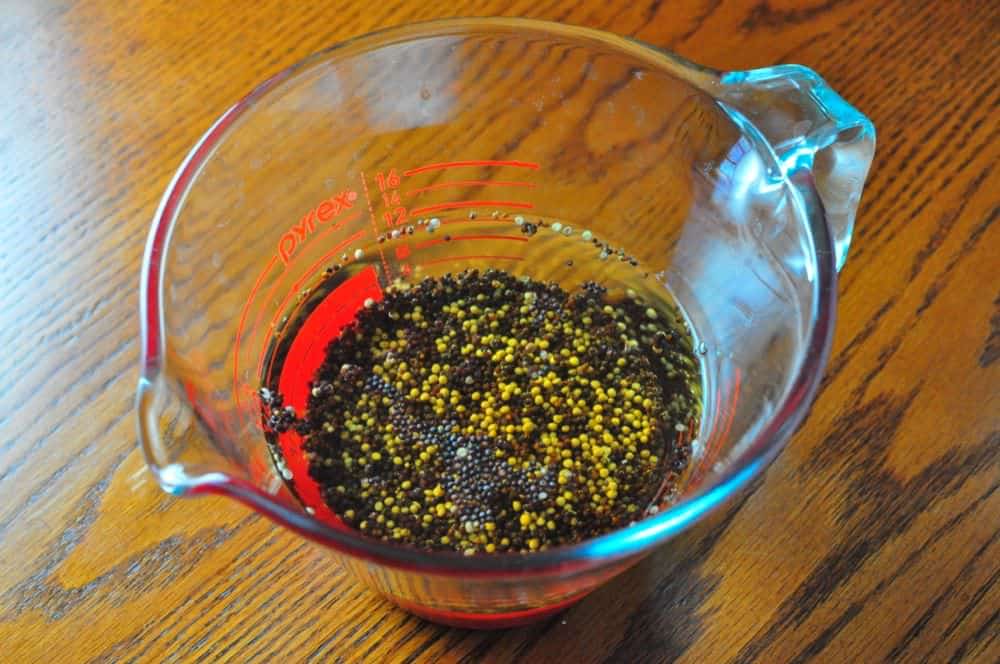
1. Soak the mustard seeds
Stir the mustard seeds, cider vinegar, white wine, and water in a small bowl. Cover and let sit overnight, or up to two days.

2. Process the mustard
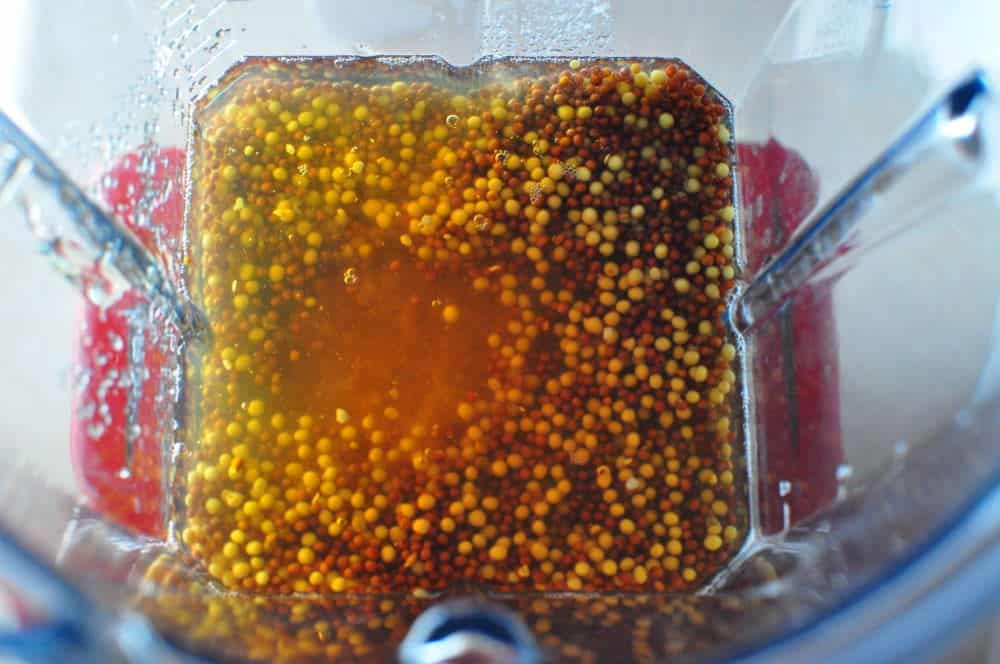
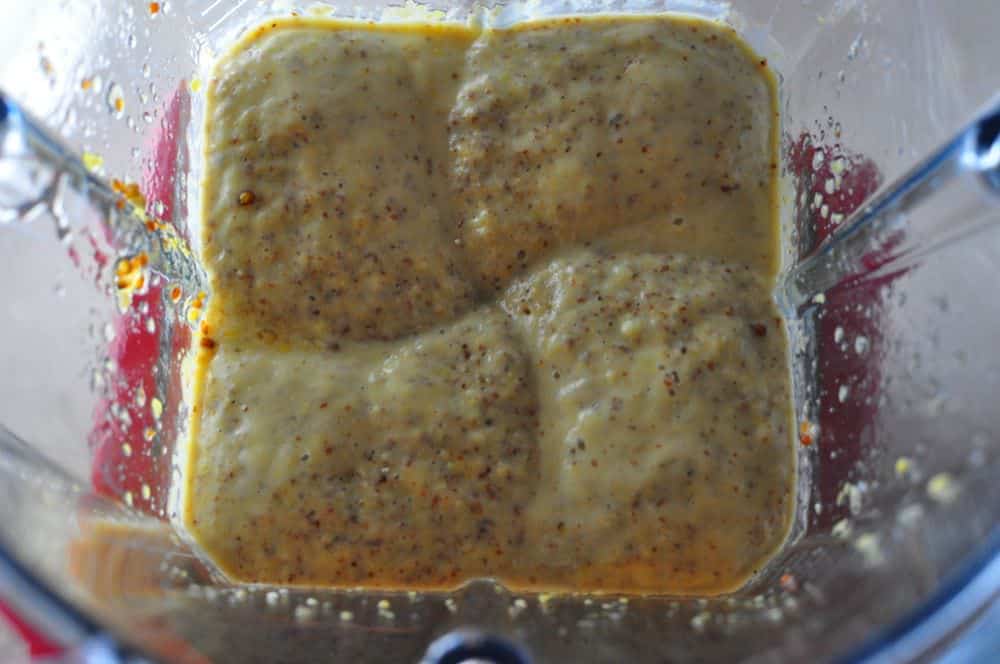
Pour the seeds and liquid into a blender. Add the sugar, honey, and salt. Run the blender, scraping down the sides occasionally, until completely processed, about 1 minute.

3. Rest the mustard
Pour the mustard into a covered container and refrigerate for a day to smooth out the flavors. The mustard will last for a month or more in the refrigerator.


Notes:

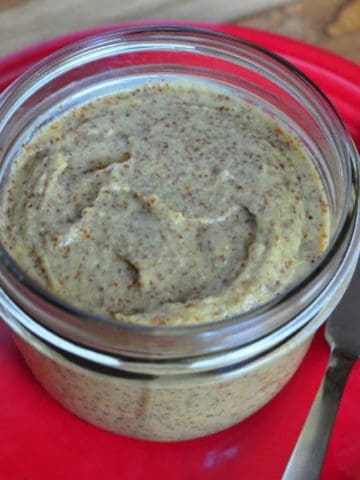
  • You don't need a Vitamix to make mustard. Any blender or food processor will do. A food processor gives you stone ground mustard, with a significant portion of the mustard seeds left whole. A blender (especially a good one like a Vitamix or BlendTec) will get you a grainy style mustard, with flecks of mustard seed visible, but no whole mustard seeds.
    *If you want a smooth mustard, start with mustard powder instead of mustard seed.

What do you think? Questions? Other ideas? Leave them in the comments section below.

Related Posts:

Smoke Roasted Aioli
Easy BBQ Sauce
Road Trip: Vitamix Factory Outlet Store

*Enjoyed this post? Want to help out DadCooksDinner? Subscribe to DadCooksDinner using the RSS or Email options on the right, link to this post from your blog, recommend DadCooksDinner to your friends, or buy something from Amazon.com through the links on this site. Thank you.
 

Road Trip: Vitamix Factory Outlet Store

October 30, 2012 by Mike Vrobel 11 Comments

Vitamix - the blender of the pros. When I visit a smoothie shop, they have a line of Viatamix blenders, each with a noise reducing cover. My health food store uses them to make shots of wheatgrass juice.  If you know a Raw Food fanatic, someone who believes cooking food kills nutrients, I'll bet they have a Vitamix on a pedestal in their kitchen.

I'm a gadget hound. I always want bigger and better. This is a bad thing in the kitchen, because good enough is usually good enough. But I keep looking for an excuse to trade up.

My blender was the exception. I use a blender exclusively for frozen margaritas. Everything else goes in the food processor, or I use a stick blender. My wife and kids, however, are smoothie fiends. They make them every chance they get, and twice on weekends. My wife hinted to me that she wouldn't mind a better blender…especially since she was taking classes with someone who worked for Vitamix.

That's how I found out the Vitamix factory is just up the road from me in North Olmstead, Ohio. And they have a factory outlet store in a nearby strip mall Solon, OH. Road trip!

[Update 8/29/2014 - The North Olmsted Vitamix store is closed, and the new Vitamix Culinary Exploration Center is open in Solon, OH, in a much nicer space. So, a lot of what I said about the store itself is out of date. Not about the deals though - they're still available, though the prices may vary over time.]

Vitamix Factory Outlet Store Solon
6134 Kruse Drive
Solon, OH 44139
Phone: (440) 782-2002
Web: vitamix.com/contact
Email: vitamixstore@vitamix.com
Hours: M, T, W, F 10AM-6PM EST
Thurs 10AM-9PM ET
Sat 10AM-6PM ET
Sun 12PM-5PM ET

The outlet store is...well, let's be kind, and call it minimalist. Boxes of blenders are lined up against the wall. A small stage is in the middle of the store, with a few blenders out so the salespeople can show them. On the weekends they have demos on the stage; local chefs come in to show what you can do with a Vitamix. If you go there during the week, you don't get a show. What you get is a good deal on a monster of a blender.

I bought a refurbished Vitamix 5200 with their shorter, 48 ounce container, for $329 (plus tax), which goes for $450+ new. The same blender with the tall container was roughly $380, and the pro model, with built in sound damping, was a little more than that.
*I'm not sure why Vitamix calls it a "Pro" model - all their blenders are built for professional use.

Now, is the Vitamix worth $300+ dollars? It is the best blender I've ever owned, by far. It churns its way through everything I've thrown at it. I'm glad I got it, but it sure is expensive for a blender.

But it doesn't matter what I think. My wife and kids love "their" Vitamix. Every weekend they pore over the cookbook and add things to my grocery list. We've had mixed berry smoothies, apple smoothies, orange and banana smoothies, and mango smoothies. We've had peanut butter cup milkshakes and strawberry milkshakes. We've had margaritas made by throwing whole limes in the blender. (Which are good, but not as good as Mexican Martinis.)

Diane even made soup, using the blender's ability to heat ingredients. The Vitamix is so powerful that if you leave it running for five minutes, it will heat the ingredients to a it heats the contents. Now, don't trust this to pasteurize anything; it warms the soup, but doesn't cook it. (And I have to say, the spinach and potato soup was excellent.)

If you want the best blender available, don't want to pay full price, and live in Northeastern Ohio, stop by the Vitamix factory store.

Online refurbished Vitamix Blenders

If you can't get to Northeastern Ohio, Vitamix has online deals for refurbished blenders. Check out Vitamix Refurbished Blenders. If you use that link, I'll get a commission for sending you their way, and you'll get free shipping. (If you use one of the links on this page, you should automatically get the free shipping code - look for it when you get to the checkout page.)

*FCC Disclosure - I did not receive any compensation for this post, and purchased the Vitamix with my own money. I did sign up as a Vitamix affiliate; if you buy a blender through the links on this page, you get free shipping, and I get a commission.

Resources

Why Viatmix over BlendTec, or other brands? Read this summary at TheWirecutter.com: The Best Blender.
Vitamix.com - Official site, full of ideas and recipes.

Map

Vitamix Culinary Exploration Center:

View Larger Map

*Enjoyed this post? Want to help out DadCooksDinner? Subscribe to DadCooksDinner using the RSS or Email options on the right, link to this post from your blog, recommend DadCooksDinner to your friends, or buy something from Amazon.com through the links on this site. Thank you.
Rotisserie Pork Shoulder Stuffed with Onions and Parsley (Spiessbraten)

October 25, 2012 by Mike Vrobel Leave a Comment

Spiessbraten is German-Brazilian fusion cuisine. Idar-Oberstein was famous for working gemstones into jewelry, especially Agate. But in the late 1700's, the agate mines were almost played out. It was getting harder and harder to find gems to work with. Then, German immigrants to Brazil found a large deposit of agate. This started a busy trade route. Agate was shipped to Idar-Oberstein and worked into jewelry, then the profits were used to buy goods that were shipped back to Brazil.

Along with the agate came the Brazilian tradition of churrasco cooking, spit roasting over an open fire. Idar-Oberstein took the idea of spit roasting and applied it to their favorite local ingredients, pork and onions. The region is famous for this dish; every year, they hold a festival in its honor.

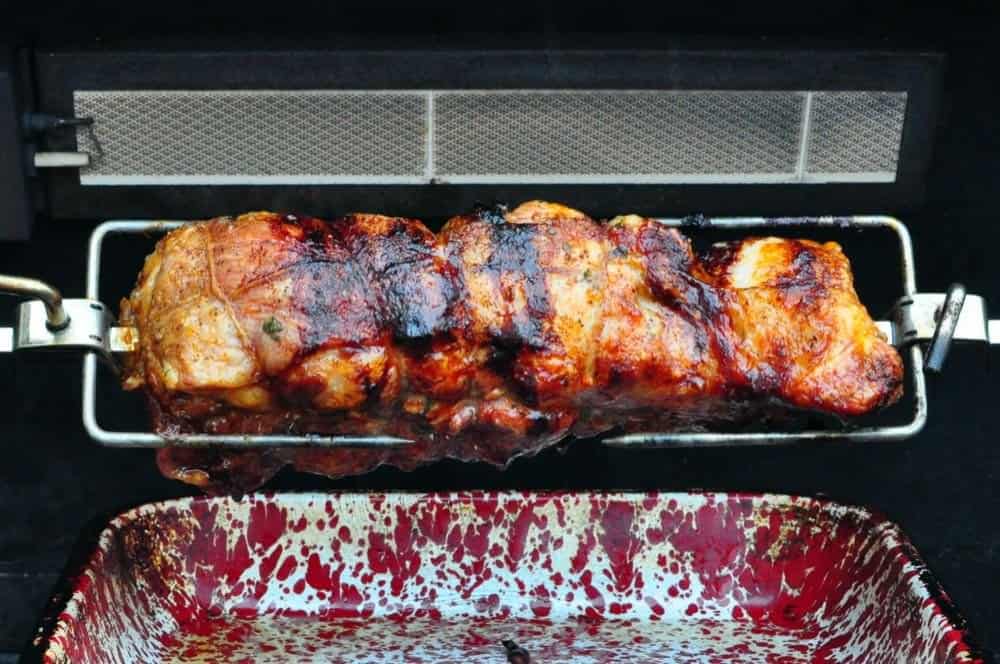
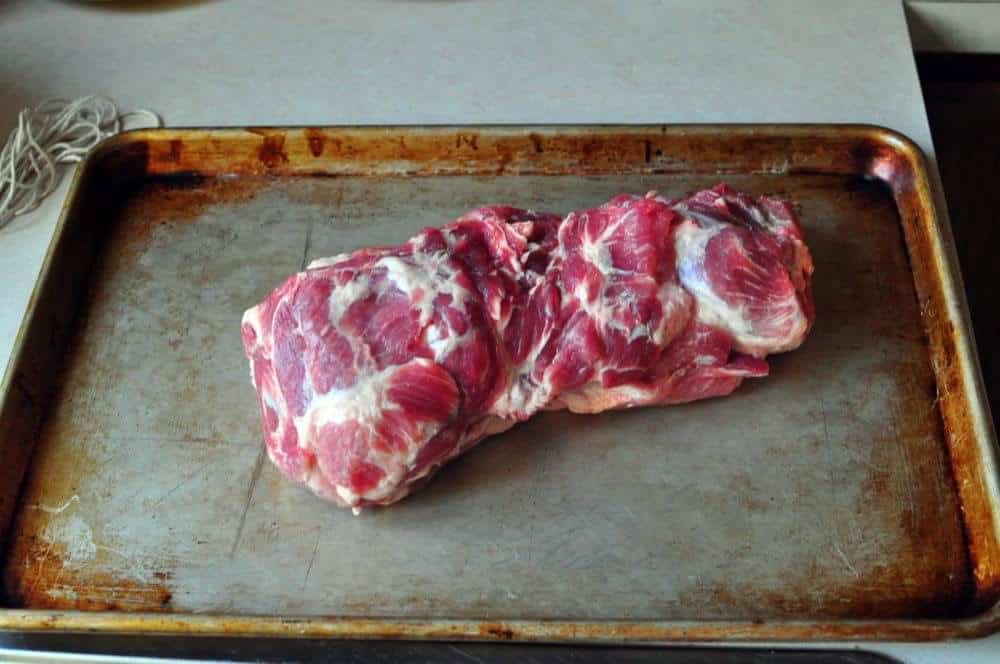
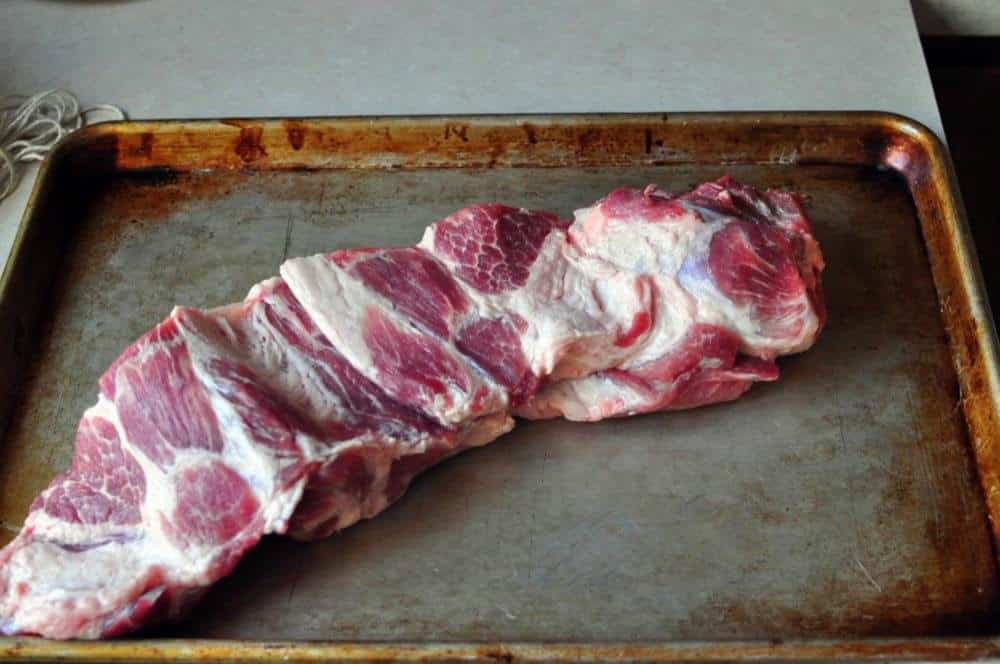
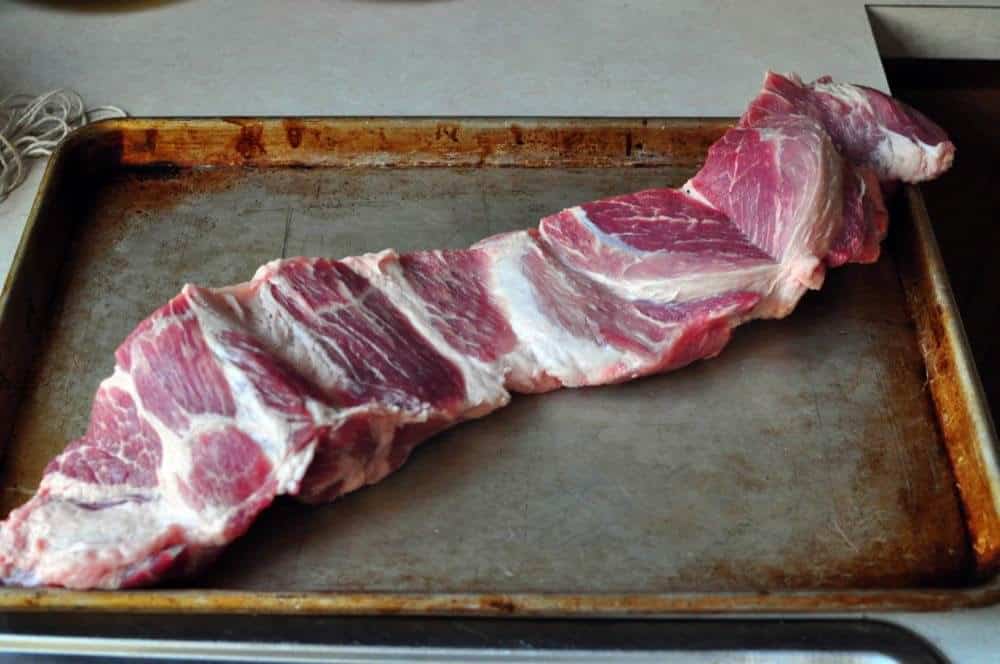
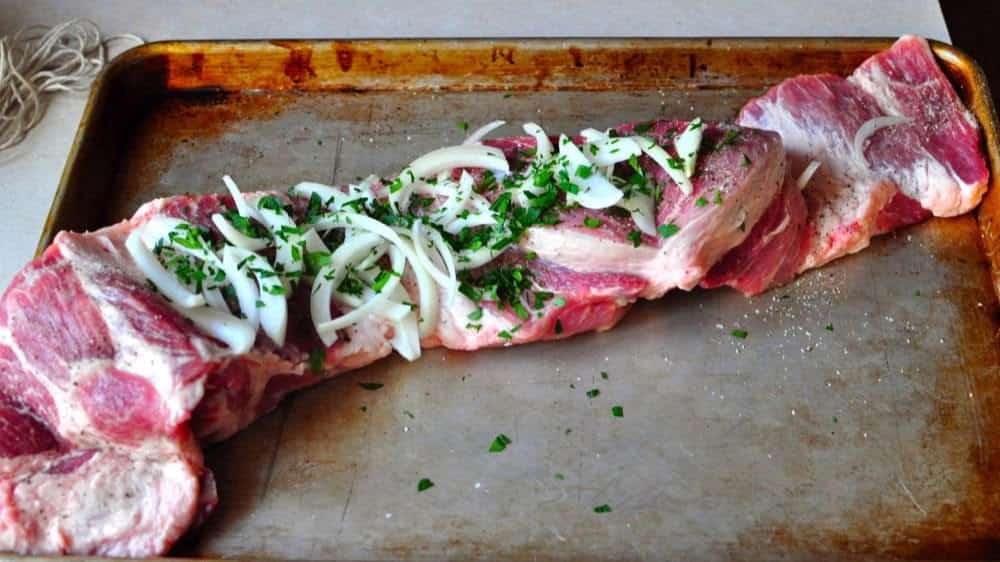
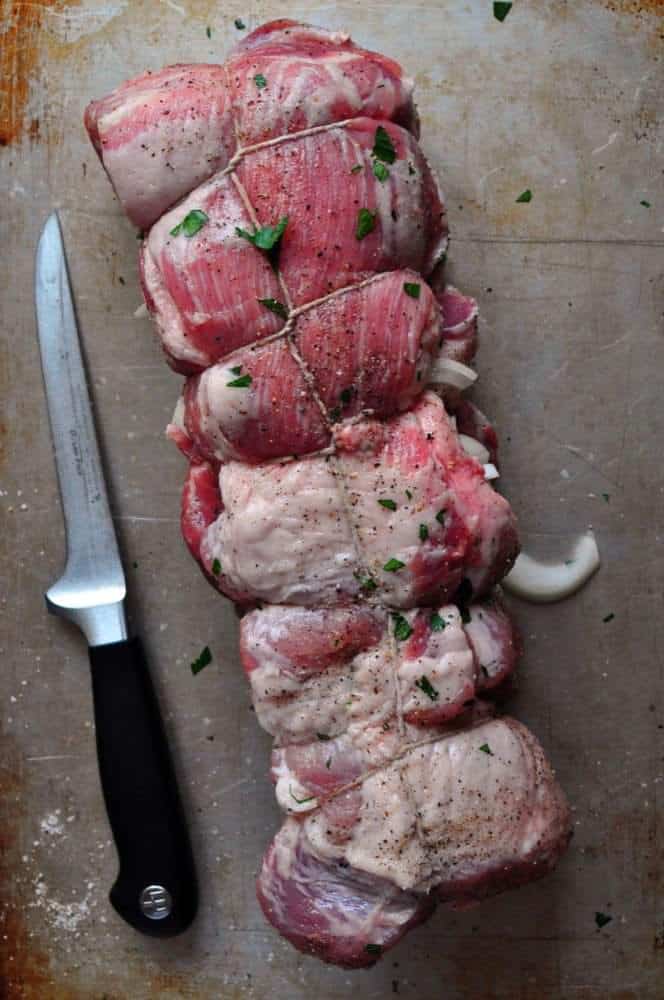
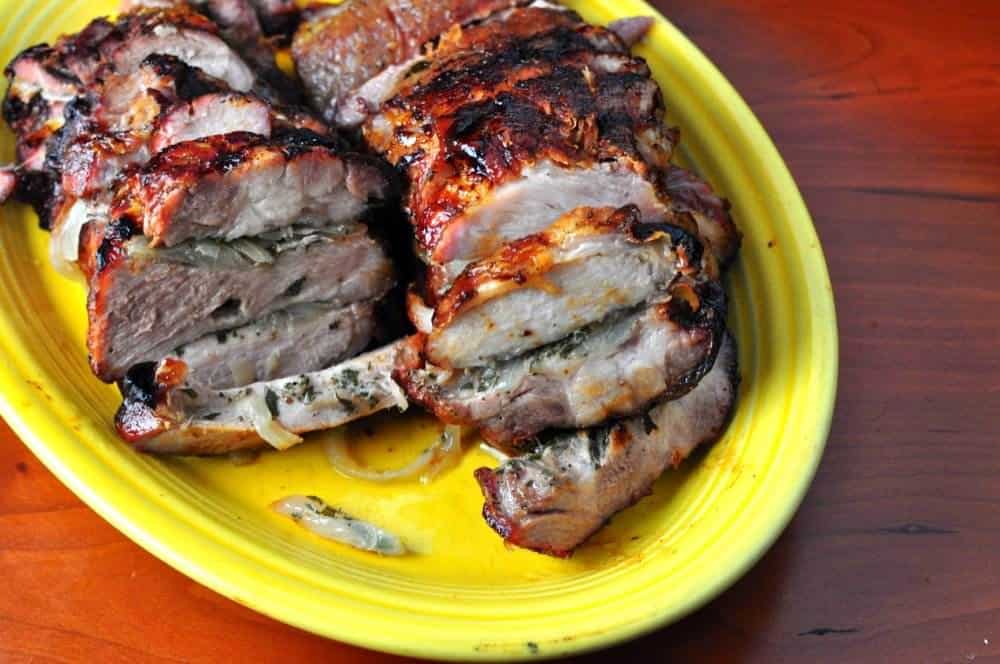
Traditionally, spiessbraten is a boned pork neck with a stuffing of onions and herbs. I use a common substitute, pork shoulder, and roll-cut it to open it up like a book. After stuffing it with onions and parsley, I cook it slowly over medium heat on the rotisserie. The result is fork-tender pork stuffed with sweet, melting onions.

Recipe: Rotisserie Pork Shoulder Stuffed with Onions and Parsley (Spiessbraten)

Cook time: 2 hours

Equipment:

  • Grill with Rotisserie attachment (I used a Weber Summit with an infrared rotisserie burner. Here is the current version of my grill.)
  • Aluminum foil drip pan (9"x12", or whatever fits your grill)
  • Butchers twine

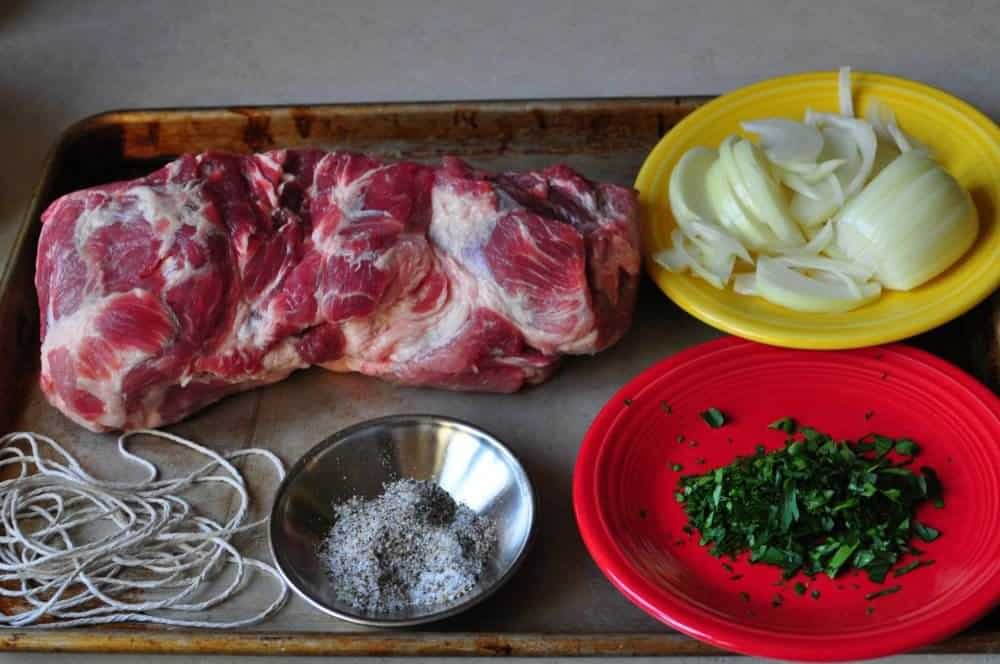
Ingredients:

  • 4 pound pork shoulder roast (also know as "pork butt" or "pork shoulder butt roast")
  • ½ of a medium onion, sliced
  • ¼ cup minced fresh parsley leaves
  • 1 tablespoon Kosher salt
  • ½ teaspoon fresh ground black pepper

Directions:
1. Stuff, truss, and rest the pork shoulder: Roll cut the pork shoulder to open it up like a book. Set the roast with the fat cap facing down. Make a cut the length of the roast, one third of the way from the bottom, which goes almost all the way to the other side of the roast but not through. Open the roast up like a book along that cut, then make another cut halfway up the opened part of the roast, almost all the way to the other side, and open up the roast again. Sprinkle the cut side of the roast with salt and pepper, then layer the onions and parsley on the cut side of the roast. Fold the roast back into its original shape, then truss with twine, tying it every inch and a half. Push any runaway onions back into the center of the roast. Sprinkle the remaining salt and pepper evenly over the outside of the roast. Refrigerate for at least two hours, preferably overnight. One hour before cooking, remove the roast from the refrigerator, secure it on the rotisserie spit, and let it rest at room temperature.

2. Prepare the grill: Set the grill up for rotisserie cooking at medium heat. For my Weber Summit, this means removing the grates, turning the two outer burners (burners 1 and 6) to high, and leaving the infrared burner off. I put my drip pan in the middle of the grill, over the unlit burners, and let the grill preheat for ten to fifteen minutes. This gives me grill temperature of about 350*F.

3. Cook the pork shoulder: Put the spit on the rotisserie, start it spinning, and center the drip pan under the pork roast. Cook with the lid closed until the pork reaches 190*F to 200*F in the thickest part of the meat, 2 to 3 hours.

4. Rest, carve and serve: Remove the spit from the grill. Be careful; the spit is hot. Remove the roast from the spit, transfer to a platter, remove the twine, and cover with foil. Let the roast rest for 15 to 30 minutes before carving the pork into ½" thick slices. Serve and enjoy!

Notes:
Any onions that are poking out of the roast are going to turn black in the heat of the grill. I think they still taste fine, but if they bother you, snip the burnt ends off before slicing the roast. The onions inside the roast will be tender and sweet.

What do you think? Questions? Other ideas? Leave them in the comments section below.

Related Posts:
Rotisserie Pork Shoulder Roast
Rotisserie Pork Shoulder, Char Siu Style
Click here for my other rotisserie recipes.

Inspired by:
Steven Raichlen Planet Barbecue


Check out my cookbook, Rotisserie Grilling.

Everything you could ask about the rotisserie,
plus 50 (mostly) new recipes to get you cooking.

It's a Kindle e-book, so you can download it and start reading immediately!


*Enjoyed this post? Want to help out DadCooksDinner? Subscribe to DadCooksDinner using the RSS or Email options on the right, link to this post from your blog, recommend DadCooksDinner to your friends, or buy something from Amazon.com through the links on this site. (Like my Rotisserie Grilling cookbook...)
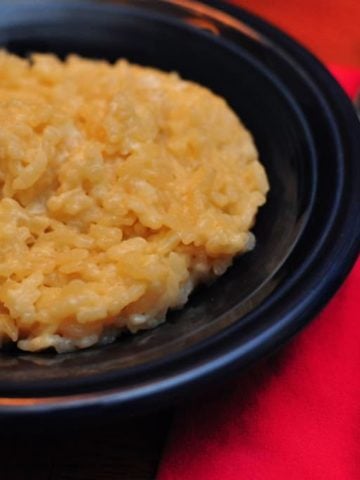
Rotisserie Cookbook Update

October 23, 2012 by Mike Vrobel 6 Comments

I want to apologize in advance. This post is "inside baseball" about my self-publishing adventure. Today was supposed to be a story about the glories of fall grilling, with colorful descriptions of leaves falling around me. That will have to wait. I screwed up my domain name transfer over the weekend, and spent my blogging time trying to get DadCooksDinner.com back on the air. I hope all the problems are solved. It takes a while for the changes to travel to Domain Name Servers across the globe. Hopefully things have settled down by the time you read this.

I need to celebrate. My cookbook has earned enough money to break even. I actually covered my expenses! I have a stack of receipts for the IRS - from lights for trussing videos, proof copies, and review editions. My biggest expense? Meat. It took a lot of roasts to test the recipes. But every copy I sell from now on goes towards profits. Whoo hoo!

Well, OK, this does mean I worked six months for free. But I can finally calculate an hourly wage on the book. Hold on, I just sold a copy - what's $3 divided by six months? (On second thought, don't tell me.) I'm counting on the long tail of sales to actually earn me some money. Let's just say...I can't quit my day job any time soon.
Step 1: Self publish niche cookbook about rotisserie grilling. Step 2: ? Step 3: Profit!

Now for some statistics. After my Kindle cookbooks rant, I was sure the Kindle edition would outsell all the others. The Kindle edition (like my other eBook editions) sells for $5; the paperback is $10. The Kindle version has color pictures, unlike the black-and-white paperback. But…paper cookbooks aren't as dead as I thought they were. The paperback just caught and passed the Kindle edition in sales, even though the Kindle edition had a month's head start.

Currently, my sales are about 50% paperback, 30% Kindle, and 20% Apple iBooks edition. I'm impressed at how well the iBooks version is selling, considering it only is only readable on Apple iDevices. The Nook edition, however...sales are slightly greater than zero percent, but not by much.

Geographically, 90% of my sales are in the US, the remaining 10% are from England, with an occasional sale in the Eurozone.

What does this all mean? I have no idea. But I love my own little window on the publishing world.

When I released the cookbook, I was #1 in the Kindle Outdoor Cooking category...for a brief moment. (I should have taken a screen shot.) Now I bounce around the top 100, and the paperback is usually in the top 100 in the Barbecuing and Grilling category. Do I spend too much time obsessing over my Amazon rankings? Of course I do.

Thank you for listening to me toot my own horn. And thank you for buying my book, and reading this blog. I wouldn't be writing if you weren't out there reading.

What do you think? Questions? Other ideas? Leave them in the comments section below.


Check out my cookbook, Rotisserie Grilling.

Everything you could ask about the rotisserie,
plus 50 (mostly) new recipes to get you cooking.

It's a Kindle e-book, so you can download it and start reading immediately!


*Enjoyed this post? Want to help out DadCooksDinner? Subscribe to DadCooksDinner using the RSS or Email options on the right, link to this post from your blog, recommend DadCooksDinner to your friends, or buy something from Amazon.com through the links on this site. Thank you.
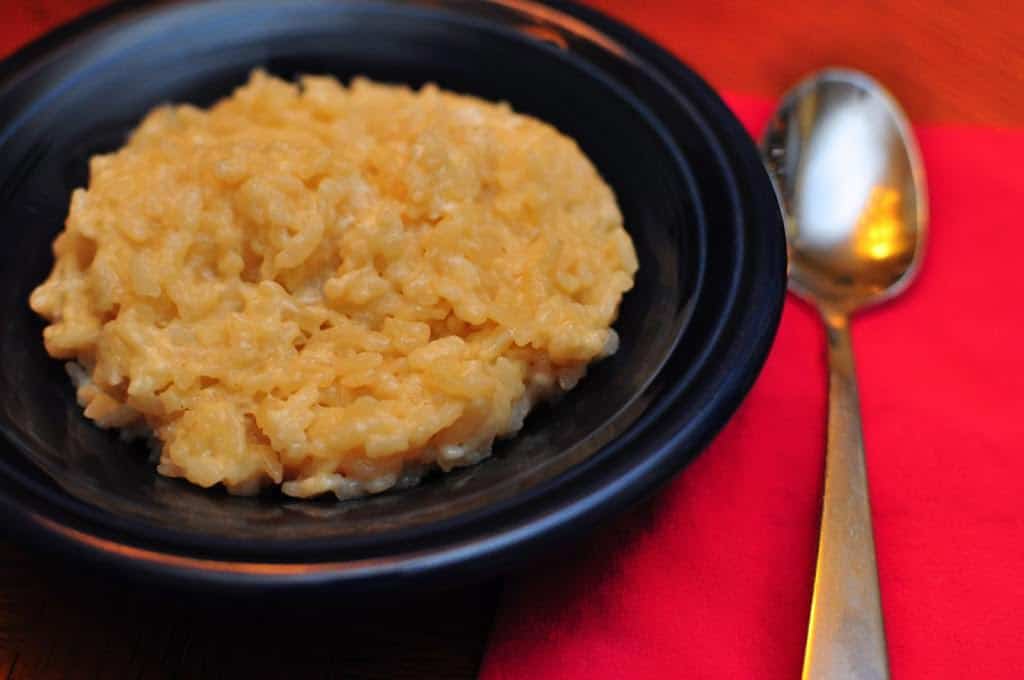
Pressure Cooker Garlic Confit

October 18, 2012 by Mike Vrobel 33 Comments

I received a bunch of complaints about this post. I was told that electric pressure cookers (and stovetop pressure cookers that aren't dedicated pressure canners) are untested for pressure canning, and are therefore unsafe. Garlic carries botulism spores, and botulism can be deadly, so you have to be careful when dealing with canned garlic.

[UPDATE 2014-11-27] The National Center for Home Food Preservation has issued a statement warning people not to can in electric pressure cookers: Can I Can in a Multi-Cooker?
I'm retracting this post. I don't want to take it down, so people see this warning; I'm striking the text of the recipe out. Please only pressure canners, not pressure cookers, for pressure canning.

If you want to see the recipe it was based on, get a copy of the Modernist Cuisine at Home cookbook, or go to the Pressure Cooker Garlic Confit recipe on Modernist Cuisine's website.


The coolest thing in Modernist Cuisine at Home? Cooking in canning jars in the pressure cooker. They use the technique where the food would have to be stirred if it was in contact with the bottom of the pot - which can't happen in a locked pressure cooker.
*I've heard of pot-in-pot cooking and pressure canning, but I never thought to do them both at the same time...

Pressure cooker garlic confit called out to me. I love the idea of a jar full of roasted garlic cloves in the refrigerator. And the garlic-infused oil is as useful as the cloves. I made braised kale using a few tablespoons of the oil and a few cloves of garlic from this recipe, and Diane was raving about it.
*See the Notes section for the kale recipe

After I got over how cool it was to see canning jars in the pressure cooker, my next thought was: Garlic infused olive oil? That can be a bad idea. Botulism multiplies in low-oxygen, low acid environments - like being covered with oil. Garlic, like most vegetables, can carry botulism spores. Fresh garlic in olive oil should be thrown away after a day or two in the refrigerator, and homemade garlic infused oil is dangerous. What about pressure cooking it? Does that make it safe?

It took a lot of searching, but I finally found out that the recipe is safe. According to the National Center for Home Food Preservation, botulism spores are killed if you can hold the temperature between 240°F to 250°F for 20 to 100 minutes, depending on the size of the jar. Conveniently, those are the temperatures you get with 10PSI to 15PSI pressure cookers. This recipe pressure cooks the jars for 2 hours, so there's no way botulism can survive. After the jar is opened, the garlic keeps for a month in the refrigerator.
*From what I could find, 3 minutes at 250°F kills the botulism spores. But it takes 20 to 100 minutes to be sure that temperature reaches the center of the jar, depending on the size.

Enough scary, but neccesary, food safety tips. This recipe couldn't be simpler if you own a pressure cooker and canning jars; the only hard part is peeling all that garlic. I'm already addicted to having a jar of roasted garlic in the refrigerator, ready whenever I want it.
*I used the technique shown here - [Youtube via Saveur.com]. It took multiple rounds of shaking to get all the cloves peeled. Don't be gentle - shake as hard as you can. Or, If there is a good Asian market nearby, keep an eye out for pre-peeled garlic, which makes this recipe much easier.

Recipe: Pressure Cooker Garlic Confit


Adapted From: Modernist Cuisine at Home

Cooking time: 120 minutes

Equipment:

  • Pressure Cooker (I used my Instant Pot electric pressure cooker)
  • 16oz canning jar

Ingredients:

  • 1 cup olive oil
  • 50 cloves garlic, peeled (4 large heads)
  • ½ teaspoon herbes de provence
  • 1 bay leaf

Directions

1. Fill the jars
Put everything in the canning jar, wipe the rim of the jar clean with a wet paper towel, then tighten down the lid finger tight.

2. Pressure cook the garlic
Put a rack in the pressure cooker pot and add 1 inch of water. (For my nine inch diameter cooker, this is about a quart of water.) Put the jar on the rack, lock the lid, and bring the cooker up to high pressure. Pressure cook on high for 2 hours. Let the pressure come down naturally. Carefully remove the jar from the PC, using tongs (or, even better a canning jar lifter). The jar will still be dangerously hot, with bubbling oil inside - let it cool to room temperature before handling. The sealed jar will last for a year at room temperature; refrigerate after opening, and the garlic will last for a month.


Notes

  • I used my electric pressure cooker, which made it very easy - turn the timer to two hours, and walk away. But any pressure cooker will do, as long as it can get to 10 PSI.
  • The recipe doubles easily...as long as you can live with peeling all that garlic.
  • Bonus recipe: Braised Kale with Garlic Confit and Oil. Strip the leaves from the stems of a large bunch of kale, and rough chop the leaves. Put four cloves of garlic confit plus two tablespoons of the garlic oil into a large pot. Add the kale, sprinkle with 1 teaspoon of Kosher salt, then toss to coat with the oil. Add a half cup of water, put the pot over medium-high heat, and cover. When steam starts escaping from under the lid, turn the heat down to medium-low and steam the kale for 20 minutes.


What do you think? Questions? Other ideas? Leave them in the comments section below.

Adapted from:

Modernist Cuisine at Home

*Enjoyed this post? Want to help out DadCooksDinner? Subscribe to DadCooksDinner using the RSS or Email options on the right, link to this post from your blog, recommend DadCooksDinner to your friends, or buy something from Amazon.com through the links on this site. Thank you.
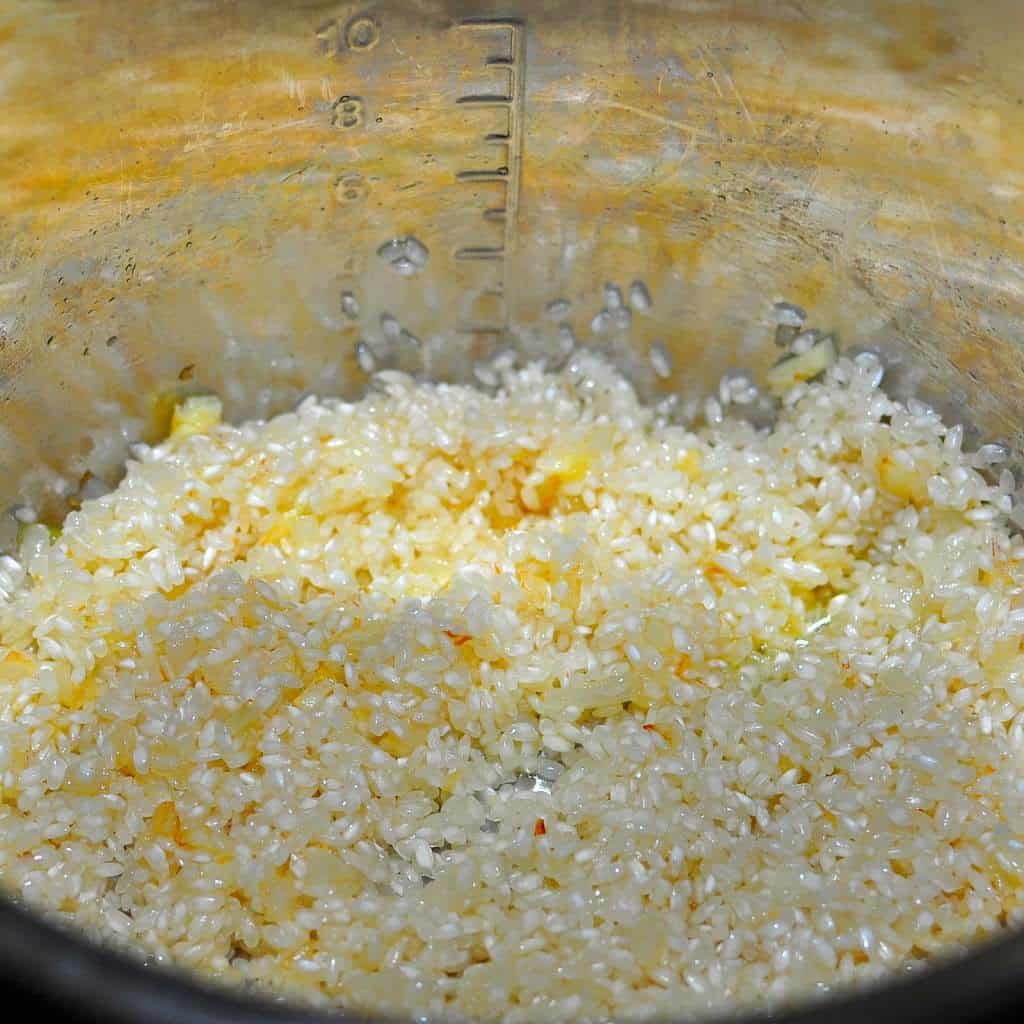
Book Review: Modernist Cuisine at Home

October 16, 2012 by Mike Vrobel 4 Comments

I'm a geek who cooks. I learned to cook by watching every episode of Good Eats twice, and reading the detailed head notes of every Cooks Illustrated recipe published between 1993 and 2005 (I asked for the back issues for Christmas.) Harold McGee was my bedtime reading. I tried out what I learned in the kitchen, made a lot of mistakes, and learned from them as well. I'm the kind of person who needs to know "why" when I'm cooking, and knowing "why" helps me become a better cook.
It took Pam Anderson's How to Cook Without a Book to pull me back from the bleeding edge of cooking. That's when my dinners went from "It's eight thirty, I'm starving, when is dinner going to be ready?" to "Dinner will be on the table at six thirty. Maybe six forty-five."

Modernist Cuisine, by Nathan Myhrvold and his team of chefs and scientists, is an encyclopedia about the cutting edge of food. The four volumes contain 2,348 pages, totaling forty pounds of science and technology applied to cooking.

Modernist Cuisine has been on my wish list since the day it came out. It costs over $450.00. It's still sitting on my wish list.

But! The Modernist Cuisine team just released a second book, Modernist Cuisine at Home. It's only (only!) $140, 456 pages, weighs ten pounds, and is more oriented towards home cooks than the original.

Ten pounds may not sound like much, but this is a substantial book. It's the biggest, heaviest book I own, by far. It outweighs my biggest atlas and dictionary, and makes my largest cookbooks look puny.

In addition to the book, with its coffee table pictures and printing, it comes with a spiral bound book with all the recipes printed on water-resistant paper, for use in the kitchen. And a slipcover to house both the book and the spiral bound recipe booklet.

For a food geek like me, getting this book was a second birthday present. I tore through it over the last week, and here are my impressions.

Pressure Cooking

The Modernist team loves pressure cookers even more than I do. This book has more pressure cooker recipes than most pressure cooker cookbooks that I own. They cover the standards, like pressure cooker stocks, braises, and risotto. Their caramelized vegetable soups use the extra high heat of the pressure cooker to brown the vegetables while they pressure cook, a brilliant idea. (They throw a pinch of baking soda in to help the browning process along.)

Then I read how they use canning jars in the pressure cooker. Polenta, rendered chicken fat, garlic confit, pressure cooked in jars on a rack over an inch of water. I love canning jars, I love my pressure cooker, and now I get to use them both together? I'm in love.
*Coming Thursday - I try Modernist Cuisine's Pressure Cooker Garlic Confit in canning jars.

Sous Vide

The book covers sous vide cooking in great detail. Sous vide cooking involves sealing food in a plastic bag, then cooking it in a water bath set to the exact temperature you want to finish at. As they explain, this technique has a lot of advantages over traditional cooking. If I want a medium-rare steak, that's what I get with sous vide. The water is set to medium-rare temperature, so the steak will cook to that temperature, but no farther. No more "darn it, it's well done!". They cover all sorts of sous vide cooking equipment, from expensive immersion circulators to the "bubba sous vide" that I use - a beer cooler filled with hot water. And, they show to brown the food after it's been cooked sous vide. This can involve a ripping hot pan, a grill, or…a blowtorch.

Other good stuff

I love the book's focus on basic techniques. There are a lot of master recipes, followed by a list of suggested variations and hints on how to make your own variations. For example, they have a recipe for pressure cooker carnitas. Then come the variations for sous vide carnitas, or using a whole pork shoulder instead of pork cubes. Then they take off on the theme of pressure cooker braises - once you know the basic technique, they show how to use it to make lamb leg tagine, pork shoulder fricassee, braised duck with steamed buns, pork vindaloo, and short rib lettuce wraps.

I am in awe of the photographers who worked on this book. I keep going over the cross-section pictures, noticing details I didn't the last time. I'm not sure which is my favorite. I have a sentimental preference for the cross-section of a Weber kettle, full of lit coals, in the middle of grilling a kebab. But the cross-section of a microwave, including cross-sectioned vacuum bags with cross-sectioned vegetables is a close second.

The equipment section is also very strong, covering what you need to stock a modernist kitchen. Pressure cookers, sous vide setups, vacuum sealers, scales, thermometers, whipping siphons - they talk about everything.

The book is full of great tips. Like: one of the reasons I dry brine nowadays, instead of wet brining, is because I get crispier skin on my poultry. They solve this problem by injecting the brine directly into the meat, avoiding the skin entirely, then leaving the bird in the refrigerator overnight. The meat brines from the inside, the skin dries out in the refrigerator, and the result is the best of both worlds.
*At least, that's the plan. I haven't had a chance to test this technique out yet.

At Home?

This book is aimed at advanced home cooks, looking to replicate restaurant cooking at home. The recipes aim for perfection. If an extra step will improve the recipe, it's in there. It doesn't matter if that's an extra pot to wash (or strainer, or blender, or whipping siphon…) This book is definitely not for a beginning cook. Or anyone looking to make a weeknight meal. Now, if you want to host a fancy dinner party and impress your guests, this is a great book to turn to.

Also, there's something about the grilling section that bothers me. Their approach to perfect grilled steak has two options:
Option 1: Sous Vide cook it, then sear it on the grill.
Option 2: Put the steak in the freezer for 30 minutes to freeze the very outside. Sear it over ultra-high heat (using a hair dryer to supercharge the coals), then move it to indirect heat, directly over a loaf pan full of ice, to slowly bring it to medium-rare.

Both of these techniques work, and the result is a great steak. But…wow, that's a lot of extra work, and it doesn't feel like grilling to me.

Summary

Reading this book taught me something about myself. I'm an odd blend - a Traditionalist Home Cooking Food Geek. I want to learn about these new techniques, but will I use them? I think Modernist Cuisine at Home will be more of a reference than a cookbook.
Also, I really want the big brother, four volume edition. No matter the cost. While I was reading At Home, there were a lot of places I asked "why does that work?" The notes would say "further reading in Modernist Cuisine." Argh!

I need to try more of the Modernist basic techniques. I'm cooking my way through the pressure cooker recipes, of course. (There's a lot of them to try out.) Sous vide cooking looks like it can help with meal planning. It removes the time sensitivity of cooking. I don't have to watch everything, to make sure I get it off the heat at the perfect moment. Everything can sit in a water bath, held at the right temperature for "done". I can sear and serve when I'm ready, not when the food's ready. It seems like slow cooking, only more focused.

Will these techniques become a regular part of my cooking routine? I don't know yet. But I'm excited the Modernist Cuisine team is out there, exploring and documenting these ideas for us.

*FCC Disclosure - I did not receive any compensation for this post, and purchased Modernist Cuisine at Home with my own money. If you buy a copy through my Amazon links, or anything else for that matter, I get a small sales commission. Thank you!

Modernist Cuisine at Home

Grilled Mexican Short Rib Tacos with Poblanos, Onions, Pineapple, and Tomatillo Salsa

October 11, 2012 by Mike Vrobel 2 Comments

Why heat up a grill and only cook meat? I want to grill everything. EVERYTHING. Taco night is the perfect grilled meal, because I don't have to turn on the stove.

I found thin-cut short ribs at my local Mexican market. They are the same cut I use for Korean grilled ribs, but I went with a Mexican lime-garlic marinade. For the rest of the meal, I'm using recipes I've mentioned on the blog before, mainly to use up the veggies I got from my CSA box. I'm grilling tomatillo salsa, peppers and onions, and pineapple.
*Even the tortillas are warmed up on the grill. I wrap the stack of flour tortillas in aluminum foil, then heat them while I grill everything else.

My grill is big enough to handle all this food at once. If your grill is smaller, cook in two batches. Start with the vegetables and fruit; they take longer. The thin-cut short ribs cook through in about five minutes, so cook them as the second batch; while the ribs cook, make the salsa, and chop the peppers and onions.

Recipe: Grilled Mexican Short Rib Tacos with Poblanos, Onions, Pineapple, and Tomatillo Salsa

Cooking time: 10 minutes

Equipment:

  • Grill (I use a monster Weber Summit. Here is the current version of my grill.)

Ingredients:

Marinade (Brinerade):

  • 1 tablespoon kosher salt
  • 1 clove garlic, minced or pressed through a garlic press
  • Juice of 2 limes
  • ¼ cup vegetable oil
  • 2 pounds thin cut (¼ inch thick) beef short ribs
  • 2 large poblano peppers, stemmed, seeded, and cut into planks
  • 1 large onion, peeled and cut crosswise into ½ inch thick planks
  • 20 flour tortillas, wrapped in heavy duty aluminum foil
  • Grilled tomatillo salsa
    • 1 pound tomatillos, husked and rinsed
    • 1 jalapeno pepper
    • 1 ring of grilled onion (from above)
    • 2 cloves garlic, peeled
  • Grilled pineapple
    • 1 pineapple, skinned and cut crosswise into ½ inch thick planks

Toppings

  • Shredded cheese
  • Sour cream
  • Mexican hot sauce (I like El Yucateco brand chipotle and green habanero)
  • Small leaf lettuce or shredded lettuce
  • Pickled jalapenos

Directions:

1. Marinate the short ribs
In a large bowl, whisk the marinade ingredients together, then add the short ribs and toss to coat. Toss the ribs every few minutes while the grill preheats to coat them with the marinade.

2. Preheat the grill
Set the grill up for cooking with direct medium heat. I preheat the grill for 15 minutes with all the burners on high, brush the grill grate clean, then turn the burners down to medium.

3. Grill it all
Start grilling the vegetables, pineapple, and heating the tortillas. Put the onions, poblanos, tomatillos, jalapeno, pineapple, and foil pack of tortillas over direct medium heat. Cook for four minutes, or until well browned on the side facing the grill. Flip everything on the grill - the vegetables, fruit, and foil pack of tortillas - then put the short ribs on the grill over direct medium heat. Cook everything for four more minutes, or until well browned. The short ribs will be cooked through - browned on the bottom, gray on top, with juices escaping. Flip the short ribs, then immediately remove everything else from the grill - the vegetables, pineapple, and pack of tortillas. Let the short ribs cook for two minutes, then remove to a platter.

4. Finish the side dishes
Let the tortillas rest on a plate, still wrapped in foil so they continue to steam, until you are ready to serve.

First, make the tomatillo salsa. Drop the garlic cloves into a running food processor, followed by the stemmed jalapeno, and let the processor run until they are completely minced. Add one of the planks of grilled onion to the food processor and pulse until minced. Add the tomatillos to the processor and run for one minute, or until completely pureed.

While the salsa is processing, cut the poblanos and remaining onion planks crosswise into ¼ inch thick strips. Put the onions and poblanos in a small bowl, sprinkle with a little salt, then toss to combine.

Cut the pineapple into 1 inch chunks, discarding the cores.

I put the ribs on the table, whole, with a set of kitchen shears to chop them up directly into my taco, but to make things easier for your diners you can cut away the bones, then cut the rib meat crosswise into thin strips before serving.

5. Serve
Put everything on the table, stand back, and let people build their own tacos.

Notes:

  • For thin cut short ribs, I use a trick I learned from Korean barbecue restaraunts. Let your eaters cut up the ribs with kitchen shears. I put the ribs on the table whole, and let everyone cut the ribs right into their tacos.
  • Don't overcook the tortillas;. the goal is to warm them through. I left them on a little too long and the bottom tortilla was brown and crispy, not soft and bendable. Then, of course, the kids loved that one tortilla, and there was much wailing over who got to eat it.

What do you think? Questions? Other ideas? Leave them in the comments section below.

Related Posts:

Tomatillo salsa
Grilled peppers and onions
Grilled pineapple
Grilled Steak Fajitas recipe

*Enjoyed this post? Want to help out DadCooksDinner? Subscribe to DadCooksDinner using the RSS or Email options on the right, link to this post from your blog, recommend DadCooksDinner to your friends, or buy something from Amazon.com through the links on this site. Thank you.
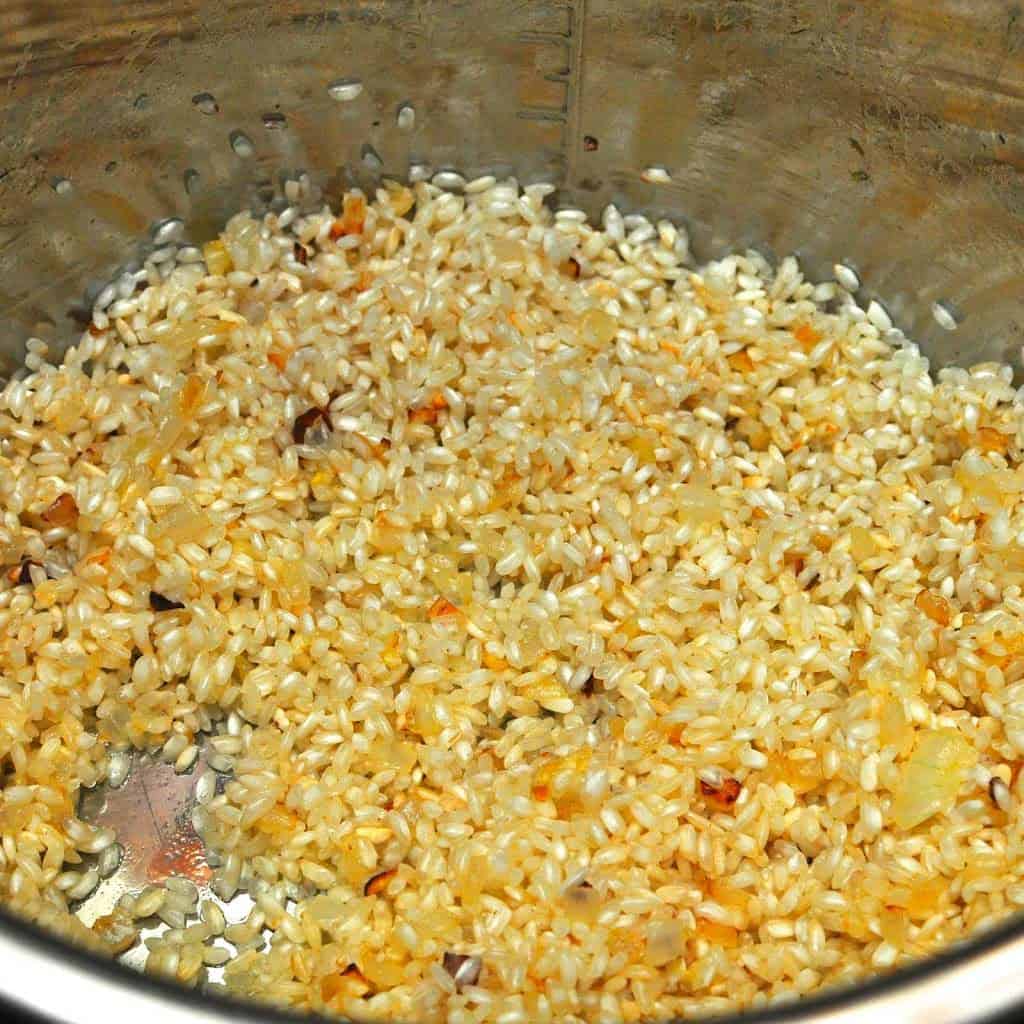
Why Family Dinner?

October 9, 2012 by Mike Vrobel Leave a Comment

A few days ago, I was interviewed by Miriam Weinstein. Miriam is the author of The Surprising Power of Family Meals, and was interviewing me for her blog, PowerOfFamilyMeals.com. Her big question was, essentially:

Why do you make family meals? Why are they important to you, and what benefits do you see from them?

I talk a lot about family meals on this blog. All these posts get their start at my dinner table. But I don't feel like I gave her a good answer. "Why?" has been nagging me since the interview.
Please bear with me. I'm trying to figure it out by writing this post.

Homemade family meals are a lot of work. Besides the actual effort of cooking and cleaning, there is planning, shopping, working around schedules, and dealing with picky eaters.

What scares me is my kids are wannabe teenagers. They're not there yet, but it's getting close enough that we can see it from here. Can I keep this up when they're actual teenagers, and really push back? They already see dinner as an interruption. They'd rather wolf something down and play with their friends.
Or play Minecraft. Holy cow, are they addicted to Minecraft.

So, why do I do it?

The statistics say that family dinners are magic. Magic! Kids who eat dinner with their family five or more times a week:

  • Get better grades
  • Are less likely to use cigarettes
  • Are less likely to abuse drugs
  • Are less likely to be depressed
  • Are less likely to be overweight

Source: CASA annual survey on family dinners.

Why do family meals help kids, especially teenagers, so much? Parents and kids who have regular family dinners are more engaged with each other. The parents know what's happening in the kid's lives, and the kids have someplace to talk about things they might be embarrassed to share with their friends. Family dinner keeps the kids talking to you.
The researchers say communication during the meal is more important than the meal itself. Kids need a safe place to talk to parents who listen. If you can't make time for family dinners, make time to talk with the kids. A lot. Please?

No, really, why do you do it?

Beyond the statistics, there are a bundle of emotional reasons I believe in family meals.

I live to eat, and love to cook. (This should be clear to anyone who reads this blog.) I want my kids to know what good food is. I want them to know it doesn't have to be fancy, or come from a restaurant. Cooking is important to me, and it is a life skill I want to pass on to them.

I want my kids to see that good food takes work. It doesn't have to be a huge amount of work, but it is not effortless. I believe "convenience" foods are causing the weight problems in this country. I hope I'm showing my kids a better way forward by getting them involved. Right now they set the table, and load and unload the dishwasher. Pretty soon they'll join us in cooking and planning.
Which means I'll have to loosen my grip on dinner. I am a control freak, after all. But I'll do it, because it will help them in the future.

A family meal weaves together all the threads of being a family. We take care of each other, meeting an essential need. (Everyone's got to eat, right?) We work towards a common goal. (I'll cook, you toss the salad, he can set the table.) We share a simple pleasure. (Did I mention I love to eat?) We connect with each other over the table. (What's better than a fun talk after a meal?). We settle conflicts. (Yes, it IS your turn to do the dishes.)

Sure, you can do all that away from the table. And I hope you do - none of them stop being important when the dishes are cleared. But I believe, down to the core of my soul, that dinner is the best time to come together as a family.

What do you think? Questions? Other ideas? Leave them in the comments section below.

Enjoyed this post? Want to help out DadCooksDinner? Subscribe to DadCooksDinner using the RSS or Email options on the right, link to this post from your blog, recommend DadCooksDinner to your friends, or buy something from Amazon.com through the links on this site. Thank you.
Pressure Cooker Persian Lamb Shanks with Eggplant and Tomatoes (Khoresht Bademjan)

October 4, 2012 by Mike Vrobel 19 Comments

Pressure Cooker Persian Lamb Shanks with Eggplant and Tomatoes (Khoresht Bademjan)

Pressure Cooker Persian Lamb Shanks with Eggplant and Tomatoes (Khoresht Bademjan)

What did you do on summer vacation? I ate my way down the Northwest coast, traveling from Portland, Oregon to Yosemite National Park, California.One of the best meals was at Maykadeh Persian Restaraunt in San Francisco. The kids and I had great kebabs, and the eggplant dips and fresh-baked flatbread were a revelation. But the best thing at the table was my wife's order, Khoresht Badjeman. Lamb Shanks braised with eggplant and tomatoes, full of sweet spices, and served with a side of basmati rice.

Here's my take on this Persian classic. As usual, I used pressure to speed up the cooking time. No pressure cooker? No worries. See the Notes section for standard cooking instructions.

Recipe: Pressure Cooker Persian Lamb Shanks with Eggplant and Tomatoes (Khoresht Bademjan)


Equipment:

  • 6 quart or larger pressure cooker (I used my Cuisinart Electric Pressure Cooker)


Aromatics, spices, and eggplant


Browning the shanks
Searing the shanks


Browning the eggplant


Sauteing the aromatics


Everything in the pot


Notes:

  • Serve with basmati rice or couscous.
  • If you're in a hurry, you can skip the browning steps for the lamb and eggplant, and start with sauteing the aromatics. This cuts about 15 minutes from the total cooking time. I like the extra layers of flavor that are built up by browning the lamb and eggplant, but I also know what it's like to be in a hurry on a weeknight.
  • No pressure cooker? No worries. Use a heavy bottomed dutch oven with a lid, and increase the amount of chicken stock to 2 cups. Follow the instructions right up until "lock the lid". Then, instead of pressure cooking, bring the pot to a boil, and cover with the lid. Move the pot to a preheated 350*F oven and bake for 2 hours, until the lamb shanks are tender.

What do you think? Questions? Other ideas? Leave them in the comments section below.

Related Posts:

Pressure Cooker Massaman Beef Curry
Pressure Cooker Cochinita Pibil (Yucatecan pit cooked bork)
Pressure Cooker Lamb Stew with Guinness and Barley
My other Pressure Cooker Recipes

*Enjoyed this post? Want to help out DadCooksDinner? Subscribe to DadCooksDinner using the RSS or Email options on the right, link to this post from your blog, recommend DadCooksDinner to your friends, or buy something from Amazon.com through the links on this site. Thank you.
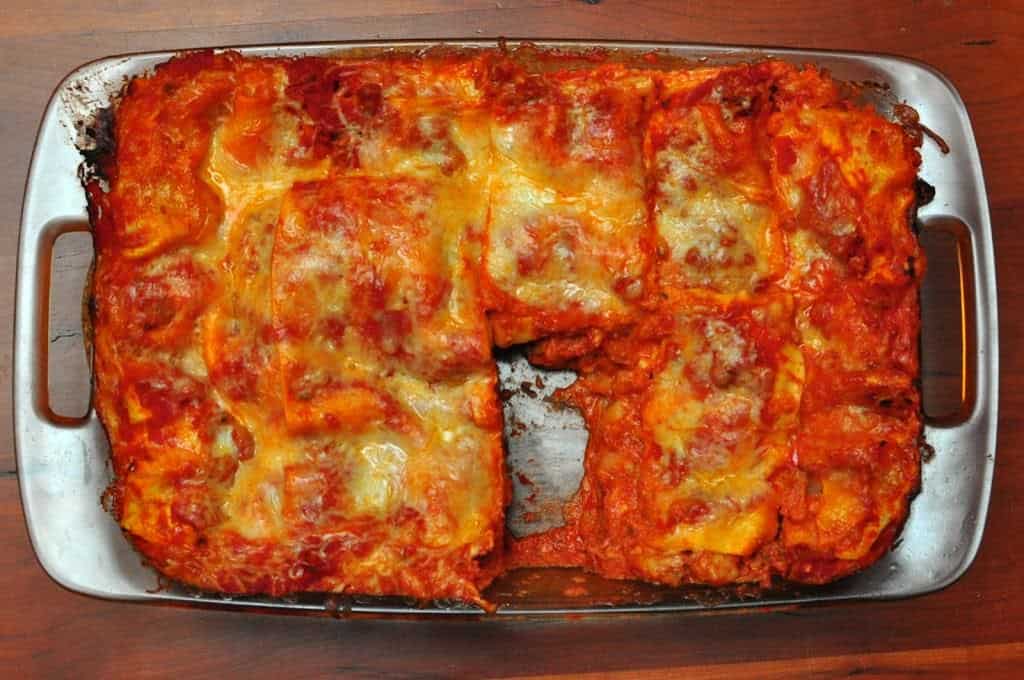
Rotisserie Alabama BBQ Chicken

September 27, 2012 by Mike Vrobel 8 Comments

White barbecue sauce?

Years ago, in my Weber Smokey Mountain, low and slow barbecue days, I heard a rumor about white barbecue sauce. It was local to Alabama, and Big Bob Gibson's was famous for it. Split chickens were smoked, then dunked in a big tub of white sauce. Who'd ever heard of such a thing? I kept an eye out for a recipe, but for years, there was nothing.

I got my first recipe for White barbecue sauce from Cooks Country magazine, and the secret was…mayonnaise. Huh. Who would have thought it? The recipe tasted great, and I loved the way the white sauce would melt onto the chicken, leaving it with a sweet, spicy glaze. That said, I was suspicious. Cooks Country? They're just a bunch of Northerners, pretending they understand barbecue. They can't have it right, can they?
*As a Northerner who pretends to understand barbecue, I feel like I can judge.

Then the floodgates opened. Chris Lilly, executive chef at Big Bob Gibson's, published his cookbook. Suddenly, white barbecue sauce recipes were everywhere. And, sure enough, Cooks Country just about nailed it. The only real difference was the sweetener - Mr. Lilly's used apple juice; Cooks Country used white sugar.

White barbecue sauce may look strange, but it really does taste like a barbecue sauce. The mayonnaise gives it a creamy base, then you get a big hit of vinegar and sweetness, followed by a hint of heat from the spices. It makes a great coating for chicken, and it's good on pork, too.
*I stuck with sugar for the sweetener in my sauce. I haven't had apple juice in the house since the kids grew out of juice boxes.

Recipe: Rotisserie Alabama BBQ Chicken


Adapted From: Chris Lilly Big Bob Gibson's BBQ Book

Cooking time: 1 hour 15 minutes

Equipment:

  • Grill with Rotisserie attachment (I used a Weber kettle with the Rotisserie attachment; the kettle is here and the rotisserie attachment is this Weber charcoal kettle rotisserie)
  • Aluminum foil drip pan (9"x12", or whatever fits your grill)
  • Butcher's twine

Ingredients

  • 1 fist sized chunk smoking wood, preferably hickory, soaked for 1 hour

Brine

  • 2 quarts water
  • ½ cup table salt
  • 2 tablespoons brown sugar
  • 2 (5 pound) roasting chickens

Alabama White BBQ Sauce

  • 1 cup mayonnaise
  • ½ cup apple cider vinegar
  • ¼ cup brown sugar
  • 1 teaspoons fresh ground black pepper
  • ¼ teaspoon cayenne pepper

Directions

1. Brine the chicken
Combine the brine ingredients in large container and stir until the salt and sugar dissolve. Submerge the chicken in the brine. Store in the refrigerator for at least one hour, preferably four hours, no longer than eight hours. While the chicken is brining, soak the smoking wood chunk in a bowl of water.

2. Make the barbecue sauce
Whisk the barbecue sauce ingredients in a large bowl, cover, and refrigerate until ready to use.

3. Prepare the grill
Prepare the grill for cooking on indirect medium heat (see details My Rotisserie Basic Technique Post. For my Weber kettle, I light a chimney starter ¾ full of charcoal, wait for it to be covered with ash, then pour it in two equal piles on the sides of the grill, and put the drip pan in the middle, between the piles.
*I recommend the Weber Chimney Starter, because it is larger than most chimney starters. It holds 5 quarts of charcoal, the perfect size for this recipe.

4. Truss and spit the chicken
While the grill is preheating, remove the chicken from the brine and pat dry with paper towels. Fold the wingtips underneath the wings, then truss the chicken. Skewer the chicken on the rotisserie spit, securing it with the spit forks. Let the chicken rest at room temperature until it is time to grill.

5. Rotisserie cook the chicken
Put the spit on the grill, start the motor spinning, and make sure the drip pan is centered beneath the chicken. Add the smoking wood to the fire, then close the lid and cook until the chicken reaches 160°F in the thickest part of the breast, about 1 hour and 15 minutes. During the last 15 minutes of cooking, brush the chicken with the white barbecue sauce every five minutes.

6. Serve
Remove the chicken from the rotisserie spit and remove the twine trussing the chicken. Be careful - the spit and forks are blazing hot. Brush the chicken one last time with the white barbecue sauce. Let the chicken rest for 15 minutes, then carve and serve, passing the remaining barbecue sauce at the table.

Notes

  • The amount of white barbecue sauce in this recipe is a little more than you need for two chickens. I make a double batch, and poured it back into the squeeze bottle mayonnaise jar. The squeeze bottle is convenient - I can squirt the sauce directly on the chicken, then store the container in the fridge when I'm done.
  • White barbecue sauce has what I would call a medium heat level. This might come as a surprise to your guests, considering the white color. If you want to cut back on the heat, cut the black pepper and cayenne in half.
  • As I said in the opening, I am cheating a bit with the sauce. To be authentic, it should have a teaspoon of prepared horseradish and a teaspoon of lemon juice in it, use white vinegar instead of cider vinegar, and substitute apple juice for the brown sugar. Here's Mr. Lilly's original version.
  • If you're really into authentic, you can make your own food processor mayonnaise as the base for the sauce. I just have to use up this bottle of sauce I made, then I'll give it a try.

Related Posts:

Click here for my other rotisserie recipes.

Adapted from:

Chris Lilly Big Bob Gibson's BBQ Book


Check out my cookbook, Rotisserie Grilling.

Everything you could ask about the rotisserie,
plus 50 (mostly) new recipes to get you cooking.

It's a Kindle e-book, so you can download it and start reading immediately!


*Enjoyed this post? Want to help out DadCooksDinner? Subscribe to DadCooksDinner using the RSS or Email options on the right, link to this post from your blog, recommend DadCooksDinner to your friends, or buy something from Amazon.com through the links on this site. Thank you.
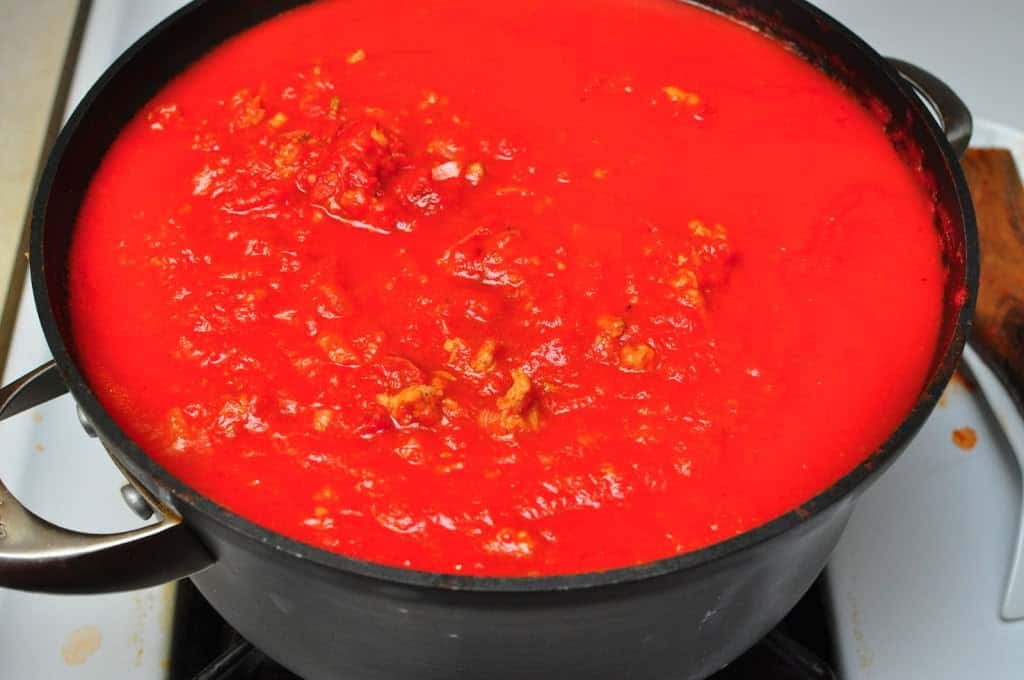
Rotisserie How To: Two Chickens, One Set of Forks

September 25, 2012 by Mike Vrobel 10 Comments

What is the most common question I get about rotisserie grilling?

"I want to cook two chickens on my rotisserie. Do I need two sets of forks?

You can spit two chickens with one set of forks. Just cram them together and…wait, this would be easier if I showed you.

First, truss the chickens


Like this

.


Spit the first chicken

Get it tight on the first spit fork.


Add the second chicken to the spit

Nose to tail


Secure them with the other spit fork

Push the chickens together as hard as you can, then lock down the second spit fork. If the chickens are not tight together, they might work loose and start wobbling around on the spit.


Done!


Notes

This works with as many chickens as you can fit on your spit. It also works for cornish hens, which are just smaller chickens. I've squeezed four cornish hens onto the spit for my Weber kettle, and I would guess I can fit at least six on the longer spit for my Weber Summit.

Two chickens plus one pineapple!

Recipe: Rotisserie Chicken with Spice Rub

What do you think? Questions? Other ideas? Leave them in the comments section below.


Check out my cookbook, Rotisserie Grilling.Everything you could ask about the rotisserie,
plus 50 (mostly) new recipes to get you cooking.It's a Kindle e-book, so you can download it and start reading immediately!

*Enjoyed this post? Want to help out DadCooksDinner? Subscribe to DadCooksDinner using the RSS or Email options on the right, link to this post from your blog, recommend DadCooksDinner to your friends, or buy something from Amazon.com through the links on this site. Thank you.
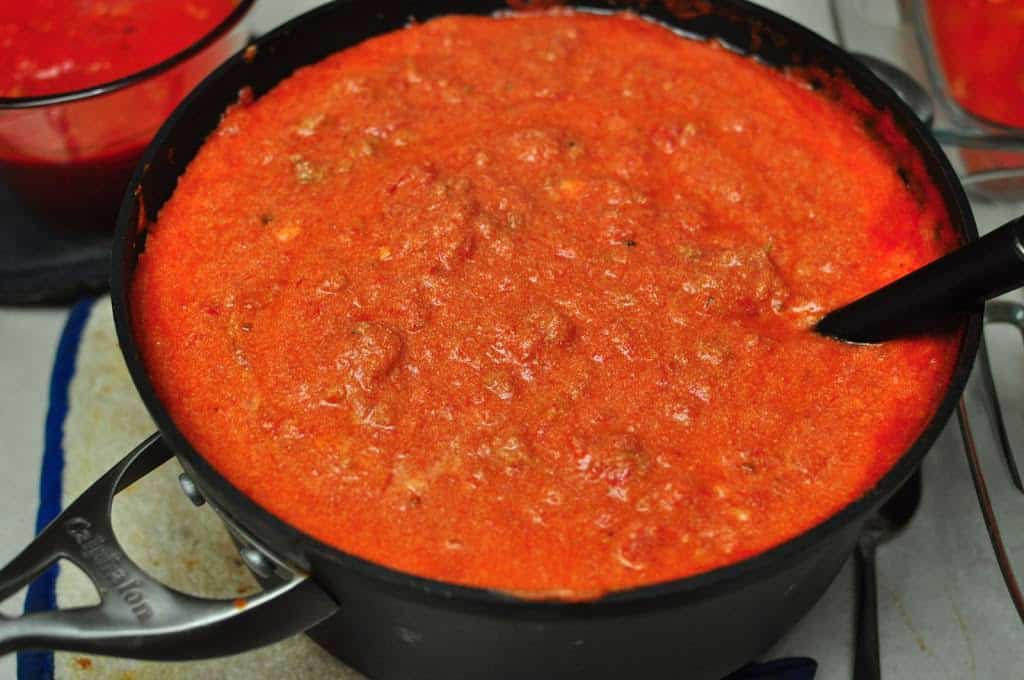
Slow Cooker Chicken Stock

September 20, 2012 by Mike Vrobel 8 Comments

Homemade chicken stock is kitchen alchemy, turning trash into gold. Take the leftover bones from a roast chicken dinner, add water, and the result is my secret weapon in the kitchen. Stock is the backbone of my soups and pan sauces.

I've been pressure cooking chicken stock for years; I throw roast chicken carcasses in the pressure cooker pot while cleaning up after dinner. An hour later I'm straining the stock. Quick and easy.

My slow cooker is the other way I bend time in the kitchen. Instead of quick and under pressure, there's long, low and slow. I finally tried slow cooker chicken stock the other day, after reading (yet another) recipe for it in Deborah Schneider's The Mexican Slow Cooker. After a Sunday roast chicken dinner, I put the chicken bones in the refrigerator overnight. The next morning, everything went in the pot before I left for work. When I came home, the smell of chicken filled the house. I tossed the bones, strained the stock, and threw together a pot of chicken noodle soup for everyone.

The full version of this recipe has a mix of aromatics and spices, to add depth to the stock. If you're really in a hurry, the only essential ingredients are the chicken bones, onion, bay leaf, and water. Frankly, I make this bare bones version of stock more often than not.
*Get it? Bare bones? I kill myself.

The other thing to keep in mind is there isn't any salt in this stock. Pan sauces made by reducing pre-salted stock get too salty, so I leave it out until I need it. That said, stock absolutely needs salt to taste right. When you're using the stock, add salt, let it dissolve, taste the stock...then repeat. You'll taste when the stock is salted enough - the flavor will suddenly go from bland to "full of chicken flavor."
*What should you do with chicken stock? See my "Related Posts", below.

Recipe: Slow Cooker Chicken Stock


Inspired By: Deborah Schneider The Mexican Slow Cooker

Cooking time: 8 hours

Equipment:

  • Slow Cooker (Preferably 6 quarts or larger, with a removable insert, and a timer mode to switch to "warm" after the 8 hour cooking time. I love my All-Clad, but I hear good things about this Crock Pot model)

Ingredients:

  • Bones of 2 roasted chickens w/ meat on, (roughly 1 ½ pounds)
  • 1 medium onion, peeled and halved
  • 1 bay leaf
  • 1 celery rib, cut in half (optional)
  • 1 large carrot, scrubbed and cut in half (optional)
  • 3 cloves garlic, crushed, with peels (optional)
  • water to cover (about 2 quarts)

Directions:

1. Slow cook the stock
Put all the ingredients in the slow cooker, and add enough water to just cover the chicken. Slow cook on low heat for 8 hours.

Ready to cover with water
8 hours on low

2. Strain the stock
Remove the solids from the cooker using a slotted spoon and discard. Strain the liquid through a fine mesh strainer, then use or freeze.

Fishing out the spent ingredients
Pouring through a fine mesh strainer

Notes:

  • This recipe can be doubled in a large (6 quart or larger) slow cooker, but you may have to break up the chicken carcasses to make them fit.
  • It helps to have a slow cooker with a removable insert - it is easier to lift out and pour the stock through a fine mesh strainer. If you don't have a removable insert, you can use a ladle to remove the stock.
  • I freeze chicken carcasses and trimmings until I have enough bones to make stock. If you start with frozen bones, cook on low for ten hours.

What do you think? Questions? Other ideas? Leave them in the comments section below.

Related Posts (AKA: What should I use this chicken stock for?):

Soup recipes:
(Most call for turkey and turkey stock, but that's OK; chicken and turkey are easy substitutions)
Turkey Noodle Soup
Tortilla Soup
Thai Coconut Soup
Turkey Ramen Soup

Pan sauce recipes:
Sear Roasted Chicken Breasts with Shallot Herb Pan Sauce
Ribeye Steak with Red Wine Pan Sauce
Sear Roasted Turkey Thighs with Tomato and Sage Pan Sauce
Pork Chop Saute with Orange Mustard Pan Sauce

Adapted from:

Deborah Schneider The Mexican Slow Cooker

*Enjoyed this post? Want to help out DadCooksDinner? Subscribe to DadCooksDinner using the RSS or Email options on the right, link to this post from your blog, recommend DadCooksDinner to your friends, or buy something from Amazon.com through the links on this site. Thank you.
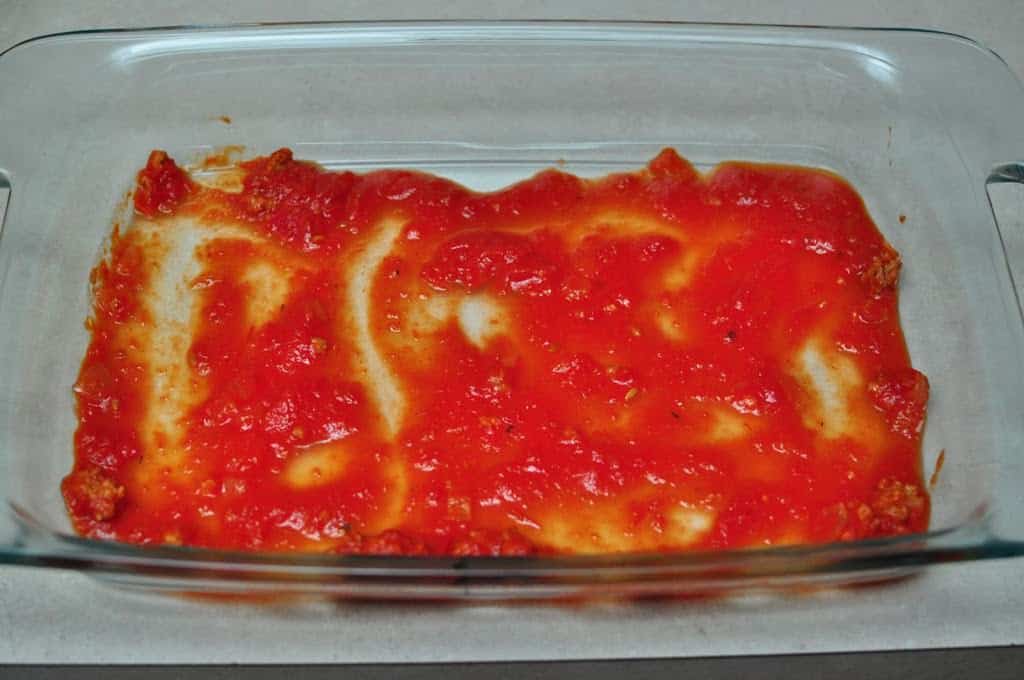
Five Fun Food Finds - September 2012

September 18, 2012 by Mike Vrobel 6 Comments

1. ThermoWorks RT345 Fun-Size Thermometer [thermoworks.com]
A keyring sized probe thermometer? From my favorite thermometer company? Only $15? I want one. I want one!

2. Alton Brown interview on the Nerdist Podcast [nerdist.com] (slightly NSFW - language)
My hero in a wide ranging interview. I learned Alton is a Dr. Who fan, got his pilot's license so he could avoid the indignity of airport security, and is working on a new show for Food Network called Food Files. There's a lot more, and Alton and the hosts are having a lot of fun. Give it a listen.
[Thanks to commenter Chris Lukowski for alerting me to this podcast.]

3. Bob Kramer Knife Videos [youtube.com]

Master Bladesmith Bob Kramer shows how a sharp knife should work. Mr. Kramer worked with J.A. Henckels and Sur La Table to make a less expensive version of his custom knives. Less expensive is a relative term - his 8 inch carbon steel chef's knife costs $350. Of course, his custom made knives go for over $200 an inch, if you can get on his years-long waiting list.

As a part of his collaboration, Mr. Kramer made set of videos on sharpening knives. They are must-watch if you are a knife fanatic like me:

What Is Sharp? [This video is embedded above]
Honing Your Knife
Stoning Your Knife
Inside the Foundry

4. Akron Ethnic Market Update: La Chiquita Latinos Market
The former La Michoacana has a new name, a new paint job, and has added a butcher counter. Stop by and check them out.
For my non-Akron readers, this is a reminder to seek out your local markets. They're worth the trip.

5. Non-Food Related Public Service Announcement: Back Up Your Data!
I lost the hard drive on my main computer a week ago. My iMac, which normally chugs along for weeks without needing to reboot, started to crash every few hours. After one of the crashes, I found an error message in the system log, which a Google search translated to "your hard drive is toast."

This computer has my life on it. All the pictures of my family, all my financial information, all my blog history...everything I've done in the last ten years is on that drive.

Thankfully, I have automated backups. My iMac spent the night at the Apple store, getting a new, empty hard drive. Then it spent the day restoring from backup. When it was done, I was back up and running - nothing was lost.

Why am I so careful about backups? Because I've been burned before, and I wasn't prepared. All hard drives are going to fail. It's just a matter of time. Maybe not today, maybe not tomorrow. If you're lucky, maybe not for a decade. But it will fail. It is the nature of hard drives. They're great...right up until a read head crashes into the platter spinning at 7200 RPM.

If you depend on your computer, you need an automated, scheduled backup. Apple's Time Machine backup has saved me many times. (Windows has its own built in backup software.) Mac, PC, Other...it doesn't matter. Get an external USB drive, plug it in, and get that backup going. Now. Tomorrow may be too late for your data.

I also pay $5 a month for CrashPlan's online backup service. In case of a natural disaster, I want a copy of my data off site.


What do you think? Any other fun food finds? Leave them in the comments section below.

*Enjoyed this post? Want to help out DadCooksDinner? Subscribe using the RSS or Email options on the right, link to this post from your blog, recommend DadCooksDinner to your friends, or buy something from Amazon.com through the links on this site. Thank you.
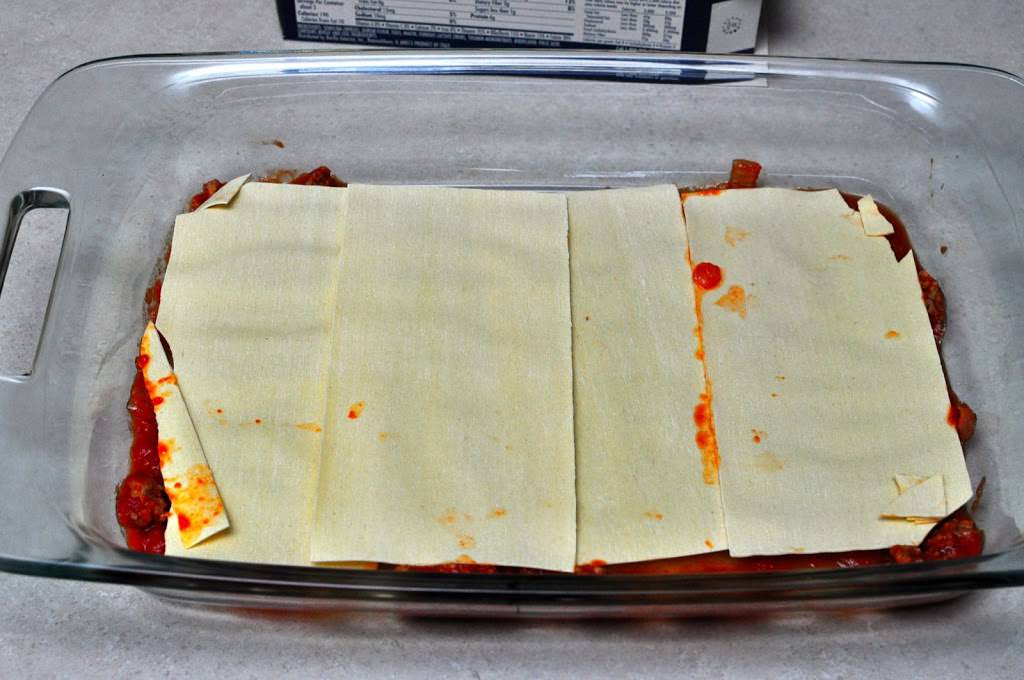
Pressure Cooker Recipe Booklets

September 11, 2012 by Mike Vrobel 7 Comments

When I bought my first pressure cooker, recipes were few and far between. There were Lorna Sass's books, Miss Vickie's website, and...that was it. I became a pressure cooker recipe collector, saving them whenever I found them.

Over the last couple of years, pressure cookers took off. Every time I turn around, another big cooking website has a feature on pressure cookers. Modernist Cuisine sang the praises of the pressure cooker, and Laura over at Hip Pressure Cooking has dedicated herself to pushing the frontier.
Pressure cooker Dulce de Leche? My goodness. I'm going to try it...but the idea of pressure cooking a sealed can makes me want to hide behind a blast shield while it cooks.

There is another source for pressure cooker recipes that I want to share. Pressure cooker manufacturers. Pressure cookers usually include a recipe booklet, and more and more of those booklets are available online. If you have a web browser and a PDF reader, you have a bunch of recipes at your fingertips.
Who cares if you own a Fagor pressure cooker, but get recipes from Kuhn Rikon? They both operate at 15 PSI. Watch out for electric pressure cooker recipes; electric PCs usually max out at 10 PSI, so their recipes take about 20% longer to cook.

The best recipe booklet is from the Godfather of pressure cooking, Kuhn Rikon. Quick Cuisine [PDF] is 100 pages of pressure cooker recipes, tips, and how-to. If you have a pressure cooker, and don't already have a copy of Quick Cuisine, grab this booklet.
[Update 2013-10-11: Kuhn Rikon took the PDF of Quick Cuisine offline during a website redesign. Darn! The only way to get it is to order the paperback version through their website. It comes free with all K-R pressure cookers, so I wouldn't bother.]

[Update 2015-03-20: I  have a different Kuhn Rikon PDF, thanks to commenter David Brown. It's not the same Quick Cuisine PDF, but it is a Kuhn Rikon PDF, from their UK branch.]

[Update 2015-08-06: Commenter Paula found a link to Quick Cuisine in the Archive.org Internet Archive. Thank you, Paula!]

Here are the other manuals with recipes I've been able to find.
*If I'm missing any good sources of recipes, please let us know in the comments.

Pressure Cooker Manufacturer Recipes

Kuhn Rikon Quick Cuisine [PDF, kuhnrikon.com via Archive.org] Get this one!
Kuhn Rikon Fresh Food Fast [PDF, kuhnrikon.com]
Fagor Pressure Cooker Recipe Library [Website, fagoramerica.com]
Fagor Pressure Cooker Home Canning Cookbook [PDF, fagoramerica.com]
Fagor Dessert Kit Recipes [PDF, fagoramerica.com]
Cuisinart Electric Pressure Cooker Recipes [PDF, cuisinart.com]
Presto 8 Quart Pressure Cooker Instruction Manual [PDF, gopresto.com]
T-Fal Pressure Cooking with Jamie Oliver [PDF, tefal.ch (Swiss version of T-Fal Website), h/t commenter AB]
Instant Pot Electric Pressure Cooker Recipes [PDF, InstantPot.com]

What do you think? Other Pressure Cooker recipe books I missed? Leave them in the comments section below.

Related Posts

What Pressure Cooker Should I Buy?
My Pressure Cooker Recipes list

Enjoyed this post? Want to help out DadCooksDinner? Subscribe to DadCooksDinner using the RSS or Email options on the right, link to this post from your blog, recommend DadCooksDinner to your friends, or buy something from Amazon.com through the links on this site. Thank you.
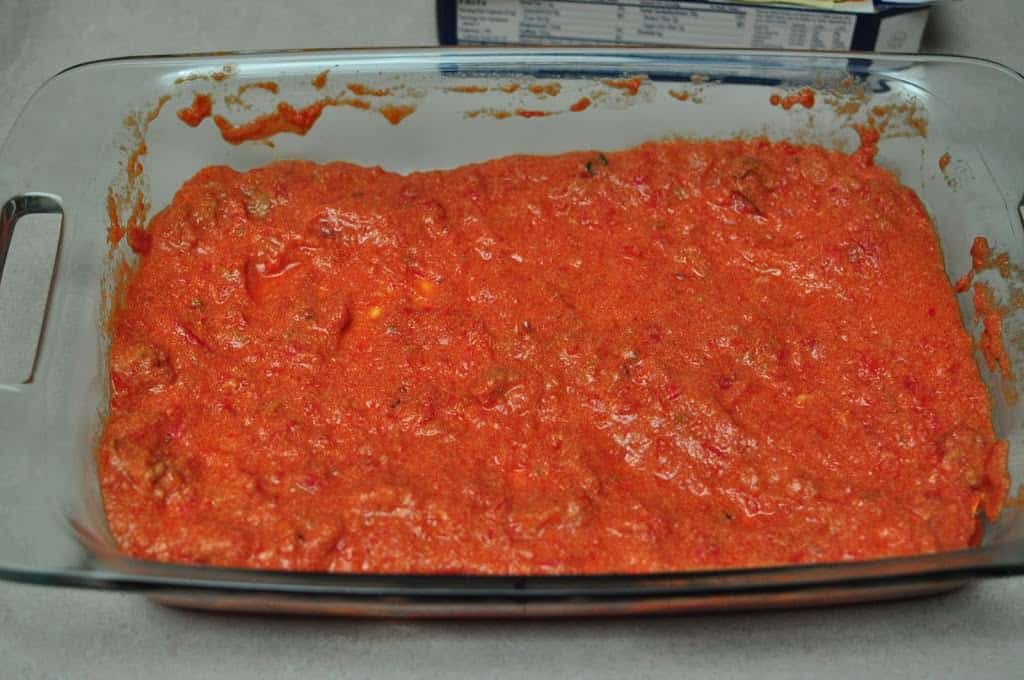
Spicy Jicama Sticks

September 6, 2012 by Mike Vrobel 2 Comments

Jicama reminds me of apples - it has the same crisp crunch, with a hint of a sweet taste. Think of a granny smith apple, but crunchier, milder, and less tart. I have eaten it a number of times, but I never had an opinion about it one way or the other. That is, until I had it as part of an appetizer at Frontera Grill in Chicago. Rick Bayless took a page from Mexican street vendors and sprinkled the jicama with a blend of chile powder and salt. The crunch and hint of sweet were enhanced by the spicy salt.

Spicy jicama sticks are now my go-to party appetizer when I want to bring something interesting but healthy. The chile salt is best with guajillo chile powder (look at your local Mexican market), but ancho chile powder makes a decent substitute.

Recipe: Spicy Jicama Sticks


Adapted From: Rick Bayless Fiesta At Rick's

Cooking time: 10 minutes

Ingredients

  • 1 medium Jicama, about 1 pound
  • 2 tablespoons guajillo powder (or ancho chile powder)
  • 1 tablespoon fine sea salt

Directions

1. Prep the jicama
Peel the jicama, then trim off the top and bottom. Slice the jicama into half inch thick planks, then slice crosswise into half inch thick sticks. (Think thick-cut French fries. About that size.). Mix the chile powder and salt until completely combined.

2. Serve the jicama
Right before serving, sprinkle the jicama with the chile salt. Pass the shaker of chili salt at the table for anyone who wants to add more heat and spice.

2 parts chile powder, 1 part salt

Notes

  • Some stores sell jicama with a waxy coating - it makes peeling more difficult. Use a heavy duty peeler, or live with a little waste and trim the peel off with your knife.
  • I love the guajillo chile salt from this recipe. I don't just use it on jicama. I make a shaker full, then use it on anything I want to give a sprinkling of Mexican heat.

What do you think? Questions? Other ideas? Leave them in the comments section below.

Related Posts:

Toasted Ancho Salsa
Mexican Hot Chocolate

Adapted from:

Rick Bayless Fiesta At Rick's

*Enjoyed this post? Want to help out DadCooksDinner? Subscribe to DadCooksDinner using the RSS or Email options on the right, link to this post from your blog, recommend DadCooksDinner to your friends, or buy something from Amazon.com through the links on this site. Thank you.
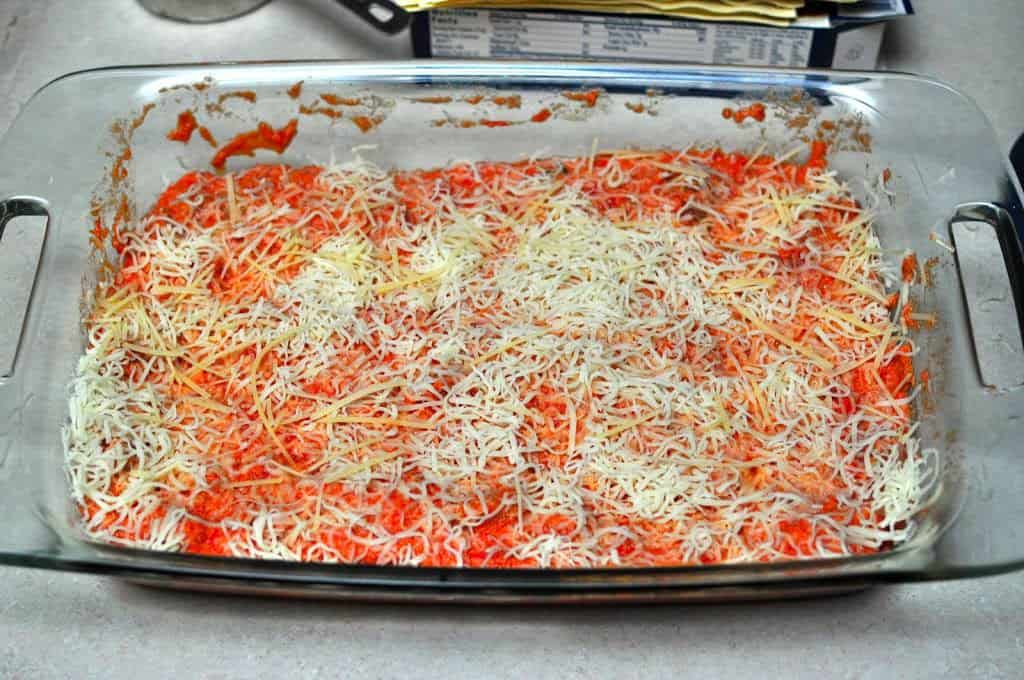
Grill-Roasted Chicken Breasts Dry Brined with Herbs

August 30, 2012 by Mike Vrobel 7 Comments

After my picky eater rant, I need some comfort food. Roast chicken. On the grill of course.
*And yes, my picky eaters will eat it. Or, at least, they'll have a few bites.

If you insist on grilling over direct heat, chicken pieces are hard. Direct heat means huge flareups as chicken fat drips onto the coals. You have to constantly move the chicken, and if your attention falters for even a second, the result is burned chicken. I prefer a more relaxed method - using indirect heat and grill roasting the chicken, with a quick sear over direct heat at the end to crisp up the skin.

Today I'm cooking chicken breasts. I usually prefer dark meat, because it has more flavor…but bone in breasts were on sale at the grocery store. That's OK - as long as the chicken breasts are not overcooked, no more than 155°F to 160°F, they will be tender and juicy.

I rubbed the chicken with my favorite dry brine, equal parts kosher salt and minced herbs. Any mix of herbs will do. I went with rosemary and thyme because the herb bushes in my front yard are growing like mad.

Recipe: Grill-Roasted Chicken Breasts with Dry Brine and Herbs


Cooking time: 35 minutes

Ingredients

  • 6 bone-in chicken breast pieces (about 4 pounds), ribs trimmed off

Dry Brine:

  • 1 tablespoon kosher salt (if using table salt, use 1 ½ teaspoons)
  • 1 ½ teaspoons minced fresh rosemary
  • 1 ½ teaspoons minced fresh thyme
  • ½ teaspoon fresh ground black pepper

Directions

1. Dry Brine the chicken pieces
Mix the dry brine ingredients in a small bowl, then sprinkle evenly over the chicken breasts, about 1 teaspoon per piece. Refrigerate the chicken breasts for at least 4 hours, preferably overnight.

2. Set up the grill for indirect high heat
Set your grill up for cooking with indirect high heat. For my Weber kettle, I light a full chimney of charcoal, wait for it to be mostly covered with gray ash, then pour it in two piles on the side of the grill and put a drip pan between the piles.

Indirect heat
Done with indirect

3. Grill the chicken
Put the chicken on the grill over indirect heat, between the coals. Cook with the lid closed until the chicken reaches an internal temperature of 155°F, 20 to 30 minutes. After the breasts are cooked through, move them over the direct heat to crisp them up, about 1 to 2 minutes per side over direct heat. Let the chicken rest for 10 minutes, then serve.

Searing over direct heat

Notes:

  • As I said in the header, use whatever herbs you have. Oregano and parsley? Great. Dill and chives? That will work too. And a little citrus zest or lemon zest never hurt.
  • Chicken legs, thighs, or drumsticks on sale, instead of chicken breasts? Even better. Cook to 170°F internal - dark meat needs to be cooked a little more to be tender.
  • Don't feel like grilling? Use the sear-roast technique from this post: Sear Roasted Chicken Breast

What do you think? Questions? Other ideas? Leave them in the comments section below.

Related Posts:

Basic Technique: Grill-Roasted Chicken Pieces
Thai Style Grill-Roasted Chicken Breasts

*Enjoyed this post? Want to help out DadCooksDinner? Subscribe to DadCooksDinner using the RSS or Email options on the right, link to this post from your blog, recommend DadCooksDinner to your friends, or buy something from Amazon.com through the links on this site. Thank you.

Picky Eaters

August 28, 2012 by Mike Vrobel 28 Comments

I think I'm making a side dish.
The kids think I'm trying to trick them into eating something gross.

When I write a story that mentions my kids are picky eaters (or, StarchAndCheeseitarians, as I call them), I get at least one comment that starts "I'm sorry, but", then continues something like this…

"Why do you let children dictate family meals? Don't give the kids any options. Eventually, they'll get hungry enough to eat what you serve them. That's what my mom did for me/that's what I do for my kids. Now our little angels eat everything we put in front of them, and love it!"

When I read these comments, here's what I get from them:

"You, sir, are a complete failure as a parent. You're letting the inmates run the asylum. So, let me tell you how to raise your kids. Show a little backbone, put those rug rats in their place, and they'll fall into line. They'll all be eating brown rice and braised kale in no time."

I always delete my first response, then my second. By the third try, I've calmed down enough to leave a neutral response, something like "I'm glad that works for you. It doesn't work for my kids."
One commenter actually got right to the point. "I'm not trying to be mean…but this is exactly what's wrong with America…" I deleted that comment without bothering to respond.

I got yet another comment like this after my New York Times interview. I wrote this post so I can email a link to it every time I get one of these "helpful" suggestions.

I'm jealous when I read these comments. These people don't have kids who are picky eaters. I do. My kids are very particular about what they put in their mouths. And it hurts me. I love food, all kinds of food, and I love cooking. I cook a wide range of foods for the kids. And, some of the time, my kids absolutely refuse to eat what I cooked.

I've already tried everything the commenters suggest. Cook and serve unprocessed foods? That's what this blog is about. Expose them to fruits and vegetables? My kids grew up going to the farmers market and the CSA with me every weekend. Don't give them any other options, and wait for them to get hungry? Tried that. My kids dig in their heels, and one is willing to skip entire meals if they don't like what's served. I've tried a "one bite rule", to get them to taste things over and over, and get used to the taste. This resulted in gagging more often than not.

To try to save my sanity, and come up with strategies to get my kids to eat healthier, I read up about picky eating. Here's what I learned.

All kids are predisposed to like fatty and sweet. Kids get a strong aversion to bitter tastes starting at about eighteen months. In nature, bitter usually associates with poison, so this was a good evolutionary strategy - right around the time kids learned to walk, they started to dislike bitter.
This is why chicken fingers with french fries and barbecue sauce is on every kids menu in the country. Kids want the fat, sweet, carbs, and bland.

After that, the science of kids taste gets muddled. There are a lot of things tied in with our sense of taste, and different people can have wildly different taste experiences. A lot of tasting is biology - tastes are hard wired into us. As an example, some people are born with a set of genes that makes them sensitive to bitter tastes in green vegetables. (See the NOVA link on picky eaters, below).

Kids aren't all the same; they have a range of taste sensitivity. Some are "live to eat" kids, who will eat anything. Most are in the middle, where they prefer fatty and sweet foods, but can eat vegetables grudgingly. Then you get to the picky eaters, who for one reason or another, view wide swaths foods as "gross". Their tastes, like their personality, are a part of them. Parents can help expand those tastes, but we can only help so much - to a large part, the kids are who they are.
*I have a range, even in my own kids. One is a middle of the road eater, one leans strongly towards the picky side, and one is deep in the picky camp, with a very defined list of what is acceptable to eat. As in, no fruit or vegetables. Yes, this terrifies me.

The good news is, as kids get older, their tastes change. The range of food they'll eat expands dramatically, usually in their teen years. In other words, most picky eaters grow out of it. I can see hints of this in my kids; the variety of foods they will eat keeps expanding. I keep exposing them to things, and hoping for a big breakthrough…but we're not there yet, and I constantly worry that we will never get there.

Judgmental parents are confusing their good fortune with good parenting. They got kids somewhere between "live to eat" and "middle of the road". I got one in the "no way, no how" camp. But these parents believe all kids are exactly like theirs, in the middle of the road, and just need a little push. And they can't wait to tell me the error of my ways. If I would just use a little tough love, everything would sort itself out, and my picky eater would suddenly become an omnivore.

Believe me, I tried. Eventually, I got tired of dinnertimes full of anger, hurt, yelling, tears, threats, and tiny nibbles of food followed by gagging. I want dinner to bring us together as a family, not push us apart. What works for us is serving a bunch of different foods, keeping it as healthy as we can, and serving something the kids will eat at every meal. (Which is usually a carb, like bread, tortillas, or rice.) Then, we let them eat what they want, and I try not to get pushy or obsess about it. Some days are successes, some are failures, but we seem to be headed in the right direction.

If this is such a painful topic, why do I write about it in my blog? Why not just ignore it, so I don't have to deal with all the back seat parenting? Because I'm not alone. There are other parents out there, struggling with what their children will (and won't) eat. Some of them have kids that are just as picky as mine. I hope sharing my experience helps them out. Also, writing it out helps me work through my own issues. It took years to figure out how to eat with my kids, and it is still difficult. But I believe in the value of family meals and home cooking, in eating healthy and eating a variety of fresh food. So I push on. I hope I'm showing others a way forward too.

So, to everyone who wants to tell me how to feed my kids:

The way I feed my family offends you. You assume what works for you will work for everyone. I wish it worked for us, but it doesn't. I'm glad it works for you, really, and I hope it continues. Your kids will be better off for it. But can you do me a favor? Can you assume I'm not a bad parent, and I'm doing the best I can for me and my family? Thanks.


What do you think? Questions? Other ideas? (He asks, hiding behind his desk chair...) Leave them in the comments section below.

Resources:

A quick summary of the science of picky eating, from NOVA scienceNow. [PBS.org]
The Science of Picky Eaters
Picky Eaters: Expert Q&A

Stephanie V. W. Lucianovic is a picky eater turned foodie, and wrote a book about it:
Parents of Picky Eaters, It's Not Your Fault [nytimes.com]
Suffering Succotash: A Picky Eater's Quest to Understand Why We Hate the Foods We Hate

Ellyn Satter wrote the book(s) on picky eating, and how to deal with it without losing your mind:
Child of Mine: Feeding with Love and Good Sense
Secrets of Feeding a Healthy Family: How to Eat, How to Raise Good Eaters, How to Cook

Related Posts:

DadCooksDinner Loses Weight...Then Gains Some Back
Family Dinners and Small Kids
Family Dinners and Busy Kids

*Enjoyed this post? Want to help out DadCooksDinner? Subscribe to DadCooksDinner using the RSS or Email options on the right, link to this post from your blog, recommend DadCooksDinner to your friends, or buy something from Amazon.com through the links on this site. Thank you.
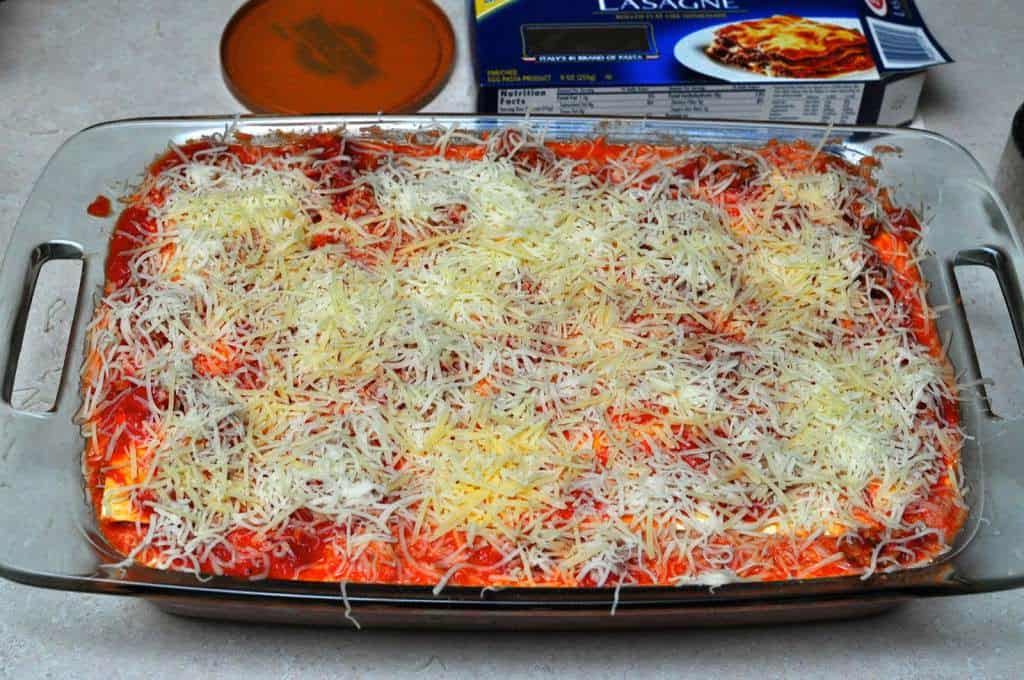
Media: In the New York Times!

August 22, 2012 by Mike Vrobel 8 Comments

I'm in the New York Times!

"It fits me to a T," moaned Mike Vrobel, father of three in Copley, Ohio, and the author of DadCooksDinner, a blog chronicling his nightly efforts cooking things like T-bone steak with olive oil, garlic and rosemary marinade; foil-pouch green beans; and footlong hot dogs.

And he makes carbs, lots and lots of carbs. Not that he likes it that way, but his three children love them, especially his oldest, Ben, 11.
...

Read the rest at: Drop the Pasta, Dad, and No One Gets Hurt [Matt Ritchel, nytimes.com]

Year Four of DadCooksDinner

August 21, 2012 by Mike Vrobel 8 Comments

This is the fourth anniversary of DadCooksDinner.  To celebrate, I made a bunch of Top Five lists.
*Why top 5? In honor of my favorite movie.

But first, some shameless self-promotion!

The big news for the last year is: I wrote a book. Rotisserie Grilling: 50 recipes for your grill's rotisserie,  is available in paperback, and e-reader editions for Amazon Kindle, Barnes & Noble Nook, and Apple iBooks.

I've sold five hundred copies in the last three months. If sales keep up, I'll actually make back my expenses. (Expenses: buying meat to test recipes.) If I break even, I'm buying myself a copy of Modernist Cuisine) to satisfy my inner food geek.

*About that Kindle e-book. I've been told "I can't read it, I have an iPad, not a Kindle." I read all my Kindle books on my iPad using the Kindle reader app. If you can see this blog, I'll bet Amazon has free Kindle reader software for you. Computer, phone, tablet, web browser…they cover it. The only thing it won't work on is a Nook reader, because Barnes and Noble would rather eat glass won't let them. Oh, and speaking of software, Barnes and Noble's Nook reader runs on most of those platforms as well.

Top 5 most popular recipes (written in the last year):

  • Rotisserie Turkey Breast with Spice Rub
  • Grilled Butterflied Chicken with Dry Brine
  • Pressure Cooker Massaman Beef Curry
  • Pressure Cooker Pork Belly Beer Braise
  • Pan Grilled Bratwurst with Onions and Peppers

Top 5 most popular recipes (all time):

  • Rotisserie Beef Prime Rib Roast
  • Pressure Cooker Short Ribs
  • Rotisserie Pork Shoulder Roast
  • Slow Cooker Pork and Sauerkraut
  • Grilled Boneless Pork Chops, Brined and Honey Basted

Top 5 pictures (selected by me):

1. Rotisserie Chicken and Pineapple, Hawaiian Style
2. Pressure Cooker Pasta Fagioli
3. Shaved Asparagus and Parmesan Salad
4. Grilled Pork Chops with Ancho Chile Spice Rub
5. Fiery Mexican Martini

Top 5 most popular recipes (selected by my kids):

*There were three quick votes for "Frozen chicken nuggets and tater tots", until I explained their allowance depended on taking this seriously.

  • Quick Baked Potatoes
  • Weeknight Fried Rice
  • Pressure Cooker Short Ribs Braised with Beer
  • Grilled Miso BBQ Chicken Wings
  • Slow Cooker Mexican Shredded Pork with Dried Chile Pepper Sauce

Blogging gets lonely; I cook a meal, take pictures, and write about it, hoping someone will notice. You did notice, and that's why I'm still writing. Thank you for reading along, commenting, and emailing. Thank you for supporting this blog by buying my book, or stuff through my Amazon links. I wouldn't be here without you.

What do you think? Questions? Other ideas? Leave them in the comments section below.

*Enjoyed this post? Want to help out DadCooksDinner? Subscribe to DadCooksDinner using the RSS or Email options on the right, link to this post from your blog, recommend DadCooksDinner to your friends, or buy something from Amazon.com through the links on this site. Thank you.
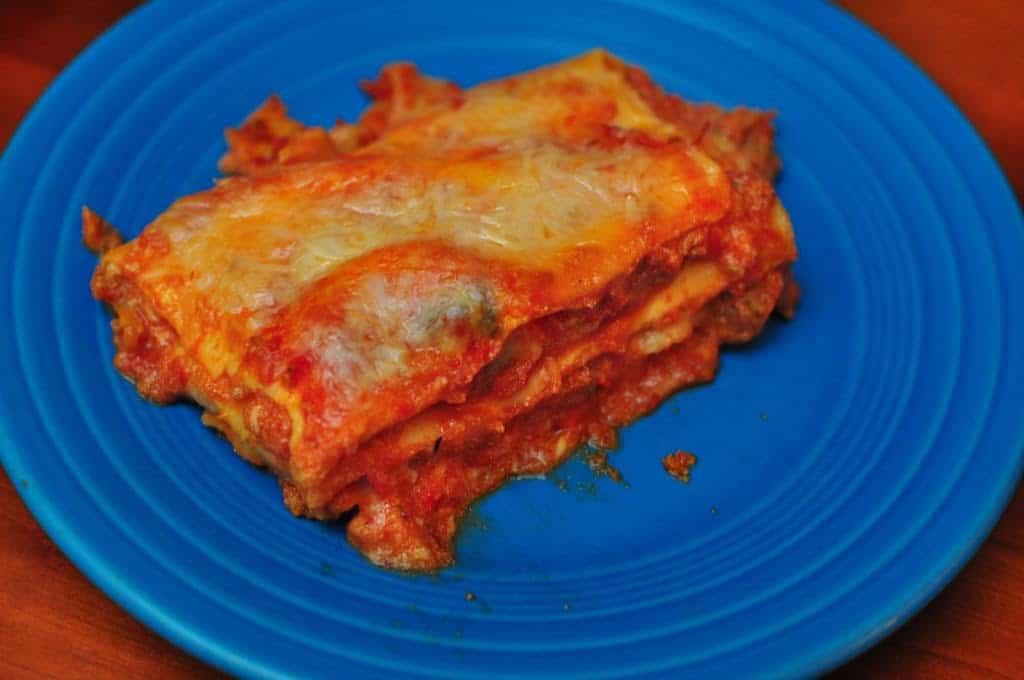
Baba Ghanoush

August 16, 2012 by Mike Vrobel 6 Comments

It's summertime, and my CSA box is starting to fill with eggplant. What do I do with it? I make baba ghanoush, the Middle Eastern eggplant dip.
*And then I make tian Provencal, once I get tomatoes, zucchini, and eggplant at the same time. And…that's the extent of my eggplant recipes. Any eggplant suggestions? Anyone? Bueller? Leave them in the comments, because even with the current drought, I'll get pounds of mixed eggplant with my CSA box for the next month or two.

This recipe is remarkably close to hummus. All I do is replace chickpeas with fire-roasted eggplant. This isn't a quick recipe - it takes at least a half an hour for the eggplant to completely cook - but it is low maintenance. Cook the eggplant until it the skin is completely burnt, and the eggplant collapses on itself. Turn it every now and again, when you feel like it - burning the skin only adds flavor. The eggplant should look like a deflated blimp right before you take it off the grill.

Recipe: Baba Ghanoush


Inspired by: Alton Brown, Baba Ghannouj

Cooking time: 40 minutes

Ingredients

  • 1 large eggplant, poked a few times with a fork
  • 2 cloves garlic, peeled
  • ¼ cup fresh parsley leaves
  • 2 tablespoons tahini (sesame paste)
  • Juice of ½ lemon
  • ½ teaspoon cumin
  • ½ teaspoon kosher salt
  • ½ teaspoon fresh ground pepper

Instructions

1. Grill the eggplant over high heat:
Set the grill up for high heat. Put the eggplant directly over the heat and grill, turning occasionally, until the eggplant deflates and the skin is entirely blackened, 30 to 40 minutes.

Eggplant on the grill
...thirty minutes later...

2. Puree the baba ghanoush:
Drop the garlic cloves in a running food processor, and let them process until completely minced. Add the parsley leaves and pulse the food processor until the parsley is minced. When the eggplant is cool enough to handle, peel it and drop it in the food processor. Add the tahini, lemon juice, cumin, salt and pepper. Run the food processor until the ingredients are smooth, scraping down the sides as necessary, about 1 minute. Taste and add more salt, pepper, or lemon juice as necessary, pulsing the food processor to mix. Serve as a dip, with pita bread or a mix of vegetables.

Mince the garlic in the food processor
Process the rest of the ingredients

Notes:

  • For most grilling recipes, I preheat the grill. Not this one; I put the eggplant on the grill the moment I start it. I'm not looking to sear the eggplant, just cook it through, so the sudden burst of heat isn't necessary. That makes this an easy side dish - I turn the grill on a half an hour ahead of time, with the eggplant on the grate, then pull it off when the grill is preheated and it is time to cook my main course.
  • No food processor? Um...well, I guess you could mince everything, then pound it together with a mortar and pestle....but that seems like an awful lot of work. And, I think it's too thick for most blenders. If you've got a monster blender like a Vitamix, it will work, but other than that, you want a food processor.
  • No grill? And you read my blog? Wow. Well, roast the eggplant in the stove at 400*F until it collapses, then continue with step 2.
  • Can't find tahini? Look in the international aisle of your local grocery store. Or, if you're desperate, substitute another nut butter - almond or peanut butter. It changes the taste, but it will work.

What do you think? Questions? Any other eggplant suggestions? Please? Leave them in the comments section below.

Related Posts:

Roasted Red Pepper Dip
Pressure Cooker Hummus

*Enjoyed this post? Want to help out DadCooksDinner? Subscribe to DadCooksDinner using the RSS or Email options on the right, link to this post from your blog, recommend DadCooksDinner to your friends, or buy something from Amazon.com through the links on this site. Thank you.
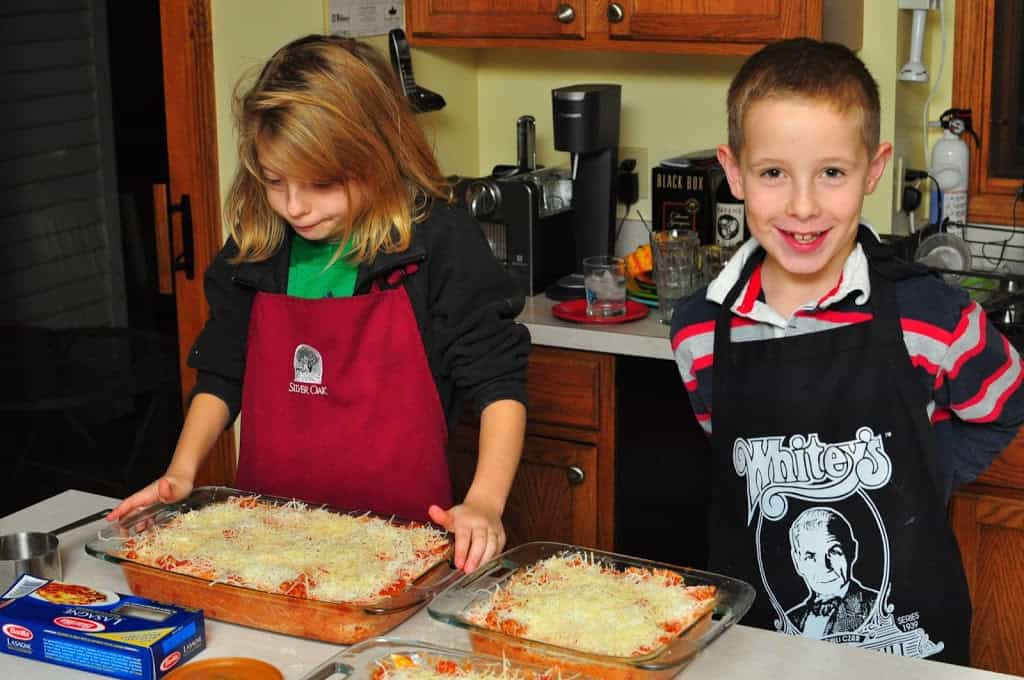
Displaying Adaptability in the Kitchen

August 14, 2012 by Mike Vrobel Leave a Comment

Improvised citrus squeezer

No plan survives contact with the enemy.

Ominous gray clouds hang over Put-In-Bay. It rained all morning, and every now and again I feel a few seconds of sprinkles before it stops again. The wind alternates between gusting and light breezes.

I'm grilling burgers for my brother-in-law's birthday. The grill is a metal box on a post, with the grill grate attached by a short chain. The kind of grill built so it can't be stolen, not so it's easy to use. My Weber kettle and my chimney starter were left behind - we got here by boat, and we only brought the essentials - the food and beverages we needed for the picnic.
*Don't forget the beverages!

I'm trying to light a pyramid of charcoal using wadded up newspaper as the starter. After a few failed attempts, I realize the ashes on the bottom of the box are soaked. The paper is absorbing the water, and not staying lit. After a quick trip to the island market for lighter fluid, and the addition of a shredded visitor guide, I get the coals going…barely.


An hour and a half after we arrive, the fire is going. The open side of the box is facing the wind, and the heat is blowing away from the burgers. Eventually, lunch is served…except for me. There wasn't enough room on the grill, so I have to cook one last burger for myself. The heat is almost gone, so I put the grill grate right onto the coals to finish cooking my lunch.

Hopefully, your weekend of cooking went better than mine. I'm not just writing this to complain. (Really.) There's a lesson here. Cooking doesn't always follow the script. Just because the recipe has timings down to the second (turn after 2 ½ minutes), doesn't mean the food will cooperate.

Cooking has so many variables - what kind of grill is it? How thick is the bottom of the fry pan? Is it a humid day, and the bread's going to rise slower? Are these steaks cut thinner than the last batch?

And those are normal variables. What if something goes wrong? A forgotten cup of flour, still sitting on the counter after all the ingredients are supposedly in the batter. Pork chops that refuse to brown. A stir-fry, interrupted by a howling kid with a scraped knee. No butter in the fridge or freezer, and the recipe needs a half a stick.

Don't leave the cedar plank with the brie
directly over a lit burner, or it will go up in flames...

If there are any beginning cooks out there, remember, things go wrong in the kitchen. Even for a food-obsessed blogger like me, someone who lives and breathes cooking, things go wrong. That's OK - it's part of the process.

And, I love it when things go wrong. Not when I'm standing there, cursing myself for forgetting to buy more butter. I love the moment when I stop blaming myself, the gears start turning, and I start working on a solution.
*We're out of diced tomatoes? How can I make salsa without tomatoes…what kind of an idiot doesn't keep a pantry full of diced tomatoes…oh, wait that's me. Now what? I've got it. The peaches from the farmers market - peach salsa!

Figuring out a way forward, so dinner can go on, turns a meal into a victory. It feels great, working around complications, hurdling obstacles, finding substitutions. Maybe it wasn't what you meant to do, but it came out all right in the end. You adapted, and the meal survived. Excellent!

No mortar and pestle? No problem.

What do you think? Questions? Other ideas? Leave them in the comments section below.

*Enjoyed this post? Want to help out DadCooksDinner? Subscribe to DadCooksDinner using the RSS or Email options on the right, link to this post from your blog, recommend DadCooksDinner to your friends, or buy something from Amazon.com through the links on this site. Thank you.

Pressure Cooker Mexican Black Bean and Noodle Soup (Frijoles y Fideos)

August 9, 2012 by Mike Vrobel 12 Comments

I love my pressure cooker. Except…there's no evaporation. Once you lock that lid, all the liquid is trapped. I'm used to a thick broth when I cook dried beans, and it's tricky to get the amount of water right in the pressure cooker.

I love noodle soup. Except…dry pasta soaks up too much liquid. I add eight ounces of pasta to a soup, and pretty soon I have noodle stew, not a soup.

I should have put two and two together, but I'm a slow learner. I made pressure cooker pasta fazool - bean soup with dried pasta - and suddenly my problems were over. I had a thick bean and pasta soup. Perfect!

I'm taking this idea south of the border. I combined a Mexican black bean soup with fideos, Mexico's vermicelli noodle soup. The result is a thick black bean and pasta soup. It's not Authentic Mexican, but it sure tastes good.

Recipe: Pressure Cooker Mexican Black Bean and Noodle Soup (Frijoles y Fideos)

Cooking time: 60 minutes

Equipment:

  • Pressure cooker (I used my Cuisinart Electric Pressure Cooker)

Ingredients:

  • 1 pound black beans, sorted and rinsed
  • 2 tablespoons vegetable oil
  • 8.8 ounce package vermicelli nests (aka bird's nest pasta)
  • 1 tablespoon ground cumin
  • 1 tablespoon ancho chile powder (or a chili powder blend)
  • 1 chipotle chile en adobo (or 1 tablespoon chipotle en adobo puree)
  • 8 cups water
  • Stems from ½ bunch of cilantro (leaves saved for accompaniments)
  • 1 (15 ounce) can fire roasted diced tomatoes
  • 1 whole head of garlic, roots trimmed off (they hide dirt)
  • 1 tablespoon Kosher salt
  • Juice of 1 lime

Accompaniments:

  • Shredded mexican cheese
  • Minced fresh cilantro
  • Hot Sauce
  • Lime wedges
  • Shredded cabbage

Directions:

1. Brown the vermicelli and bloom the spices:
Heat the vegetable oil in the pressure cooker pot over medium-high heat until shimmering. Add the vermicelli nests in a single layer; cook in batches if you need to. Brown the nests on one side, about 1 minute. Carefully flip the nests and brown on the other side, about another minute. Remove the nests to a paper towel lined plate with a slotted spoon, leaving as much oil behind as possible. After all the nests are browned, add the cumin, chile powder, and chipotle to the hot oil. Cook the spices until they are sizzling and fragrant, about 1 minute.

2. Pressure cook the beans:
Add the black beans and water to the pressure cooker, then stir to mix in the spices. Tie the cilantro stems into a bundle, then add the bundle of cilantro, garlic head, and can of diced tomatoes to the top of the liquid on the cooker. Lock the lid on the pressure cooker, increase the heat to high, and bring the cooker up to high pressure. (RTFPCM - read the fine pressure cooker manual - for the high pressure signal of your cooker). Reduce the heat to maintain the pressure and cook at high pressure for 25 minutes (35 minutes in an electric pressure cooker). Turn off the heat and let the pressure release naturally, about another 15 minutes. Remove the lid carefully, opening away from you - even when it's not under pressure, the steam in the cooker is very hot.
*Optionally, cook under pressure for 30 minutes, then quick release the pressure.

3. Cook the pasta:
Fish out the cilantro bundle and the head of garlic, and discard, then stir the tomatoes into the beans. Turn the heat to high under the cooker and bring the pot back to a simmer. Stir in the 1 tablespoon Kosher salt and the browned pasta. Simmer until the pasta is tender, about 9 minutes. (Note - do not lock the lid again - we aren't cooking the pasta under pressure.) Stir in the lime juice, taste, and add more salt, pepper, and lime juice as needed.

4. Serve:
Ladle the soup into bowls, sprinkle the accompaniments on top, and serve.

Notes

  • Why vermicelli nests? Because they're the right size to fit in the bottom of my pressure cooker pot for browning, and the nest makes it easy to flip and brown the other side. I didn't like the idea of chasing individual noodles around the bottom of the pan. Of course, it would be more authentic if I took 8 ounces of vermicelli noodles and broke them into rough 2 inch lengths before browning. (Cheaper too.) But I took the easy way out.
  • Loose noodles in the bottom of the bag? Don't bother browning them - just brown the nests, then dump the loose noodles into the pot with the browned nests.
  • I didn't soak the beans for this recipe, because Rick Bayless says... OK, you got me, it's because I forgot to soak them. But that's OK - they came out fine. If you want to, brine the beans in 3 quarts of water plus ¼ cup of table salt for at least 8 hours, then drain and rinse before cooking. Cut the cooking time for soaked beans to 15 minutes under high pressure (20 minutes in an electric PC), with a natural pressure release. (Thanks to Tami for asking about this in the comments.)

What do you think? Questions? Other ideas? Leave them in the comments section below.

Related Posts:

Pressure Cooker Pasta Fazool
Pressure Cooker Pinto Beans in Tex Mex Broth
Click here for my other pressure cooker recipes

*Enjoyed this post? Want to help out DadCooksDinner? Subscribe to DadCooksDinner using the RSS or Email options on the right, link to this post from your blog, recommend DadCooksDinner to your friends, or buy something from Amazon.com through the links on this site. Thank you.

  • « Previous Page
  • 1
  • …
  • 23
  • 24
  • 25
  • 26
  • 27
  • …
  • 37
  • Next Page »

Welcome to Dad Cooks Dinner!

I'm Mike Vrobel, a dad who cooks dinner every night. I'm an enthusiastic home cook, and I write about pressure cooking, rotisserie grilling, and other food topics that grab my attention.

More About Me →

Popular

  • Three bowls of cooked Pinto Beans on a wood table
    Instant Pot Pinto Beans (No Soaking)
  • Pressure Cooker Beef Shank (Osso Bucco)
  • Pressure Cooker 7 Hour Leg of Lamb (in 90 minutes)
    Pressure Cooker 7 Hour Leg of Lamb (in 90 minutes)
  • Pressure Cooker Brown Jasmine Rice
  • Grilled Tomahawk Steak (Long Bone Ribeye, Reverse Seared)
    Grilled Tomahawk Steak (Long Bone Ribeye, Reverse Seared)
  • A green bowl full of chicken noodle soup
    Instant Pot Rotisserie Chicken Noodle Soup

Seasonal

  • A bowl of asparagus risotto
    Instant Pot Asparagus Risotto (Pressure Cooker Recipe)
  • Grilled Butterflied Chicken with Garlic Butter
  • Sous Vide rack of lamb sliced into chops
    Sous Vide Rack of Lamb with Dijon Bread Crumb Crust
  • A bowl of beef stew with asparagus, carrots, and radishes.
    Instant Pot Spring Vegetable Beef Stew
  • A Rotisserie Chicken (Pollo Asado)on a platter of shredded cabbage
    Rotisserie Chicken Pollo Asado
  • Rotisserie Pork Shoulder Roast with Carolina Mustard BBQ Sauce
    Rotisserie Pork Shoulder with South Carolina Mustard Barbecue Sauce

Footer

↑ back to top

About

  • Privacy Policy

Newsletter

  • Sign Up! for emails and updates

Contact

  • Contact

Copyright © 2025 Dad Cooks Dinner