DadCooksDinner

  • Home
  • Rotisserie
  • Recipes
  • Tools
  • Books
  • Merch
menu icon
go to homepage
  • Recipes
  • Books
  • Tools
  • Merch
  • About
subscribe
search icon
Homepage link
  • Recipes
  • Books
  • Tools
  • Merch
  • About
×
Home » Recipes

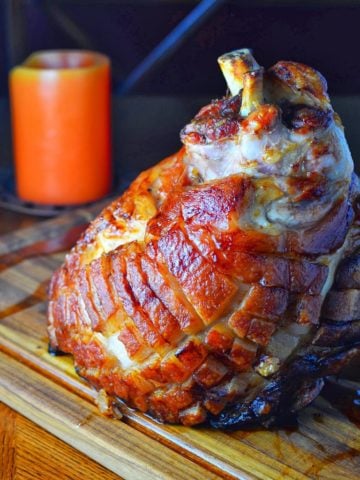
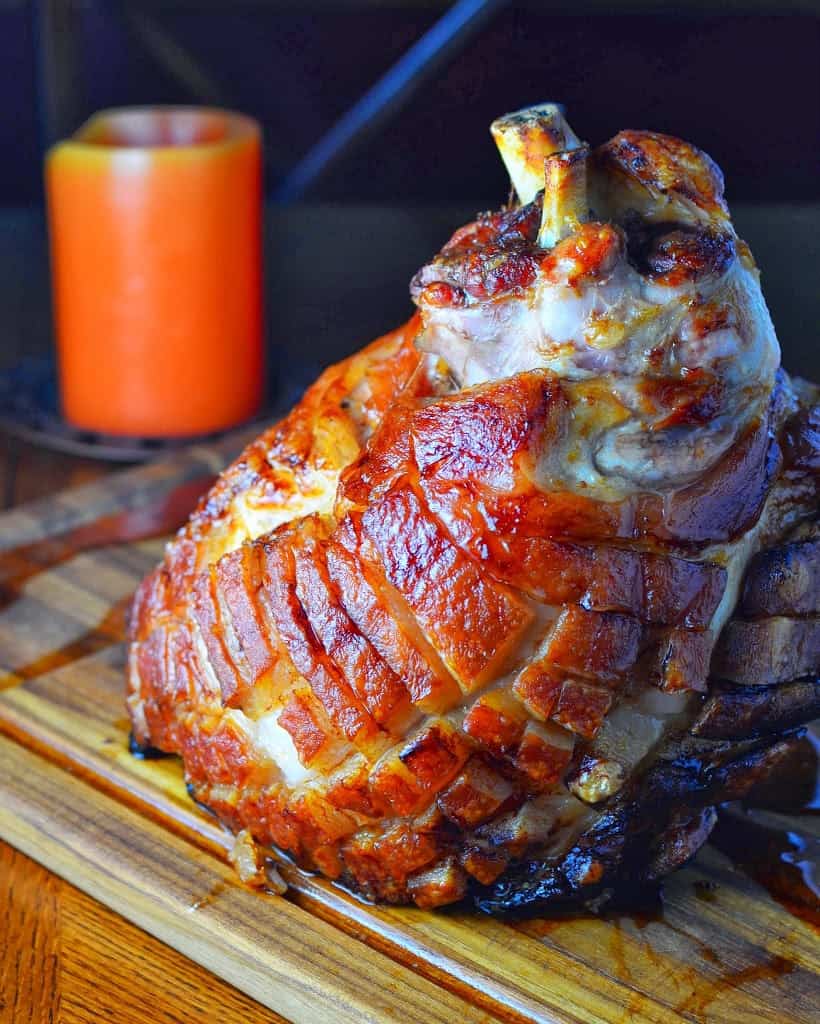
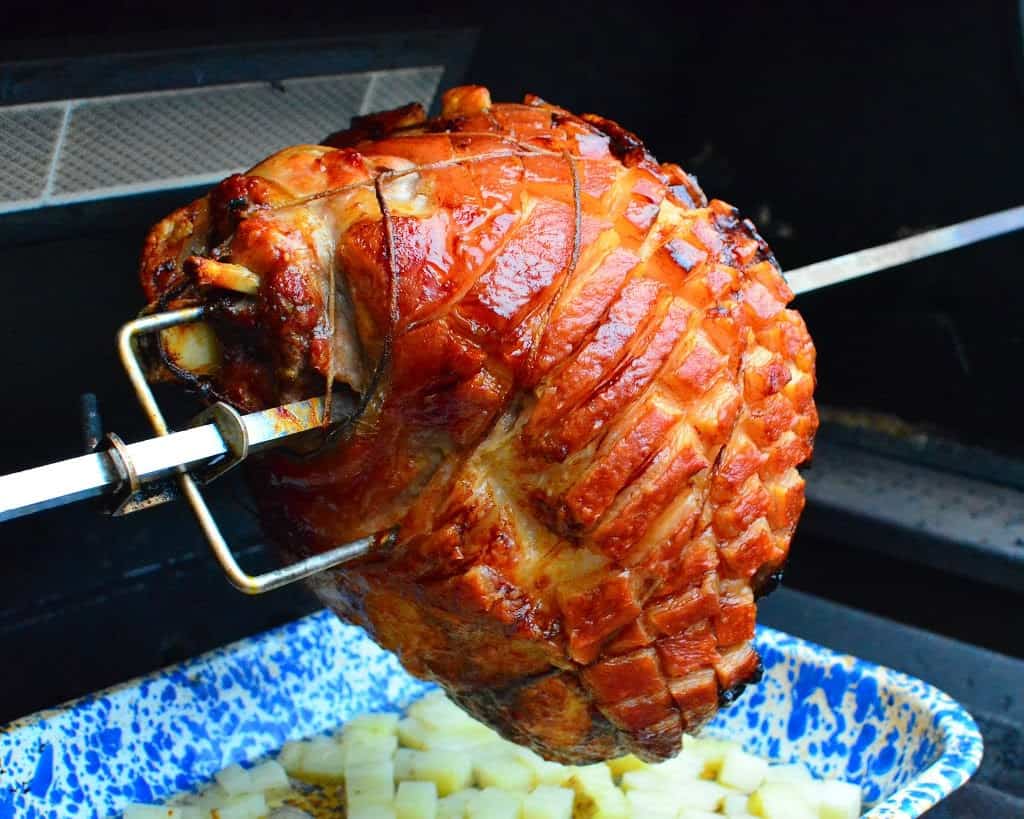
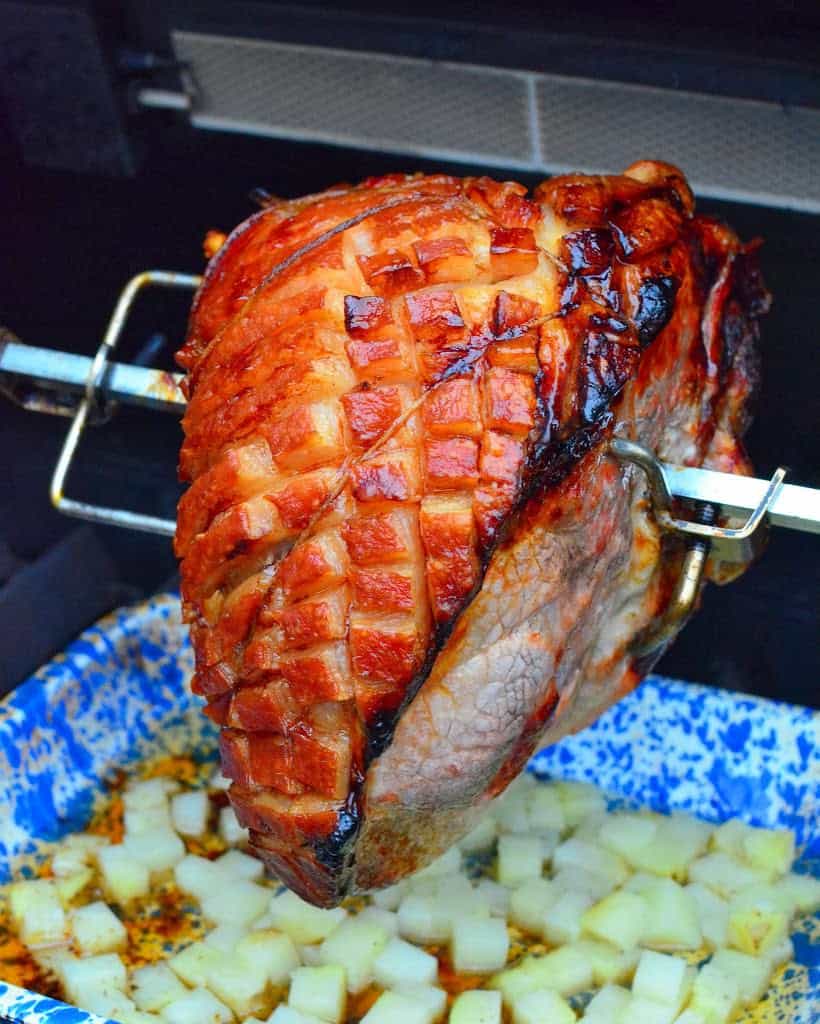
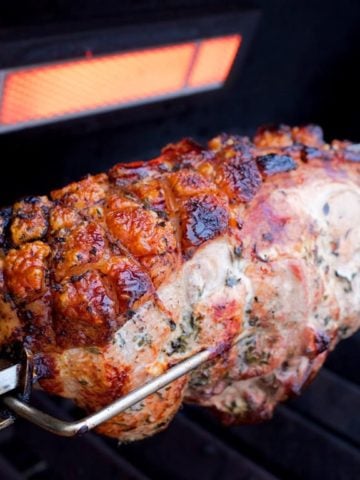
Rotisserie Leg of Pork Roast with Injection Brine and Herb Rub

March 13, 2014 by Mike Vrobel 3 Comments

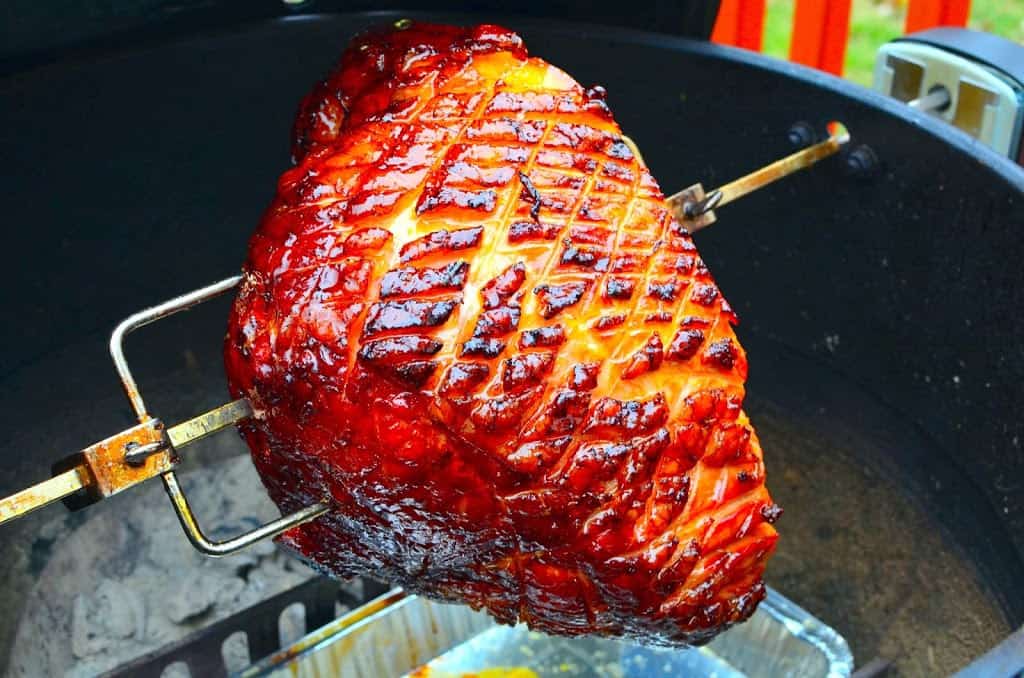
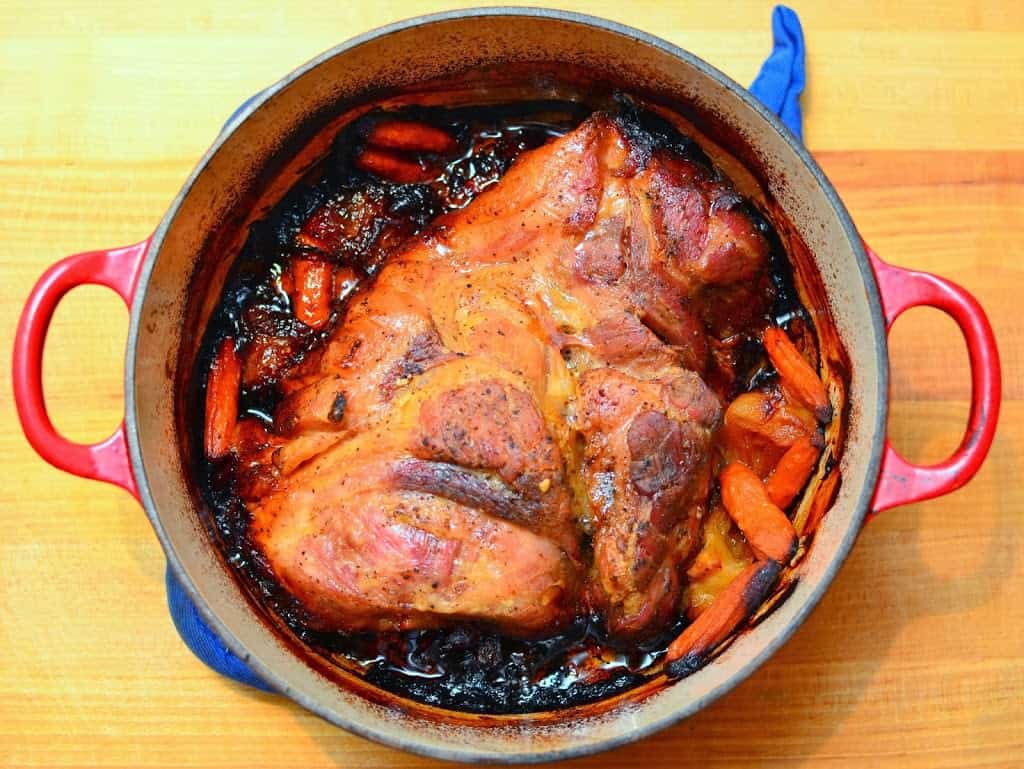
Leg of Pork is a common cut in England. Here in the states, we don't see leg of pork roasts that often; they are usually cured and sold as ham. I have a good butcher, so I can get fresh pork legs whenever I want.
The English also call a roast a "joint of meat", and their Sunday roast is often called a "Sunday joint." Here in the states, that name is a little too close to a marijuana joke. Like, you can only eat it in Colorado or Washington…thank you, thank you, I'll be here all week.

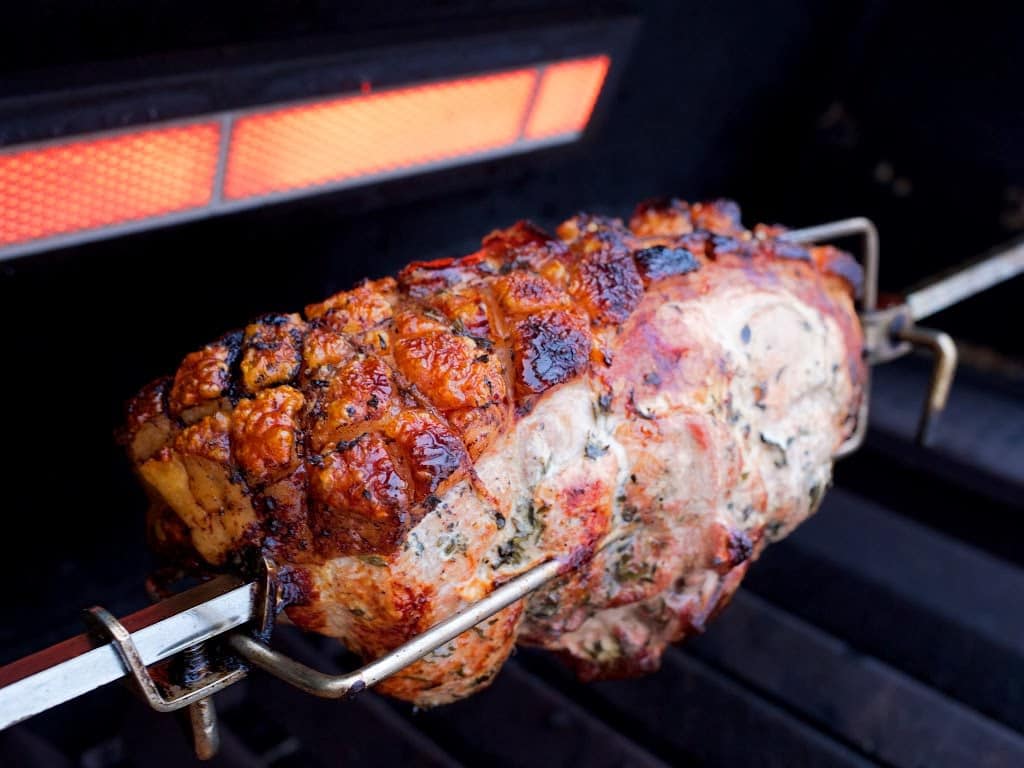
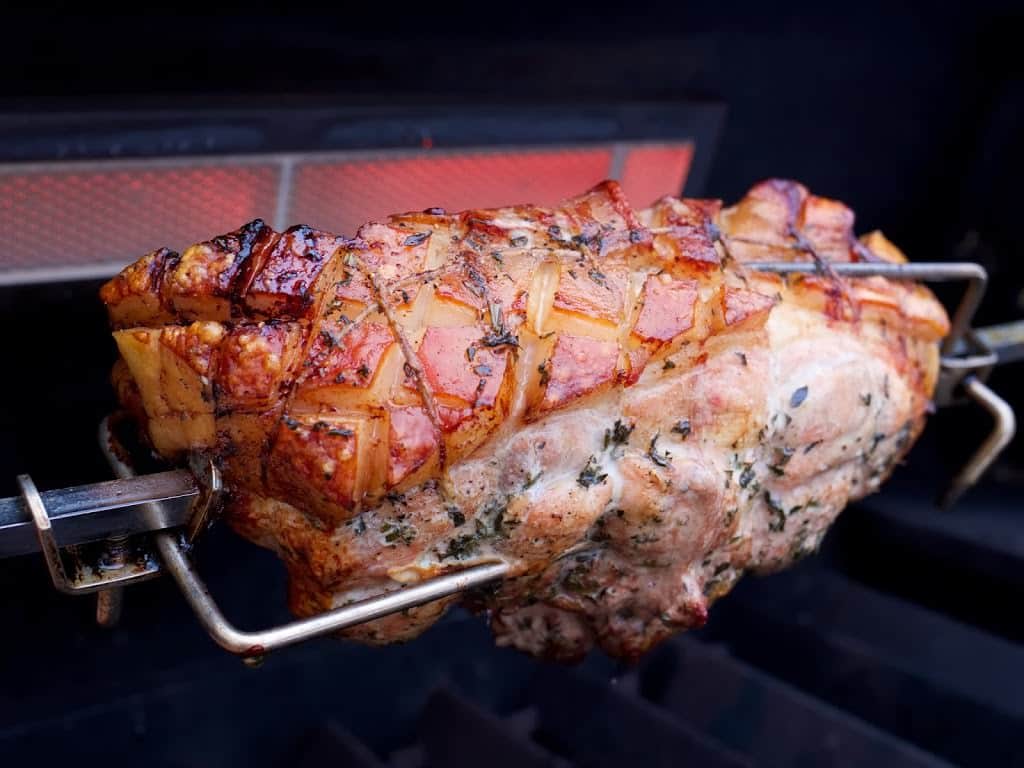
Pork leg is a lean cut of meat, similar to pork loin. So, why cook pork leg, instead of the ubiquitous boneless pork loin roast? Because you can get pork leg with the skin on, and a thick layer of fat between the skin and the meat. Pork skin and a rotisserie give you cracklings - crunchy crisped pork skin - which I eat like pig candy. Also, the thick layer of fat bastes the lean meat as it spins in the rotisserie, resulting in a juicier roast.

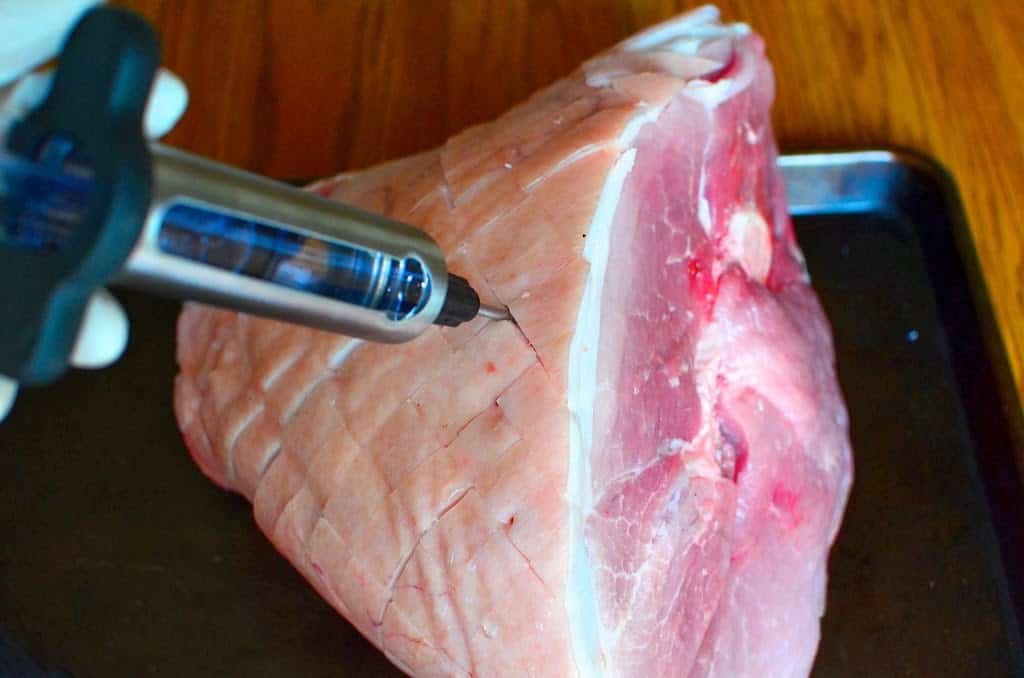
Also, just like when I cooked a bone-in fresh ham, this is the perfect time for an injection brine. I prefer wet brined pork, but I don't want to waterlog the skin. Wet skin makes it hard to crisp up the cracklings. Solution? Get out the big needle.

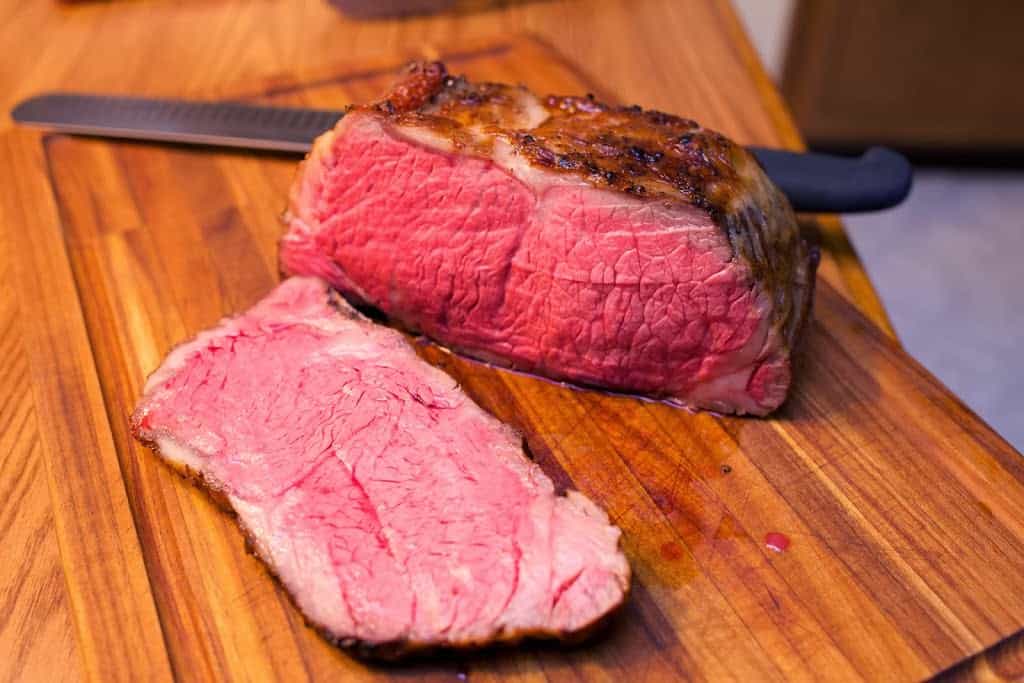
Crackling skin, lean meat? The perfect Sunday joint.


Shout out to my local butcher, Sherman Provision, for stocking fresh ham legs an trimming this one to order. Thanks, Mike and Mauri!


Recipe: Rotisserie Leg of Pork Roast with Injection Brine and Herb Rub


Prep Time: 20 minutes
Cook Time: 1 hour 30 minutes

Equipment

  • Grill with Rotisserie Attachment (Here's the current version of my Weber Summit)
  • 9 by 13 aluminum foil drip pan
  • Butcher's twine

Ingredients

  • 1 (5 pound, 4 inch thick) boneless leg of pork roast, skin and fat cap still attached
  • 1 cup wood chips (or 1 fist sized chunk of smoking wood) - oak, hickory, or apple are my favorites with pork

Injection Brine

  • 1 cup water
  • 1 tablespoon kosher salt (1 ½ teaspoons table salt)
  • 2 teaspoons brown sugar

Herb Paste

  • 1 tablespoon minced thyme
  • 1 ½ teaspoons minced rosemary
  • 2 cloves garlic, peeled and minced
  • ½ teaspoon fresh ground black pepper
  • ¼ teaspoon kosher salt
  • 1 tablespoon extra virgin olive oil

Directions

1. Score and injection brine the pork

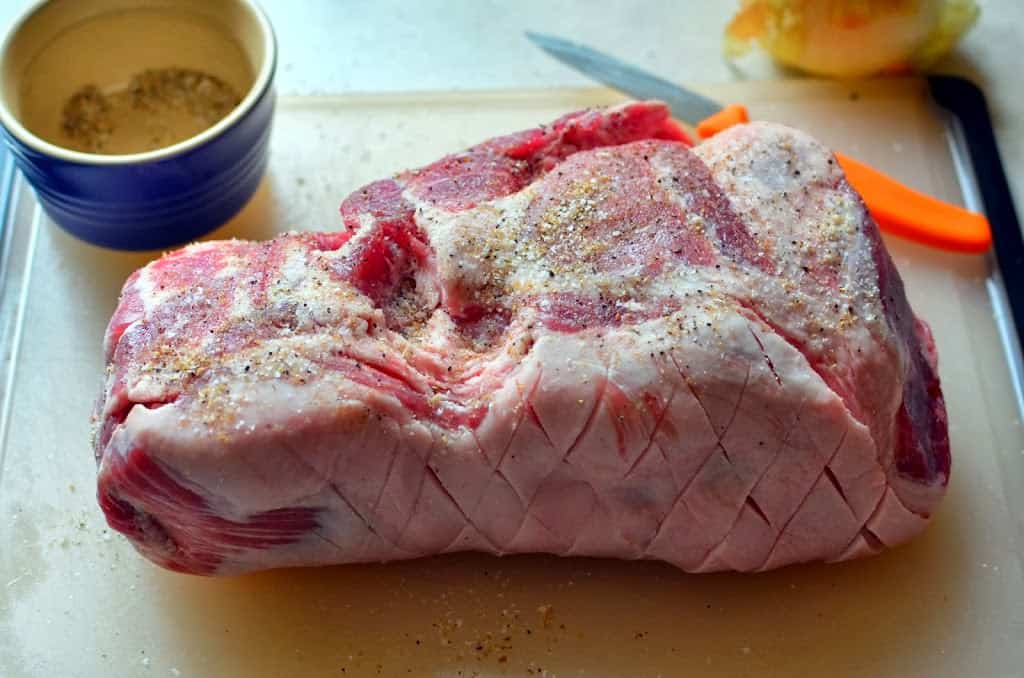
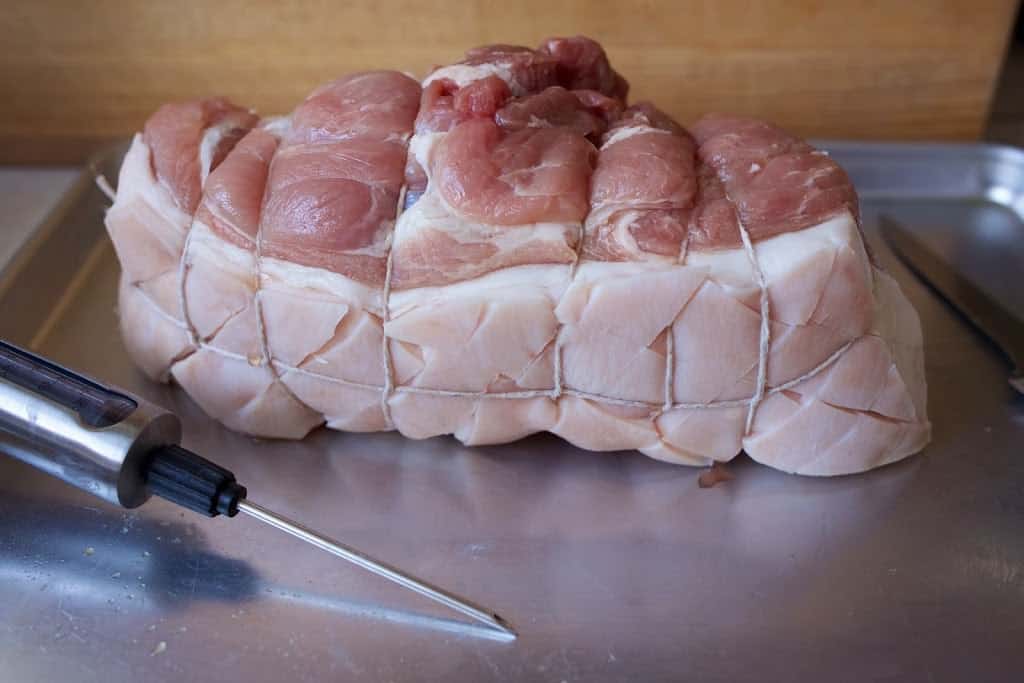
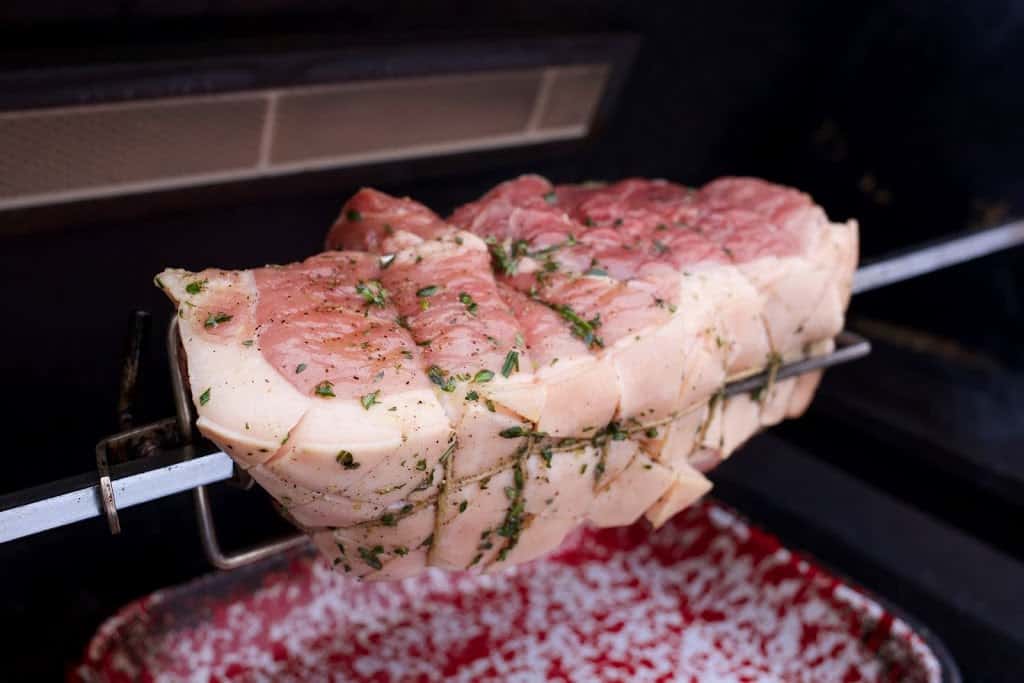
Stir the brine ingredients in a measuring cup until the salt and sugar dissolve. Score the skin on the leg of pork in a 1 inch diamond pattern. Inject the brine into the pork, poking through the scores in the skin every couple of inches. Push the needle all the way in, then depress the plunger while slowly pulling the needle out, spreading the brine along the puncture. Let the leg of pork rest in the refrigerator for at least an hour to absorb the brine; four to eight hours would be better. Soak the smoking wood, starting an hour before cooking time.
2. Truss and spit the pork

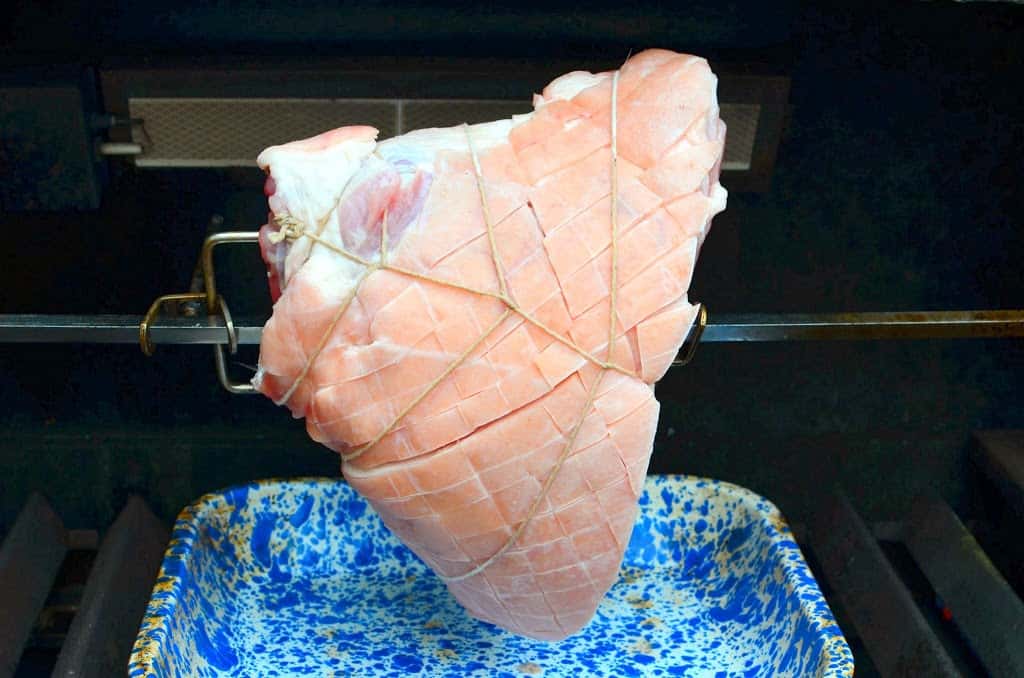
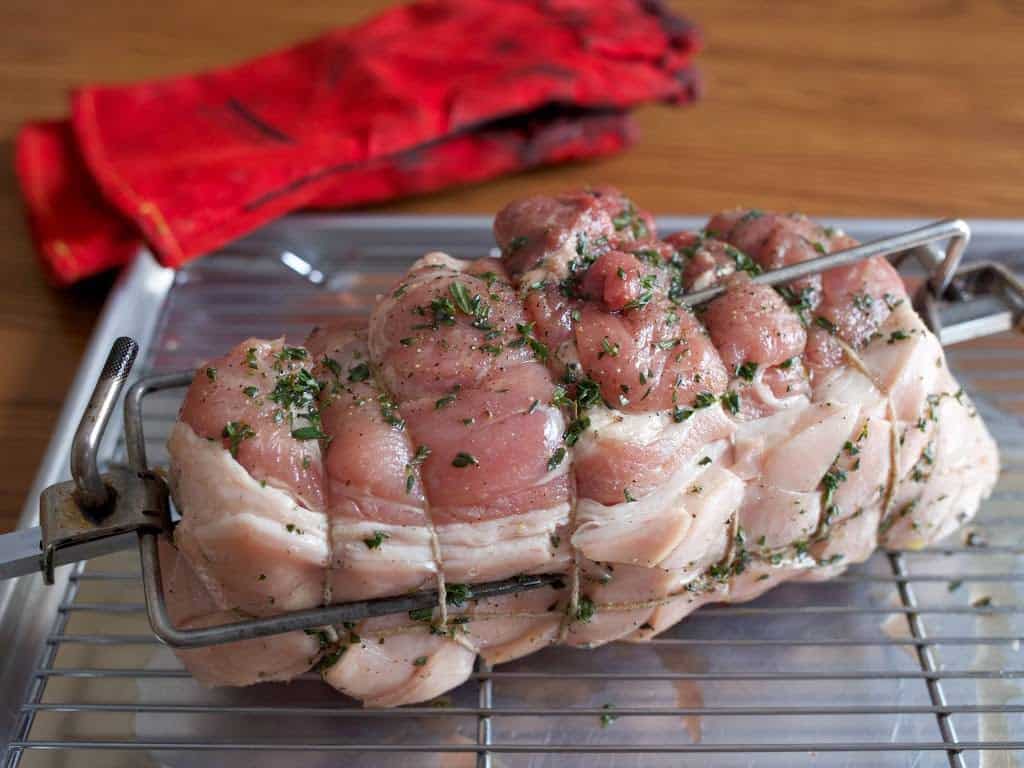
Before preheating the grill, remove the pork from the refrigerator. Mix the herb paste ingredients in a small bowl, then spread the herb paste over the pork leg, working it into the natural seams of the meat. Truss the pork roast every 1 ½ inches. Run the spit through the roast, aiming for center mass, and secure the roast to the spit with the spit forks. Let the roast rest at room temperature while the grill pre-heats.
3. Set up the grill for indirect medium-low heat

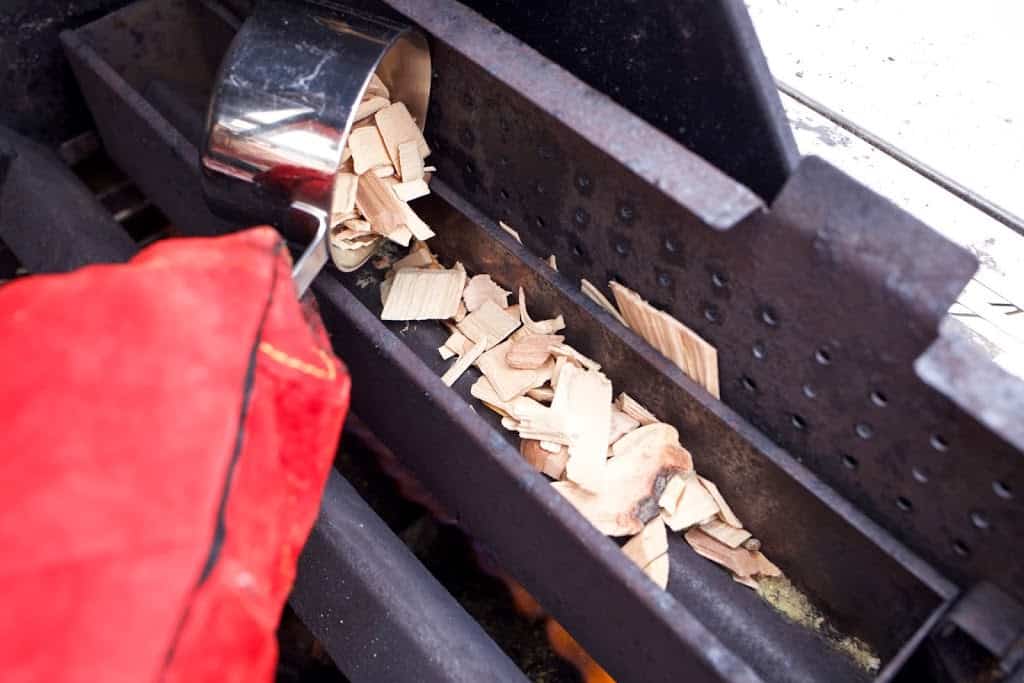
Set your grill up for indirect medium-low heat (300°F), with a drip pan in the center of the grill grate, and preheat for ten minutes. For my Weber Summit, I remove the grates, turn burner #1 and #6 to medium, turn the smoking burner to high, and put my drip pan in the middle of the grill, over the unlit burners. (If I didn't have the smoker burner, I'd go with #1 and #6 at medium.) For a charcoal grill, light a chimney ½ full with charcoal. When it is covered with gray ash, spread it in two piles on the grill grate, with a drip pan in the middle.
4. Rotisserie the leg of pork

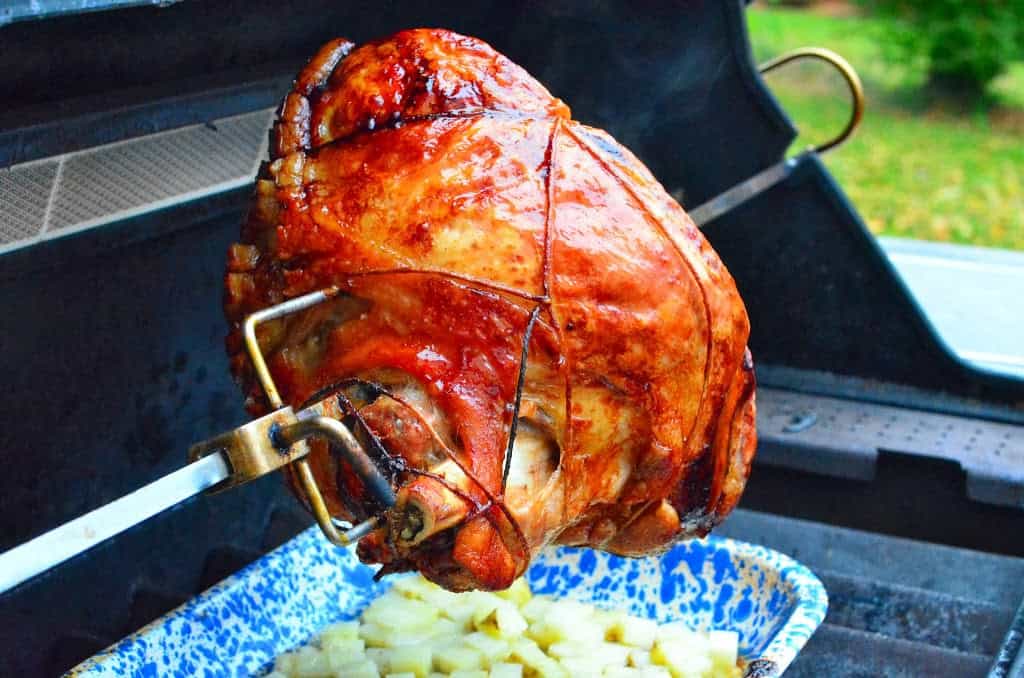
Put the smoking wood on the fire - chips wrapped in foil and on the burner cover directly over a lit burner in a gas grill, or chunk on the coals for a charcoal grill. Put the spit on the rotisserie, start it spinning, and center the drip pan under the pork roast. Cook with the lid closed until the pork reaches 120°F in its thickest part, about 1 hour and 15 minutes. Increase the heat to indirect high to crisp up the pork skin. (If you have an infrared rotisserie burner, set it to high to help with the browning.) Cook the pork until the skin is crisped and bubbling in spots, and the pork reaches 140°F in its thickest part, about 15 minutes. For a charcoal grill, start another half a chimney of charcoal after the pork has been cooking for 50 minutes. When it is covered with gray ash (this should take about 20 minutes), add it to the coals on one side of the charcoal rate, and give the roast another 15 minutes to crisp up the skin.
5. Rest, carve and serve

Remove the spit from the rotisserie, remove the pork roast from the spit, and cut the trussing twine away from the roast. Let the pork rest for 15 minutes, then carve into ½ inch thick slices and serve.
Notes

  • You have to make drip pan potatoes with this recipe. Yes, have to. Pork drippings make fantastic drip pan potatoes. Add them to the pan when you increase the heat to crisp up the skin.
  • You will not use all the brine - only a quarter to half cup of it. Why make extra brine? Because I don't like trying to chase the last few drops of brine around the cup.

What do you think?

Questions? Other ideas? Leave them in the comments section below.

Related Posts

Rotisserie Fresh Ham with Injection Brine
Rotisserie Rack of Pork with Apple Cider Brine
Rotisserie Boneless Pork Loin with Apricot Glaze

Enjoyed this post? Want to help out DadCooksDinner? Subscribe to DadCooksDinner via eMail or RSS reader, recommend DadCooksDinner to your friends, buy something from Amazon.com through the links on this site, or donate through my tip jar. Thank you.


Book signing in Chicago - IACP 2014 Book & Blog Festival

March 12, 2014 by Mike Vrobel 2 Comments


It's 106 miles to Chicago...
<checks google maps>
...correction. It's 357 miles to Chicago. I've got a full tank of gas...

Road trip!

I'm going to the International Association of Culinary Professionals 2014 conference in Chicago this weekend, and I have a table at the Book & Blog Festival at the Downtown Marriott on Saturday, March 15th from 7PM to 8PM.
The festival is open to the public, and general admission tickets are $35 for non-IACP members. That's a lot to say hello just to me, but there *will* be a bunch of better known bloggers and authors there.
Information about the conference: IACP 2014 Annual Conference
Tickets for the Book & Blog Festival only: IACP 2014 Book & Blog Festival
If you're at IACP 2014 this weekend, stop by and say hello!

Late Winter Recipe Links - March 2014

March 11, 2014 by Mike Vrobel 1 Comment

I am SO looking forward to spring this year. We keep getting hints of it - temperatures are in the 50°s today - and then we have a winter storm warning for tomorrow. This winter has to end…eventually…right?

The little virus vectors kids brought something home from school that knocked us all flat for the week. Here are recipes I dreamed about while I sat under a blanket, sniffling and sipping tea.

1. Grilled Steaks - The Reverse Sear via Weber.com

Mike from AnotherPintPlease.com, is now writing for Weber's official blog. Congratulations, Mike!

2. Pressure Canned Dried Beans via FoodInJars.com

I love pressure cooking my own dried beans, but I need to give myself about an hour. Marissa figured out how to pressure can them, so they're sitting on the shelf, ready to be opened and added to a recipe. I will be trying this out soon…

3. Egg whites to clarify pressure cooker consomme via IdeasInFood.com

Speaking of pressure cooker ideas - how about adding egg whites to clarify pressure cooker stock? Brilliant!

4. Tacos de Suadero via MexicoInMyKitchen.com

Authentic Mexico City style shredded beef tacos. I have a plan for my next taco night.

5. Vegetable Porn for Dedicated Carnivores via Ruhlman.com

Michael Ruhlman gets a shipment of vegetables from The Chef's Garden. Oh, my.

Bonus: John Candy vs The Old '96er - The Great Outdoors

Bon Appetit! (h/t TheSweethome for reminding me about this scene...and recommending some new steak knives.)

What do you think?

Any posts you've loved recently? Leave them in the comments section below.

Enjoyed this post? Want to help out DadCooksDinner? Subscribe to DadCooksDinner using the RSS or Email options on the right, recommend DadCooksDinner to your friends, buy something from Amazon.com through the links on this site, or donate through my tip jar. Thank you.
Which Pressure Cooker Should I Buy

March 6, 2014 by Mike Vrobel 47 Comments

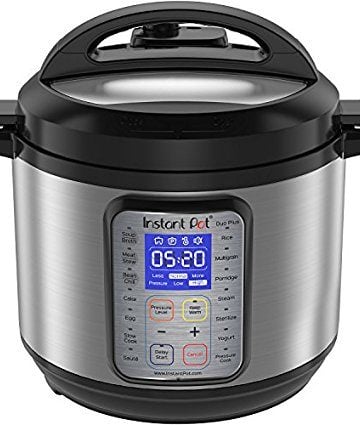
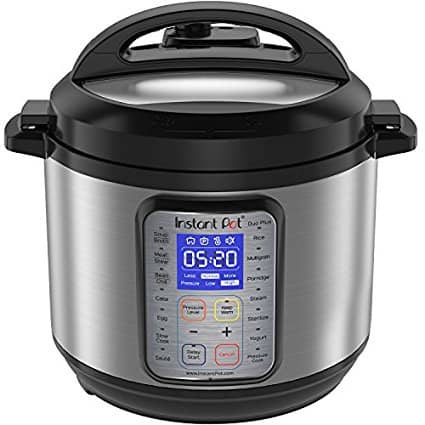
Instant Pot IP-DUO Plus 6 Quart (Image courtesy of Amazon.com) | DadCooksDinner.com
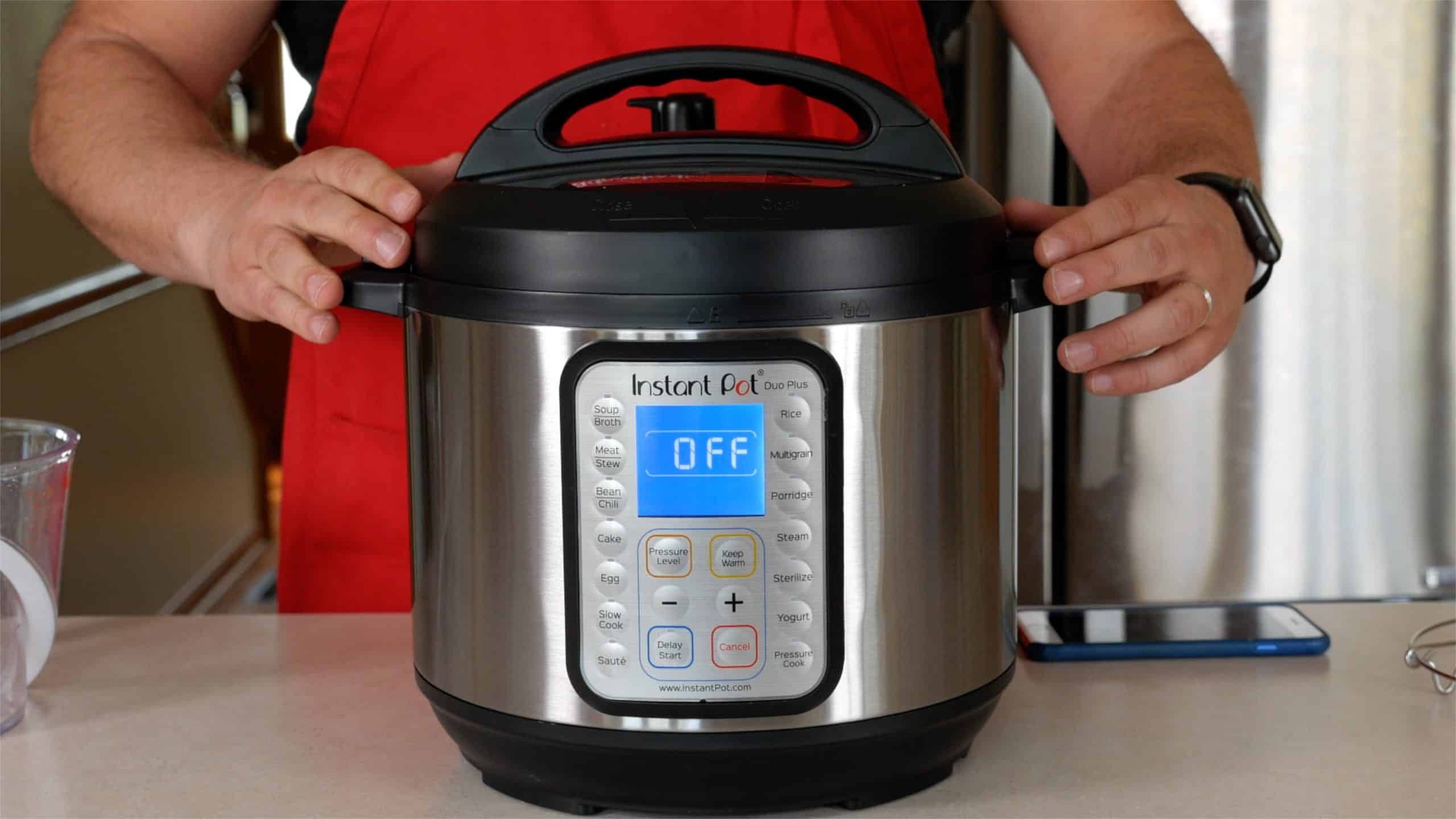
Instant Pot IP-DUO Plus60 Unboxing

If you had to pick one pressure cooker, what would it be?

I get this question a lot, and, frankly, it's tough to answer. My response to "Which pressure cooker should I buy?" is "I only get one?" I own four five pressure cookers right now; they're that useful. But if I could only have one...

There can be only one

If I could only have one pressure cooker, I would choose…

Instant Pot IP-DUO Plus 6 Quart (Image courtesy of Amazon.com) | DadCooksDinner.com
Instant Pot IP-DUO Plus 6 Quart (Image courtesy of Amazon.com)

The Instant Pot IP-Duo Plus 60 electric pressure cooker.

(I know, having a picture of an Instant Pot at the top of the post kind of gives it away.)

Now, this is a change for me. I used to recommend stove top pressure cookers. Nowadays, I reach for the electric pressure cooker first. Set it and forget it cooking is just too convenient. Once I lock the lid and set the timer, the electric PC takes it from there, and I can focus on the rest of dinner. The electric PC brings itself up to high pressure, levels off, maintains high pressure until the end of cooking, and then turns itself to a warming mode and lets the pressure start to come down naturally.

Why the Instant Pot? I prefer the durable, easy to clean stainless steel insert - I'm always worried about scratching the nonstick lining on my other pots. The bracket that holds the Instant Pot silicone gasket is built into the lid, making it easy to install and remove, and the silicone gasket is dishwasher safe. My favorite feature is a simple one - the lid holder in the handle on the body Set the tab on the lid in the slot on the handle. If I could keep only one pressure cooker, the Instant Pot would stay.

The IP-Duo Plus 60 is the latest in the Instant Pot line. I used the IP-Duo for years, and the IP-Lux 60 for a few years before that. The Duo Plus has an easier to understand electronics panel (a "Pressure Cook" button - hooray!) and a convenient handle/lid holder design. If you have an IP-Lux 60 or IP-DUO 60, it's not worth upgrading...but if you are getting a new for a new pot, get the IP-Duo 60 Plus. Also, for more questions and answers about Instant Pots, check out my Instant Pot Frequently Asked Questions.

Choices, Choices

Now for the nuanced answer. I don't have to restrict myself to one cooker, thank goodness. I own a few of them; different pressure cookers have different strengths.
My wife would be happier if I had only one…but the same can be said of fry pans, grills, chef's knives, and the countless kitchen gadgets overrunning our house. Yes, I have a problem.

What kind of pressure cooker should *you* buy? Read on, and pick the one that sounds best to you.

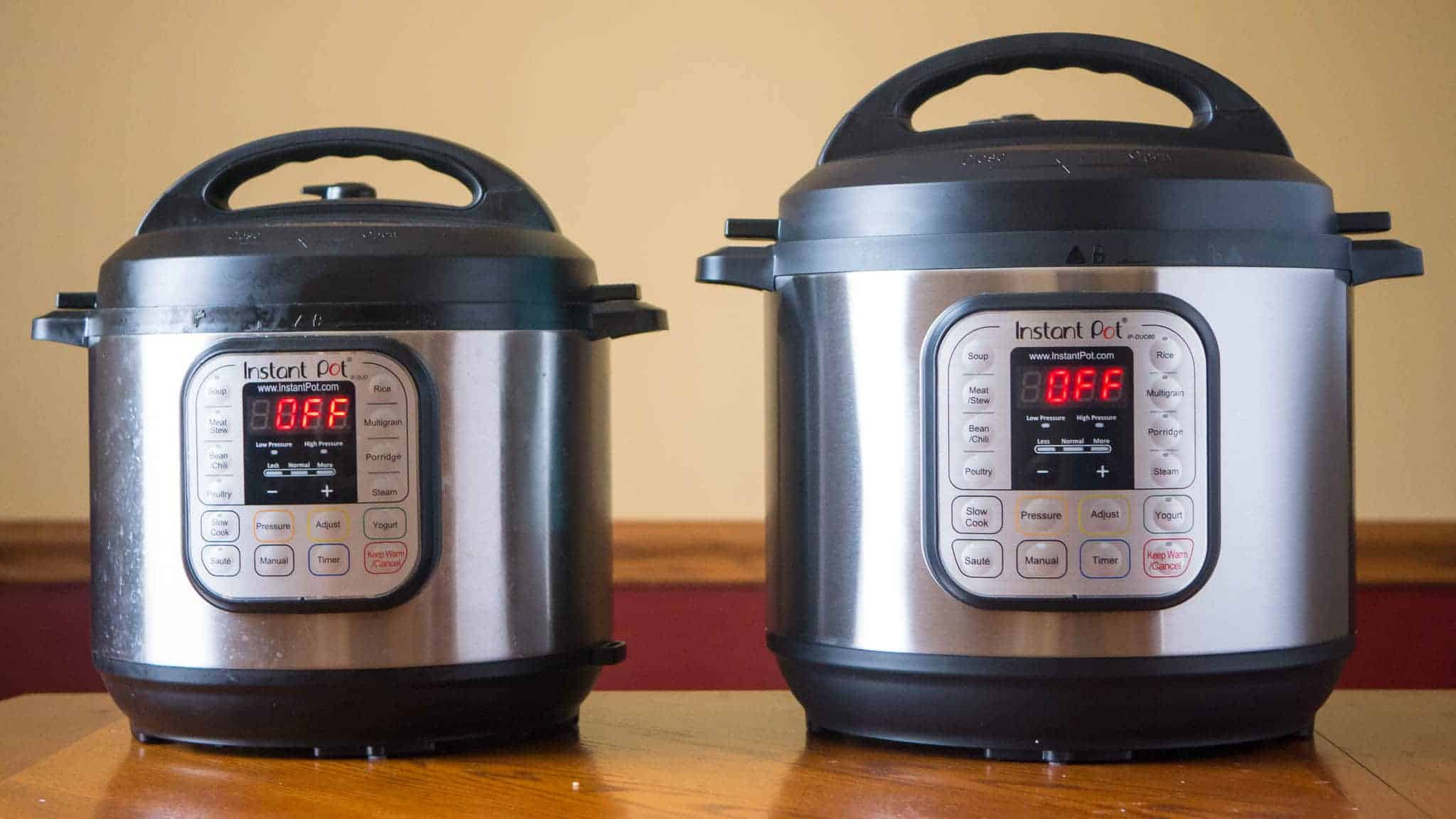
Electric Pressure Cookers - Instant Pot IP-DUO60 and IP-DUO80 | DadCooksDinner.com
Electric Pressure Cookers - Instant Pot IP-DUO60 and IP-DUO80

Electric Pressure Cookers

Advantages of electric pressure cookers:

  • More automated - set the time and it will beep when it is done
  • More convenient
  • Did I mention set it and forget it?

Disadvantages of electric pressure cookers:

  • Large electric pressure cookers (8 quart or larger) are less common
  • Lower pressure - Most top out at 11 or 12 PSI, so add 20% to the cooking time under pressure for published recipes
  • Confusing controls - read the f(ine) manual to figure them out
  • Only way to quick release pressure is to open pressure valve and live with hissing steam for a few minutes

As I said earlier, electric pressure cookers have one advantage, but it's a big one. Set it and forget it cooking. Once the lid is locked and the timer is set, the cooker takes care of everything else, and beeps at you when it is done.

Recommended electric pressure cookers

  • Instant Pot IP-DUO60 Plus
  • Instant Pot IP-DUO80
  • Zavor Lux 6 Quart
  • Zavor Lux 8 Quart
  • Instant Pot IP-DUO60
  • Instant Pot IP-LUX60

IP-DUO80: We already talked about the Instant Pot IP-DUO60 Plus. If it sounds good, get it. You won't regret it. Now, let's talk size. I said "bigger is better" above in the stovetop pressure cooker section - but I still recommend the 6 quart IP-DUO60 Plus over the 8 quart IP-DUO80. The 6 quart is large enough for 95% of my cooking for a family of five. If you're cooking for larger crowds on a regular basis, go with the 8 quart IP-DUO80 - the two cookers are very similar. Also, if you want a second pressure cooker, I'd get the big one. I use the IP-DUO80 as my backup pressure cooker, and I love knowing I have it available if I need the extra space.

Zavor Lux: If you don't want to buy an Instant Pot, I recommend the Zavor Lux line of cookers, available in a 6 quart and an 8 quart model. I like the Zavors, but they aren't quite as convenient as the Instant Pot. That integrated lid holder in the Instant Pot is a killer feature. (Note: These cookers used to be from Fagor; Zavor America rose from the ashes of the Fagor bankrupcy, saving these pressure cookers from an untimely death.)

Cheaper Options: If you are looking for the lowest cost possible, check out the Instant Pot IP-LUX60. It's the older model of the instant pot. It doesn't have the lid holder that the IP-DUO line has, but you can usually save about $30 by going with the IP-LUX.

If you want to save a few dollars, but want that lid holder, the older Instant Pot IP-DUO 60 is still a fine cooker, and one that I used for years. But, since the Plus is available, that's the one I recommend - the front controls are better, and if you're going to try to save money, the IP-LUX60 is cheaper. The IP-DUO is fine, but I'd go higher priced or lower priced, depending on what you're looking for.

(I use my pressure cooker many times a week, so I happily paid extra for the conveniences in the IP-DUO Plus. But, your judgement of value may be different.)

Bluetooth Instant Pot IP-SMART60: The IP-SMART60 is the same cooker as the IP-DUO, but with Bluetooth connectivity. I'm a gadget hound, so I bought one, but I don't use the Bluetooth connectivity; it's just an extra expensive IP-DUO60 to me. Get the IP-DUO60 Plus instead.

Instant Pot on sale at Amazon: Keep an eye out around "big purchase" holidays, like Black Friday, Christmas, and Amazon Prime Day in Mid-July. Amazon will almost always have a great deal on an Instant Pot - most years a 6 quart model, sometimes the 8 quart model. You can get a fantastic price if you wait for the holiday.

General advice: buy from a dedicated pressure cooker manufacturer

Regardless of what type of cooker you get, buy from a company that you can count on. Pressure cooker parts wear out, especially the sealing gaskets. Don't get stuck with a pot that you can't get fixed ten years down the road. I buy from companies that are dedicated to pressure cookers, companies that make it obvious how to get spare parts.

I check for two things. Can I find spare parts on Amazon? Or, can I order them directly from the company's website? If the only support they give is "call our 800 number or email us," I get suspicious; if they don't respond to emails asking about how to get spare parts, I move on to the next brand.

Stove top Pressure Cookers

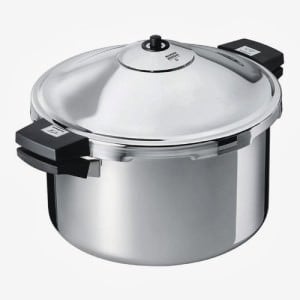
[Image via Amazon.com]

Stove top cooker advantages

  • High pressure is 15PSI - slightly faster cooking times
    • Also - most published recipes assume 15 PSI
  • Wider pots (on some models) make browning easier
  • Quicker to heat up (on a powerful stove)
  • Quick pressure release - cold water pressure release is quicker (and quieter) than opening pressure valve
  • Can double as a regular pot

Stove top cooker disadvantages

  • Manual timing - the cook has to watch the pot, start the timer when the cooker reaches high pressure, and turn off the heat when cooking time is done
  • Manual heat maintenance - the cook has to adjust the burners on the stove to maintain pressure, and this can vary depending on how full the cooker is.

Recommended stove top cookers

  • Kuhn Rikon 12 Quart Duromatic
  • Zavor Duo 10 Quart Pressure Cooker/Canner

For years, these were my only pressure cookers - first the Fagor (now Zavor), then the Kuhn Rikon. The K-R has a better pressure valve - no steam is released when it is at high pressure; it only vents when it is seriously over pressure. Also, the K-R is huge. Bigger is better with pressure cookers - you have to leave ⅓rd of the pot empty so there's enough airspace to build up pressure. A larger pot gives you room to cook more.

The Zavor's advantage? At 10 quarts it is bigger than most pressure cookers, and it costs about a third of the K-R price. The Kuhn Rikon and Zavor are also wide for pressure cookers - most cookers are narrow (about 9 inches diameter), but the K-R and Zavor are wider. A wider pot has more room to brown meat and saute aromatics before pressure cooking. (Note - if you don't want the extra size of these cookers, the 8 quart models are also very good.)

So, which should you get? If you can afford the best, get the Kuhn Rikon. I've never regretted switching to it. If cost matters, get the Zavor; it is the best value in pressure cookers, giving the most space for the least amount of money.

Other stove top cookers to consider

Some people swear by pressure skillets. (This includes Lorna Sass, author of my pressure cooking bible, Pressure Perfect). They're low, wide cookers that are best for smaller braises. I'm always pushing the "max fill" line on my 6 quart cookers, so I've never been into pressure skillets, but if you're interested, these are the models I recommend:

  • Zavor Duo 4.2 Quart
  • Zavor Duo 6.3 Quart
  • Zavor Duo 8.4 Quart
  • Kuhn Rikon Duromatic 2.5 quart
  • Kuhn Rikoon Family Style Pressure Braiser 5 quart - the short version of my favorite 12 quart; every bit as wide, almost as expensive

I need a really inexpensive stove top pressure cooker

If price is a big issue for you, this inexpensive Presto 6 quart PC is recommended by people I trust:

  • Presto 6 quart stainless steel pressure cooker

Street price is about $45. I'd save up and get an 8 or 10 quart model, but for such a low price, this cooker is a deal.

FCC Notice

I paid for all these pressure cookers with my own money - except for the Kuhn Rikon, which I was given as a review model years ago. I've used almost all the pots mentioned in my own kitchen, or a very similar model. None of these comments were paid for - I'm on my own. I get a small sales commission if you buy something through my links to Amazon. (And, if you do, thank you for your support!)

What do you think?

Questions? Other ideas? Leave them in the comments section below.

Related Posts

Instant Pot FAQ - where I try to answer all the Instant Pot questions that I can
Pressure Cooker Recipe Index
Things I Love: Pressure Cookers
Things I Love: Cuisinart Electric Pressure Cooker
Review: Kuhn-Rikon 12 Quart Family Stockpot Pressure Cooker
Instant Pot IP-DUO80: First Look and Longer Term Testing Notes

Enjoyed this post? Want to help out DadCooksDinner? Subscribe to DadCooksDinner via eMail or RSS reader, recommend DadCooksDinner to your friends, buy something from Amazon.com through the links on this site, or donate through my tip jar. Thank you.
Pressure Cooker Beef Noodle Soup with Mushrooms and Carrots

February 27, 2014 by Mike Vrobel 1 Comment

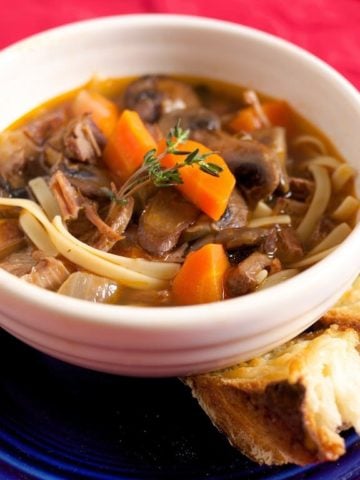
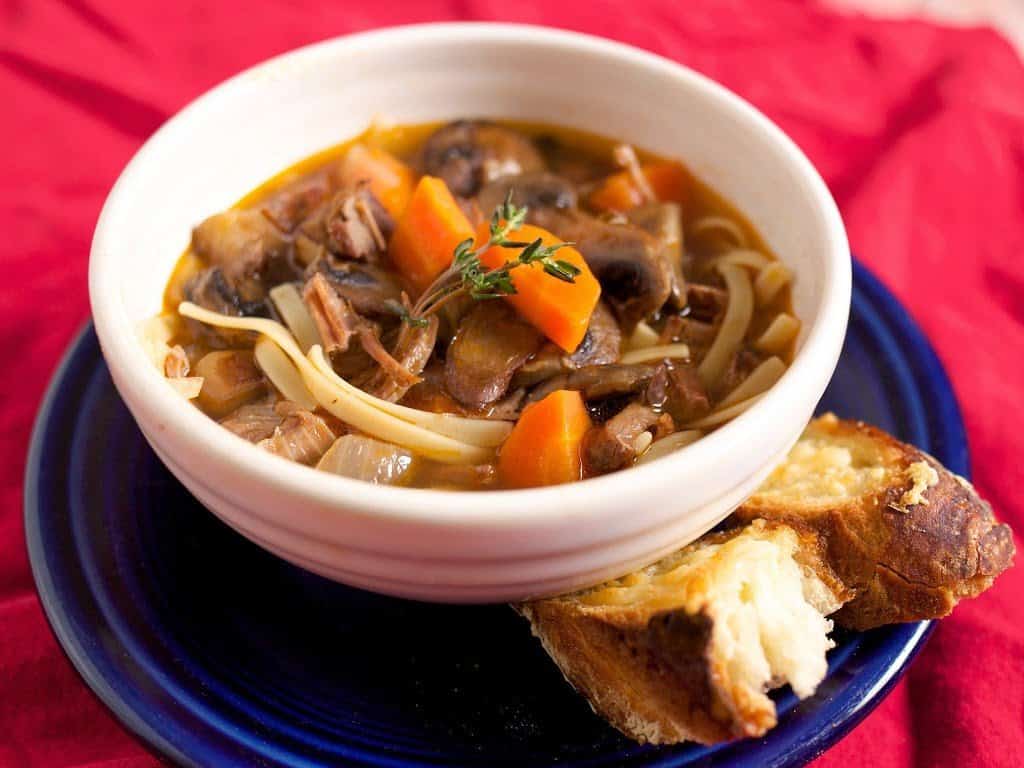
Pressure Cooker Beef Noodle Soup with Mushrooms and Carrots

Pressure Cooker Beef Noodle Soup with Mushrooms and Carrots

How do I use my browned beef stock? I make the best beef and noodle soup ever. (That's how it was rated by three finicky recipe testers, aged twelve, ten and nine.)

I lucked out on the timing of this recipe. When I made my weekly meal plan, I didn’t know there was a storm coming. (This year, I should always assume a storm is coming…but I digress.) The kids took advantage of the snow day and headed outside to play with their friends. I took advantage of the piece and quiet and made beef stock. As they came back in the house, leaving a trail of snowy clothes behind them, each one said “what smells so good?”

Oh, just beef noodle soup. “Cool!” was the universal answer, followed by the sound of them pounding downstairs to play Xbox.

(Later, one came upstairs while the broth was cooling on the deck and asked in a worried tone: “Why don’t I smell the beef soup any more?”)

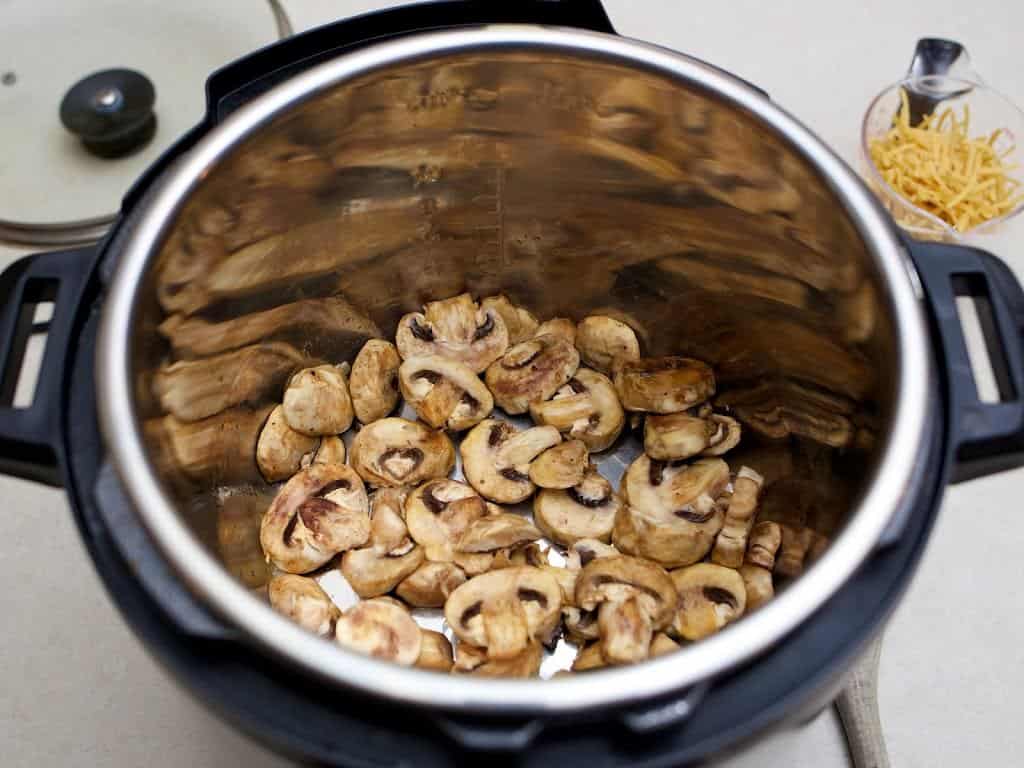
Homemade stock is the key to this recipe; it adds flavor and body that store-bought broth can’t duplicate. The soup starts with sauteed mushrooms, adding another layer of umami to the bones and tomato paste in the beef stock. After that comes a base of aromatic onions and garlic, with a touch of crushed red pepper to spice it up a bit. Then we build the soup with thick pieces of carrot, shredded beef, and egg noodles.

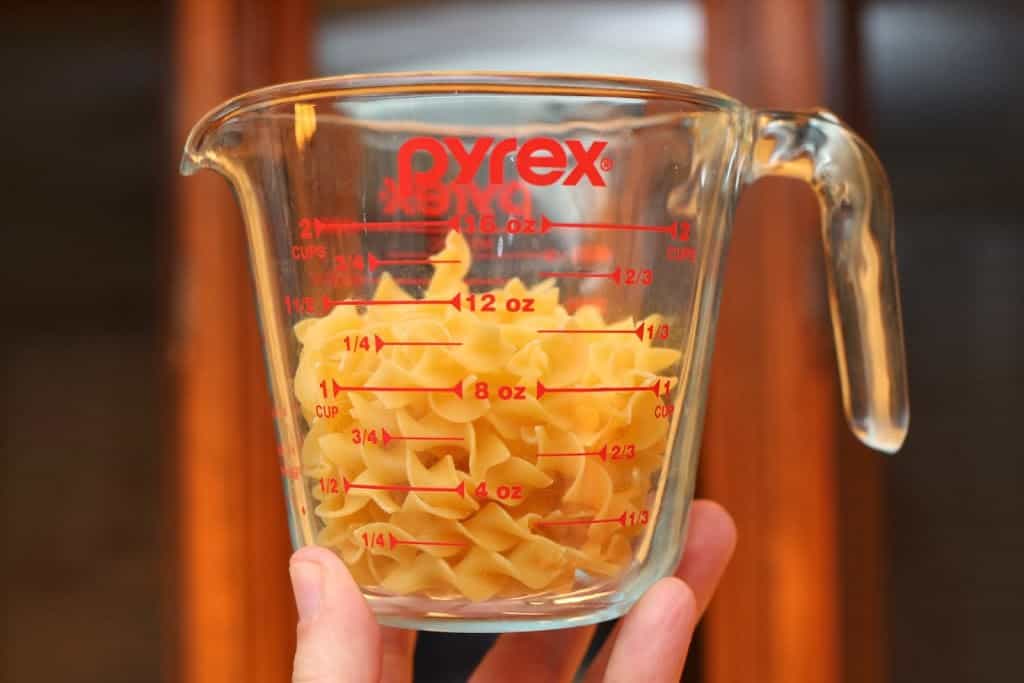
Watch out with the noodles. One cup of dried noodles will not look like enough, but please, don’t add more. More noodles will suck up all the broth, leaving you with a noodle stew instead of a soup.

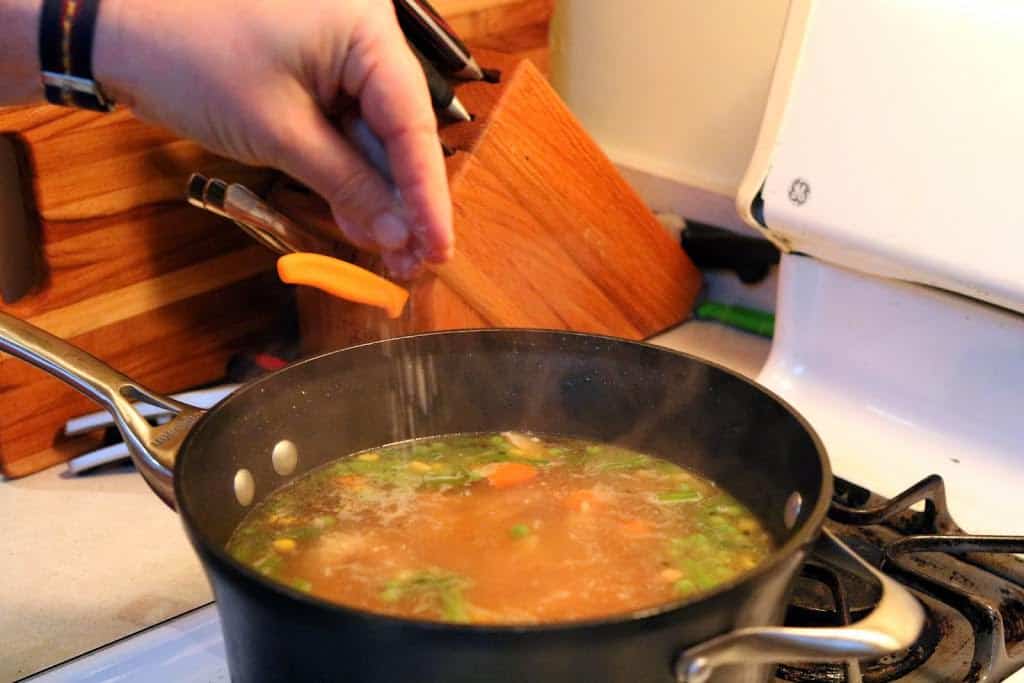
A soup is not ready to serve until it has been aggressively seasoned. (Think of Remy fixing the soup…adding a dash of this and a bit of that, tasting some more, snapping his fingers, wondering if it needs something else.) A splash of vinegar adds some acid. Then use a heavy hand seasoning the soup with salt and pepper. Keep adding salt until the soup tastes sweet and suddenly has a lot of body - salt brings out the flavors of the broth, and the soup tastes bland without it.

Want the best beef and noodle soup ever*? Here it is.
*After all the mushrooms are picked out, according to one of the finicky reviewers.

Recipe: Pressure Cooker Beef Noodle Soup with Mushrooms and Carrots

Equipment

  • 6 quart or larger pressure cooker (I used a Instant Pot electric pressure cooker)

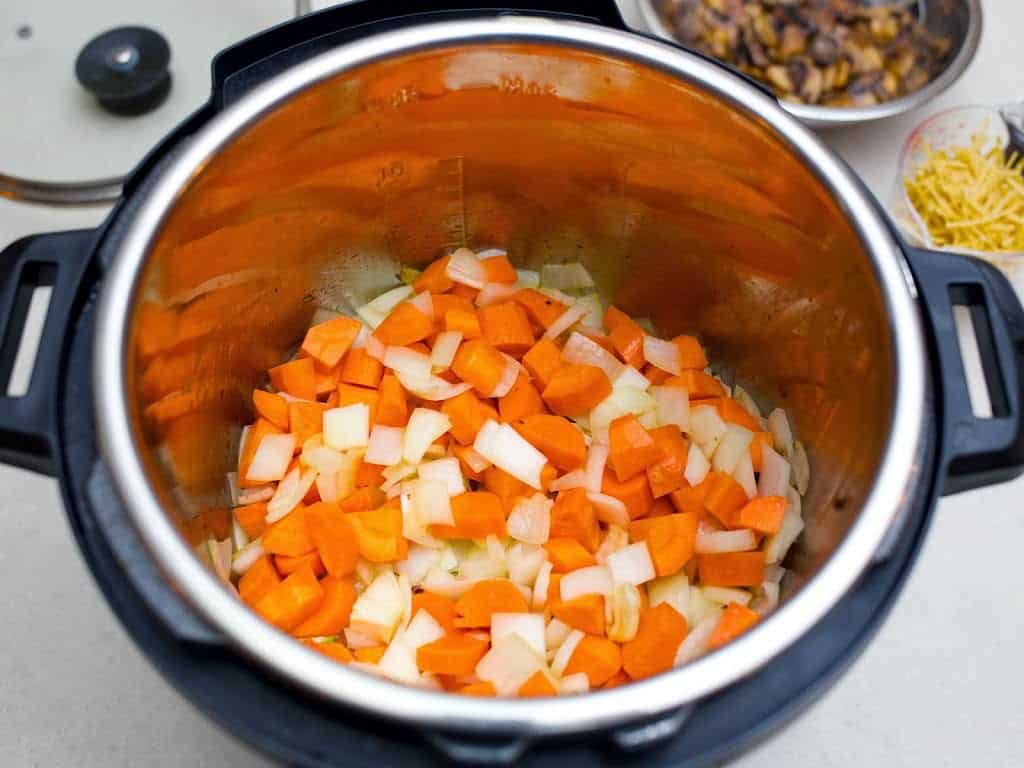
Saute the mushrooms

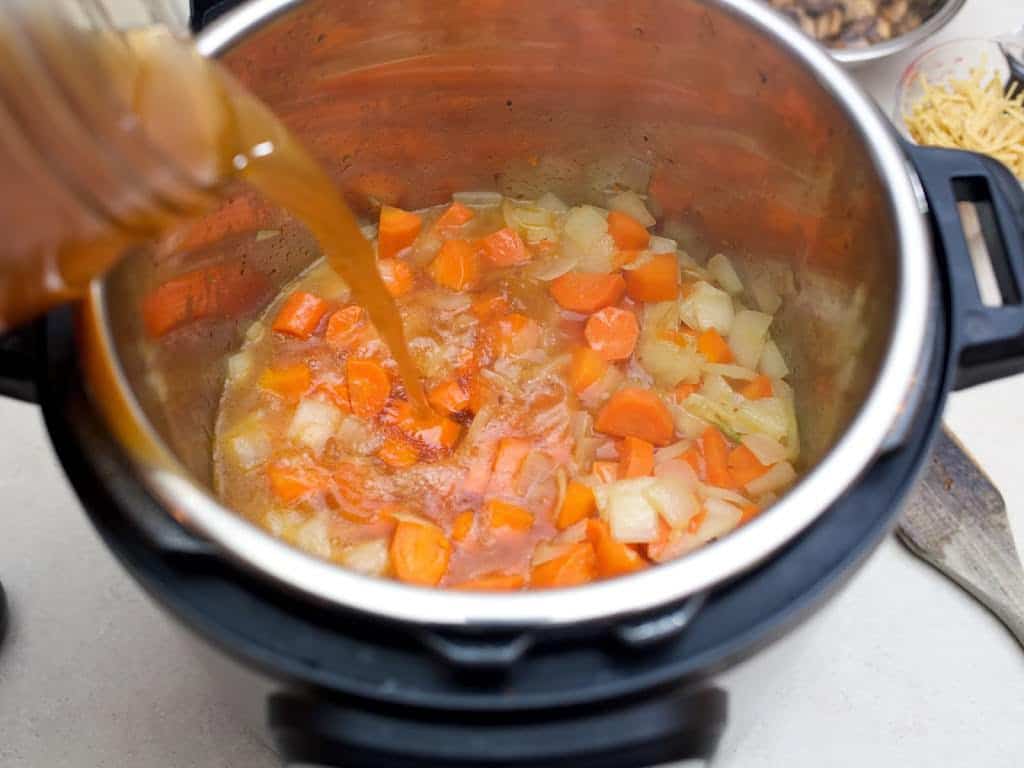
Saute the aromatics

Add the beef broth

Simmer the noodles, season to taste

Notes

  • No pressure cooker? No worries. You only need it for making the beef stock. (See the Pressure Cooker Beef Stock recipe for stove top instructions.) Nothing else on this page is pressure cooked - it's all stove top cooking.
  • Following a tip from Jacques Pepin, I always buy mushrooms discounted for closeout. A little slimy around the edges? No worries, by the time you're done sauteing them, they'll be indistinguishable from perfect mushrooms.
  • Don't have beef stock? Substitute chicken stock. It won't be as beefy…but it will still be a great soup.
  • I cooked this recipe in my electric pressure cooker, using it as a regular pot. That way, I didn't dirty another pot after I made the broth.

What do you think?

Questions? Other ideas? Leave them in the comments section below.

Related Posts

Pressure Cooker Pho Bo - Vietnamese Beef Soup
Pressure Cooker Turkey Noodle Soup with Vegetables
Pressure Cooker Pasta and Bean Soup
Instant Pot Vegetable Beef Soup

Enjoyed this post? Want to help out DadCooksDinner? Subscribe using the RSS or Email options on the right, recommend DadCooksDinner to your friends, buy something from Amazon.com through the links on this site, or donate through my tip jar. Thank you.
Dads That Cook Kickstarter campaign

February 26, 2014 by Mike Vrobel Leave a Comment

I just had a fun talk with Jason Glover, creator of a new TV food show, Dads That Cook. I'll be sharing that interview with everyone soon, but right now, Jason's show needs your help.

Jason is traveling the country, talking to regular dads who cook for their families, learning new recipes, and filming their stories for his show. Dads That Cook will air on PBS, starting on...Father’s day, of course.

Obviously, this show is right in my sweet spot - dads that cook? These are my people. I can’t wait to see it.

So, what's the problem? Dads That Cook is in need of funding. PBS doesn’t pay to produce the show.
It wouldn’t be a PBS show without a pledge drive, now would it?

Jason and his team need to complete the first season of the show to increase their chances of corporate sponsorship. To raise the money to finish season one, Jason is Kickstarting the first season of Dads That Cook.

Want to help out Dads That Cook? Visit the link below and pledge. There are only nine days left in the Kickstarter drive, so please act quickly. Thank you!

Dads That Cook Kickstarter

To whet your appetite, here’s the trailer for season one:

Dads That Cook Kickstarter Video

Thanks again, and good luck, Jason!

Pressure Cooker Browned Beef Stock

February 25, 2014 by Mike Vrobel 8 Comments

Pressure Cooker Browned Beef Stock

Pressure Cooker Browned Beef Stock

I got a complaint about my Pressure Cooker Beef Stock: it is too expensive!

I think this is because oxtail and beef shanks can be cheap throwaway cuts or expensive gourmet ingredients, depending on your grocery store. Sometimes, even at the same store, the prices vary. (Thanks to a manager's special, beef shank cost less than beef soup bones when I was shopping for this recipe.) So…use whatever is cheapest at your store. As long as it is about half bones and half meat, you’ll get good results.
If you’re really trying to save money, don’t make beef stock. Make chicken stock instead. Chicken necks and backs are dirt cheap, less than a dollar a pound at my local stores, and they make a great stock. Even better - a leftover carcass from a roast chicken is essentially free, after you pick all the meat off of it.

Now, to make up for the cheap bones, we’re going to add a lot of umami to the stock by browning the beef with tomato paste. This is a classic French technique to build flavor; browned beef stock is one of the hallmarks of french cooking.
Though, beef stock is not as versatile as veal stock. Veal stock is neutral tasting, liquid umami…but that’s a recipe for another day.

Also, to be more frugal this time around, we’re going to save the meat from the beef stock. The meat on the beef shanks is mostly spent…but I shred it and save it for use in soup.

How to use Browned Beef Broth

Use it in Instant Pot Vegetable Beef Soup recipe, Beef and Noodle Soup with Mushrooms and Carrots, Instant Pot Chinese Beef Soup with Short Ribs, or Instant Pot Beef and Barley Soup.

Recipe: Pressure Cooker Browned Beef Stock

Adapted from: Beef Stock Technique, ChefSteps.com

Equipment

  • 6 quart or larger pressure cooker (I used a Instant Pot electric pressure cooker)

Beef and aromatics ready to roast

Browned and ready to pressure cook

Deglaze the pan - we want all that flavor in the stock

Everything in the pot

After pressure cooking

Notes

  • No pressure cooker? No worries. When you get to step 4, instead of pressure cooking the stock, slide the pot into an oven set to 180°F (or as low as you can get it) and simmer the stock in the oven for twelve hours. (Or simmer it on the stove top - but the oven holds low heat better.)
  • Stock is best made the night before, cooled, and refrigerated. The fat in the stock will float to the surface and harden into a solid disk, which is easy to remove with a slotted spoon.

What do you think?

Questions? Other ideas? Leave them in the comments section below.

Related Posts

Pressure Cooker Beef Stock - Less browned, more of an Asian flavor
Pressure Cooker Chicken Stock
Pressure Cooker Turkey Stock Revisited

Enjoyed this post? Want to help out DadCooksDinner? Subscribe to DadCooksDinner using the RSS or Email options on the right, recommend DadCooksDinner to your friends, buy something from Amazon.com through the links on this site, or donate through my tip jar. Thank you.
Grilled Pork Ribeye Chops with Chipotle, Agave, and Tequila Glaze

February 20, 2014 by Mike Vrobel Leave a Comment

Chipotle and agave glaze? Why didn’t I think of that?

This recipe is based on a meal I had at Orale Contemporary Mexican Kitchen in Cleveland. They serve the pork chops “long bone” style, with a frenched rib bone still attached to the chop. It is an impressive presentation, and worth the trip to the near west side to try out.

Don’t try this at home? Quite the opposite; I had to try this at home. Here is my version, which adds tequila to the chipotle-agave glaze. Why tequila? Well, because I’m serving this with Mexican Martinis, and the hint of tequila in the glaze will tie the meal together.
Kind of like the Dude’s rug. It really tied the room together. Wait - I should be serving white russians….ahem. Sorry. Off on a tangent there.

Recipe: Grilled Pork Ribeye Chops with Chipotle, Agave, and Tequila Glaze

Inspired by: Chipotle-agave glazed long bone pork chops, Orale Contemporary Mexican Kitchen

Prep Time: 60 minutes
Cook time: 16 minutes

Equpiment

  • Grill (I use a Weber Summit, which I love)

Ingredients

  • 1 quart water
  • ½ cup kosher salt
  • ¼ cup brown sugar
  • 4 thick-cut (1 ½ inch thick) pork ribeye chops or pork porterhouse chops

Chipotle-Agave-Tequila glaze

  • ¼ cup dark agave syrup (or substitute honey)
  • 2 tablespoons tequila
  • 1 teaspoon chipotle en adobo puree (or 1 chipotle en adobo, with adobo sauce, minced fine)

Directions

1. Brine the pork chops

Stir the water, salt, and brown sugar in a deep bowl until the salt and sugar dissolve. Add the pork chops to the water, put the bowl in the refrigerator, and refrigerate for at least an hour. (Four hours is better, eight hours max.)

2. Make the glaze

Put the glaze ingredients in a small saucepan over high heat, and bring to a simmer. Reduce the heat to low and simmer until the glaze thickens enough to coat the back of a spoon, about 10 minutes.

3. Set the grill up for two zone cooking

Set the grill up with a zone for direct high heat, and another zone for indirect heat. For my Weber Summit, I preheat the grill with all burners on high for fifteen minutes. Then I turn all but two of the burners off - leaving burners 1 and 2 on (direct high heat zone) and turning burners 3 through 6 off (indirect heat zone). Then I clean the grates with my grill brush.

4. Grill the chops

Overview: Sear the chops over direct high heat for 8 minutes. Brush with glaze, then finish the chops over indirect heat. Cook until the chops reach 135°F internal temperature, about 8 minutes, brushing with glaze halfway through, and again when the chops are done cooking.

Details: Remove the chops from the brine and pat them dry with paper towels. Put the chops on the grill over direct heat and cook with the lid closed as much as possible. Grill the chops until they have brown grill marks on the bottom and release easily from the grate, about 2 minutes, then flip and grill until the other side has good grill marks, about 2 minutes. Flip the chops again and rotate the chops 90 degrees to get crosshatched grill marks, and cook until browned, about 2 more minutes. Flip the chops one more time and grill until there is a good crosshatch of grill marks on the last side, about 2 more minutes. At this point the chops should have a nice, brown crust on them, but they will not be cooked through in the middle. Move them to the indirect heat side of the grill, over the unlit burners, and brush with the agave-chipotle-tequila glaze. Cook, brushing with glaze and flipping the chops after four minutes, otherwise keeping the lid closed as much as possible. The chops are done when the reach an internal temperature of 140°F - about eight minutes of cooking over indirect heat.

5. Serve

Remove the chops to a platter, and pour any remaining glaze over the chops. Rest the pork for ten minutes, then serve.

Notes

  • 1 teaspoon of chipotle puree adds just a hint of heat. You can skip it if you want…but my heat-sensitive child didn't notice it. On the other end, if you want to bump up the heat, go with a tablespoon of chipotle puree.

What do you think?

Questions? Other ideas? Leave them in the comments section below.

Related Posts

Grilled Pork Chops with Ancho Chile Rub
Grilled Thick Pork Chops with Adobo Paste
Grilled Pork Chops with Knob Creek Lemon Glaze

Enjoyed this post? Want to help out DadCooksDinner? Subscribe to DadCooksDinner using the RSS or Email options on the right, recommend DadCooksDinner to your friends, buy something from Amazon.com through the links on this site, or donate through my tip jar. Thank you.
Pressure Cooker Sopa De Ajo (Mexican Garlic Soup)

February 13, 2014 by Mike Vrobel 1 Comment

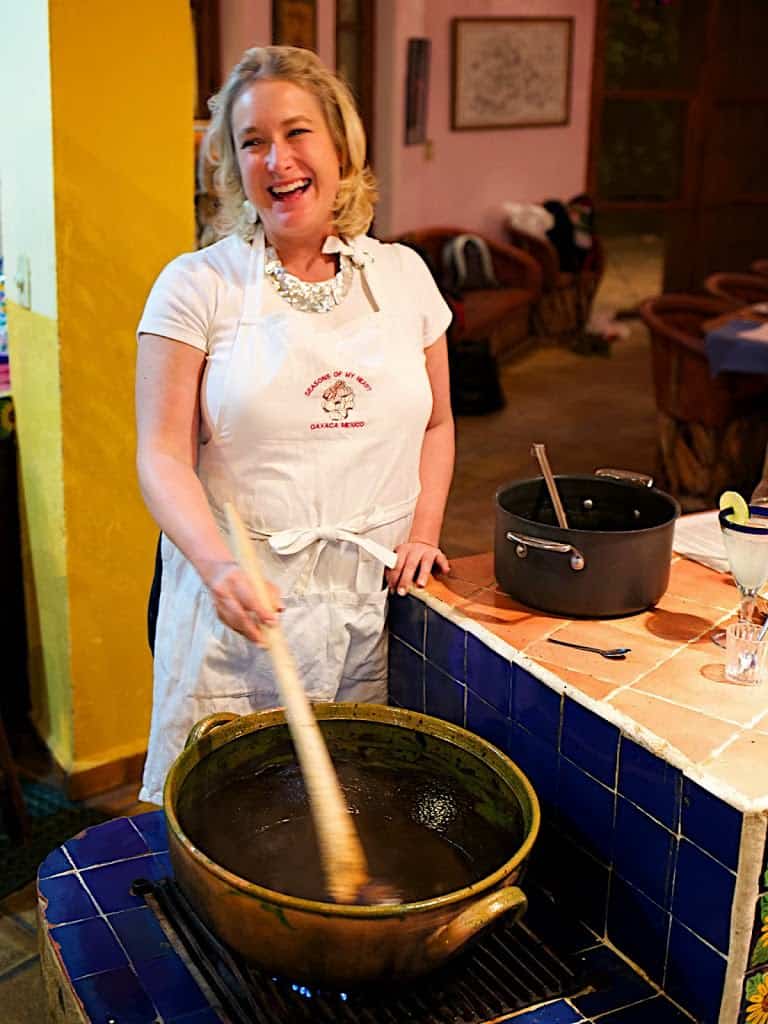
It’s Mexico week on DadCooksDinner. I spent five fantastic days at Seasons of My Heart cooking school in Oaxaca, Mexico. I’ll be sharing what I learned for months, but here’s the first batch of posts.

I came back from my week at Seasons Of My Heart cooking school, stepped out of the Cleveland airport, and winter welcomed me home with a cold slap to the face.

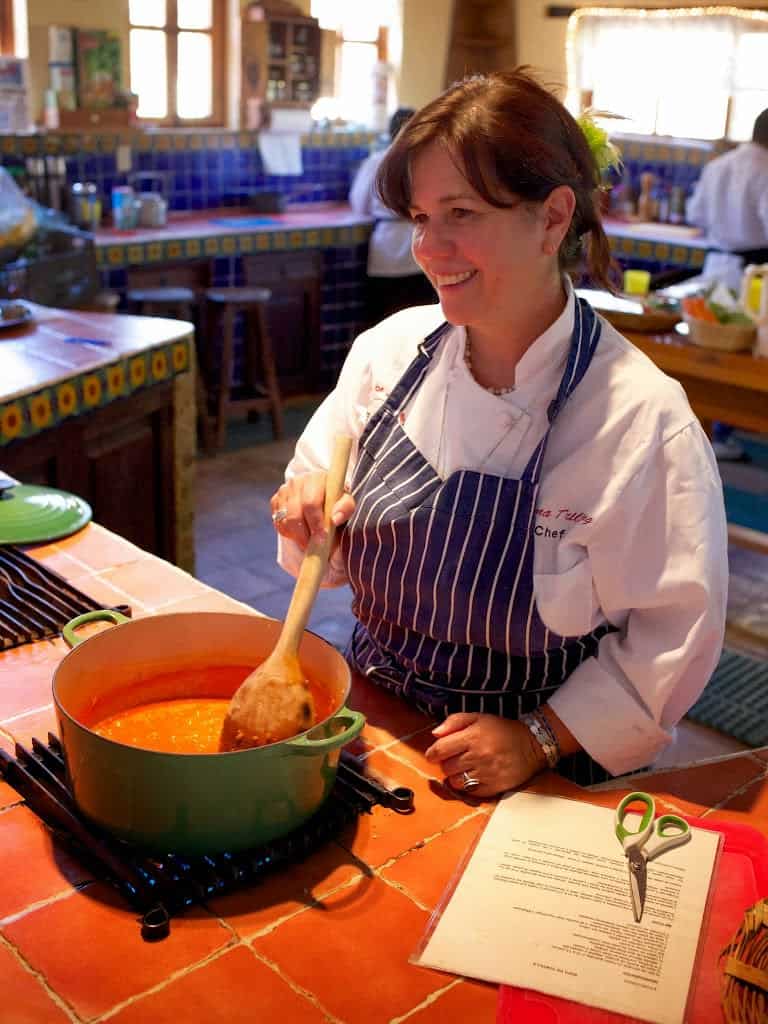
I needed Susana Trilling’s garlic soup.

Sopa de ajo was a revelation. There isn’t much to it - chicken broth, a few spices, garlic, croutons, cheese cubes. But, oh, the flavors in that simple combination of garlic and broth. A whole chile de arbol, simmered with the soup and then discarded, adds a hint of warmth. Not enough to make me notice that the soup is spicy, but a nice touch in the background.
Susana’s full version included sauteed squash blossoms - good luck finding them in the middle of a Northeastern Ohio winter - but I didn’t need them. The broth is exceptional without them.

Technique matters, because this recipe is so simple. Now is not the time to buy a carton of chicken broth from the store - it needs homemade broth. The garlic needs patience. The trick is slowly sweating the garlic, without browning, for ten to twenty minutes. The garlic will turn translucent and soft, with a hint of yellow-brown around the edges - but if it start to brown, the heat is too high. Get the pot off of the heat to slow down the cooking, then turn the heat down, and start sweating again.

Your patience will be rewarded. Besides, we’re using the pressure cooker to speed things up - we can wait a few minutes for the garlic.

Chicken soup for the soul? My new motto is garlic soup for the soul.

No pressure cooker? No worries. See the Notes section for instructions using a traditional pot.

Recipe: Pressure Cooker Sopa De Ajo (Mexican Garlic Soup)

Adapted from: Susana Trilling, Sopa De Ajo con Calabaza, Seasons of My Heart: A Culinary Journey through Oaxaca, Mexico

Prep Time: 10 minutes
Cook time: 60 minutes

Equipment

  • 6 quart or larger pressure cooker (I used a 6 quart electric Instant Pot pressure cooker )

Ingredients

Mexican Chicken Stock

  • 1 medium onion, peeled and quartered
  • 2 carrots, peeled and cut into 2 inch chunks
  • 1 rib celery, cut into 2 inch chunks
  • 4 garlic cloves, peeled
  • 1 (4 pound) chicken, cut into pieces (legs, wings, and breast)
    • OR 3 pounds of chicken legs
    • OR 3 pounds chicken backs, necks, or carcasses
  • 1 bay leaf
  • 1 whole dried chile de arbol - optional
  • 1 sprig fresh thyme (or ½ teaspoon dried)
  • 4 black peppercorns
  • 1 whole allspice
  • 8 cups water

Soup

  • 1 tablespoon butter
  • 1 tablespoon vegetable oil
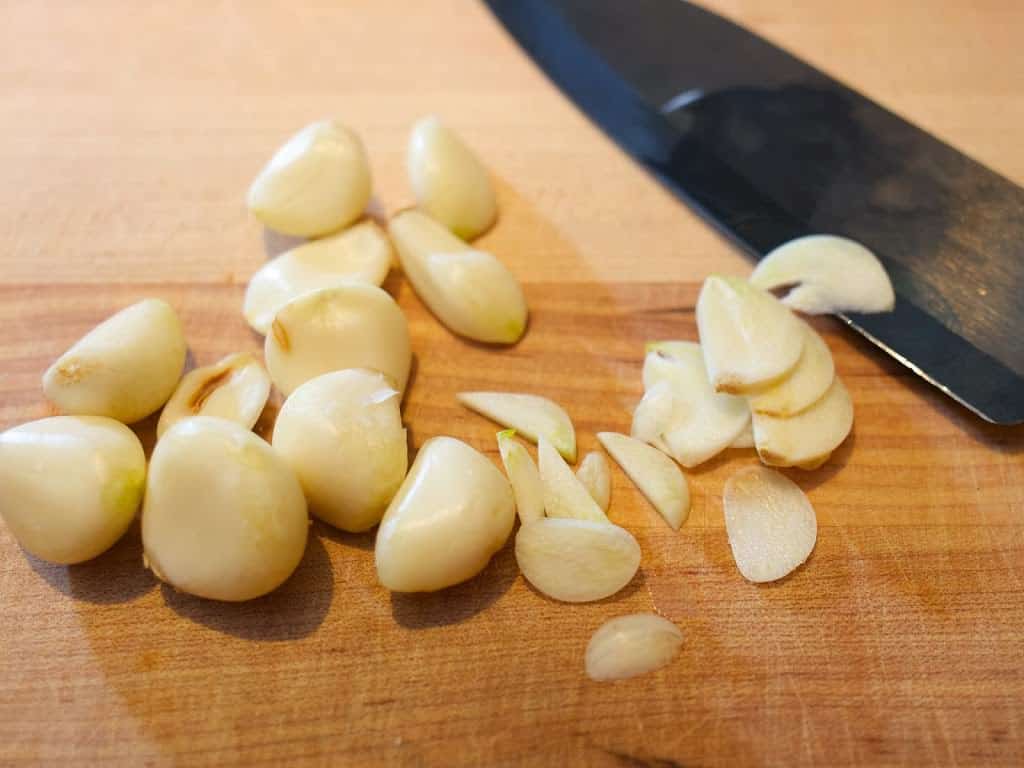
  • 1 head garlic, cloves peeled and sliced thin
    • OR 15 pre-peeled cloves of garlic
  • 1 whole dried chile de arbol (optional)
  • 1 bay leaf
  • 8 cups of chicken stock (from above recipe)
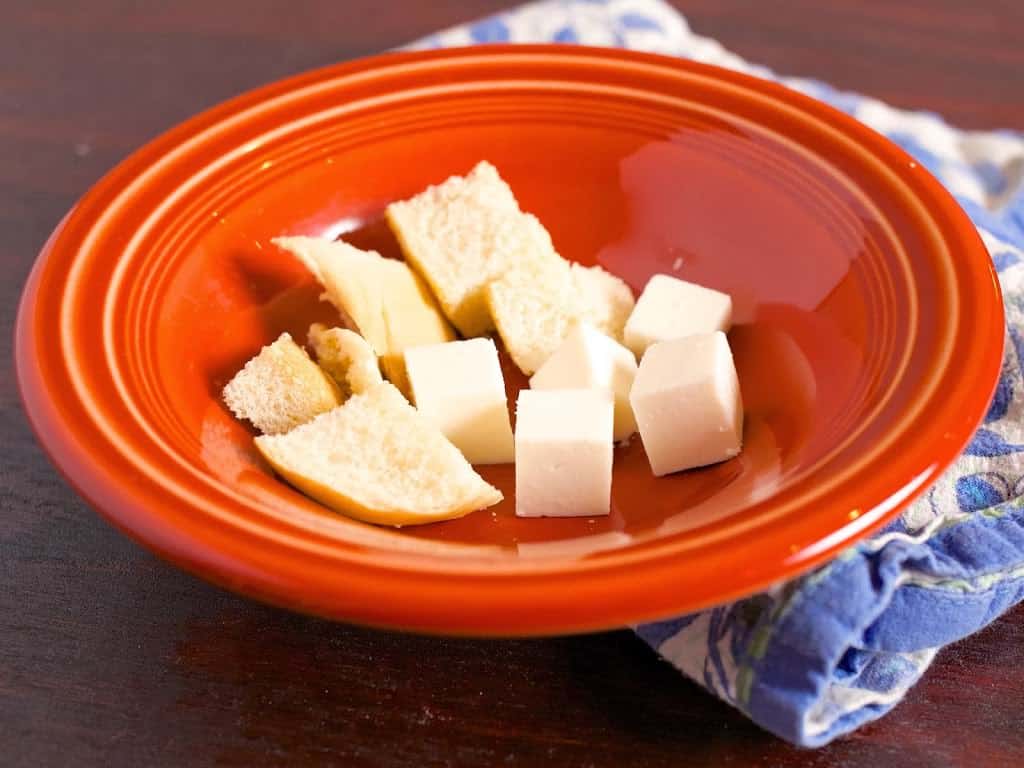
  • 2 cups of 1 inch bread cubes from light but crusty white bread (Italian bread or Mexican bread are best, a french baguette is an acceptable stand in)
  • salt to taste (I used 2 teaspoons of kosher salt)
  • 4 ounces queso fresco (or farmers cheese), cut into ½ inch cubes
  • ½ cup minced fresh parsley
  • 1 cup watercress or arugula (optional)

Directions

1. Make the stock

Add the vegetables, chicken, and spices to the pressure cooker pot, then cover with 8 cups of water. Lock the lid on the pressure cooker, bring it up to high pressure, then cook on high pressure for 20 minutes (24 minutes in an electric PC). Turn off the heat and let the pressure come down naturally, about 20 minutes. Unlock the lid and open it away from you - carefully, the steam is scalding. Remove the chicken and reserve it for another use (I discard the skin and bones and shred the meat for tacos.) Strain the broth through a fine mesh strainer and discard the solids. This will yield about 10 cups of chicken stock; use all of it in the recipe, or use 8 cups and freeze the extra 2 cups for later use.
This step can be done up to two months ahead of time - freeze the stock, and thaw it out when you’re ready to make soup.

2. Sweat the garlic

Wipe out the pressure cooker pot, put it back over low heat, and add the butter, vegetable oil, and garlic. Don’t fry the garlic - let it slowly simmer in the oil and melted butter. Cook, stirring often, until the garlic is translucent and just turning golden brown, about 15 minutes.

3. Toast the bread

While the garlic sweats, spread the bread cubes on a baking sheet and bake in a 350°F oven for 10 minutes, until the bread is dried out and slightly toasted.

4. Simmer the broth

Stir the chicken stock into the pot, scraping the garlic off the bottom and into the then stock. Add the chile de arbol and bay leaf. Lock the lid, bring the pressure cooker to high pressure, and pressure cook for 5 minutes at high pressure (6 minutes electric PC). Quick release the pressure. Open the lid away from you - again, be careful, the steam is scalding. Discard the chile de arbol and bay leaf. Salt the soup to taste.
It will need salt. There isn’t any in the recipe up to this point. Add salt until the soup tastes bright and sweet, and gains body - you should just start to feel the salt on the tip of your tongue. I added 2 teaspoons of kosher salt to get the flavor I wanted.

5. Build the soup bowls

In the bottom of each bowl, put a few cubes of bread and a few cubes of cheese, and a three finger pinch of watercress. Ladle the broth into the bowl, sprinkle parsley on top as a garnish, and serve.

Ready for broth

Notes

  • No pressure cooker? No worries: Cook everything in a large, heavy pot or dutch oven. In step 1, simmer everything on the stove for 1 hour (instead of under pressure for 20 minutes with a natural pressure release). In step 4, simmer the garlic and broth broth for 30 minutes (instead of under pressure for 5 minutes with a quick release).
  • How do you peel an entire head of garlic? Instead of peeling each clove individually, do the whole head at once. Separate the head of garlic into cloves, then put the cloves in a medium pot with a tight fitting lid. Grab the pot and the lid with both hands so you can hold the lid on the pot, and shake like mad for 30 seconds, slamming the garlic around. When you're done, most of the cloves will be peeled, and the rest will have their skin loosened so they can be easily peeled. (If that description doesn't make sense, watch this video from Saveur: How to Peel a Head of Garlic in Ten Seconds. They recommend using two bowls, but I can get a better grip on a pot with a helper handle and tight lid.)
  • How do you peel an entire head of garlic, the throw money at the problem way: buy a jar of pre-peeled garlic. My local grocery store carries this nowadays, but I have to watch the age of the garlic - pre-peeled garlic ages quickly. Watch out for wet garlic, or bright white spots on the garlic. (And, of course, check the "sell by" date.)
  • Susana added 16 fresh, cleaned squash blossoms and 2 minced hoja santa leaves, sauteed for a few minutes at the tail end of sweating the garlic. I had to skip them - squash blossoms are impossible to find in the middle of the winter in Ohio. Yet another reason I wish I was back in Oaxaca.
  • Susana also recommended adding a poached egg for each bowl of soup. I took her advice the day after I made this recipe, when I had leftovers for lunch. I reheated the soup in the microwave, and added a sunny-side up egg to the bowl. I broke the yolk, stirred it into the soup, and completely forgot that it was 9°F outside.

What do you think?

Questions? Other ideas? Leave them in the comments section below.

Related Posts

Pressure Cooker Mexican Black Bean Soup and Noodles (Frijoles y Fideos)
Pressure Cooker Pho Bo - Vietnamese Beef Noodle Soup
Pressure Cooker Tortellini en Brodo

Enjoyed this post? Want to help out DadCooksDinner? Subscribe to DadCooksDinner using the RSS or Email options on the right, recommend DadCooksDinner to your friends, buy something from Amazon.com through the links on this site, or donate through my tip jar. Thank you.
Road Trip - Seasons of My Heart Cooking School in Oaxaca, Mexico

February 11, 2014 by Mike Vrobel 7 Comments

Susana Trilling’s cooking school, Seasons of My Heart, has been on my bucket list for a while. I learned about it years ago; probably from Rick Bayless, but maybe from Susana’s cookbook, which I picked up at the library. Oaxaca is acclaimed as the best food city in Mexico, famous for its seven different types of mole, the complex sauce based on chiles, nuts, seeds, and chocolate. And Susana is the expert on Oaxacan cooking.

I would occasionally check the Seasons of My Heart website, looking at the list of classes, dreaming about an escape to Mexico. (Especially this time of year - in February, highs in the 80’s sound fantastic, and that was before this brutal winter.) Late last year, I saw it - Susana was hosting a week long chef’s intensive tour of Oaxaca for culinary professionals. A whole week? In a cooking school in Mexico? I’m so there.

Seasons of my Heart has lots of shorter, less intense classes; half day classes, Wednesday market trips with cooking lessons, and week long tours that aren’t “chef’s intensive”. Check out the schedule on their website for more details.


What am I doing?

What makes a culinary professional? For this class, a membership in the International Association of Culinary Professionals. Hey, I make a little money food writing for the blog, so I’m a professional, right? I joined the IACP (which I’ve been meaning to do anyhow), and then immediately signed up for the class at Seasons Of My Heart.

I’m sitting in my hotel room in Oaxaca, one hour before the class is meeting for the first time, having a panic attack. I’m an impostor - who am I to call myself a culinary professional? I’m a blogger, an enthusiastic and adventurous home cook, a part time food writer and photographer…but a professional? My only professional food experience is working the drive through at McDonald’s as a teenager. Sure, I make a little money on the blog, but food writing is a side job for me. I can’t afford to quit the day job any time soon. The other students on the trip? They are real professionals, people who make their living through food. Would they see right through me?

Even worse, I find out that they all know each other - socially, professionally, or both. Susana catered the wedding of two of my fellow classmates, and a bunch of the rest of them attended. There are ten of us, and I’m the odd man out - the only one who doesn’t know everyone else on the trip.

More margaritas? I drank too much last night.

What about the mezcal tasting we went to this afternoon?

Oh, that was only a tasting. That doesn't count.

I’m panicking for no reason, of course. Cooking professionals? Yes. That means food lovers. My tribe. Usually, I’m the only food fanatic in the room; now we’re travelling in a pack. It’s like meeting a bunch of friends I didn’t know I had. Even better, they worked hard to make sure I felt like part of the group.
Which, given my introvert tendencies, can be tough. I clam up when I’m nervous. Thanks for making me feel like part of the team, everyone!

Barbacoa de borrego at the market


Oaxaca Tours

The class was divided into two main parts - touring Oaxaca, and hands on cooking at the school. Every day, after breakfast at the hotel, we head out for a tour.

The breakfasts at the hotel were great - huevos rancheros, chilaquiles, huevos divorcidados, huevos al gusto - but I had to skip breakfast the last couple of days, to pace myself for the eating to come.

Pepper vendor at the market


Watch out in the markets. If someone throws a baby at you, they're trying to distract you and pick your pocket.

(later, on the way home from the market)

Hey, no one threw baby at us...and I'm kind of disappointed.

Some days were market tours, wandering through the crowded stalls, picking out ingredients for later, tasting the foods as we went. Then we’d grab a bench near the market’s food stalls and sit down for plates of antojitos - tacos, empanadas, tlayudas, and other little bites of Mexican street food, served with shredded fresh vegetables, spicy salsas and thin guacamole salsa.

In the market, I tried a spiced grasshopper, fried and sprinkled with a spice blend. They said everyone who eats a grasshopper comes back to Oaxaca. I hope so…it was crunchy, like a potato chip, very spicy…and I had to work hard to not think about what I was actually eating.

Working on a rug

Other days we visited local artisan villages. We saw rug weavers, wood carvers, and painters. Even better, they took us into their homes and cooked us breakfast, showing us how traditional mexican breakfasts were made, like higaditos (egg and shredded chicken soup), tlayudas (a Oaxacan specialty, similar to quesadillas, toped with thin-sliced grilled beef), and tejate (cacao beans ground until they liquefy, then whipped by hand into a filling drink).

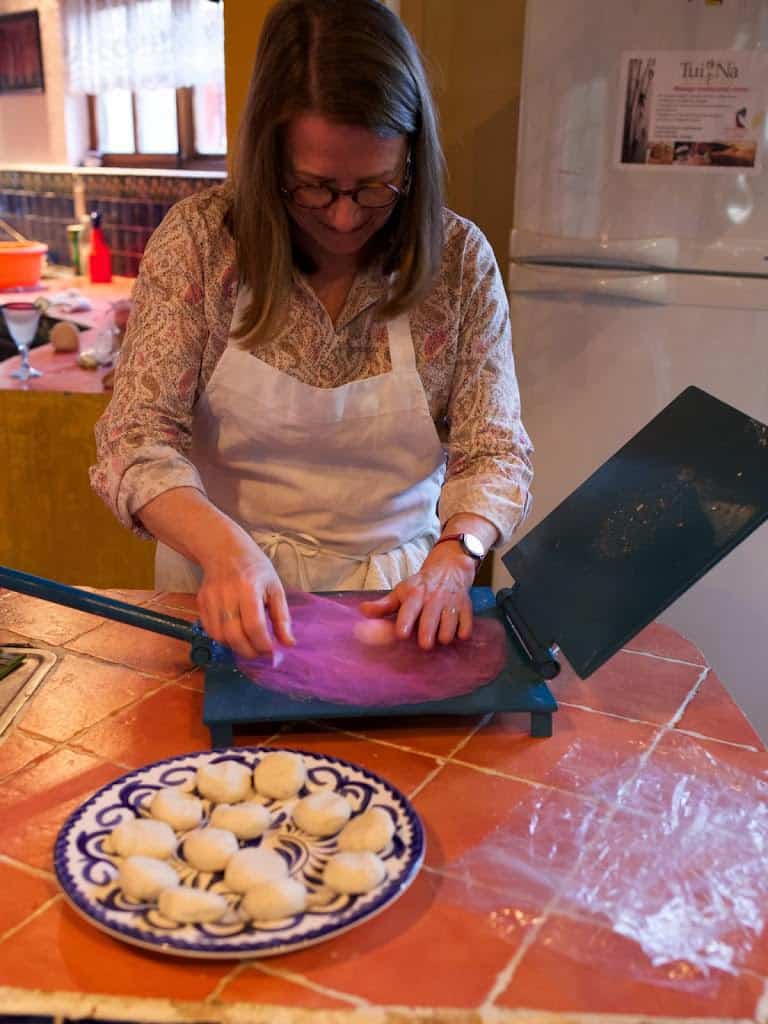
Sometimes they even let us help, like when we pressed and toasted the huge tortillas used to make tlayudas. And, of course, when we were done eating, we had a chance to buy some art. (I had to restrain myself, particularly at the wood carvers. The carvings were a riot of colors, and I now I want to re-do my house in that wild color scheme.)

My knees hurt just looking at this picture

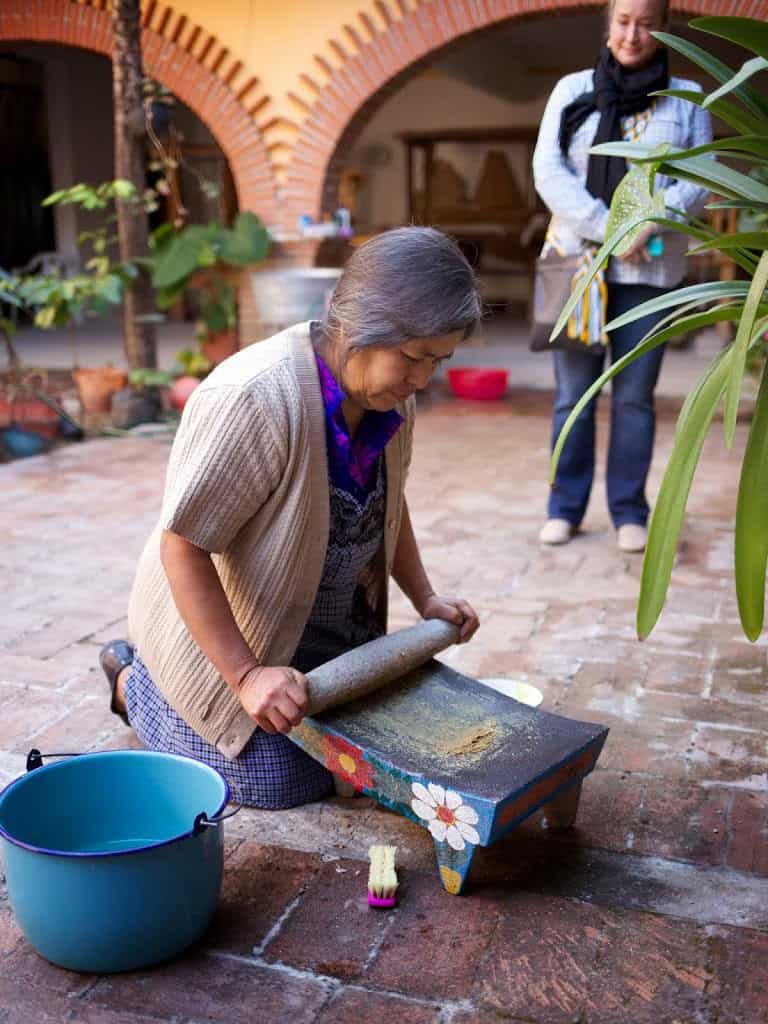
I was amazed at the effort it takes to make a typical Mexican breakfast. Some meals needed hours of grinding on a flat stone metate - something I can barely do for a minute before my arms cramp up. This is considered women’s work? Those the wives and mothers have forearms like steel cables.

Then there was the eating. We dined at high end Mexican restaurants, the food artfully arranged on the plate, the chef combining traditional Oaxacan flavors with modern culinary techniques. On the other end of the scale, we ate at humble food carts, eating minced cow head tacos, served with a cup of warming broth with a little more minced meat in there.

If you want to, you can ask for your favorite part of the cow’s head. I tried cheek, tongue, and…eyeball. It’s considered a delicacy, and I’m glad I tried it. Once.

We sampled mezcal, the traditional alcohol of Oaxaca. Mezcal is similar to tequila, distilled from the maguey, a relative of agave. This is not the rotgut that I tried to drink in college, the one with the worm at the bottom of the bottle. We visited a distillery and tasted the sweet heart of the maguey plant. They showed us how it is smoke roasted, crushed to extract its juices, fermented, and aged in barrels to make a drink full of smoky flavor and complexity. (And the worm? It loves the sap of the maguey plant, so some distilleries leave a single worm in each bottle.) Tequila? Boring. You can have it. I’m a mezcal fanatic now.

Well, OK, twist my arm, and I’ll force myself to have a margarita.


Cooking School

Don't worry, it will still taste good.

Don't say that. I know what that means. It means I messed up!

Now, I was there to eat…but after these morning tours, the idea of eating again, ever, was the last thing on my mind. I was stuffed and ready for a nap. We’d get in the van and head back to the school for our evening of cooking. Jesus would pass around a sip of mezcal and a piece of chocolate, and suddenly I’d perk up again. Susana would talk us through the evening’s recipes, we’d divide them amongst ourselves, and get to work.

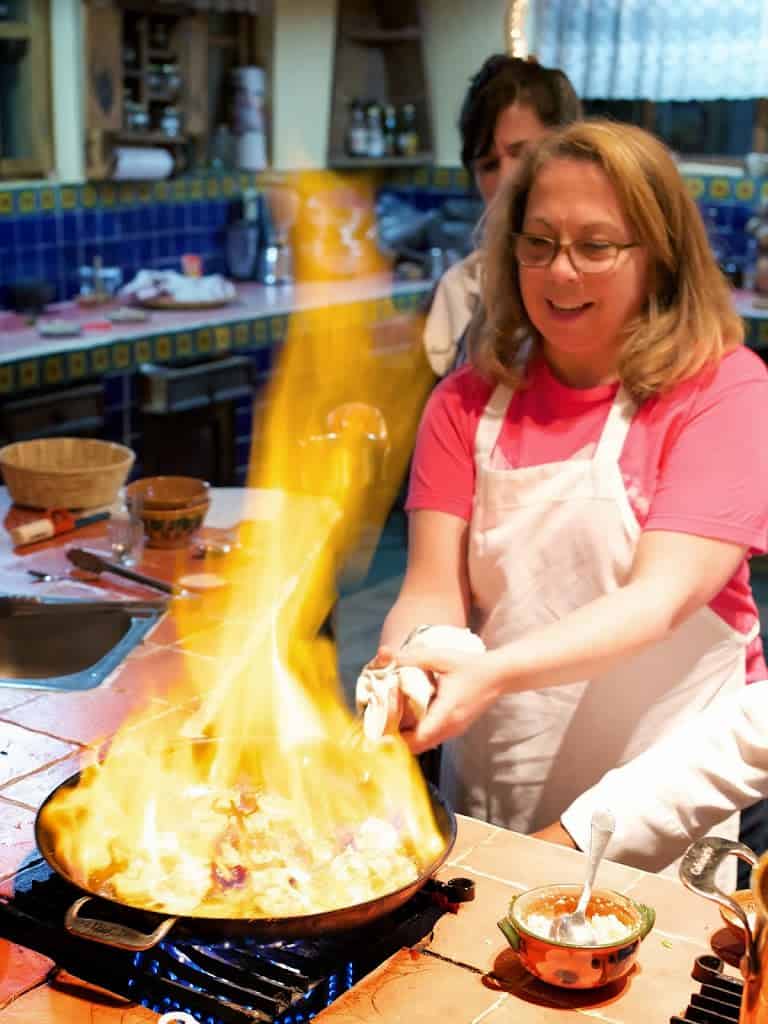
Shrimp flambé with mezcal.

There were about eight recipes every day, split among the ten of us. Most of the time, you had your own recipe. Some were complex enough to have a team of two, and if there was a recipe that took a lot of hands, we’d all gather at the big table in the center of the kitchen to help. (Some things, like folding tamales or rolling molotes, are best made in an assembly line.)

We had our choice of agua fresca, cerveza, or margaritas to quench our thirst while we worked on dinner. Susana and her assistants, Norma, Lorenza, and Jesus, would mingle, answer questions, keep an eye on us, and help out where we needed. (And they washed all the dishes!)

So, what did we cook? Just about everything. Here’s our menu for the first day, to give you an example:

  • Salbutes con Salsa de Chile Habaerno
  • Sopa de Ajo con Flor de Calabaza
  • Ensalada de Piña, Jicama y Aguacate
  • Tamales de Frijol
  • Ensalada de Nopales Asados
  • Tamales de Rajas
  • Tamales Oaxaqueños
  • Crepas Rellenas de Requesón y Cubierta de Peras Bañadas en Mezcal

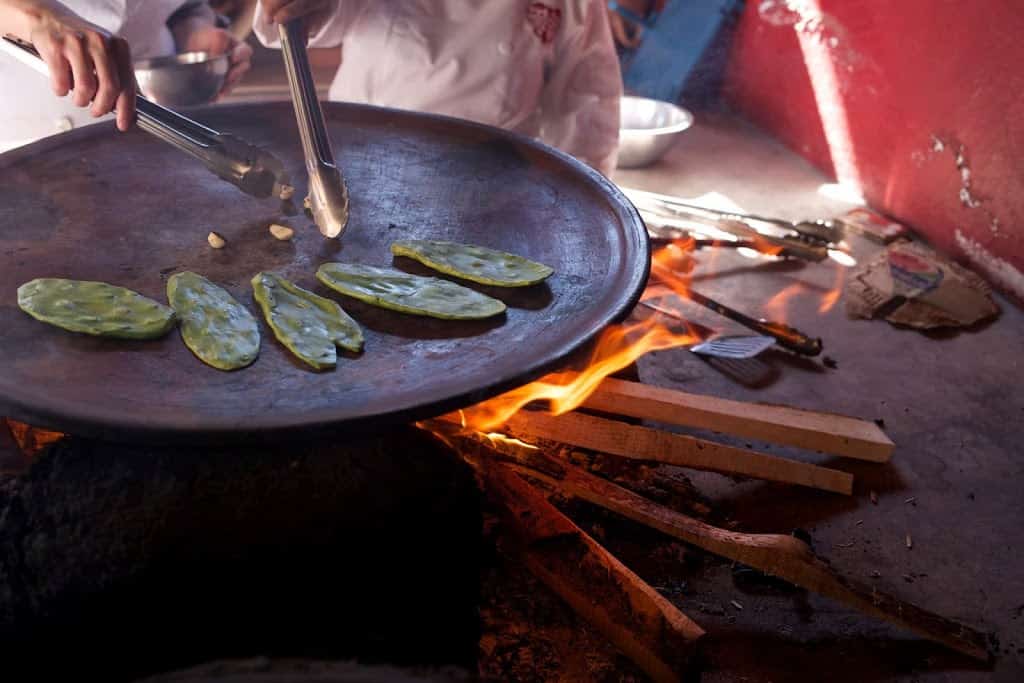
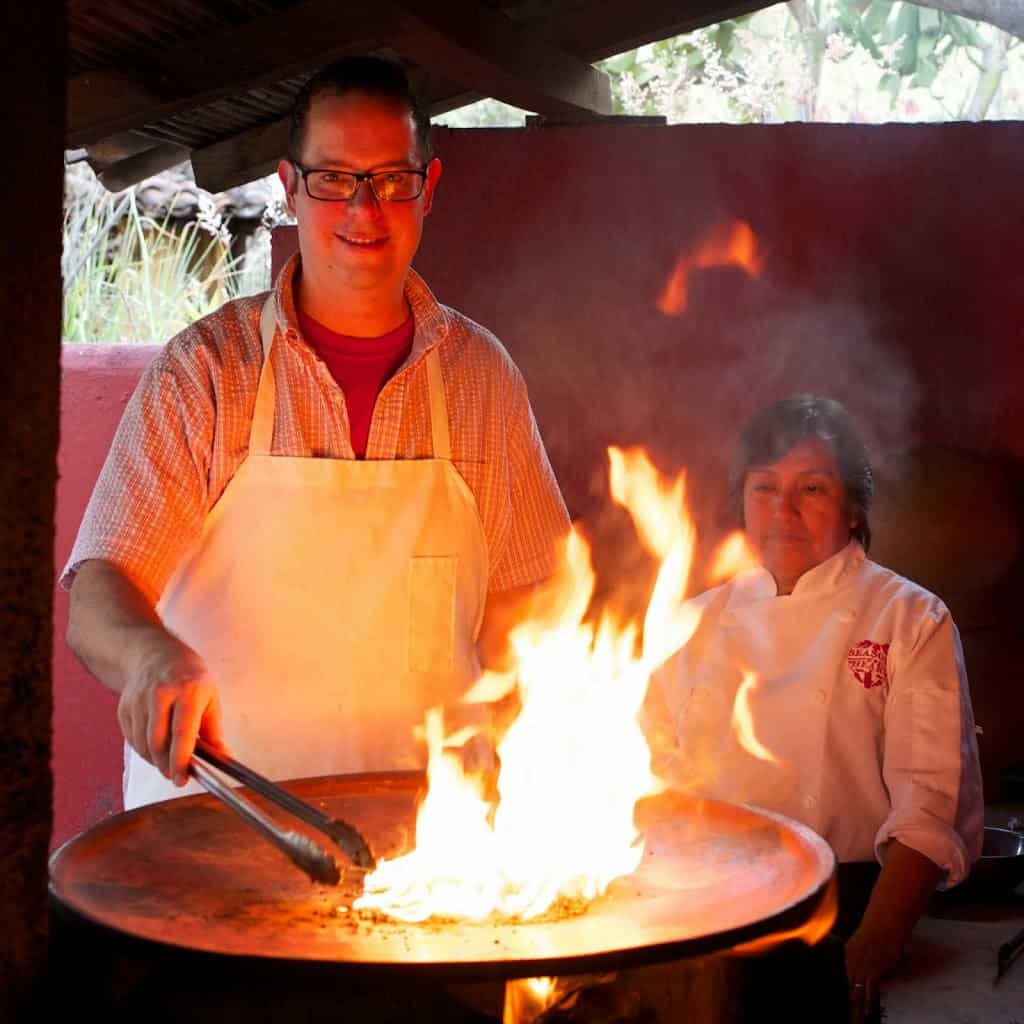
A lot of recipes centered around the comal, a large, flat clay disk heated over an open wood fire. The comal is a skillet on a large scale, used to toast and blacken foods, and the open fire gives them a hint of wood smoke flavor.

I want one in my back yard, but I don’t think I have the space. I’ll have to improvise, using my kettle grill with some wood chunks thrown in the coals.

Aprons off! Come, sit down.

After all the cooking, we would gather at the table to eat. (While Jesus, Norma and Lorenza would plate our dishes and serve us. Thank you!) It was another wave of food, and a grand tour of Mexican cooking.

Tamales, three ways

We had a day centered around pre-Hispanic tamales (that’s the one from the menu above), a day centered around chiles, a day of antojitos, and, the grand finale…mole day.

Pronounced moe-lay, and rhymes with olay. Does not rhyme with hole. Not pronounced like the small, furry rodent. No matter how many times my kids cracked up about small rodent sauce.

Blackening the chiles...and I do mean blackening.

In Oaxaca, you're judged by how black your mole negro is. If it's a little red, they know you don't care enough to put in the work.

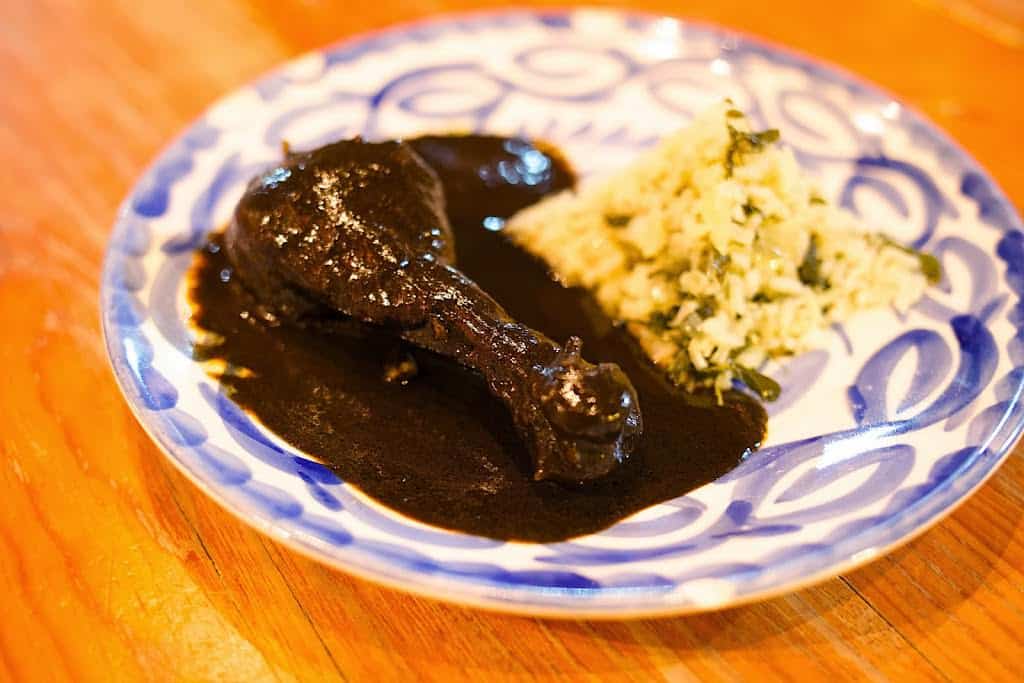
That was the one I was waiting for. Three of us got to work on Mole Negro, the famous black mole of Oaxaca. And…I was sure we were ruining it. Normally, recipes warn you not to burn chiles when you’re toasting them. Lorenza kept telling us to put them back on the comal, that they weren’t black enough yet. Then we put the seeds from the chiles on the comal, with instructions to cook them until the caught fire…and the fire burned out. Also: tear gassing everyone downwind of us. By the time we were done with this step, I expected mole negro to taste like the ashes on the bottom of my grill.

Thought bubble: "We are so doomed."

But, after toasting, sauteing, and blending up the rest of the ingredients with the blackened chiles to make a thick chile paste...it started to smell pretty good. Then it was time to simmer. The thick chile paste was thinned out with chicken stock, sweetened with chocolate, and reduced for hours. We all took turns stirring, scraping the bottom to make sure it didn’t burn. (Which, after how the recipe started, seemed ironic.)

The thick, glistening black sauce that resulted from all that work was poured over roasted chicken, which we ate using tortillas as spoons. Oh, my. Now I know why mole negro is the ultimate in Oaxacan cuisine.


Thank you

Travelling is homework for life.

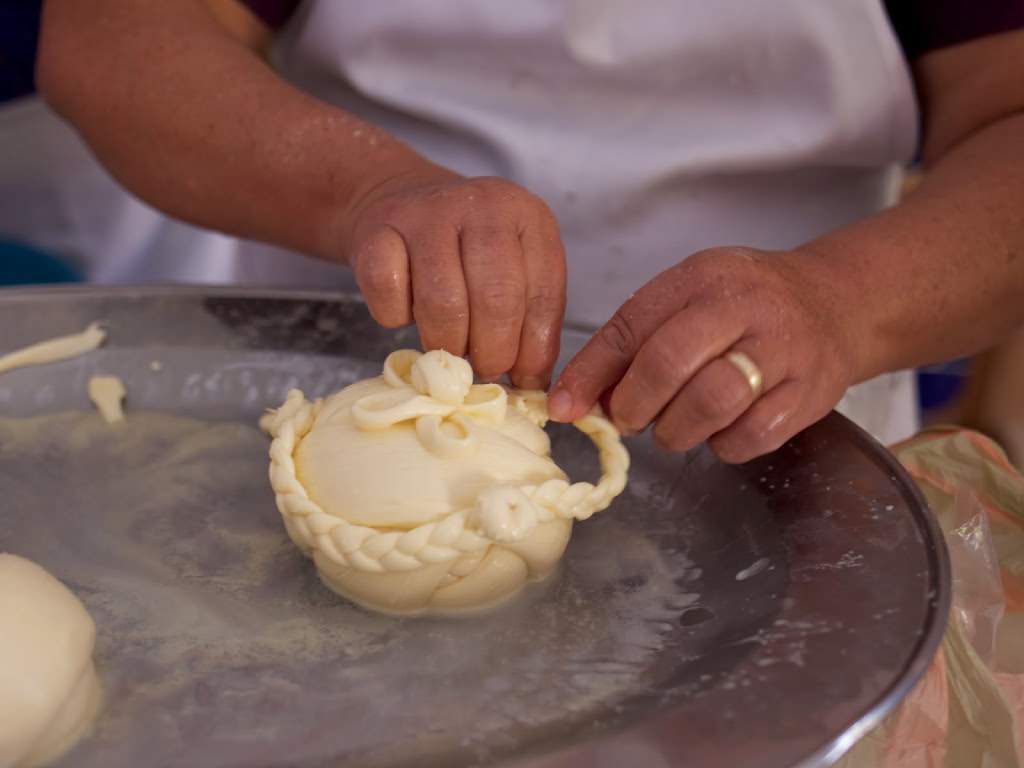
I struggled with this post; I feel like it will take years to absorb everything I learned on this trip. There are so many things I forgot to mention, like our tour of the ruins of Monte Alban, the cheese making demo, and making our own Mexican chocolate. (Wait…I forgot chocolate? That’s criminal.)

Cheese making demonstration

I need to end with thanks to everyone on the trip:

David, our driver, picking us up every morning and keeping a careful watch on us for the rest of the day, as we wandered in all directions like a herd of cats.

Jesus, Norma, and Lorenza, the cooking school assistants, helping us out in the kitchen and putting up with our (OK, my) fumbling kitchen Spanglish, all with smiles and great humor. (And did I mention they do dishes?)

Lorenza, Jesus, Lars, Scott, Norma, David, and Susana

Nicole, Susana’s intern, who organized us via email before the trip, and shared her sunny personality during her last week in Oaxaca with us. (She made a special stop for me, visiting the English language bookstore that had a few remaining copies of Susana’s out of print cookbook. Thank you, Nicole!)

My fellow classmates: Cathy, Cynthia, Cynthia, Hanna, Kirsten, Ray, Lars, Scott and Shelly. Amongst them were cooking teachers, cooking school managers, professional chefs, restaurant reviewers, caterers, cookbook authors, magazine editors, cookbook publishers, professional eaters, professional musicians, and four former IACP presidents. (And Norwegians, Tejanos, Baltimorians, and rabid Seahawks fans, to go with this Ohioan. Obviously, everyone wore multiple hats, and I’m sure I left out a bunch of things they’ve done. These people were an inspiration.)

Thank you for quickly nicknaming me “Grilling Daddy”, designating me the class photographer, and generally making me feel wanted. (Sorry about all the blurry pictures...) And, thank you for sharing a honeymoon and a 50th birthday party with us on the trip - we were honored.

It's out of focus, motion blurred...and captures the spirit of the
tour better than any other picture I took.

Finally, Susana, our host. Thank you for sharing your knowledge, skill, and love of Oaxaca and cooking with us. I ate a grasshopper - that means I get to come back, right?


Resources

  • Seasons of My Heart [SeasonsOfMyHeart.com] - Cooking School website, with information about classes and tours
  • Seasons of My Heart Shop - Susana's online store, selling Mole paste, Oaxacan chocolate (she supplies high end Mexican restaurants throughout the US), and jarred chiles.
  • Season Of My Heart: A Culinary Journey Through Oaxaca, Mexico - Susana's Cookbook
  • Oaxaca: Color and Flavors Abound - Cynthia Nims, fellow classmate, shares her thoughts on the class

Enjoyed this post? Want to help out DadCooksDinner? Subscribe to DadCooksDinner using the RSS or Email options on the right, recommend DadCooksDinner to your friends, buy something from Amazon.com through the links on this site, or donate through my tip jar. Thank you.
Guacamole Sauce (Salsa de Guacamole)

February 10, 2014 by Mike Vrobel 2 Comments

It’s Mexico week on DadCooksDinner. I spent five fantastic days at Seasons of My Heart cooking school in Oaxaca. I’ll be sharing what I learned for months, but here’s the first batch of posts.

What was my first food discovery in Mexico? Guacamole. Yes, really.

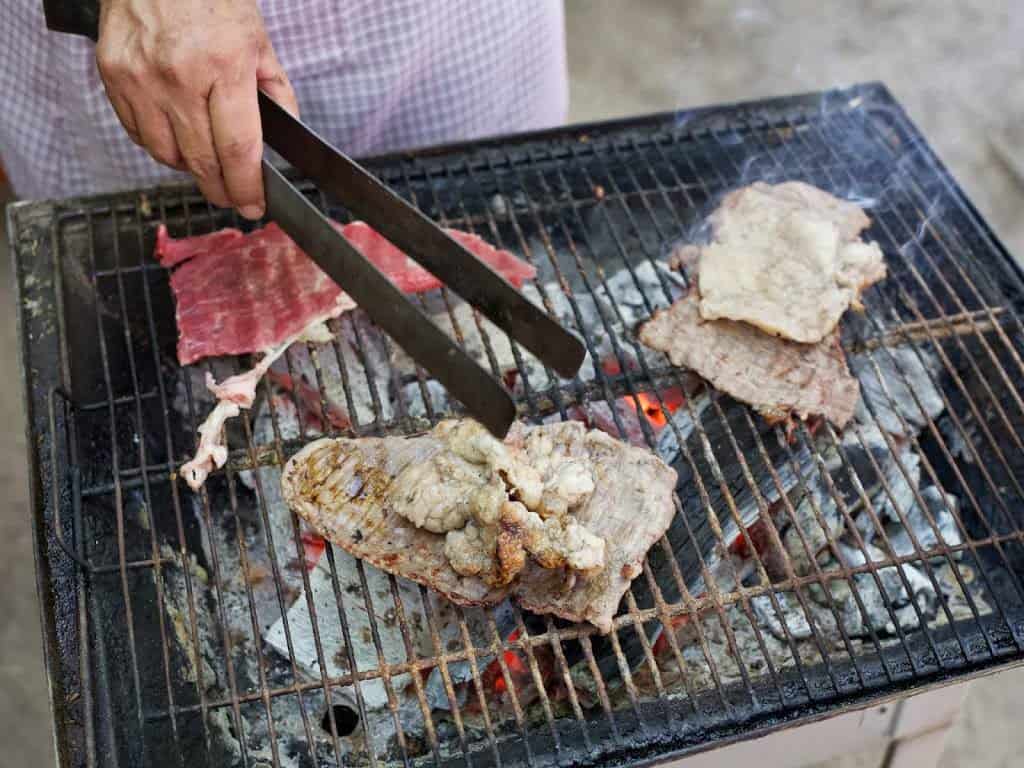
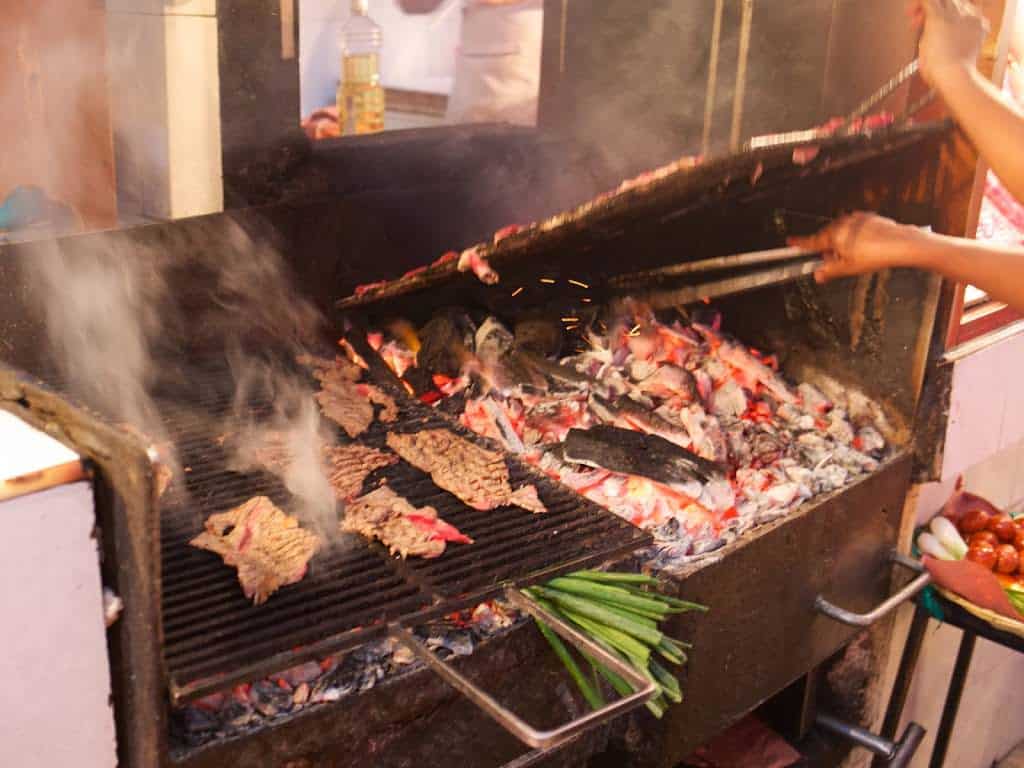
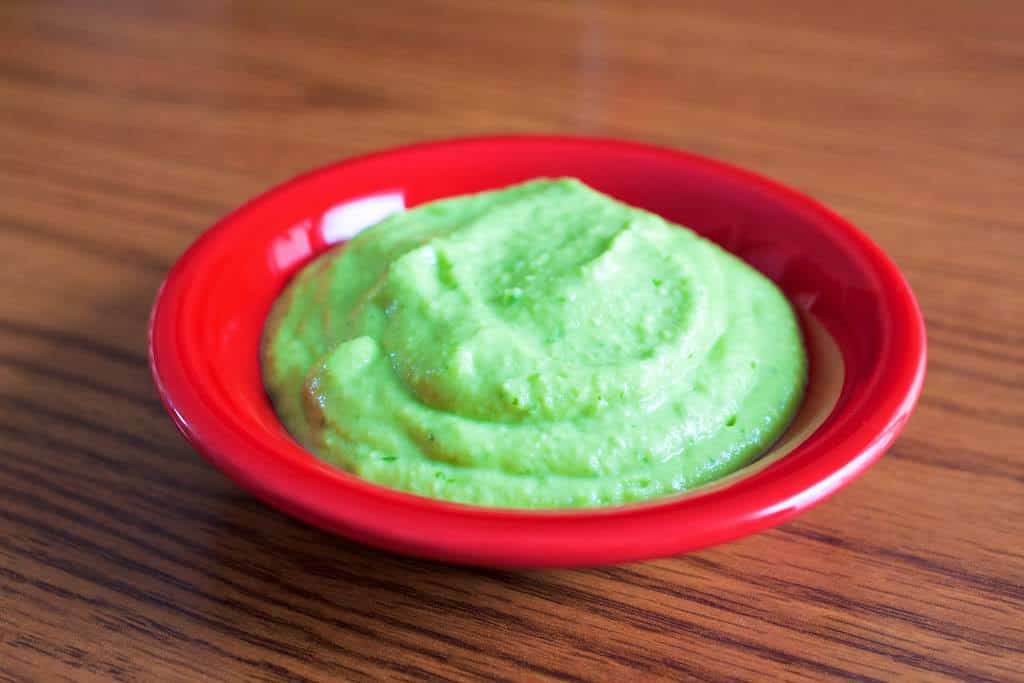
In Oaxaca, Guacamole is not the thick, chunky dip I am used to. My first day in Oaxaca, I went to lunch in the 20 de Noviembre market for the hall of Carne Asadas - an entire hall of grilled meat. (I was in heaven.) After choosing my meat and taking a seat, I ordered guacamole to go with my grilled beef and chorizo. What arrived with a bowl of thin sauce, the bright green color of ripe avocados, with a spoon floating on top. Was this the guacamole? Yes. Oaxacan guacamole is thin, ready to drizzle off of the spoon and onto my tacos.

Much to my surprise, I preferred it to my usual, chunky guacamole. Saucy guacamole works better if it is meant to be a topping. It still works as a dip for tortilla chips, too - like a thin salsa instead of a chip dip. I ate a ton of it, dipping my tortillas in it…for taste testing purposes, of course.

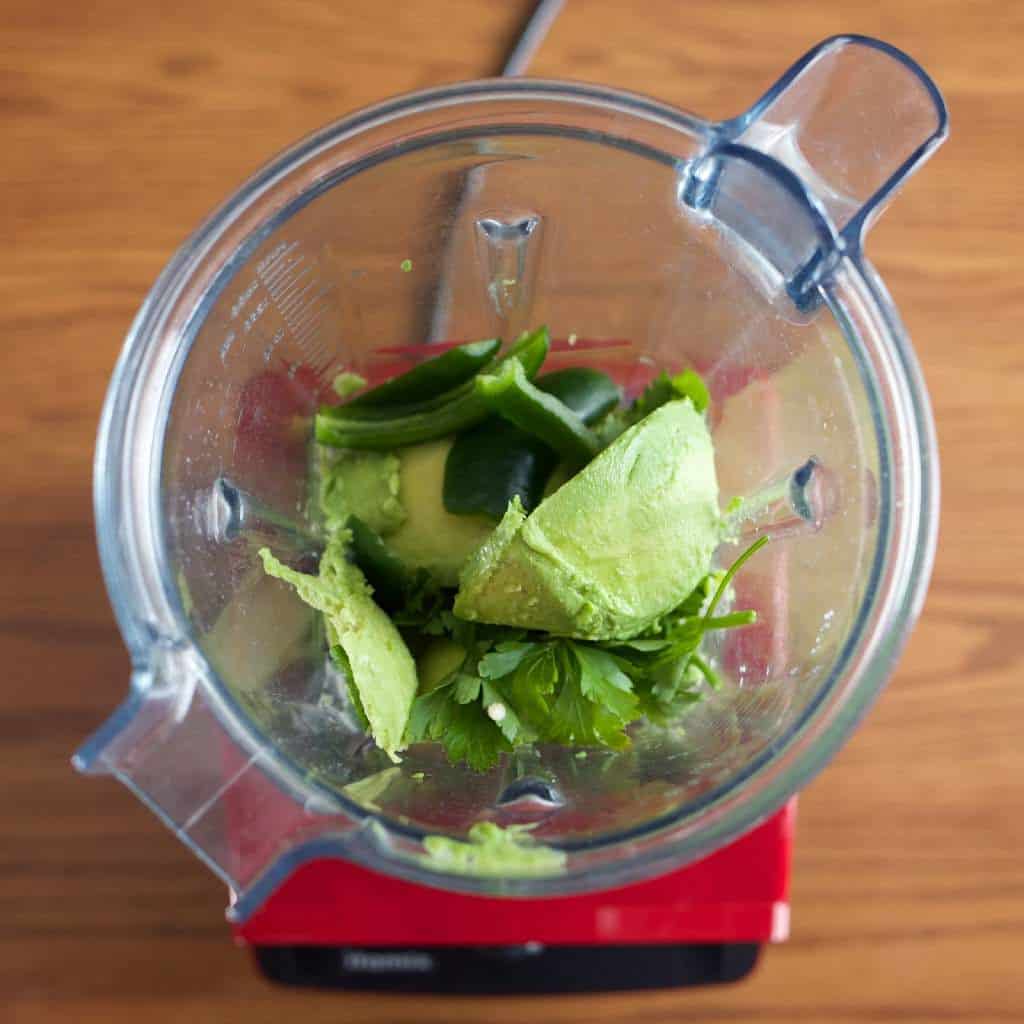
And it’s so simple to make. Toss everything in the blender and blitz it until it’s perfectly smooth, adding water as needed to thin it out. You’ll be ready to serve guacamole in about a minute.

Recipe: Guacamole Sauce (Salsa de Guacamole)

Adapted from: Salsa de Guacamole, Susana Trilling, Seasons Of My Heart, a Culinary Journey through Oaxaca, Mexico

Prep Time: 5 minutes
Cook time: 5 minutes

Ingredients

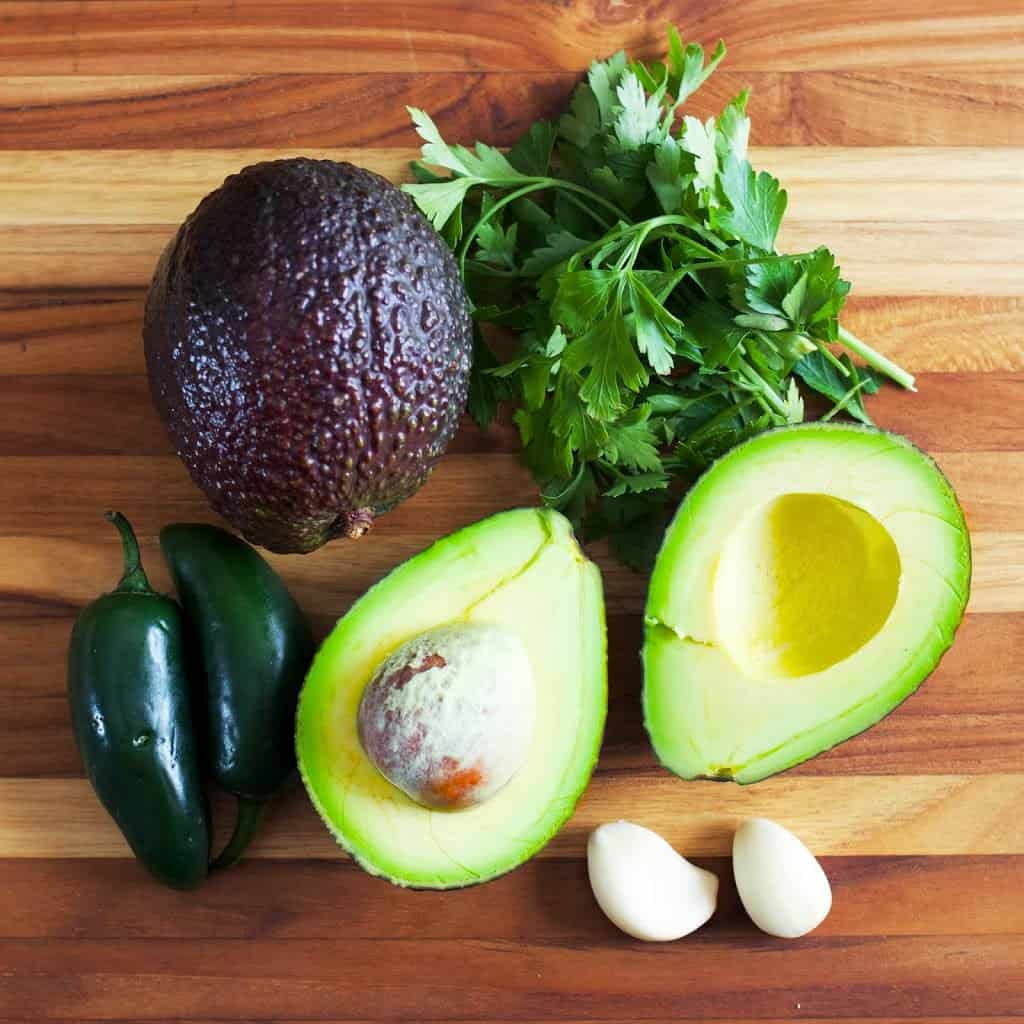
  • 3 cloves garlic, peeled
  • 2 avocados, peeled and seeded, scooped out in large chunks
  • 2 jalapenos, stemmed and seeded
  • ¼ cup cilantro ( a packed handful)
  • water
  • salt to taste

Directions

1. Puree everything

Put the garlic cloves, avocados, jalapenos, and cilantro, and a half cup of water in a blender or food processor. Blend until pureed and smooth, adding water to keep the blades moving and thin the sauce out. This salsa should be very thin, and will need extra water. When everything is completely pureed, and the cilantro has disappeared into the sauce, taste and add salt as needed, pulsing the blender to stir the salt into the sauce. Add salt until the avocado flavor jumps, and starts to have a hint of sweet on the tip of your tongue. Serve.

Seeding an Avocado

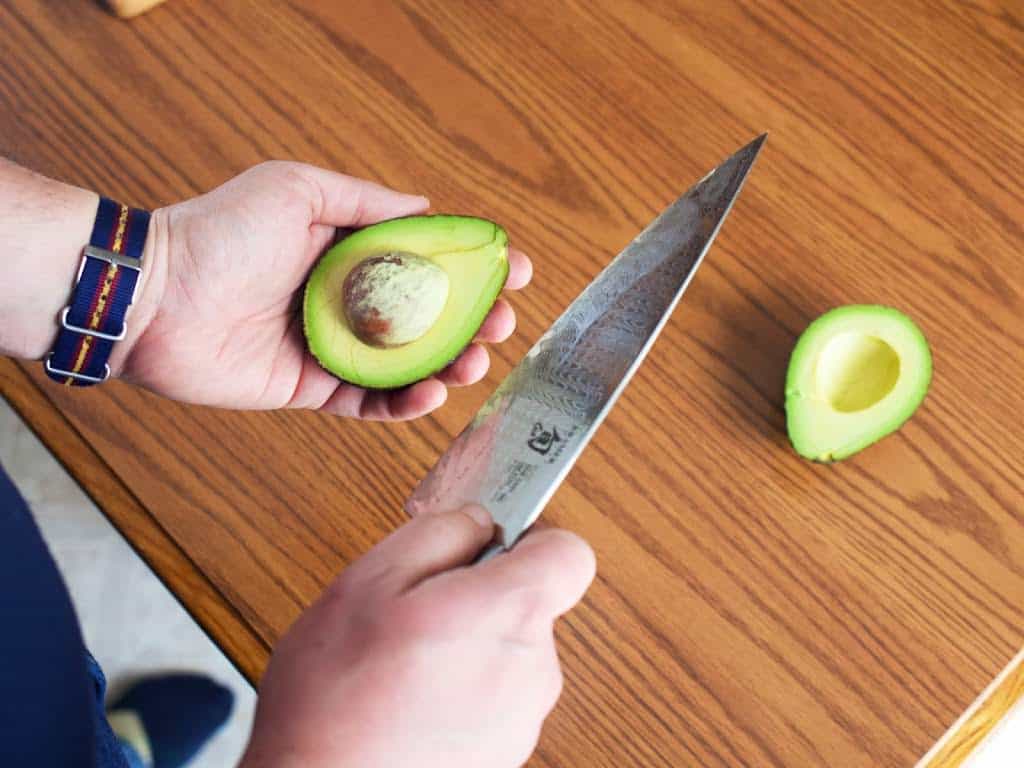
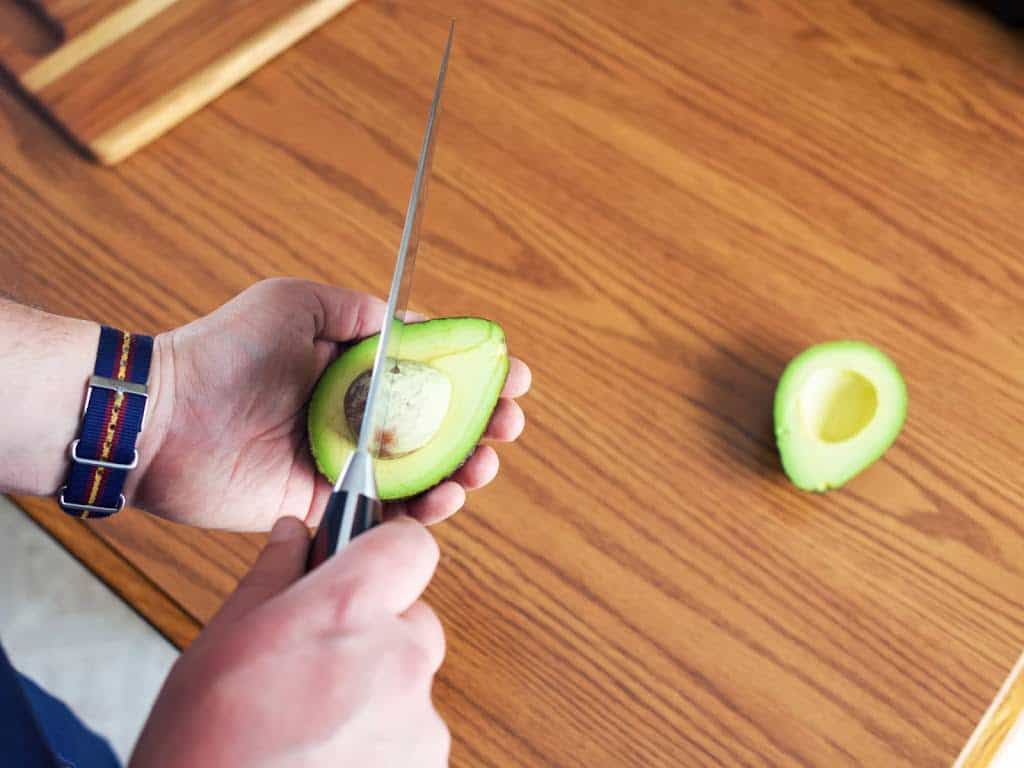
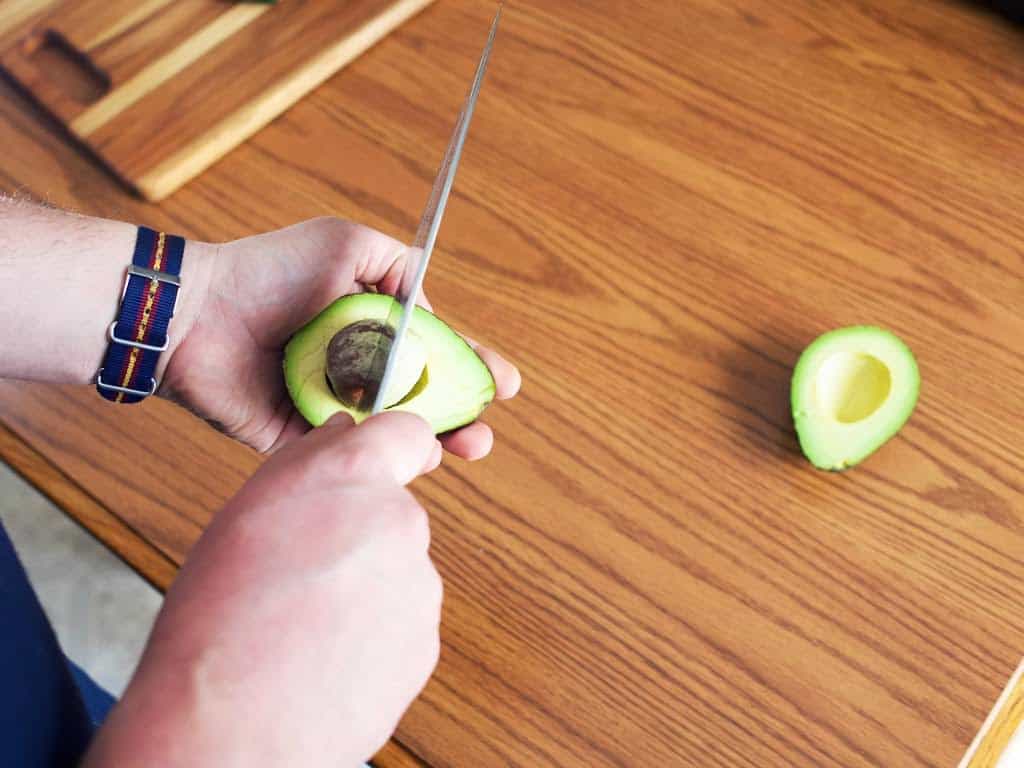
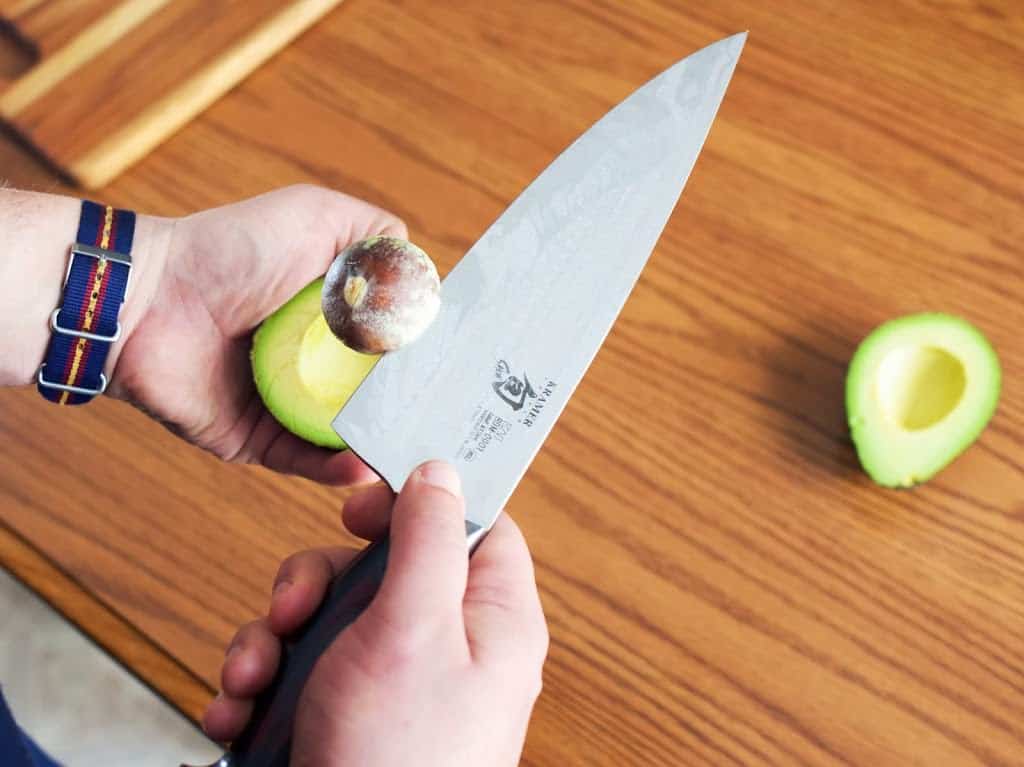
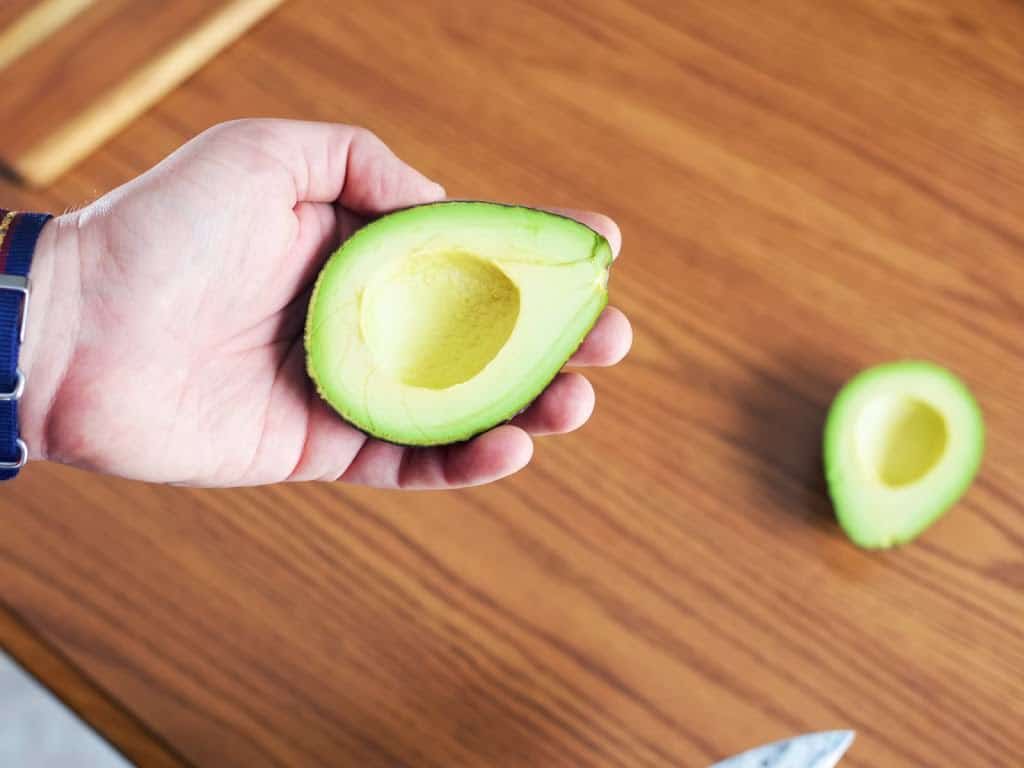
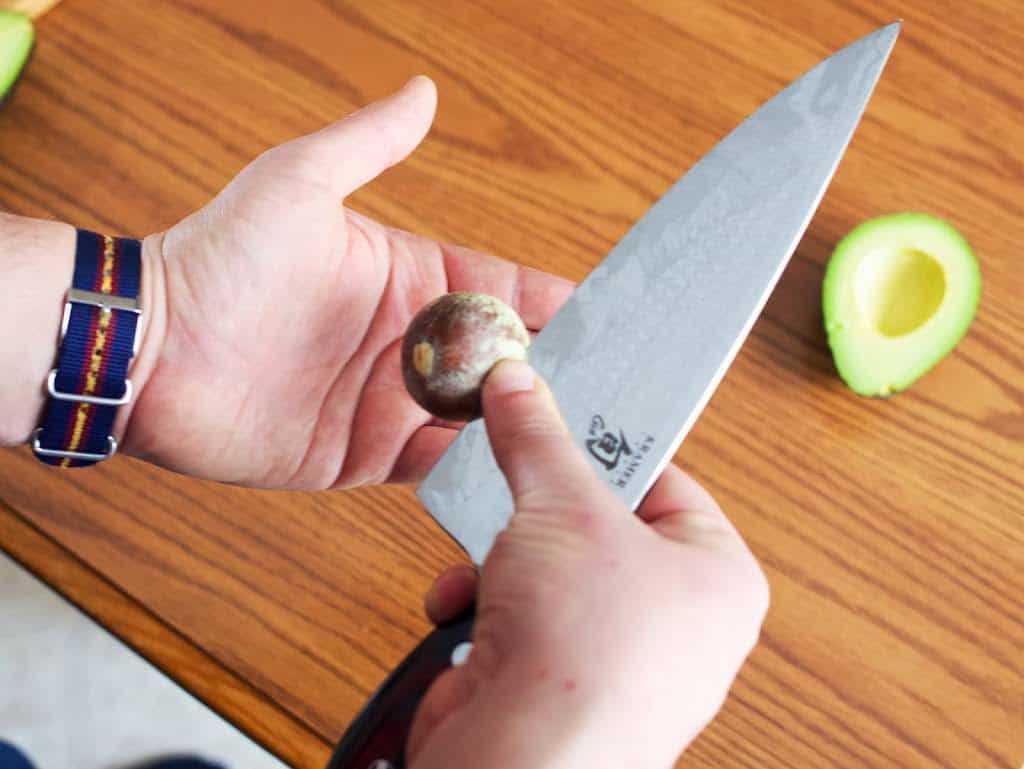
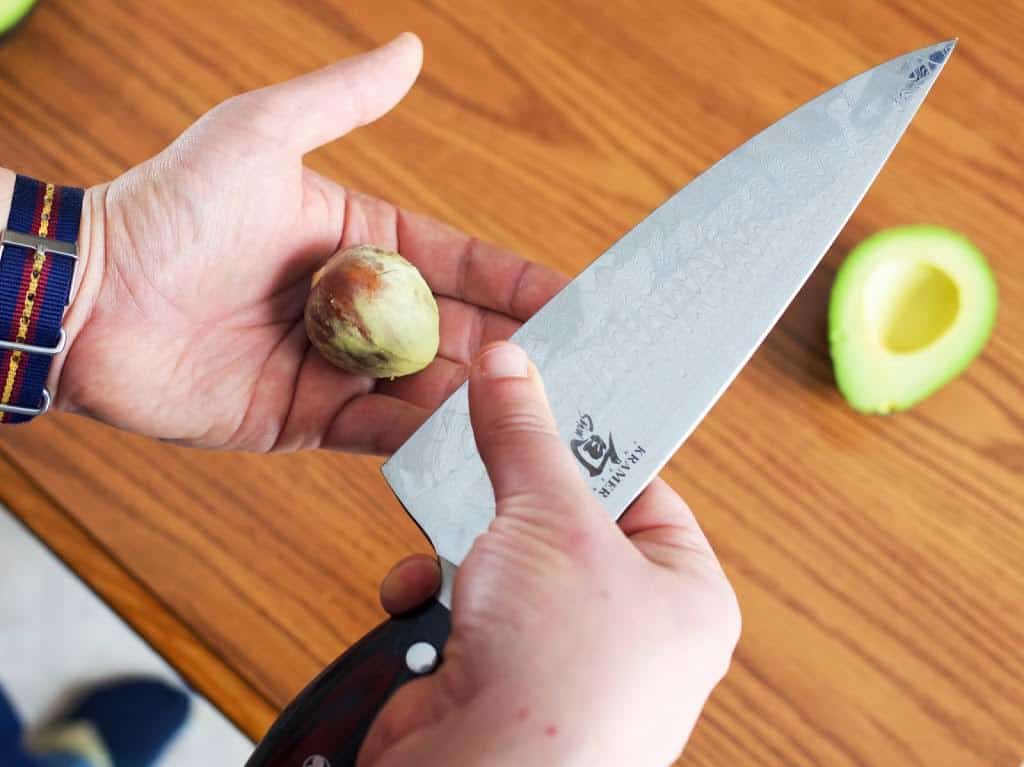
Here’s how I learned it from Alton Brown: cut the avocado in half, twist the halves to pull them apart, and the seed will stay in one side. Put that side in your palm, and carefully but firmly whack a chef’s knife into the seed. Hold the knife and seed steady, twist the body of the avocado, and the seed will pop out. Now, reach around the back of the blade and carefully pinch the seed off of the knife - keeping your fingers away from the sharp blade. Easy!

Notes

  • Because I'm pureeing the guacamole, I don't need perfectly ripe avocados. It's cheating, but...the blender will turn unripe avocados into a sauce, no problem. (Especially a powerful one like my Vitamix.) Now, like any fruit, avocados taste better when they are ripe. You'll need a little more salt than usual with unripe avocados to help out the flavor.

What do you think?

Questions? Other ideas? Leave them in the comments section below.

Related Posts

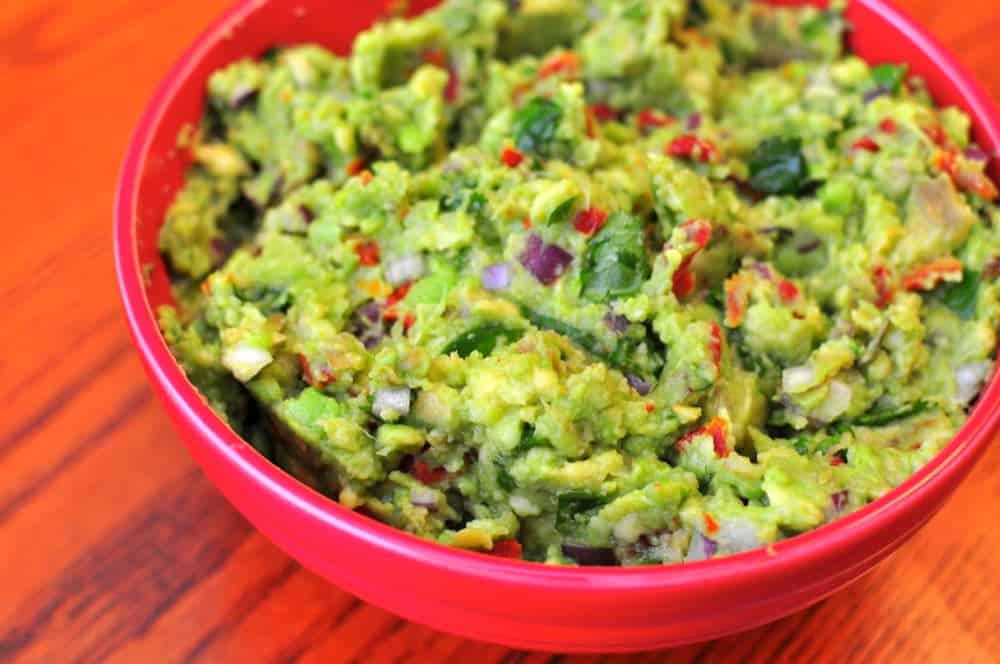
Grilled Guacamole with Sun Dried Tomatoes
The Ten Item Mexican Pantry
Grilled Tomato-Tomatillo Salsa

Enjoyed this post? Want to help out DadCooksDinner? Subscribe to DadCooksDinner using the RSS or Email options on the right, recommend DadCooksDinner to your friends, buy something from Amazon.com through the links on this site, or donate through my tip jar. Thank you.
Five Fun Food Finds Winter 2014

February 4, 2014 by Mike Vrobel 3 Comments

I’m recovering from my trip to Mexico, Super Bowl Sunday, and two kids worth of basketball playoffs. While I work on some new recipes, here are some new cooking gadgets I’ve got my eye on.

1. Weber's new skewers

I bought Weber’s new Essential Skewer Set for myself (late Christmas present…I felt like I deserved it), and I love these skewers. They’re thick enough to keep food from rolling around when you turn the skewer, but not thick enough to split food as you skewer it. Highly recommended.

Also, take a look at Weber’s funky Elevations Tiered Cooking System. It's a grill rack that lets you stack skewers three levels high over your grill. I’m not sure about this one - it looks like it adds a ton of grilling space, which is great, but I worry about it lifting the food too far from the heat of the grill. My blog-buddy Mike at Another Pint Please seems to love it, though. [h/t AnotherPintPlease.com]

2. Ball Heritage Collection Green Canning Jars

Last year’s blue canning jars must have been a hit; Ball is releasing two different sizes of limited edition green canning jars this year - regular mouth pint jars, and wide mouth quart jars. I’m a wide mouth jar fan, so I’m glad to hear about the quart jars, but they don’t seem to be available yet - I can only find the pint jars for sale. [h/t FoodInJars.com]

3. Lodge Cast Iron Scrubber Brush

As you can see from my recent recipes, I’m using my Lodge cast iron skillet a lot this winter. And…I’ve already warped bristles on the old style scrubber brush that I bought with it. I’m going to get one of their new brushes as a replacement - it looks a lot more durable than the old one.

4. Seasons of my Heart Mole Pastes

The story about my week at Seasons of My Heart cooking school in Oaxaca, Mexico is coming. I promise. But, I couldn’t wait to share this: mole paste, like you can buy at a Mexican market in Oaxaca. I spent hours making Mole Negro at the cooking school - sharing the work with two other people. These pre-made pastes take Mole from a multi-hour (or all day) process down to about an hour, without losing the deep, complex flavor of the peppers, spices, nuts, and chocolate. Available in Mole Rojo, Mole Coloradito, and Mole Negro. [h/t SeasonsOfMyHeart.com]

5. Oxo 2 Cup Fat Separator

I have one of Oxo’s 4 cup fat separators, and I use it all the time. But, sometimes it’s too big, like when want to defat the juices from a sous vide bag. I just noticed this 2 cup Oxo fat separator on Amazon - I’m going to pick one up for smaller jobs.

FCC Notice

I was not paid to mention any of these items - I’m recommending them because they look interesting. If you buy them (or anything else) through the Amazon links on my site, I get a small commission. Thank you!

What do you think?

Any new kitchen gadgets catch your eye? Share them with us in the comments, below.

Enjoyed this post? Want to help out DadCooksDinner? Subscribe to DadCooksDinner using the RSS or Email options on the right, recommend DadCooksDinner to your friends, buy something from Amazon.com through the links on this site, or donate through my tip jar. Thank you.
Big Game Suggestions 2014

January 31, 2014 by Mike Vrobel 2 Comments

For the Super Bowl …whoops, can't say that, it's trademarked. Deep breath…

Big Football Game To Determine The Champion of the National Football League

…gasp...

…I make chili, a couple different types (one all meat, one meat and bean), with lots of toppings. We also have wings, and lots of chips and dips - so everyone can serve themselves without bothering me WHILE I'M WATCHING THE GAME! (Ahem. Sorry.)

Here are a few DadCooksDinner suggestions for your Big Game party:


Chili

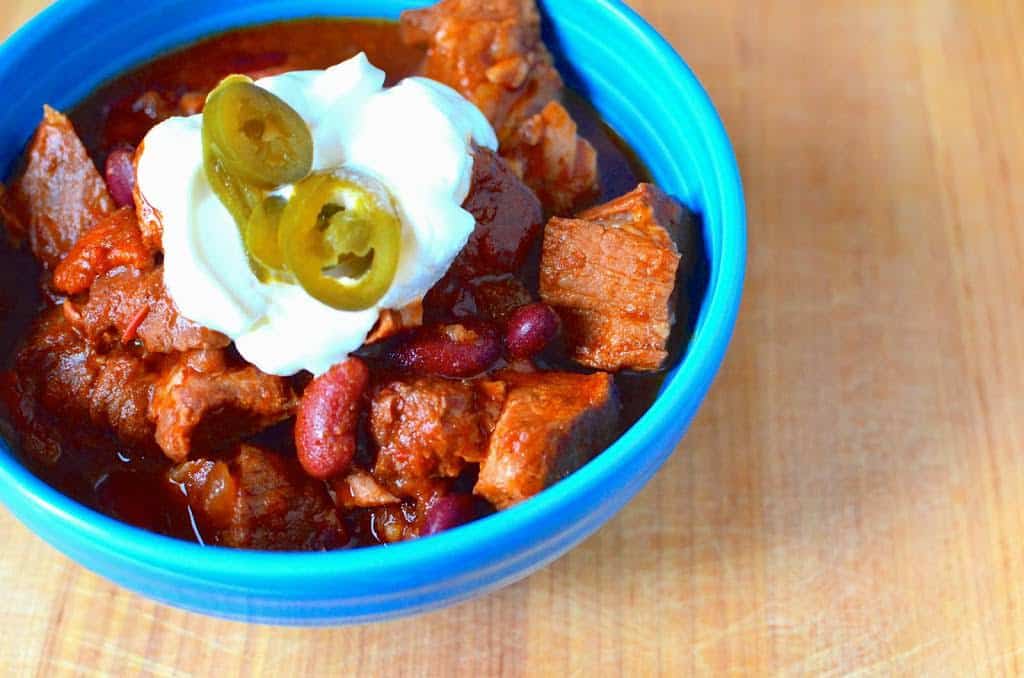
Pork Chili with Beans - for a Crowd
Slow Cooker Texas Red Chili
Pressure Cooker Frito Pie


Chicken Wings

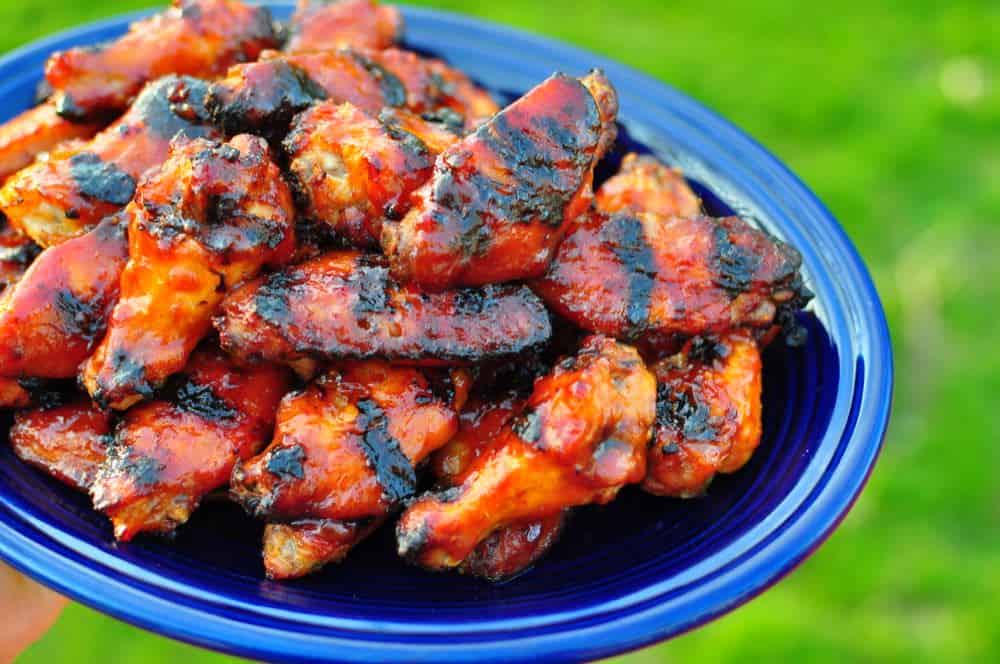
Grilled Buffalo Chicken Wings
Grilled Miso BBQ Chicken Wings
Grilled Chinese Chicken Wings (Chuan'r Chicken Wings)


Dips

Grilled Guacamole with Sun Dried Tomatoes
Grilled Tomato-Tomatillo Salsa
Roasted Red Pepper Dip


As for the game itself? I don't know who I'll be rooting for. As a Browns fan, I should probably root against Denver, but that was so long ago that I've kind of gotten over it. (Though I still swear Rich Karlis was wide right in overtime in '86…sigh.)

I hate to bet against Peyton Manning and the juggernaut that is the Denver offense this year, but...defense wins championships. So, my money is on the Seahawks. Which, given my track record, means Denver in a blowout.


*Enjoyed this post? Want to help out DadCooksDinner? Subscribe to DadCooksDinner using the RSS or Email options on the right, recommend DadCooksDinner to your friends, buy something from Amazon.com through the links on this site, or donate through my tip jar. Thank you.
Pressure Cooker Pig Head Soup with Root Vegetables

January 30, 2014 by Mike Vrobel 4 Comments

Oh no! I forgot the pig’s head!

My brother loves pig roasts. He bought a La Caja China Cuban pig roaster a few years ago, and now all he needs is an excuse to roast a pig. Family together at the cottage in the summer? Pig roast. Ohio State-Michigan game? Pig roast. Co-worker having a party? Matt shows up, roaster in tow.

I always grab some leftovers from Matt on my way out, so I can make shredded pork sandwiches. This time, when I was leaving, I remembered Judy Rodgers’ Zuni Cafe’s pig stock.
And her story about the burglar who snuck into the kitchen early one morning and stole the boiling hot head out of the stock pot. Talk about desperate…

Matt packed up the head for me…and I forgot it while wrangling the kids out the door. Matt threw the head in the freezer for me, and gave it to me as part of my Christmas presents.
A frozen pig’s head! Exactly what I wanted…

So it’s the week after Christmas, and I have a pig’s head and a pile of root vegetables left from my winter CSA share. Soup time!

If you can’t get a pig head, don’t worry - 5 pounds of meaty pork bones will work, and, frankly, won’t gross out your family. One glimpse of the pork jaw and my daughter shrieked and ran from the room.

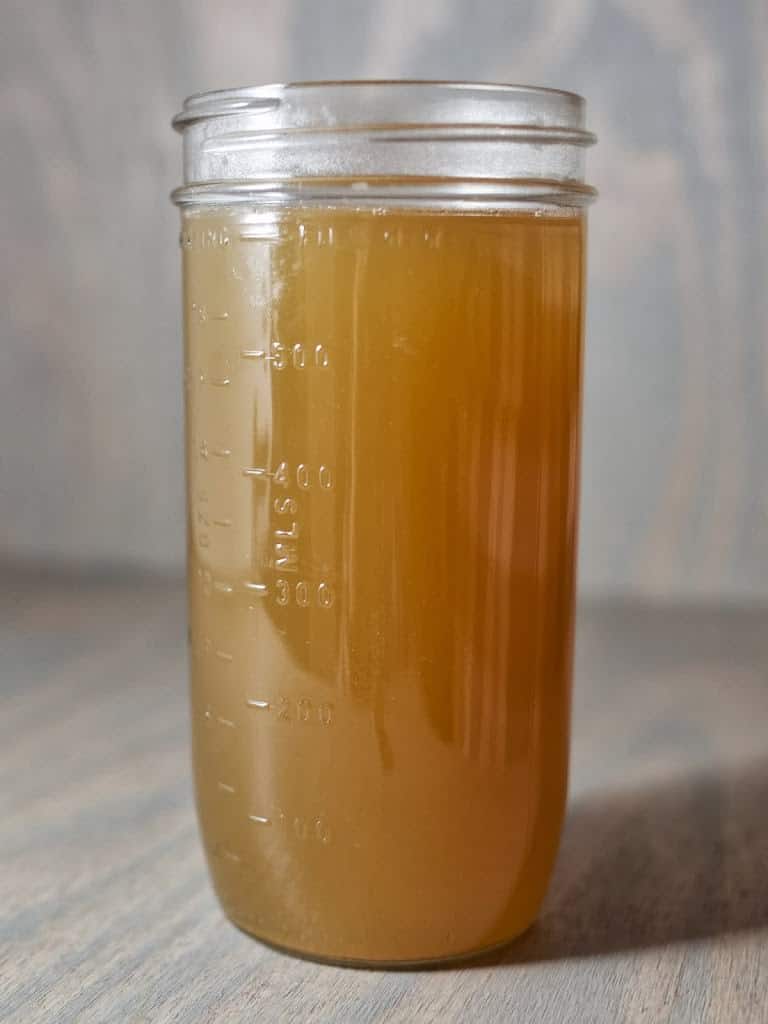
Now, you don’t have to use pork stock - homemade chicken stock is an acceptable substitute. If you’re desperate, you can use store bought chicken broth, preferably low sodium broth in the aseptic packages - but please, at least once, try to make your own stock. With homemade stock, the broth is the highlight of the soup; with store bought broth, the soup is more about what you add into it.
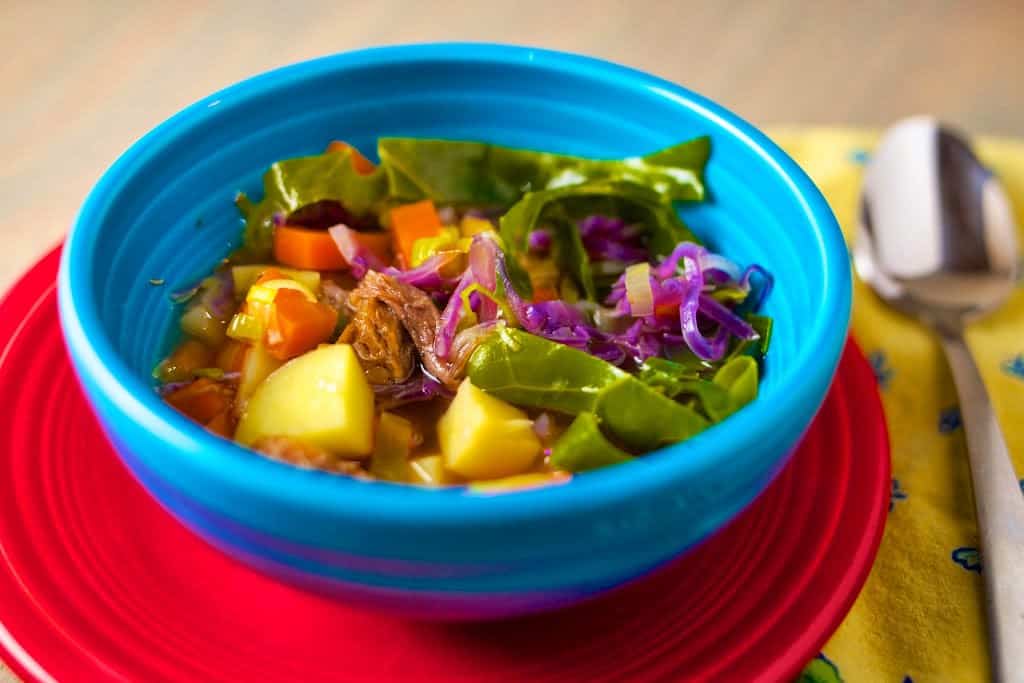
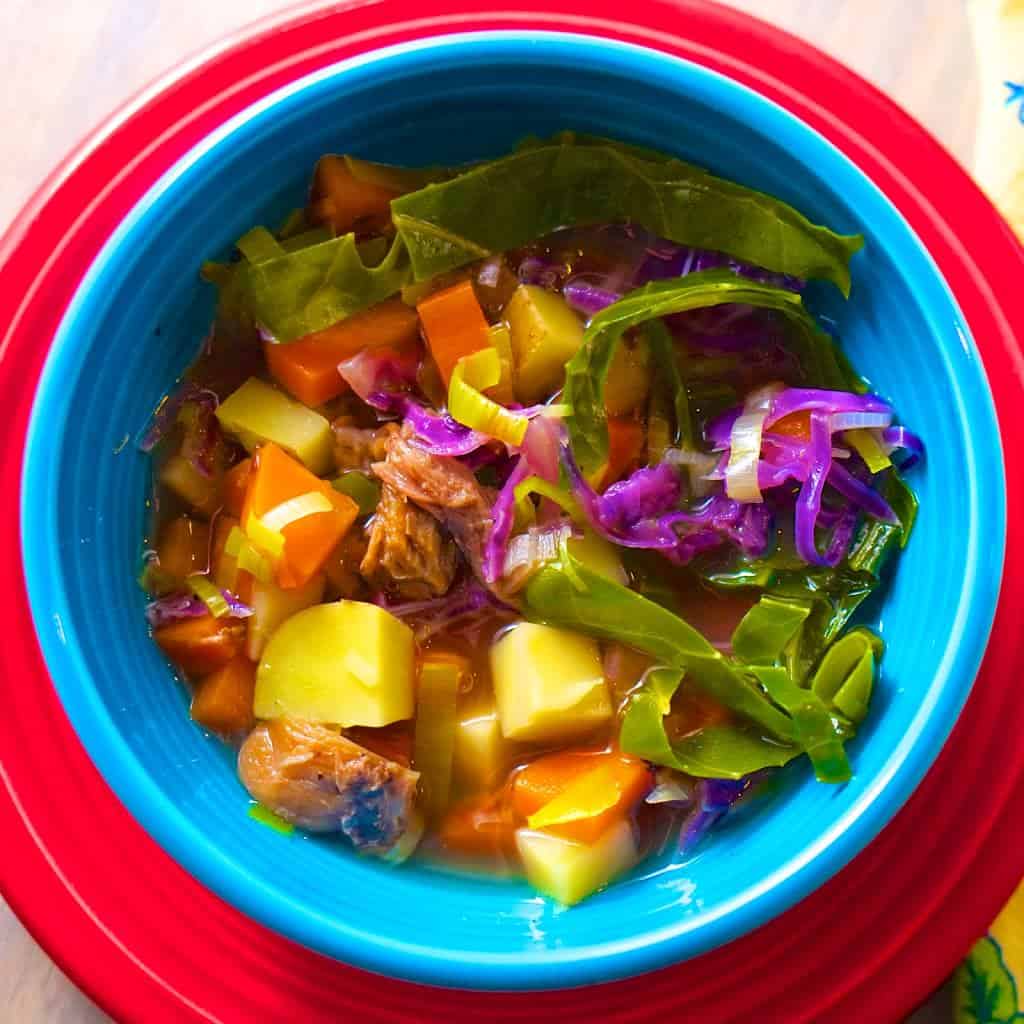
…and that’s why this soup is OK with store bought - we’re adding in shredded pork, leftover from a roast. Leeks, kale, cabbage, potatoes, parsnips, and carrots. You can hide a bland stock behind all that.

No pressure cooker? No worries. See the notes section for stove top pork stock instructions.

6 quart or smaller pressure cooker? Skip the pig head, and use a smaller amount of meaty pork bones. See the notes section for electric pressure cooker instructions.

Recipe: Pressure Cooker Pig Head and Root Vegetable Soup


Adapted From: Judy Rodgers The Zuni Cafe Cookbook

Cooking time: 90 minutes

Equipment

  • 8 quart or larger pressure cooker (I use my massive Kuhn Rikon 12 quart stockpot)
  • Large pot for the soup (you can re-use the pressure cooker pot if you wipe it out first)

Ingredients

Stock

  • 1 (5 pound) pig head, or 5 pounds of meaty pork bones
  • 2 quarts chicken stock (or water)
  • 3 quarts water (plus more to cover if needed)
  • 1 medium onion, peeled and halved
  • 2 stalks celery
  • green leaves from a leek (optional)
  • 1 bay leaf
  • 1 teaspoon whole peppercorns

Soup

  • 1 tablespoon vegetable oil
  • 1 leek, trimmed, rinsed, and sliced thin
  • ½ teaspoon Kosher salt
  • 2 quarts pork stock (Or chicken stock. Or store bought chicken broth if you're desperate.)
  • 2 cups shredded cooked pork (save some from the roast where you got the head)
  • 2 large carrots, peeled, quartered, and diced
  • 1 large parsnip, peeled, quartered, tough core removed, and diced
  • 8 ounces kale, stemmed, sliced thin
  • 8 ounces cabbage, sliced thin
  • 1 pound new potatoes, cut into small cubes
  • 1 teaspoon kosher salt
  • 1 teaspoon sherry vinegar
  • Salt and pepper to taste

Directions

1. Pressure Cook the pork stock

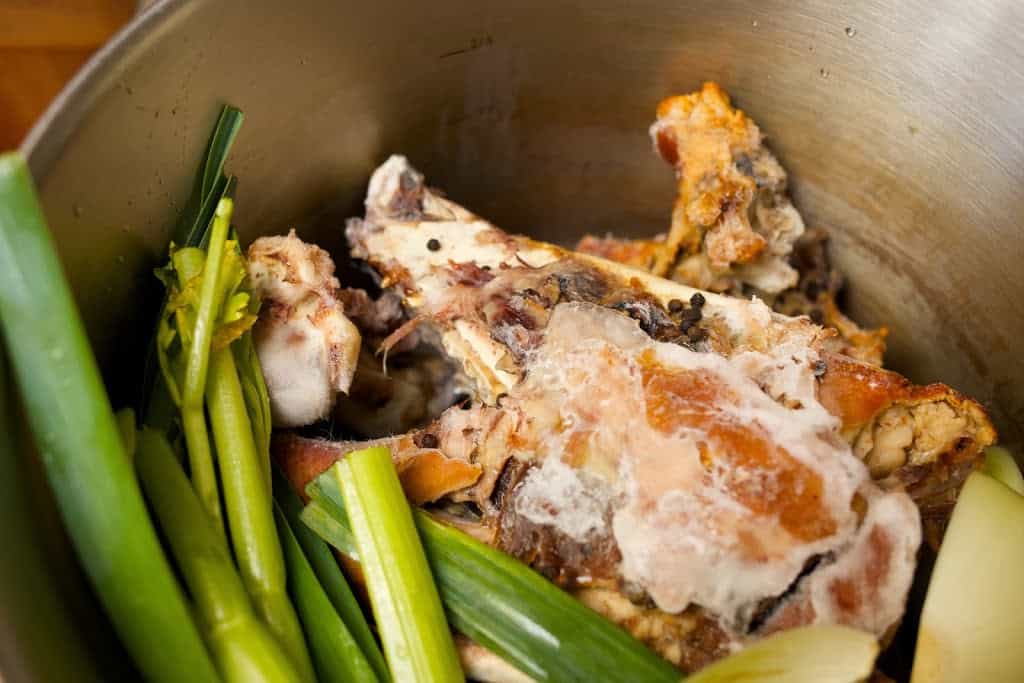
Put all the pork stock ingredients in the pressure cooker pot, and add extra water if needed to just cover the pork. (Don’t go over the pressure cooker’s max fill line). Lock the lid, bring the pressure cooker up to high pressure, and cook for 1 hour at high pressure. Let the pressure come down naturally for 15 minutes, then quick release any remaining pressure. Remove as much of the solids from the pot as possible using a slotted spoon, then strain the stock through a fine mesh strainer. Let the strained stock settle, then spoon off the layer of fat on top. (Or degrease the fat in batches using a gravy separator. Even better, if you have the time: make the stock the night before, refrigerate it, and scrape off the solidified fat cap the next morning.) Use 2 quarts of stock for this recipe, and freeze the rest for a second batch of soup later.
This step can be done weeks in advance - freeze the pork stock in quart containers and thaw out before continuing.

2. Saute the aromatics

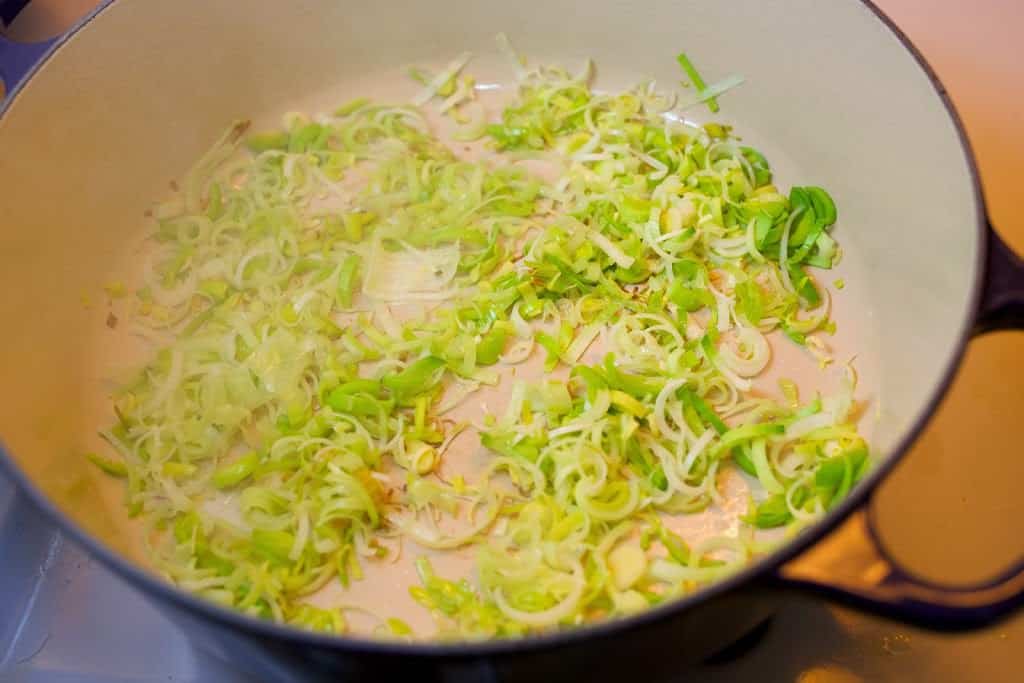
In a large (6 quart or larger) pot, heat the vegetable oil over medium heat until shimmering. Add the leek, sprinkle with ½ teaspoon kosher salt, and saute until the leek softens and starts to brown around the edges, about 5 minutes.

3. Cook the soup

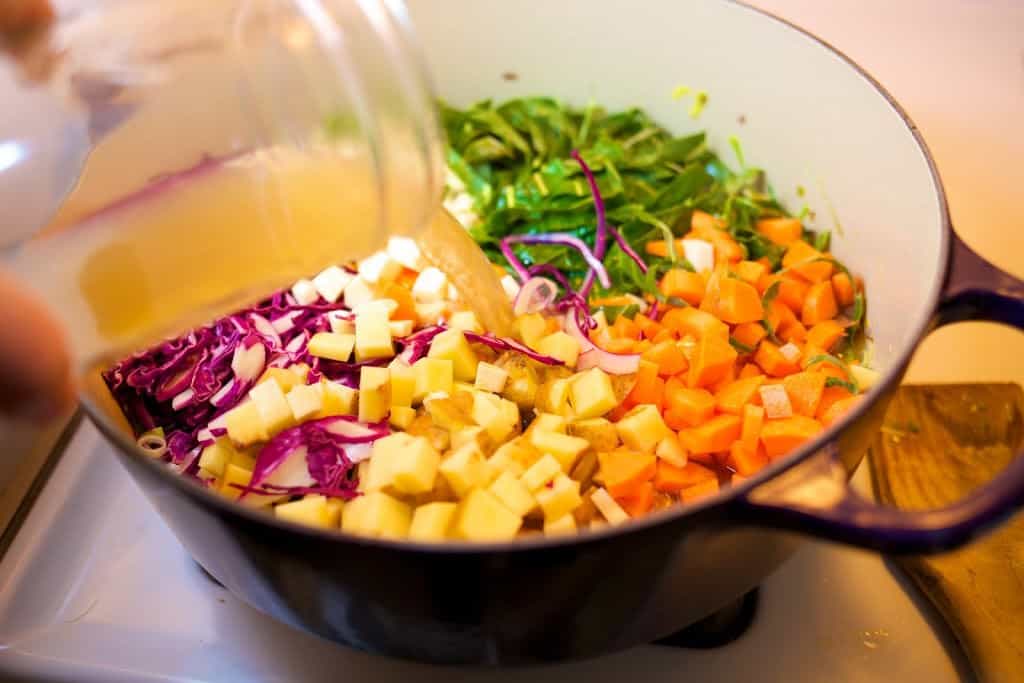
Add the stock to the pan, and scrape loose any browned leeks that are stuck to the pan. Add the shredded pork, carrot, parsnip, kale, cabbage, potatoes, and 1 teaspoon kosher salt. Cover the pot, increase the heat to high, and bring the pot to a boil. Remove the lid, reduce the heat to a simmer, and simmer for ten minutes, until the vegetables are softened. Stir in the vinegar, then add salt, pepper, and more vinegar to taste.

Notes

  • Don't have exactly these root vegetables? No worries. Use about 1 pound of shredded dark green leafy vegetables (kale, collards, cabbage, etc...), and about 1 ½ pounds of starchy root vegetables (potatoes, carrots, parsnips, celery root, turnips, etc...)
  • No pressure cooker? No worries. Make the stock in the oven. Put all the stock ingredients in a large (8 quart or larger) stock pot, bring to a simmer, then transfer to a 200°F oven for 6 to 8 hours. Strain and continue with the recipe.
  • Electric Pressure Cooker or smaller stove top PC: most electric PCs can hold 6 quarts. This is way too small for a pig's head; it's going to be a tight fit on an 8 quart PC, and a 10 or 12 quart model is even better. If you have a 6 quart pressure cooker, use 2 pounds of meaty pork bones, 1 quart of chicken stock, and 1 quart of water (plus more to cover, and don't go over the max fill line on the PC.) Pressure cook on high pressure for 1 hour (1 hour 20 minutes in an electric PC), then let the pressure come down naturally. There should be just enough broth for the soup in step 3.
  • This recipe makes a lot of stock - five to six quarts - and you only need two quarts of stock for the soup. (Hey, I had a whole pig's head to use up.) Freeze the extra stock and use it in a different soup: Vietnamese pho, tortellini en brodo, or tortilla soup are some of my favorites.

What do you think?

Questions? Other ideas? Leave them in the comments section below.

I'm hiding the picture of the pig head in the pot down here...be warned...

Related Posts:

Here are some more ideas to use up the extra stock. Substitute the word "pork" for "turkey":
Pressure Cooker Turkey Noodle Soup with Vegetables
Turkey Soup with Chickpeas and Vegetables
Turkey Ramen Soup
Click here for my other pressure cooker recipes.

*Enjoyed this post? Want to help out DadCooksDinner? Subscribe to DadCooksDinner using the RSS or Email options on the right, recommend DadCooksDinner to your friends, buy something from Amazon.com through the links on this site, or donate through my tip jar. Thank you.
Pressure Cooker Beets with Blue Cheese

January 28, 2014 by Mike Vrobel 21 Comments

Pressure Cooker Beets

Pressure Cooker Beets

Beets are my one food phobia. 1Well, that and tripe. Tripe just smells wrong to me. Unfortunately, my wife loves beets. And my CSA box delivers them on a regular basis. Eventually I learned that roasting them made them tolerable…and maybe, just maybe, edible.

Whenever I serve Brussels sprouts, my wife’s one food phobia, she fires back “you’ll make yourself Brussels sprouts, but you won’t make me beets?”

But? Beets are a pain to cook. They take a LONG time in the oven to tenderize; thick beets can take over an hour to cook all the way through.

Pressure cooker to the rescue! Oh, and a handful of blue cheese. Straight up beets? That’s too much for me.

Recipe: Pressure Cooker Beets with Blue Cheese

Equipment

  • 4 quart or larger pressure cooker (I use a 6-quart electric Instant Pot pressure cooker in the pictures).


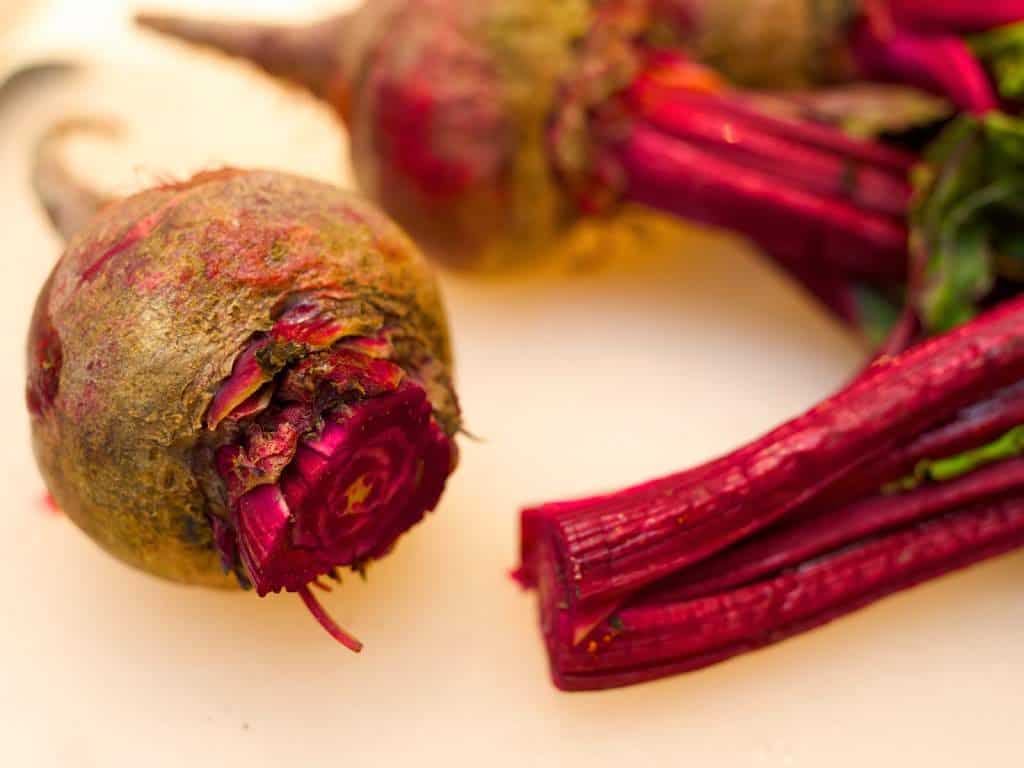
Trimming the beets
Trimming the beets

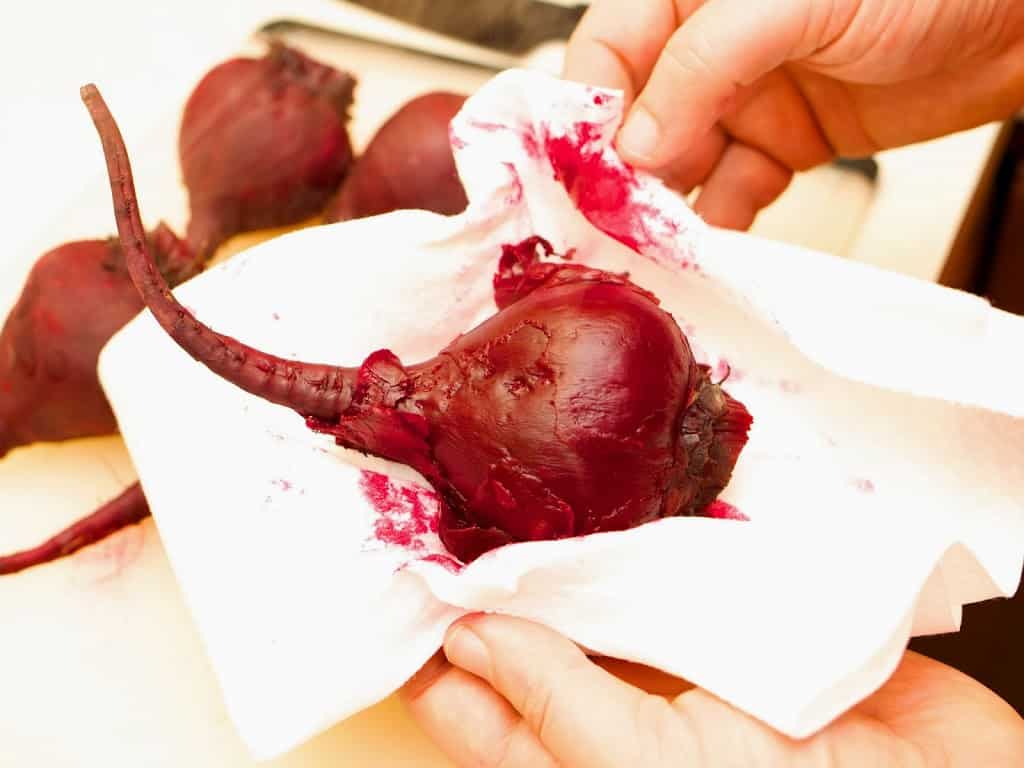
Peeling the cooked beets

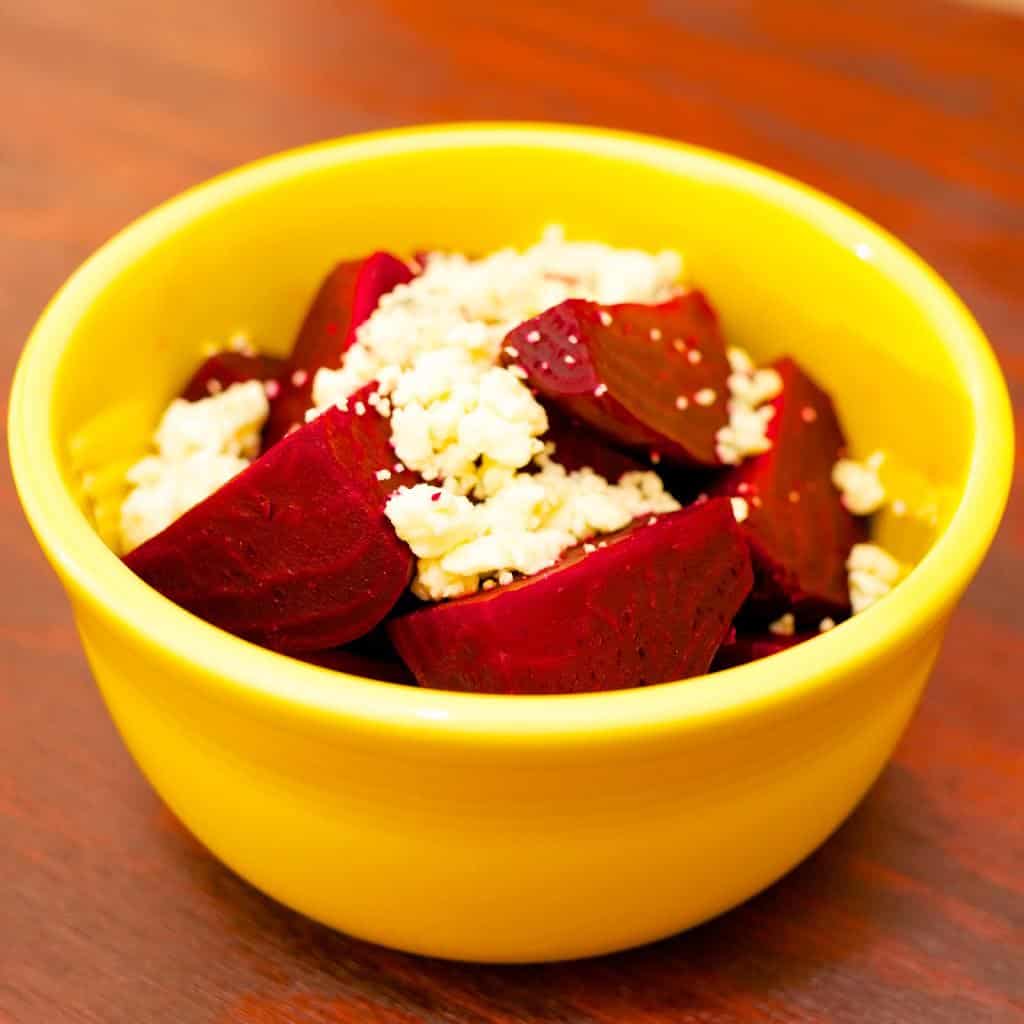
Ready to eat
Ready to eat

Notes

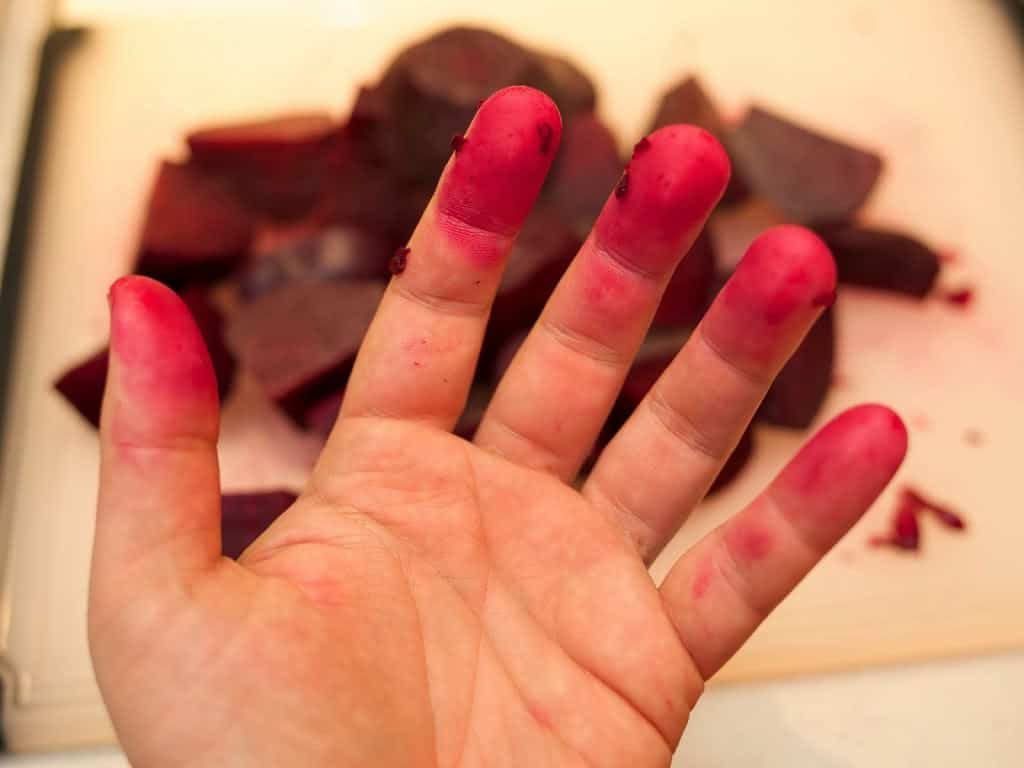
  • If you can, cut the beets on a plastic cutting board that is dishwasher safe. Beets are messy - take a look at my fingers down below. Beet juices will stain anything they come in touch with. I tell you, beets can't be trusted.
  • The next time you use the bathroom, don't be alarmed. You don't have internal bleeding - that's beeturia. OK, I'm going to stop talking now, this is probably too much information for a food blog. If you want to check that link, you're on your own.

Beet fingers!
Beet fingers!

What do you think?

Questions? Other ideas? Leave them in the comments section below.

Related Posts

Grilled Beets
Pressure Cooker Roasted Sweet Potato Puree
Pressure Cooker Refried Pinto Beans
Enjoyed this post? Want to help out DadCooksDinner? Subscribe to DadCooksDinner using the RSS or Email options on the right, recommend DadCooksDinner to your friends, buy something from Amazon.com through the links on this site, or donate through my tip jar. Thank you.
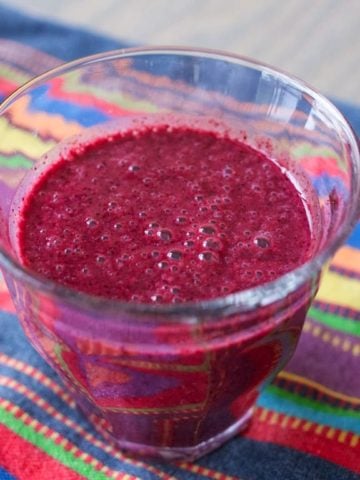
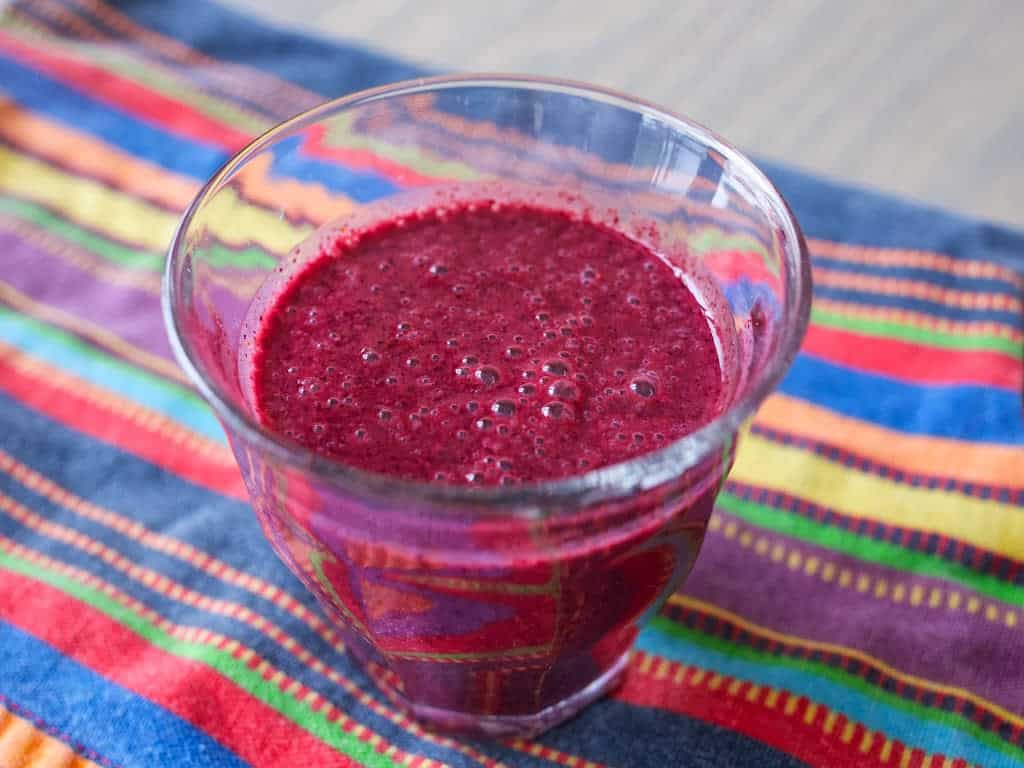
Blue Moon Smoothie

January 27, 2014 by Mike Vrobel Leave a Comment

This recipe is inspired by the Blue Moon smoothie they serve at Mustard Seed Market & Cafe in my hometown of Akron.

Every weekend, we have an argument before our big Sunday breakfast - who gets to make the smoothie.
That’s not fair! He made it last week! It’s my turn! No, you made it last week! I get to do it now! Sigh. Who wants to make the eggs? Anyone? Anyone?

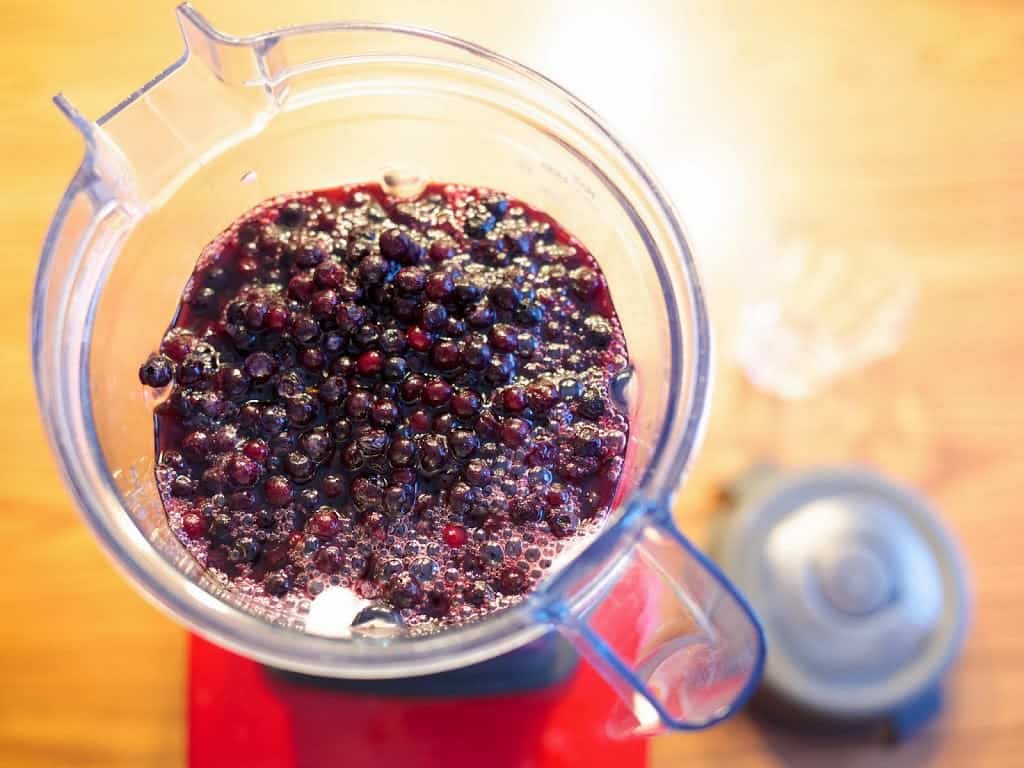
I’m surrounded by smoothie addicts, and they love our new (refurbished) Vitamix. Now, you don’t have to have a Vitamix, BlendTec or other high-powered blender to make smoothies; we made them for years with a collection of Osterizers and KitchenAids. But. Oh, my, the extra power in a Vitamix just makes smoothies easier. Now, I may be biased, becasue I am a Vitamix affiliate…but I’ve seen the kids dump entire bags of frozen fruit into the Vitamix, and the powerful motor breaks things up and keeps them moving. 2And, Vitamix is a local company, based here in Northeast Ohio, so I'm proud to support them.
Did I mention that I’m a Vitamix affiliate? And if you buy one through my links, I get a small commission? OK, I’m good with the FCC now.

Usually, our smoothies are free-form, empty out the freezer operations. The kids add most of a bag of frozen fruit, a frozen bannana or two (we freeze any that are too brown to eat, and save them for smoothies), some yogurt, and apple juice or simple syrup to keep things moving and sweeten up the smoothie. I sat down and measured everything, snatching it out of their hands before they could put it in the blender…and here’s what I came up with.

Recipe: Blue Moon Smoothie


Prep Time: 1 minute
Cook time: 1 minute

Equipment

  • Blender (I love my Vitamix)

Ingredients

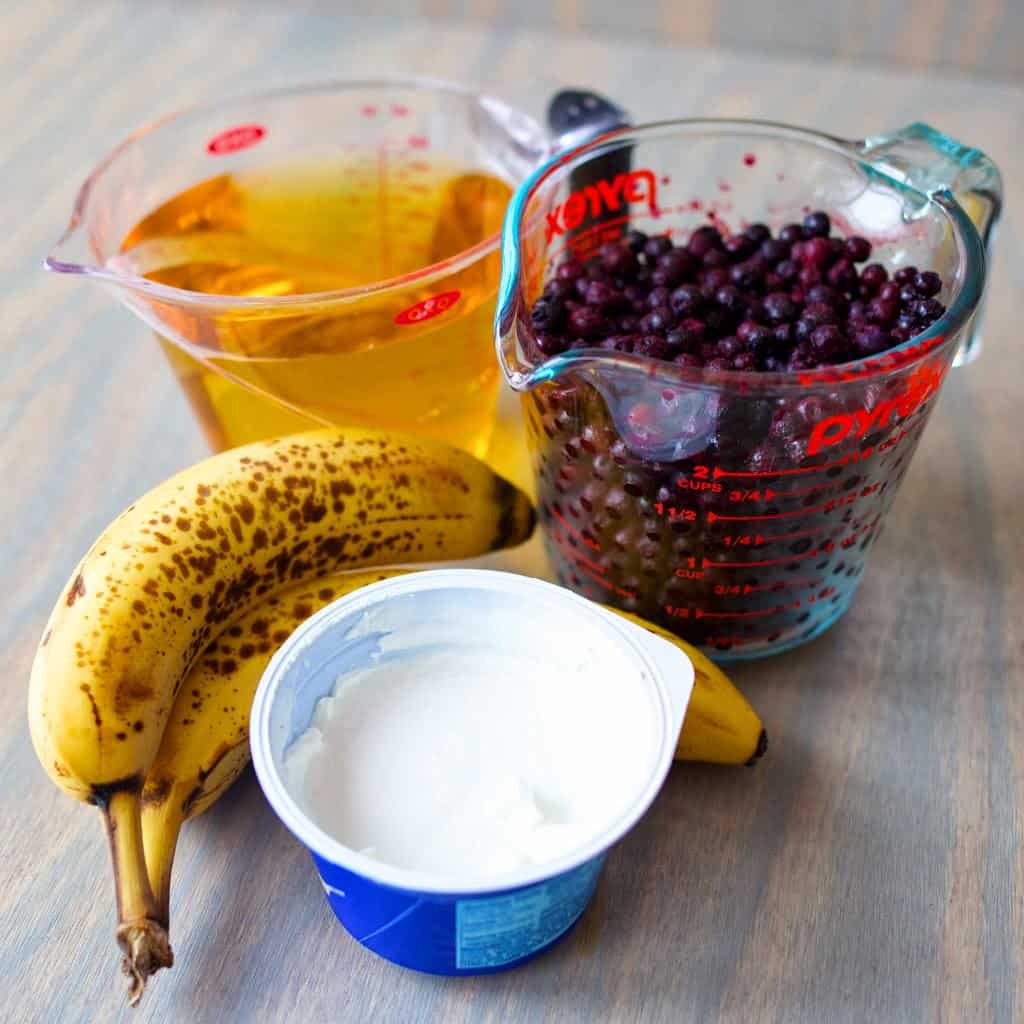
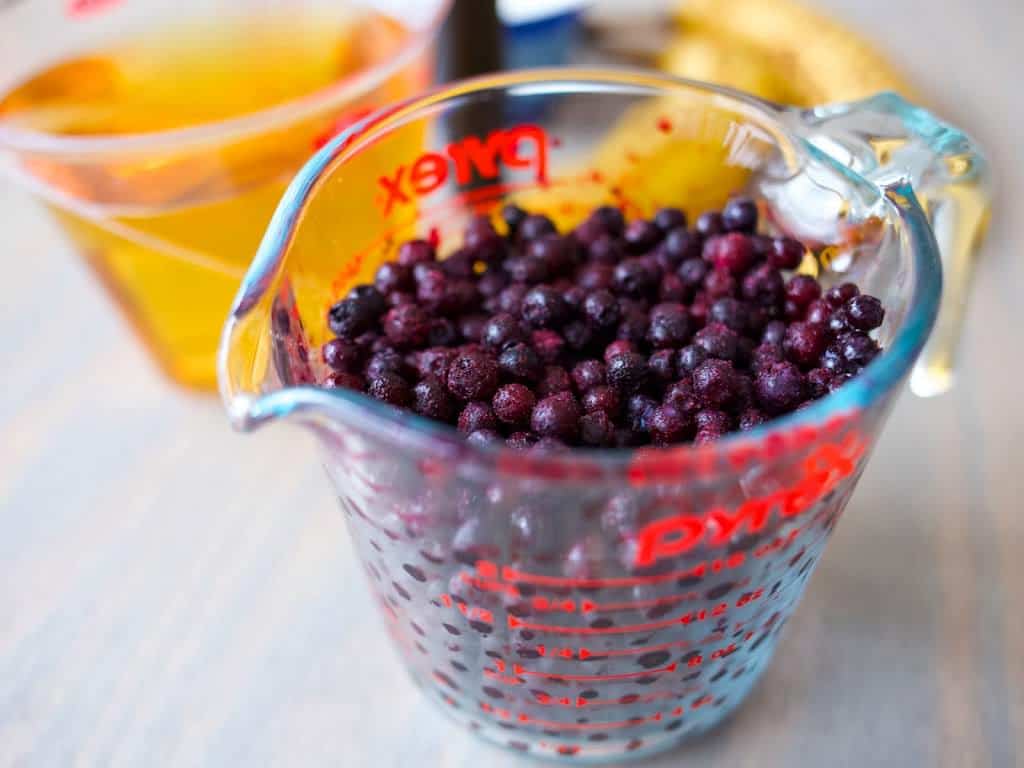
  • 10 ounces (2 cups) frozen blueberries
  • 2 bananas, peeled, frozen
  • 1 (5 ounce) container plain greek yogurt
  • 1 ½ cups apple juice (plus more to keep the blender moving, if necessary)

Directions

1. Blend it all

Put everything in blender, start on low, and slowly increase the speed to the highest setting. (On my Vitamix, Variable 10.) Blend on high until the ingredients are smooth, about 1 minute. If the smoothie isn’t spinning and forming a vortex, add some more apple juice and break up the smoothie with your blender’s tamper. (If you don’t have a tamper, shut the blender off and use a spatula, then restart it.)

Notes

  • If you don't have frozen blueberries, use whatever frozen fruit you have. I buy a variety of frozen fruit on sale at the grocery store, and the kids grab whatever takes their fancy on Sunday morning.
  • If you don't have plain greek yogurt, substitute flavored yogurt. Blueberry is the obvious choice for this smoothie, but any flavor will work. Call it a blueberry-bannana-whatever flavor at that point.
  • The other nice feature of the Vitamix is the tamper. It fits in the hole in the lid, and reaches just above the blades. It is perfect for breaking up a smoothie that has separated into two layers - a blended layer on the bottom, and a frozen fruit layer on the top. A few pushes with the tamper and everything gets moving again. (If things don't move after tamping, that's a sign to add more liquid to the blender…)

What do you think?

Questions? Other ideas? Leave them in the comments section below.

Related Posts

Road Trip: Vitamix Factory Outlet Store
Fresh Tomato Gazpacho (in a Vitamix)
Homemade Honey Mustard

Enjoyed this post? Want to help out DadCooksDinner? Subscribe to DadCooksDinner using the RSS or Email options on the right, recommend DadCooksDinner to your friends, buy something from Amazon.com through the links on this site, or donate through my tip jar. Thank you.
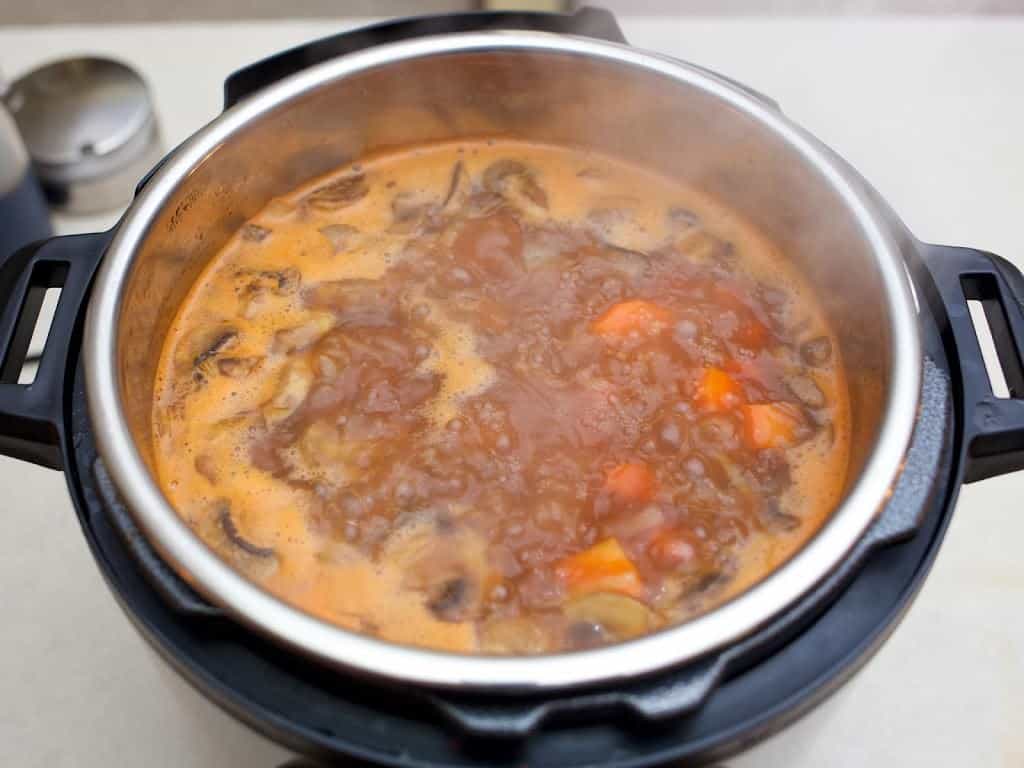
Rotisserie Chicken with Spanish Smoked Paprika Rub

January 23, 2014 by Mike Vrobel 16 Comments

Rotisserie Chicken with Smoked Spanish Paprika Rub

Rotisserie Chicken with Smoked Spanish Paprika Rub

Smoked Spanish paprika is my secret ingredient.…Whoops. If it's a secret, I'm not supposed to tell you, right? Never mind - smoked paprika is too good to keep a secret. I love the subtle flavor it brings to food.

I needed a quick rub, because of a warm snap in January. (Warm enough to light a chimney of charcoal without frostbite! Whoo hoo!). I used my secret ingredient in its natural habitat, a rub with flavors from Spain - garlic, thyme and lemon.

The chicken went on the rotisserie, of course - January or no January, if I'm grilling a chicken, I'm rotisserie grilling a chicken. But, no rotisserie? No worries. See the notes section for regular grill-roast chicken instructions.

Recipe: Rotisserie Chicken with Spanish Smoked Paprika Rub


Equipment:

  • Grill with Rotisserie attachment (I use Weber Kettle Grill with the Rotisserie Attachment)
  • Charcoal Chimney (The Weber Charocal Chimney holds the right amount of charcoal for this recipe)
  • Aluminum foil drip pan (9"x13", or whatever fits your grill. I use an enameled steel roasting pan or Weber Extra-Large aluminum foil drip pans.)
  • Butchers twine
  • Instant Read Thermometer


Rubbed, trussed, spit, and on the grill


Heating up
Heating up


Spinning away
Spinning away


Notes

  • I used dried minced lemon peel from Penzeys in the rub. If you can't find dried lemon peel, use fresh lemon peel. (Fresh lemon peel tastes better than dried anyhow.)
  • No rotisserie? No worries. Your best option is grilling a butterflied chicken - use the instructions in my grilled butterflied chicken recipe, but substitute the smoked Spanish paprika rub for the dry brine.
  • Grill-Roast Chicken: Don't feel like butterflying the chicken? Set the grill up for indirect high heat as described in step 2, then put the grill grate in the grill, and put the chicken, breast side down, on the grate over the drip pan. Close the lid and cook for 30 minutes, then flip the chicken breast side up (using wads of paper towels to protect your hands), and grill until the chicken measures 160°F in the breast, about 30 more minutes.

What do you think?

Questions? Other ideas? Leave them in the comments section below.

Related Posts

Rotisserie Chicken Zatar
Rotisserie Chicken with Knob Creek Maple Glaze and Drip Pan Potatoes
Grilled Butterflied Chicken with Dry Brine
My list of Rotisserie Recipes


Check out my cookbook, Rotisserie Grilling.

Everything you could ask about the rotisserie,
plus 50 (mostly) new recipes to get you cooking.

It's available as a paperback, or in Kindle e-book format if you want to download it and start reading immediately!


Enjoyed this post? Want to help out DadCooksDinner? Subscribe to DadCooksDinner using the RSS or Email options on the right, recommend DadCooksDinner to your friends, buy something from Amazon.com through the links on this site, or donate through my tip jar. Thank you.

Grilled Chicken Thigh Kebabs with Mini Sweet Peppers

January 21, 2014 by Mike Vrobel 5 Comments


Last week I complained about awful weather….and that was before the polar vortex arrived to remind me what real cold weather was like. On Tuesday, the temperature was –10°F according to my backyard thermometer.

Today is Saturday, four days after the polar vortex left town. The temperature is up to 47°F, with scattered rain.
And I wonder why I get sinus headaches in the winter.

47°F? In January? Of course I’m grilling. Time for some chicken thigh kebabs in a soy sauce marinade.And I’ll see you on the dark side…of the chicken.

I’m taking a shortcut with sweet peppers and using mini sweets. If I leave the peppers whole, they’re too big for the rest of the ingredients on the skewer; halved, they are the perfect size to go with the chicken and onion pieces.

Patience is essential to winter grilling. If the weather is cooperating, take advantage of it and get out there and grill.

Recipe: Grilled Chicken Thigh Kebabs with Mini Sweet Peppers


Prep Time: 20 minutes
Cook time: 16 minutes

Equipment

  • Grill (I love my massive Weber Summit…but you don't need a supergrill for this recipe.)
  • 8 skewers, each at least 8 inches long (I used these from Weber)

Ingredients

  • 1 ½ pounds boneless chicken thighs, cut into 1 ½ inch pieces. (7 thighs, each cut into 6 pieces)
  • 2 medium onions
  • 20 mini sweet peppers
  • 8 grape tomatoes

Marinade

  • 2 cloves garlic, peeled
  • 1 green onion, root end trimmed, cut into 1 inch lengths
  • 2 tablespoons brown sugar
  • ¾ cup soy sauce
  • ¼ cup vegetable oil

Directions

1. Marinate the chicken thighs

Process the marinade ingredients in a blender or food processor until the garlic and green onion are completely pureed. Cut each chicken thigh into 6 pieces, each piece about 1 ½ inches square. Each thigh is wider than it is high; I cut it into three pieces width wise, then I cut each piece in half. Put the chicken in a gallon zip-top bag, pour in the marinade, squeeze all of the air out, then seal the bag. Refrigerate the chicken for 1 to 4 hours, turning the bag occasionally to redistribute the marinade.

2. Prep the onions and peppers

Trim and peel the onions. Cut each onion in half, then cut each half into quarters. Discard the inner layers of the onion, leaving the outer three layers. Cut each remaining piece in thirds, leaving 48 pieces of onion, each about 1 inch across. Cut the mini sweet peppers in half across the middle, leaving 40 pieces of pepper.

3. Build the kebabs

Skewer the ingredients in the following pattern: a piece of chicken, a piece of onion, and a piece of pepper. Repeat three more times (chicken, onion, pepper; chicken, onion, pepper), then finish each piece with a piece of chicken, and a grape tomato on the point of the skewer. Repeat until everything is skewered. (There will be a few extra onions and pieces of chicken - squeeze them onto the end of a skewer.)

4. Preheat the grill

Set the grill up for direct medium heat, preheat for 15 minutes, then clean the grill grate.

5. Cook the kebabs

Put the kebabs on the grill over direct medium heat. Keep the lid closed as much as possible if you’re on a gas grill. I think of each kebab having four sides, since the pieces of chicken are cut into squares, and we’re going to brown each side. Cook with the first side down until the kebabs have dark brown grill marks on the bottom, about 4 minutes. Give the kebabs a quarter turn, and grill until the side that is down is browned, about 4 more minutes. Another quarter turn, grill until browned, about 4 more minutes. The final quarter turn should put the last uncooked side facing down, and you know the drill: grill until browned, about 4 more minutes. The entire kebab should be browned and the chicken should be cooked all the way through. Remove the kebabs to a platter.

6. Serve

Serve the kebabs. (Be careful if you used metal skewers. Give them a few minutes to cool down; don’t burn your lips.)

Notes

  • Chicken thighs are almost impossible to overcook. More cooking is always better; if the kebab is not burning, keep it cooking.
  • I always lose a few of the grape tomatoes as they soften up; that's OK. If you can, grab them with your tongs and move them to the serving platter when they fall off.
  • I like the new Weber essentials skewer set. At a quarter of an inch wide, they are twice as wide as my regular skewers. The extra width keeps the kebab ingredients in place, so they don't spin when I try to flip the skewer. These skewers a little pricey at $10 for a set of four - probably because those four skewers weigh more than a dozen cheaper skewers.

What do you think?

Questions? Other ideas? Leave them in the comments section below.

Related Posts

Grilled Pork Shoulder Kebabs with Peppers, Onions and Spice Rub (and Tailgating Tips)
Zucchini and Summer Squash Kebabs
Grilled Beef Kebabs with Tomato, Onion, Lemon and Thyme

Enjoyed this post? Want to help out DadCooksDinner? Subscribe to DadCooksDinner using the RSS or Email options on the right, recommend DadCooksDinner to your friends, buy something from Amazon.com through the links on this site, or donate through my tip jar. Thank you.

 

Sous Vide New York Strip Roast with Bourbon Cream Pan Sauce

January 16, 2014 by Mike Vrobel 20 Comments

Sous Vide New York Strip Roast with Bourbon Cream Pan Sauce. A whole beef roast cooked sous vide, with a creamy bourbon pan sauce.

After my experiments with reverse searing, I thought - what if I tried to sous vide an entire beef roast?
And then my local grocery store had a sale on New York Strip Roasts. Kismet!

I found conflicting evidence on how long to sous vide a roast. The most thorough answer came from Douglas Baldwin's Practical Guide to Sous Vide. His guide says it will take between 2 ¼ hours and 5 ½ hours for a roast as thick as mine…depending on the actual shape of the meat. I went with the middle of this range - 4 hours - and my roast came out evenly cooked.
It was 128°F from edge to edge in a 130°F water bath. I guess the Moderinst Cuisine guys were right when they suggested your temperature 1°F high.

As for seasoning the roast, I followed my usual strategy for making a pan sauce - open the fridge and hope for the best. It went something like this:

  • Hey, look, leftover heavy cream - time for beef roast au poivre, with a cognac cream sauce!
  • No, I don't like au poivre style - the layer of peppercorns is way too hot, and blows out the taste of the beef. I'll cut back to a heavy sprinkling of cracked black pepper.
  • Wait - I don't have any cognac for the cream sauce. That's OK, the Knob Creek folks left me well stocked. Bourbon cream sauce it is!
  • Let's use the beef juices from the sous vide bag in the sauce. Oh…there's only a quarter cup of juices at most. Top that off with some chicken stock…and we're ready!

The roast itself? Oh, my. I've rarely cooked beef so perfectly.
Rarely - get it? I'll be here all week, and don't forget to tip your waitress.

I always forget how flawlessly pink sous vide beef is until I try it again. And I will try this again. Now…can I fit a ribeye roast in a gallon vacuum bag?

Adapted from: Douglas Baldwin's Practical Guide to Sous Vide


What do you think?

Questions? Other ideas? Leave them in the comments section below.

Related Posts:

Sous Vide Grilled Filet Mignon with Sous Vide Egg and a Fresh Herb Salad
Sous Vide Grilled Lamb T-Bones with Provencal Tian
Sous vide Grilled Chicken Breasts with Japanese Glaze and Dipping Sauce
Sous Vide Flat Iron Steak
Sous Vide Top Sirloin Sandwiches
Grilled New York Strip Steaks
Click here for my other sous vide recipes.

*Enjoyed this post? Want to help out DadCooksDinner? Subscribe to DadCooksDinner using the RSS or Email options on the right, recommend DadCooksDinner to your friends, buy something from Amazon.com through the links on this site, or donate through my tip jar. Thank you.

Modernist Cuisine at Home - eBook Edition

January 14, 2014 by Mike Vrobel 2 Comments

Modernist Cuisine at Home has finally been release in an e-book edition! It is published by Inkling in two editions - a standalone iOS app, and through their new Inkling eBook reader.
Yes, I know, yet another format. I've already got Kindle books, iBooks books, Nook books, and I think I have a Kobo book floating around somewhere. Now I need Inkling books?

But...I can see why the Modernist Cuisine people went with Inkling. The book is gorgeous. It maintains the formatting of the print version, and the stunning photographs jump off the page, particularly on the high resolution screen of a retina iPad.

The ebook edition has the additional features I expect from e-books; search for text, and an integrated notebook so I can add my own notes. It also includes cookbook specific features, like recipe scaling - the recipe serves four, but you're serving seven? You can increase the servings, and the quantities in the recipe change. Then the next feature comes into play - you can save the recipe to the shopping list; pick a few recipes, add them to the shopping list, and you're ready for the store. The book also includes multimedia - videos of techniques in MC@H. This shouldn't be that out of the ordinary, but it feels like multimedia in e-books hasn't really started happening yet, and they make good use of it here.


The interface for the books confused me at first. Inkling uses a "a chapter is a card" metaphor. To switch between chapters, swipe left and right; to read a chapter, scroll up from the bottom (and wait for it to load each section within a chapter as another "card".) I'm used to e-books scrolling right to left, like physical books, so I kept trying to change pages by swiping left, when I should have been scrolling down. I'm sure once I get used to the navigation it will be OK. After all, it's how most webpages work...including the one you're reading right now. But I'm still adapting to it - sometimes I feel like I'm swiping in different directions at random, hoping the book will go where I want it to.

The other downside is: this book is expensive, particularly for an eBook. The paper version costs $120; the digital edition is $79.99. Yes, you get the entire MC@H, with all the digital advantages...but I already own the book, and I can't bring myself to pay another $80 just for the digital edition.

I'm an e-book fan, though, and I love the idea of carrying Modernist Cuisine at Home around in my pocket - the paper version weighs 11 pounds. But the paper version also has the gorgeous, 11 by 16 printed photos. It's a tough choice. If you're the kind of person who wants a copy of MC@H, I think you'll be happy with either edition, eBook or hardback.

UPDATE: Thanks to commenter Anne: If you're a registered owner of MC@H, you can get the ebook for 50% off...through January 15, 2014. That's right, it's tomorrow. You should have received an email on how to order it (I didn't), or try emailing [info@modernistcuisine.com]. Good luck, and let me know if anyone gets the book at a discount.

One other advantage to the Inkling eBook version - once you've purchased it, it's stored in your Inkling library, and you can read it through your web browser if you don't have access to your iDevice.
Now, about the iPad app version? I don't know why anyone would buy it. It's exactly the same as the Inkling reader version - but it runs as a standalone app. It doesn't get loaded into your Inkling library, so you can't view the web version, or download it in the reader on another device - you have to re-install the app. Absolutely positive you'll never buy another book from Inkling? Love Modernist Cuisine at Home so much you want it as an icon on your home screen? Ok, then get the iPad app. I won't judge.


Not sure if you want to drop $80 on MC@H yet? Try before you buy. Download sample chapters from Inkling or get the free Lite version of the app from the Apple App Store.

Modernist Cuisine at Home - editions


Modernist Cuisine @ Home eBook at Inkling
Modernist Cuisine @ Home standalone app at Apple App Store
Modernist Cuisine @ Home - Hardbound edition at Amazon

Enjoyed this post? Want to help out DadCooksDinner? Subscribe to DadCooksDinner using the RSS or Email options on the right, recommend DadCooksDinner to your friends, buy something from Amazon.com through the links on this site, or donate through my tip jar. Thank you.
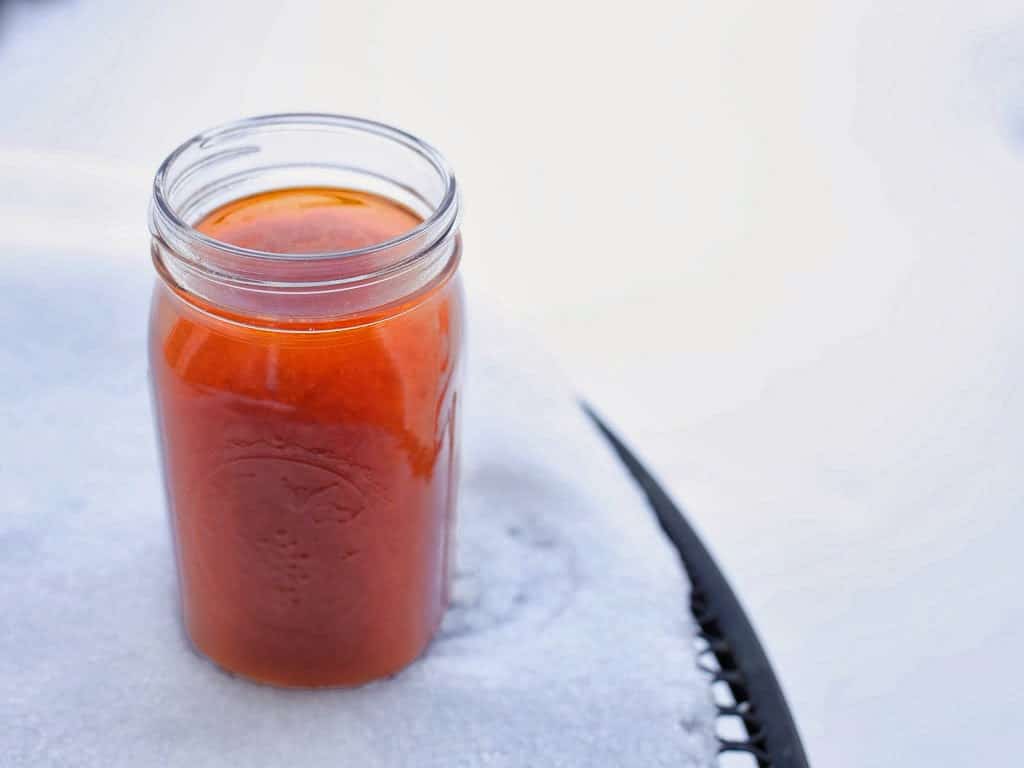
Shrimp Saute with Garlic Butter

January 13, 2014 by Mike Vrobel 1 Comment

A plate of cooked shrimp

Shrimp Sauté with Garlic Butter. Easy peel shrimp, sautéed in garlic butter. A sweet, messy, garlicky main dish that is ready in no time.

A plate of cooked shrimp
Shrimp Sauté with Garlic Butter
[feast_advanced_jump_to]

My plan was to follow my don't let a little winter weather stop you from grilling post, and make some shrimp skewers. Then we had a snowstorm, the kind where I don't want to shovel five inches of snow off the deck, while the storm is blowing sideways, and it's not supposed to end for hours. So, I changed my plans to this quick pan sauté of shrimp.

Ingredients

  • 21-25 count "easy peel" shrimp
  • Kosher salt
  • Fresh ground black pepper
  • Butter
  • Olive oil
  • Garlic
  • Red pepper flakes (optional)
  • Parsley (optional)

What Kind of Shrimp Should I Use?

Frozen shrimp are the way to go, unless you are close to the ocean and can get shrimp straight from the boat. Otherwise, If you are buying shrimp from a grocery store, the shrimp came to the store frozen. (The unfrozen shrimp in the fish case were frozen, thawed by the store, and put in the case). I'd rather do the thawing myself, to make sure the shrimp are frozen until I need them.

I get 21-25 count "easy peel" shrimp. Let's break that down into pieces. 21-25 count means 21 to 25 shrimp per pound. This recipe works with slightly larger and smaller shrimp; if you have 16-20 count or 26-30 count, follow the instructions. If your shrimp are larger or smaller or larger than that, you'll have to use your own best judgement on how many minutes per side. Use the description in the recipe (shrimp turn pink in the middle) to determine doneness instead of trusting a timer.

Next, Easy peel. Easy peel means the shrimp are shell on, but the shells have been cut and the shrimp are already deveined. You can make this recipe with regular, shell-on shrimp; either split the shell down the back with kitchen shears and devein them yourself, or skip the splitting and deveining, and serve the whole shrimp.

How to Thaw Shrimp

The best way to thaw shrimp is to leave them in the refrigerator overnight to thaw. But, I never plan that far ahead, so I go with a quick thaw in cold water. I pour the shrimp into a large bowl, put the bowl under cold running water, and leave the water running until the shrimp thaw, about 20 minutes.

Seasoning Options for Shrimp

This is a simple shrimp recipe, with nothing but salt, pepper, butter, red pepper flakes, and lots of garlic. (I think of it as an Italian style recipe.) If you have a favorite spice or spice blend that you think meshes well with shrimp, you can add a teaspoon or two with the red pepper flakes. Or, if you want to add fresh herbs, a couple of teaspoons of minced rosemary or thyme are good options. See the "Recipe Variations" section, below, for some specific options.

How to Make a Shrimp Sauté

  1. Season the shrimp: Sprinkle the shrimp with the salt and pepper.
  2. Sauté the garlic: Melt the butter and olive oil in a large skillet or frypan, then add the garlic (and optional red pepper flakes) and sauté for a minute, or until you smell garlic.
  3. Cook the Shrimp: Add the shrimp to the pan and toss to coat with butter. Spread the shrimp out in a single layer and let them cook without moving until the shrimp are pink around the edges, about 3 minutes. Flip the shrimp and cook until they are pink all the way through, about 3 more minutes. Toss the shrimp again to coat with the butter, pour the shrimp from the pan onto a platter, scrape any butter and garlic left in the pan over the platter of shrimp, sprinkle with parsley, and serve.

Recipe Variations

  • Shrimp with garlic and herb butter: Add a teaspoon of minced rosemary and 2 teaspoons of minced thyme when you add the garlic and red pepper flakes.
  • Spanish Tapas Shrimp: Add a tablespoon of smoked Spanish paprika when you add the garlic and red pepper flakes.
  • Greek Garlic and Lemon Shrimp: Add 2 teaspoons of minced fresh oregano when you add the garlic and red pepper flakes. When the cooking time is over, toss the sautéed shrimp with the fresh-squeezed juice of 1 lemon just before serving.
  • Mexican Garlic Shrimp: Replace the red pepper flakes with 1 teaspoon of chipotle powder (or chili powder if you want to cut the heat). When the cooking time is over, toss the sautéed shrimp with the fresh-squeezed juice of 1 lime, and substitute minced cilantro for the minced parsley.

Serving Suggestions

Going with my Italian theme, I serve this shrimp with a side dish of angel hair pasta in tomato sauce, steam-sauteed broccoli, and a salad. Or, with a risotto and green beans.

Adapted From: Pam Anderson, Sauteed Shrimp, Fine Cooking Magazine #50

A bowl of raw shrimp between two paper towels
Patting the shrimp dry with paper towels
A frypan full of sautéed shrimp in garlic butter
Sautéing the shrimp

What do you think?

What do you think?

Questions? Other ideas? Leave them in the comments section below.

Related Posts

Ribeye Steak Saute with Red Wine Pan Sauce
Salmon Saute with Tequila Orange Pan Sauce
Sauteed Chickpeas
Instant Pot Shrimp Risotto
Instant Pot Shrimp Étouffée

Enjoyed this post? Want to help out DadCooksDinner? Subscribe to DadCooksDinner using the RSS or Email options on the right, recommend DadCooksDinner to your friends, buy something from Amazon.com through the links on this site, or donate through my tip jar. Thank you.
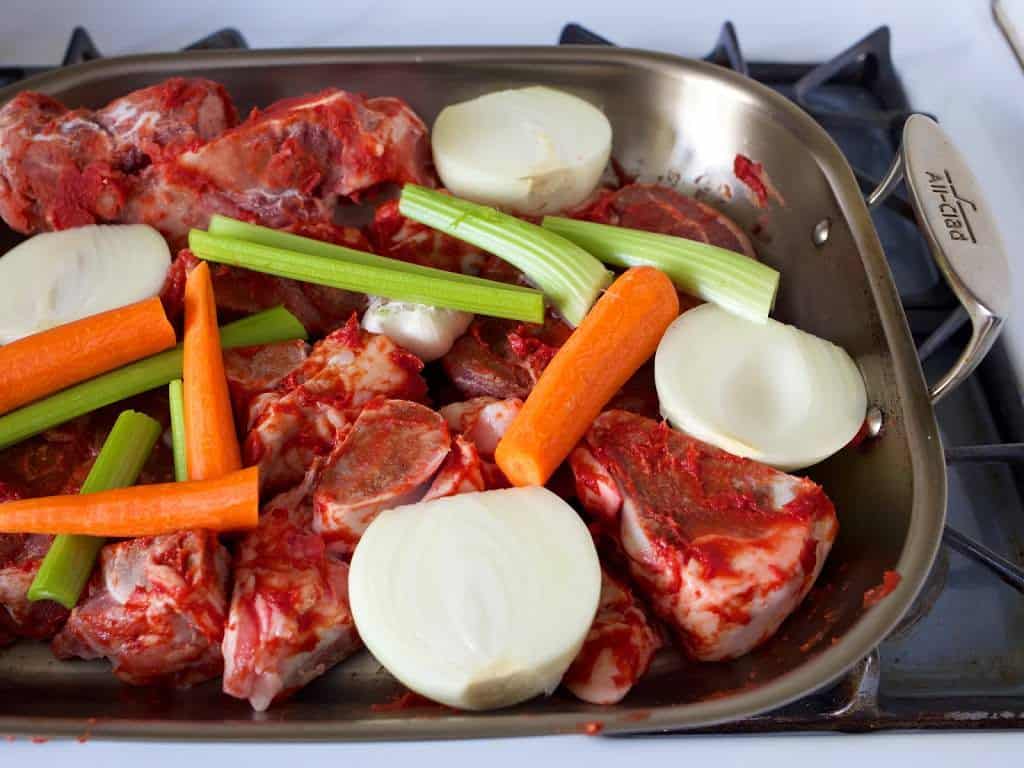
Pressure Cooker Risotto with Edamame

January 7, 2014 by Mike Vrobel 13 Comments

My kids have very…um…interesting tastes. They're picky eaters, but in strange ways. Nothing will explain better than this recipe.

My plan was to make risi e bisi - Venetian rice and peas, a variation on risotto.

I asked the kids - are you OK if I mix peas into the rice? Their reaction?

"Eeeewww!"

Then I asked: What about edamame? They eyed me suspiciously, then two out of three agreed to try it.

Pressure Cooker Risotto with Edamame
[feast_advanced_jump_to]

Peas are too much. But edamame? Sure, they'll eat soybeans. As I've said before, my kids are picky eaters…but, they're picky eaters across a lot of cultures.

This is where I put my "no pressure cooker, no worries" disclaimer. Not today. I'm sure there are Italian grandmothers itching to rap me on the knuckles with a wooden spoon for saying this, but...this is one case where you are much better off using a pressure cooker. Traditional risotto? Thirty minutes of stirring, adding stock a ladle at a time, waiting for the rice to absorb it before adding the next ladle...forget it. PC all the way.

🥫Ingredients

  • Olive oil
  • Butter
  • Onion
  • Arborio rice
  • White wine
  • Chicken broth
  • Frozen shelled edamame

See recipe card for quantities.

Adding edamame to steam in the pot

🥘 Substitutions

Arborio rice is my default for risottos, because it is the easiest one to find at my local grocery stores. I prefer Carnaroli rice for pressure cooker risotto, when I can find it. It stands up to cooking a little better than Arborio or Vialone Nano, and I don't mind having a little extra cushion when I'm pressure cooking.

If you use store-bought broth, watch out for "regular" chicken broth - it's loaded with salt. If you can't find low-sodium chicken broth, use water.

But, please, try homemade chicken broth. If you have an Instant Pot, you will love it.

The white wine is optional - it's traditional in risotto, but you can leave it out if you are avoiding alcohol. I use pinot grigio in my risottos - it's a dry Italian white, so it feels appropriate - but use whatever white wine you have on hand.

This recipe can be vegetarian if you are OK with butter; use vegetable broth instead of the chicken broth. (And, again, if you're using store-bought broth, try to find low sodium broth.)

🛠 Equipment

A 6-quart pressure cooker. Pressure Cooker risotto converts a lot of people to pressure cooking - no tedious stirring needed, just a few minutes under pressure.

📏Scaling

This recipe doubles easily in a 6-quart pressure cooker. Cut all the ingredients in half and this recipe will fit in a 3-quart pressure cooker.

💡Tips and Tricks

  • Pressure cooking is the key to easy risotto. No need to stir for 30 minutes, carefully ladling broth into the pot. I can lock the lid on my Instant Pot, set it to cook for 5 minutes, and have a fantastic risotto without all the extra work.
  • Homemade broth is another key to this recipe. I know, I know, it's extra work. But it is SO GOOD. Make it ahead, freeze it in 2-cup containers, and you'll always be ready to make a fantastic risotto or chicken soup.


Adapted From: Lorna Sass Pressure Perfect

☃️ Storage

According to the USDA, Leftover risotto is good for up to three days in the refrigerator, or three months in the freezer, as long as it is refrigerated (or frozen) within an hour of cooking. (I portion out my rice in 2-cup containers before I put it in the fridge or freezer.) Also, be sure to reheat the rice all the way through - to be precise, an instant read thermometer should read 165°F in the middle of the rice.

🤝 Related Posts

Pressure Cooker Risotto with Goat Cheese
Pressure Cooker Macaroni and Cheese
Pressure Cooker Osso Bucco
My other pressure cooker recipes

*Enjoyed this post? Want to help out DadCooksDinner? Subscribe to DadCooksDinner using the RSS or Email options on the right, recommend DadCooksDinner to your friends, buy something from Amazon.com through the links on this site, or donate through my tip jar. Thank you.
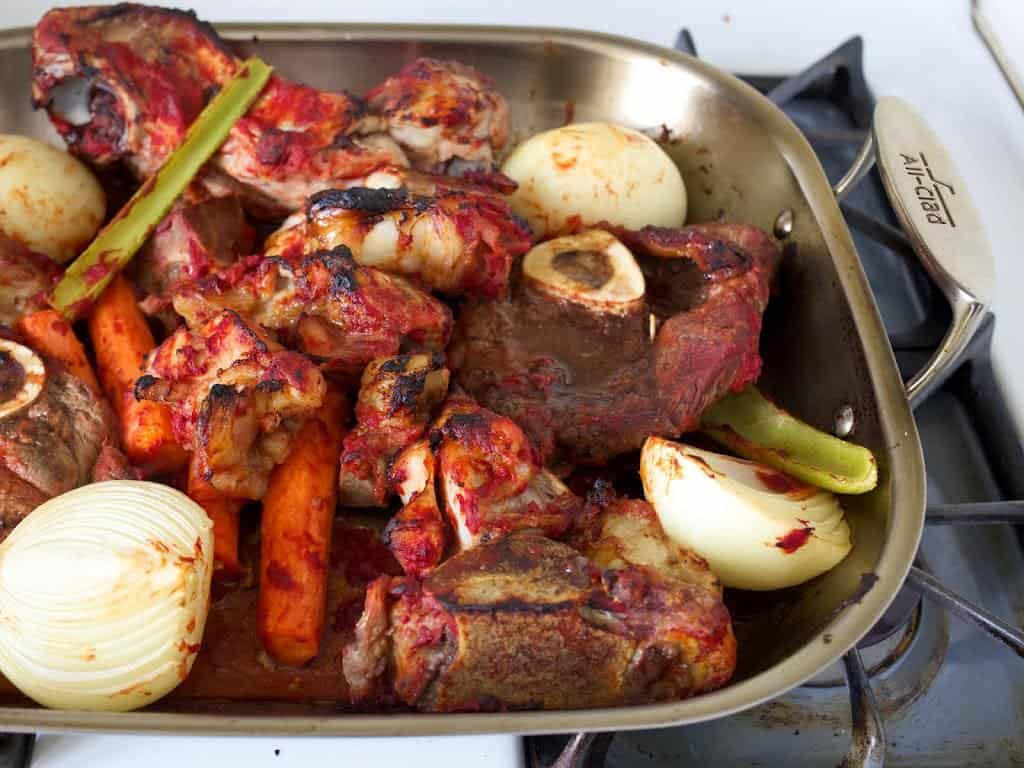
Tilapia In Crazy Water (Pesce All’Acqua Pazza)

January 2, 2014 by Mike Vrobel 12 Comments

I ordered it because of the name. Crazy Water? How could I pass it up?

I saw this recipe on the menu at Macaroni Grill, of all places. I wasn't impressed when it came to the table. It looks bland - white fish, poached in water - but it packs some big flavors.

The flavor is in the crazy water. Onions, tomatoes, and capers; garlic, herbs, and white wine. That’s a lot of flavor to go with the mild white fish.
Say it with me: Craaaaazy water.

The recipe is quick, warming, light, and healthy…what more could you want?

Recipe: Tilapia In Crazy Water (Pesce All'Acqua Pazza)


Inspired by: Canal House Cooking Volume number 8: Pronto

Equipment

  • Large, shallow pan with a lid (I use a Le Creuset Braiser, but a large fry pan or saute pan will also work)

Ingredients

  • 2 tablespoons extra virgin olive oil
  • 1 medium onion, sliced thin
  • 1 teaspoon capers, drained
  • ½ teaspoon kosher salt
  • 2 cloves garlic, sliced thin
  • ¼ teaspoon crushed red pepper flakes
  • 1 teaspoon Italian seasoning blend (or dried oregano)
  • ½ cup dry white wine (pino grigio is my favorite for this)
  • 15 ounce can diced tomatoes
  • 1 quart water
  • 1 teaspoon kosher salt
  • ½ teaspoon fresh ground black pepper
  • 4 (4 ounce) tilapia fillets
  • 1 teaspoon kosher salt
  • ½ cup minced parsley

Directions

1. Saute the aromatics

Heat 2 tablespoons olive oil in a large frypan over medium heat. When the oil is shimmering, add the onion, capers, garlic, red pepper flakes, and Italian seasoning. Sprinkle with salt, and saute until the onions are soft, about 5 minutes. Pour in the white wine and bring to a simmer, scraping any browned onions from the bottom of the pan with a wooden spoon. Simmer the wine for one minute.

2. Simmer the broth

Pour in the diced tomatoes and simmer, scraping the bottom of the pan to loosen any browned bits, until the tomato juices thicken, about 5 minutes. Add the water, 1 teaspoon kosher salt, and black pepper. Increase the heat to high, bring the water to a boil, then reduce the heat and simmer the water for ten minutes.

3. Cook the fish

Sprinkle the fish evenly with 1 teaspoon kosher salt (about ¼ teaspoon per fillet). Add the fish to the simmering water - the water won’t completely cover them. Cover the pan and cook the fish for five minutes.

4. Taste and serve

Taste the broth in the pot, and add salt and pepper if needed. Scoop each fish fillet into a shallow bowl, sprinkle with a big pinch of parsley, then divide the broth between the bowls, making sure each fillet is topped with a bunch of tomatoes and onions. Serve.

Notes

  • I use tilapia, because it's inexpensive and environmentally friendly, but any mild, flaky white fish will work.
  • You can substitute a pint of cherry tomatoes for the canned diced tomatoes if you want, but since they're cooking in the water, I don't bother - I start with the pre-cooked canned tomatoes. (Don't try other types of store-bought tomatoes; they're tasteless. If you can get fresh, summer tomatoes, though, this recipe is an excellent way to use them.)

What do you think?

Questions? Other ideas? Leave them in the comments section below.

Related Posts:

Sear Roasted Salmon with Knob Creek Smoked Maple Glaze
Mussels with Spanish Chorizo
Tilapia with Brown Butter and Lemon
Air Fryer Tilapia

*Enjoyed this post? Want to help out DadCooksDinner? Subscribe to DadCooksDinner using the RSS or Email options on the right, recommend DadCooksDinner to your friends, buy something from Amazon.com through the links on this site, or donate through my tip jar. Thank you.
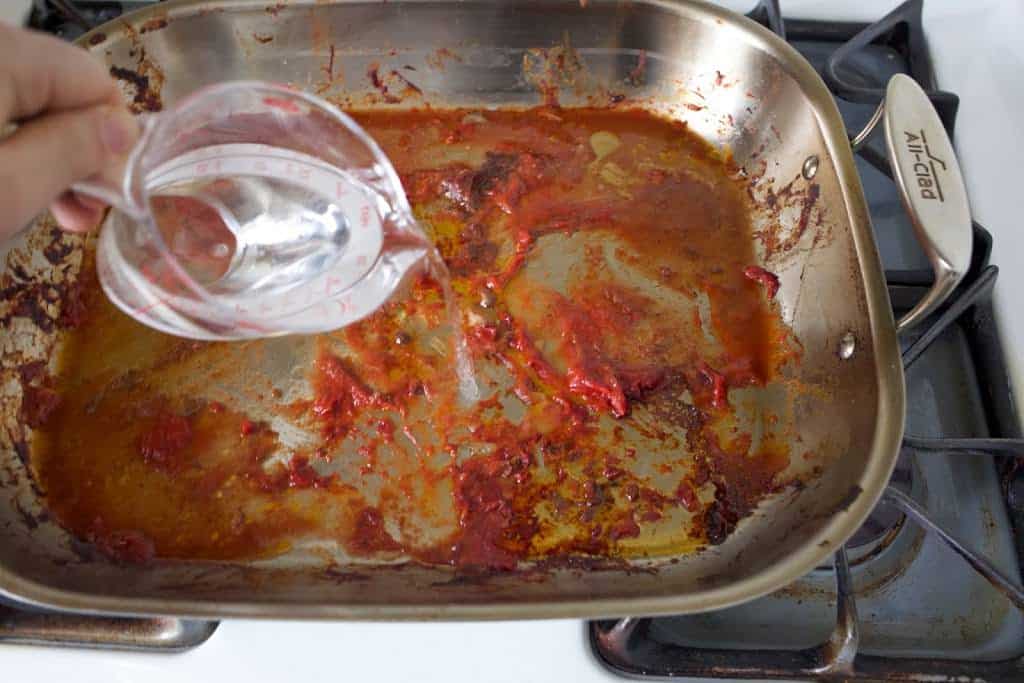
Happy New Year 2014

December 31, 2013 by Mike Vrobel 6 Comments

Pressure Cooker Macaroni and Cheese

What are my new year’s resolutions? I’ve got three:

I need to lose weight. As always. I lost ten pounds in 2013 using a low-carb diet. I didn’t talk about it on the blog, but I’m sure my regular readers noticed - the blog was meat heavy this year. I haven’t been good recently - I lost close to 25 pounds by June - but my weight drifted back up over the second half of the year. I need to re-focus, or try a different diet.

More simple recipes. Judy Rodgers passing shook me. The Zuni Cafe Cookbook was a huge influence on my cooking, with its straightforward approach to cooking. I publish a lot of gadgety recipes - rotisserie, pressure cooking, sous vide - because they’re fun, and because I like playing with new toys. I need to get back to basics. I’m going to publish more simple recipes this year.

Finish my next book. I’ve been procrastinating. I have two books about halfway done, and ideas for two others, but I need to focus on one of them and get it out the door. I need to remind myself - real artists ship.

Here's a look back at my thirteen most popular posts of 2013

#1 Rotisserie Injection Brined Turkey

#2 Pressure Cooker Macaroni and Cheese

#3 Slow Cooker Texas Red Chili

#4 Grilled Mini Sweet Peppers

#5 Pressure Cooker Refried Pinto Beans

#6 Grilled Turkey, Dry Brined (Grilling Basics)

#7 Rotisserie Ham with Orange and Honey Glaze

#8 Grilled Butterflied Chicken with Garlic Butter

#9 Baked Italian Meatballs

#10 Grilled Cowboy Chop (Double Cut Ribeye, Reverse Seared)

#11 48 Hour Sous Vide Grilled Short Ribs (with Sous Vide Q&A)

#12 Rotisserie Prime Rib Roast, Reverse Seared on a Gas Grill

#13 Grilled Korean Pork Belly Lettuce Wraps (Daeji Bulgogi)

Happy New Year, everyone!

*Enjoyed this post? Want to help out DadCooksDinner? Subscribe to DadCooksDinner using the RSS or Email options on the right, recommend DadCooksDinner to your friends, buy something from Amazon.com through the links on this site, or donate through my tip jar. Thank you.
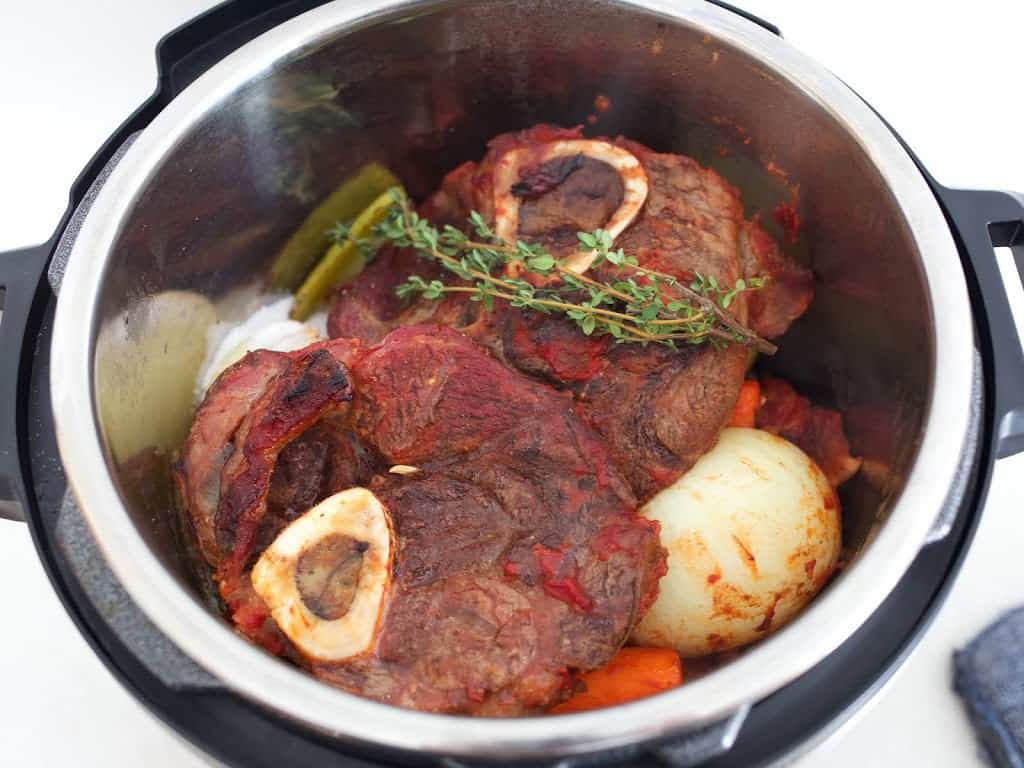
Sous Vide Chicken Thighs with Garlic and Herb Pan Sauce

December 30, 2013 by Mike Vrobel 4 Comments

Tongs holding a golden brown chicken thigh

Easy Sous Vide Chicken Thighs. I use modernist cooking techniques for an easy weeknight chicken dinner (after a few hours of sous vide cooking).

You don't know the power of the dark side…of the chicken. Join us! We have flavor!

Famous chefs use Modernist Cuisine to make the perfect meal. Me? I use it to get dinner on the table in ten minutes.

Tongs holding a golden brown chicken thigh
Sous Vide Chicken Thighs
[feast_advanced_jump_to]

Months ago, I bought chicken thighs on sale at the grocery store. My meal prep is seasoning them with salt and pepper, vacuum sealing them in flat, single layers, and freezing them. When I need an easy chicken thigh dinner, I fill my sous vide tank with water, set my sous vide circulator to 80°C (176°F), and drop in a bag of frozen chicken thighs before I start work. The chicken thighs are ready to sear whenever I'm ready for dinner.

Look at that - weeknight sous vide. Ten minutes of active time and I'm ready to serve tender chicken with crackling crisp skin, perfectly cooked dark meat, and a tasty pan sauce.

If you're looking for some other sous vide recipes, check out my Sous Vide Boneless Ribeye Roast recipe, Sous Vide Porterhouse - from the freezer, or Sous Vide 48 Hour Baby Back Ribs

Equipment

  • SousVide machine and water tank (I use a Anova Sous Vide circulator and a Lipavi sous vide container)
  • Vacuum sealer and gallon vacuum bags (to seal the chicken thighs)
  • Large, heavy fry pan (I use a large cast iron pan or a 12-inch frypan)
  • Coffee filters or a fine mesh strainer

Ingredients

  • Bone-in chicken thighs
  • Fine sea salt
  • Fresh ground black pepper
  • Garlic
  • Dry rosé wine (or white wine)
  • Fresh thyme
  • Fresh rosemary

See the recipe card for details

Sous Vide Chicken Thighs Step By Step Instructions

A vacuum sealed bag of chicken thighs
Vacuum sealed chicken thighs

Season chicken thighs with salt and pepper, and vacuum seal them in a single layer. Sous vide at 176°F/80°C for 4 to 8 hours.

A cast iron pan full of chicken thighs
Sear the thighs skin side down

Remove the chicken thighs from the bag, saving the liquid. Pat the chicken thighs dry with paper towels. Heat a heavy frypan over medium-high heat, then add the chicken thighs, skin side down, and sear until the skin is crisp and brown, about 3 minutes. Remove to a platter.

A pan with a thin layer of broth and sprigs of fresh thyme and parsley
Simmering the sauce with herbs

Strain the juices in the vacuum bag through a fine mesh strainer. Add the slices of garlic to the frypan and cook until browned, about 1 minute. Add the wine, strained juices, and herb sprigs to the frypan, and simmer until reduced by half, about 5 minutes.

Cooked chicken thighs on a plate with vegetables, with a glass of wine.
Serve and enjoy

Serve the chicken thighs, passing the pan sauce at the table. Enjoy!

Notes

  • Why strain the juices from the bag? It filters out coagulated proteins - a trick I picked up from StefanGourmet.com. This keeps the sauce from looking terrible, with a layer of curdled protein scum floating on top.
  • What if I do not drink...wine? Use chicken broth instead, or skip the wine and just use the juices from the sous vide bag.
  • Can I use boneless skinless chicken thighs in this recipe? Yes, but cut the sous vide time down to 2 hours.
  • Why sous vide? The long, slow cooking time gives me tender and juicy chicken, and it can't overcook, so it's ready when I am. Just pull the bag from the circulator, cut it open, and chicken dinner is ready.

Questions? Other ideas? Leave them in the comments section below.

Related Posts

Sous Vide Grilled Lamb T-Bones with Provencal Tian
Sous Vide Salmon with Fennel Salad
Sous Vide Grilled Chicken Breasts with Japanese Glaze and Dipping Sauce
Click here for my other sous vide recipes.

*Enjoyed this post? Want to help out DadCooksDinner? Subscribe to DadCooksDinner using the RSS or Email options on the right, recommend DadCooksDinner to your friends, buy something from Amazon.com through the links on this site, or donate through my tip jar. Thank you.
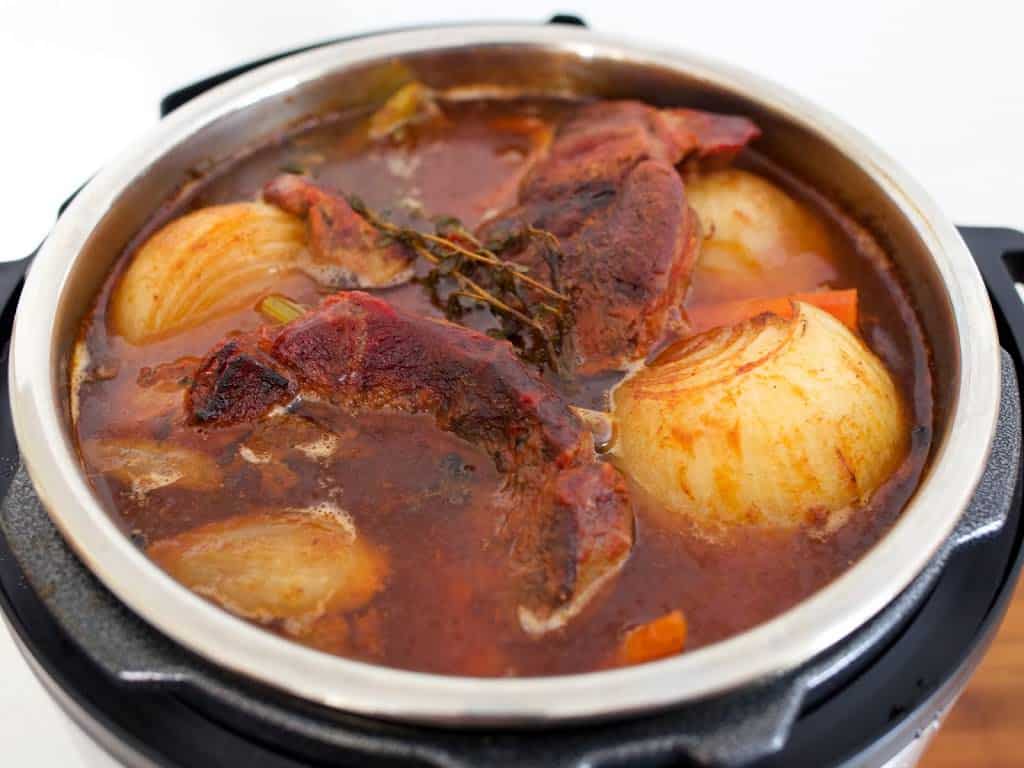
Rotisserie Fresh Ham with Injection Brine

December 26, 2013 by Mike Vrobel 13 Comments

Rotissierie Fresh Ham with Injection Brine

Rotissierie Fresh Ham with Injection Brine

Fresh ham is hard to find...except around New Year's Day. Northeastern Ohio has a lot of Eastern Europeans, and everyone wants pork and sauerkraut for good luck in the New Year.
I don't have Eastern European in my background - but my wife does. Me? I came to pork and sauerkraut later in life - as a high schooler, eating knockwursts buried in sauerkraut from the hot dog vendors in downtown Cleveland.The British call this a "leg of pork roast", which is a better explanation than fresh ham…but I'm going with the American name for now. I think it explains the cut better to my American audience.
I'm cooking half of a leg - pictured is the shank end of the fresh ham. The butt end is boned and in my freezer, waiting to be turned into a boneless roast at some point in the future.

Fresh ham is a lean cut of pork, similar to pork loin. I injection brine the leg roast to season it all the way through, and add some moisture to the lean meat. Even with the brine, it doesn't have the cured meat taste that makes me think "ham". This is a pork roast, through and through._

So, why go through all the effort? Because, pork cracklings. There's nothing better than pork skin, crisped up on the grill in its own pork fat.
The meat isn't bad, either - like I said, it's kind of lean, like a pork loin - but it has more fat and connective tissue, so it doesn't dry out as quickly as the loin. If you like lean pork, try pork leg - you'll enjoy it.

Recipe: Rotisserie Fresh Ham with Injection Brine

Equipment

  • Grill with Rotisserie attachment (I use a Weber Summit with an infrared rotisserie burner. Here is the current version of my grill.)
  • Aluminum foil drip pan (9"x13", or whatever fits your grill. I use an enameled steel roasting pan.)
  • Butchers twine
  • Instant Read Thermometer

Injecting the pork
Injecting the pork

Trussed and Spit
Trussed and Spit

Getting there...
Getting there...

Crisping with the infrared rotisserie burner

Done
Done

Notes

  • Fresh ham can be hard to find...unless you have a really good butcher, where they stock it in their meat case. If you can't find it, ask your butcher or meat department to order one - they should be able to get fresh ham without too much trouble.
  • Why injection brine? I don't want the pork skin absorbing water, making it harder to crisp up into cracklings. Injecting the brine puts it where I want it, in the meat, and leaves the skin to dry out and get all crunchy and delicious.
  • Drip pan potatoes in pork fat are amazing. You must try them. Must, I tell you!

What do you think?

Questions? Other ideas? Leave them in the comments section below.

Related Posts:

Rotisserie Pork Shoulder with South Carolina Mustard Sauce
Rotisserie Barbecued Pork Belly
Rotisserie Stuffed Pork Loin with Pepperoni, Provolone and Capicola
Click here for my other rotisserie recipes.


Check out my cookbook, Rotisserie Grilling.Everything you could ask about the rotisserie,
plus 50 (mostly) new recipes to get you cooking.

It's a Kindle e-book, so you can download it and start reading immediately!


*Enjoyed this post? Want to help out DadCooksDinner? Subscribe to DadCooksDinner using the RSS or Email options on the right, recommend DadCooksDinner to your friends, buy something from Amazon.com through the links on this site, or donate through my tip jar. Thank you.
Merry Christmas! (2013 Edition)

December 24, 2013 by Mike Vrobel Leave a Comment

Dear George:

Remember, no man is a failure who has friends.

Thanks for the wings!
Love
Clarence

Merry Christmas, everyone!

Mike Vrobel
DadCooksDinner.com

Rotisserie Prime Rib Roast, Reverse Seared on a Gas Grill

December 19, 2013 by Mike Vrobel 26 Comments

Rib Roast on a cutting board in front of a Christmas tree

Today, we're cooking a big rib roast on my gas grill's rotisserie.

Big means four bones or more of the prime rib - up to the entire seven bone rib section.

We're going to use a trick that all good food scientists recommend - the reverse sear. We cook the roast low and slow to 110°F, then finish with a blast of heat, bringing the roast to medium-rare and giving it a browned, crisp crust. The reverse sear gives us a perfectly cooked roast, medium rare all the way through, and keeps the juices in the roast where they belong.
Why? If you're interested, see my long-winded post about it earlier this week.

Rib Roast on a cutting board in front of a Christmas tree
Rotisserie Rib Roast, Reverse Seared, In front of the Christmas tree

A gas grill makes this easy - especially one with an infrared rotisserie burner. Set the grill up for indirect low heat, with a drip pan in the middle, and the outer burners set for a grill temperature of 250°F. Cook the roast to 110°F (or as close as you can get), then turn the outer burners to high, turn the rotisserie burner to high, and blast the roast with heat for fifteen minutes, until it has a beautiful browned crust and reaches an internal temperature of 120°F. Rest for 15 minutes, carve, serve, and wow your guests with a perfect, medium-rare prime rib.

Prime rib roast, sliced to show the pink interior
Reverse sear for perfect pink prime rib

My "Prime Rib" disclaimer

Technically, this is a beef rib roast, not prime rib. That is, unless you can afford to pay for USDA Prime graded beef. I did this - once - and it was fabulous. It also cost $16.99 a pound for a five bone roast, weighing 16 pounds. (My wallet still screams thinking about it). Since then, I look for Choice rib roasts with a lot of small streaks of fat inside the muscle (aka "well marbled"). I can usually find them between $6.99 and $9.99 a pound.

Special thanks to my butcher, Mike at Sherman Provision. He put up with multiple roast requests because I had to test this technique against a "high and fast" roast. And, for the record, his roasts are both well marbled and inexpensive.

Equipment

  • Grill with Rotisserie attachment (I use a Weber Summit with an infrared rotisserie burner. Here is the current version of my grill.)
  • Aluminum foil drip pan (9"x13", or whatever fits your grill. I use an enameled steel roasting pan.)
  • Butchers twine
  • Instant Read Thermometer

Notes

  • You can reverse sear on a charcoal grill - start the grill out low and slow, then add a chimney full of lit charcoal at the end for the blast of high heat. I wouldn't bother, if I were you. Charcoal burndown gives you low and slow naturally, starting high, then cooling off as it burns, and finishing the roast on low heat. It's not quite the food scientist approved method, but it's close enough, and it is less fussy. Check out my Rotisserie Prime Rib Roast recipe for charcoal grill setup.
  • About cooking times. The weight of the roast doesn't matter - the thickest part of the meat determines how long it will cook. Butchers size rib roasts by the number of bones you want; an entire rib roast has seven bones. Below two bones is a thick steak, so we won't talk about that here. Two bone roasts, about 4 pounds, are taller than they are wide - they cook more from the heat on the sides of the roast, and take less time to cook - start checking their temperature at 30 minutes, and expect them to take about an hour to get to 110°F. Three bone roasts are about as wide as they are tall, and cook from all directions. Start checking after 45 minutes, and expect them to take an hour and a half to get to 110°F. 4 bone or larger roasts, up to the entire seven bone rib roast, all cook in about the same time - the roast is now wider than it is tall, the heat has to work its way in from the sides, and adding extra width will not slow that down. They take about 2 ½ hours to cook to 110°F. (All timings are approximations. Please use an instant read thermometer to be sure, because if you're going to go through all this effort, don't you want to know what's going on in that roast?)

What do you think?

Questions? Other ideas? Leave them in the comments section below.

Related Posts

Rotisserie Prime Rib Roast (Charcoal grill setup)
Rotisserie Beef Tenderloin with Shallot Herb Butter and Horseradish Sauce (Use the horseradish sauce with any beef recipe)
Rotisserie Boneless Ribeye Roast with Garlic Crust
Click here for my other rotisserie recipes


*Enjoyed this post? Want to help out DadCooksDinner? Subscribe to DadCooksDinner using the RSS or Email options on the right, recommend DadCooksDinner to your friends, buy something from Amazon.com through the links on this site, or donate through my tip jar. Thank you.
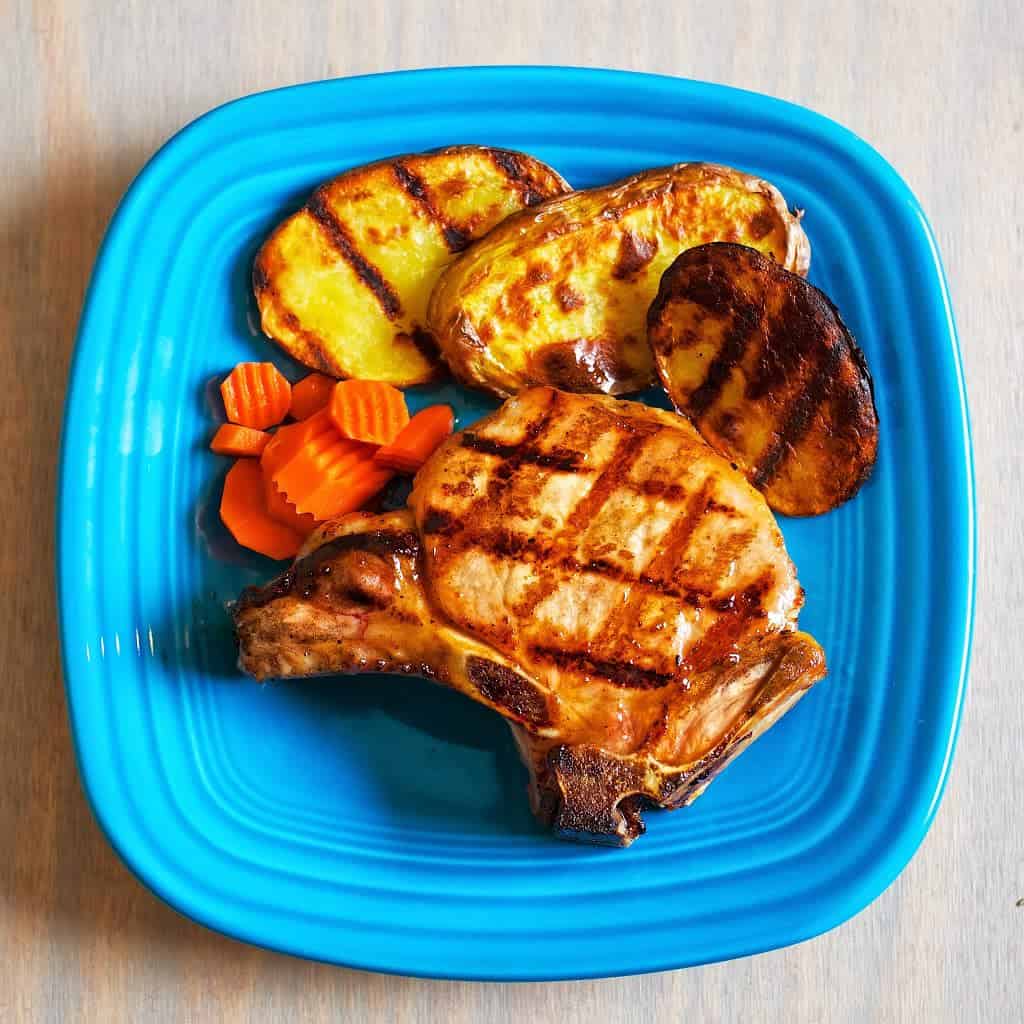
Testing Reverse Sear on the Rotisserie

December 17, 2013 by Mike Vrobel 12 Comments

Before I get started: Everything below talks about grilling with a rotisserie, because it’s my favorite way to roast meat. If you don’t have a rotisserie, keep reading - the results apply to grill roasting and oven roasting. I feel like I should apologize for the rotisserie slant - but I’m not sorry. It just works too well for me.

I use my gas grill rotisserie for “set it and forget it” grilling. For a big prime rib, I set the grill up for indirect medium-high heat, around 400°F, start the rotisserie spinning, and cook until the roast is done (120°F internal temperature).

But…I get better results from my charcoal grill rotisserie, even though I use the same basic technique. Why? Because charcoal is the opposite of “set it and forget it”. Charcoal may start at high heat, but it as it burns, it cools off. The result is high-low cooking: a blast of high heat to brown the meat at the start, then a gradual burn-down to low heat to finish the roast.

All the food scientists say this is a good thing - I should cook my roasts low and slow. Low and slow results in medium-rare meat from edge to edge; high heat gives a bulls-eye of doneness, with medium rare in the center, surrounded by rings of medium, medium-well, and well done meat before you get to the surface. Only some of the roast is cooked the way you want it.
When I say all the food scientists, I mean ALL the food scientists. Everyone I trust...Cook’s Illustrated, Shirley Corriher, Alton Brown, Kenji Alt, Helen Rennie, Meathead Goldwyn…they all agree on the technique.

Now, low heat is great for an evenly cooked roast, but it leaves the outside of the meat pale and flabby. To get a browned, crisp crust on the meat, we need high heat. That’s where the reverse sear comes in. Most modern roast recipes recommend cooking low and slow (somewhere between 200°F and 250°F) until the roast is almost done, then finishing with a blast of heat, or a sear in a hot pan to caramelize the outside of the roast.

Why reverse sear? Why not duplicate charcoal’s high-low approach? High-low is better than constant high heat, with the advantage of low and slow for most of the cooking time. But the high heat blast at the beginning starts overcooking the outside of the roast, and that heat carries over. Reverse searing saves that blast of heat for the very end, so we can get the meat away from the high heat quickly. In other words, a reverse seared roast is more evenly cooked on the inside.

So, that’s the theory behind a reverse sear. But, is it really worth the extra effort? Let’s find out.

Time to Test

I bought two 4 bone prime rib roasts for testing.
Special thanks to my butcher, Sherman Provision, for providing the beautiful roasts you see here.

Constant heat roast

One roast was cooked on the rotisserie with constant high heat. The grill is set for indirect medium high heat (400°F) for the entire cooking time; the roast is done when it reaches 115°F to 120°F internal temperature. (Carry over heat will bring it up to about 130°F, medium-rare). This took roughly 1 hour 45 minutes for a 10 pound roast.

Reverse seared roast

The other roast was cooked on the rotisserie with a reverse sear. The roast cooks at indirect low heat (250°F) until it reaches 110°F internal temperature, which took about 2 ½ hours. Then the grill is cranked up to indirect high heat (rotisserie burner to high, outer burners to high) and the roast sears until it gets a nice, browned crust and reaches 120°F to 125°F internal temperature, about 15 minutes.

I want you to know what I went through to bring you this information. Here I use my trusty Thermapen to check the outdoor temperature. 18.5°F! It’s a heat wave!

Results

Whoops

First, I have to let you know - I screwed up, and overcooked the constant heat roast. Internal temperature readings:

  • 1 hour (77°F)
  • 1 hour 30 minutes (108°F)…getting close
  • 1 hour 35 minutes (114°F)…maybe five more degrees…give it five more minutes…
  • 1 hour 40 minutes (129°F)

Gaah! Too much! The constant heat roast came out medium, not medium-rare like I was aiming for. Which leads to my first finding:

Nooooo!

Reverse sear has more room for error

High heat rotisserie doesn’t leave much margin for error - when the roast is getting close, check it often. (Overcooking the Christmas roast is so sad.) Low and slow has more wiggle room. Now don’t get complacent, and leave your roast alone. But…an extra five minutes at 250°F will push the roast’s internal temperature up a few degrees. Not a big deal. An extra five minutes at 400°F? As I showed above, the roast can go from medium-rare to medium. Advantage, reverse sear.

Reverse sear - more evenly cooked
Constant heat - gray to pink to red

Edge to edge medium-rare? Well…

Well, I didn’t exactly get edge to edge medium-rare on the reverse seared roast…I was a little disappointed at the half inch gray ring around the outside of the roast; I wanted pink right to the crusty edge. But when compared to the constant heat roast? The reverse sear is much more evenly cooked. Advantage, reverse sear.

Crust on constant heat roast

Browned crust

Rotisserie is a pain - trussing and spitting the roast, wrangling the motor and cord - but the browned crust on the outside of the roast makes it all worthwhile. The high heat rotisserie roast has a better crust, crisp and flavorful. But I was surprised how good the reverse sear crust was. I thought fifteen minutes of heat wouldn’t be enough. I was wrong - the outside of the meat was dry from the low and slow cooking, and the blast of high heat quickly browns the roast. Advantage: slight edge for constant heat rotisserie.

Low and slow after two and a half hours

Slowwwwly

The downside to low and slow? The “slow” part. You’re adding an extra hour of cooking time with the low and slow approach. Now, it’s not like a rib roast is a thirty minute meal, but that extra hour can be the difference between a smashing success of a meal, and having your guests hovering over your shoulder asking “is it done yet?”. Advantage: constant heat rotisserie.

Gotta love the pink

Summary

Reverse sear wins…barely.

In the end, like most cooking questions, there is no absolute right answer. Tastes differ. What do you want in a prime rib roast? Questions to ask yourself:

Reverse sear if…

You want perfectly pink meat in your roast. Do you send a steak back if it’s medium-rare and you asked for rare? Definitely reverse sear your roast. Are you nervous, worried about overcooking your roast? (Because, say, one of your guests sends back a steak if it’s medium-rare, and they asked for rare?) Reverse sear is the way to go.

Constant medium-high heat if…

Are you in a hurry? Guests arriving any minute? Go with constant heat, it’s quicker. Do you lust after the ends of the roast, where the browned, caramelized, crispy crust is? Don’t care about the bullseye of doneness inside if the crust is perfect? Constant heat, no question. Do you buy a well marbled rib roast…then destroy it cook it well done all the way through? Constant heat; you might as well ruin it finish faster.

Notes

  • No rotisserie? Reverse sear is even easier. Set the grill up for indirect low heat. Put the roast over the middle of the grill, with the heat on the sides, and insert a probe thermometer with the alarm set to 110°F. When the alarm goes off, sear the roast over what's left of the coals. Easy. (But, the rotisserie will give you a better seared crust, by basting the meat in its own juices while it constantly turns.)
  • Sous vide cooking is reverse searing taken to the extreme - you put the meat in water set to the exact temperature you want - say, 125°F for medium rare. It can't overcook the meat. You wait for the temperature to equalize between the meat and the water bath, and your steak is perfectly medium-rare. But…good luck fitting a ten pound rib roast in a vacuum seal bag without industrial sized equipment.
  • I really do need to compare a high-low charcoal grilled roast with a reverse seared gas grilled roast. But, I've already paid for two rib roasts this year, and I need a third one for Christmas. My wallet says I have to wait for next year to do that comparison. Stay tuned!

What do you think?

Questions? Are you a hot and fast, or low and slow kind of roaster? Talk about it in the comments section below.

Related Posts:

[Coming Thursday] Rotisserie Prime Rib, Reverse Seared
Constant heat recipe: Rotisserie Prime Rib Roast
Click here for my other rotisserie recipes.


Check out my cookbook, Rotisserie Grilling.

Everything you could ask about the rotisserie,
plus 50 (mostly) new recipes to get you cooking.

It's a Kindle e-book, so you can download it and start reading immediately!


*Enjoyed this post? Want to help out DadCooksDinner? Subscribe to DadCooksDinner using the RSS or Email options on the right, recommend DadCooksDinner to your friends, buy something from Amazon.com through the links on this site, or donate through my tip jar. Thank you.
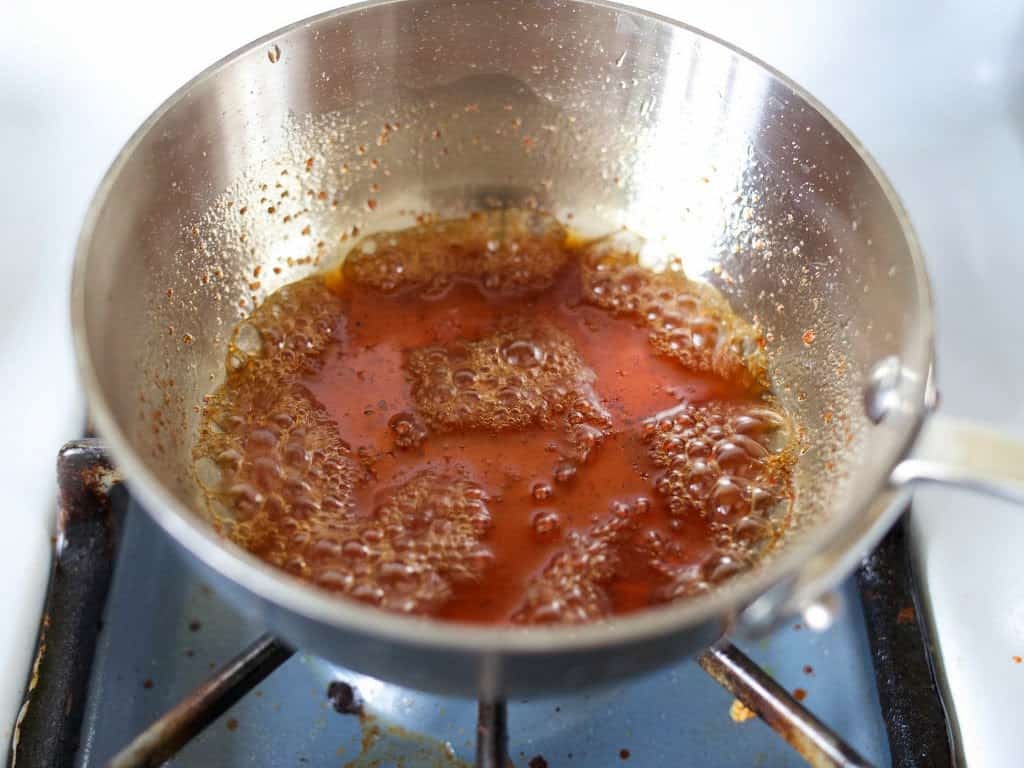
Cast Iron Roasted Butterflied Chicken

December 16, 2013 by Mike Vrobel 21 Comments

Cast Iron Roasted Butterflied Chicken

Cast Iron Roasted Butterflied Chicken

Judy Rodgers had the courage of her convictions and the guts to keep things simple.
David Tanis

This post is in remembrance of Judy Rodgers, who passed away earlier this month. Judy is a huge influence on my cooking; The Zuni Cafe Cookbook is one of my go-to reference books, and the meals I ate at the Zuni Cafe still linger in my memory.
My first meal at Zuni - roast chicken with bread salad - is still my favorite restaurant meal ever. Perfect roast chicken is simple, but not easy, and that was perfect roast chicken.

Judy introduced me to early salting. I call it dry brining, even if it isn't a brine, and I use it everywhere. There's nothing better than a simple roast chicken, salted the night before cooking, roasted hot and fast.

Now, I'm not following Judy's exact recipe here; I don't have Zuni's super-hot brick oven. Instead of roasting the whole chicken, I'm butterflying it, browning it in a heavy, cast iron pan to crisp up the skin, then sliding that pan into the oven to finish roasting. Simple, delicious. Maybe not the perfection of a Zuni roast chicken, but the perfect meal for a cold night, and a fond farewell.

Recipe: Cast Iron Roasted Butterflied Chicken

Inspired By: Judy Rodgers, Zuni Cafe Cookbook

Equipment

  • Large cast iron skillet (or a heavy, oven safe frypan)
  • Poultry shears
  • Probe thermometer (optional, but makes it easy to tell when the chicken is done)

Butterflied chicken
Butterflied chicken


Searing the chicken
Searing the chicken


Ready for the oven
Ready for the oven


Roasted, ready to serve


Ready, set...
Ready, set...


...carve!
...carve!

Notes

  • The roasting juices are perfect drizzled over quick baked potatoes.
  • This chicken was larger than I expected - about five pounds - and it was crowding the pan. A smaller, four pound chicken will fit better.

What do you think?

Questions? Other ideas? Leave them in the comments section below.

Related Posts

Quick Baked Potatoes
Grilled Butterflied Chicken with Dry Brine
Baked Chicken Thighs with Mustard and Herbs

*Enjoyed this post? Want to help out DadCooksDinner? Subscribe to DadCooksDinner using the RSS or Email options on the right, recommend DadCooksDinner to your friends, buy something from Amazon.com through the links on this site, or donate through my tip jar. Thank you.
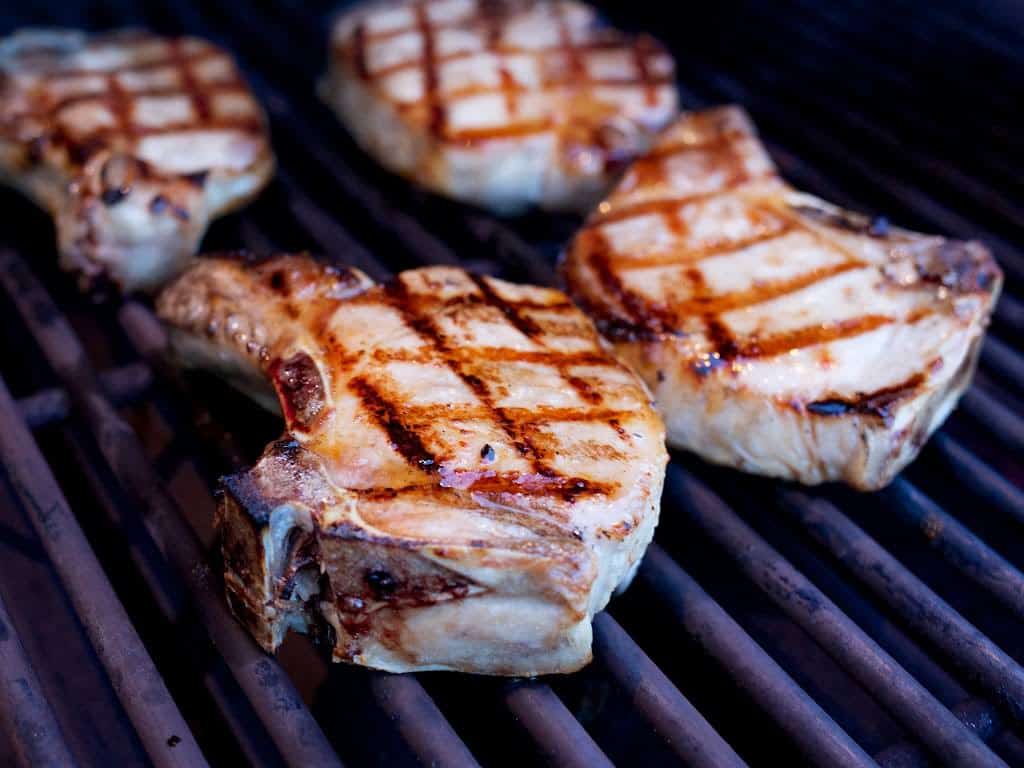
Slow Roasted Pork Shoulder with Beer and Mustard Sauce

December 12, 2013 by Mike Vrobel 17 Comments

Slow Roasted Pork Shoulder with Beer and Mustard Sauce

Slow Roasted Pork Shoulder with Beer and Mustard Sauce

This recipe is lazy. Perfect for a cold winter day - where you want to stay under blankets in front of the fire, and you have more time than energy. Season the pork, drop it in the pot, surround with vegetables, slap on the lid, and slide it into the oven. Go relax. Five hours later the pork roast is fall apart tender. Remove the lid, raise the heat in the oven, and let it brown for forty-five minutes. Spoon out the roast and the caramelized vegetables, and use the browned drippings in the pot to make a pan sauce.

The pot is also full of fat. Pork shoulder is not a lean cut. That’s why it is perfect for this recipe; the long, slow roast renders the fat and tenderizes the meat. Make sure you pour out all the fat before you start the pan sauce. Don’t worry; plenty of good pork flavor will be stuck in the browned sides of the pot.

Technically, this is a pot roast. I am cooking it in a lidded pot, after all. But the only liquid comes from the vegetables and the pork itself, so I’m not sure it qualifies. Can we get a ruling on this? Is this a braise, or a roast? Whatever it is, it’s delicious.

Recipe: Slow Roasted Pork Shoulder with Beer and Mustard Sauce

Equipment

  • Large pot or dutch oven with a heavy, tight fitting lid (Le Creuset, with their cast iron lids, are perfect for this.)

Roast, salted and peppered

Everything in the pot

Cooking down the pan sauce

Notes

  • For serving, I try to cut the roast into slices. Emphasis on "try" - the roast is so tender that most of the slices fall apart as I try to cut them. That's OK. Do your best, but don't worry if the cuts look ragged - mine did too - I just poured a few tablespoons of the pan sauce on top and served it up.
  • The key to this recipe is a heavy, tight fitting lid. That's why I recommend cast iron in the equipment section. The heavy lid will help radiate heat onto the meat, and the tight fit will trap liquid, helping the roast steam as it cooks. If your pot lid does not make a tight seal, use aluminum foil to help it out. Cover the top of the pot with a sheet of foil that overhangs the edge, then push the lid down into the foil, and crimp the foil around the edge of the pot and lid.
  • Add more diced onions and carrots if you have room in your pot. I used a round Le Creuset 3.5 quart oven, which was a tight fit for the pork. I think a 5 quart pot would have worked better. (My Le Creuset selection has a hole in the middle. I go from 3.5 quarts to 9.5 quarts, with nothing in between, so I went with what I had, and it worked fine.)

What do you think?

Questions? Other ideas? Leave them in the comments section below.

Related Posts:

Baked Chicken Thighs with Mustard and Herbs
Quick Baked Potatoes
Sous Vide Pork Steaks

*Enjoyed this post? Want to help out DadCooksDinner? Subscribe to DadCooksDinner using the RSS or Email options on the right, recommend DadCooksDinner to your friends, buy something from Amazon.com through the links on this site, or donate through my tip jar. Thank you.
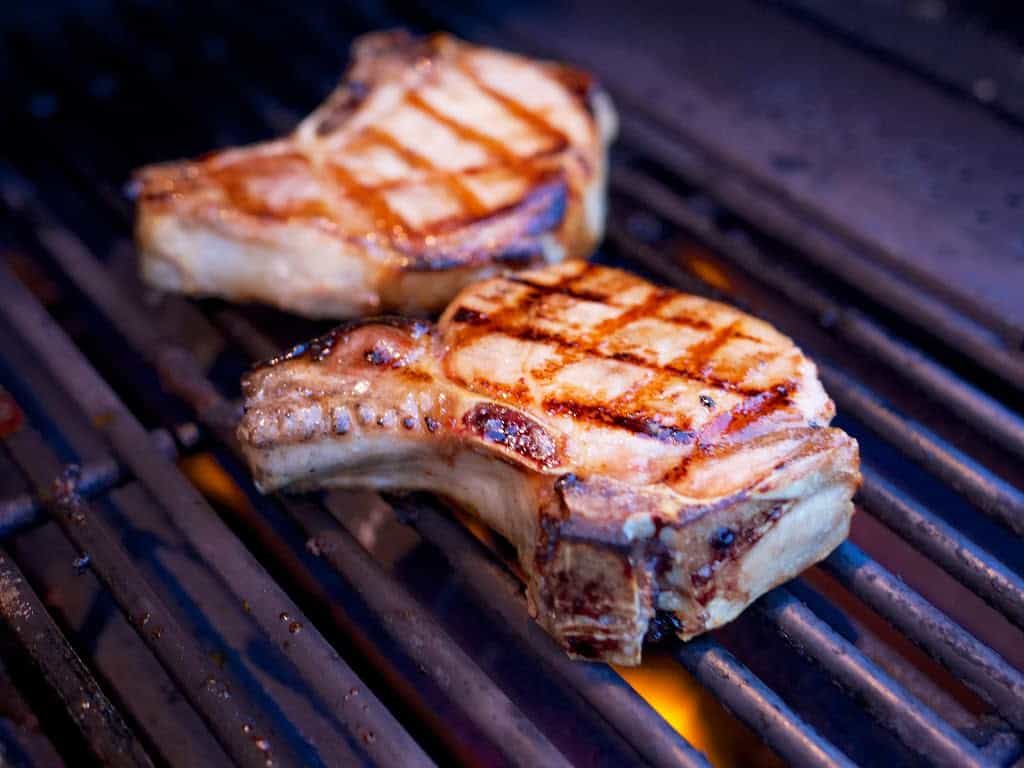
Sear Roasted Salmon with Knob Creek Maple Orange Glaze

December 5, 2013 by Mike Vrobel 9 Comments

Sear Roasted Salmon with Knob Creek Maple Orange Glaze. Seared salmon with a sweet and tart glaze.

It's the Sunday after Thanksgiving, and I need a change. (Please, no more turkey!) Salmon to the rescue.

I never thought I'd beg for turkey mercy. I'm a Sunday roast kind of guy, and I love a good roast bird. But...in November, I cooked three turkeys for the blog. I cooked three more for my family's big Thanksgiving dinner. I had turkey soup the next day. I'm done with turkey - for a few weeks at least. I've still got bones in the freezer to turn into stock.

Sear Roasted Salmon with Knob Creek Maple Orange Glaze

I planned on Copper river salmon, but one look and I switched to the King salmon.When you buy seafood, buy what looks good. Flexibility at the fish case will result in better dinners. (And if nothing looks great? Cut your losses and switch to pork chops.)

The fillets were 1 ½ inches thick - too thick to cook through on the stove top without overcooking the outside. So I used sear roasting to cook them. Sear roasting gives the best of both worlds - searing browns the flesh side, and then the pan goes into the oven, gently roasting the fish to the perfect temperature. (For me, that means medium - 130°F - when the center is just losing its raw color.)

A quick glaze adds another layer of flavor to the recipe. I simmered Knob Creek Smoked Maple bourbon, maple syrup, and the juice of an orange, and brushed it on right before roasting.

This was high quality salmon - I could have skipped the glaze. I couldn't help myself. I wanted that sweet, tart, crunchy crust on the fish. And, if I can add bourbon while I'm cooking, it's always a bonus.


Adapted From: How To Cook a Perfect Fish Fillet, Tom Douglas, Fine Cooking Magazine, issue 92

Salmon and other ingredients
Seared piece of salmon
Nicely seared
Frypan of seared salmon going into the oven to roast
Time to roast the salmon
Checking the temperature of roast salmon with an instant read thermometer
Checking the temp...done!

Special Thanks

To Knob Creek® Brothers of Bourbon for the bottle of Knob Creek® Smoked Maple.

What do you think?

Questions? Other ideas? Leave them in the comments section below.

Related Posts

  • Grilled Salmon with Coriander and Fennel Rub
  • Grilled Cedar Plank Salmon
  • Sous Vide Grilled Salmon with Fennel Salad
  • Simple Sous Vide Salmon

*Enjoyed this post? Want to help out DadCooksDinner? Subscribe to DadCooksDinner using the RSS or Email options on the right, recommend DadCooksDinner to your friends, buy something from Amazon.com through the links on this site, or donate through my tip jar. Thank you.

Pressure Cooker Turkey Noodle Soup with Vegetables

December 3, 2013 by Mike Vrobel 1 Comment

I had big plans for my post-Thanksgiving turkey soup...until life got in the way.

I woke up the day after Thanksgiving feeling run down. I wanted to lie in bed all day, but we had a schedule to keep, picking up our Christmas tree, getting it set up, and (unfortunately) facing the Black Friday onslaught to get a new television set 2The old TV picked the perfect time to go on the fritz. On the one hand, I got a Black Friday deal on the replacement. On the other hand, I’d pay twice as much to avoid standing in that line again. So long, so boring, and so many terrible versions of Christmas carols. What did Irving Berlin and Mel Torme do to deserve it?

By the time we got home, I needed something comforting. This is a basic Turkey, noodle, and vegetable soup, based on what I had in the house. Much to my surprise, I was out of a lot of my pantry basics - even onions and carrots were out, used up in the stuffing - so I had to make do.

This means I…I…I had to use frozen mixed vegetables. Mixed Vegetables? I should be ashamed, and turn in my locavore membership card. But there was no way I was facing that traffic again just for some carrots and celery.

Beyond the frozen mixed vegetables issue, this was a breeze. The turkey carcass went in the cooker, and pressure cooked for about an hour, while I collapsed on the sofa. I strained out the bones, sauteed shallots and thyme, and cooked noodles, leftover turkey, and the vegetables in the broth. A tossed salad, some saltine crackers, and dinner was on the table with maybe fifteen minutes of actual work.

No pressure cooker? No worries. See the notes section for stove top instructions.

Recipe: Pressure Cooker Turkey Noodle Soup with Vegetables

Equipment:

  • 6 quart or larger pressure cooker (I use a Instant Pot Electric PC)


Notes

  • No pressure cooker? No worries. Put everything in a large, oven safe pot, bring it to a boil, then put it into an oven preheated to 200°F for 4 hours. (Or, simmer on the stove for 4 hours - but the oven method is less work.)
  • This is great as a make-ahead meal - step one can be completed in advance, leaving about fifteen minutes of actual cooking time. Stock can be refrigerated for up to three days, or frozen for months.
  • It also makes great leftovers for lunch - freeze the soup in 2 cup containers, and microwave it for about 6 minutes on high, or until the middle of the soup is hot.
  • You don't want to make turkey stock, but you still want soup? Sigh. I guess you can use two quarts of store bought chicken broth instead of making your own turkey stock. But…it's so good, and it's so easy…try making your own stock, just once, then see if that cardboard carton of stock seems like a good idea.
  • You will be tempted to add more noodles to the soup. They'll look lost in all that broth. Don't do it! The noodles act like sponges, sucking up the broth; any more, and what you're left with is a very thick noodle stew, not soup.

What do you think?

Questions? Other ideas? Leave them in the comments section below.

Related Posts:

Turkey Soup with Chickpeas and Vegetables
Turkey Ramen Noodle Soup
Southwestern Turkey and Black Bean Soup

*Enjoyed this post? Want to help out DadCooksDinner? Subscribe to DadCooksDinner using the RSS or Email options on the right, recommend DadCooksDinner to your friends, buy something from Amazon.com through the links on this site, or donate through my tip jar. Thank you.
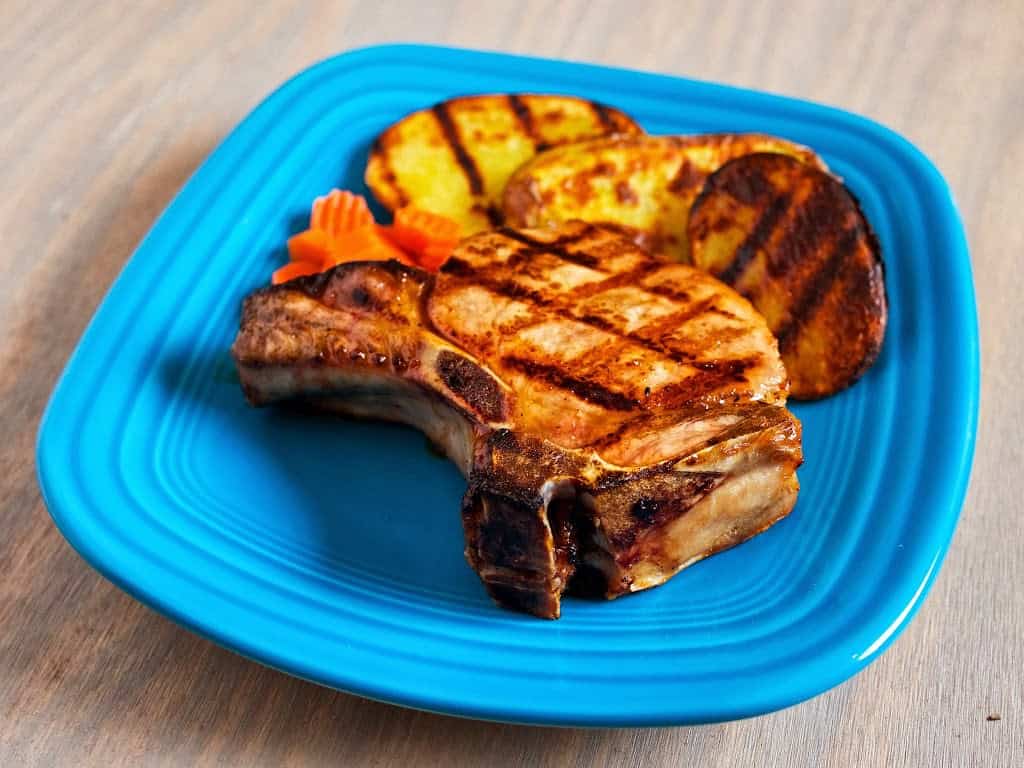
How To Support DadCooksDinner

December 2, 2013 by Mike Vrobel 4 Comments

On this Cyber Monday, a brief request for support.

A lot of work goes into DadCooksDinner - I spent over 800 hours in 2013 working on it. This is a labor of love, and I essentially did it for free for the first few years.
Ah, the good old days. Writing an unknown food blog, with no one but family members reading. And they only read when I stood over their shoulder, telling them the URL.

Over time, I’ve picked up readers. As the blog grows, I try to be more professional (professionalish?). As a result, I pick up more expenses. A test turkey here, a road trip to the Le Creuset outlet store there…it all adds up.

So, we have operators standing by to take your call…um, no. I’m not going into full-on pledge drive mode. Let me start again…

To support DadCooksDinner, please consider contributing in one of two ways:

Holiday purchases through my Amazon.com links

If you purchase anything on Amazon after clicking through one of the links on this page, I get a small commission. You won’t pay any more for your purchases, so this is an inexpensive way to help me out. (Last year, someone bought a Weber Summit through my link - best Amazon commission month ever!)
I support the blogs I follow through their Amazon affiliate links. I try to do all my Amazon shopping through their websites. Does my Amazon addiction contribute to their blogs? Oh, yes, yes it does.

Through my tip jar

Not an Amazon kind of person? Want to help me out directly? You can tip me through PayPal. Tips can either be a one-time payment, or a recurring subscription.
Donations are through PayPal, but you do not need a PayPal account to donate. They they take all major credit cards.
Special thanks to subscribers Chris L, Martha H, and Robert C for their ongoing support through subscriptions. 

Thanks again for reading, everyone!

Related Posts

Working For Tips (Blog Economics 101 for DadCooksDinner)

Giving Thanks 2013

November 28, 2013 by Mike Vrobel Leave a Comment

I'm thankful for my family, especially my wife and kids. We had some fun adventures this year.

I'm thankful for my readers. It keeps me writing, knowing that you're out there, reading my blog, buying my book, and leaving comments. Thank you for sharing another year with me.

And, don't forget to make stock with your leftover turkey carcass. Make some soup to serve with the turkey leftovers, and freeze the rest for later.

  • Pressure Cooker Turkey Stock (the recipe I use all the time)
  • Stovetop/Oven Turkey Stock (the Ruhlman method)
  • Slow Cooker Turkey Stock (OK, the recipe is for chicken stock. Use turkey bones instead.)

How should you use the turkey broth? My recipe for Turkey Thai Curry Soup is coming next week...

Happy Thanksgiving, Everyone!

If you were as fortunate as I was this year, please consider a donation to fight hunger in my home town:

Donate to the Akron-Canton Regional Food Bank

Dad Cooks Thanksgiving Dinner 2013

November 26, 2013 by Mike Vrobel 16 Comments

Dry Brined Grilled Turkey | DadCooksDinner.com

T–2 and counting. Are you ready for Thanksgiving?

Thanksgiving is all about tradition….until I went on a Modernist Cuisine binge with my Thanksgiving Recipes. Hopefully the classic cornbread stuffing and basic grilled turkey made up for it:

  • Rotisserie Turkey, Injection Brined
  • Pressure Cooker Mashed Acorn Squash
  • Cornbread and Sage Sausage Stuffing
  • Grilled Turkey with a simple Dry Brine

Thanksgiving Tips

I have some suggestions for a successful Thanksgiving - and you don’t have to go all Modernist for it to work.

  • Cook your turkey on the grill (Why you should grill your Thanksgiving Turkey)
  • Dry Brine your turkey (Rotisserie Turkey Dry Brined with Orange and Spices - it should be salted and in the refrigerator tonight.)
  • Use your grill's rotisserie, if you have one (Video: How to Truss and Spit a Turkey for the Rotisserie)
  • Cook the turkey breast to 150°F to 155°F (Turkey temperature: the 150 question)
  • Save the carcass for turkey stock to make the best soup ever (Pressure Cooker Turkey Stock Revisited).

DadCooksDinner Thanksgiving Recipes

My favorite Thanksgiving recipes on DadCooksDinner:

  • Rotisserie Turkey Dry Brined with Orange and Spices on my Weber kettle (I keep mentioning this one because it is my favorite turkey recipe ever.)
  • Cajun Dry Brine Rotisserie Turkey (on my Weber Summit, if you want gas grill instructions)
  • Bacon Wrapped Rotisserie Turkey
  • Basic Wet Brine Rotisserie Turkey
  • Dry Brined Rotisserie Turkey Breast (For a small thanksgiving dinner, a turkey breast is the perfect size)
  • Spice Rubbed Turkey Breast
  • Grilled Mashed Sweet Potatoes
  • Drip Pan Sweet Potatoes (if you have the turkey on the rotisserie, don't let the drippings go to waste.)
  • Bread Stuffing with Cranberries and Apples
  • Chestnut Stuffing
  • Pressure Cooker Giblet Gravy (A pressure cooker isn't absolutely necessary, but it speeds things up).

*What? I don’t have a mashed potato recipe? Again? Here, use this one from Pam Anderson. I really need to fix that.

Thanksgiving Question

This year’s question from a reader:

How much of a load is too much of a load for these little electric rotisserie motors, and how long does it take to balance the bird on the spit?

I get both of these questions a lot, to the point that I wrote posts about them. The answers:

  • The rotisserie motor can handle a 24 pound turkey. I could probably go larger on my Weber kettle, but that was the biggest bird I could find last year, and it fit with room to spare.
  • I don't worry about the counterweight. I run the spit through the cavity of the bird, and that seems to balance it well enough for the rotisserie.

Have Fun

I try to remind myself: Thanksgiving isn’t entirely about the food. (No, really.) I tend to get wrapped up and forget the family will be fine as long as they get that one favorite side dish. (Yes, even if it’s cranberry sauce straight from the can, with the ridges on the can still visible. Shudder.)

One more thing

Please, don’t go shopping on Thanksgiving, no matter how tempting the deals are. Black Friday keeps inching further and further into Thanksgiving, and it is up to us to push it back, using our power as consumers. If no one shows up until Friday, they won’t open on Thanksgiving. Fight the power!

Cartoon by: Randy Bish

*Enjoyed this post? Want to help out DadCooksDinner? Subscribe to DadCooksDinner using the RSS or Email options on the right, recommend DadCooksDinner to your friends, buy something from Amazon.com through the links on this site, or donate through my tip jar. Thank you.
Dry Brined Grilled Turkey (Grilling Basics)

November 25, 2013 by Mike Vrobel 8 Comments

Grilled Dry Brined Turkey | DadCooksDinner.com

Dry Brined Grilled Turkey | DadCooksDinner.com
Dry Brined Grilled Turkey

I’ve said it before: grilling is the best way to cook your Thanksgiving turkey. But, to my shame, I realized that I don’t have a grilled turkey recipe on the blog. Whoops.
I always rotisserie my bird…but that’s just me being a fanatic. Skip the rotisserie (and the trussing, and spitting, and extra equipment) and grill your turkey. It won’t be quite as perfect as the rotisserie version…but a grilled turkey is still better than any bird you’ll get out of the oven, or the deep fryer, and it’s a lot less work.

Now, this is going to look complicated, but, really, it’s not that bad. None of these tricks add much work; they just need planning ahead. And you can skip any of them you want. I have them listed in order of importance…Dry brining helps more than icing the breast, which helps more than U of fire, and so on. It's a menu - you can pick the entries you want.
2And, if you don't want to do any of them: a grilled turkey, salted right before cooking, plopped breast side up on the grate, cooked with indirect heat, coals added every hour - even then, it will blow away an oven-cooked turkey. Or a deep fried turkey - I know, blasphemy - but the grill-smoked flavor just works better with turkey.

Still with me? Great. Because it's time to get to work.

Over the years, I’ve picked up a lot of tricks to help cook the perfect grilled turkey. The most important one is how we season the bird.

Dry brine the turkey

Salt the bird a couple of days ahead of Thanksgiving, and stash it in the back of the refrigerator. (Thanks to Judy Rodgers’ Zuni Cafe Cookbook for the dry brining technique, and Russ Parsons of the Los Angeles Times for promoting it.)

2Dry Brine Standard Disclaimer: a dry brine really isn’t a brine, it’s early salting. But the salt acts like a brine, pulling the juices out of the meat, then helping the meat re-absorb them like a brine. The result is deeply seasoned meat, with lots of turkey flavor.

The next most important turkey tip is...

Don't overcook the white meat

Ultra-lean white meat is overcooked if it gets above 160°F. Dark meat is full of fat and connective tissue, and it needs to cook to at least 175°F. Properly cooking a turkey is tough, and usually results in a trade off. Do you want dry, overcooked breast meat? Or tough, chewy legs? Dry brining the turkey helps the breast - brined meat will hold on to more liquid - but it can only help so much. The rest of my tips are trying to cook the legs more, while keeping the breast below 160°F.

Ice the breast This is a trick from Harold McGee, food scientist extraordinaire. Mr. McGee straps ice packs to the breast of his turkey, so it starts cooking at a lower temperature than the legs. I don’t want to disinfect ice packs when I’m done cooking, so I use a gallon zip-top bag full of ice. The turkey comes out of the refrigerator an hour (or two) before cooking, and the bag of ice sits on the breast, keeping it chilled while the legs warm up.

U of fire The turkey can’t cook over direct heat on the grill; it will burn way before it cooks through. So, we set the grill up for indirect heat, to grill roast the bird. The standard indirect heat setup is to split the coals into two piles on each side of the grill. Instead, I put the coals in a U shape on one side of the grill, so I can concentrate the heat on the legs, and away from the breast. Also, I prefer charcoal - it makes it easy to add a fist sized chunk of smoking wood in the coals. The coals will burn out before the turkey is done, so I add 24 unlit coals to the fire every hour to keep it going.
Thanks to Jamie Purviance, Weber’s grilling guru, for suggesting the U of charcoal in Weber’s Charcoal Grilling. And for being a grilling inspiration - the first turkey I cooked on a grill was following his recipe.

Rotate the bird Once again, I’m trying to keep the breast from overcooking. I start the bird breast side down in a roasting pan. The pan shields the breast from the heat for the first hour of cooking; after that, I rotate the turkey breast side up so it will brown.

Cook the breast to 150°F Now, for a walk on the wild side. The USDA safe minimum temperature for turkey is 165°F. We’re going to ignore that, go directly to the USDA Time/Temperature charts, and only cook the turkey breast to 150°F…OK, maybe 155°F.
3My Samoan attorney advised me to add: If you are feeding infants, people with compromised immune systems, or people who like to sue penniless food bloggers, you should follow the USDA guidelines and cook the turkey until the breast measures 165°F in its thickest part. The dry brine will help, but you'll probably want to pour some extra gravy on the white meat...or grab a drumstick before they disappear.

Recipe: Grilled Turkey, Dry Brined

Equipment:

  • Grill (I love my Weber kettle)
  • Aluminum foil roasting pan (11"x15", or an oval turkey roaster)
  • Roasting rack (or use ribs of celery to hold the bird off the bottom of the pan)
  • Gallon zip-top bag full of ice
  • Instant-read thermometer (My ChefAlarm probe thermometer lets me set an alarm for the proper temperature, so I don't have to lift the lid to check the temp.)

Dry Brined Grilled Turkey | DadCooksDinner.com
Turkey, salted and ready to dry brine in the refrigerator

Dry Brined Grilled Turkey | DadCooksDinner.com
Dry brine done, resting with the bag of ice on the breast

Dry Brined Grilled Turkey | DadCooksDinner.com
U of coals on one side of the grill - I'm using my charcoal basket to hold them in place before I add the drip pan

Dry Brined Grilled Turkey | DadCooksDinner.com
On the grill, ready to cook. Note the legs are pointed at the U of coals

Dry Brined Grilled Turkey | DadCooksDinner.com
After 1 hour of cooking, it is time to flip the bird breast side up

Dry Brined Grilled Turkey | DadCooksDinner.com
Checking the temperature with my probe thermometer in the deepest part of the breast

Dry Brined Grilled Turkey | DadCooksDinner.com
Ready to carve!

*Enjoyed this post? Want to help out DadCooksDinner? Subscribe to DadCooksDinner using the RSS or Email options on the right, recommend DadCooksDinner to your friends, buy something from Amazon.com through the links on this site, or donate through my tip jar. Thank you.
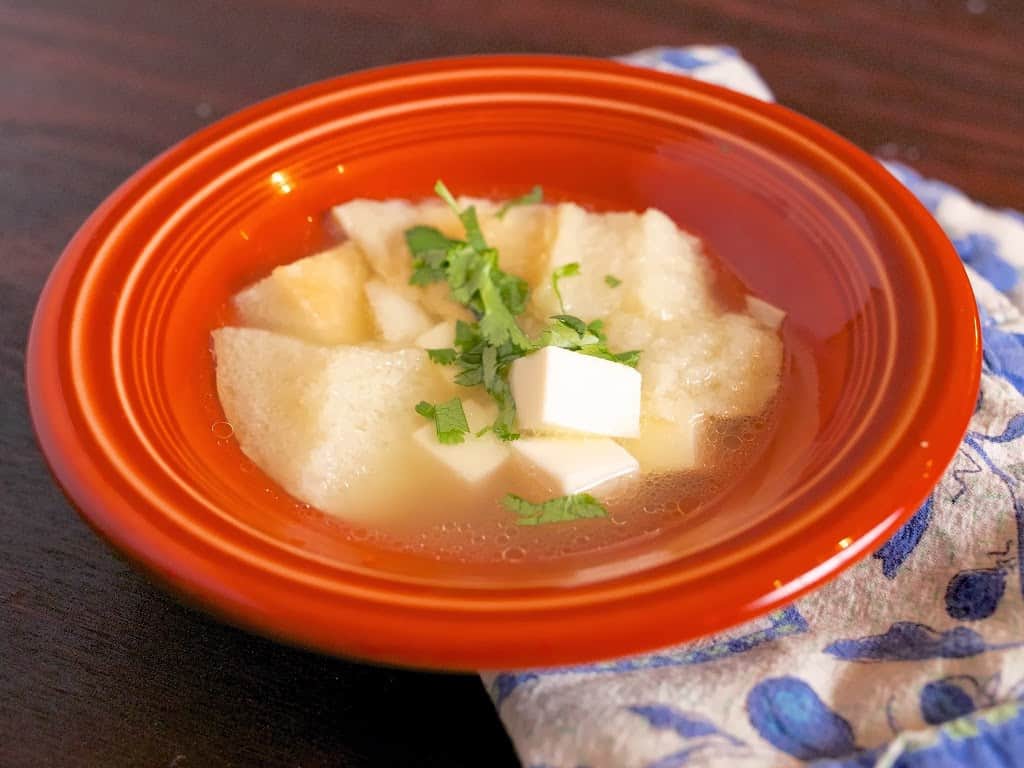
Rotisserie Injection Brined Turkey

November 21, 2013 by Mike Vrobel Leave a Comment

I hate needles. I was one of those kids who had to be held down to get my vaccinations.

But, years ago, I saw John Madden with a deep fried Cajun turkey during the Thanksgiving day football game. It looked amazing. I had to try it! All the Cajun turkey recipes recommended injecting a marinade, so I dutifully bought an injector kit. I got streaks of marinade and Cajun spices, surrounded by dry, unseasoned meat. I quit injection marinades and deep fried turkey the moment I tried a brined, grilled turkey.

After that, I moved from wet brines to dry brines. I prefer the taste to wet brining, and it’s a lot simpler - no heavy pot full of turkey and brine that I have to find space for in the refrigerator.

This year, I’m going back…to the future. Modernist Cuisine at Home convinced me to dust off my injector kit, mix up a wet brine, and injection brine my turkey.

Injection brining solves a number of turkey problems:

  • Injection brine actually penetrates the meat: Unlike oil based injection marinades, a salt water brine will be absorbed into the surrounding meat. No more streaks of seasoning - the meat is seasoned all the way through.
  • Faster than wet or dry brining: Injecting the brine deep into the bird speeds up the brining process - it doesn't have to work its way into the meat from the outside. You can start brining your turkey the night before Thanksgiving, instead of needing to start days in advance.
  • Injection brine keeps the skin dry: Wet brines leave the turkey skin kind of flabby, because they plump up the skin with water just like they do the meat. Injecting the brine into the meat leaves the skin dry, so it will crisp up and brown.
  • Neater: No lugging around a huge pot of brine, contaminated by raw turkey juices. You only need two cups of brine, and after injecting, they are inside the turkey. No mess, no fuss.

The downside? I still hate needles. I get a little squeamish every time I open the injection kit - these are some serious looking needles.

Injecting the brine into the turkey

How does injected turkey taste? I’m torn. I love my dry brined turkey, but it does give the turkey a bit of a cured meat flavor. (I think that’s why I like it.) The injection brine is more neutral, and has the advantage of adding moisture to the turkey breast, giving it an extra cushion before the white meat hits that “dry as dust” stage. Not a huge cushion, mind you - get it out of the grill as close to 160°F as you possibly can - but I don’t mind the extra moisture, and my wife (who prefers white meat) said this may be my best turkey ever.
This is why turkey processors enhance so many of their birds - juicy breast meat. Watch out for the words “enhanced with a x% solution” on the turkey’s wrapper. Enhanced means the turkey is pre-brined at the processing plant. You’re paying for extra water, and you risk over salting if you brine it yourself. Try to find a “natural” turkey - that is, just turkey, no added water or brine.

I’m borrowing another trick from Modernist Cuisine, and brushing the skin with a soy sauce and paprika glaze. This will season the skin (which we’re avoiding with the injection brine), while the protein in the soy sauce helps the skin to brown.

So, what am I going to do on Thanksgiving? Dry brine or injection brine? I will do both - two twelve pound turkeys, one dry brined, one injection brined. I have quite a crowd to feed this year, and I’d rather cook two smaller turkeys than one big bird.

Basting the turkey with the soy sauce baste

Icing the breast meat

Turkey on the spit, spit on the grill, drip pan underneath

Turkey on a yellow platter
Turkey is ready to serve

What do you think?

Questions? Other ideas? Leave them in the comments section below.

Related Posts:

Rotisserie Turkey Dry Brined with Orange and Spices - My favorite turkey
Rotisserie Turkey with Cajun Dry Brine - Simulates that cajun turkey
Rotisserie Turkey Breast, Dry Brined - Cook the breast if you dont’ need a whole turkey
Click here for my other rotisserie recipes.


Check out my cookbook, Rotisserie Grilling.

Everything you could ask about the rotisserie,
plus 50 (mostly) new recipes to get you cooking.

It's a Kindle e-book, so you can download it and start reading immediately!


*Enjoyed this post? Want to help out DadCooksDinner? Subscribe to DadCooksDinner using the RSS or Email options on the right, recommend DadCooksDinner to your friends, buy something from Amazon.com through the links on this site, or donate through my tip jar. Thank you.
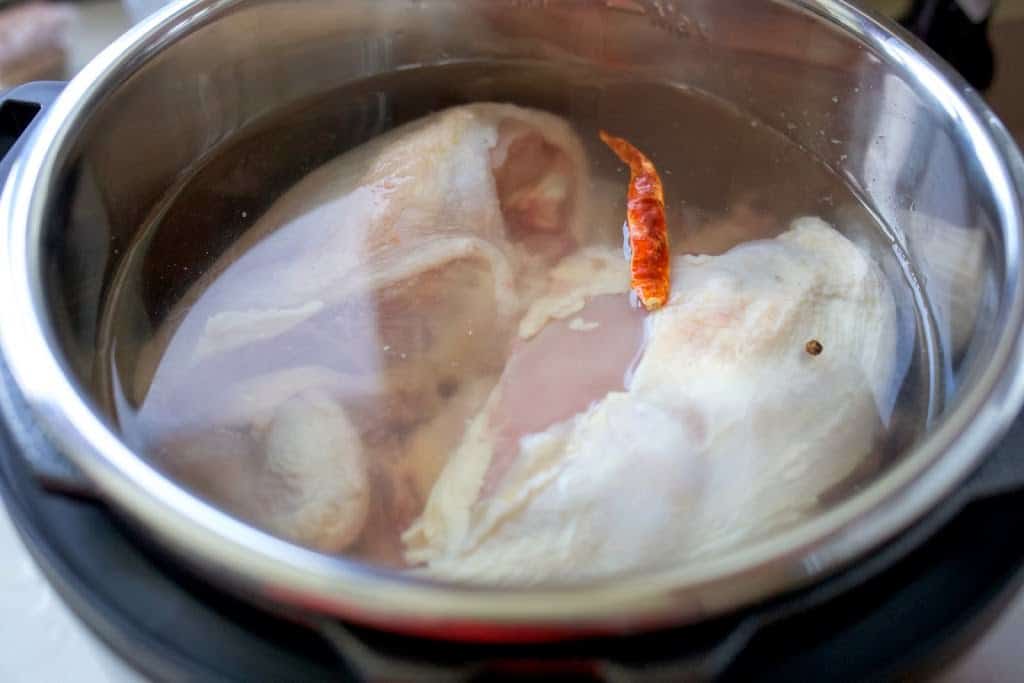
Cornbread and Sage Sausage Dressing

November 19, 2013 by Mike Vrobel 6 Comments

A bowl of cornbread dressing

That stuffing looks good - but you HAVE to try cornbread dressing.

A friend challenged me after I posted my Thanksgiving stuffing recipe. Cornbread dressing? After some research, I found out it's a Southern tradition, loaded with sausage.

(I'm a Yankee, of course - how else would I miss out on Conrbread Dressing?)

A bowl of cornbread dressing

That will work - cornbread and sausage sounds like a splendid combination. The recipes are similar to my usual stuffing recipes. Saute aromatics, toss with dried bread - cornbread - cubes, stir in beaten eggs as a binder, bake, and brown.

As a blogger, I have to cook two Thanksgiving dinners. One is on Thanksgiving; the other is a few weeks ahead of time, so I can test my recipes and post my pictures. This was the dressing I served in our early Thanksgiving. I got a few funny looks when I put it on the table, but the proof was in the tasting, and once everyone took a bite, it was a hit.
Except for my one son. He picked out chunks of sausage and brushed the cornbread off. Oh, well, can't please everyone.

Equipment

  • 11" by 15" foil pan (you can use a large baking dish if you're cooking in the oven)
  • Aluminum foil

Ingredients

  • 4 tablespoons butter
  • 2 onions, minced
  • 2 stalks celery, minced
  • 1 red bell pepper, minced
  • 2 teaspoons kosher salt
  • 1 pound sage sausage
  • ¼ cup minced parsley leaves
  • 2 pounds stale cornbread, cut into 1 inch cubes (8-10 cups)
  • 3 to 4 cups chicken broth (preferably homemade), amount depends on how dry the cornbread is
  • 2 teaspoons fresh ground black pepper
  • 2 teaspoons kosher salt (if chicken broth is homemade - don't add more salt if chicken broth is store bought)
  • 2 eggs, beaten

Directions

Sautéing onions, celery, and peppers

Sauté the aromatics

Melt the butter in a large frypan over medium-high heat. Add the onions, celery, and bell pepper, then sprinkle with 2 teaspoons of kosher salt. Sauté until the onions are soft, about five minutes.

Cooking sausage with sautéed aromatics

Brown the sausage

Add the sausage to the pan with the onions and cook, breaking the sausage into bite sized pieces. Cook until the sausage is no longer pink, about five minutes. Stir in the parsley, and remove from the heat.

Mixing ingredients for a bowl of cornbread stuffing

Mix the Dressing

Put half the cornbread in a large mixing bowl. Scrape the onion and sausage mix from the frypan into the bowl, then stir until evenly mixed. Pour in half the chicken stock, add the pepper (and salt if using homemade stock), and stir until all the cornbread is damp. As you stir, the cornbread will compact itself; add the rest of the cornbread and stock in batches, stirring to pack it down. Stir in the beaten egg, then pour the dressing into the foil pan.

An aluminum foil pan full of cornbread dressing, ready for the oven or grill

Cook the Dressing

Oven Instructions
Crimp a sheet of aluminum foil over the pan. Put the dressing in a preheated 350°F oven. Cook with the foil covering the dressing for 45 minutes. Remove the foil from the top of the pan and cook until the dressing is browned and crispy on top and 150°F in the middle, about 15 more minutes.

OR: Drip Pan Instructions (for rotisserie or grill)
Crimp a sheet of aluminum foil over the pan, then cut slits in the pan so the turkey drippings can drip through into the dressing. The grill should be set for indirect medium heat (about 350°F), with a drip pan under the turkey. When the turkey has 1 hour left to cook, replace the drip pan with the pan full of dressing. Pour any drippings in the drip pan onto the sheet of aluminum foil covering the dressing; it will drip through the slits into the dressing. Cook with the foil covering the dressing for 45 minutes. Remove the foil from the top of the pan and cook until the dressing is browned and crispy on top and 150°F in the middle, about 15 more minutes.

Serve the Dressing

Carefully remove the dressing from the oven or grill, scoop the dressing into a serving dish, and serve. If the dressing needs to sit while you carve the turkey, cover the pan with foil to keep the dressing warm.

A foil pan of cooked cornbread dressing

What do you think?

Questions? Other ideas? Native born Southerners who think I'm a clueless Yankee? Talk about it in the comments section below.

Related Posts

Rotisserie Pan Bread Stuffing with Cranberries and Apples
Chestnut Stuffing (and rotisserie capons)

*Enjoyed this post? Want to help out DadCooksDinner? Subscribe to DadCooksDinner using the RSS or Email options on the right, recommend DadCooksDinner to your friends, buy something from Amazon.com through the links on this site, or donate through my

Pressure Cooker Mashed Acorn Squash

November 14, 2013 by Mike Vrobel 16 Comments

Pressure Cooker Mashed Acorn Squash

Pressure Cooker Mashed Acorn Squash

Thanks to everyone who answered my call for help with winter squash. There are some great recipes in the comments - go check them out.

After my whining about “It’s sooo hard to peel winter squash”, there was a recurring theme in the comments. Why bother to peel it? Halve it, seed it, cook it with the skin on, and then scrape out the flesh. No wrestling with the hard skin, other than cutting it in half. (Which is difficult enough - I had to put my weight into it to force my chef’s knife through, and I’m not a small guy. I can see why some people recommend using cleavers and/or mallets to split them. Please be careful!)

Once again, I borrowed the pressure roasting technique from Modernist Cuisine at Home. Combining an alkaline environment with the high heat of the pressure cooker results in even caramelization of the squash. How do we get an alkaline environment? We sprinkle the squash with a little baking soda. The squash roasts as it pressure cooks, and is beautifully caramelized in 20 minutes.
*No pressure cooker? No worries. See the Notes section for oven baked squash instructions.

Then I mix in the good stuff - butter, brown sugar, and nutmeg. My mother-in-law suggested cinnamon, which sounded like a great idea...but I forgot when I was mashing. If you want to try it, add a quarter teaspoon, taste, and add more from there. I don't think it needs cinnamon, but I don't want to disappoint mom.

Recipe: Pressure Cooker Mashed Acorn Squash

Adapted From: Pressure Cooker Squash, Nathan Myhrvold and Maxime Bilet, Modernist Cuisine at Home

Equipment:

  • 6 quart or larger pressure cooker (I used my electric Instant Pot PC)


Acorn squash
Acorn squash

Squash in the cooker - just barely fit

Done pressure cooking

Scoop out the squash

Mash away!
Mash away!

Notes

  • No pressure cooker? Cook the squash in the oven. Split the squash, seed them, and salt them. Skip the baking soda - there's no need for it in the oven. Put the squash in a baking dish, add ½ cup of water to the dish, and roast the squash in a 400°F oven. The squash are done when they are browned and easily pierced with a paring knife, about 45 minutes. Continue with step 2: Mash the squash.
  • Seriously, watch out when you're splitting the acorn squash. I don't want anyone losing a finger over one of my recipes. Alton Brown suggests cutting into the squash with a cheap Asian cleaver, then tapping it through with a mallet. Cooks Illustrated recommends a bench scraper and a mallet. Me? I stuck my 8 inch chef's knife in there, held the point on the cutting board, and leaned into it, rocking back and forth, until it split. I'm probably going to be the one to lose a finger…so, I'd go with the AB or CI approach if I were you.
  • Cooking for a crowd? You want three (or more) squash, and an 8 quart pressure cooker (or larger.) Don't worry about the pressure cooker's max fill line - just don't pile the squash above the top of the pot. There's enough airspace around the squash to come up to pressure, even if you're above the max fill line.

What do you think?

Questions? Other ideas? Leave them in the comments section below.

Related Posts:

Pressure Cooker Roasted Sweet Potato Puree
What do I do with: The Winter Squash issue
Click here for my other pressure cooker recipes

*Enjoyed this post? Want to help out DadCooksDinner? Subscribe to DadCooksDinner using the RSS or Email options on the right, recommend DadCooksDinner to your friends, buy something from Amazon.com through the links on this site, or donate through my tip jar. Thank you.
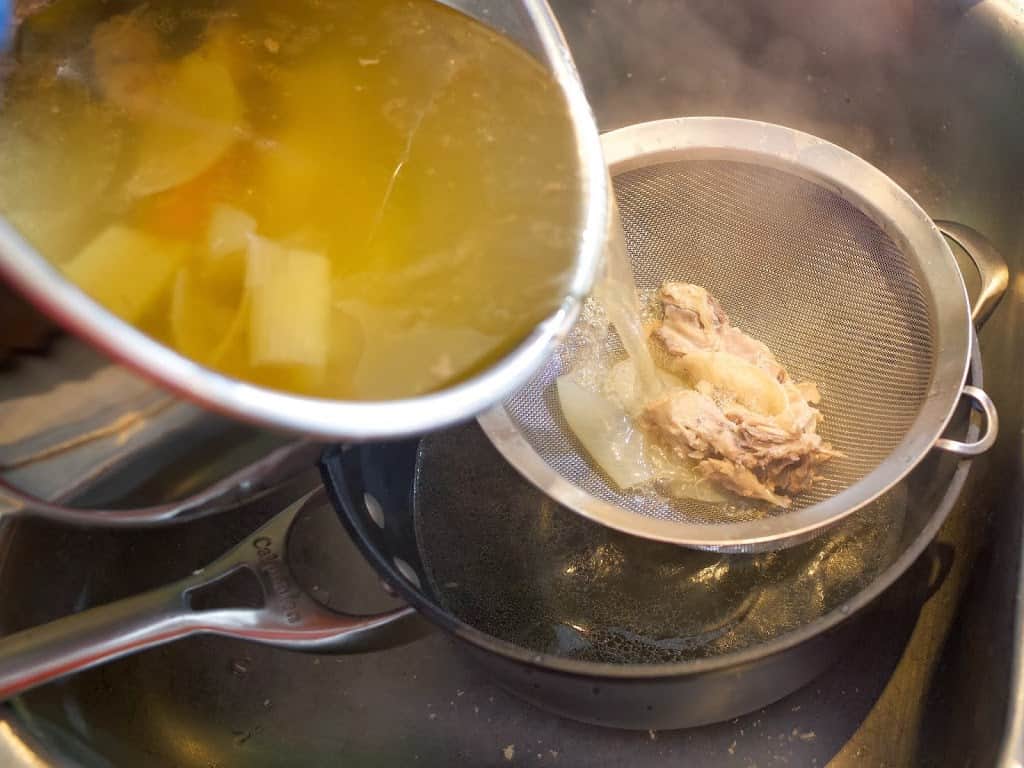
  • « Previous Page
  • 1
  • …
  • 20
  • 21
  • 22
  • 23
  • 24
  • …
  • 37
  • Next Page »

Welcome to Dad Cooks Dinner!

I'm Mike Vrobel, a dad who cooks dinner every night. I'm an enthusiastic home cook, and I write about pressure cooking, rotisserie grilling, and other food topics that grab my attention.
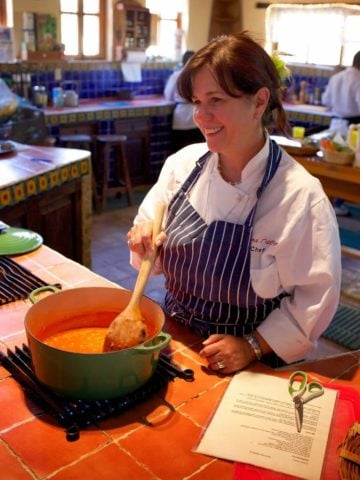
More About Me →

Popular

  • Three bowls of cooked Pinto Beans on a wood table
    Instant Pot Pinto Beans (No Soaking)
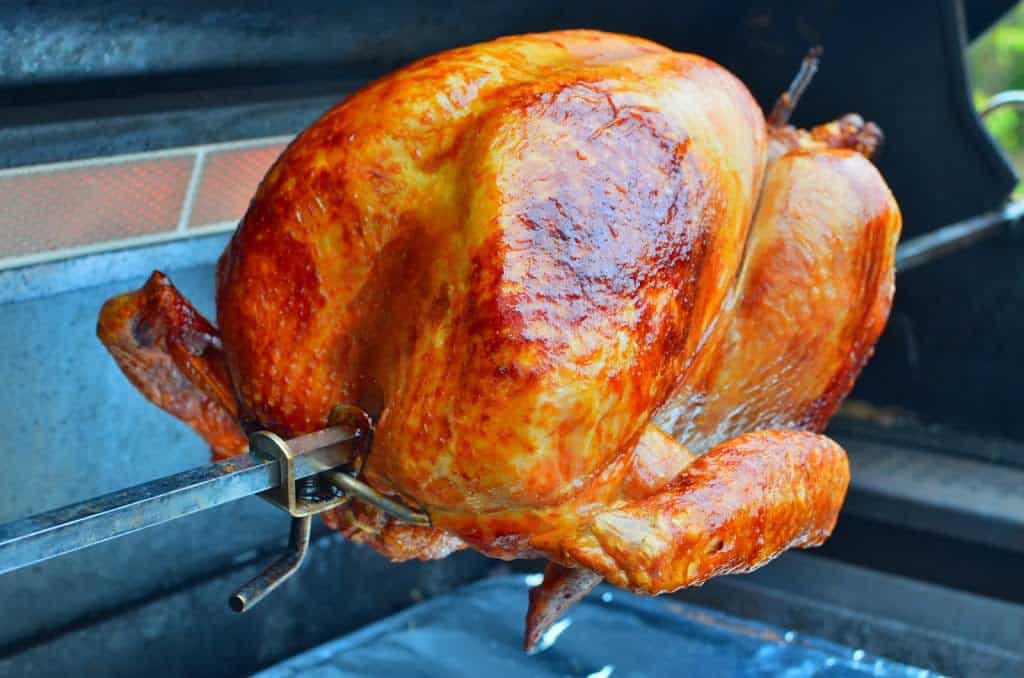
  • Pressure Cooker Beef Shank (Osso Bucco)
  • Pressure Cooker 7 Hour Leg of Lamb (in 90 minutes)
    Pressure Cooker 7 Hour Leg of Lamb (in 90 minutes)
  • Pressure Cooker Brown Jasmine Rice
  • Grilled Tomahawk Steak (Long Bone Ribeye, Reverse Seared)
    Grilled Tomahawk Steak (Long Bone Ribeye, Reverse Seared)
  • A green bowl full of chicken noodle soup
    Instant Pot Rotisserie Chicken Noodle Soup

Seasonal

  • A bowl of asparagus risotto
    Instant Pot Asparagus Risotto (Pressure Cooker Recipe)
  • Grilled Butterflied Chicken with Garlic Butter
  • Sous Vide rack of lamb sliced into chops
    Sous Vide Rack of Lamb with Dijon Bread Crumb Crust
  • A bowl of beef stew with asparagus, carrots, and radishes.
    Instant Pot Spring Vegetable Beef Stew
  • A Rotisserie Chicken (Pollo Asado)on a platter of shredded cabbage
    Rotisserie Chicken Pollo Asado
  • Rotisserie Pork Shoulder Roast with Carolina Mustard BBQ Sauce
    Rotisserie Pork Shoulder with South Carolina Mustard Barbecue Sauce

Footer

↑ back to top

About

  • Privacy Policy

Newsletter

  • Sign Up! for emails and updates

Contact

  • Contact

Copyright © 2025 Dad Cooks Dinner