DadCooksDinner

  • Home
  • Rotisserie
  • Recipes
  • Tools
  • Books
  • Merch
menu icon
go to homepage
  • Recipes
  • Books
  • Tools
  • Merch
  • About
subscribe
search icon
Homepage link
  • Recipes
  • Books
  • Tools
  • Merch
  • About
×
Home » Recipes

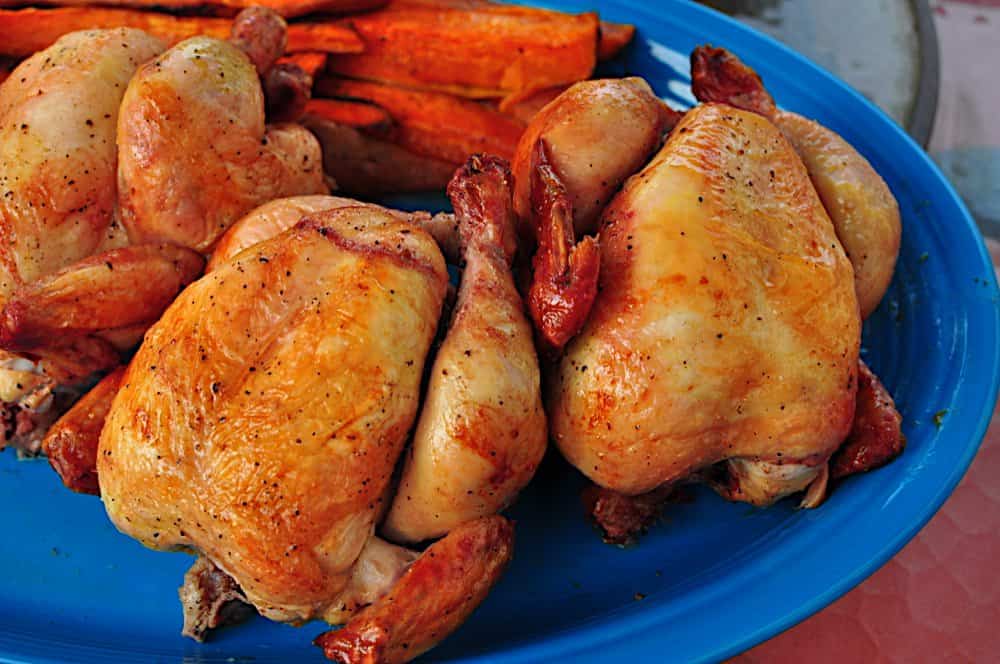
Rotisserie Cornish Game Hens with Lime and Herbs

May 26, 2011 by Mike Vrobel 2 Comments

It's time for another Little Chickens recipe!
*Apologies to my grandfather. I can't call them Cornish game hens, I have to call them little chickens. It's a Vrobel thing.

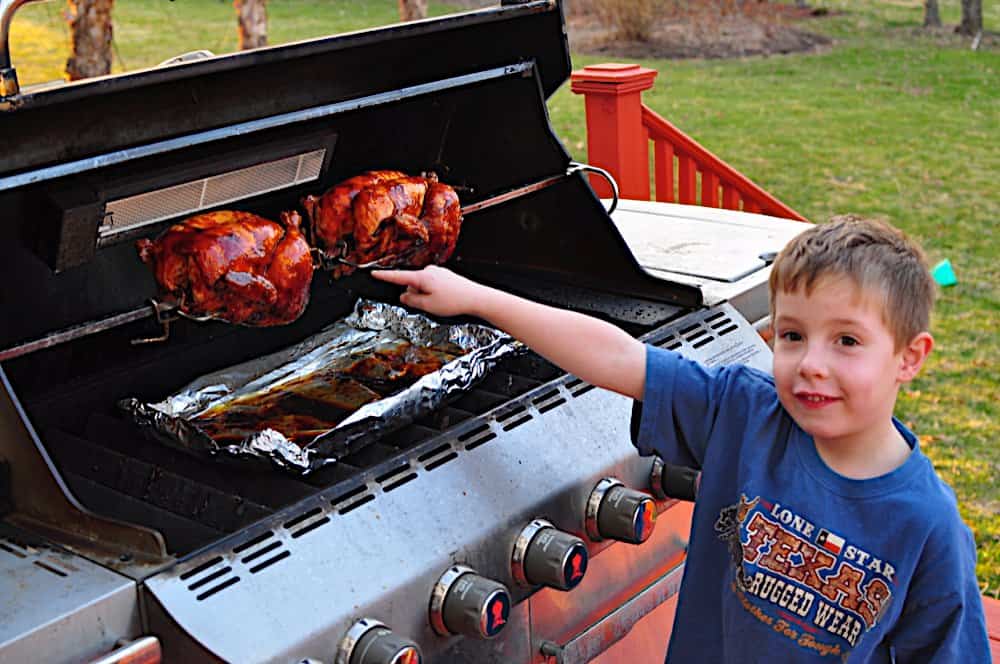
I had a taste for Cornish game hens, but the recipe had to be simple. I bought them frozen the morning, and most of my prep time would involve thawing them in a water bath. I thought some citrus would be a nice touch, checked my refrigerator, and found limes. Lime? I have some cilantro in there as well, right? Right. Lime and cilantro - a good combination. To add a different herb, I grabbed a bunch of the unkillable thyme that I have in my front yard. Add a good dose of salt and pepper, and I was ready to grill.
*Well, I was ready to grill after some trussing, spitting, and preheating. Rotisserie recipes always have a little extra work involved. And they are so worth it.

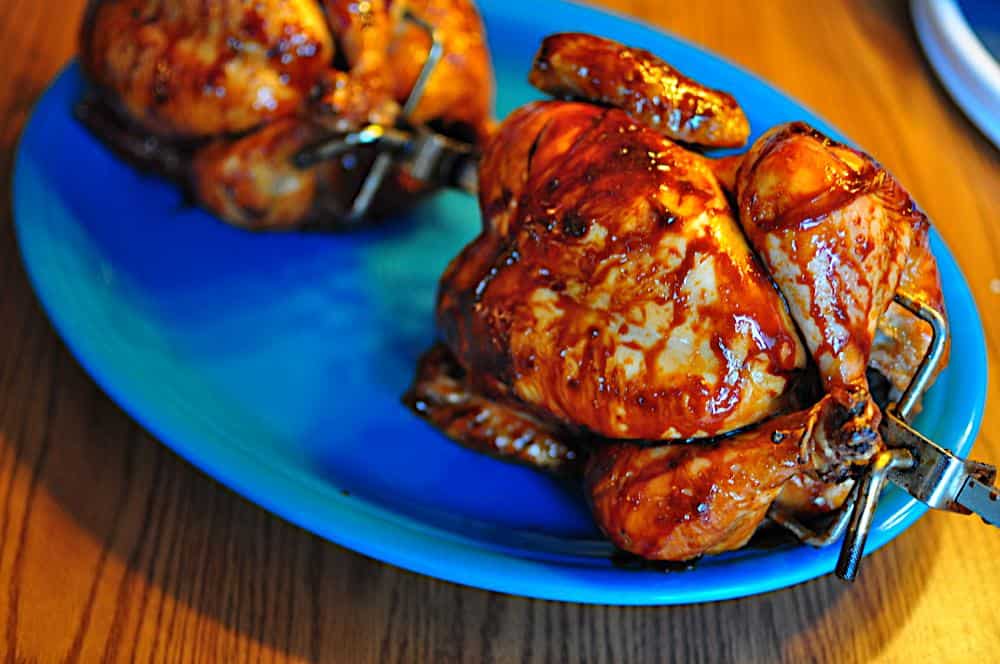
The lime steams the chicken from the inside, spreading the citrus and herb flavor into the meat. The rotisserie crisps the skin on the outside. Every bite is a mix of flavors and textures. And, really, who doesn't love picking the meat off the bones of a petite cornish hen?
*I sure do. I have to remember to make cornish hens more often.

Recipe: Rotisserie Cornish Game Hens with Lime and Herbs

Cook time: 45 minutes

Equipment:

  • Grill with Rotisserie attachment (I used a Weber kettle with the Rotisserie attachment; the kettle is this Weber Grill and the rotisserie attachment is this Weber charcoal kettle rotisserie)
  • Aluminum foil drip pan (9"x12", or whatever fits your grill)
  • Butcher's twine

Ingredients:

  • 4 Cornish game hens (Mine were about 1.75 pounds each)
  • 6 teaspoons Kosher salt, 1 ½ teaspoon per hen
  • 2 teaspoons fresh ground black pepper (½ teaspoon per hen)
  • 2 limes, halved (one half per hen)
  • 4 bushy sprigs thyme (one per hen)
  • 4 sprigs cilantro (one per hen)

Directions:
*See my Rotisserie Poultry basic technique for an overview.
1. Prep the hens: For each hen: sprinkle evenly with 1 teaspoon kosher salt and ½ teaspoon black pepper, making sure to get some in the cavity. Squeeze a half lime into the cavity, then stuff the hen with the half lime and a sprig of thyme and cilantro. Fold the wingtips back under the wings, then truss the hen tightly. (See the basic technique for trussing details). Once the hens are all salted, stuffed and trussed, skewer them on the spit.
*If you have the time, do this an hour before cooking. This lets the hens come up to temperature before they go on the grill, which results in better browning.

2. Prepare the grill: Prepare the grill for cooking on indirect high heat (see details My Rotisserie Basic Technique Post). For my Weber kettle, I light a chimney starter* full of charcoal, wait for it to be covered with ash, then pour it in two equal piles on the sides of the grill, and put the drip pan in the middle, between the piles.
*I highly recommend the Weber Chimney Starter, because it is larger than most chimney starters. It holds 5 quarts of charcoal, which exactly the right size for cooking this recipe.

3. Rotisserie the hens: Put the spit on the grill, turn on the rotisserie motor, and cook with the lid closed. The cooking time will be from 30 minutes to 1 hour, depending on the size of the bird. My 1.75 pound Cornish hens cooked in 45 minutes. Checking the temperature in the thickest part of the breast meat with an instant read thermometer is the best way to tell if the hens are done. You want the temperature to be 160*F to 165*F.
*I check the temperature at the 30 minute mark, and every 5 to 10 minutes after that.
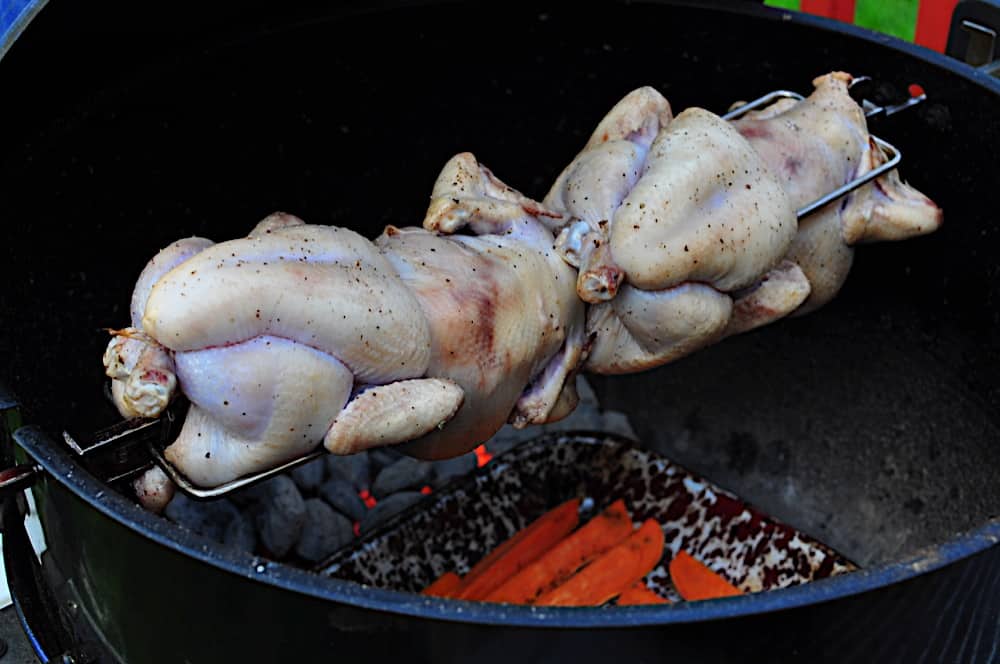
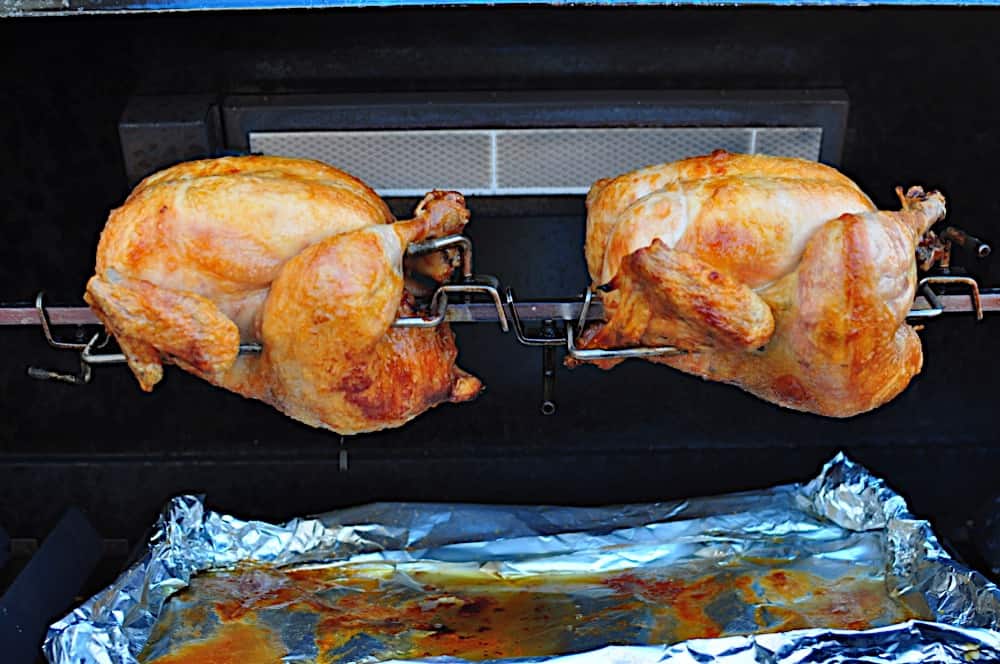
Make sure the hens are on tight, or they get a little wobbly.
The second hen from the left is trying to shake loose.

4. Serve: Remove the spit from the grill, remove the hens from the spit, and remove the trussing string from the hens. Let the hens rest for at least 15 minutes, then split in half, discarding the lime and herbs. Serve.

Variations:
*Different citrus or herbs: Substitute Lime (quartered) or orange (wedges) for the lemon; substitute your favorite herbs (any of the "song" herbs, parsley, sage, rosemary and thyme will work.)

Notes:
*One hen will serve two regular eaters, or one big eater. Like me, when I get rolling. Oh, those hens were so good...

*Thawing frozen game hens: I put them in a large container, covered them with cold water, and replace the water every hour. To hurry things along, after every water replacement I leave the faucet running for five to ten minutes, to keep the water circulating around the hens. The result was thawed hens in four hours.

What do you think? Questions? Other ideas? Leave them in the comments section below.

Related Posts:
Rotisserie Cornish Game Hens, Dry Brined
Rotisserie Cornish Game Hens, Brined and Herbed
Click here for my other rotisserie recipes.

Check out my cookbook, Rotisserie Grilling.

Everything you could ask about the rotisserie,
plus 50 (mostly) new recipes to get you cooking.

It's a Kindle e-book, so you can download it and start reading immediately!


*Enjoyed this post? Want to help out DadCooksDinner? Subscribe to DadCooksDinner using the RSS or Email options on the right, link to this post from your blog, recommend DadCooksDinner to your friends, or buy something from Amazon.com through the links on this site. (Like my Rotisserie Grilling cookbook...)
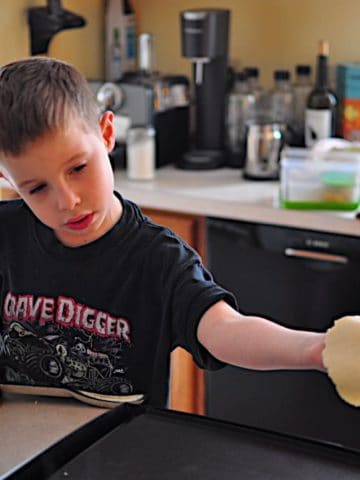
Cooking With The Kids

May 24, 2011 by Mike Vrobel 3 Comments

When I saw the headline What Grant Achatz and Alinea Have to Teach About Eating At Home on StayAtStoveDad, I had to check it out. What does molecular gastronomy have to do with cooking for your family? I love reading about all the wild, wacky ideas that Grant Achatz comes up with at Alinea...but I never imagined it as something that would affect how I cook for my kids.

The more I read the article, the more I found myself nodding in agreement. The line that really stuck with me was:

Achatz's approach to dining is to be kept in mind by parents who need to feed their children. He said that in planning dishes he likes to ask himself "What can we do that's really silly, to ultimately have some fun?" Now, that's the best advice.
[John Donohue, StayAtStoveDad.com] 

How do we have fun with food? I get the kids involved with cooking. Or, I try to. Diane is good at this; the kids help her make tortillas all the time. She even has our youngest helping with the garden, and as a result he is much more likely to try one of "his" plants when we cook it.

I, however, don't have it so easy. I'm a control freak in the kitchen. To work around that, I picked out some "project meals" where the kids help with preparation. Over the last few months, the big hits have been:

  • Bao (Steamed Pork Buns) from Eileen Yin-Fei Lo at FineCooking.com
  • Empanadas from Rick Bayless and America's Test Kitchen
  • Chinese Dumplings from Mark Bittman at NYTimes.com

The common thread? All are foods they love to eat, and they all involve wrapping a pre-made filling. I set our kitchen island up so the kids have space to work, give them a pile of wrappers and a bowl of filling, then stand back. Sure, there are some complaints about "this is hard, I'm not doing it right...", but with some gentle encouragement, and a little help, they get everything wrapped. (This is the hard part for my inner kitchen control freak.) No matter how messy it gets, they love eating the results.
*The simplest version is taco night. Set out a pile of tortillas and a variety of taco fillings, and let everyone make their dinner at the table.

So, what do you do to make your family meals fun for the kids? What do you do to get them involved? Let me know in the comments section, below.

Inspired by:

*Enjoyed this post? Want to help out DadCooksDinner? Subscribe using your RSS reader or by Email, recommend DadCooksDinner to your friends, or buy something from Amazon.com through the links on this site. Thank you!

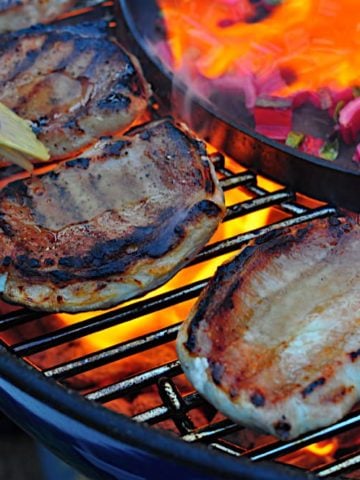
Grilled Pork Chops with Bourbon Brine and Baste

May 19, 2011 by Mike Vrobel 4 Comments

I know boneless pork loin is bland. But when it's on sale, I can't help myself - I grab a package from my local megamart. "What a deal!" I think...until it is time to cook it. Then I start to kick myself . What was I thinking? What can I do to make boring pork loin something I want to eat? Couldn't I at least have bought bone-in pork chops? (No, they weren't on sale.) Then, inspiration crawled out of the bottle. Bourbon pork chops suddenly sounded delicious.
*In fact, I'd rather have this bottle in front of me than a frontal lobotomy! Hahahaha...ahem. Sorry. My inner 13 year old got loose again.

I added bourbon to my brine, then basted the pork chops with a mix of bourbon, butter, and brown sugar. The bourbon adds a smoky, complex flavor to an otherwise straightforward recipe.
I didn't realize how alliterative this recipe was until just now. There sure are a lot of "B"s in there...

Now, I always hesitate to cook with something I would rather drink straight up.*
*The biggest disappointment was a recipe for chicken with a margarita marinade. I used two cups of alcohol, and the results were boring. I should have skipped the marinade and made a margarita to drink with the chicken.

This is not the time to get the top shelf bourbon out - don't use your Pappy Van Winkle for this one. My mom is a Jim Beam loyalist (the Manhattan is her drink of choice), so I always have some on hand.

Recipe: Grilled Pork Chops with Bourbon Brine and Baste

Cook time: 10 minutes

Equipment:

  • Grill (I used my trusty Weber kettle)

Ingredients:

  • 6 boneless pork loin chops (¾" thick)
  • ¼ teaspoon fresh ground black pepper

Brine

  • 1 quart water
  • ¼ cup bourbon (Jim Beam, according to my mom)
  • ¼ cup Kosher salt (or 2 tablespoons table salt)
  • 2 tablespoons packed brown sugar

Bourbon Baste

  • 2 tablespoon butter
  • 1 tablespoon bourbon
  • 1 teaspoon kosher salt
  • 1 teaspoon brown sugar

Directions:
1. Brine the pork chops: Stir brine ingredients until the salt and sugar dissolve, then add the pork chops. Brine for at least 30 minutes and up to 2 hours.

2. Prepare the grill: Prepare the grill for cooking on medium-high heat, then clean with a grill brush. For my Weber kettle, I light a chimney starter* ¾ full of charcoal, wait for it to be covered with ash, then pour it evenly over one half of the grill grate. This gives me half the grill on medium-high heat, and half off the heat.
*I highly recommend the Weber Chimney Starter, because it is larger than most chimney starters. It holds 5 quarts of charcoal, which exactly the right size for cooking this recipe.

3. Prepare the bourbon baste: While the grill heats up, put the bourbon baste ingredients in a small bowl. Microwave on high until the butter has melted and the ingredients are bubbling, then stir to combine. (Or, put the ingredients in a grill safe pot or cup, and bring them to a simmer on the grill while cooking the pork chops.)

Ready for the grill
Browned on one side, ready to flip
Grilling side two
Bourbon baste

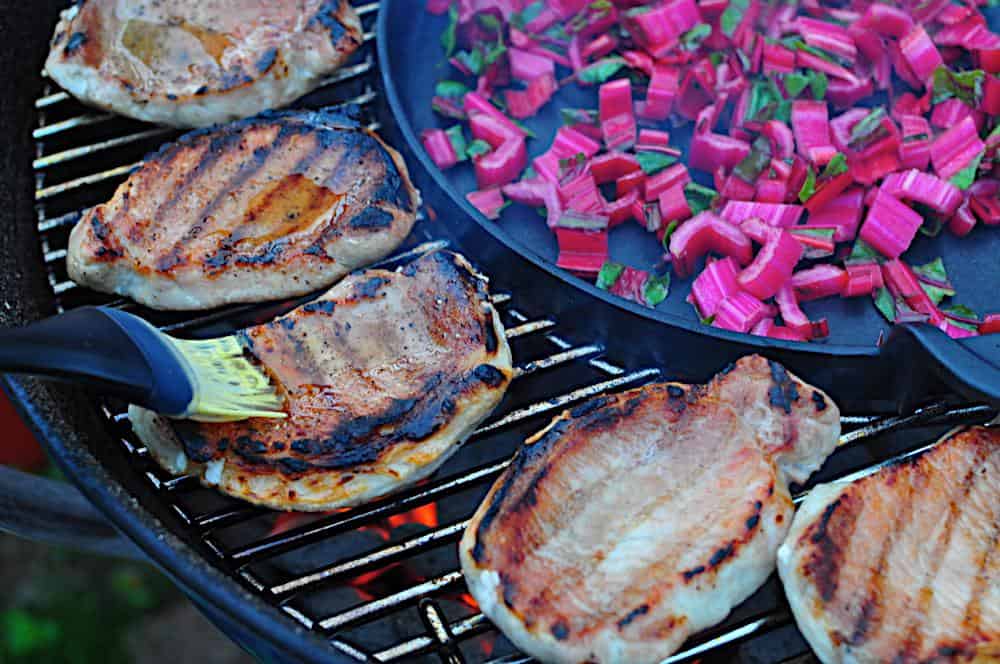
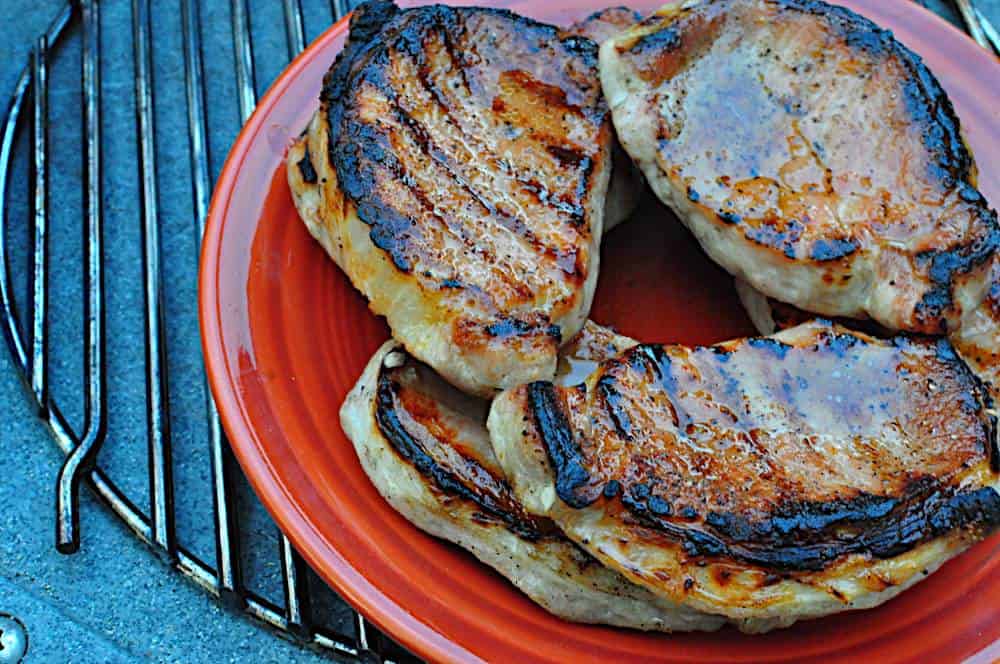
4. Cook the pork chops: Remove the pork chops from the brine, pat dry with paper towels, then sprinkle evenly with the ¼ teaspoon black pepper. Put the pork chops on the grill over medium-high heat. Cook uncovered for 2-3 minutes, until the pork chops are starting to brown a little. Rotate the chops 90 degrees (don't flip yet), moving them around if some are browning quicker than others due to hot spots on the grill, and cook for another 2-3 minutes, until well browned. Flip the chops and cook for 2-3 more minutes. The chops should be cooked to medium-rare, with an internal temperature of 135*F at this point. Brush the chops with the bourbon baste, flip them, and immediately brush the other side. (Move them around on the grill if there are flareups while you baste.) Remove the chops to a serving platter, brush with the baste one last time, let rest for ten minutes, then serve.

Variations:
*Non-alcoholic version: Substitute apple juice, apple cider, or apple cider vinegar for the bourbon.

Notes:
*The baste will cause impressive flare-ups. (Alcohol, butter, and sugar make a remarkably flammable combination, especially when they drip onto lit charcoal.) Make sure there is room on your grill to move the chops around, to get them out of the flames.

*You can see the swiss chard I was cooking in the new Weber Gourmet BBQ System griddle. But that's a recipe and a review for another day...

What do you think? Questions? Other ideas? Leave them in the comments section below.

Related Posts:
Grilled Thin Pork Chops, Quick Brinerated
Grilled Pork Chops, Brined and Honey Basted
Grilled Pork Chops Agrodolce

*Enjoyed this post? Want to help out DadCooksDinner? Subscribe using your RSS reader or by Email, recommend DadCooksDinner to your friends, or buy something from Amazon.com through the links on this site. Thank you!

A Farewell to Good Eats

May 17, 2011 by Mike Vrobel 4 Comments

G.E. fans, I've decided to cut the half hour series at 249 eps. There will be 3 new 1 hour eps this year and that's it. But mourn not. New things brew on the horizon..."good" things.
@altonbrown, twitter

And with that, one of my food heroes moved on to new things. Good Eats is no more. People ask "who are your influences?" Alton Brown is a big one. Good Eats taught me that food isn't just food. Food is an essential part of our human experience. Learn about food, and you learn about science, technology, history, and anthropology. Alton's half hour exploration of food got a pebble rolling in my head, which started the avalanche that eventually became this blog.
*I was lucky enough to meet Alton when he taught a cooking at the Western Reserve School of Cooking. I was the guy sitting in the front row, shooting my hand in the air until he had to say "Do you mind if someone else asks a question?" I worry that I'm the one who drove him to remake "Misery", about an obsessive fan. (Episode 74, "This Spud's for You"). But then I remember: I may be that obsessive, but I can't be that memorable.

Me and Alton, 2002. OK, I do look obsessed.

I feel like I'm losing a friend. I've been watching Good Eats since I stumbled across Crustacean Nation (Episode 18) on the Food Network. To this day, Good Eats is - was - the only show on my Tivo that I watch religiously. Other shows I pick over, choosing the ones that look interesting. Not Good Eats. I watched every one of the 249 episodes. Most of them at least twice, to make sure I didn't miss anything.
*OK, except for episode 249. It sits on my TiVo, unwatched. I can't bring myself to start it...not yet.

Now, as Alton said in one of his follow up tweets: "Stop talking about me like I'm dying! It's not a tumor." I can't wait to see what else he has up his sleeve.

Alton, thank you for everything you've taught me. Best of luck, and come back soon!

Easy Cedar Plank Salmon Recipe

May 12, 2011 by Mike Vrobel 10 Comments

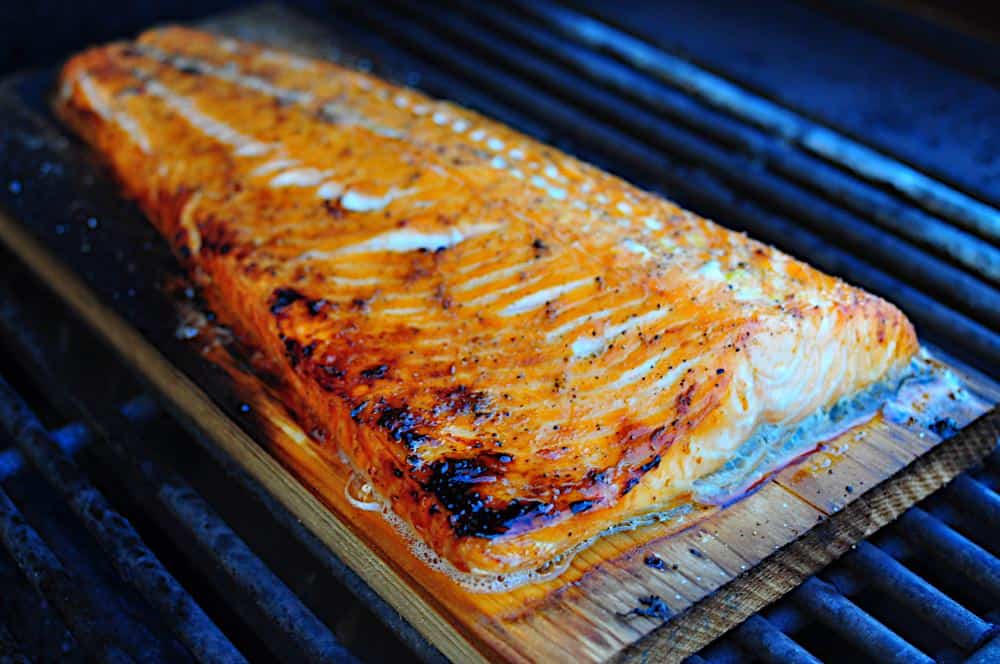
A cooked filet of salmon on a cedar plank on a grill

Cedar plank salmon simulates a pacific northwest potlatch salmon bake on a backyard grill. Cooking salmon on a plank adds a touch of smoky flavor to the fish, and it makes cooking a snap. No fish sticking to the grill - put the plank on the grill, grill roast for about a half an hour, pull the plank off the grill, done.

Now, it's not perfect. You will have to deal with the smoking hot cedar plank. Make sure you have a sheet pan or something like it, and a heat proof trivet to put it on when you are done cooking.

A cooked filet of salmon on a cedar plank on a grill
Cedar Plank Salmon
[feast_advanced_jump_to]

What You'll Need

To cook salmon on a cedar plank, you need a grill, a piece of salmon, and an untreated cedar plank. The safest way to get untreated cedar is to buy grilling planks at cooking store...but they are  expensive, and they tend to be on the small side if you want to cook an entire salmon fillet. The cheaper, but riskier way is your local hardware store. I used to buy untreated cedar 1x8 boards and cut them into 16 inch lengths. But, be aware: there is a risk that untreated hardware store cedar was piled up with treated wood while it was in storage, and the toxic chemicals used to treat that wood have leached into the cedar.

Use your own best judgement. Like I said, I used to buy untreated cedar boards from the hardware store. I've been cooking on cedar planks for years; when I started the ONLY option was the hardware store. Nowadays, I buy cedar planks that are made for grilling. They're more expensive, but I prefer the peace of mind to the savings.
*If you want the best of both worlds, check high end cookware stores at the end of summer. I don't like paying $20 for 4 feet of wood at a cooking store...but at the end of the grilling season, when it's on sale for $5, I snap it up.

How to Make Cedar Plank Salmon

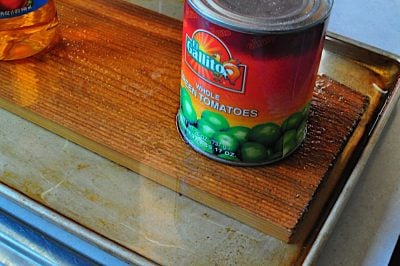
  1. Soak the plank in water: Put an untreated cedar plank in a pan or dish, cover it with water, and weigh it down with cans. (I use a rimmed baking sheet). Let the cedar soak for at least an hour.
  2. Prepare the salmon and sour cream sauce: After you have soaked the cedar plank, remove the plank from the water. Put the salmon filet on the plank, skin side down. Sprinkle the salmon with kosher salt, black pepper, brown sugar, and lemon zest. Mix the sour cream sauce ingredients (sour cream, olive oil, fresh lemon juice, chopped capers) in a small bowl.
  3. Set the grill up for indirect cooking at high heat (450°F or higher): For my Weber Summit gas grill, I preheat the grill for 15 minutes with all the burners on high, then I turn off the middle burners (leaving burners 1 and 6 lit and on high heat). For my Weber Kettle charcoal grill, I light a chimney full of charcoal, let it get covered with ash, then pour the coals into charcoal baskets on two sides of the grill, leaving the center of the charcoal grate clear.
  4. Cook the plank of salmon: Remove the plank from the grill with tongs. (Heatproof gloves are a good idea too.) Move the plank to a rimmed baking sheet or other fireproof surface, and set that on a heatproof pad. Cut the salmon crosswise into 2 inch wide pieces and serve, passing the sauce at the table.
  5. Serve: Using tongs, remove the plank to a sheet pan or other fireproof surface, then set on a heatproof pad. Cut the salmon crosswise into 2 inch wide pieces and serve, passing the sauce at the table.

Recipe Tips

Simple Salmon

The simplest version of this recipe is salmon, salt and pepper, and the cedar plank. Everything else in the recipe improves the flavor, but simple smoked salmon is still sensational.

Sizing the plank

When I can, I get the plank first, then take it to the grocery store and ask for a piece of salmon that will cover it. If the salmon is a little too wide, I'll trim off the thin side of the fillet so it doesn't hang over the edge.

Different plank woods

If you can find it, Alder is more traditional. It's the original wood used in northwestern salmon cooking. The difference between Alder and Cedar is subtle. I have a slight preference for the flavor of alder over cedar. But, it is hard to find alder planks where I live, and when I can, they are more expensive. So I usually go with cedar wood.

Maple, cherry, and oak planks will also work for this recipe. Again, no matter what type of wood you sue, make sure it is untreated.

Indirect Heat

When I'm cooking with a plank, I use indirect high heat. Cedar planked salmon, cooked over direct heat chars the board and generates way too much smoke. The cedar taste overwhelms the fish. Also, with indirect heat, I don't have to worry about the plank going up like a torch, taking my salmon with it.

What's that popping sound?

While the plank is on the grill, you will occasionally hear a loud popping noise. This is normal.

Keep an eye on the grill, looking for smoke. A little white smoke rising from the grill is what you want; if you see smoke pouring out of the grill, especially black smoke, the plank is on fire. Use tongs to move the plank away from the heat on the grill, and the plank should extinguish itself.

You are working with a piece of wood on a grill grate over an open fire, so there is the chance the plank will catch on fire. (The hint of danger helps make this recipe a show stopper.) Make sure you have tongs to handle the hot (probably smoldering) cedar plank, and a heat-proof surface to move it to. Also, the charred wood from the plank will make a mess - think of drawing with charcoal on a sidewalk - so I move the wood plank to a rimmed baking sheet, then put that on a heatproof pad to protect whatever is under it.

Related Posts

  • Grill Smoked Salmon
  • Grilled Mahi-Mahi Fish Tacos
  • Grilled Trout, Herb and Citrus Stuffed

My other Salmon Recipes

Inspired by: Ted Reader Sticks & Stones: The Art of Grilling on Plank, Vine and Stone (The Game & Fish Mastery Library)

Cedar plank covered with water, held down with a large can
Soaking the plank - weighted down with a big can
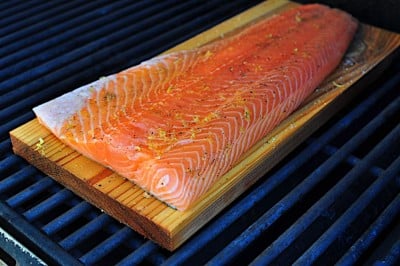
Cedar plank and uncooked salmon filet on the grill
Plank and Salmon on the grill
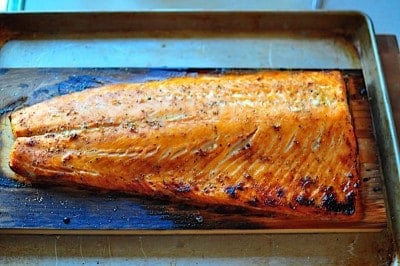
Cedar plank salmon cooked and in a roasting pan
Done - plank in the pan

What do you think?

Questions? Other ideas? Leave them in the comments section below.

Related Recipes

For different takes on grilled salmon, try my Grill-Smoked Salmon, Grilled Mustard Crust Salmon, or Grilled Salmon with Coriander-Fennel Spice Rub. Other ways to cook salmon are my Sous Vide Salmon or Sear-Roasted Salmon in the oven.

Inspired by:
Ted Reader, Sticks & Stones: The Art of Grilling on Plank, Vine and Stone (The Game & Fish Mastery Library)

*Enjoyed this post? Want to help out DadCooksDinner? Subscribe using your RSS reader or by Email, recommend DadCooksDinner to your friends, or buy something from Amazon.com through the links on this site. Thank you!

Patatas Bravas (Spanish style fried potatoes)

May 10, 2011 by Mike Vrobel 4 Comments

My kids have a new favorite side dish.
*My six year old has taken ownership of this recipe. He keeps asking "Dad, are you making MY potatoes tonight?"

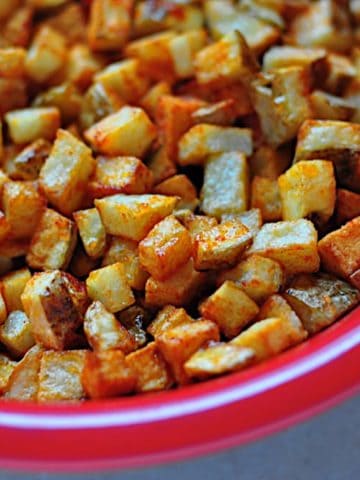
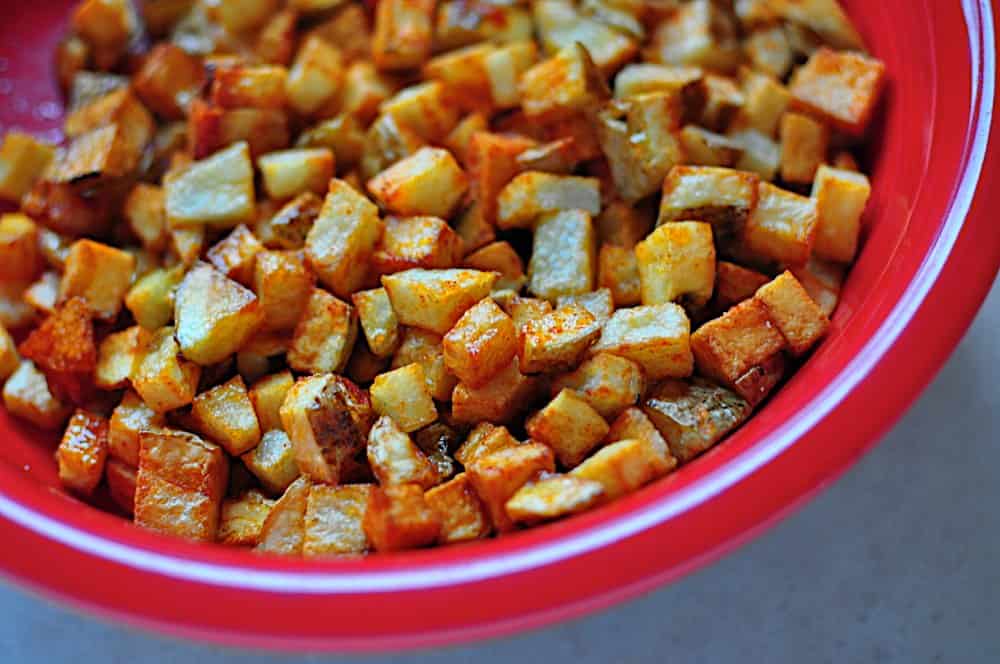
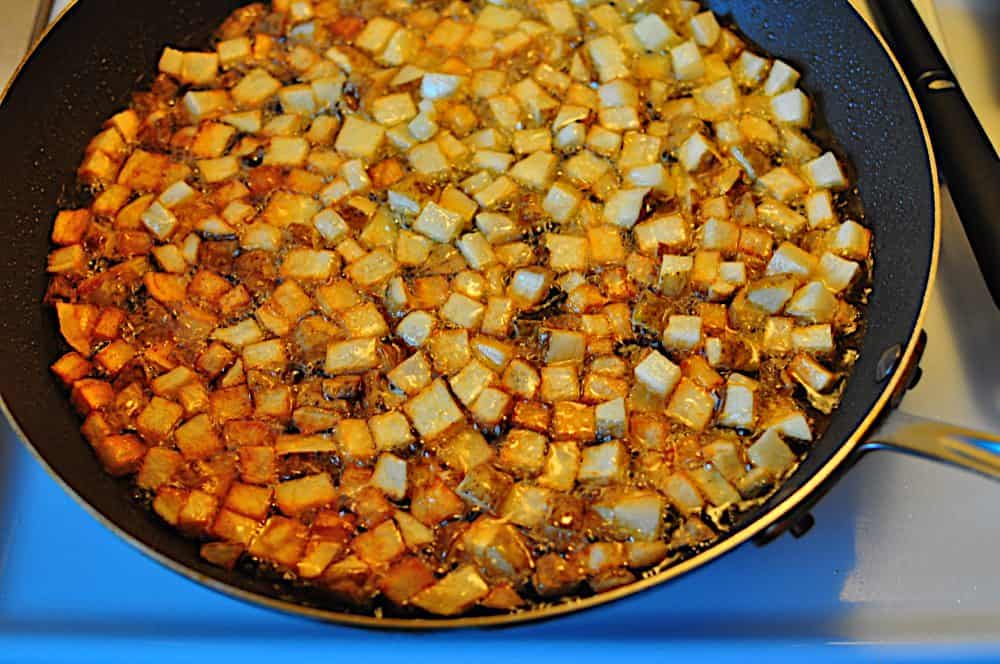
I had never heard of Patatas bravas. Then, a few months ago...bang! A wave of recipes popped up all over the Internet. The recipe is simple. Diced potatoes are fried and sprinkled with salt and smoked paprika, then served with aioli*, mayonnaise loaded with garlic.
*Or maybe it is called allioi. I see it spelled both ways. I'm used to the Provencal spelling, aioli, so that's what I'm going with.

There are two major variations in the recipe. Version one has larger chunks of potato, which are par-boiled before frying. Version two has smaller chunks of potato which go into the frying oil raw. I've tried both versions, and they're both delicious. The second version, with a smaller dice of potatoes, is the one I use.
When I cook on a weeknight, I want to eliminate the extra step of par-boiling. And, more important, the extra pot I would have to clean.

While I'm simplifying things, I also shortcut the aioli. Sure, I could make my own mayonnaise in the food processor. If I'm being fancy for my friends, that's what I'll do. But on a weeknight, I cheat. I doctor pre-made mayonnaise with olive oil, lemon juice, and garlic for a sorta aioli.
*The kids won't touch the aioli anyhow. They just give me a look that says: "Mayonnaise? On French fries? Seriously?" That's why I've made the aioli optional.

Recipe: Patatas Bravas (Spanish style fried potatoes)

Adapted From: Sharon Anderson, Mayo, you win [ThreeManyCooks.com]

Cook time: 15 minutes

Equipment:

  • 12 inch fry pan
  • paper towels and a large plate

Ingredients:

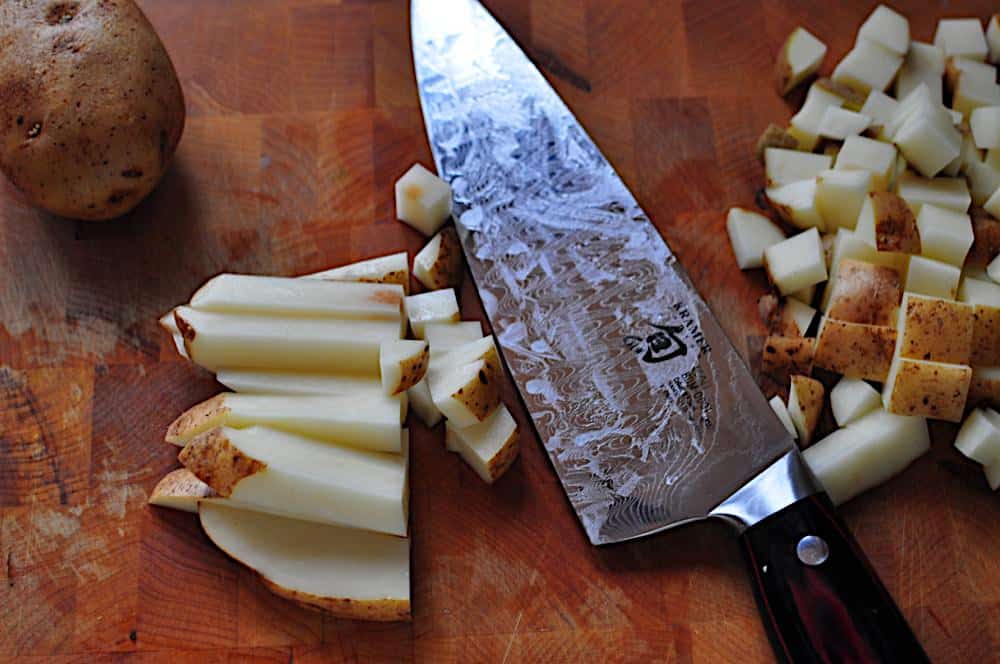
  • 1 ½ pounds russet potatoes, cut into ½" dice
  • ½ cup olive oil
  • ½ cup vegetable oil
  • 1 teaspoon Kosher salt
  • 1 teaspoon smoked Spanish paprika (Pimenton de la vera)

Quick Aioli (optional)

  • ½ cup mayonnaise
  • ¼ cup olive oil
  • juice of ½ lemon
  • 2 cloves garlic, minced or pressed through a garlic press

Directions:
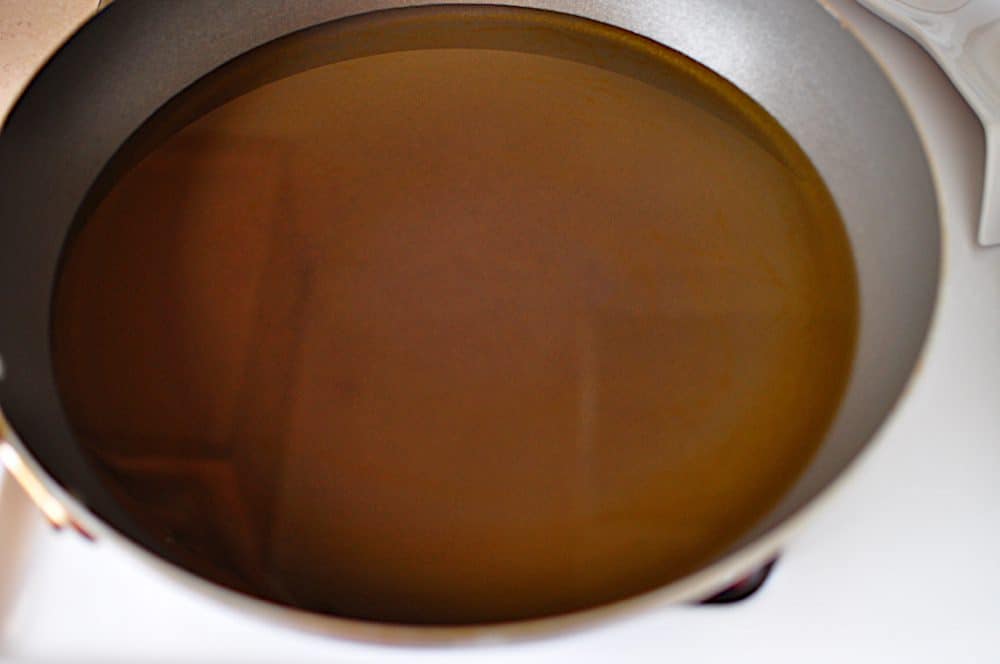
1. Prep work: Dice the potatoes, whisk the aioli ingredients together, put a couple of layers of paper towels on the serving plate, and heat the olive and vegetable oil in the fry pan over medium-high heat.

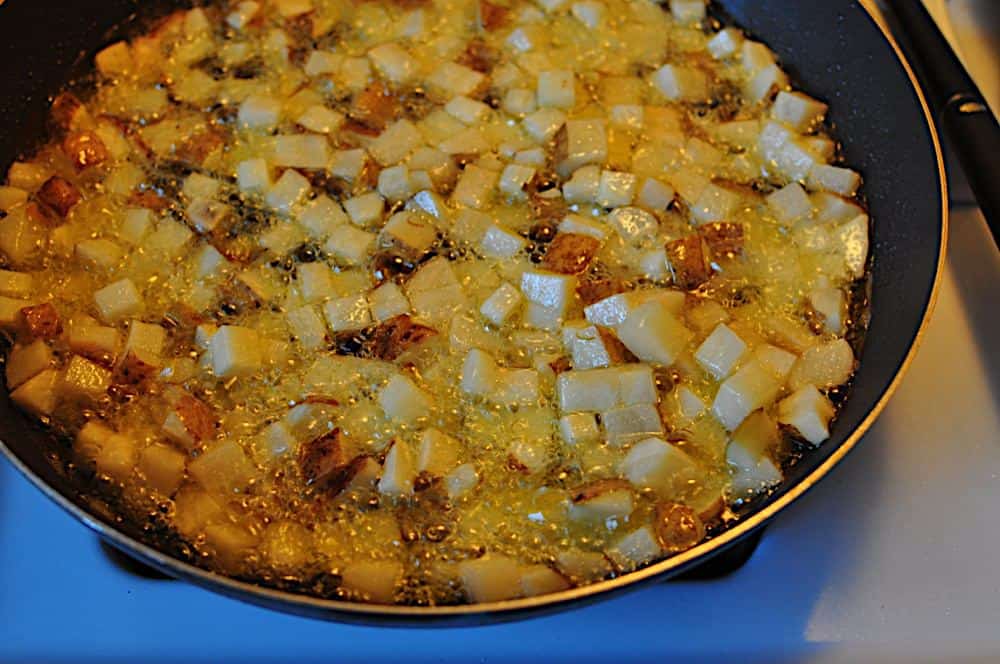
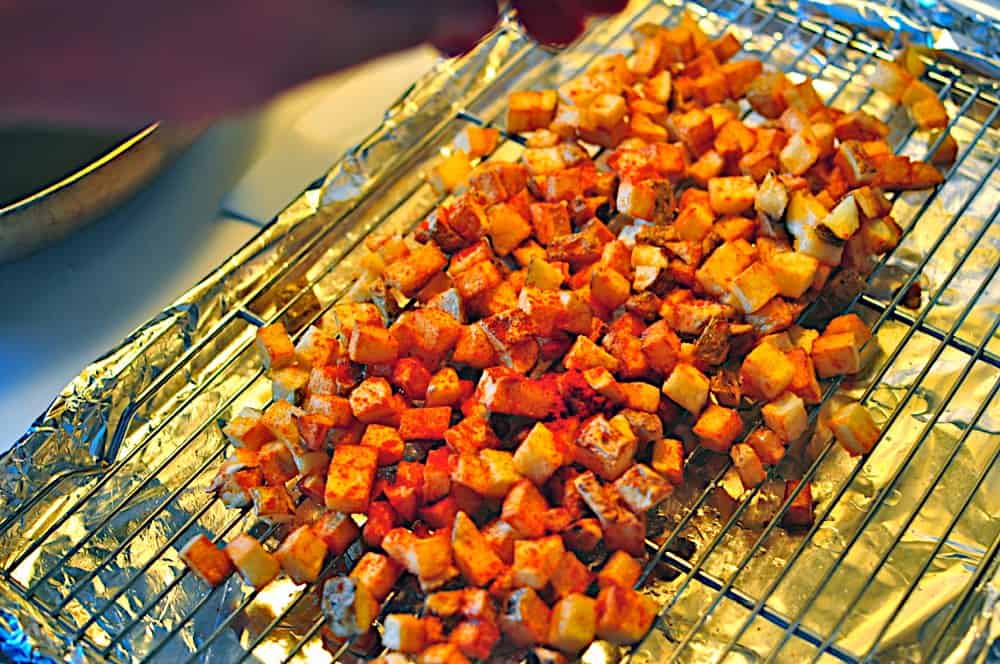
2. Cook the potatoes: Wait for the oil to start shimmering (350*F), then carefully add the potatoes in a single layer. Cook for 10 to 15 minutes, stirring and flipping occasionally, until the potatoes are crispy and brown. Use a slotted spoon to move the potatoes to the paper towel lined plate, and blot as much oil off as you can with some more paper towels. Immediately sprinkle the potatoes with the salt and smoked paprika, and toss to coat. Serve with the aioli on the side.

Variations:
*Larger Patatas Bravas: Cut the potatoes into 1 inch cubes. Cover with salted water in a saucepan, bring to a boil, and cook for 5 minutes, until just tender. Drain the potatoes, pat dry, then continue with frying in step 2 above.

*Peeled potatoes: You could peel the potatoes before dicing them. I like potato skin, so I leave it on.

Notes:
*In my pictures, I'm cooking two pounds of potatoes. I used my 13 inch fry pan and 1.5 total cups of cooking oil (1 cup vegetable oil plus ½ cup olive oil).

*The key to this recipe is the smoked Spanish paprika. Really, these potatoes are just home fries...until you add the smoked paprika.

*Make sure you have enough paper towels to pat the potatoes dry, or you'll have to improvise a drip pan, maybe with a sheet pan and a rack. Not that I would let such a thing happen to me...

What do you think? Questions? Other ideas? Leave them in the comments section below.

Adapted from:
Sharon Anderson, Mayo, you win [ThreeManyCooks.com]

*Enjoyed this post? Want to help out DadCooksDinner? Subscribe using your RSS reader or by Email, recommend DadCooksDinner to your friends, or buy something from Amazon.com through the links on this site. Thank you!

Kale Chips with Chinese Flavors

May 5, 2011 by Mike Vrobel Leave a Comment

Spring has been a wet blanket. Every day has been gray and raining.
*Every day? I may be exaggerating. But I keep having this urge to build an Ark, and fill it with breeding pairs of animals.

I am starting to worry for Tim, my CSA farmer. Every week, he sends our spring CSA update. Every week, he tries not to complain about the lack of sunshine. Now, he's used to the interesting weather we get in Ohio. But he needs sunshine, at least occasionally.
*It's that whole photosynthesis thing we learned about in grade school. No sun, no plants.

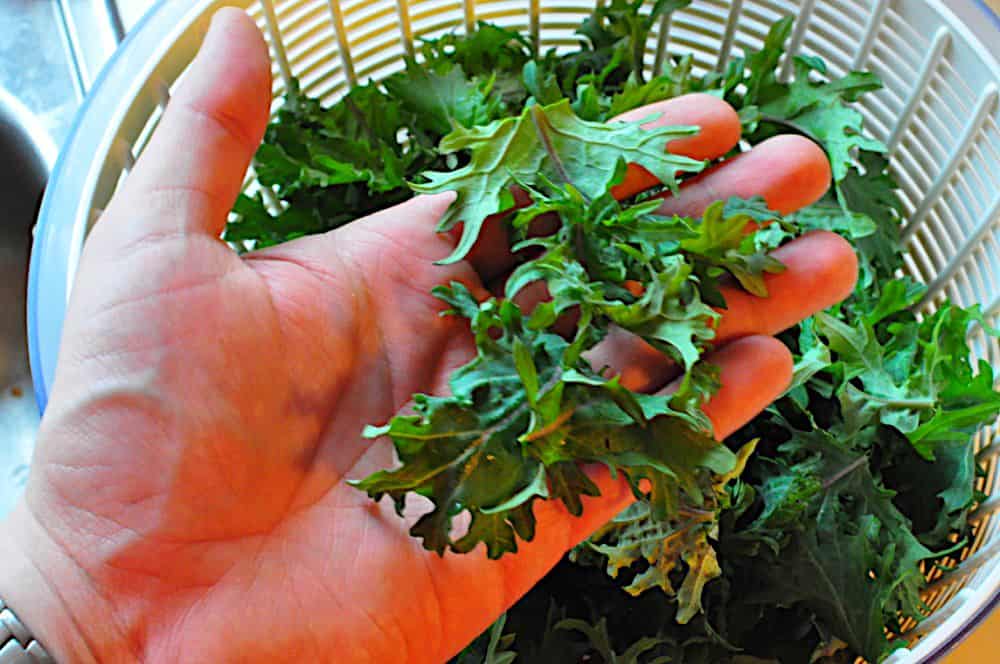
Tim managed to scrape together enough vegetables for our first Spring CSA share. One of the offerings was a bag of baby kale. I'm used to large leaves of kale; these were tiny, with two to three inch leaves. I forgot all about the miserable spring weather - it is Kale chip time!

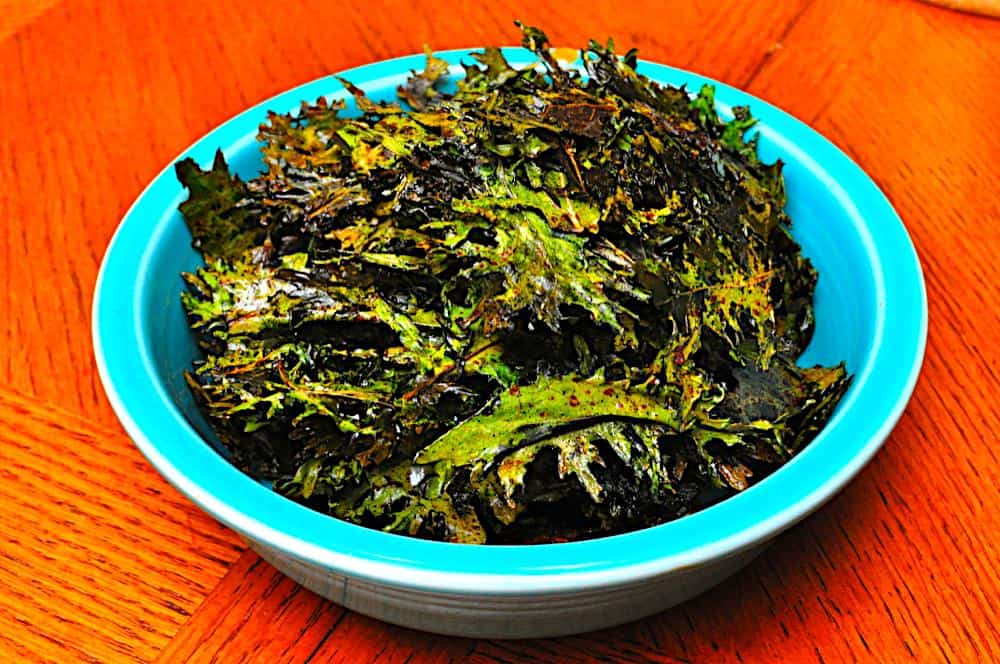
Following a suggestion from reader terrin, I made these kale chips with a Chinese flavor profile. I can see why she was raving about them. The soy and sesame oil were great paired with the crispy kale. Even the kids were chowing down; the entire batch disappeared during dinner.
*Well, OK, only one of the kids was chowing down. But we had to take the bowl of kale chips away from him, so Diane and I could have a few. But - kale? Had to take it away from him? There's a sentence I never thought I would write.

Recipe: Kale Chips with Chinese Flavors

Cook time: 15 minutes

Ingredients:

  • 8oz kale, tough stem trimmed out and cut into 2 to 3 inch pieces (or baby kale with the stems pinched off)
  • 1 tablespoon vegetable oil
  • 1 teaspoon sesame oil
  • 1 teaspoon soy sauce
  • ½ teaspoon Kosher salt

Baby Kale

Directions:
*See my Kale Chips post for an overview of the technique, and pictures of how to trim large leaves of kale.
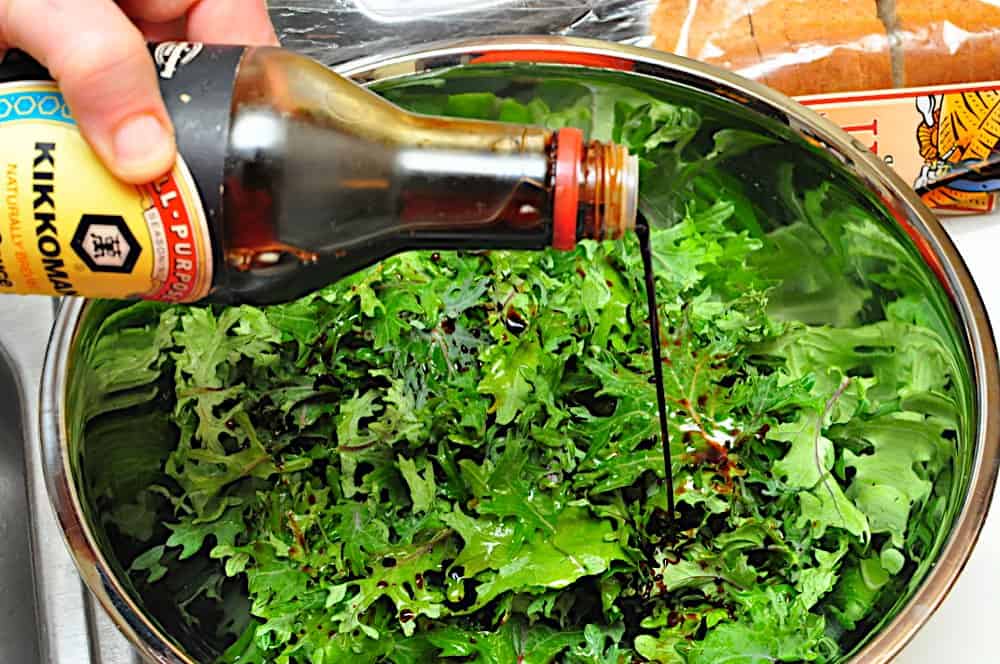
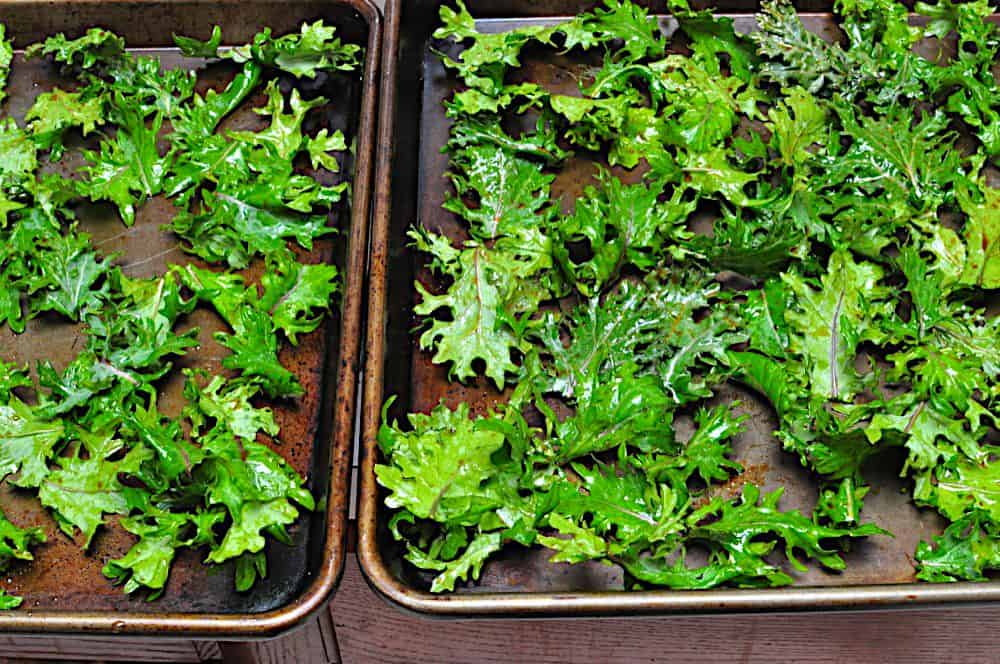
1. Prepare the kale: Preheat the oven to 350*F. Rinse and dry the kale in a salad spinner, then toss with the vegetable oil, sesame oil and soy sauce until evenly coated. Spread the kale out in a single layer on two baking sheets, then sprinkle evenly with the kosher salt.

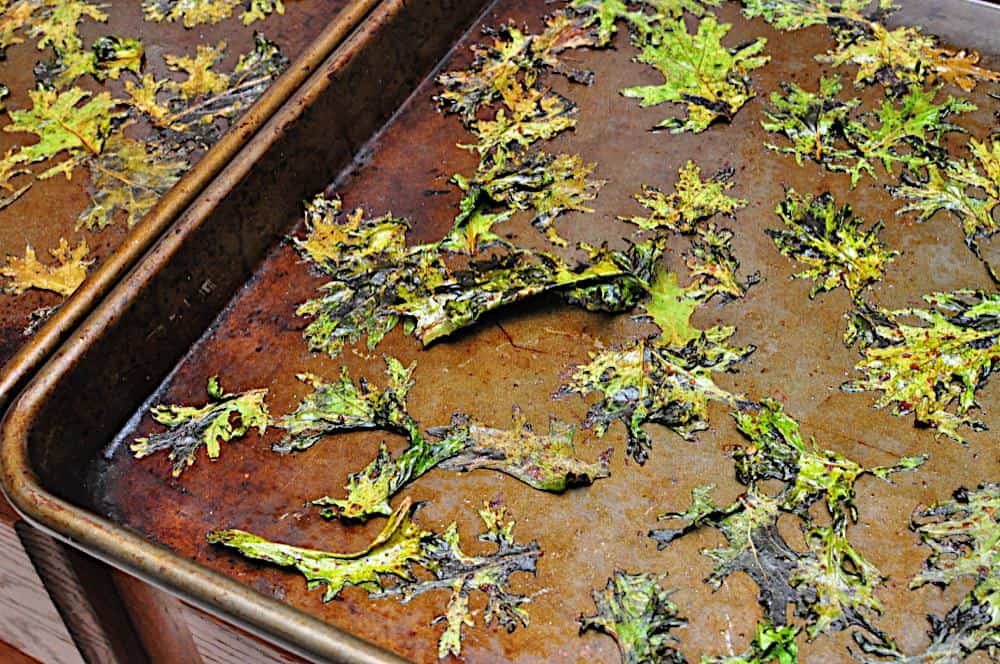
2. Cook the kale: Cook the kale in the oven for 15 minutes, rotating and swapping the pans after 10 minutes. When the kale is done, it should be just getting crisp and some of the pieces will be turning an dark olive green to black color. Remove from the oven and let cool for five minutes. Gently loosen the kale from the baking sheet, transfer to a bowl, and serve.

Variations:
*See my original recipe for Italian style kale chips.

Notes:
*After fifteen minutes, the chips were just barely crisp - I stopped at that point, not wanting them to get too bitter. Some of the chips seemed a touch soft coming out of the pan, but once they cooled down they were perfect, crispy and delicious.

Kale taste test

What do you think? Questions? Other ideas? Leave them in the comments section below.

Related Posts:
My original Kale Chips recipe

Inspired by:
Tim Knorr and the baby kale from the Crown Point CSA

*Enjoyed this post? Want to help out DadCooksDinner? Subscribe using your RSS reader or by Email, recommend DadCooksDinner to your friends, or buy something from Amazon.com through the links on this site. Thank you!

Beer Cooler Sous Vide Grilled Rack of Lamb

April 28, 2011 by Mike Vrobel 11 Comments

I am obsessed with Kenji Alt's Beer Cooler Sous Vide Hack, using a cooler full of hot water to cook meat to a perfect medium-rare. In the last two months I've used it on strip loin steaks, tri-tip, thick-cut pork chops and top sirloin roasts.
*The only disappointing result has been pork chops. They were good, but they weren't noticeably better than regular pork chops.

My favorite reaction was from my mom, who is passionate about medium-rare beef. On her birthday, as I lugged a cooler full of hot water and top sirloin roasts into her house, I explained sous vide cooking. She didn't get it. I tried again; it still wasn't making sense to her. I pulled the roasts out of their baggies, and gave them a quick sear on the grill. Mom was grabbing pieces off the cutting board as fast as I could slice them. "Michael," she said, "I still don't understand it works, but this is perfectly cooked." I felt like The Good Son.

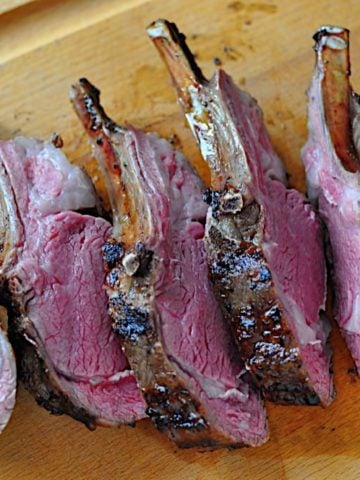
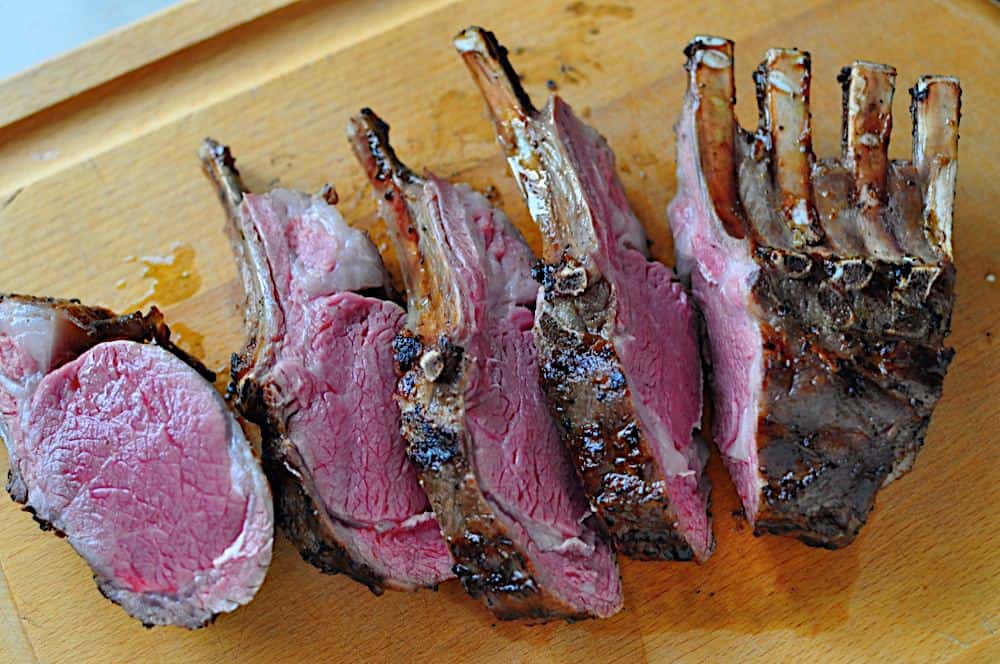
For Easter, I tried my new favorite technique with rack of lamb. I rubbed the lamb with herbes de provence and mustard, cooked it for an hour in 135*F water, then seared it quickly on the grill. And I do mean quickly - dripping lamb fat gave me some impressive flare-ups. If I left the rack still for a few seconds, it was engulfed in flames. One downside of the technique is you don't get to melt off the fat over indirect heat.

As usual, the lamb was cooked to perfection, medium-rare from side to side. That is what I really love about this technique. No more poking the pad at the base of my thumb, then the meat. No more trying to find center mass with my probe thermometer. No more being a nervous wreck, wondering if the steak is going to be perfectly pink, or depressingly grey. It is dead simple, and it just works.
*The downside? It feels like I'm cheating, and all the zip top baggies I go through. I haven't reconciled my carnivorous desire for perfectly cooked meat with my tree-hugging desire to use less stuff.

Recipe: Beer Cooler Sous Vide Grilled Rack of Lamb

Adapted From: Kenji Lopez-Alt Cook Your Meat in a Beer Cooler [SeriousEats.com]

Cook time: 1 hour water bath, 5 minutes on the grill

Equipment:

  • Grill (I used my Weber Summit. Here is the current version of my grill.)
  • Large cooler (At least 2 gallons capacity; more is better)
  • Gallon sized zip-top bags

Ingredients:

  • 1 rack of lamb
  • 2 teaspoons Kosher salt
  • ½ teaspoon fresh ground black pepper
  • 2 teaspoons herbes de provence
  • 2 teaspoons dijon mustard

Directions:
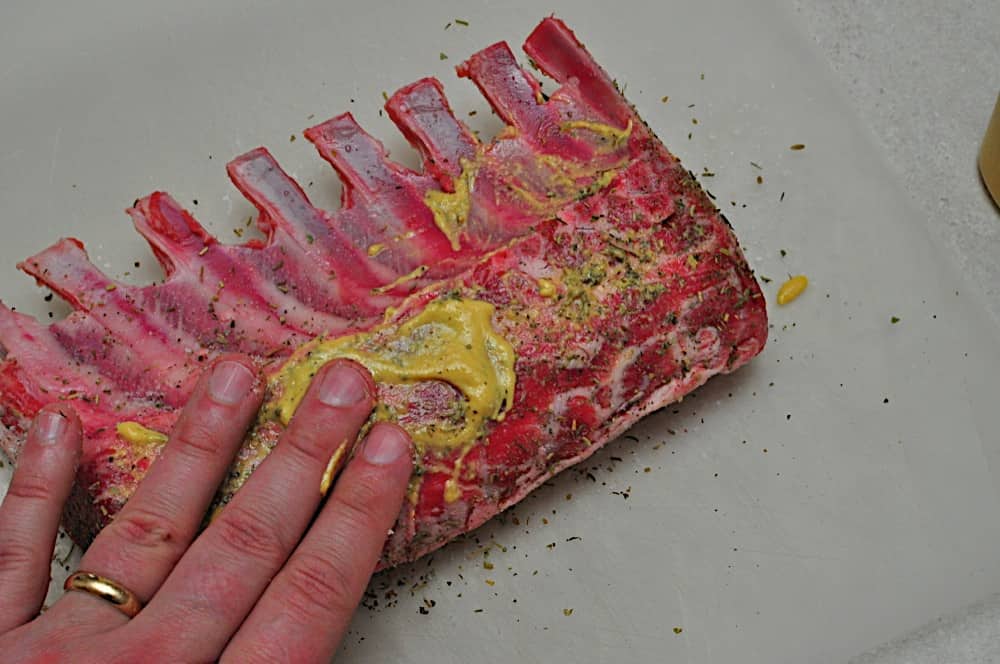
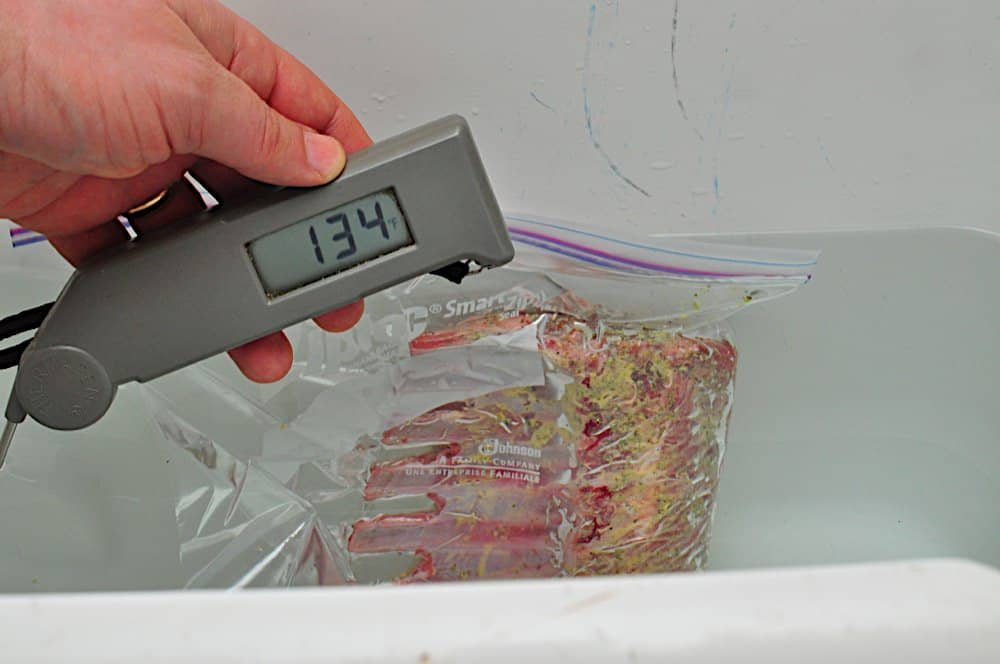
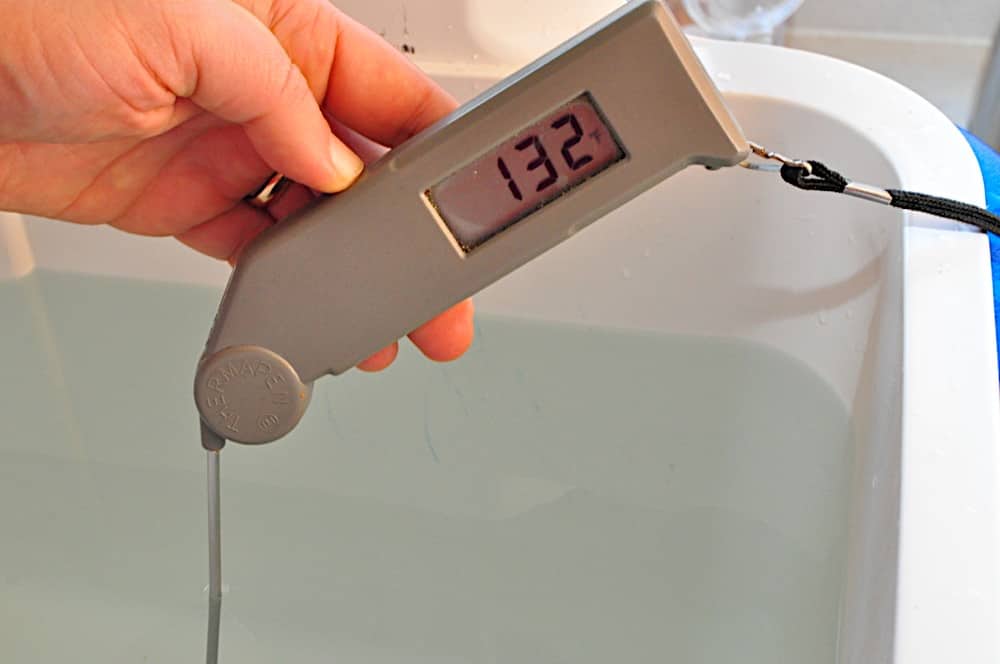
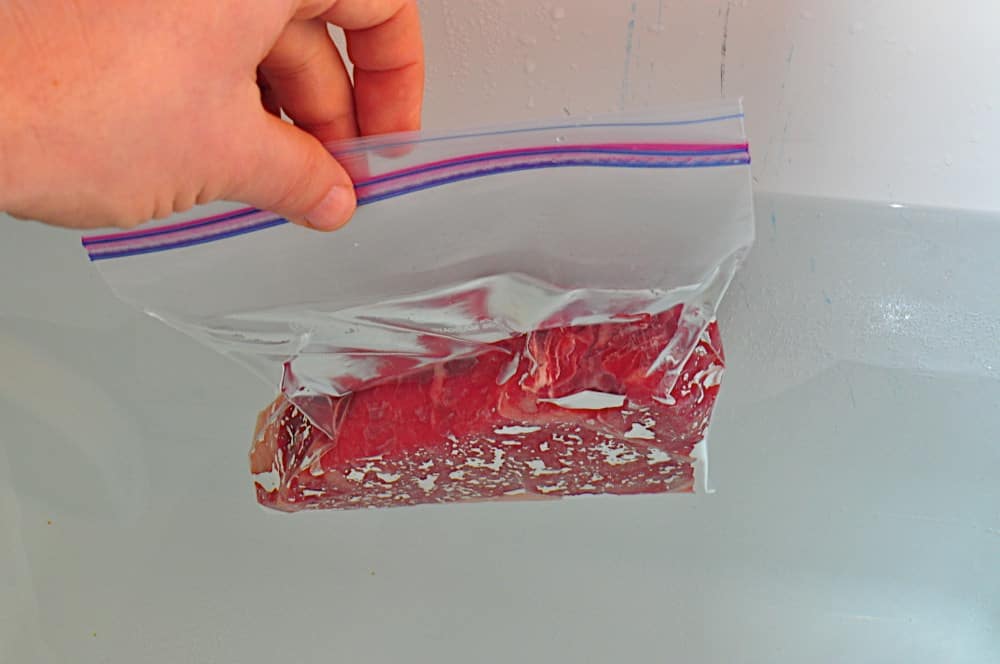
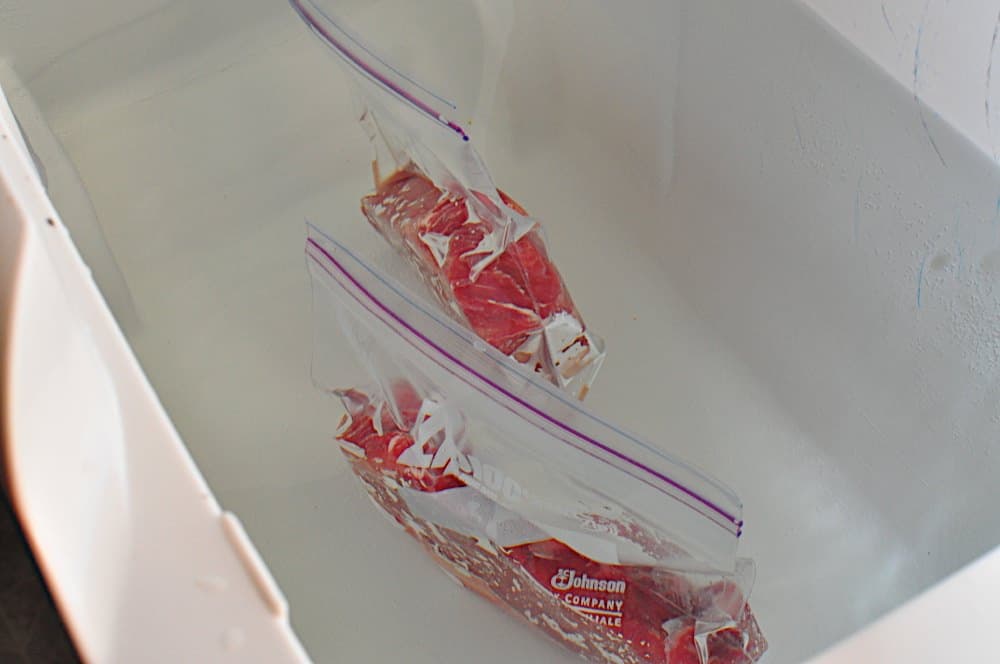
1. Cook the lamb in the beer cooler water bath: Fill a large cooler with 135*F water. (I fill the cooler most of the way with hot tap water, then add boiling water until I get to 135*F). Sprinkle the rack of lamb evenly with the salt and herbes de provence, then rub with the dijon mustard. Put the lamb in the zip-top bag. Slowly lower the bag into the water, letting the water push the air out of the bag and seal itself around the lamb. When the bag is submerged to the level of the zip, seal the bag, then let it sink into the water. Close up the cooler and cook the lamb in the hot water bath for at least an hour.
*If you are cooking for more than two hours, check the water temperature and add boiling water occasionally to keep the temperature between 125*F and 130*F.

Rubbing on the mustard
Not quite 135*F, but close enough.

2. Prepare the grill: Set the grill up for cooking at high heat; as high as you can get it. For my Weber Summit, I turn all the burners to high, let the grill preheat for 15 minutes, then brush the grate clean with my grill brush.

3. Sear the lamb: Remove the lamb from the zip-top bags. Put the lamb over the highest heat part of the grill, bone side up, and cook for two minutes, rotating 90 degrees after a minute to make a cross-hatched pattern. Flip the lamb and cook for another two minutes, rotating 90 degrees after one minute. Grab the lamb by the bones, and hold it vertically on the grill for one minute to sear the bottom of the rack. Remove the lamb to a platter, and rest for ten minutes before serving.

Notes:
*As I said in the opening, the fat on the rack of lamb gave me impressive flare-ups while I was grilling. Keep the rack moving around the grill as the flames get out of control. With the mustard coating, it shouldn't take long to brown, and it is already cooked through from the water bath. As soon as the rack is browned to your liking, get it off the heat.

*If you don't want the flare-ups, buy a well trimmed rack of lamb. I like having some fat on the bones when I'm gnawing at them, so I am willing to live with the flare-ups.

*I prefer to serve as "lamb popsicles", by slicing along each rib to cut the rack into individual chops.

*A rack of lamb serves two regular people, or one hungry carnivore. To cook more than one rack, use the ingredients list as a "per rack" amount, and seal each rack into its own zip-top bag for the water bath.

What do you think? Questions? Other ideas? Leave them in the comments section below.

Related Posts:
Beer Cooler Sous Vide Grilled New York Strip Steaks
Grilled Rack of Lamb

Adapted from:
Kenji Lopez-Alt Cook your meat in a beer cooler [SeriousEats.com]

*Enjoyed this post? Want to help out DadCooksDinner? Subscribe using your RSS reader or by Email, recommend DadCooksDinner to your friends, or buy something from Amazon.com through the links on this site.  Thank you!

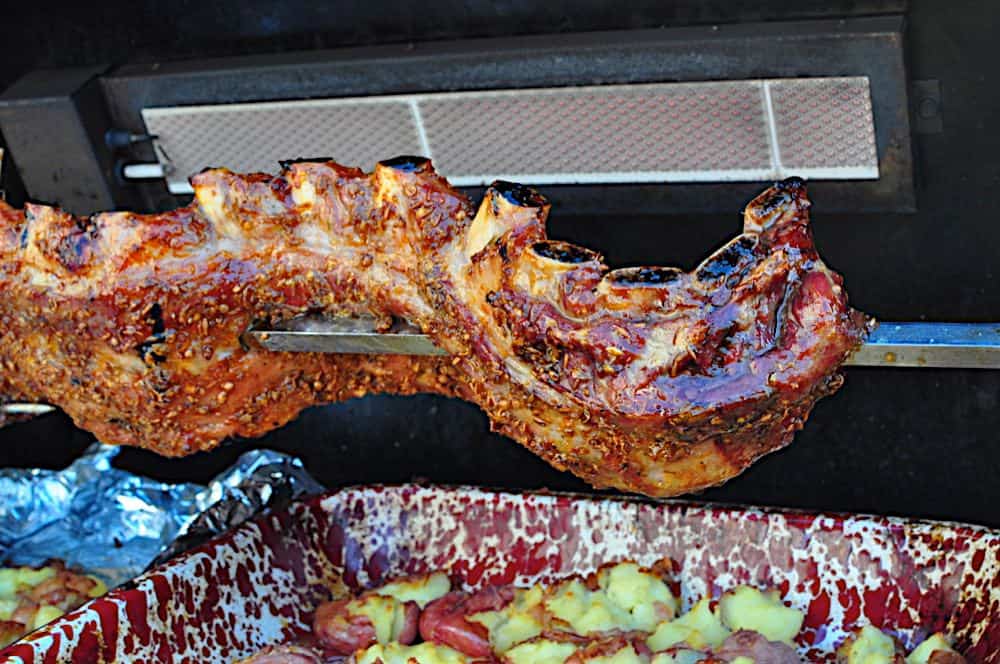
Rotisserie Baby Back Ribs, Cuban Style

April 21, 2011 by Mike Vrobel 4 Comments

After our endless winter, we finally had a warm snap this weekend. The temperature went from the forties on Friday to a high of 78*F on Sunday. I had to grill.

My local grocery store had extra-meaty slabs of baby back ribs on sale. I'm not used to this - when I started grilling, you had to double check the packages, to make sure you didn't get shiners - ribs where the meat had been cut down to the bone, and the shiny ribs were showing through. Now they're selling "extra meaty" ribs. I had to get some.

I was wandering around the La Caja China website, looking at yet another barbecue toy I desperately want, but can't justify.
*I can hear the conversation now. "Yes, dear, I really needed this charcoal fired roasting box. Why? So I could cook a whole pig. And ten chickens.  But who's counting...what's that dear? For who? You don't think the five of us can finish eighty pounds of pork?"

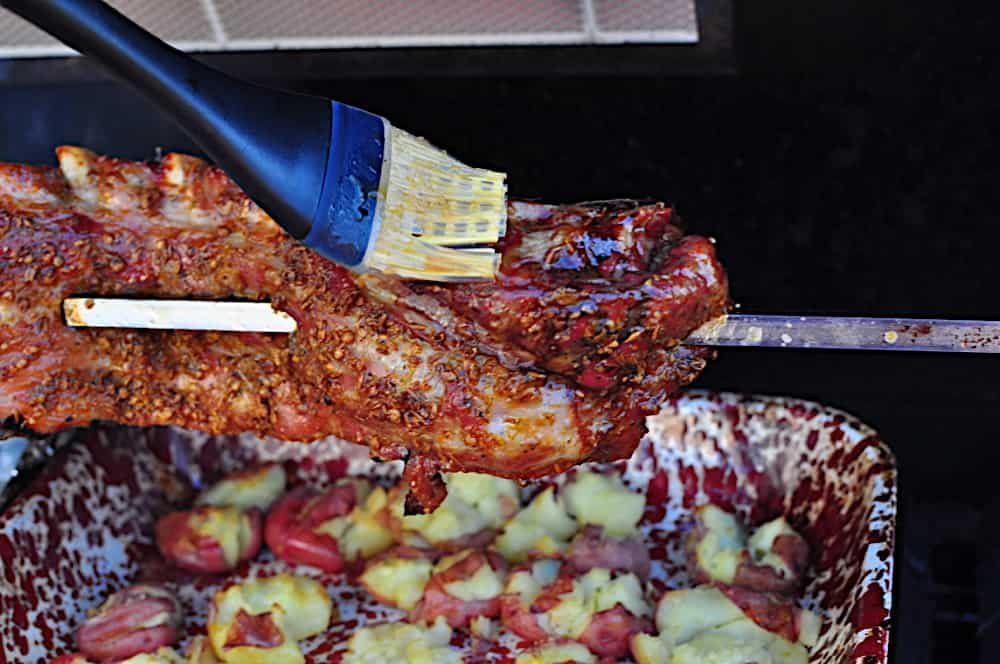
Even though I won't buy the roasting box, thoughts of Cuban pork bounced around in my head. This recipe is what happened when I took the flavors from a couple different mojo recipes and ran with them.
*I'm substituting a mix of orange, lemon and lime for the sour orange that is traditional in mojo sauce. I liked Adam Perry Lang's mop sauce, so I mixed that in as well.

The ribs are a mix of crispy and tender pork, coated in spices, layered with the sweet-sour of the citrus based sauce. Even better - the ribs were gone in fifteen minutes, so I must have done something right!

Recipe: Rotisserie Baby Back Ribs, Cuban Style

Inspired By: Steven Raichlen, How To Grill

Cook time: 120 minutes

Equipment:

  • Grill with Rotisserie attachment (I used a Weber Summit with an infrared rotisserie burner. Here is the current version of my grill.)
  • Aluminum foil drip pan (9"x12", or whatever fits your grill)

Ingredients:

  • 1 rack baby back ribs

Brine

  • 3 quarts cold water
  • 6 tablespoons table salt (or ¾ cup kosher salt)
  • ¼ cup brown sugar

Rub:

  • 4 large cloves garlic, minced
  • zest of one orange
  • zest of one lemon
  • zest of one lime
  • 1 teaspoon cumin seed
  • 1 teaspoon coriander seed
  • 1 teaspoon oregano
  • ½ teaspoon pepper

Glaze

  • ¼ cup brown sugar
  • juice of one orange
  • juice of one lemon
  • juice of one lime
  • ¼ cup apple cider vinegar
  • 1 minced clove garlic

Directions:
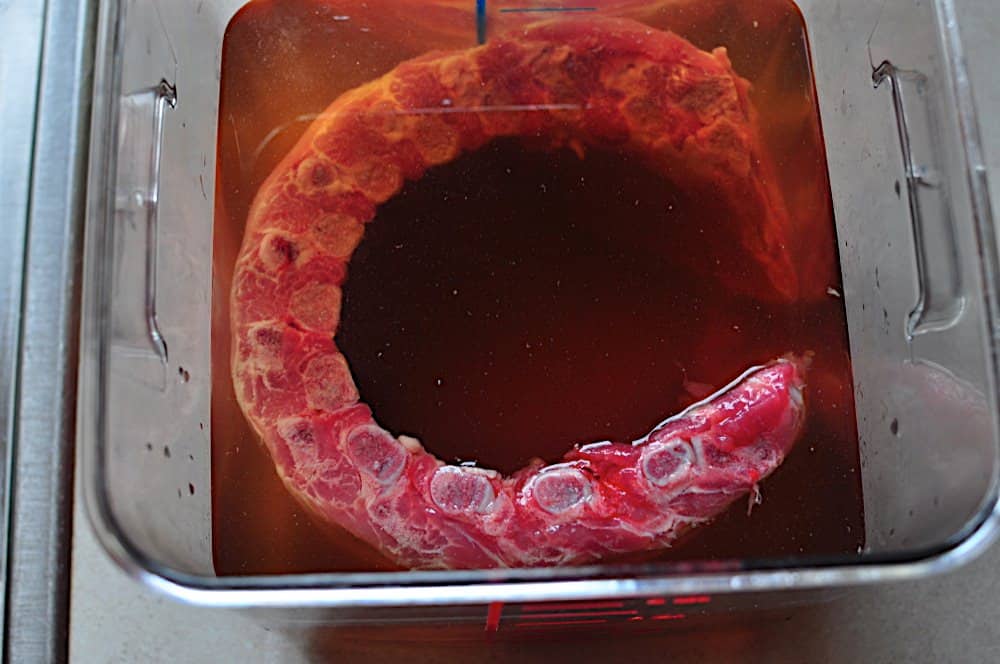
1. Prep the ribs: Remove the membrane on the bone side of the rib. Loosen it by running a butter knife between the membrane and one of the bones on the end of the rib, then pull it off. Put the brine ingredients in a container large enough to hold the ribs and 3 quarts of water, and stir until the salt and sugar have dissolved. Add the ribs, and brine for at least one hour and up to four in the refrigerator.

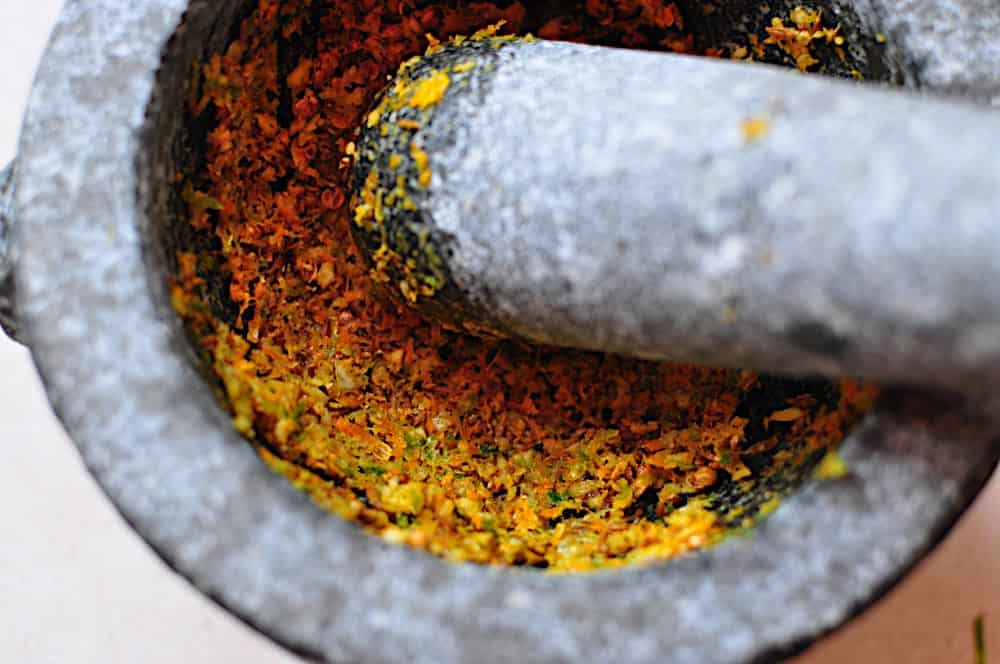
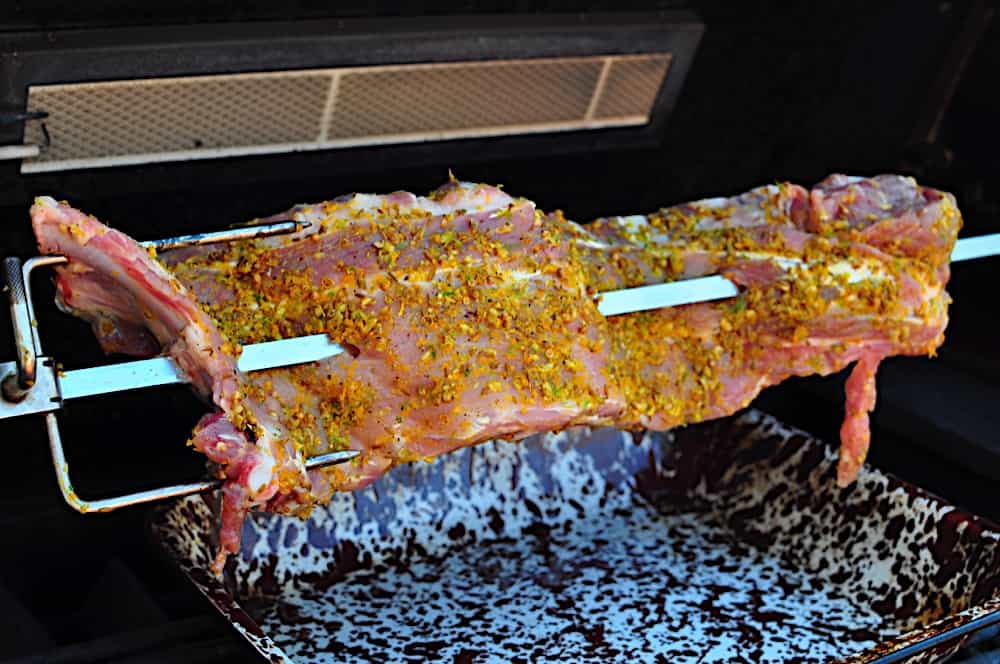
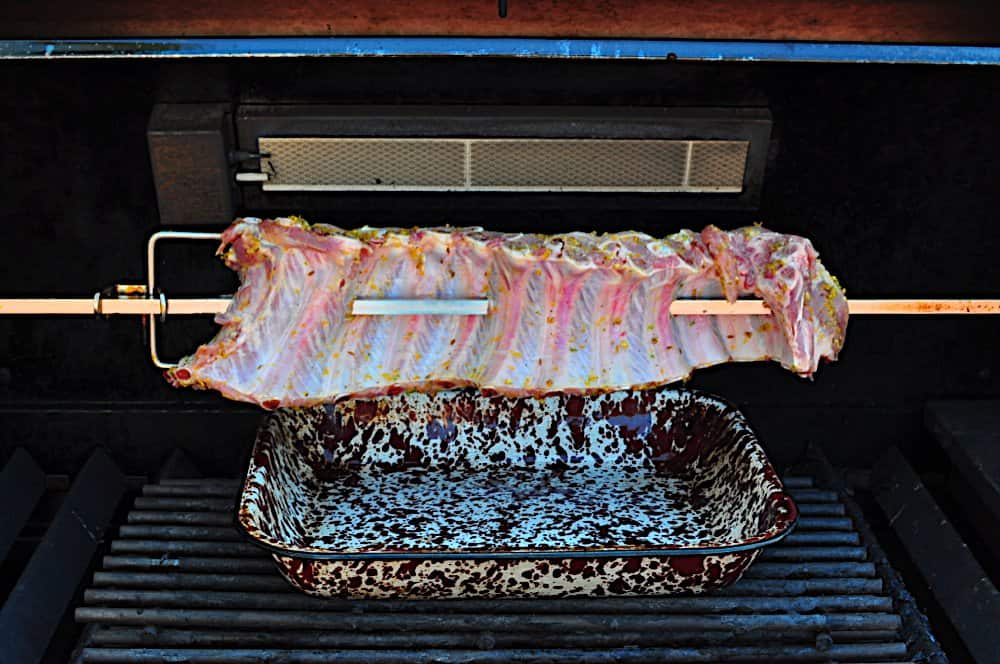
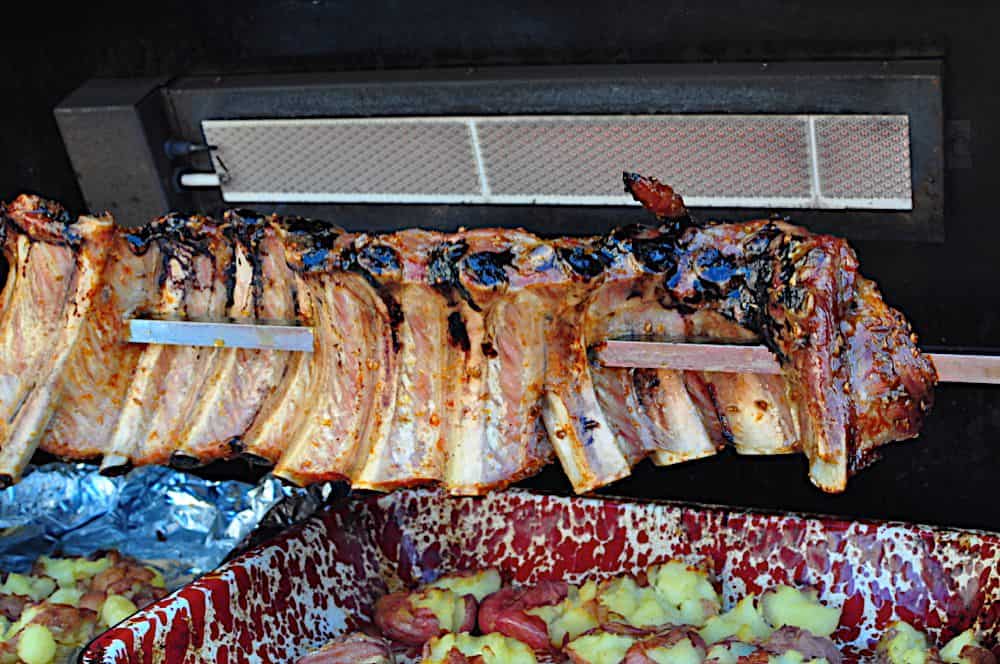
2. Rub and skewer the ribs:  Combine the rub ingredients in a spice grinder or mortar and pestle, and grind into a thick paste. Remove the ribs from the brine and pat dry. Spread the rub over the ribs, concentrating most of the rub on the meaty side. Weave the ribs onto the rotisserie spit, running the spit between every three bones on the rack. Secure the ends of the ribs with the rotisserie forks.

3. Prepare the grill: Set the grill up for rotisserie cooking at medium heat. For my Weber Summit, this means removing the grates and preheating the grill on high for ten to fifteen minutes. Then I turn the two outer burners (burners 1 and 6) down to medium, and turn off all the other burners. (I leave the infrared burner off as well.) Finally, I put my drip pan in the middle of the grill, over the unlit burners. (See My Rotisserie Basic Technique Post for more rotisserie setup details.)

4. Cook the ribs: Put the skewer of ribs on the rotisserie, and start it spinning. Cook with the lid closed for 1 hr 15 minutes to 1 hour 45 minutes. (I had very meaty ribs, and I had to cook them for 1 hour and 45 minutes this time). The ribs are done when they are nicely browned, and the meat has pulled back from the bones on the end by about ½".

5. Glaze the ribs: Increase the heat on the grill to high (I turn my two burners up, and light the infrared burner), then brush the ribs with the glaze. Cook for another ten minutes, basting the ribs with the glaze every few minutes.

6. Serve: Remove the ribs from the spit and brush one last time with the glaze. Let the ribs rest for 15 minutes. Cut the ribs into serving size portions and serve.

Variations:
*Easier rub: Instead of fresh garlic, whole cumin, and whole coriander, use pre-ground cumin and coriander, and 4 teaspoons garlic powder. Zest the fruit, mix with the pre-ground spices, and it's ready.

*Don't have a rotisserie? Set your grill up for cooking on indirect medium heat, with a drip pan in the middle, just like I explain above. Then put the ribs on the grate, and flip them every half hour or so until they are cooked through. Other than that, it's the same recipe.

Notes:
*You can cook 1 or 2 racks of ribs at a time, depending on the size of your rotisserie skewer. On my kettle, I can just squeeze two racks onto the skewer; on my big Weber Summit, I can fit three easily. Three quarts of brine is enough to cover at least two slabs of ribs; it will depend on your container. The rub, however, will only cover one slab of ribs - double the rub for every rack of ribs you want to cook.

*If you forget to put the first fork on my spit before weaving the ribs, it's OK. The fit is tight with the bones, and one fork is enough to hold the ribs steady. Um...not that if you look closely at the pictures you'll see only one fork on my rotisserie spit or anything...
What do you think? Questions? Other ideas? Leave them in the comments section below.

Related Posts:
Rotisserie Baby Back Ribs recipe
Rotisserie BBQ Baby Back Ribs.
Click here for my other rotisserie recipes.

Inspired by:
Steven Raichlen: How To Grill


Check out my cookbook, Rotisserie Grilling.

Everything you could ask about the rotisserie,
plus 50 (mostly) new recipes to get you cooking.

It's a Kindle e-book, so you can download it and start reading immediately!


*Enjoyed this post? Want to help out DadCooksDinner? Subscribe to DadCooksDinner using the RSS or Email options on the right, link to this post from your blog, recommend DadCooksDinner to your friends, or buy something from Amazon.com through the links on this site. (Like my Rotisserie Grilling cookbook...)
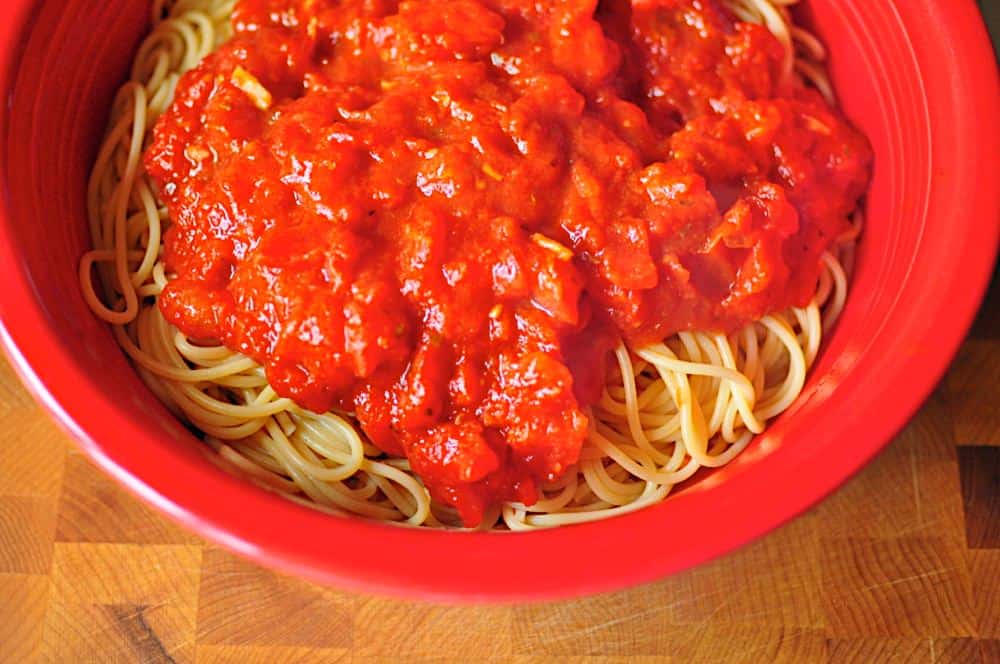
Weeknight Tomato Sauce

April 19, 2011 by Mike Vrobel 5 Comments

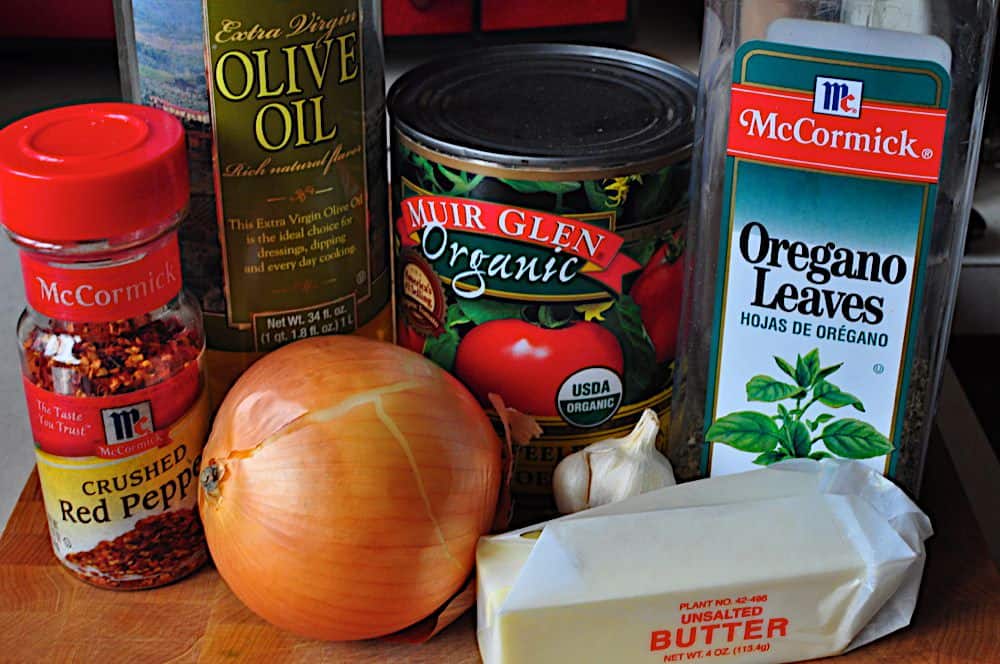
When my grand scheme for dinner falls apart, spaghetti with tomato sauce is my backup plan. I always have a few onions, some garlic, and canned tomatoes at hand.
*One of the keys to making dinner every night is having a backup plan. After a long day at work, the temptress of pizza delivery is whispering sweet nothings in my ear. Instead of reaching for the phone, I reach for the dried pasta and a can of tomatoes.

My tomato sauce recipe has evolved over the last few years. I started out with olive oil, diced onion, garlic, and diced tomatoes, and simmered until thick. Then two things happened:

  1. I read about Marcella Hazan's famous tomato sauce [h/t smittenkitchen.com]
  2. I had kids

Marcella's sauce taught me to use butter instead of olive oil, for the rich taste that only butter seems to have.
*OK, butter and pork fat. But pork fat seemed excessive.

The other trick I learned from Marcella (and one the kids reinforced) is using a halved onion instead of diced onion. The halved onion gives up its sweet flavor to the sauce, without sauteing the diced onion. It's quicker, and when you discard the onion, the kids don't see the chunks of "yucky stuff" in the sauce.
*I want my kids to be adventurous eaters...but I get tired of them eating around pieces of onion in the sauce.

My other change is culinary heresy. I...I used crushed tomatoes. I know, to maintain my image, I should use nothing less than whole plum tomatoes, canned in San Marzano. But...I need a quick, weeknight sauce, not something that must simmer for 45 minutes.

So, here is my current tomato sauce recipe. It takes less time than boiling the pasta water. Like all good recipes, it's still evolving. But right now, if I'm backed into a corner by dinner, this is how I fight my way out.

Looking for an Instant Pot version of this recipe? Try my pressure cooker tomato sauce.

Recipe: Tomato Sauce

Adapted From: Marcella Hazan Essentials of Classic Italian Cooking

Cook time: 25 minutes

Ingredients:

  • 1 tablespoon butter
  • 1 tablespoon extra virgin olive oil (or replace with butter)
  • 2 cloves garlic, minced (or pressed through a garlic press)
  • 1 teaspoon dried oregano
  • pinch of red pepper flakes (optional)
  • 1 medium onion, peeled and halved
  • 28oz can crushed tomatoes
  • 1 large sprig fresh basil (optional)

Directions:
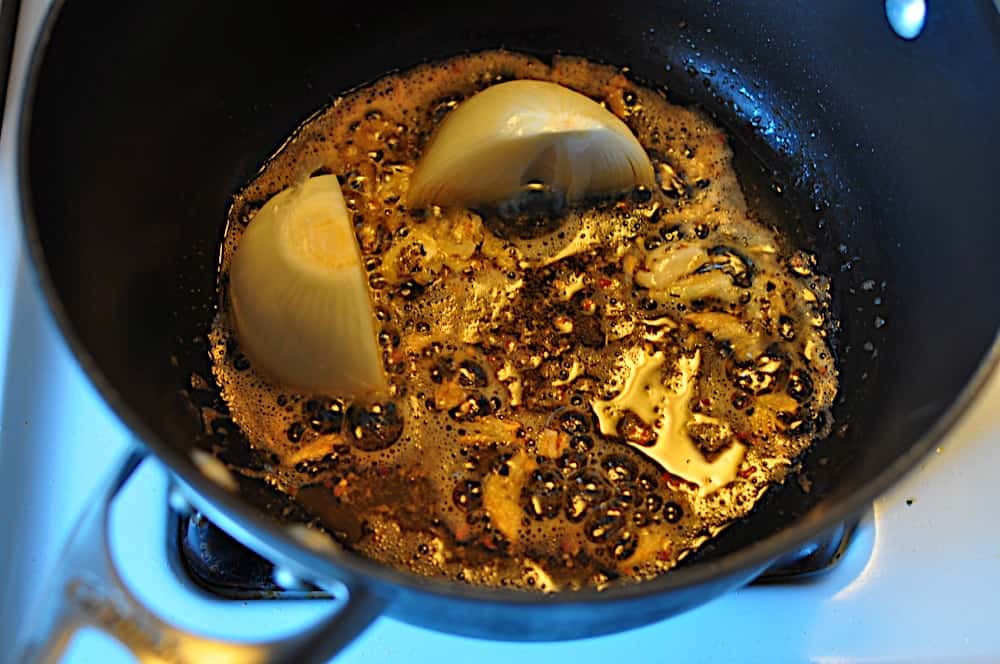
1. Quickly saute the aromatics: Heat the butter and olive oil in a sauce pot over medium high heat until the butter stops foaming. Add the garlic, oregano and red pepper flakes, and cook for 1 minute, or until you smell garlic.

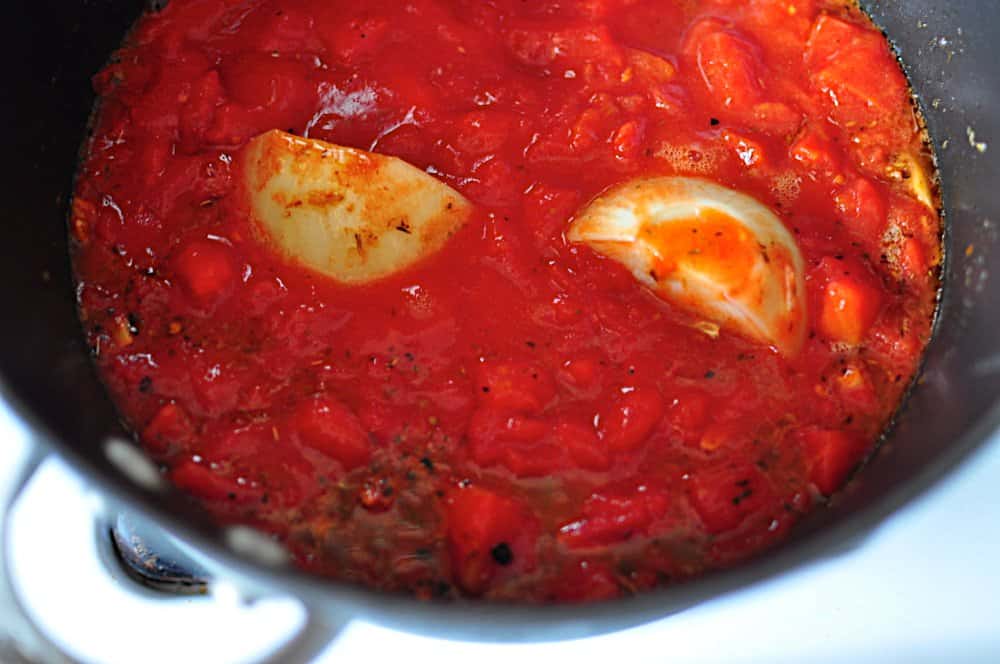
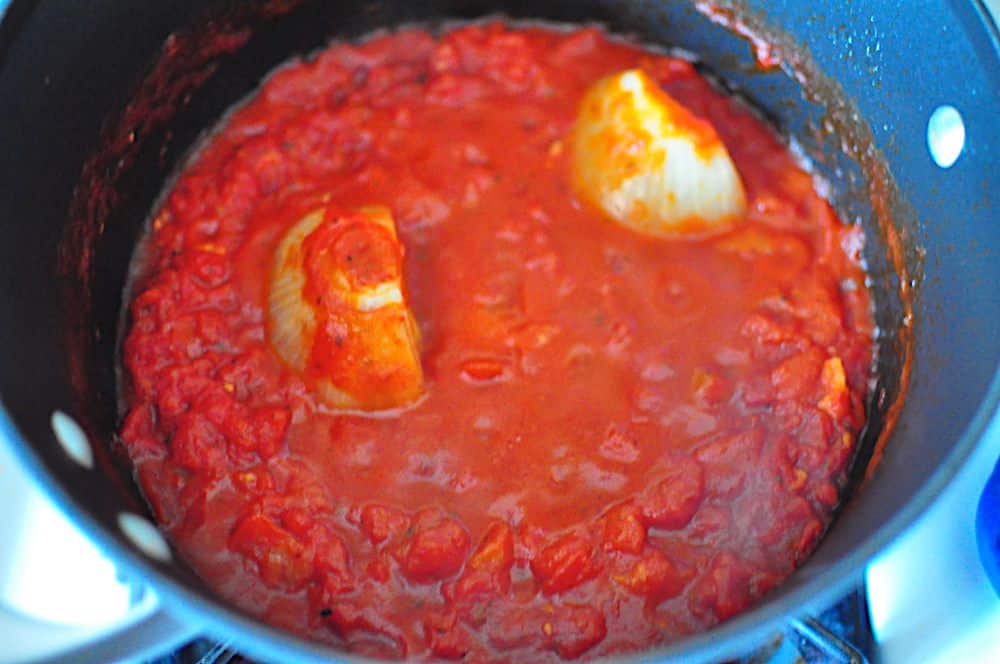
2. Cook the sauce: Add the onion (cut side down), the crushed tomatoes, and the basil sprig. Bring to a boil, then reduce the heat and simmer for 15 minutes, until the tomatoes thicken. Discard the onion and the basil sprig, and serve.

Starting to simmer
Thickened up, and ready to serve

Variations:
*Diced onion: This is the other way I make sauce: Mince the onion and cook it until softened in the melted butter.  Then add the garlic and red pepper flakes.

*Fresh herbs: Instead of the dried oregano, add a sprig of fresh oregano or fresh thyme; make sure to remove it with the onion and basil sprig.

*Whole canned tomatoes: Simmer for 45 minutes instead of 15 minutes.  Or turn them into crushed tomatoes by whizzing them with a stick blender (which is what I do...)

Notes:
*Really, the only requirements for this are some butter or oil, onion, and tomatoes. I love the extra flavor the garlic and herbs add, but I've made the sauce without them in a pinch, and it comes out fine.

*I have to admit, I'm going back and forth on sauteing diced onions vs the halved onion. It tends to come down to how I'm feeling that day - if I have five extra minutes, I'll dice the onions and saute them; if I don't, the halved onion is tossed in the sauce.

What do you think? Questions? Other ideas? Favorite pasta sauce techniques? Leave them in the comments section below.

Related Posts:
Sear Roasted Turkey Thighs in Tomato Sauce

Adapted from:
Marcella Hazan Essentials of Classic Italian Cooking

*Enjoyed this post? Want to help out DadCooksDinner? Subscribe using your RSS reader or by Email, recommend DadCooksDinner to your friends, or buy something from Amazon.com through the links on this site. Thank you!

Pressure Cooker Short Ribs Mexican Style

April 14, 2011 by Mike Vrobel 9 Comments

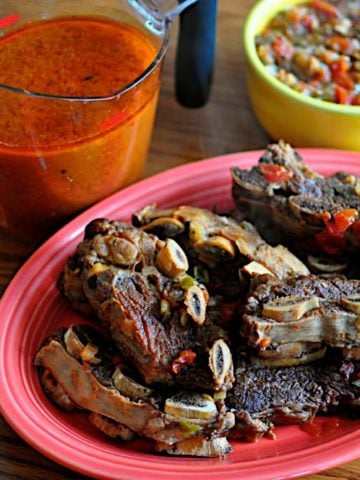
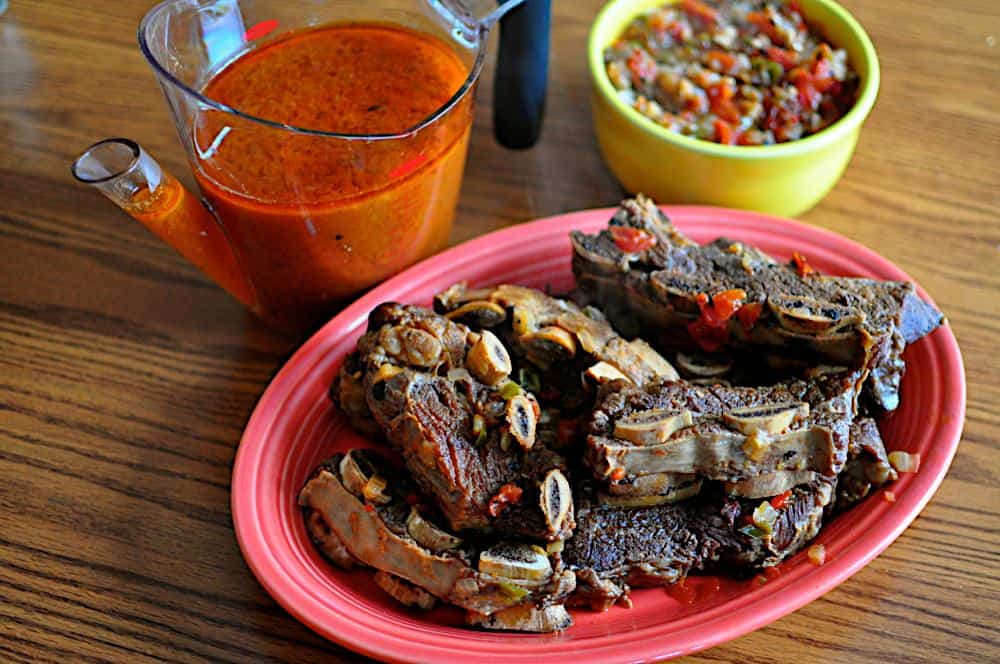
Pressure Cooker Short Ribs with Mexican Flavors

Pressure Cooker Short Ribs Mexican Style

My Pressure Cooker Short Ribs recipe took over the top spot on my Google stats a month ago, as my most popular post for the last month. I love that recipe, and I'm happy to see it bringing in new readers. Then I realized that I have short ribs in my freezer that need to be cooked. Obviously, this is a sign that I should revisit pressure cooker short ribs.

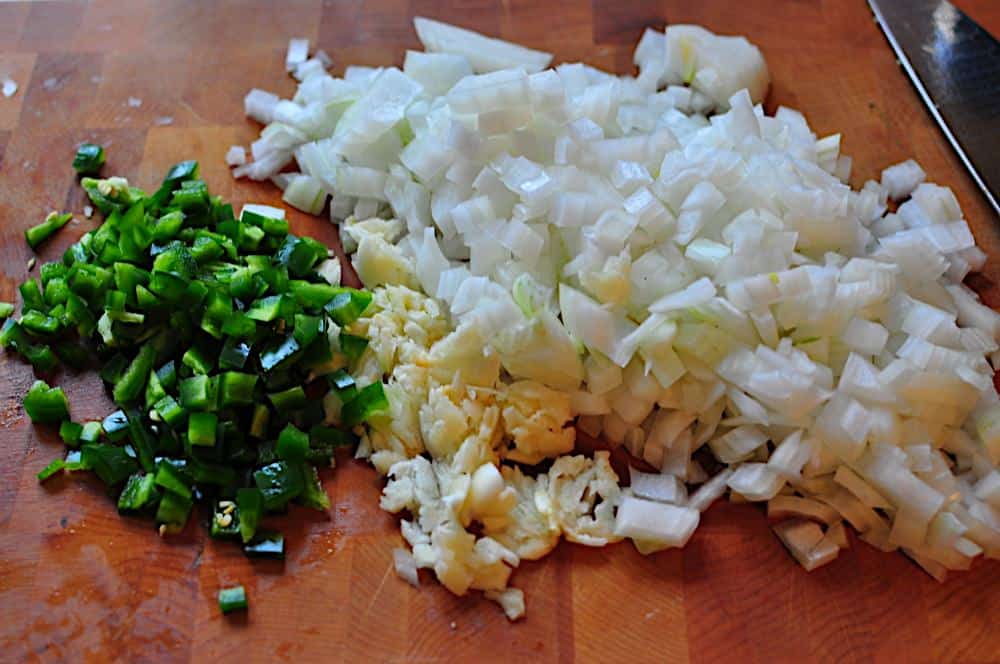
I'm craving Mexican food today; out came my collection of Rick Bayless cookbooks. The braised short rib recipe in Mexico, One Plate at a Time jumped out at me. I had most of the ingredient list at hand, and it is a straightforward short rib braise.

But...I couldn't just make Mr. Bayless's recipe. I can never follow a recipe any more, even when I try; I'm always tweaking and adjusting. Rick's ingredient list was the jumping-off point. I worked those ingredients into my trusted pressure cooker short ribs technique.
*And, I added beer to the recipe. It seemed like the right thing to do.

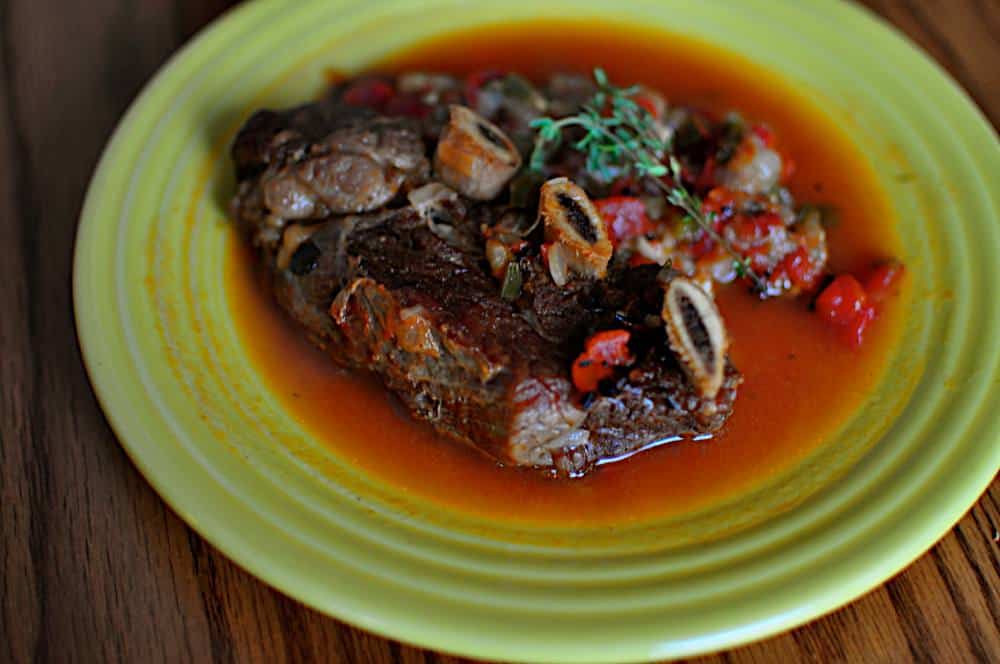
The result was tender ribs, the zing of hot peppers giving them a spicy edge. All in a little over an hour! This is the perfect comfort food to fight off early spring snowstorm blues.
*It was sixty degrees last weekend! How can it possibly be snowing! Seasonal affective disorder, here I come...

And...don't have a pressure cooker? No worries. See the Variations section for pressure free options.

Recipe: Pressure Cooker Short Ribs Mexican Style

Adapted From: Rick Bayless Mexico One Plate At A Time

Equipment:

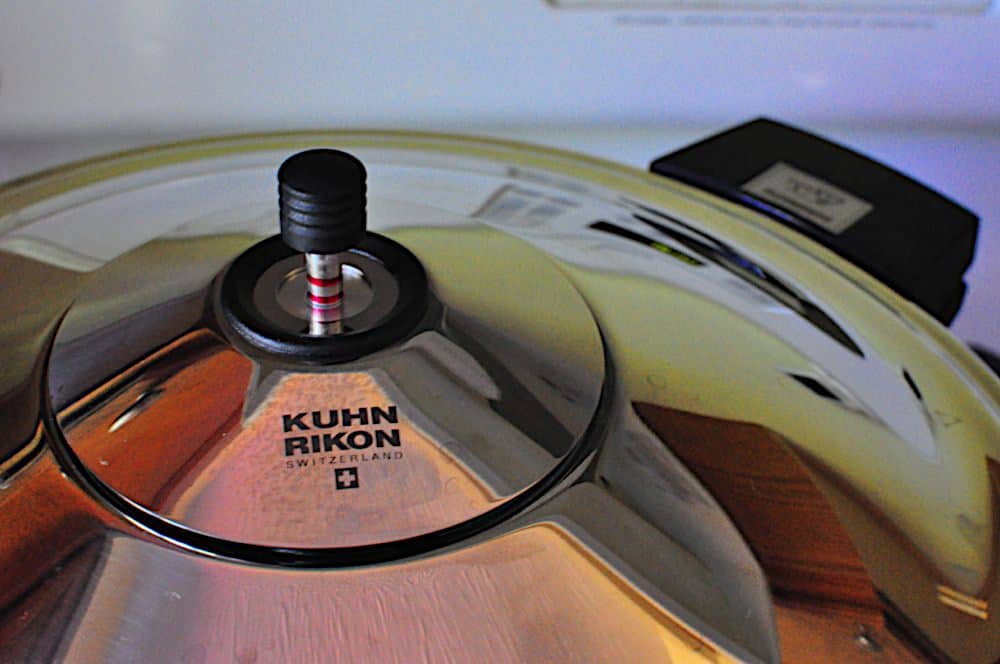
  • 6 quart or larger pressure cooker (It is overkill, but I used my massive Kuhn Rikon 12 Quart Pressure Stock Pot)
  • Fat separator (You need a big one, at least 4 cups in size).

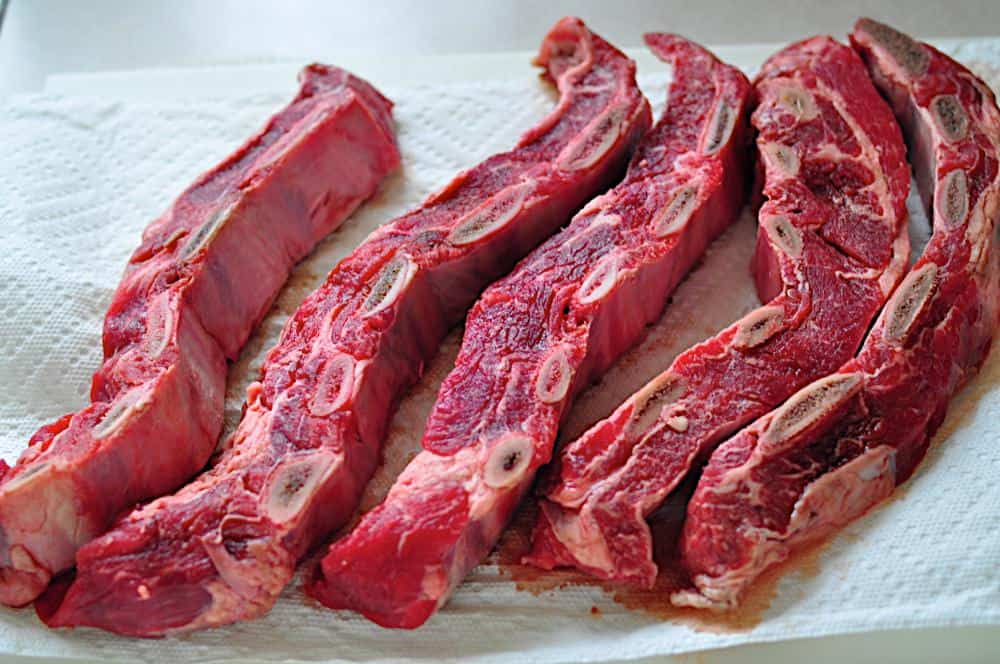
Short ribs (before cutting into 3 rib portions)

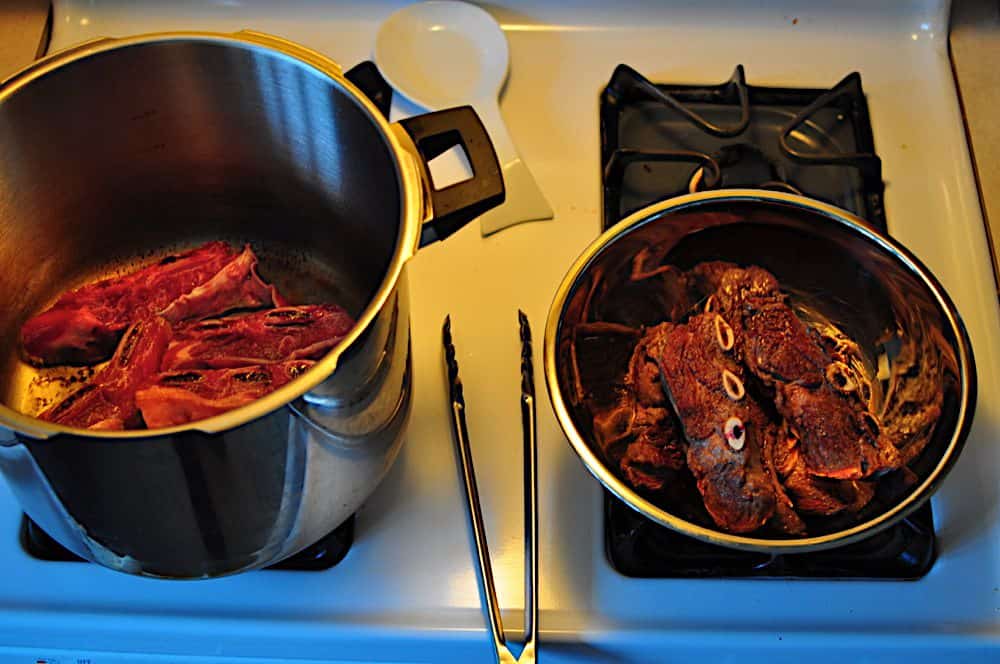
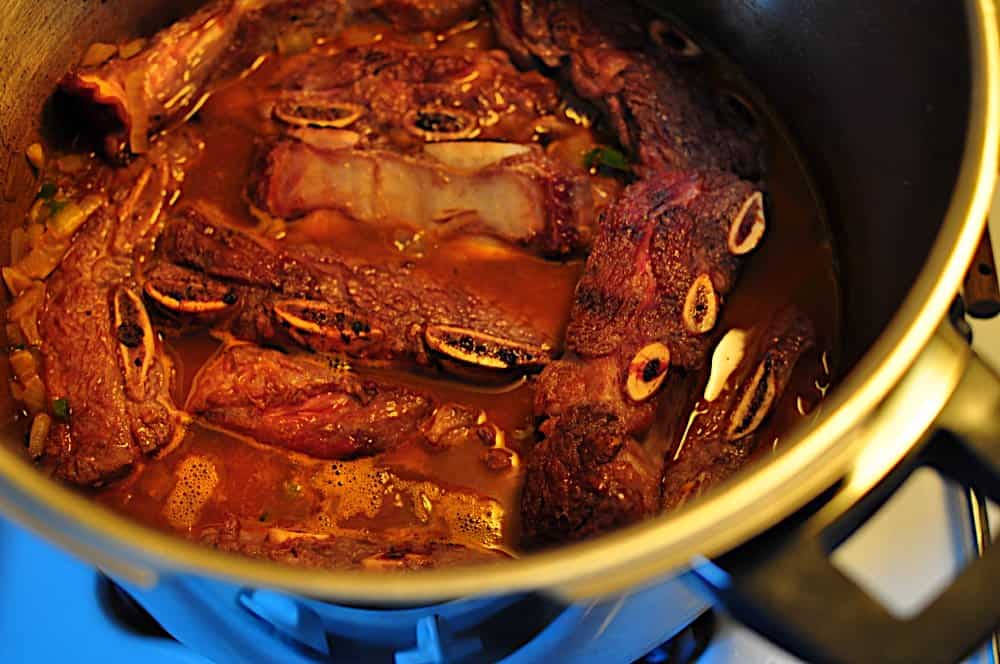
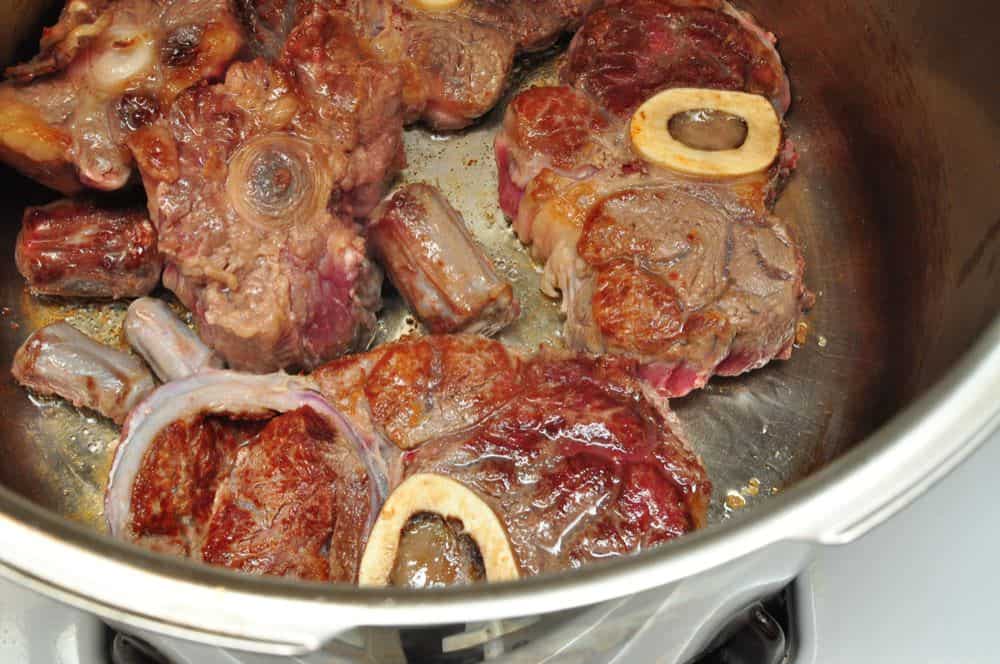
Browning the ribs
Browning the ribs

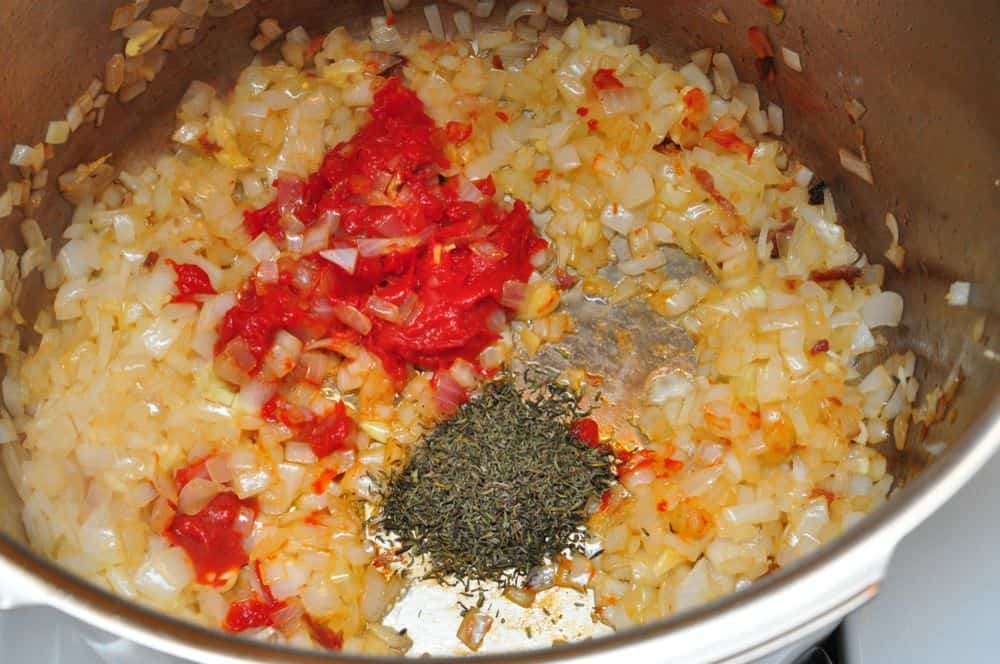
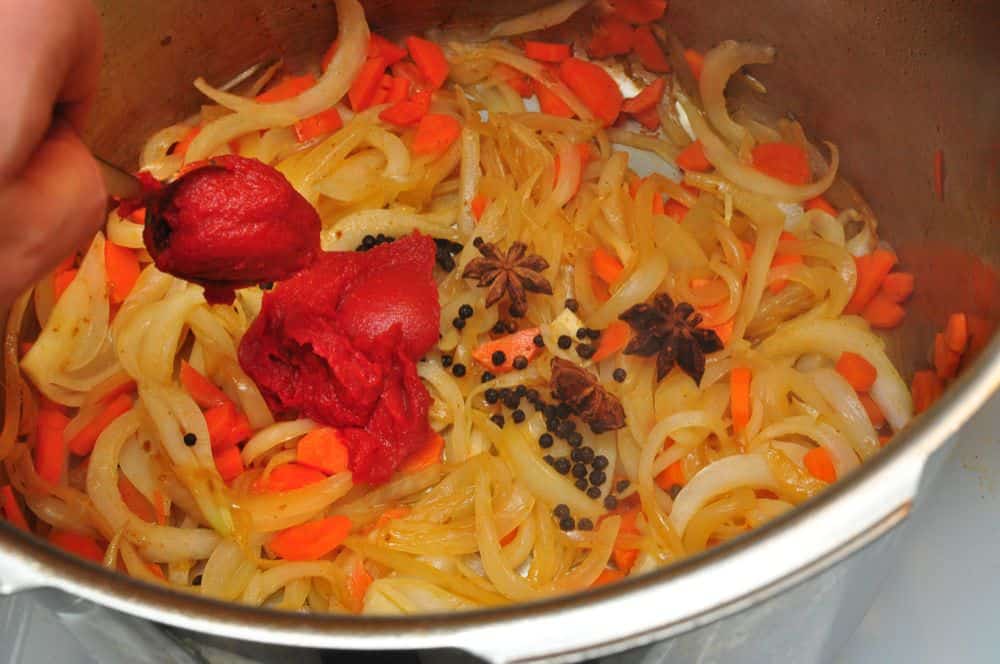
Aromatics ready for the pot

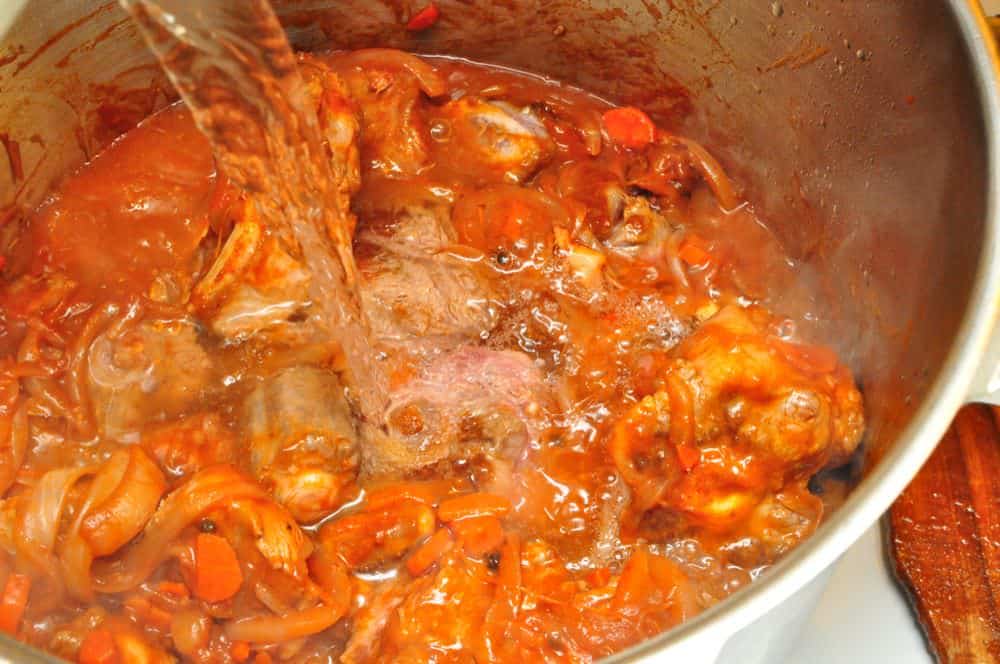
Done pressure cooking
Ribs are done pressure cooking

Done
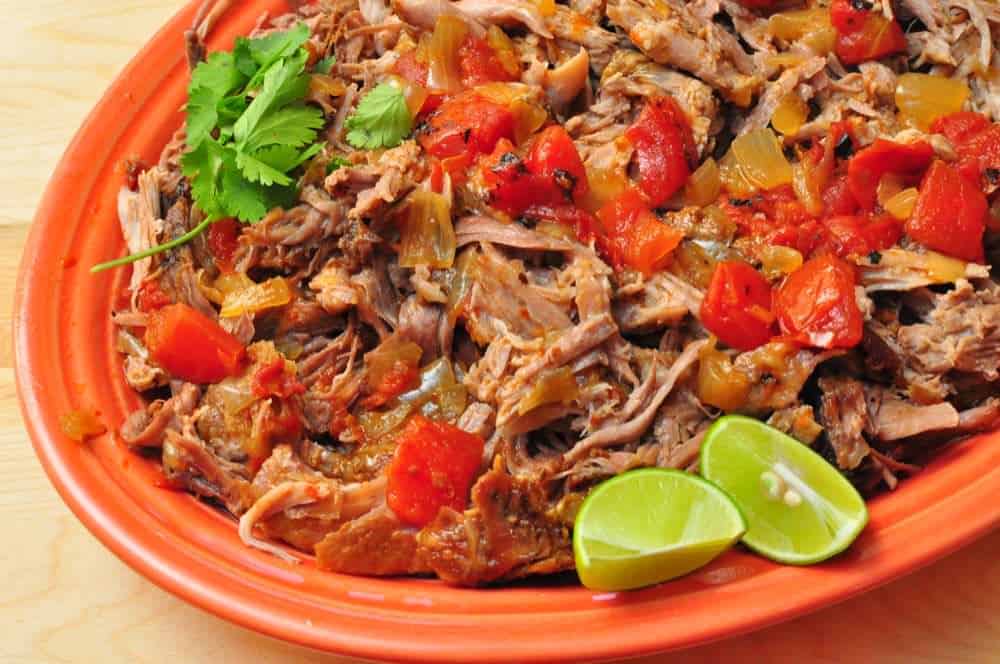
Serve!

Variations:
*Hot pepper substitutions: Instead of jalapeno peppers, use a tablespoon of chipotle en adobo puree. Or, use fire roasted poblano peppers, which is what Rick Bayless did this in his version of this recipe.

*Don't have a pressure cooker? Replace step 3 with:

Dutch oven: Put the ingredients in a dutch oven and bring to a boil. Cover the dutch oven, and move to a 325*F oven. Cook in the oven for 2 to 3 hours, until the ribs are tender. Remove from the oven, and continue with step 4.

Slow cooker: Put the ingredients in a slow cooker, and cook on high for 5 hours, or low for 10 hours. Continue with step 4.

Notes:
*Short ribs make amazing leftovers. Shred the meat, discard the bones, and stir in some of the tomato/onion/pepper mixture and a little sauce. Refrigerate or freeze.  (If you're freezing, covering the ribs in sauce will help protect them.) Reheat, and serve with tortillas for the best taco night ever.

*As I said in my I love pressure cookers post, every pressure cooker works differently. Make sure you have read your pressure cooker manual before starting this recipe, so you know how to lock it, how to tell when it's up to high pressure (15 PSI), and how to release the pressure when you're done.

What do you think? Questions? Other ideas? Leave them in the comments section below.

Related Posts:
Pressure Cooker Short Ribs
Pressure Cooker Turkey Chili with Chorizo and Beans
My other pressure cooker recipes

Adapted from:
Rick Bayless Mexico One Plate At A Time
...and my pressure cooker timing came from Lorna Sass Pressure Perfect

*Enjoyed this post?  Want to help out DadCooksDinner?  Subscribe using your RSS reader or by Email, recommend DadCooksDinner to your friends, or buy something from Amazon.com through the links on this site.  Thank you!

What Do I Do With: The Electric Pressure Cooker Question

April 12, 2011 by Mike Vrobel 15 Comments

[Update 2015-02-08]: Things change. Nowadays, my favorite pressure cooker is an electric PC. See my post: What Pressure Cooker Should I Buy?

This post is a little different from my usual "what do I do with" questions. Instead of an ingredient, I'm asking you, my loyal readers, about a kitchen appliance. I occasionally receive email from a reader, asking about electric pressure cookers. I have never used one; all my pressure cookers have been stove top models. I vaguely remember reading that stove top models are better than electrics, but I couldn't remember why. I decided to research electric pressure cookers; the next time I'm asked, I want a better answer than "because that's how I've always done it."

Electric pressure cookers seem like a good alternate to stove top models. I like the idea of set it and forget it pressure cooking...set the timer, then get on to something else. No messing with getting the burner to the right heat to hold the pressure. Also, a pressure cooker with a timed delay feature sounded great. A delay means I could leave beans soaking in the cooker, and when the soaking time was complete, the PC would turn on and cook the beans. And, finally, a few of the electric pressure cookers could also be used as rice cookers or slow cookers. As an Alton Brown groupie, I'm always a fan of multitaskers.

Now, there is some downside. First, it's yet another kitchen appliance. (I'm running out of room with all my gadgets - I'd have to trade something in to make room for the new cooker.) Second, almost all the electric pressure cookers are 6 quart models. They are not made in the wide range of sizes as stove top pressure cookers.
*With pressure cookers, size matters. Pressure cookers need airspace to come up to pressure. A pressure cooker can't be filled past ⅔rds of the listed size, or it won't have enough air to pressurize.

Then I found the big issue. In electric pressure cookers, "high pressure" is significantly lower than high pressure in stove top cookers. Stove top PCs have a high pressure of 15 pounds per square inch (psi), electrics only come up to about 10 psi. That is closer to the low pressure on stove top cookers than it is to high pressure.

What difference does that extra 5 PSI make? I downloaded the Fagor Electric Pressure Cooker manual, and compared it to my Fagor stove top PC's manual. Generally, the cooking times in the electric were 30% longer than the stove top model. As an example: beef brisket cooks in 35-40 minutes at high pressure in the stove top PC. It takes 50-60 minutes in the electric cooker. Why is that important? Well, pressure cookers are sold as a way to speed up cooking. 60 minutes for brisket is quicker than the usual 3+ hours...but 40 minutes is even faster. Does the convenience of the set it and forget it electric make up for the extra time? Also, Lorna Sass, Miss Vickie, and all the other sources of pressure cooker recipes and write their recipes for a high pressure of 15 psi. I have to multiply my cooking time by 1.3 every time I try a new recipe? I'm sure I'll forget that at the worst possible time.
*And pressure cooking is more timing dependent than most other forms of cooking, because you can't check on how things look as they cook. Once a cooker is up to pressure, it can't be opened, unless you take the time to bring the pressure down, then back up when you're done.

All that said...I've never used one myself; everything I'm sharing here is from reading the literature, not personal experience. So, I'm throwing the question out to my readers:

Have you used an electric pressure cooker? Like it? Dislike it? What are the advantages and/or disadvantages? Share your experiences with us in the comments section, below.

*And...I am such a weakling when it comes to new kitchen toys. After everything I've read, I don't think I'd use an electric pressure cooker enough to justify the purchase. But I still kind of want one. Darn it.

Here are the three cookers I've been asked about. Again, not a recommendation, but they are the ones that I've heard about second-hand. I would love to hear about personal experience with any of these pressure cookers.

Fagor 670040230 Stainless-Steel 3-in-1 6-Quart Multi-Cooker

Cuisinart CPC-600 1000-Watt 6-Quart Electric Pressure Cooker, Brushed Stainless and Matte Black

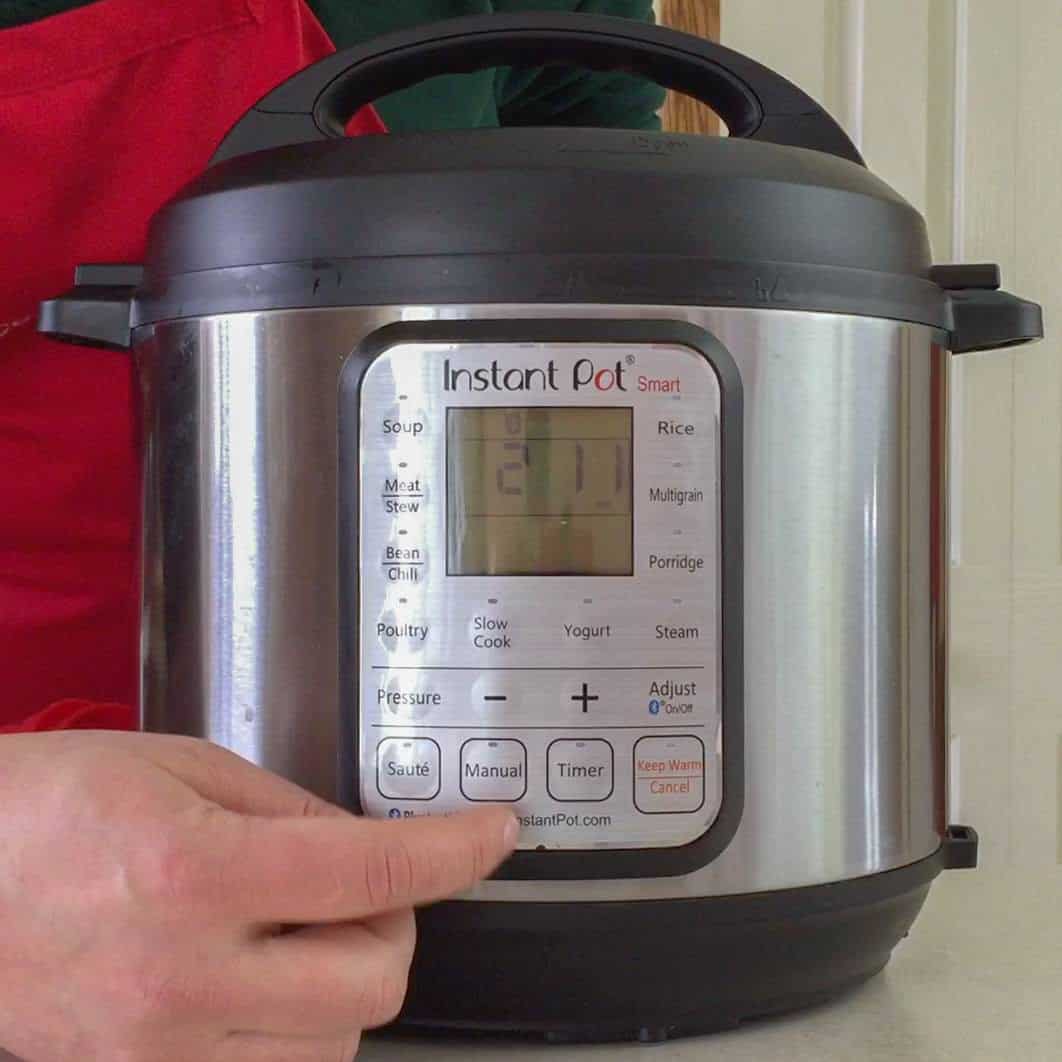
Instant Pot® 5-in-1 Electric Pressure Cooker, 6.33Qt, Latest 3rd Generation Technology, Brushed Stainless Steel

*Enjoyed this post? Want to help out DadCooksDinner? Subscribe using your RSS reader or by Email, recommend DadCooksDinner to your friends, or buy something from Amazon.com through the links on this site. Thank you!

Rotisserie Chicken with Teriyaki Sauce

April 7, 2011 by Mike Vrobel 10 Comments

I cook a lot of chicken on my rotisserie. Usually, I keep it simple. I dry brine the chicken, add a little fresh ground black pepper, and I'm done. Occasionally, when I'm feeling fancy, I stuff herbs under the skin. This time around, though, I wanted something more. I was looking for something different than my usual roast chicken, without adding a lot of extra work.

Luckily, I bought myself a subscription to Canal House Cooking for Christmas. I've been enjoying Melissa and Chris's recipes and pictures so much that I went back and bought all their back issues. (There were only three- it wasn't that big a deal.) And, in one of the books, they had a recipe for roast teriyaki chicken. I had my inspiration - but why roast the chicken when I could rotisserie it?

Rotisserie teriyaki chicken is exactly what I was looking for. Teriyaki sauce has simple, pantry ingredients and takes all of three minutes to make. Don't let the simplicity of the sauce fool you, though - it adds a sweet, sour and salty glaze that matches chicken perfectly.
*Teriyaki sauce and grilled chicken is a combination perfected in Japanese yakitori restaurants. I'm just scaling the recipe up - instead of bite sized pieces of chicken on bamboo skewers, I'm going with whole chickens on a rotisserie spit. Godzilla sized yakitori, anyone?

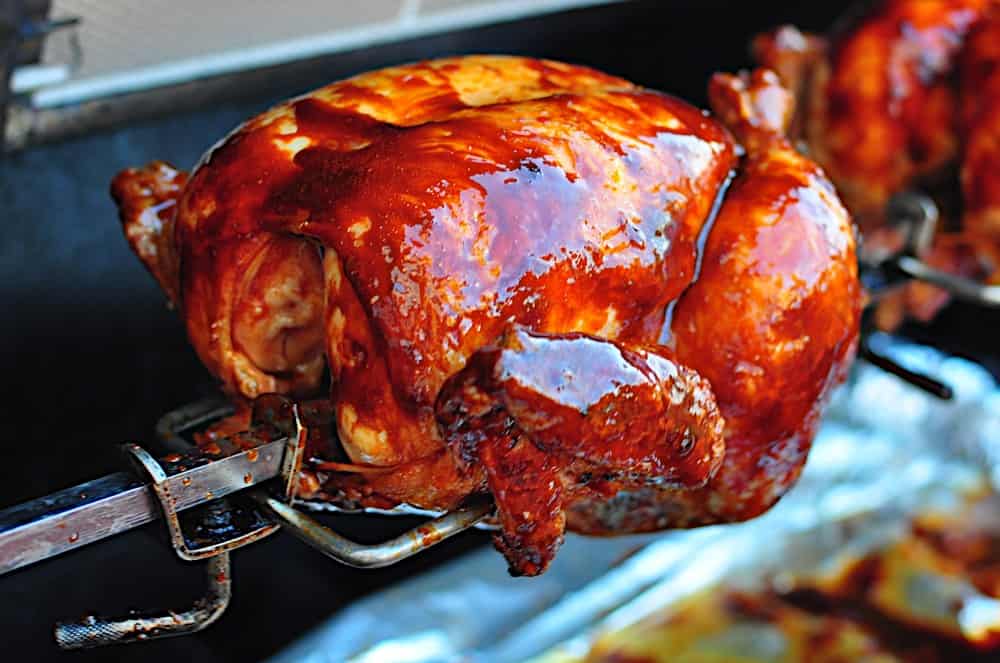
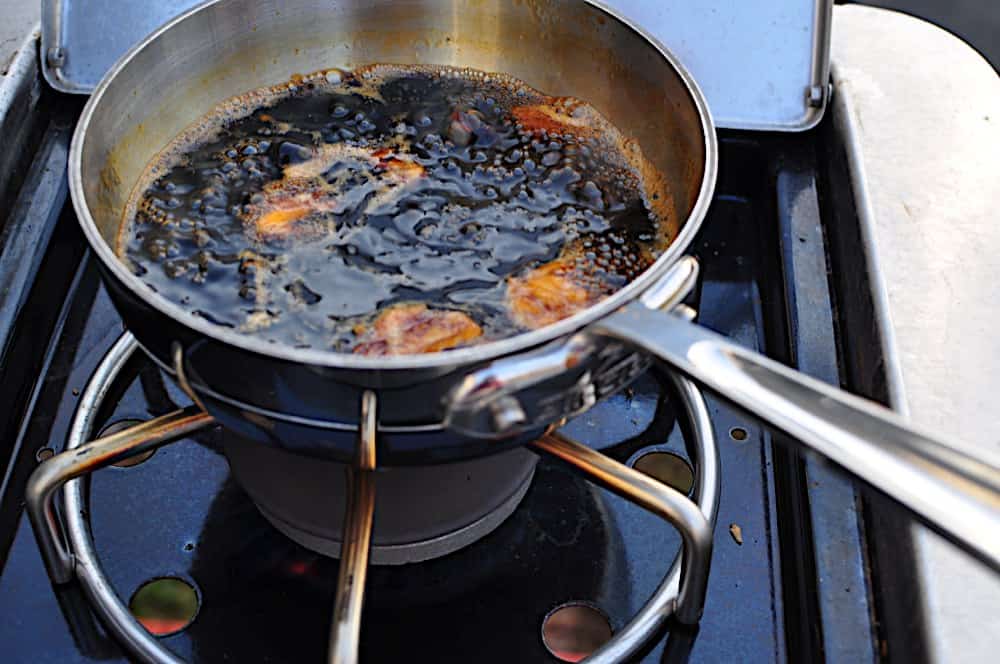
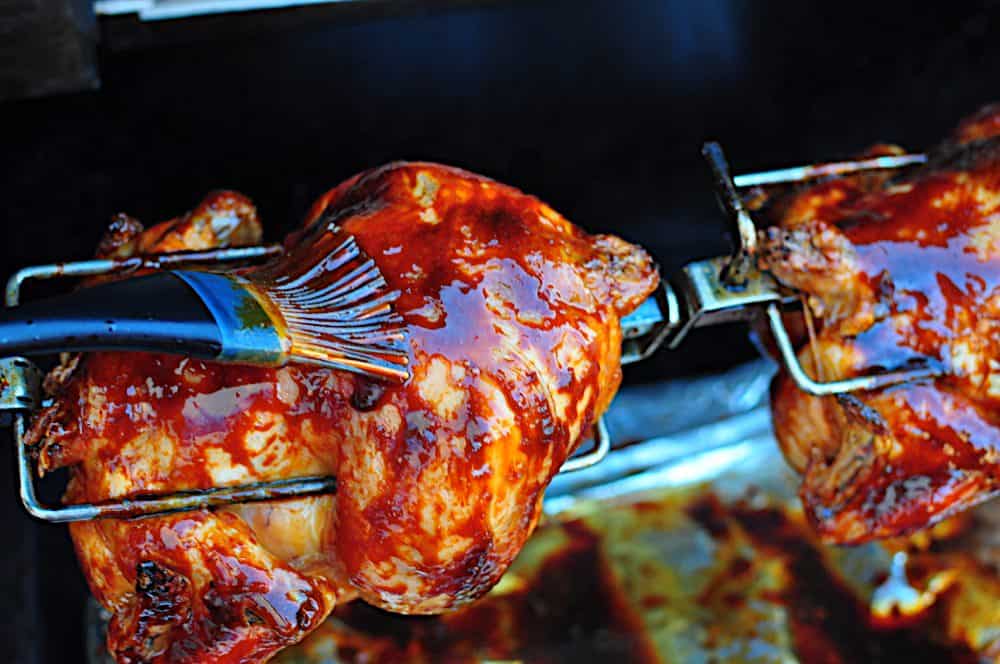
The only real trick is to save the teriyaki sauce for the last fifteen minutes of grilling, then brush it on frequently. Teriyaki sauce has a lot of sugar in it. The high heat of the grill will burn the sauce if it is cooked for too long. Waiting for the last last fifteen minutes lets the heat tighten up the sauce, but does not leave enough time for the sauce to burn. Applying the sauce in layers builds a thick glaze on top of the browned chicken skin.

Recipe: Rotisserie Chicken with Teriyaki Sauce

Inspired By: Melissa Hamilton, Christopher Hirsheimer Canal House Cooking

Cook time: 75 minutes

Equipment:

  • Grill with Rotisserie attachment (I used a Weber Summit with an infrared rotisserie burner. Here is the current version of my grill.)
  • Aluminum foil drip pan (9"x12", or whatever fits your grill)
  • Butcher's twine
  • Basting brush (I use a silicone brush. That way, I can throw it in the dishwasher after coating it with sticky teriyaki sauce)

Ingredients:

  • 2 (3 ½ to 5 pound) chickens
  • 5 teaspoons Kosher salt (½ teaspoon per pound of chicken times two chickens)

Teriyaki sauce:

  • ½ cup soy sauce
  • ½ cup mirin (Japanese sweet rice wine)
  • ½ cup honey
  • 1 garlic clove, smashed
  • ¼ inch slice of ginger, smashed

Directions:
See my Basic Technique: Rotisserie Poultry for an overview of rotisserie chicken.

1. Prepare the chicken and teriyaki sauce: Sprinkle the salt evenly over the chickens. I start by sprinkling salt in the cavity of the bird. Then I salt and rotate: first the breast, then one side (with the leg and wing facing up), then flip and do the other side. Finally, I salt the bottom (backbone) side of the chicken. I use about ½ teaspoon of salt per "side". Combine all the teriyaki sauce ingredients in a medium saucepan and stir until the honey dissolves.
*If you have the time, salt the chicken the night before you are going to cook it, and refrigerate. Remove the chicken from the refrigerator one hour before it is time to cook.

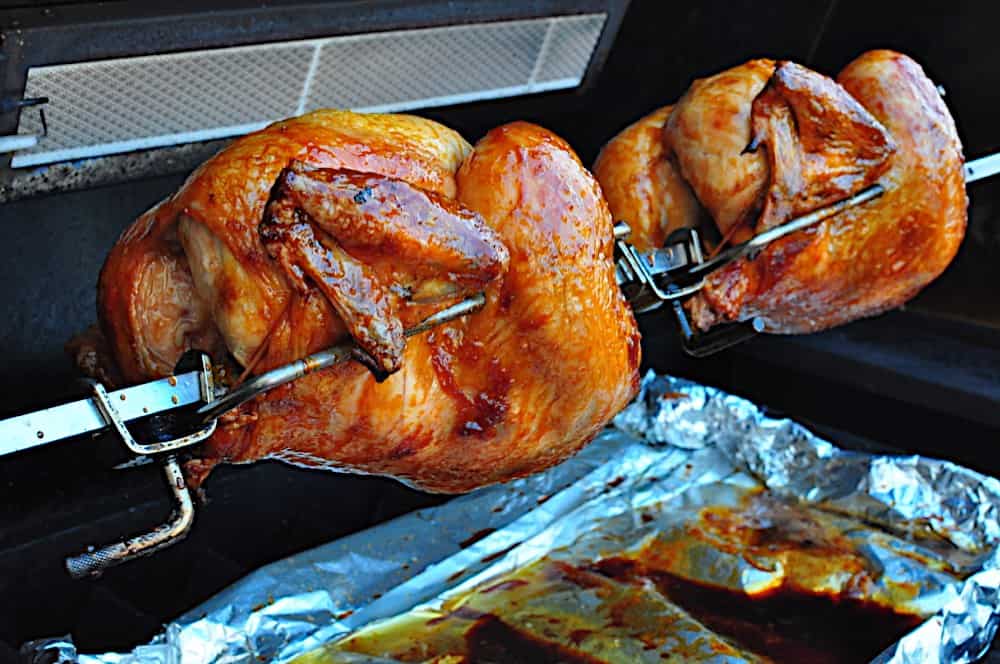
2. Truss and skewer the chicken: Fold the wingtips back under the chicken, then truss the chicken tightly. (See the basic technique for trussing details). Skewer the chicken on the spit - get it on there tight! I like to put one set of prongs under the breast of the first chicken, then the other skewer through the thighs. I put the second bird on upside down compared to the first bird. This makes the whole spit more balanced, easing the load on the rotisserie motor. Also, it looks cool that way.*
*Yes, I'm a cooking nerd.

3. Prepare the grill: Set the grill up for rotisserie cooking at high heat. For my Weber Summit, this means removing the grates, turning the two outer burners (burners 1 and 6) to high, and turning the infrared burner to high. Then I put my drip pan in the middle, over the unlit burners, and let the grill preheat for ten to fifteen minutes. (Once again, see My Rotisserie Basic Technique Post for more rotisserie setup details.)

Reducing the teriyaki sauce
Chicken coming along nicely

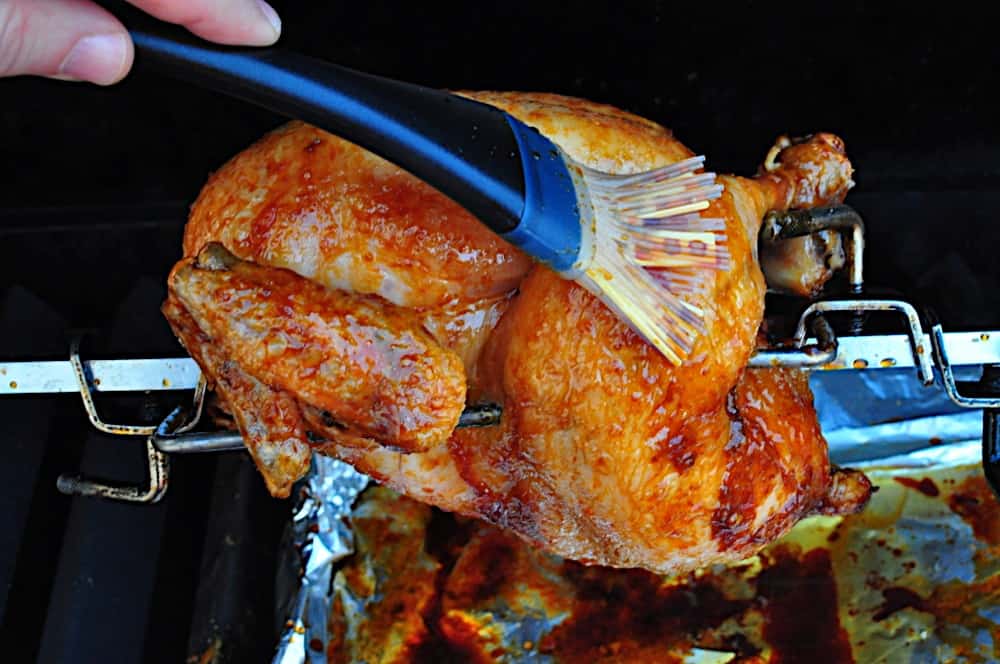
4. Cook the chicken: Put the spit on the grill, turn on the rotisserie motor, and cook with the lid closed. While the birds are cooking, reduce the teriyaki sauce. Bring the sauce to a boil, then simmer until reduced by a little more than half, about 15 minutes. (Reduce to the consistency of a barbecue sauce). The birds will cook for about 15 minutes per pound. A 4 pound bird will be done after an hour, a five pound bird after an hour and 15 minutes. Baste the bird with the teriyaki sauce fifteen minutes before it will be done, then baste again every five minutes until the internal temperature of the breast reaches 160*F to 165*F. (That means I baste four times - 15 minutes to go, 10 minutes to go, 5 minutes to go, and when it's ready to come off the grill.)

First layer of teriyaki sauce
(Sauce is still a little thin; I kept simmering it)
First layer of sauce
Last layer before taking it off the grill
(This is how thick you want the teriyaki sauce to be)
Done!

5. Serve: Immediately remove the chicken from the spit, then remove the trussing twine. Let the chicken rest for 15 minutes, then carve and serve, passing any leftover teriyaki sauce for dipping.

My assistant, Tim
Ready to remove from the spit

Notes:
*When reducing the teriyaki sauce, watch out for boil-overs. The sauce is very sticky, and bubbles up whenever I put my spoon in to stir it. If it threatens to boil over, stop stirring and remove the pot from the heat until it subsides.

*I don't use the side burner on my grill very often, but it was perfect for this recipe. While the chicken was on the rotisserie, the sauce was reducing on the side burner. Then, between my basting sessions, the pot went back on the burner. Two pieces of advice with the side burner, though. Don't use it if the temperature is 42*F outside, because the sauce will take forever to come to a boil. And, don't over-reduce the sauce, or you'll wind up with a teriyaki glue. Um...not that I had both of these problems or anything like that...

*In a pinch, you can use store-bought teriyaki sauce. Make sure to reduce it a bit - you want a thick sauce to brush on the chicken. But, if you have access to a store that stocks mirin, you really should make your own teriyaki sauce. Like I said in the opening, it is really easy to make, and the result tastes much better than a store-bought sauce.

What do you think? Questions? Other ideas? Leave them in the comments section below.

Related Posts:
Rotisserie Chicken, Dry Brined with Rosemary and Lemon
Rotisserie Peking Duck
Click here for my other rotisserie recipes.

Inspired by:
Melissa Hamilton, Christopher Hirsheimer Canal House Cooking


Check out my cookbook, Rotisserie Grilling.

Everything you could ask about the rotisserie,
plus 50 (mostly) new recipes to get you cooking.

It's a Kindle e-book, so you can download it and start reading immediately!


*Enjoyed this post? Want to help out DadCooksDinner? Subscribe to DadCooksDinner using the RSS or Email options on the right, link to this post from your blog, recommend DadCooksDinner to your friends, or buy something from Amazon.com through the links on this site. (Like my Rotisserie Grilling cookbook...)
Slow Cooker Pot Roast, Italian Style

April 5, 2011 by Mike Vrobel 4 Comments

My recipe for slow cooker Italian pot roast evolved from a recipe in Cook's Country magazine. Cook's Country is part of the America's Test Kitchen empire, and the younger sibling of Cook's Illustrated magazine. I look forward to new issues of Cook's Country in large part because of their Slow Cooker column. It's fascinating to see what the...um...extraordinarily thorough* test kitchen has come up with. Cook's Country has slow cooker recipes that don't compromise flavor for ease of use.
*Sometimes they run off the rails in their quest for a perfect recipe. But I'm glad they're out there, pushing the envelope. Someone has to lead the fight against recipes with canned mushroom soup in them.

I was thrilled when they released Slow Cooker Revolution. This cookbook compiles all those Cook's Country recipes I love, plus hundreds of other slow cooker recipes they've been working on in the test kitchen. Finally, I have a cookbook I can refer people to when they ask about slow cooking.
*It was worth the price just for the picture of the "wall of slow cookers" they installed in the test kitchen. Someday I'll have a wall of slow cookers. And a test kitchen.

This is a standard pot roast recipe, with a couple of tricks that help it out during the long, slow cooking. The roast and aromatics are browned, to add the depth and complexity that only comes from caramelization. Dried mushrooms, tomato paste, and a little soy sauce add meatiness to the dish. Slow cookers trap liquid, resulting in a watery sauce; minute tapioca thickens the sauce for us. Finally, I use my stick blender to puree the sauce right in the slow cooker. The result is meltingly tender meat with a thick red sauce perfect for topping pasta. Enjoy!

Recipe: Slow Cooker Pot Roast, Italian Style

Adapted From: America's Test Kitchen Slow Cooker Revolution

Cook time: 10 hours

Equipment:

  • 6 quart or larger slow cooker (Crock Pot brand is fine, but I like my fancy one from All-Clad)

Ingredients:

  • 1 oz dried mushrooms, rinsed (I used shitake; portobello is traditional)
  • 8 oz hot tap water
  • 1 teaspoon olive oil
  • 4 to 5 pound boneless beef chuck roast (or two 2 ½ pound roasts)
  • 2 to 3 teaspoons Kosher salt
  • ½ teaspoon fresh ground black pepper
  • 1 large onion, diced
  • ½ teaspoon Kosher salt
  • 4 cloves garlic, peeled and crushed
  • 3 oz tomato paste (half a can)
  • 1 teaspoon red pepper flakes
  • 28oz can crushed tomatoes
  • 1 teaspoon soy sauce
  • 2 tablespoon minute tapioca
  • 1 sprig fresh oregano (or 1 teaspoon dried)
  • 2 sprigs fresh thyme (or 1 teaspoon dried thyme)
  • 1 sprig fresh rosemary (optional)
  • 1 bay leaf
  • 1 tablespoon sugar (if necessary)

Directions:
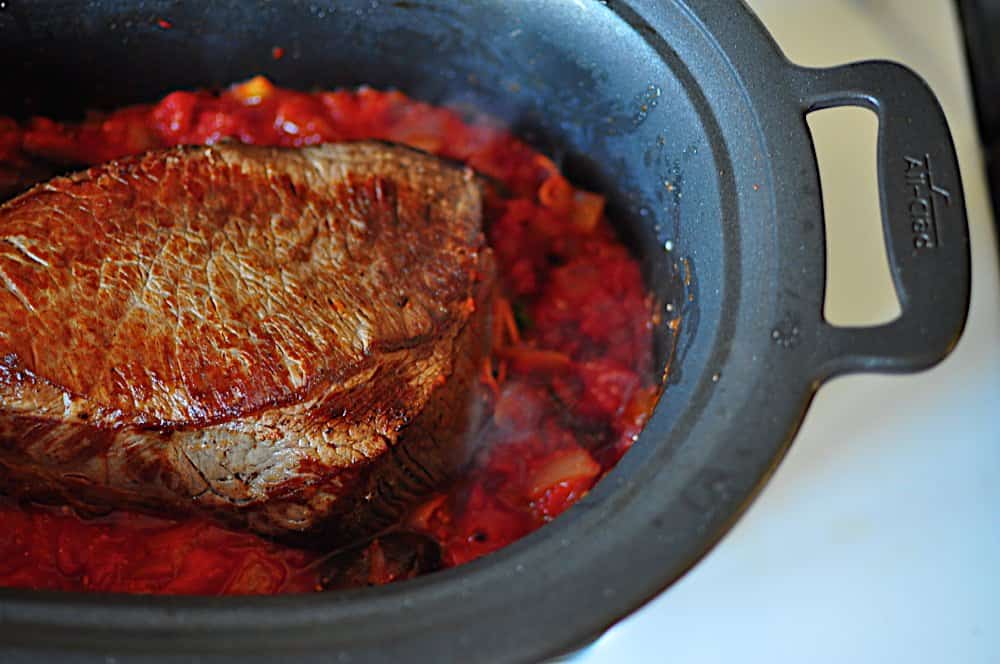
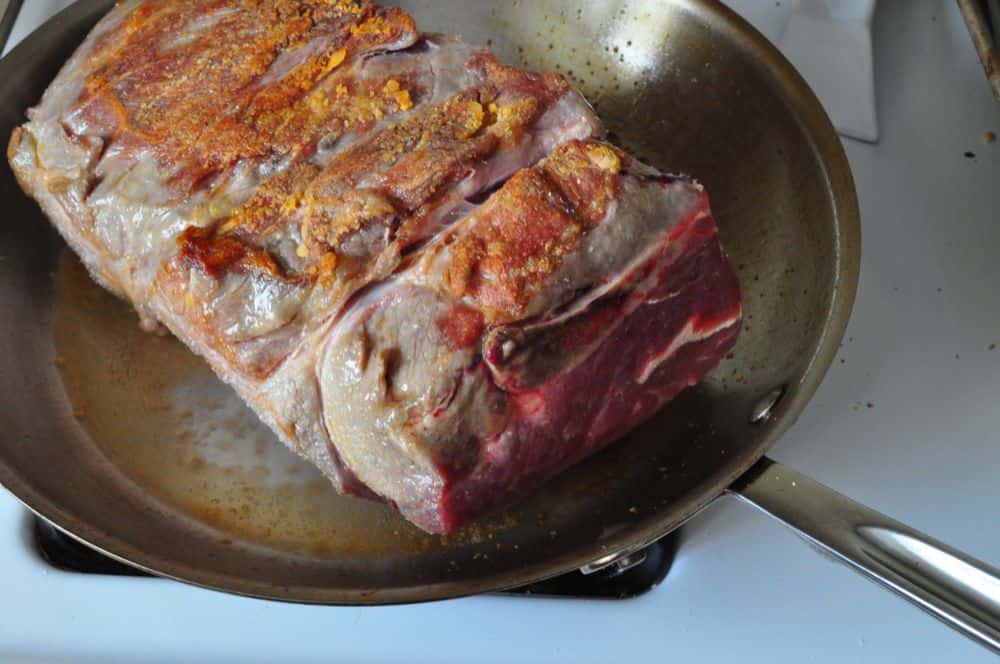
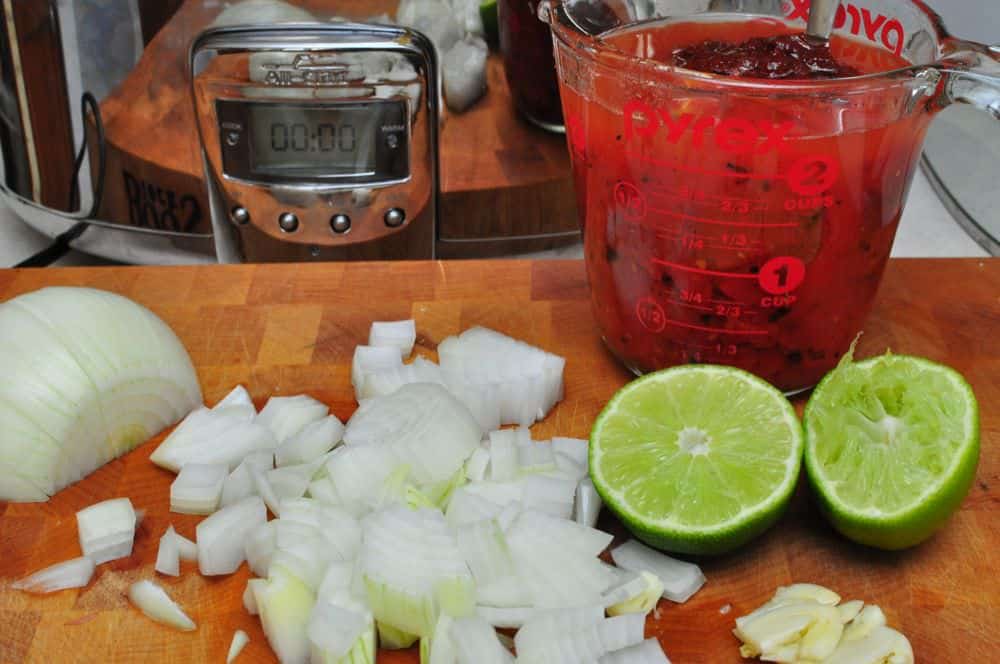
1. Prep the ingredients and brown the beef: To get the recipe in the slow cooker as quickly as possible, here is how I prepare the ingredients. The mushrooms need to soak, so the first thing is to rinse them off and get them into the hot tap water. Put a bowl on top of the mushrooms to keep them submerged. Next, put the oil in a large fry pan and heat over medium-high heat. While the oil is heating, sprinkle the beef with 2 teaspoons of salt and ½ teaspoon of pepper. When the oil starts shimmering, put the beef in the pan and sear for 3 minutes on two sides, a total of 6 minutes. While the beef is searing, prep the other vegetables. When the beef is done searing, move it to the slow cooker.

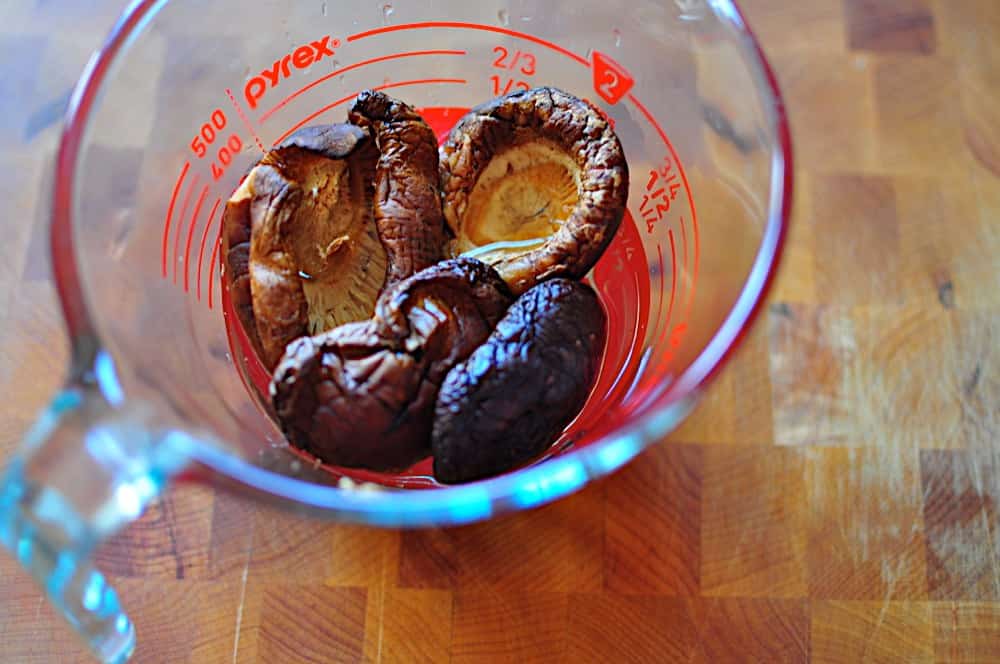
Soaking the mushrooms

2. Saute the aromatics: Add the onions, ½ teaspoon of kosher salt, garlic cloves, tomato paste and red pepper flakes to the pan. Saute, stirring and scraping often, until the onions soften and the tomato paste is starting to brown, about 5 minutes. Stir in the reserved mushrooms and their liquid, crushed tomatoes, soy sauce, tapioca, oregano, thyme, rosemary, and bay leaf. Increase the heat to high, and bring to a simmer. Pour over the beef in the slow cooker.

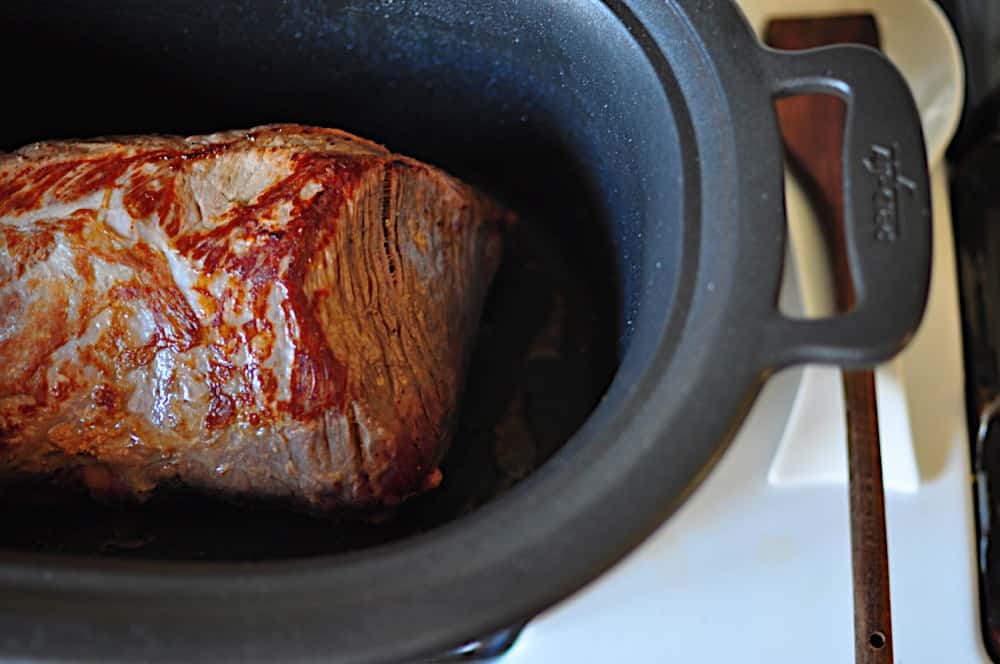
Browning the beef
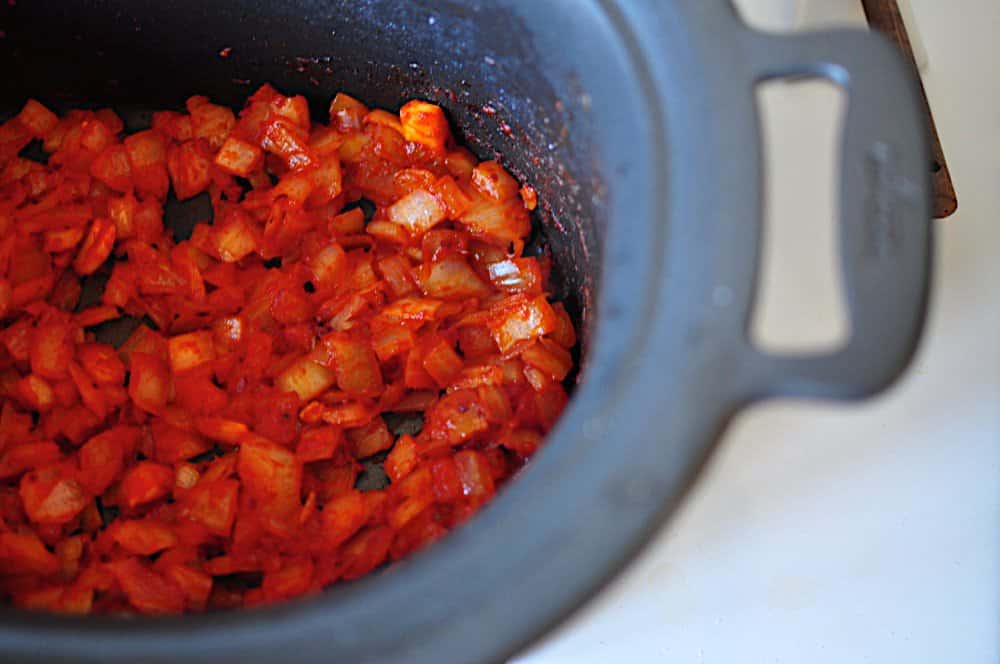
Sauteing the onions and tomato paste
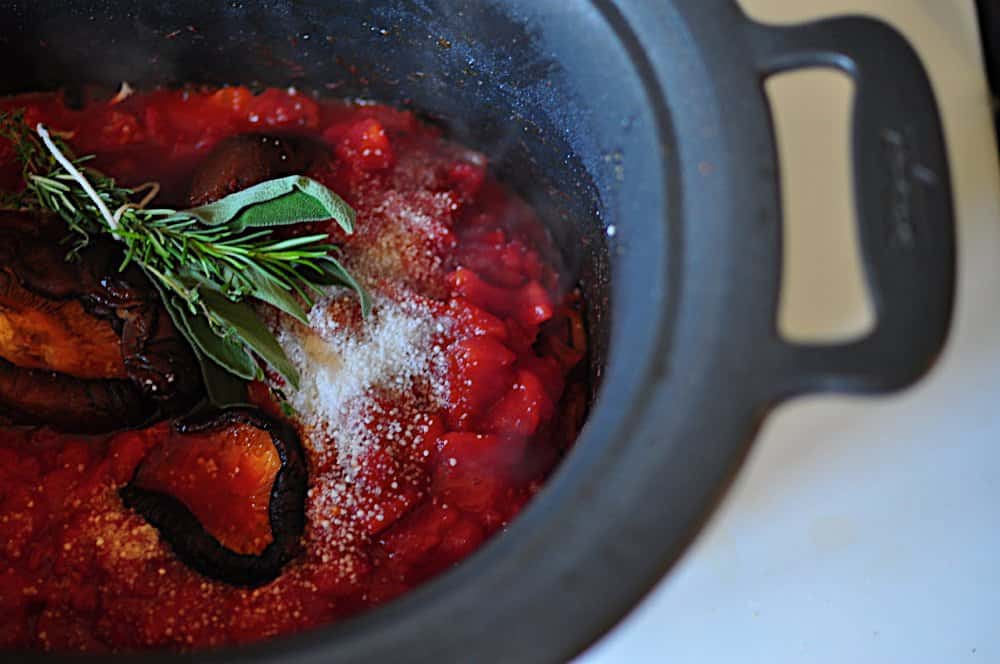
Everything else in the pot
Ready for the slow cooker

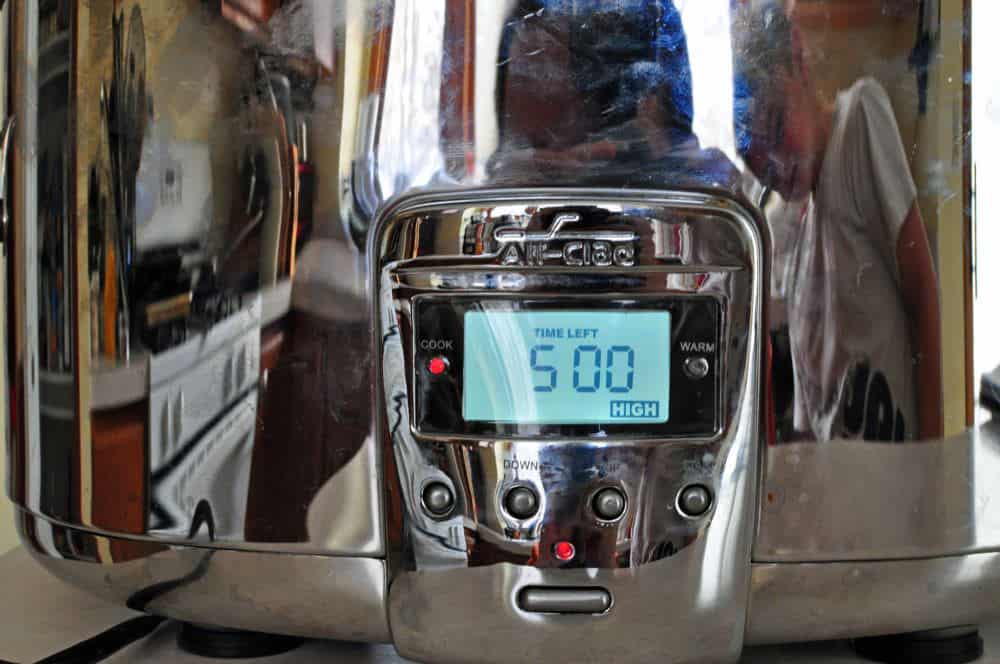
3. Slow cook the beef: Cover and cook on low heat for 10 hours or high heat for 5 hours.

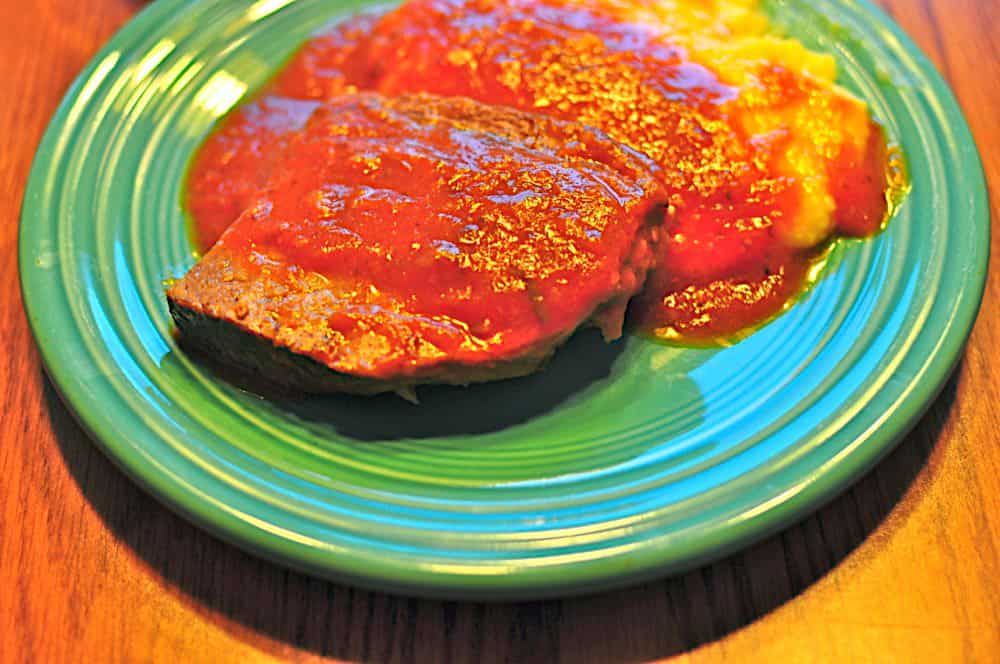
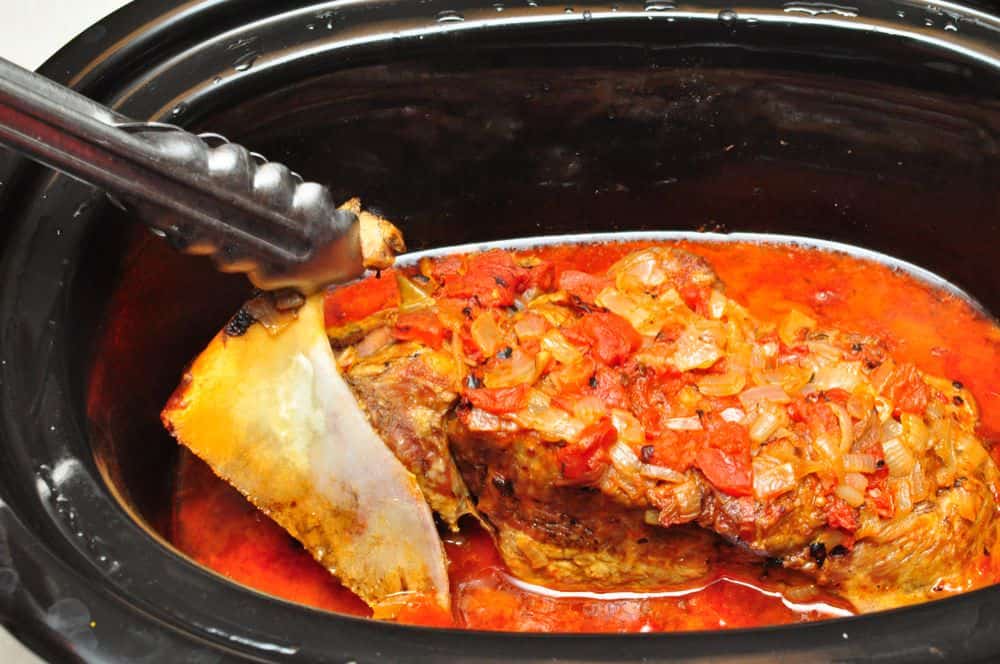
4. Slice, puree and serve: Remove the beef to a carving platter, leaving as much of the sauce behind as possible. Remove the herb sprigs and bay leaf from the crock pot, then use a stick blender to puree the sauce, about 3 minutes. (For big pieces like the mushrooms: trap them under the business end of the stick blender, then turn it on to break them up.) Taste the sauce, and add the sugar plus more salt and pepper if it needs it. Slice the beef into ½ inch slices; it's OK if it breaks up as you try to do this. Sprinkle the beef with a little more salt at this point, to season the inside of the meat. Move the meat a platter, spoon a couple ladles of sauce over the beef, and serve. Pass the rest of the sauce at the table (or use it to cover a pound of pasta).

Variations:
*Rustic sauce: skip the pureeing step; dice the dried mushrooms before adding them to the slow cooker.

*Shredded beef: instead of slicing, pull the beef into shreds with a pair of forks. Toss with 2 cups of the sauce.

*Stovetop safe slow cooker insert: In the pictures, you can see me browning and sauteing in my slow cooker's insert. I wrote the instructions for normal slow cookers, and assumed the use of a pan for the browning. To use a stovetop-safe insert, the only change is to move the browned beef roast to a large bowl instead of the slow cooker.  Then, saute the aromatics in the insert. Once the aromatics step is done, and everything is boiling, submerge the roast and any juices from the bowl in the insert, and move the insert to the slow cooker.

Notes:
*I love serving this recipe with polenta, but the kids usually prefer pasta. Just make sure to have a starchy side like noodles, mashed potatoes or polenta to soak up the delicious sauce.

*This recipe makes a lot of beef and sauce. Freeze a quart or two, and when you need a quick dinner, reheat it and serve over pasta.

*Leftovers also make great beef sandwiches - split a crusty roll and top with reheated beef and sauce.

*Don't make my mistake; remove the herb sprigs and bay leaf BEFORE you try to puree the sauce. Whoops. It's hard to unwind your herb bundle from the shaft of the stick blender's blades when everyone is waiting for dinner...

What do you think? Questions? Other ideas? Leave them in the comments section below.

Related Posts:
Slow Cooker Tex-Mex Post Roast
Slow Cooker Bolognese Sauce

Adapted from:
America's Test Kitchen Slow Cooker Revolution

*Enjoyed this post? Want to help out DadCooksDinner? Subscribe using your RSS reader or by Email, recommend DadCooksDinner to your friends, or buy something from Amazon.com through the links on this site. Thank you!

Grilled Mahi-Mahi Fish Tacos with Red Cabbage Slaw

March 31, 2011 by Mike Vrobel 9 Comments

I missed my one chance at San Diego's famous fish tacos. Back when I was a fledgling food fanatic, I made my lone visit to San Diego. I didn't know there was such a thing as a fish taco. That is, until I got home. Then, every magazine I read for the next year had an article about the glories of fish tacos. Doh! I had to learn to make them myself, to find out what I had missed.

Nowadays, instead of the traditional fried version, I grill my fish tacos. Mahi-mahi is my fish of choice. It is sustainable (according to Seafood Watch), easy to find in my local stores, and relatively inexpensive. Mahi-mahi is a firm fleshed white fish with a neutral taste; it works well as a carrier for spice rubs, and the firm flesh does not disintegrate when I flip it on the grill.

Mahi-mahi's neutral taste (read: bland) needs some help. I like my meal to have some punch, so I rub the fish with spices, including chipotle chile powder to bring some heat. Fish tacos are always served with cabbage slaw, and I can see why - the cabbage adds a nice crunch and even more flavor. (I make the slaw with a creamy dressing to simulate the traditional crema and lime topping.) Serve everything in a tortilla, top with salsa or hot sauce, and the fish taco is ready to go.

Why is cabbage slaw traditional with fish tacos? This question gnawed at me for years...until I read the answer, and then it was obvious. Fish tacos originated on the Baja coast of Mexico, before migrating north to San Diego. The little shacks serving fish tacos on the beach don't have refrigeration, and cabbage will hold up much better than, say, lettuce, which would wilt in the heat. Voila - cabbage slaw.

Recipe: Grilled Mahi-Mahi Fish Tacos with Red Cabbage Slaw

Inspired By: Karen Adler and Judith Fertig Fish and Shellfish, Grilled and Smoked

Cook time: 10 minutes

Equipment:

  • Grill (I used a Weber Summit. Here is the current version of my grill.)

Ingredients:
Grilled Fish

  • 4 mahi-mahi fillets (each 8 ounces; about 2 pounds of fish)
  • 2 teaspoons kosher salt (½ teaspoon per fillet)
  • 1 teaspoon fresh ground black pepper
  • 2 teaspoons ground ancho pepper powder
  • ½ teaspoon ground cumin
  • ½ teaspoon ground chipotle powder
  • ½ teaspoon brown sugar
  • Juice from ½ lime

Red Cabbage Slaw

  • 2 tablespoons lime juice (about 2 limes)
  • 1 teaspoon brown sugar
  • ½ teaspoon kosher salt
  • ½ teaspoon fresh ground black pepper
  • 1 clove garlic, minced (or pressed through a garlic press)
  • 2 tablespoons mayonnaise
  • 2 tablespoons extra virgin olive oil
  • 1 pound red cabbage, thinly sliced (1 small head of cabbage)
  • ½ medium onion, thinly sliced
  • 1 Serrano pepper, halved and thinly sliced
  • ¼ cup minced cilantro

Accompaniments

  • tortillas (You can't have tacos without tortillas!)
  • salsa
  • avocado slices
  • sliced Serrano (or jalapeno) peppers
  • Mexican hot sauce

Directions:
*For an overview on grilling fish, see my Grilled Barramundi recipe.
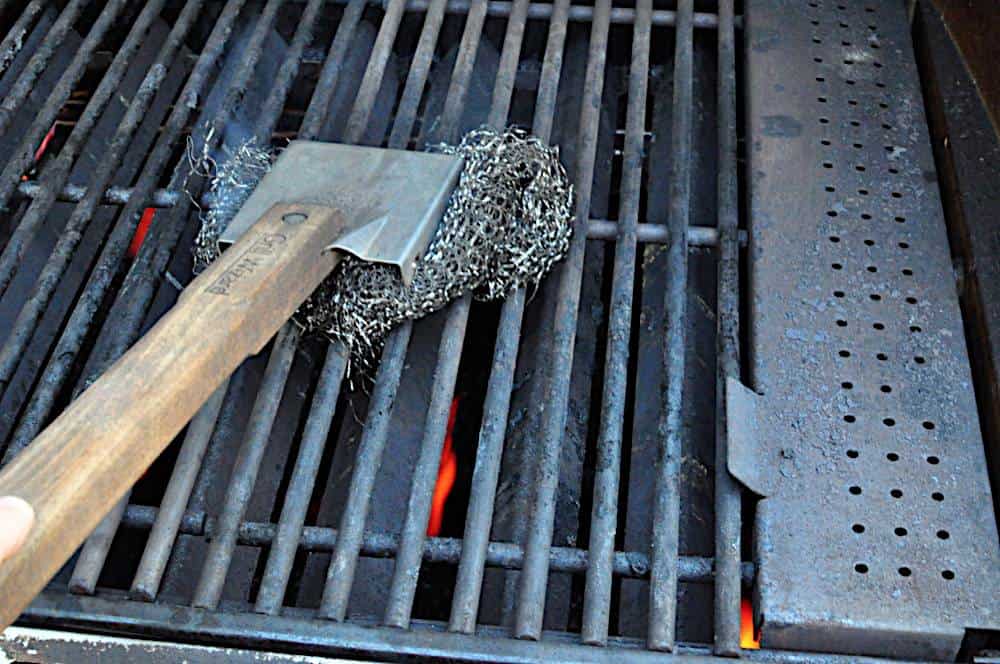
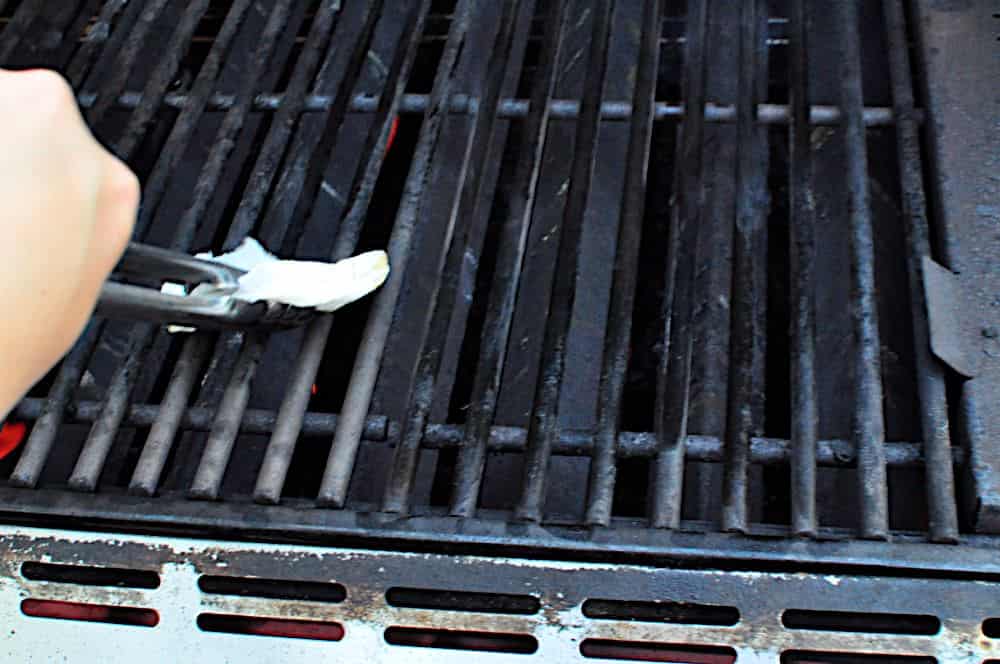
1. Prepare the grill: Start by setting the grill up for cooking with direct high heat. Preheat the grill for 15 minutes, then clean the grill grate thoroughly. For my Weber Summit, I turn all the burners to high and wait fifteen minutes. Then I brush the grate with my grill brush, and wipe the grate with a paper towel dipped in vegetable oil.

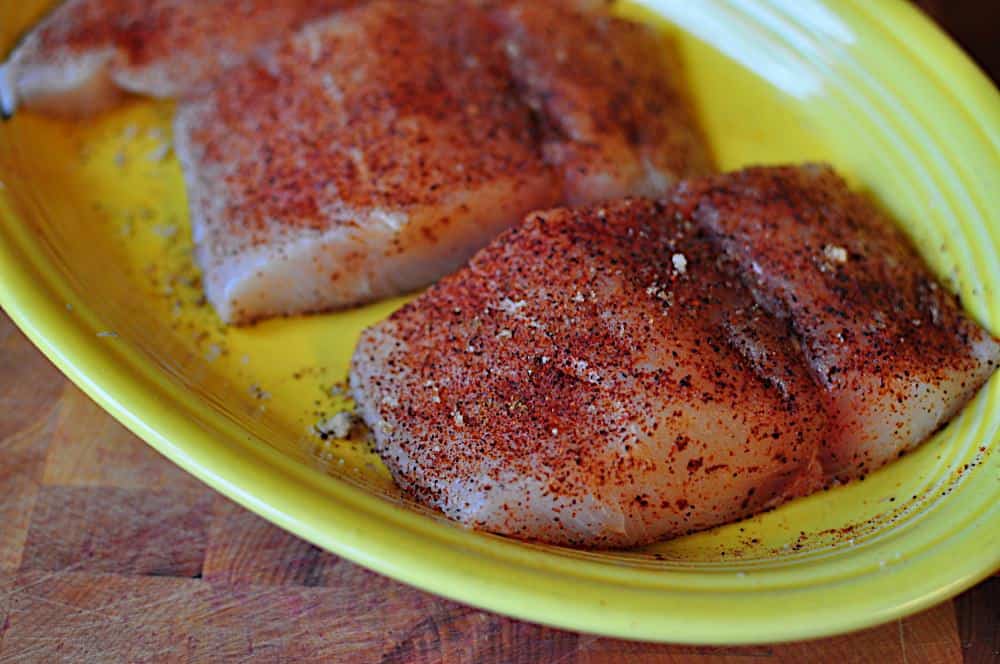
2. Prepare the mahi-mahi: While the grill is preheating, sprinkle the mahi-mahi filets with the salt, black pepper. Mix the ancho pepper, cumin, chipotle pepper, and brown sugar in a small bowl, then rub the spice mix evenly over the flesh side of the fish.

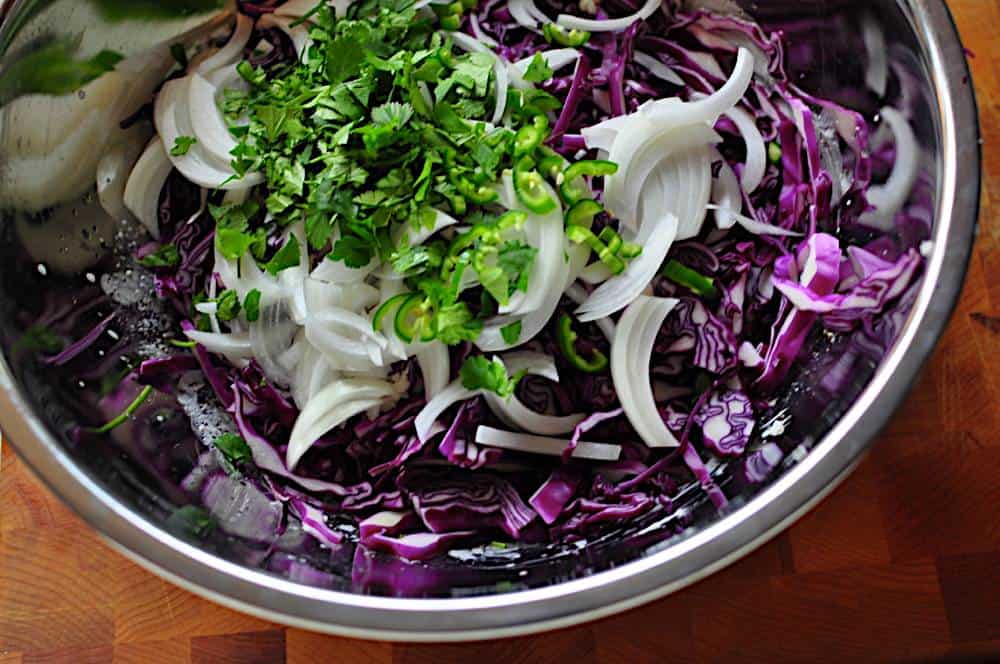
3. Prepare the red cabbage slaw: In a large bowl, whisk the lime juice, brown sugar, salt, pepper, and garlic until the salt and sugar dissolve. Add the mayonnaise and olive oil, and whisk into a smooth dressing. Add the red cabbage, onion, serrano pepper and cilantro to the bowl, and toss until evenly coated by the dressing.

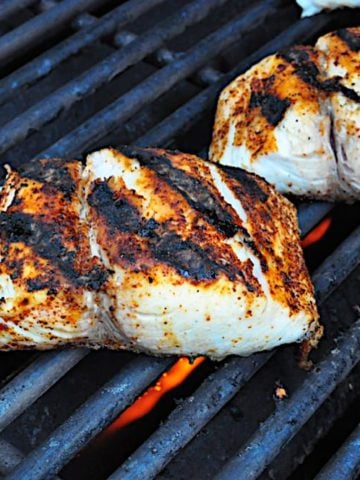
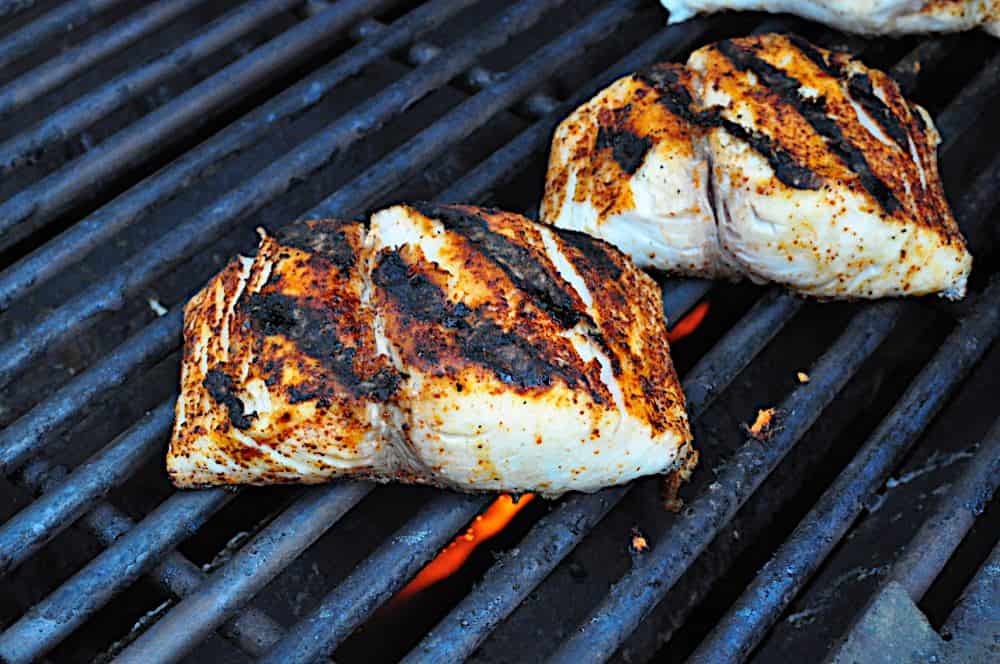
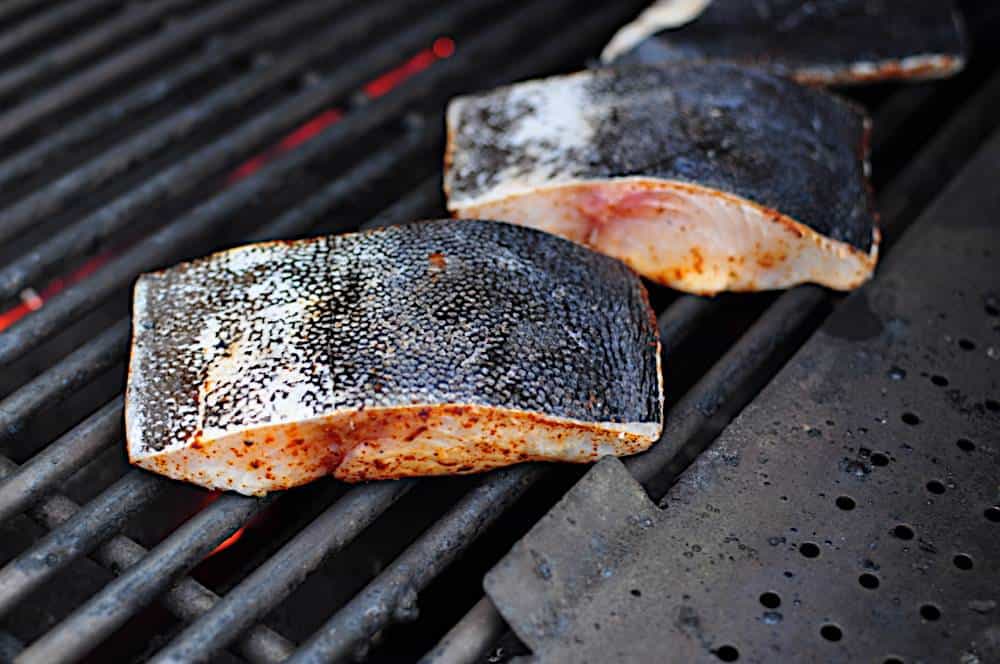
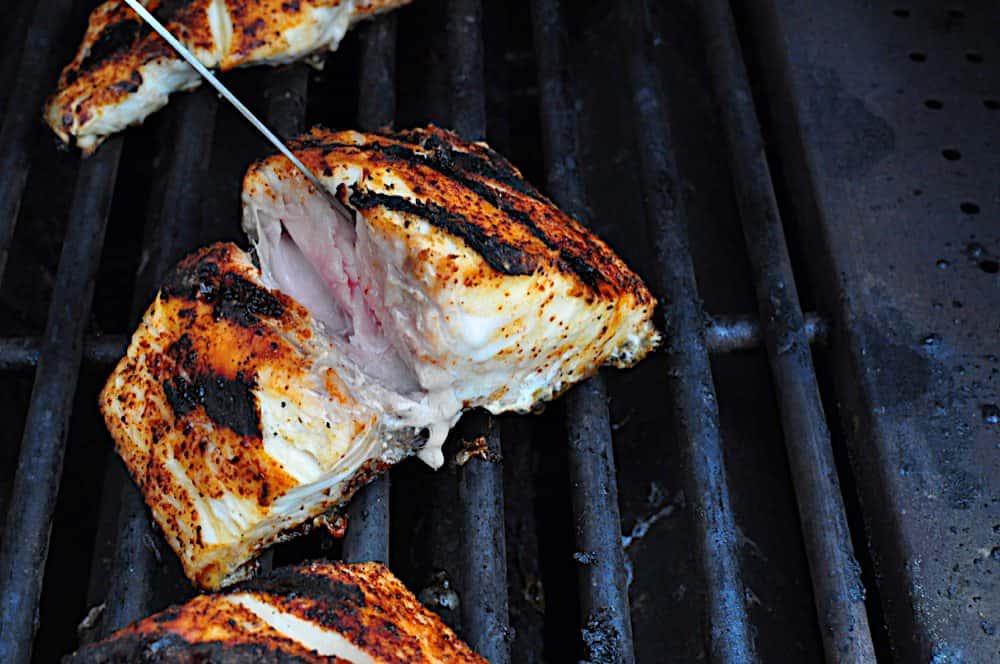
4. Grill the mahi-mahi: Place the mahi-mahi on the grill over direct high heat, flesh side down. Grill for four minutes, then gently work a spatula under the mahi-mahi and flip skin side down. Grill for four to six more minutes, until the mahi-mahi is just opaque in the thickest part; I peek in the natural seam that runs through the fillet with a paring knife. It is OK to let it cook longer on this side; the skin will protect the fish from burning. Once the fish is cooked through, gently work a spatula under the mahi-mahi and move to a platter. Drizzle the fish with the juice from half a lime.

Starting flesh side down
Cooked through, ready to come off the grill

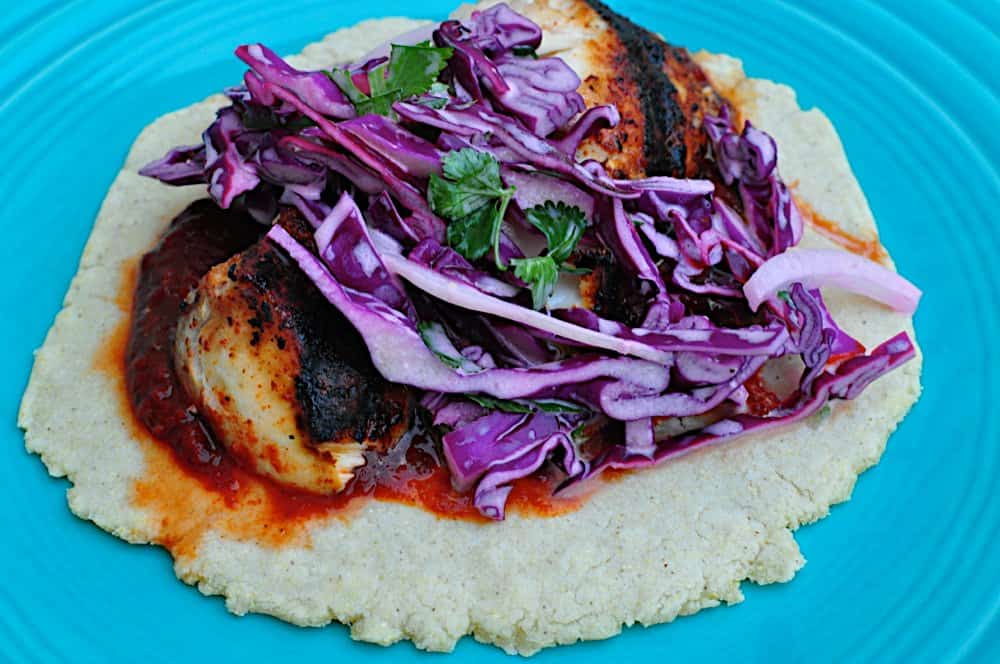
5. Serve: Serve, passing the tortillas and red cabbage slaw at the table. To eat, break large chunks of mahi-mahi from the fillets using a fork, and pile them on top of a tortilla. Top with the red cabbage slaw, whatever other toppings you like, and dig in.

Variations:
*Other fish: Any firm fleshed white fish works with this recipe.

*Cabbage: I used red cabbage because I like the color in my pictures. I often use napa cabbage in this recipe, and green cabbage also works.

*Fruit salsa: Instead of the red cabbage slaw, top with a fruit salsa. Avocado Orange Salsa or Mango Salsa are good matches for this dish.

Notes:
*The cooking time is based upon 1 ½ inch thick mahi-mahi filets, which took ten minutes to cook through. If the fillets are 1 inch thick, they should only take about six to eight minutes total. (And, thank you to BayLobsters Fish Market in Twinsburg for the wonderful Mahi-mahi filets.)

What do you think? Questions? Other ideas? Leave them in the comments section below.

Related Posts:
Grilled Barramundi with Avocado Salsa
Grilled Trout, Herb and Citrus Stuffed
Air Fryer Tilapia

Inspired By:
Karen Adler and Judith Fertig Fish and Shellfish, Grilled and Smoked

*Enjoyed this post? Want to help out DadCooksDinner? Subscribe using your RSS reader or by Email, recommend DadCooksDinner to your friends, or buy something from Amazon.com through the links on this site. Thank you!

The Joy of a Full Freezer

March 29, 2011 by Mike Vrobel 6 Comments

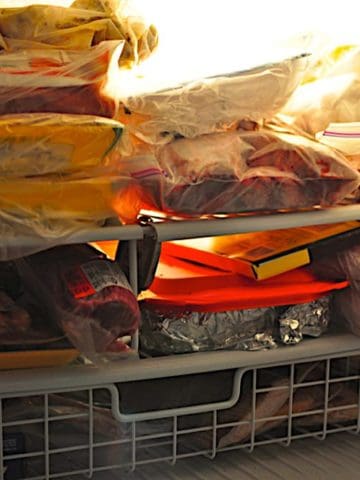
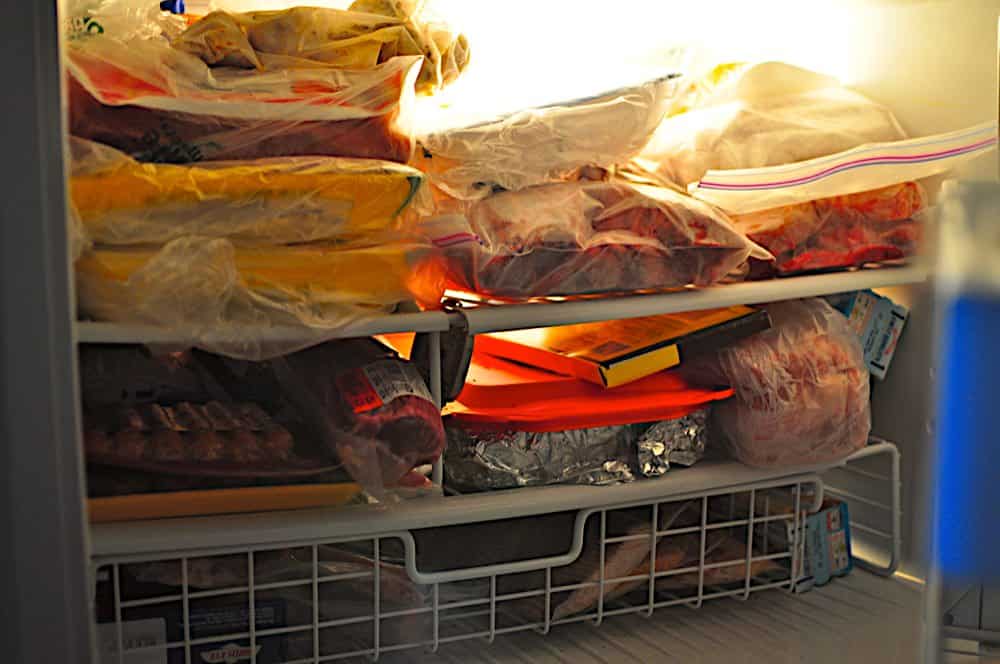
Here there be monsters. Or frozen pork chops? Either way, I should have labelled the package.

I'm not big on buying food ahead of time. I like to keep my options open, and go where my weekly grocery flier, trip to the farmers market, or CSA box take me.

But...occasionally, when a deal is too good to pass up, I'll buy extra and store it in my freezer. I bought an extra corned beef brisket on sale for St. Patrick's day, and it barely fit into my freezer. The current contents of my freezer, and why it wound up in there:

  • One whole turkey (Thanksgiving special - $.59/lb)
  • One slab of baby back ribs (Out of grilling season special - $1.99/lb)
  • Two pork shoulder "steamship" roasts (After New Year's special - $.69/lb)
  • One pork leg "steamship" roast (After New Year's special - $.99/lb)
  • One pork loin roast ($1.99/lb)
  • One pork tenderloin ($2.99/lb)
  • Two packages Johnsonville Brats (Out of grilling season - Buy one get one free sale)
  • Two packages chicken thighs ($.99/lb)
  • Bacon (Various sales)
  • Six pounds butter (Various sales)
  • Lamb Shoulder Chops (Farmers Market - last ones available until spring)
  • 3 pounds grass fed beef hamburgers (Farmers Market)
  • 2 pounds ground buffalo (Farmers Market)
  • 2 slabs Pork Belly (Asian Market)
  • 3 pounds beef short ribs (Mexican Market)
  • 2 pounds Hungarian Sausage (Al's Quality Meats)
  • 1 pound Chorizo Sausage (Al's Quality Meats)
  • ...plus that corned beef I just bought. Also, various pre-made ingredients like meatballs, chicken stock, and a lasagna in case of emergency.

One thing I've realized, from writing up this list - almost everything on it comes cryovaced - that is, vacuum packed in thick plastic. I've found that cryovaced meat will last in the freezer for quite a while without freezer burn.

Also, it shows my split personality. Half of the items made me say "wow, that's such a deal! I can't pass that up!". The other half made me say "I've been looking all over for that! I can't pass that up!"
*I don't have a shopping problem - I can quit any time I want. I don't go out of my way to visit new and interesting ethnic markets and gourmet grocery stores... Oh. Wait...

The good thing about doing this inventory? I learned that I have to eat into my stash, and not buy meat for the next couple of weeks. That way, I'll have room for the next deal I can't pass up. It is comforting to know I am stocked up. Because, in the end...I like having frozen assets.*
*Thank you, thank you, I'll be here all week.

What do you think? What do you keep in your freezer? What deals make you stock up? What do you need to thaw out and cook? Let me know in the comments, below.

*Enjoyed this post? Want to help out DadCooksDinner? Subscribe using your RSS reader or by Email, recommend DadCooksDinner to your friends, or buy something from Amazon.com through the links on this site. Thank you!

Steak Saute with Flaming Cognac and Cream Sauce

March 24, 2011 by Mike Vrobel 2 Comments

Why flambe? Well, there is the obvious reason...showing off. I love to gather everyone in the kitchen, turn off the lights, and every so slowly tilt the pan until the cognac ignites and flames shoot into the air.

What's that? You need better reason than satisfying my pyromaniacal tendencies to try this recipe? Ok, Ok, there are other reasons to light this candle. How about:the flames caramelize the sugars in the cognac and burn off the alcohol. Flaming results in a smoother, sweeter sauce than just simmering the alcohol.

Of course, flames shooting towards the ceiling are dangerous. Safety tips: turn off the flame on the stove before adding the Cognac, to keep it from igniting early. Keep anything flammable away from the stove. Especially yourself - don't wear loose clothing, and if you have long hair, make sure it is held back.
I don't have to worry about long hair; I have to worry about keeping what little hair I have. Sigh.

Have the lid for the pan nearby. The quickest way to kill the flames is to cover the pan and smother the fire. Also, you do have a fire extinguisher in your kitchen, right?

Once the fire is dying down, shake the pan; this brings the alcohol to the surface of the liquid, where it will burn. Towards the end, you will have to shake the pan constantly to keep the flames going. When they finally wink out, your sauce is ready to go.

Have I scared you off yet? No? Good, because the result is delicious. Good luck!
And, no, I haven't caught anything on fire with this recipe. I always wonder, when those flames are first leaping towards the ceiling, if this is the time I pushed my luck..

Recipe: Steak Saute with Flaming Cognac and Cream Sauce

Adapted From: Pam Anderson How to Cook Without a Book

Cook time: 15 minutes

Equipment:

  • 12 inch stainless steel fry pan (I love my All-Clad 12" fry pan for sautes).

Ingredients:

  • 4 top sirloin steaks, ¾ inches thick (About 1.5 pounds of beef)
  • 2 teaspoon kosher salt (½ teaspoon per steak)
  • 1 teaspoon fresh ground black pepper (¼ teaspoon per steak)
  • 1 teaspoon vegetable oil

Sauce ingredients:

  • ½ cup cognac (Or other brandy. Don't use the good stuff here)
  • ¼ cup heavy cream
  • salt and pepper to taste

Directions:
*For an overview, see my Saute with Pan Sauce basic technique 
1. Prepare the Steaks: Sprinkle the salt and pepper evenly over the steaks.

2. Prepare the pan: Heat the oil in the fry pan over medium-high heat, until the oil is shimmering and just starting to show tiny wisps of smoke. Swirl the oil to get a very thin coat on the entire bottom of the pan.

3. Saute the Steaks: Place the steaks in the pan. Shake the pan to get the oil under the steaks, then let sit for 3 minutes, or until well browned. Flip the steaks, and cook the other side for another 3 minutes, or until well browned. Remove the steaks to a plate.


4. Make the Pan Sauce: Turn the heat off. Turn the vent fan on, if you have one. Make sure you have a lid that will cover the pan nearby, to smother the pan if necessary. Add the cognac to the pan, turn the burner back on to medium-high heat, then carefully ignite the cognac by tilting the pan slowly until the fumes from the alcohol catch fire. (If you are the cautious type, ignite the cognac with a long necked click lighter instead of tilting the pan.) Let the flames burn down, shaking the pan when the fire gets low to keep the flames going as long as possible. Once the flames are out, add the cream. Simmer until thickened, about 3 minutes. Taste the sauce, and add salt and pepper until it is well seasoned.

Tilted just enough for the flames to start...
Flambe!
Keep shaking...
Thickened and ready to serve.

6. Serve: Serve with 1 tablespoon of sauce drizzled on top of each steak, and pass the rest of the cognac sauce at the table.

Variations:
New York Strips or Ribeyes: Use the same instructions. Aim for 1 ½ to 2 pounds of meat; any more than that and you will be crowding the pan. If the steaks are closer to 1 inch thick, cook for 4 minutes a side.

Herbs: Add a sprig or two of fresh thyme, rosemary or tarragon with the cream give a herbal flavor to the sauce.

Notes:
Cognac is traditional in this recipe; it's name is right there in the title, after all. But, any brandy will do. I use a VSOP cognac, because it is what I keep on hand to drink. But I, hesitate before putting it in the pan, thinking: Do I really want to use this for cooking? In other words, this is not the time to bring out the XO Excellence Premier Cru Cognac...the bottle of VS in the back of the liquor cabine, the one that has been open for a while, is just fine.

In spite of the fancy ingredients, and the impressive floor show, this recipe takes almost no time to put together. Keep that in mind when you need to wow someone on short notice.

What do you think? Questions? Other ideas? Leave them in the comments section below.

Related Posts:
Saute Basic Technique
Ribeye Steak Saute with Red Wine Pan Sauce
Chicken Breast Saute with Marsala Sauce

Adapted from:
Pam Anderson How to Cook Without a Book


*Enjoyed this post?  Want to help out DadCooksDinner?  Subscribe using your RSS reader or by Email, recommend DadCooksDinner to your friends, or buy something from Amazon.com through the links on this site.  Thank you!

Sauteed Chickpeas

March 22, 2011 by Mike Vrobel 8 Comments

What do you do with chickpeas after you've made hummus?

I love cooking my own chickpeas in the pressure cooker. Chickpeas have a sweet taste and a creamy, meaty feeling when you bite into them.
*Tim, my youngest son, is addicted to them. When he saw me cooking for this post, he refused to eat his pepperoni sandwich, and insisted on chickpeas. Can you imagine? A kid turning down pepperoni for beans?
I top salads with chickpeas, and stir them into soup. Of course, there's lots and lots of hummus. But after that, I didn't know what to do. How do I use up the batch of chickpeas stored in the freezer?

Sauteed chickpeas are the answer.  They are the star of the show, not something to use as a topping. Sauteing chickpeas gives them a hint of crunch as you bite into them, before you get to the creamy interior. Toss them them in a vinaigrette to add a tart finish, and you have chickpeas that are good enough to stand on their own.

As usual, this recipe is best with homemade chickpeas (from your pressure cooker, of course). But...OK, I'll admit it. Homemade chickpeas add a level of finesse to the recipe, and add depth to the flavor, but canned chickpeas are still pretty good. If canned are all you have (or all you have time for) don't be ashamed. Drain a can of chickpeas and get to work. Sure, homemade is better, but don't let perfect be the enemy of very good.

Recipe: Sauteed Chickpeas

Inspired by: Heidi Swanson Pan Fried Chickpea Salad [101cookbooks.com]

Cook time: 8 minutes

Equipment:

  • 12 inch fry pan (I love my All-Clad fry pan)

Ingredients:

  • 2 tablespoon olive oil
  • 2 cups cooked chickpeas, drained and thoroughly dried
  • ½ teaspoon kosher salt
  • 2 garlic cloves, minced or pressed through a garlic press
  • 1 green onion, cut on the diagonal into ¼" thick slices

Dressing:

  • 2 tablespoon sherry vinegar
  • pinch of salt
  • pinch of fresh ground pepper
  • ¼ cup extra virgin olive oil

Directions:
1. Saute the chickpeas: Heat 2 tablespoon olive oil over medium-high heat until shimmering. Add the dried chickpeas and saute, tossing and stirring occasionally, until the chickpeas are browned and crispy on the outside, about 8 minutes. Add the minced garlic and saute for another 30 seconds, then stir the garlic into the chickpeas.

Patting dry with paper towels
Sauteing until browned

2. Toss with the dressing: While the chickpeas are sauteing, whisk together the dressing ingredients. Immediately after cooking, toss the chickpeas with the dressing until well coated. Add the scallions and toss again to combine. Serve.

Variations:
*Any vinaigrette works with this recipe - I particularly like the citrus flavor of lemon vinaigrette with chickpeas.

*For a Spanish tapas version, add a couple of ounces of diced chorizo to the pan when sauteing the chickpeas.

Notes:
*This is a perfect use for make-ahead chickpeas. When I make dried beans, I always make extra, freeze them, and use them for recipes like this one.

*If you're going to buy canned chickpeas, seek out the Goya brand chickpeas. I've heard good things about them, and they're no more expensive than the other brands.

What do you think? Questions? Other ideas? Leave them in the comments section below.

Related Posts:
Pressure Cooker Chickpeas
Hummus
Turkey Soup with Chickpeas and Vegetables

Adapted from:
Heidi Swanson Pan Fried Chickpea Salad [101cookbooks.com]

*Enjoyed this post? Want to help out DadCooksDinner? Subscribe using your RSS reader or by Email, recommend DadCooksDinner to your friends, or buy something from Amazon.com through the links on this site.  Thank you!

Pressure Cooker Lamb Stew with Guinness and Barley

March 17, 2011 by Mike Vrobel 19 Comments

Pressure Cooker Lamb Stew with Guinness and Barley

Pressure Cooker Lamb Stew with Guinness and Barley

This year, for Saint Patrick's day, I decided to get fancy. Instead of my usual corned beef and cabbage, I wanted to make a traditional Irish lamb stew.
Traditional may be pushing it a bit, since I did want to cook it in my pressure cooker.

Unfortunately...my headnote is going to be a lot quicker than usual. I cooked this recipe a week before St. Patrick's day, so I would have pictures for the blog. It was fabulous - lamb shoulder chops have so much flavor that they carry this relatively simple stew. (Adding some Guinness helps as well. Brilliant!)

I wrote up the instructions, picked out the good pictures, and went to bed.  The next morning, I threw my back out. Ow ow owie ow. It's three days later, and I can finally sit upright for a few minutes...thanks to all the interesting medicines the ER doctor gave me.
*In other words - If this doesn't make any sense, I apologize. It's the meds talking.

Looking for a quick stew for St. Patrick's day? Grab some lamb shoulder chops and fire up the pressure cooker.
*Don't have a pressure cooker? No problem. See the Notes section for instructions on cooking with a standard dutch oven.

Recipe: Pressure Cooker Lamb Stew with Guinness and Barley

Inspired By: Lorna Sass Cooking Under Pressure

Equipment

  • Pressure cooker, at least 6 quarts (I love my giant Kuhn Rikon 12-quart pressure cooker, which is probably overkill for this recipe)

Cutting lamb shoulder chops into cubes


Carrots and onions, ready to sauté


Browned the lamb, sautéing the onions


Adding the flour
Adding the flour


Stirring in the Guinness


Adding barley and herbs


Everything in the pot, ready to lock the lid


Fishing out the bones


Notes

  • No pressure cooker? No worries. Use a heavy bottomed dutch oven with a lid, and increase the amount of water to 4 cups. Follow the instructions right up until "lock the lid". Then, instead of pressure cooking, bring the pot to a boil, and cover with the lid. Move the pot to a preheated 350*F oven and bake for 2 to 2.5 hours, until the lamb is tender. Continue with the serving step.
  • Add a packet of potatoes to the stew: Wrap a couple of pounds of diced, salted and peppered potatoes in aluminum foil, and float them on top of the stew right before you lock down the lid.
  • Serve with mashed potatoes. To make this dish more traditional, stir sliced green onions into the mashed potatoes and call it Champ.
  • I use lamb shoulder chops because, without special ordering, I can't find lamb shoulder roasts in my area. Round bone shoulder chops are easier to trim into boneless cubes; seek them out if you can. Also, I like the round bones because they have the marrow in them.  I add the round bones to the pot with everything else, then fish them out at the end, and scrape the ; this lets the marrow in the bones melt and join the stew.
  • The recipe calls for one cup of Guinness. I always buy pint cans with the carbonation capsule. Why? Because I can drink the rest.

Some for the pot, some for the cook...

What do you think? Questions? Other ideas? Leave them in the comments section below.

Related Posts

Pressure Cooker Beef Short Ribs
Click here for my other pressure cooker recipes.

Inspired By:
Lorna Sass Cooking Under Pressure (20th Anniversary Edition)

Enjoyed this post? Want to help out DadCooksDinner? Subscribe using your RSS reader or by Email, recommend DadCooksDinner to your friends, or buy something from Amazon.com through the links on this site. Thank you!

Favorite Links, March 2011

March 15, 2011 by Mike Vrobel Leave a Comment

Recent food articles I've enjoyed:

Michael Ruhlman's review of Nathatn Myhrvold's Modernist Cuisine. [NYTimes.com]
I lust after this book, but I can't justify the $625 price. (Even if it is on sale for only (only!) $461.26 at Amazon.)
Bonus: Look at the jaw-dropping photography: The Wok Shot [Kenji Alt, seriouseats.com]

Watch Pam Make Quick, Easy Lo Mein [ThreeManyCooks.com]
*I'm a self-taught home cook...by cooking my way through Pam Anderson's How to Cook Without A Book. In this video, Three Many Cooks (AKA Pam and her daughters Maggie and Sharon) show how to make a weeknight Veggie Lo Mein. Need a quick, one dish, weeknight dinner? Pam's got you covered.
Bonus: Pam versus Maggy, Pot Braised versus Slow Cooker Barbecued Beef. The winner? Whoever gets to eat either of the recipes.

Rick Bayless shows Christopher Kimball how to make Empanadas [AmericasTestKitchen.com]
Speaking of how I became a self-taught home cook - Rick Bayless's Salsas That Cook and my subscription to Cooks Illustrated were also huge influences.  Put the two together? I'm there. This was a Sunday Dinner project for me and the kids, and it was a big hit.
**Bonus: Bloopers from Cooks Country.

One Pot Meal: Mini Meatball Pressure Cooker Broth [Hip-Cooking.com]
*I love my pressure cooker, and I can't wait to try this recipe.

The (Surprising) Truth About Salt [GoodHousekeeping.com]

*Years ago, I read that restricting salt in your diet is only necessary if you are at risk of hypertension.  For most people, salt restriction isn't needed. (Which I liked, because food without enough salt is boring.) Last year, there was a big public health push to reduce salt in the American diet, led by (among others) New York City. I assumed that new studies provided a definitive health problem with salt. Um...no, nothing new.
**My favorite takeaway: 80% of the salt in our diet is from prepared foods. So, how do I try to eat? See ERF, below.
Mark Bittman's Soup Matrix [NYTimes.com]
*Looks like I worried about the end of the Minimalist column for nothing. I now have a half a dozen soup recipes I am dying to try out.
**Bonus: Is "Eat Real Food" Unthinkable? My new favorite acronym: ERF. Eat Real Food.

The Sounds of Winter Grilling [AnotherPintPlease.com]
*Sure, you can read everything I wrote about winter grilling.  Or, you can watch Mike's thirty second video. If the sound of fat popping in the rotisserie drip pan (at the 0:17 mark) doesn't make you want to go out and grill regardless of the temperature, then nothing I can say will change your mind.

Two Simple Steps To A Steady Writing Habit [QuickWritingTips.blogspot.com]
*My goal for this blog: every day, write for a half an hour. Do I feel like it? Do I have time? Doesn't matter. Write for a half an hour. Every day. The result? Closing in on three years of blogging.
(And, am I perfect? No, of course not. I miss days. But having this goal is the key.)
**Bonus: WriteOrDie.com - Daniel suggested this site when I asked about his paperless writing. Writing with a sword of damocles hanging over your head is surprisingly effective when I need to get ideas past my internal editor and out onto the page.
Dear Sriracha Rooster Sauce [NSFW, theoatmeal.com]
Sums up my love for Sriracha sauce in one twisted, beautiful, obscene comic strip.
*Bonus: An Ode To Tabasco Sauce. [CasualKitchen.blogspot.com] As Daniel says, "You know you've had a long healthy marriage when you finish your first bottle of Tabasco" is a little out of date nowadays...

What do you think? What did I miss? Leave them in the comments section below.

*Enjoyed this post? Want to help out DadCooksDinner? Subscribe using your RSS reader or by Email, recommend DadCooksDinner to your friends, or buy something from Amazon.com through the links on this site.  Thank you!

Jambalaya with Chicken and Sausage

March 8, 2011 by Mike Vrobel 14 Comments

This year, my Fat Tuesday recipe is Jambalaya. Jambalaya is the Cajun version of chicken and rice - a dish that exists all over the world, wherever rice is grown. Jambalaya, Paella, Arroz con Pollo - it's all chicken and rice, the rest is just detail. As with all chicken and rice dishes, the goal is great rice. The other ingredients are just supporting players, there to add flavor to the rice.

Jambalaya goes together like a stew. Brown the meat, saute the aromatics, add the rice and liquid, and cook until the rice is tender, with a thin layer of browned rice on the bottom. The rice comes out carrying the flavors from the other ingredients - Cajun spices, meaty sausage and chicken, sweet aromatics, and of course, a big hit of garlic. When serving, make sure to scrape some of the browned rice from the bottom of the pot into every serving; the crunch of the browned rice adds a delicious counterpoint to the rest of ingredients.

I was almost able to slip this one past my kids. Almost. Their love of rice got them to try it. Natalie enjoyed it, and came back for seconds. Tim ate a bowlful of the rice by carefully fishing the rice out with his spoon, avoiding the "yucky stuff" like peppers, and onions. Ben had his mandatory taste, then asked if he could ask the question of the day.
*Oh, well, one and a half out of three is a pretty good batting average for me.

Forget about the kids, though. I couldn't stop eating it. I love how the rice is packed with flavor. Want some spicy rice for Mardi Gras? Here's the recipe for you.

Recipe: Jambalaya with Chicken and Sausage

Adapted From: Emeril Lagasse Andouille and Chicken Jambalaya [emerils.com]

Cook time: 65 minutes

Equipment:

  • 6 quart or larger heavy dutch oven with a lid (I love my All Clad 8 quart stock pot for this, but any good, heavy bottomed dutch oven will work.)

Ingredients:

  • 2 tablespoons vegetable oil
  • 1 ½ pounds boneless chicken, cut into 1 ½ inch chunks (Skin on if you can find it, and I prefer dark meat chicken for this recipe)
  • 2 tablespoons Cajun seasoning (store bought is fine)
  • 1 pound smoked sausage, cut into ½ inch thick slices (andouille sausage is traditional)
  • 2 medium onions, diced
  • 1 bell pepper, diced
  • 1 stalk celery, diced
  • ½ teaspoon kosher salt
  • 4 cloves garlic, minced
  • 1 tablespoon Cajun seasoning
  • ¼ cup white wine
  • 3 cups medium-grain rice
  • 1 teaspoon kosher salt
  • 1 teaspoon Tabasco sauce
  • 1 bay leaf
  • 4 ½ cups water
  • 1 green onion, sliced thin

Directions:
1. Brown the meat: Toss the chicken with 2 tablespoons of Cajun seasoning. In a large dutch oven, heat the vegetable oil over medium-high heat until shimmering. Add the sausage to the dutch oven and cook until browned on one side, about 3 minutes. Using a slotted spoon, remove the sausage to a bowl. Add the chicken to the dutch oven (skin side down if it has skin), and cook for 4 minutes or until golden brown. Flip the chicken pieces and cook until the second side is golden brown, about 4 more minutes, then remove the chicken to the bowl.

Chicken, browned and ready
Fond - those bits are full of flavor

2. Saute the vegetables: Add the onions, bell pepper, celery, and sprinkle with the ½ teaspoon salt. Cook, stirring often and scraping any browned bits from the bottom of the pan until the onions are well browned, about 10 minutes. Make a hole in the onions and add the garlic and 1 tablespoon Cajun seasoning. Let cook until you can just smell the garlic, about 1 minute, then stir the garlic and seasoning into the vegetable mix. Add ¼ cup white wine and scrape all the browned bits from the bottom of the pan.

3. Cook the jambalaya: Add the rice, 1 teaspoon salt, Tabasco, and bay leaf to the dutch oven, then stir until the rice is evenly coated with all the other ingredients. Add the water, and stir again. Spread the chicken and sausage on top of the rice, pouring any juices from the bowl into the dutch oven. Bring to a boil, cover, reduce the heat to low, and simmer for 30 minutes. Turn off the heat, and let the rice finish cooking in the residual heat for 10 minutes with the lid on.

4. Serve: Move the jambalaya to a serving platter, sprinkle with the green onion, and serve with Tabasco sauce on the side.

Variations:
*I use a lot of finesse with this recipe, to add layers of flavor. If you're in a hurry, skip the following:

  • Browning the sausage (and, if you're really in a hurry, browning the chicken)
  • Deglazing the pan with white wine
  • Stirring the rice, salt, Tabasco, and bay leaf before adding the water - dump 'em all in there together
  • Letting the rice rest for 10 minutes - when it's done, serve it up!

Notes:
*Make your own Cajun seasoning - coming Thursday!

*This really is Cajun paella - I can't wait to try this on the grill in my paella pan next summer.

What do you think? Questions? Other ideas? Leave them in the comments section below.

Related Posts:
Grilled Paella with Shellfish, Chorizo and Chicken
Slow Cooker Red Beans and Rice

Adapted from:
Emeril Lagasse, Andouille and Chicken Jambalaya

*Enjoyed this post? Want to help out DadCooksDinner? Subscribe using your RSS reader or by Email, recommend DadCooksDinner to your friends, or buy something from Amazon.com through the links on this site.  Thank you!

Rotisserie Pork Belly

March 3, 2011 by Mike Vrobel 18 Comments

Pork belly is the current "It" ingredient at restaurants. (Replacing short ribs, I think.) Why? When cooked long and slow, it is a wicked combination of pork meat and melting pork fat. Never heard of it? Sure you have. Cured pork belly is commonly referred to as bacon. Who doesn't like bacon? Chefs know that; they love bacon as much as everyone else. A good chef uses pork belly as a canvas for all his technique, and the diner gets the deliciousness of high-end bacon. It's a win-win situation.

Pork belly, in spite of its popularity in restaurants, is hard to find in grocery stores. I wanted to try it on my rotisserie, but I could not find it in my local stores. (And I wasn't organized enough to special order it.) Then, I got lucky. I found pork belly in the meat case of my local Asian market. I bought it immediately. And? Pork belly cooked on the rotisserie has crackling skin, covering layers of luscious fat and tender meat.
*Pork belly needs long, slow cooking. For good results, most of the fat has to melt out. Again, think of bacon. Undercooked bacon is all chewy fat. Perfectly cooked bacon has a balance of fat, tender meat, and crunch. That's what we're looking for with pork belly.

How did pork belly go over with the kids? I was a little worried; pork belly seemed like a name that would turn them off. But, when I brought the spit in from the grill, I was surrounded. "What's that, Dad?" (I think they were drawn in by the heavenly smell.) I gave everyone a sample. Natalie kept coming back, asking for more. No, I told her, not until dinner. "Pork belly, Pork belly, Pork belly" she started chanting, dancing in circles around the room. I couldn't help myself - she got her second taste.

Recipe: Rotisserie Pork Belly

Cook time: 3 hours

Equipment:

  • Grill with Rotisserie attachment (I used a Weber Summit with an infrared rotisserie burner. Here is the current version of my grill.)
  • Aluminum foil drip pan (9"x12", or whatever fits your grill)
  • Butcher's twine

Ingredients:

  • 1.5 pound pork belly (1 ½" thick - thicker is better)
  • 2 quarts water
  • ½ cup table salt (1 cup kosher salt)
  • 2 tablespoon brown sugar

Directions:
1. Brine the pork belly: Score the skin side of the pork belly in a crosshatch pattern, spaced 1 inch apart, cutting through the skin and into the fat, but not into the meat. Dissolve the salt and brown sugar in the water, then add the pork belly and refrigerate for 4 to 8 hours.

2. Prepare the grill: Set the grill up for rotisserie cooking at high heat. For my Weber Summit, this means removing the grates, turning the two outer burners (burners 1 and 6) to high, and turning the infrared burner to high. Then I put my drip pan in the middle, over the unlit burners, and let the grill preheat for ten to fifteen minutes. (See My Rotisserie Basic Technique Post for more rotisserie setup details.)

3. Skewer the pork belly: While the grill is pre-heating, skewer the pork belly on the rotisserie spit. Aim for center mass, skewer the belly lengthwise, and secure it with the spit forks.

Scored and skewered
(see the variations for the herb rub on the right hand piece of belly)

4. Cook the pork belly: Put the spit on the rotisserie, and cook with the lid closed. Cook on high (500*F or higher) for a half an hour to 45 minutes, until the pork belly is starting to brown. Turn the heat down to medium-low (325*F).
*On my Weber Summit, I do this by turning off the infrared rotisserie burner; charcoal burns down naturally, and I add about 12 coals per hour to maintain the medium-low temperature.
Cook on medium-low for about 2 ½ hours, or until the pork belly reaches 160*F internal temperature. (Pork belly is hard to overcook, so don't worry too much about specific timing or temperature.)

After 30 minutes - good browning, turn down the heat
3 hours total - ready to eat!

5. Serve: Take the pork belly off the spit immediately, then rest for at least 15 minutes. Carve into ¼" thick slices and serve.

Resting...

Variations:
*Herb rubbed: After brining, rub the pork belly with the zest of a half a lemon and 2 tablespoon of minced fresh herbs. Use your favorites of thyme, rosemary, oregano, and marjoram.

Notes:
*I wanted to test my assumptions about pork and brining. I am a fan of dry brines, but with pork, wet brines have worked better. I had two pieces of pork belly from the store, so I tested a dry versus wet brine.  One piece was dry brined with a herb rub; the other used the wet brine version I share in the recipe. Both versions were good, but the wet brined belly was everyone's favorite. The dry brined pork turned out, well, a little dry - the wet brine improved the moistness of the pork. (Moistness is a word, right?)
*I've read that herbs don't really work in a brine. That was something else I should have tested. Darn!

What do you think? Questions? Other ideas? Leave them in the comments section below.

Related Posts:
Rotisserie Pork Shoulder
Rotisserie Pork Loin, Brined and Maple Sugar Glazed
Instant Pot Pozole
Click here for my other rotisserie recipes.


Check out my cookbook, Rotisserie Grilling.Everything you could ask about the rotisserie,
plus 50 (mostly) new recipes to get you cooking.

It's a Kindle e-book, so you can download it and start reading immediately!


*Enjoyed this post? Want to help out DadCooksDinner? Subscribe to DadCooksDinner using the RSS or Email options on the right, link to this post from your blog, recommend DadCooksDinner to your friends, or buy something from Amazon.com through the links on this site. (Like my Rotisserie Grilling cookbook...)
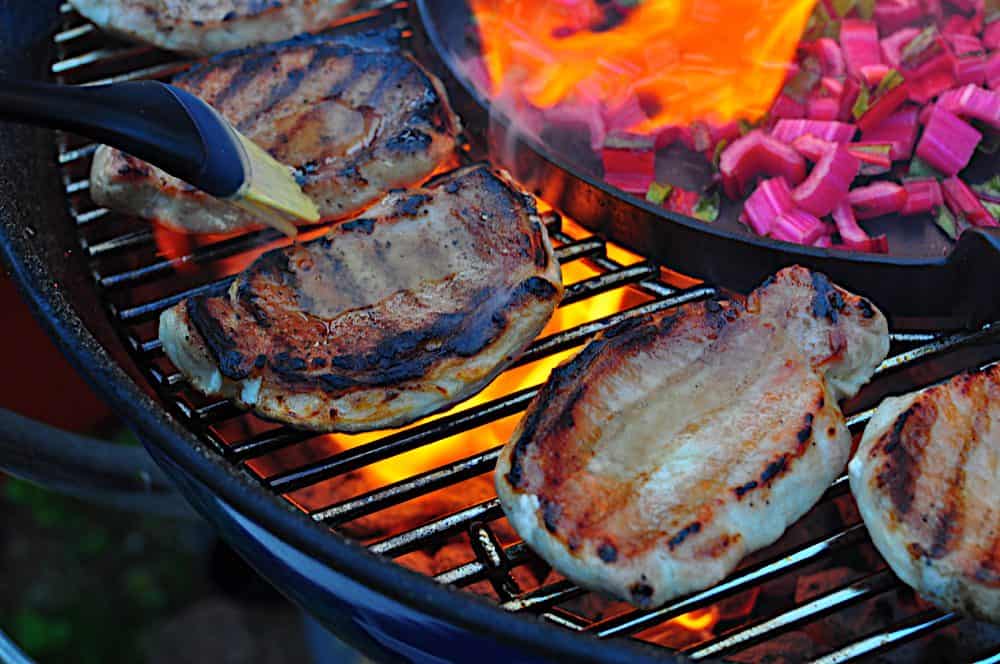
Things I Love: Heavy Wood Cutting Board

March 1, 2011 by Mike Vrobel 5 Comments

The real star of the show is in the background...

The first purchase I made specifically for this blog was my wood, end grain chopping block. Why? Well...my white plastic cutting board wasn't photogenic enough; I needed the look of natural wood in my pictures. That's right - my first vanity purchase, bought just because of the way it looks on the blog.

Before...
After...

I may have bought it for its good looks, but that slab of wood has become my second favorite kitchen tool, just behind my knife.  And, really, the two are inseparable. My love for this wooden board is all about feel. Cutting on a solid wood block feels natural. The wood cutting board gives just a little when chopping - it isn't harder than the knife. It is probably all in my head, but when I use my plastic boards, it hurts. There is no give there; it feels like I'm cutting on rock. I may be imagining it, but I can feel the edge of the knife getting dull as it pounds on the hard plastic.
*If you want the worst of all worlds, get a glass cutting board. Hard as stone, breakable, dulls knives instantly. Who buys them? We have one at my family's cottage, and I hiss like a vampire confronted with garlic whenever I see it. Which reminds me...time for a burial at sea (or, at least Lake Erie) for that board.

The chopping block is a solid chunk of wood, 18 by 12 by 1.75 inches of maple. When I put it on the counter, it stays on the counter, no matter how enthusiastic I get with my chopping.* Or pounding - the first step I always take when mincing garlic is to smash it flat, and this heavy wooden board stays solid beneath my pounding.  I've had plastic cutting boards that would jump across the counter when I did that.
*Tip: Whether you are using a plastic or wood cutting board, it helps to put a piece of grippy rubber shelf liner, cut to size, under the board to hold it in place. With my wood board I only need it occasionally, but my plastic boards are useless without it. I wind up chasing them across the counter as I cut on them.

I also love the extra height of the thick wood board. I'm a tall guy, 6 feet 3 inches, and my counter tops are too low for someone my size. When I'm working on a recipe that requires a lot of knife work, I feel it in my back. The extra thickness of the wood board raises the cutting surface closer to where I need it. *Ideally, my countertops would be higher. Julia Child had her countertops raised 2 inches to match her 6 foot 2 inch height. While higher counters would help me, it would make them way too tall for Diane, who is 5 feet 4 inches. I'm contemplating one of these extra-thick boards to get it higher still.  But I love my end grain board, and I don't think it's worth trading in for the extra half inch.

With all this love going on, why did it take me so long to switch to a wood cutting board? I was worried about maintenance and sanitation. The advantage to plastic boards is you can toss them in the dishwasher, and they come out clean and sanitized.  Easy, no fuss. You have to take better care of a wooden cutting board; it needs occasional rubdowns with mineral oil, and it needs to stay dry. The good news is you don't have to be a fanatic about it. I only oil my board occasionally - usually, when it starts to smell a little funky. Yes, I know, shame on me for neglecting my board, but it hasn't been a problem. As for keeping it dry, I regularly wipe it down with a damp cloth to keep it clean, and store it on its edge, to help it dry quickly. In other words, in spite of my neglect, the wooden board is thriving - it is not the delicate flower I was lead to believe it was.

As for sanitation, there are certain things I won't cut on my wooden board. Meat, obviously. Uncooked meat goes on one of my plastic boards; cooked meat only goes on my carving board. I also avoid anything that would leave permanent stains - beets come to mind - they go on my plastic boards as well.  All the rest of my prep work happens on my wood board. Wood has an interesting antibacterial property - it absorbs harmful bacteria, and traps it just below the surface of the wood. Bacteria needs water to survive, so when the wood dries out, the bacteria dies, and the board is sanitized again.

Interested in improving your knife skills without any additional practice? Try out a heavy wood cutting board.

What do you think? Questions? Other ideas? Leave them in the comments section below.

John Boos RA03 24-by-18-by-2-¼-Inch Reversible Maple Cutting Board

*Enjoyed this post? Want to help out DadCooksDinner? Subscribe using your RSS reader or by Email, recommend DadCooksDinner to your friends, or buy something from Amazon.com through the links on this site.  Thank you!

Beer Cooler Sous Vide Grilled New York Strip Steaks

February 24, 2011 by Mike Vrobel 20 Comments


*Or, as I like to call it, Bubba Sous Vide.

I've been reading about the magic of sous vide cooking for a while now. Chefs have been using the technique for years; it lets them cook food to a very specific level of doneness, using a water bath with an immersion circulator. If they want a steak cooked to perfect medium-rare, 128*F, they set the immersion circulator to 128*F, seal the steak in a vacuum bag, and put it in the water bath. The steak cooks all the way through to the temperature of the water, and stays at that temperature for as long as it is in the water. When the chef is ready to cook, they unseal the bag, sear the steak, and serve it. Voila - perfect medium rare from edge to edge.

Immersion circulators aren't cheap; professional models are out of the price range of home cooks. (Or at least this home cook.) Sous Vide Supreme came out with a model for home cooks last year - it is tempting, but at $500, I've been able to resist temptation so far.
*I'd love to get one, but I couldn't justify the $500 price tag, and the kitchen space it will use. I love my gadgets, but this seemed like a gadget too far.

Then, Kenji Lopez-Alt had a brainstorm. Instead of an immersion circulator and a vacuum sealer, he filled a beer cooler with hot water, and used a zip-top bags. The cooler traps the heat, keeping the temperature of the water steady enough to use as a sous vide water bath.

Kenji's Beer Cooler Sous Vide was a hack worthy of McGyver, and I loved reading about it. I put it on my "I need to try that" list, and...promptly forgot about it. That is, until I went grocery shopping for Valentine's Day dinner. My local grocery store had a great deal on thick cut New York Strip steaks. I grabbed a couple, then wondered how I could cook them to a perfect medium-rare.  (Perfect medium-rare is my quest.*  And it's tough with thick cut steaks.) Kenji's technique popped back into my head, and I knew what I had to do.
*My greatest shame is presenting my mom with a steak that is not rare. For all my skill as a cook, I have a problem with overcooking beef. What can I say? I get distracted sometimes. I was hoping a side effect of this technique would be more consistent results. It is easier to measure the temperature of a cooler full of water than it is a thin steak.

The process is simple: fill a beer cooler with water about five degrees higher than the temperature you want the steak to finish at, because the temperature will drop slightly. Season the steak, then put it in a zip-top bag, and seal the bag most of the way shut. Slowly lower the bag into the water to force out the air. Once the bag is almost all the way submerged, seal the top and close the cooler. Let the steak sit in the water bath for at least one hour, to cook all the way through to the temperature of the water.
*Timing isn't critical - the steak can't get hotter than the water, so it can not overcook. This is part of the beauty of the technique.

Remove the food from the bag, pat it dry, then sear on ripping high heat. I go two minutes a side, rotating 90 degrees after one minute to get a diamond pattern of browned crust on the meat. It doesn't need any more cooking than that; it is already cooked to the doneness you want by the water bath.

Instead of searing in a fry pan, I got my grill as hot as I could, then grilled the steaks for 2 minutes a side. I had nice browning, an impressive set of diamond grill marks. And the results? Oh...the results...Ohhhh...
*Sorry, give me a moment. I'm overcome by the memory.

This was, bar none, the best thick-cut steak I've ever cooked. An inch and a half of perfectly pink beef from edge to edge, with a thin browned crust on the outside. Not the usual gradation of red in the middle,  through shades of pink, then gray and overcooked, before getting to the brown crust. This was medium rare from one side to the other. And, tender? The long, slow cooking in the water bath leaves the juices in the meat. They don't get squeezed out during the cooking time. The result is buttery beef, the likes of which I've never made before.
*I can't wait to try this technique with prime grade beef. Or rack of lamb. Or a thick cut pork chop. Oh, and about that Sous Vide Supreme? Darn it, now I'm lusting after one.

Are you a home cook looking to try something out of the ordinary? Have you been on a quest for a perfectly cooked piece of beef? You have to try this out. Thank you, Kenji!

Recipe: Beer Cooler Sous Vide Grilled New York Strip Steaks

Adapted From: Kenji Lopez-Alt Cook Your Meat in a Beer Cooler [SeriousEats.com]

Cook time: 1 hour water bath, 4 minutes on the grill

Equipment:

  • Grill (I used my Weber Summit. Here is the current version of my grill.)
  • Large cooler (At least 2 gallons capacity; more is better)
  • Quart sized zip-top bags

Ingredients:

  • 2 thick-cut New York Strip Steaks (at least 1 ½ inches thick)
  • 1 ½ teaspoons Kosher salt
  • ½ teaspoon fresh ground black pepper

Directions:
1. Cook the steaks in the beer cooler water bath: Fill a large cooler with 132*F water. (I fill the cooler most of the way with hot tap water, then add boiling water until I get to 132*F). Sprinkle the steaks evenly with the salt and pepper. Put each steak int its own zip-top bag. One at a time, slowly lower the bags into the water, letting the water push the air out of the bag and seal itself around the steak. When the bag is submerged to the level of the zip, seal the bag, then let it sink into the water. Close up the cooler and cook the steak in the hot water bath for at least an hour.
*If you are cooking for more than two hours, check the water temperature and add boiling water occasionally to keep the temperature between 125*F and 130*F.

Hot water bath, ready to go
Slowly lowering the bag into the water
Ready for their bath
One and a half hours later - water and steaks both 125*F

2. Prepare the grill: Set the grill up for cooking at high heat; as high as you can get it. For my Weber Summit, I turn all the burners to high, let the grill preheat for 15 minutes, then brush the grate clean with my grill brush.

3. Sear the steaks: Remove the steaks from the zip-top bags, and pat them completely dry. Put the steaks over the highest heat part of the grill, and cook for two minutes, rotating 90 degrees after one minute to make a cross-hatched pattern on the steaks. Flip the steaks and cook for another two minutes, rotating 90 degrees after one minute. Remove the steaks to a platter, and rest for ten minutes before serving.

Diamond grill marks - perfect!
After resting, the temp came up a bit

Notes:
*I cooked these steaks on my gas grill because my charcoal grill (and deck) are covered with mix of snow and ice that I haven't been able to break through. I would much rather use charcoal for my searing; the high, dry heat of charcoal will brown the meat much better than gas. I'm going to use a full chimney of charcoal, piled two coals deep over half my charcoal grate to create a very high heat searing zone.

*February in my house can't be described as warm, which gave me a couple of obstacles to overcome. The hottest water from my tap was only 115*F, so I added boiling water to bring the temperature up.  (Luckily, my electric kettle boils water very quickly.) My house was also very cold; according to my Thermapen, the air temperature in my kitchen was 62*F. I did a dry run (wet run?) with the cooler and two gallons of water, and the temperature dropped ten degrees in two hours. I added a lot more water the second time around, filling the cooler completely, and trusted the extra thermal mass to keep the temperature up. I started the steaks in 133*F water; after an hour and a half the water was down to 126*F. I think the water bath can hold the steaks longer in the summer; in the winter I would be ready to grill after no more than an hour of cooking in the water bath.

*Another advantage to this technique is the brining effect, caused by seasoning the steaks before they are cooked in the water bath. I forgot the pepper - these steaks were just beef and salt, but they were seasoned all the way through.

*I'm really excited by this technique. Can you tell? I thought this would be a cute trick, something to try once; instead, I've been thinking about these steaks ever since I ate one, and I can't wait to try this again.

What do you think? Questions? Other ideas? Leave them in the comments section below.

Related Posts:
Grilled Rib Eye Steaks with Mediterranean Herb Butter
Grilled Flank Steak with Chimichurri
Grilled Flat Iron Steak with Salsa Verde

Adapted from:
Kenji Lopez-Alt Cook your meat in a beer cooler [SeriousEats.com]

*Enjoyed this post? Want to help out DadCooksDinner? Subscribe using your RSS reader or by Email, recommend DadCooksDinner to your friends, or buy something from Amazon.com through the links on this site.  Thank you!

Grilled Baby Bok Choy with Lime Dressing

February 22, 2011 by Mike Vrobel 6 Comments

I wanted to know what else I could do with bok choy, an ingredient that always looks good at the farmers market this time of year. The answer from my loyal readers - grill it!
*Why didn't I think of that? It should have been obvious to me, Mr. Winter Grilling, Mr. Everything tastes better grilled.

Recipes for grilled bok choy all use the same basic technique. Purchase baby bok choy - small heads, 4 to 5 inches long, are better for grilling.  Split them, then trim the leaves on the top so they won't burn on the grill. Toss the bok choy in a flavorful vinaigrette, then grill until tender and cooked through.
*Martha Stewart's recipe was the first one recommended, and was a good one. What do you know - Martha knows what she's talking about!
**Kidding! Just kidding! I may have some issues with Martha, but when it comes to recipes, I love her perfectionism. Her recipes just work.

Most of the recipes had an Asian flavor profile; bok choy is an Asian vegetable, after all. (It is sometimes called Chinese cabbage). I was serving it with a grilled steak, so I wanted a western flavor profile. I tossed the bok choy in a lime vinaigrette before grilling (using my lemon dressing basic technique). The sweet and sour of the vinaigrette punched up the tender and crisp bok choy; the tart dressing made it a perfect counterpoint to the grilled beef.

Looking for something new to do with bok choy? Try this one out.
*And - thank you to everyone who recommended grilling bok choy - you were right!  Tami (aka  Dine In Diva) suggested the Martha Stewart version within seconds of my asking the question.  Thank you, Tami!

Recipe: Grilled Baby Bok Choy

Adapted From: Martha Stewart Everyday Food, Grilled Bok Choy

Cook time: 12 minutes

Equipment:

  • Grill (I used my Weber Summit. Here is the current version of my grill.)

Ingredients:

  • 6 heads baby bok choy (about 1.25 pounds), split in half, and large leaves trimmed from the top
  • 1 teaspoon Kosher salt

Vinaigrette:

  • Juice of 2 limes (about ⅓ cup)
  • zest of 2 limes
  • 2 teaspoon sugar
  • pinch of kosher salt
  • ½ teaspoon fresh ground black pepper
  • ⅓ cup olive oil

Directions:
1. Prep the bok choy: If the bok choy is dirty, soak it in a few changes of water in a salad spinner, then spin dry. Sprinkle the dried bok choy heads with the teaspoon of kosher salt. Whisk together the vinaigrette ingredients in a large bowl, then toss with the bok choy. Let the bok choy rest in the marinade, tossing occasionally, until it is time to grill.

2. Preheat the grill: Preheat the grill, brush the grates clean, then set to medium-low heat. On a gas grill, this is easy - preheat on high for 15 minutes, then turn the burners to medium-low. For a charcoal grill, see the notes section for suggestions on how to get to medium-low heat.

3. Grill the bok choy: Remove the bok choy from the vinaigrette, letting any excess drip back into the bowl. Place the bok choy over the medium low heat, starting it cut side down. Grill for six minutes, or until the bok choy has nicely browned grill marks. Flip the bok choy, then grill for another six to eight minutes, or until the bok choy is crisp-tender. (It will give just a little resistance when poked with a paring knife.) Move the grilled bok choy back to the bowl with the vinaigrette and toss to coat. Rest in the bowl until it is time to serve, letting the bok choy soak up the vinaigrette. Toss one last time before serving.

Variations:
*Herbs or garlic are good additions to the vinaigrette. Add a teaspoon to a tablespoon of your favorites.

*Asian vinaigrette: Use the following vinaigrette: ¼ cup rice wine vinegar, 2 teaspoon sugar, 1 tablespoon soy sauce, ⅓ cup vegetable oil

Notes:
**You can probably see in the pictures that I didn't trim the leaves off the top of the bok choy, and a few of them came out burnt. I'm recommending you chop them off in the recipe; think of it as giving the heads a flat-top haircut.

*Gas grilling vegetables is easy - set the temperature to medium-low, wait until the vegetables are browned and tender, and you're done. Charcoal grilling is more of an art, because of the constantly changing temperature of live coals.
*I seem to have two stages of heat on my charcoal grill: too much heat, so the vegetables burn instantly, or not enough heat, so they take a long time to cook.

My favorite method for charcoal grilling vegetables is to cook the protein first; the extra twenty minutes lets the coals burn down, and the heat drops to where the vegetables won't burn before they cook through. (Also, on my Weber kettle, I usually don't have space for both the protein and vegetables at the same time.) When I am only grilling vegetables, I fill a charcoal chimney half full, then spread the coals in a single layer over ⅔rds of the charcoal grate.

What do you think? Questions? Any other bok choy suggestions? Leave them in the comments section below.

Related Posts:
Grilled Green Beans (guest post on BlackIronDude)
Grilled Lamb Chops with Grilled Fennel (guest post on ThreeManyCooks)
Grilled Asparagus

Adapted from:
Martha Stewart Grilled Bok Choy, from Everyday Food September 2004

*Enjoyed this post? Want to help out DadCooksDinner? Subscribe using your RSS reader or by Email, recommend DadCooksDinner to your friends, or buy something from Amazon.com through the links on this site.  Thank you!

Korean Grilled Beef Lettuce Wraps (Bulgogi)

February 17, 2011 by Mike Vrobel 8 Comments

Bulgogi makes me ask: Why haven't I heard more about Korean grilling? It is beautifully simple; thin sliced beef with a quick marinade, served in a lettuce wrap.
*And then it is topped with with kimchi. I'm not sure I'm sold on the kimchi part. But the rest? Genius.

For bulgogi, you want a tender cut, one that would be used for American steaks.  My favorite is rib eye, but New York strip or sirloin are also good. The steak is sliced very thin, marinated in a sweet soy marinade, grilled quickly, wrapped in lettuce, and served. It is quick enough to cook on a weeknight, and uses pantry ingredients (though my parents may differ).  And the taste? My wife demanded I make it again. She's the one who usually asks for me to cook more vegetables.

The only hard part about Bulgogi is slicing the beef. You can cut the beef yourself, ¼" to ⅛" thick, from a small roast.
*This requires a steady hand. Steadier than I am able to muster. The one time I tried to slice the beef myself, they were anywhere between ½" thick to ⅛" thick...sometimes in the same slice.

I go to my local Asian market; they carry thin-sliced rib eye in the freezer section. If you don't have an Asian market nearby, see if the meat counter at your local grocery store can thin-slice a roast for you.

Recipe: Korean Grilled Beef Lettuce Wraps (Bulgogi)

Adapted From: SavorySweetLife.com Bulgogi 

Cook time: 8 minutes

Ingredients:
Marinade:

  • 1 cup soy sauce
  • ¼ cup honey
  • 2 tablespoons toasted sesame oil
  • 2 cloves garlic, minced or pressed through a garlic press
  • 1 green onion, sliced thin
  • 1 teaspoon black pepper

Grilled ingredients:

  • 1.25 pounds thin-sliced beef (⅛" thick, and use a tender cut that would work as a steak. I bought ribeye. Sirloin and new york strip are also good choices.)
  • 1 large onion, sliced ¼" thick
  • 1 bell pepper, cut into planks

Lettuce wrap and toppings:

  • 1 head Boston bibb lettuce, separated into leaves and rinsed
  • 2 green onions, sliced thin
  • white rice 
  • Sriracha sauce (As a substitute for kochujang)
  • Kimchi (if you're up for it - it is an acquired taste)

Directions:
1. Marinate the beef: Whisk the marinade ingredients until the honey dissolves; Pour 1 cup of the marinade over the thin-sliced beef, and marinate at room temperature for up to 2 hours. (I like to do this in a zip-top bag, so I can turn and toss the beef occasionally while it marinades). Reserve rest of marinade for brushing the vegetables and as dipping sauce.

Marinade ready for the beef
Yep, that's thin all right
Marinating the beef in a zip-top bag
Brushing the onions with the marinade

2. Prepare the grill: Prepare your grill for cooking in two zones, one on high heat and the other on medium heat. For my gas grill, I preheat with all the burners on high for 15 minutes. Then I clean the grill grate with my grill brush, and oil the grates with a paper towel dipped in vegetable oil. Finally, I turn half the burners down to medium, and leave the other half on high.

3. Grill the onions, peppers and beef: While the grill is preheating, brush the onions and bell peppers with some of the reserved marinade. When the grill is preheated, put the onions and peppers over the medium heat and grill for 4 minutes. Flip the onions and peppers, then carefully lay the beef slices over the high heat section of the grill. Grill for 1 to 2 minutes, or until the beef is well browned on the side facing the heat, and cooked through on the top side. (The beef is so thin it does not need to be flipped.) Remove the beef to a platter, then let the onions and peppers cook for another minute or two (total of four minutes on the flip side of the onions and peppers.) Remove the onions and peppers to the platter with the beef. Pour the remaining marinade over all the grilled ingredients, toss to coat, and let rest for five minutes.

4. Serve: Chop the onion slices in half, and the peppers into ½" thick slices. Serve, passing the beef, onions and peppers with the lettuce and toppings so the diners can make their own lettuce wraps.

Notes:
*This is a brinerade, really; the soy sauce gives it enough salt to brine the beef. It's better if it can brinerate for one to two hours. But on weeknights, I toss the beef and the marinade, then start preheating the grill, and the fifteen minutes of marinating is enough to flavor the beef.

*In the pictures I've flipped the beef to show the grill marks, but you don't need to do that. The beef is so thin that, to brown properly, it needs to spend all the cooking time with one side down.

*If you look closely at the pictures, you'll see that I am not grilling any bell peppers.  Whoops...

What do you think? Questions? Other ideas? Leave them in the comments section below.

Related Posts:
Korean Short Ribs (Kalbi)
Grilled Thin Pork Chops, Quick Brinerated
Grilled Beef Fajitas Recipe

Adapted from:
Adapted From: SavorySweetLife.com Bulgogi

*Enjoyed this post? Want to help out DadCooksDinner? Subscribe using your RSS reader or by Email, recommend DadCooksDinner to your friends, or buy something from Amazon.com through the links on this site.  Thank you!

Family Dinner: Topic Of The Day

February 15, 2011 by Mike Vrobel 4 Comments

I've been cooking dinner for my family for over ten years now. This is supposed to be a good thing for all of us. Studies done by the National Center on Addiction and Substance Abuse show family dinners are a great way to stay connected with your kids. Regular family dinners correlate with better grades, less drug and alcohol abuse, and healthier bodies.

I agree with the research.  I love making dinner every night.  I strongly believe that our family dinners are a good thing. But...I have a problem. In my head, we all sit down, enjoy a healthy meal, chat about our day, and enjoy our time together. In the real world? More often than I would like, we sit down to dinner, and this happens...

DADCOOKSDINNER
So, who wants to tell us about their day?

BEN
(Pokes at food) Can I please be excused?

TIM
I do not LIKE THIS FOOD. Hmf.

DADCOOKSDINNER
No, you can't leave the table until everyone tells us about their day. Natalie, why don't you start. How was your day?

NATALIE
Meepo. Meepo. Meepo. Meepo!

BEN
Naaataaalie, stop that!

DADCOOKSDINNER
Natalie, please stop. That's annoying.

MOM
Can you tell us about your day?

NATALIE
...

DADCOOKSDINNER
(Getting exasperated) Natalie, Mom asked you a question. How was your day?

NATALIE
Awful.

MOM
Awful? Was it really that ba...

NATALIE
Ben wouldn't let me use the computer! He kept pushing me off and playing his games!

BEN
I did not!

NATALIE
Did too!

DADCOOKSDINNER
Hey...

BEN
Well, you hit me!

NATALIE
Did not!

BEN
Did too!

DADCOOKSDINNER
HEY! THAT'S ENOUGH YOU TWO!

BEN
...

NATALIE
Did not.

TIM
I do not want this. May I please be excused?

Yes, even for DadCooksDinner, family dinner has accusations, threats, and whining. But what I find even worse is this:

DADCOOKSDINNER
So, what did you learn in school today?

BEN
Nuthin'

DADCOOKSDINNER
Nothing?

BEN
(Shrug)

As they read this, my parents are laughing so hard that tears are rolling down their cheeks. One word answers?  Payback.  It's the "May your children grow up to be just like you" curse. I was the king of one word answers when I was a kid. (How was your day? Fine. What did you do today? Nothing. Did anything interesting happen? Shrug.) My goal was just to get away from the table as quickly as possible. And, usually, my kids have the same reaction. Dinner seems to be a hassle to them, something that gets in the way of interesting stuff, like the TV, the Wii, the computer, and their friends.

This has been one of my biggest frustrations with dinner. How do I get the kids to open up and talk? How do I get them to stop bickering? And, maybe more important, how do I stop lecturing at them? I want family dinners to be something my children look forward to, not something they endure. Occasionally, we catch lightning in a bottle, and a topic catches their interest. Usually, we are met with silence, short answers, or (sometimes even worse) long rambling accounts of how their lives would not be complete without some new video game. *We had to make a rule - no talking about video games at the table.

I was stumped, until I came across the same great idea in a pair of books. I first stumbled across it in Steve and Annette Economides's Cut Your Grocery Bill In Half, and then in Laurie David's The Family Dinner. Both books said that you have to plan what you will talk about. Don't expect kids to be brilliant conversationalists out of the blue. (Especially if you aren't one yourself. Ahem.) Use a topic of the day to get the conversation going!

This was a light-bulb moment for me. Or, maybe, more of a "Doh! Why didn't I think of that?" moment.
Both books have lists of fun questions you can ask to start conversations. Here are my top five topics from these books that have worked at our table:

  1. What I like about you is...(Pick a person, go around the table, and say something nice about them. Then move to the next person at the table.)
  2. What are you grateful for this week?
  3. What was the best thing that happened to you this week, and the worst?
  4. If you could go anywhere for vacation, where would it be?
  5. What is the bravest thing you've ever done?

Fun is important. One of the books talked about the question: "How was your day?". From a kid's perspective, this isn't a question, it's a trap. Give the wrong answer, get a lecture. "You need to improve your study habits, be nice to your brother and sister, and get a better group of friends." No wonder the day was fine, with no details!
*And I have to confess...I'm terrible about this. I love my kids, and want to make everything better. The moment they tell me about a problem I try to "fix" it. Unfortunately, that usually results in me lecturing at them. Part of what I learned is I'm as guilty as the kids are.

Here are our ground rules, which are still evolving:

  1. No interrupting! Listen to whoever is talking. Passing an item around to designate who gets to talk is a great idea. We go with "Spanky", the huge wooden cooking paddle from Michael Ruhlman. That way, I get to say "Don't make me use Spanky!", and they start giggling.
  2. Respect the person and their answer. You can ask questions (when they're done talking, see #1), but no making fun of answers. No "that's dumb", no "what kind of an answer is that". This is a chance to practice good manners.
  3. One conversation. This is related to both interrupting and respect. When the conversation is flowing well, sometimes it splits, and it helps to bring things back together.
Tim's turn!

The downside to table topics: I have to be prepared! Coming up with an age appropriate, neutral topic can be difficult. Sometimes I get caught and don't have a topic for discussion. Then I ask for suggestions from the kids. So far, someone has always come up with a good one.
*Economides recommends having topics on cards, so you can pick a card when you're out of ideas. I want to check out these Table Topics question cards for exactly that reason.

Another good idea from both books: the topic of the day doesn't have to be a question. Mix in some games or quizzes. David likes to have a book of obscure words nearby, to see if the kids can spell and define them. The Economides family would do Mad Libs as a group activity - someone would ask for the parts of speech, fill them in, and then read the results to the table.
*So far, our favorite game was "My friend doesn't like P's. What can you give her to eat?". The trick is, she won't eat anything with the letter P in it, not peas. (My friend loves bananas, but hates peaches.) Each person names a food for my friend to eat; if the answer has a P in it, she doesn't want it. Tell them they have to figure out the connection in what she doesn't like, and keep going around the table until someone figures it out. Then, play an elimination round - each person gets five seconds to answer, and if the answer has a P in it, they're out.

Why am I telling you all of this?  Because Topic of the Day has been a huge success.  Yes, the kids groan when I say "Time for the topic of the day!" But they always participate, and our family dinner conversations are much more relaxed and free-flowing. Isn't that what time together should be about?

What do you think? Any other family dinner suggestions?  What do you do to make everyone want to come to the table? Any topics you love to talk about? Leave them in the comments section below.

Related Posts:
Weekly Dinner Plans (A requirement for family dinners- no plan usually means no dinner.)
Family Dinners and Busy Kids

Adapted from:
Steve and Annette Economides: Cut Your Grocery Bill in Half
Laurie David: The Family Dinner

*Enjoyed this post? Want to help out DadCooksDinner? Subscribe using your RSS reader or by Email, recommend DadCooksDinner to your friends, or buy something from Amazon.com through the links on this site.  Thank you!

Pressure Cooker Pork Stew with Sweet Potatoes and Prunes

February 10, 2011 by Mike Vrobel 14 Comments


We've been pounded by snowstorms this winter. I'm in the mood for comforting braises. If it seems like I've been working the pressure cooker hard, well...there you go.

Pork Stew with Sweet Potatoes and Prunes, made in the pressure cooker, is now a regular in my recipe rotation. I've made pork stew with sweet potatoes, and pork stew with prunes. Pam Anderson combined them in Perfect One-Dish Dinners. She makes the recipe in a pseudo-pressure cooker, tightly wrapping aluminum foil over a dutch oven. I have a pressure cooker, so I adapted her recipe to work with the real thing.

The first time I made this recipe, it was for my in-laws. Then, a few weeks later, I cooked it for my side of the family. Diane asked for it again this week, to fight the ice storm we were having. Make a recipe three times two months? I never do that; I'm a fickle cook, always moving on to the Next Big Thing. I realized I have a new favorite on my hands.

Why is this recipe so good?  The sweet potatoes and prunes melt completely under pressure.  The result is pork coated with a thick, earthy, and very sweet sauce. This is one of the few stews my kids eat without prompting - they love dipping bread into that sweet sauce.

Looking for a pressure cooker recipe stew to hold the Snow Miser at bay? Give this one a try.
*Don't have a pressure cooker? That's OK - use Pam's aluminum foil braising technique as described in Lamb Shanks with White Beans.  Or see my notes below...

Recipe: Pressure Cooker Pork Stew with Sweet Potatoes and Prunes

Adapted From: Pam Anderson Perfect One Dish Dinners

Equipment:

  • Pressure cooker, at least 6 quarts (I love my giant Kuhn Rikon 12-quart pressure cooker, which is probably overkill for this recipe)

Ingredients:

  • 5 lbs pork shoulder, cut into 1 ½ inch cubes
  • 2 teaspoon kosher salt
  • 1 tablespoon vegetable oil
  • 1 large onion, diced
  • 4 cloves garlic, crushed
  • ½ teaspoon kosher salt
  • 2 tablespoon tomato paste
  • 1 tablespoon dried thyme
  • 2 tablespoon flour (All purpose is fine)
  • 1 cup red wine (preferably a cheap blend, like a cote du rhone)
  • 2 cups chicken stock (preferably homemade) or water
  • 3 lbs sweet potatoes, peeled and cut into 1 ½ inch chunks
  • 2 cups pitted prunes
  • salt and pepper to taste

Directions:
1. Brown the pork: Sprinkle the pork evenly with 2 teaspoon kosher salt. Heat the oil in the pressure cooker over medium-high heat until shimmering. Cook the pork in two to three batches, depending on the size of your pressure cooker. Cook each batch for six minutes total, turning the pork halfway through the cooking time to brown it on two sides. Remove the pork to a bowl with tongs or a slotted spoon, leaving as much fat behind as possible.

2. Saute the aromatics and deglaze the pan: Reduce the heat to medium, then add the onions, garlic, and ½ teaspoon kosher salt to the pressure cooker. Saute the onions and garlic until softened, about 3 minutes, scraping occasionally to release the browned pork bits from the bottom of the pot. Add the tomato paste and thyme, stir, and saute for one minute. Add the flour and stir until the flour looks wet. Add the red wine, and scrape any browned bits from the bottom of the pot.

3. Cook the stew: Put the pork (and any juices in the bowl) into the pressure cooker, then the chicken stock, sweet potatoes, and prunes. Stir to combine, scraping the whole bottom of the pot one more time. Lock the lid on the pressure cooker, increase the heat to high, and bring the cooker up to high pressure. (Read the fine pressure cooker manual for how this works with your particular cooker). Reduce the heat to maintain the pressure, and cook at high pressure for 15 minutes. Remove the pressure cooker from the heat, and let the pressure come down naturally, about 20 minutes. Taste the stew and add more salt and pepper to taste.

Under Pressure (exciting, I know...)

Variations:
Don't have a pressure cooker? Cook the recipe in a dutch oven. In step 3, instead of pressure cooking on high, bring the pot with all the ingredients to a boil. Then cover the pot and move it to a 350F oven for 2 hours. Remove from the oven, and season to taste.

*The sweet potatoes melt into the stew, and thicken the sauce into a gravy.  If you want sweet potato chunks, they need to be protected from the pressure.  Instead of stirring them into the stew, I wrap the cubed sweet potato in aluminum foil.  Float the foil package on top of the stew just before locking the lid, and when the cooking time is over, unwrap the foil and stir the sweet potato chunks into the stew.

Notes:
*Serve with the same type of wine you added to the pot, of course.

*Speed up the browning by using two pans. Instead of browning all the pork in the pressure cooker, brown one batch in a fry pan and the other batch in the pressure cooker. Remove all the pork to a bowl, continue with the onions in the pressure cooker, and simmer the wine in the fry pan, scraping the browned pork on the bottom of the pan into the wine. Those browned bits are pure flavor - don't lose them! Pour the wine from the fry pan into the pressure cooker when the recipe says it is time to add the wine.

*This stew is great right after cooking.  But, if you have the time, resting it overnight takes will improve the flavors even more.  After cooking, let the stew cool down, then refrigerate overnight. The next day, scrape the fat cap off the stew and reheat it. Your patience will be rewarded.

*This recipe freezes well; don't worry about making too much. I freeze it in 2 cup containers for future lunches.

What do you think? Questions? Other ideas? Leave them in the comments section below.

Related Posts:
Pressure cooker pork chili with beans
Pressure cooker beef short ribs
My other pressure cooker recipes

Adapted from:
Pam Anderson Perfect One Dish Dinners

*Enjoyed this post?  Want to help out DadCooksDinner?  Subscribe using your RSS reader or by Email, recommend DadCooksDinner to your friends, or buy something from Amazon.com through the links on this site.  Thank you!

Slow Cooker Mexican Shredded Pork (Pork Tinga)

February 8, 2011 by Mike Vrobel 18 Comments

Pork shoulder and slow cookers were made for each other. Slow cookers try to overcook everything; most meat dries out during the long cooking time. Pork shoulder gets better the longer it is cooked; it needs long, slow cooking to melt all the fat and connective tissue it holds. Properly cooked pork shoulder is juicy, and shreds at the touch of a fork. It is the perfect cut for stews, braises, barbecue, and today's recipe, slow cooker Mexican shredded pork.

Shredded pork is a great weeknight dinner. I start it in the morning (on low heat) or at lunchtime (on high heat), and come dinnertime I have a roast that is tender and ready to be pulled apart. I use the shredded pork for taco night, and then I get creative with the leftovers. I've used it in soups and topped it with cornbread to make tamale pie. But, I usually serve it in cheap white hamburger buns. If I want Tex-Mex sandwiches, I top the pork with salsa and shredded cheese; If I want something more southern, I add barbecue sauce and dill pickles.

Recipe: Slow Cooker Mexican Shredded Pork (Pork Tinga)

Adapted From: Rick Bayless, Mexico One Plate At A Time

Cook time: 10 hours

Equipment:

  • 6 quart or larger slow cooker (Crock Pot brand is fine, but I like my fancy one from All-Clad)

Ingredients:

  • 1 teaspoon vegetable oil
  • 5 lbs pork shoulder
  • 3 teaspoon kosher salt
  • ½ teaspoon fresh ground black pepper
  • ½ cup water
  • 1 teaspoon kosher salt
  • 1 large onion, sliced thin
  • 15 oz can fire roasted diced tomatoes
  • 1 tablespoon chipotle en adobo puree
  • 2 cloves garlic, peeled and crushed
  • Juice of 1 lime

Directions:
1. Brown the pork: Heat the vegetable oil in a 12 inch fry pan over medium-high heat until shimmering. While the pan is heating, sprinkle the pork roast evenly with 3 teaspoon kosher salt and the black pepper. Put the roast in the pan, fatty side down. Sear the roast for 3 minutes, or until well browned. Flip the roast, and sear for another 3 minutes on the other side. Move the pork roast into the slow cooker.

2. Deglaze the pan: Reduce the heat in the fry pan to medium and add the ½ cup water. Heat for a minute, then scrape the bottom of the pan to loosen up all the browned bits of pork into the water. Add the rest of the ingredients, stir, bring to a simmer, then pour over the pork in the slow cooker.

3. Slow cook the pork: Cover and cook on low heat for 10 hours or high heat for 5 hours.

Hey dad...
whatcha doing?
When you can pull out the bone with a slight tug,
it's done

4. Shred and serve: Remove the roast to a carving board. (It will probably break into pieces while you do this.) Let the roast cool for five minutes, then shred with two forks. Move the shredded pork to a serving platter, and spoon 1 cup of the sauce over the top of the pork. Serve, passing the rest of the sauce on the side. Serve with tortillas, salsa, and any other preferred taco toppings.

Notes:
*I find that browning meat adds a lot to the flavor of the finished dish.  I timed myself while I took the pictures for this post. It only took fifteen minutes to brown the pork and get everything into the slow cooker. If you have the time, don't skip the browning!
...
That said, I know that sometimes life gets in the way. The recipe still tastes great if you skip the browning, dump all the ingredients in the slow cooker, and run out the door.

*My preferred taco toppings are: salsa (of course), thin-sliced red onion, cilantro, shredded cheese, and hot sauce.

The perfect side dish, if you own a second slow cooker? Slow cooker beans in broth.

If I have more pork than I can use in the next couple of days, I freeze the leftovers. I use one quart zip-top bags - they freeze flat, and are easier to thaw out in the microwave.

What do you think? Questions? Other ideas? Leave them in the comments section below.

Related Posts:
Slow Cooker Beef Barbacoa
Slow Cooker Pork Pot Roast
Slow Cooker Dried Beans

Adapted from:
Mexico One Plate At A Time

*Enjoyed this post?  Want to help out DadCooksDinner?  Subscribe using your RSS reader or by Email, recommend DadCooksDinner to your friends, or buy something from Amazon.com through the links on this site.  Thank you!

Frito Pie with Buffalo Chili

February 3, 2011 by Mike Vrobel 5 Comments

It's time for my Super Bowl chili recipe. This year I'm serving a Texas standard: Frito pie.

Frito pie is traditionally made by ripping open a bag of Fritos, topping them with chili, and covering with Velveeta. It is against everything I believe as a locavore...but if Frito pie is wrong, I don't want to be right. The crunchy chips, gooey cheese, and beefy chili make for a killer combination.
And by killer, I'm talking both amazing taste, and cardiac arrest. Don't make this a regular in your meal plan, OK? Serve it with some vegetables at least. And would it kill you to tuck in your shirt and stand up straight? Um...ahem...sorry, got stuck in Nagging Dad mode there.

Robb Walsh's fancy Frito Pie with Venison Chili was my target - it is clearly Frito pie, but it has enough real ingredients in it to get over my "eat local" objections. Instead of venison, though, I used buffalo. When I was in my fanatic weight loss mode, I would always substitute buffalo for beef. Buffalo is very lean, and tastes just like beef, only more so.*
*I'm sorry if that doesn't make sense. It's just...beefier. It makes me think of grass fed beef. Try some; you'll see what I mean.
**I buy my buffalo it from Red Run Bison Farm; they sell Buffalo at my local farmers market and supply my local health food store. 

I tried a new chili technique in this recipe: I replaced chili powder with a paste made from dried chiles, as suggested by both Robb and Kenji Alt. I followed Kenji's suggested combo of fruity (California), hot (arbol), and earthy (pasilla) chiles. Then I ignored his misguided hostility to smoky flavors in chile, and added a dried chipotle chile as well. Kenji, I love your writing, and you are a great source for ideas...but I can't make chili without adding chipotle.
*If the dried chile paste sounds like too much work, take the easy way out and use chili powder -see the variations section.

Recipe: Frito Pie with Buffalo Chili

Adapted From: Robb Walsh Frito Pie with Venison Chili

Equipment:

  • Blender or food processor (I used my blender; it results in a smoother chili paste.)

Ingredients:

  • 2 dried California chiles (aka New Mexico or Anahiem), stemmed and seeded
  • 1 dried chipotle chile, stemmed and seeded (or substitute 2 teaspoons chipotle en adobo puree)
  • 1 dried arbol chile (add a couple more if you like it hot), stemmed and seeded
  • 2 dried pasilla chiles (or substitute dried ancho chiles), stemmed and seeded
  • 2 tablespoon vegetable oil
  • 2 cups water
  • 1 large onion, diced
  • ½ teaspoon Kosher salt
  • 4 cloves garlic, minced or pressed through a garlic press
  • 2 tablespoons tomato paste
  • 1 tablespoon ground cumin
  • 1 tablespoon ground coriander
  • 1 tablespoon Mexican oregano
  • 4 pounds ground buffalo (or substitute lean ground beef)
  • 2 teaspoons kosher salt
  • 2 tablespoons brown sugar
  • 2 tablespoons cider vinegar
  • salt and pepper to taste

For serving:

  • Fritos (or tortilla chips)
  • Shredded cheese (or, to be authentic...Velveeta. Ugh.)
  • 4 cups cooked red kidney beans or pinto beans (optional)
  • Hot sauce

Directions:
1. Toast and blend the chiles: Remove the stems from the chiles, split them open, and remove as much of the seeds as you can. If the chiles are dusty, rinse them off. Heat the oil over medium heat in a large dutch oven until the oil is shimmering. Add the chiles and toast until slightly puffed and a little lightened in color, flipping once, about 30 seconds to 1 minute. Remove the chiles to the blender with a slotted spoon. (Start the next step by adding the onions to the pot now, to keep the oil from burning.) Add the water to the blender, and blend for 1 minute, until the chiles are a smooth puree.

L to R: California, Chipotle, Arbol, Pasilla
Trimming the stem
Just starting to puff up
Blender with messy kitchen

2. Saute the aromatics, buffalo, and chili paste: Add the onions to the pot, sprinkle with ½ teaspoon kosher salt. Saute for 3 minutes, until just softened. Make a hole in the onions and add the garlic, tomato paste, cumin, coriander, and oregano. Toast for 1 minute, or until you can smell the garlic cooking, then stir into the onions. Add the buffalo and sprinkle with 2 teaspoons kosher salt. Increase the heat to high and cook, stirring and breaking up the buffalo, for 5 minutes, or until the buffalo just loses its pink color. Pour in the chile puree and return to a boil. Stir in the crushed tomatoes and bring to a boil again.

Toasting the spices
Adding the buffalo
Still some pink - keep cooking
Adding the chile paste

3. Cook the chili:Reduce the heat, partially cover the chili, and simmer the chili for at least a half an hour; 1 to 2 hours would be better. Stir and scrape the bottom of the pan occasionally while the chili is simmering. (Or, to skip the stirring, simmer the chili by baking in a 325F oven with the lid on the pot.)

4. Adjust seasonings and serve: Stir in the brown sugar and cider vinegar, then add salt and pepper to taste. (If you can, refrigerate the chili for a day or two, then reheat before serving.) To serve, put a layer of Fritos on the bottom of a bowl, top with a good ladle of chili, a ladle of the (optional) beans, then sprinkle with cheese and hot sauce.

Variations:
Chili powder: Not up for making a chile puree? Skip step 1, and substitute ½ cup chili powder blend. Add it with the other spices in the "toast the spices" step.

Fresh toasted cumin and coriander: A question I asked myself halfway through making this recipe - why go through the effort of making the chili puree, but use ground coriander and cumin? If you want to go all out, use 1 tablespoon each of whole cumin and coriander, and toast it over medium heat until just fragrant. Move to the blender, then continue with step 1 and add the oil to toast the chiles.

Notes:
I may look down my nose at Velveeta, but my kids are fanatics for pre-shredded "Mexican" cheese. I know, I know, I don't have a lot of room to knock Velveeta when that's what I use in its place. If you don't have to deal with picky kids, Robb's goat cheese topping is a great idea; if that sounds like too much, use freshly shredded cheddar.

Was the chili puree worth the extra work? It definitely has a smoother taste; I'll use it again. I think I need to tweak the flavor profile a little more. (For me, that means more chipotle and pasilla chiles, I think.) But it wasn't such an improvement that I'm throwing out my large jar of Penzey's Medium-Hot Chili powder.

Oh, and since this post is littered with a lot of brand names...No, this post wasn't sponsored by Frito-Lay, the Velveeta people, or the Texas board of tourism. That's right, you're not from Texas...

What do you think? Questions? Other ideas? Leave them in the comments section below.

Related Posts:
Texas Red Chili (My other Super Bowl standby. My mom doesn't like beans.)
Ranch Hand Chili
Pressure Cooker Turkey and Bean Chili

Adapted from:
Adapted From: Robb Walsh Frito Pie with Venison Chili
Robb Walsh: The Tex-Mex Cookbook

*Enjoyed this post? Want to help out DadCooksDinner? Subscribe using your RSS reader or by Email, recommend DadCooksDinner to your friends, or buy something from Amazon.com through the links on this site.  Thank you!

What Do I Do With: The Bok Choy Issue

February 1, 2011 by Mike Vrobel 6 Comments

My question about what to do with Celeriac brought in some great ideas.  My favorites were:

  • Mashed celeriac (just like mashed potatoes, with or without some potato)
  • Celeriac soup (made like potato-leek soup but substituting the celeriac for the potato)
  • Celeriac remoulade (julienned celeriac tossed in a mayonnaise vinaigrette).

I liked the suggestions so much that I may make this a regular feature.
*I really, really loved the celeriac soup.  Delicious.  Thank you for the idea, Tom!

My next cry for help is about Bok Choy.

Bok Choy is one of the stars of winter farmers markets.  Even in the depths of our cold season, I can find good looking Bok Choy.  But what do I do with it?  I think of it as an Asian vegetable; it is commonly referred to as Chinese cabbage.  So I stir-fry it, or I...well, I stir fry it.

I have two stir-fry recipes for Bok Choy, and I use them over and over.  My base technique is to separate the white stems from the leaves and slice them both thin.  Then I stir-fry the stems with some garlic, ginger and red pepper flake until crisp-tender, and finally add the leaves to wilt.  One of my recipes is to  finish the Bok Choy stir-fry with a light lemon sauce.  The other is to sprinkle on salt and Szechuan pepper to taste.  I love both these techniques, but I've already used them this month, and I bought  more Bok Choy at the market last weekend.

So, faithful readers, I'm asking for help.  What do I do now?  What do you do with Bok Choy?  Any new stir-fry sauces I should try?  Any other ways you like to cook and serve it?  Please leave some ideas in the comments section below.

Thank you!

Rotisserie Duck with Pomegranate Glaze

January 27, 2011 by Mike Vrobel 5 Comments

Cooked duck on a rotisserie spit

Cooked duck on a rotisserie spit
Rotisserie Duck with Pomegranate Glaze

Rotisserie Duck with Pomegranate Glaze is a last minute improvisation. I planned to have a different post today, but it fell apart.
1Literally. The salmon wouldn't stay on my rotisserie spit. It kept tearing loose and dropping into the drip pan.

I went to my local farmers market, desperately searching for something to put on the rotisserie. Desperation turned into inspiration. I noticed a small sign among the jars of honey on the Schmidt Family Farms table - "Muscovy duck for sale." Jackpot!

Muscovy has less fat than the typical Long Island duck sold at your local store. It also has more meat on the bones - the breast is much larger in a Muscovy. I was excited to find it; I wanted to try Muscovy on my rotisserie.

I bought some Schmidt Farms honey with the duck (I'm a sucker for local honey in cute little honey bears.) Honey plus pomegranate juice became the base for my sauce. I looked through my copy of The Flavor Bible for ideas, and added lemon, ginger and thyme to round out the sauce. The fruity, citrusy, sweet glaze was perfect with the Muscovy duck meat.
The kind folks at POM Wonderful gave me the pomegranate juice.  Phew - now I'm good with the FTC.

I have to say up front - if you are a fan of medium-rare duck breast, you need to look elsewhere. Duck legs need to be well done to be tender; by the time the legs are edible, the breast meat will also be well done. That's OK - when it is cooked on the rotisserie, slowly basting in its own duck fat, well done meat tastes pretty darn good.

Sprinkled with salt and ready to dry brine

Honey and pomegranate sauce ingredients

Cooked and ready to carve

What do you think?

Questions? Other ideas? Leave them in the comments section below.

Related Posts:
Rotisserie Duck
Rotisserie Duck, Peking Style
Rotisserie Pan Potatoes

Click here for my other rotisserie recipes.

Adapted From: Steven Raichlen's Rotisserie episode of "Primal Grill"


Check out my cookbook, Rotisserie Grilling.Everything you could ask about the rotisserie,
plus 50 (mostly) new recipes to get you cooking.It's a Kindle e-book, so you can download it and start reading immediately!

*Enjoyed this post? Want to help out DadCooksDinner? Subscribe to DadCooksDinner using the RSS or Email options on the right, link to this post from your blog, recommend DadCooksDinner to your friends, or buy something from Amazon.com through the links on this site. (Like my Rotisserie Grilling cookbook...)
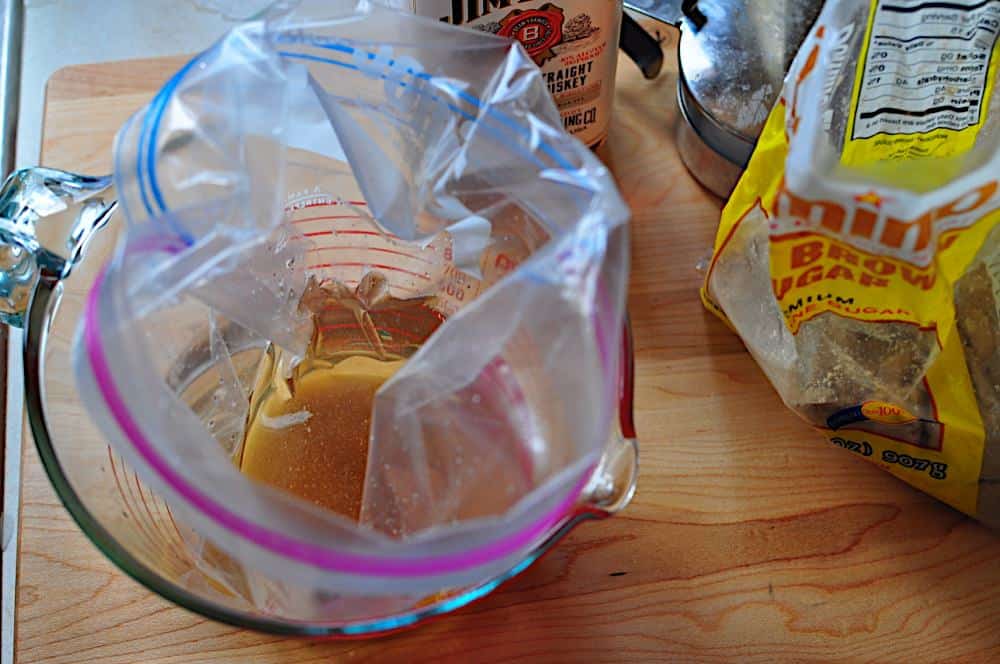
Mark Bittman Stepping Down from The Minimalist

January 26, 2011 by Mike Vrobel 2 Comments

The Minimalist Makes His Exit:

To me the question was not, "Would I cook this as a native would?" but rather, "How would a native cook this if he had my ingredients, my kitchen, my background?" It's obviously a different dish. But as Jacques Pépin once said to me, you never cook a recipe the same way twice, even if you try. I never maintained that my way of cooking was the "best" way to cook, only that it's a practical way to cook. (I'm lazy, I'm rushed, and I'm not all that skillful, and many people share those qualities.)

Noooooo!  Don't go!  Arrgh.

In honor of the Minimalist's retirement, here are my top five Mark Bittman recipes:
1. Soupy Dal, American Style (my take on this): Natalie's favorite meal; I make it a couple of times a month.
2. Baked Mustard-Herb Chicken Legs (my take on this): Bittman puts my love for dark meat chicken into words.
3. The Clambake, Minus The Beach: I turn to this recipe every fall for a clambake.
4. Fried Rice, Dressed Simply (my take on this): Bittman's take on  Jean-Georges Vongerichten's fried rice.
5. No Knead Bread: The internet sensation.  I don't bake, but when I do, this is the recipe I use.

*Mark's favorites: The Minimalist Chooses 25 Of His Favorites

Thank you, Mr. Bittman, for all the years of experimenting, travelling, tasting, and thinking about food, then stripping it down to the basics.  You will be missed.

Slow Cooker Bolognese Sauce (Ragu Bolognese)

January 25, 2011 by Mike Vrobel 15 Comments

Bolognese sauce, the mostly meat sauce from Bologna, Italy, simmers for hours and hours. What better recipe for my new slow cooker's first meal?
*Aren't Christmas presents wonderful?

My problem with slow cooker Bolognese sauce has always been too much liquid. Traditional recipes assume the sauce will be simmering all day, and lose a lot of liquid to evaporation. In a slow cooker, the lid traps all that evaporating liquid, resulting in ground meat swimming in juice. I cut back on the wine, milk, and tomatoes, and finally had the thick, meaty sauce I was looking for.

This recipe is a make-ahead gold mine. The recipe makes three quarts of Bolognese sauce, enough to coat three pounds of pasta. I use one third of the sauce, then freeze the sauce in 1 quart containers. With  Bolognese sauce in the freezer, dinner is a snap. Boil some pasta, reheat the sauce, and dinner's ready!

Sure, you could cut the recipe by ⅔rds and only make one night's dinner. But why would you? It doesn't add more than a couple extra minutes to the cooking time to make a big batch, and there's nothing quite like having some frozen assets waiting for you at the end of a long day.
*Get it? "Frozen" assets? Hahahaha! I kill myself.

Recipe: Slow Cooker Bolognese Sauce (Ragu Bolognese)

Adapted from: Slow Cooker Beef Bolognese Williams-Sonoma.com
Cook time: 10 hours

Equipment:

  • 6 quart or larger slow cooker (Crock Pot brand is fine, but I like my fancy one from All-Clad)

Ingredients:

  • 1 tablespoon butter
  • 1 tablespoon olive oil
  • 4 oz prosciutto, cut into thin strips and separated (or diced pancetta)
  • 1 large onion, diced
  • 1 large carrot, peeled and diced
  • 1 celery rib, diced
  • ½ teaspoon kosher salt
  • 4 cloves garlic, crushed
  • ⅓ cup tomato paste (half of a 6 oz can)
  • 1 ½ lbs ground beef
  • 1 ½ lbs ground pork
  • 1 teaspoon kosher salt
  • ½ teaspoon fresh ground black pepper
  • 1 cup white wine
  • 1 cup milk
  • 28oz can crushed tomatoes
  • 2 bay leaves
  • 2 by 3 inch piece of Parmesan rind (optional)
  • 1 pound pasta, cooked (tagliatelle is traditional, but use your favorite pasta)

Directions:
1. Saute the meat and aromatics: Heat the oil, butter, and prosciutto in a large pot over medium-high heat, and saute until the prosciutto starts to crisp up, about 3 minutes. Add the onion, carrot, celery, and ½ teaspoon kosher salt, and saute until the onion is softened, about 4 minutes. Stir in the garlic and tomato paste and saute until the tomato paste darkens, about 2 minutes. Add the ground beef and pork, sprinkle with the 1 teaspoon salt and ½ teaspoon pepper, and saute until the meat just loses its pink color. Increase the heat to high, add the wine, and bring to a boil. Stir in the milk, tomatoes, bay leaves, and Parmesan rind, and bring to a simmer.

Prosciutto getting crispy
Stirring in the tomato paste
Adding the milk
Bay leaves and Parmesan rind

2. Slow cook the Bolognese sauce: Transfer the ingredients to the slow cooker, cover, and cook on low heat for 8-10 hours or high heat for 4-5 hours.

Ready, set...go!  Um...slowly.
Done

3. Serve: Discard the bay leaves and Parmesan rind. Toss 1 pound of cooked pasta with 1 cup of the Bolognese sauce, then pour 3 more cups on top of the pasta. (Or - use the 3 cups of sauce to top individual servings of pasta - see the picture below.) Freeze the rest of the sauce in 1 quart containers for later use.

Tossed with 1 cup of sauce
Topped with a good helping of sauce

Variations:
*Substitute meatloaf mix for the beef and pork. I had a couple of pounds of grass fed hamburger from my local farmers market in my freezer, so I picked up a pound of ground pork at my local store to fill it out.

Notes:
*Tagliatelle vs regular noodles. Tagliatelle, long, medium-width egg noodles are the traditional pasta used in Bologna. I couldn't find tagliatelle in my local store, so I let the kids pick the shape. They surprised me by picking Campanelle, which worked out great. The trumpet shape traps the little bits of meat in the sauce.

Later, I figured out that egg fettuccine, usually sold in nests, is just about the same thing - slightly narrower, but a good substitute.

*If possible, for the last hour of cooking, increase the heat on the slow cooker to high and remove the lid. This thickens up the sauce a bit. In their recipe, Cooks Country Magazine recommends cooking the whole thing uncovered on high, but that makes me nervous - what if the slow cooker runs a little cold?

*If you're paying attention to the pictures, you can see I'm preparing the ingredients in the slow cooker insert. I'm loving the cast aluminum, stovetop safe insert.  One pot slow cooking, even with a lot of extra steps!  My only issue is: the insert is nonstick.  It wasn't a problem with this recipe.  But if I want browned fond on my pan, to help build the sauce, this insert won't help.  I'll have to pull out my stainless steel pans.  All-Clad, I know everyone wants nonstick nowadays, but how about an anodized aluminum insert next time?

What do you think? Questions? Other ideas? Leave them in the comments section below.

Related Posts:
Slow Cooker Pork Pot Roast
Slow Cooker Turkey Thighs with Beer and Onions

*Enjoyed this post?  Want to help out DadCooksDinner?  Subscribe using your RSS reader or by Email, recommend DadCooksDinner to your friends, or buy something from Amazon.com through the links on this site.  Thank you!

Mussels with Spanish Chorizo

January 20, 2011 by Mike Vrobel 10 Comments

Mussels are cheap, sustainably farmed*, quick and easy to cook, and delicious.
*Because they are filter feeders, mussels actually improve the water quality wherever they are farmed.

I love the the classic French mussels recipe, Moules Mariniere, where the mussels give up their juices into a broth of white wine, shallots, and parsley.
*My branch of heaven will include daily servings of broth from a batch of Moules, accompanied by a good baguette for dipping.

When it comes to cooking, I tend to be a traditionalist. I thought that Moules Mariniere were perfect, something that couldn't be improved...until I read the Moules a la Portuguese recipe in Anthony Bourdain's Les Halles Cookbook. Spanish chorizo? Added to mussels? Yes, please! Chorizo is a particular favorite of mine, so the moment I saw the recipe I had to try it.
*Technically, I think he is suggesting a Portuguese chorizo; the recipe is titled Moules a la Portugese, after all. Which leads to my second favorite quote from the book, the entire headnote for this recipe: "I had to include this. My boss is Portugese."
**My favorite quote? "I'll take you by the hand and walk you through the process in much the same way - and in the same caring, sensitive, diplomatic tone - as I would a new recruit in my restaurant kitchen."

Tony knows his mussels - chorizo is a brilliant addition. Spicy sausage permeates the mussels and broth, improving on perfection. How often can you say that?
*The only problem with the recipe? I can't get the kids to try it. Some of them will eat shrimp; some of them will even eat clams. But there's something about mussels...maybe the black shells, maybe the suspicious looking meat...whatever it is, they won't give them an honest try. They have been declared "yucky" before they even take a taste. All they'll eat is the bread. So, this recipe gets reserved for when Diane and I have a night alone.  Someday they'll get over this picky eater thing, right?

Recipe: Mussels with Spanish Chorizo

Adapted From: Anthony Bourdain Les Halles Cookbook

Equipment:

    6 quart or larger pot with lid (I love my All-Clad 8 quart dutch oven, but any big pot with a lid will work with this recipe.)

Ingredients:

  • 2 tablespoons olive oil
  • 8 oz Spanish Chorizo, halved then thin-sliced (Dry-cured chorizo, not the uncooked version; or substitute another smoked sausage)
  • 1 medium onion, diced
  • 2 cloves garlic, crushed
  • ½ teaspoon Kosher salt
  • 1 cup dry rose wine (or dry white wine)
  • 2 pounds mussels (roughly one mesh bag), scrubbed and debearded, any cracked or open mussels discarded
  • 2 tablespoons minced parsley
  • 2 tablespoons minced cilantro (optional)

Directions:
1. Saute the aromatics: Heat the olive oil in the dutch oven over medium-high heat until shimmering, then add the chorizo, onions, and garlic. Sprinkle with the ½ teaspoon salt, then saute until the onions are starting to brown on their edges, about 5 minutes.


2. Cook the mussels: Add the wine to the pot and bring to a boil, about 1 minute. Add the mussels, stir, and cover with the lid. Cook for 4 minutes, shaking occasionally, until all the mussels have just opened up. Sprinkle the minced parsley and cilantro on top, then stir to mix.

3. Serve: Divide the mussels into serving bowls, then ladle all of the broth and chorizo out of the pot and over the mussels. Serve with a lot of slices of crusty bread for mopping up the sauce.

Variations:
*For traditional French mussels, skip the chorizo, replace the onion with a large shallot, use white wine instead of rose, and skip the cilantro. It's a simpler recipe, but almost as good.

Notes:
*Mussel buying: I live in Ohio, and every fresh mussel I can buy seems to come from Prince Edward Island in Canada. PEI is the east coast center of mussel farming, and I've never been disappointed with the results. That is, if I buy and store them with care. When you buy them, ask to smell the mussels. They should smell faintly like the ocean; if they smell bad, or have a strong smell, ask if there are any better bags of mussels in the back. Mussels need to be alive when you cook them, and they need air to breathe. Don't smother the mussels! Never buy mussels that have been shrink-wrapped, unless a lot of holes have been poked in the wrap. Make sure they don't smother while in your care; make sure the bag they are in is not closed. Once they are home, the mussels keep them in the refrigerator for a day of two if I keep them on a bed of ice. After that, the odds of bad mussels goes up dramatically.

*Mussel cleaning: Scrubbing and debearding is only really necessary if you don't buy farm-raised mussels. (Again, all of the mussels I can find come from PEI farms, so I don't really worry about cleaning or debearding.)

*Mussel sorting: A bad mussel will ruin the entire batch. Inspect every mussel. If it has a cracked shell, discard it. If it is gaping open, and doesn't close after a few seconds when squeezed, discard it. Trust your nose when sorting mussels - if it smells funky, it probably is - discard it. The mussel motto is: when in doubt, throw it out. Better to lose one than ruin the whole batch of broth.

*I went with a dry rose wine instead of the usual white wine.  I love dry rose, so I always have some on hand.  White wine is a perfectly acceptable substitute.

What do you think? Questions? Other ideas? Leave them in the comments section below.

Related Posts:
Grilled Paella Mixta
Sustainable Seafood

Adapted from:
Anthony Bourdain Anthony Bourdain's Les Halles Cookbook: Strategies, Recipes, and Techniques of Classic Bistro Cooking

*Enjoyed this post? Want to help out DadCooksDinner? Subscribe using your RSS reader or by Email, recommend DadCooksDinner to your friends, or buy something from Amazon.com through the links on this site.  Thank you!

Road Trip: Al's Quality Market

January 18, 2011 by Mike Vrobel 4 Comments

Al's Quality Market

Al's Quality Market is an old school Eastern European butcher and sausage maker in downtown Barberton, Ohio. If you are looking for ethnic sausage made the old fashioned way, you need to check out Al's. Their motto is worn proudly on their t-shirts: "It's all about the sausage."

And, if thinking about that sausage makes you hungry, stop at Al's Corner Restaurant, located right around the corner from the market. The restaurant only serves lunch, from 11AM to 2PM on weekdays. Hot and mild Hungarian sausage, stuffed cabbage, chicken paprikash, pierogies, cabbage and dumplings...I couldn't decide, so I got it all with their sampler platter.

*Lisa Abraham at the Akron Beacon Journal did a great writeup on Al's last year. Check it out: Old World Flavors [ohio.com]

Al's Quality Market
151 2nd Street Northwest
Barberton, OH 44203
Phone:330-753-7216

Hours:
Tuesday to Friday: 9 - 5:30
Saturday: 8 to 4

My top five list of favorite things they sell are, in no particular order:

  1. Smoked sausage: This is the star attraction at Al's; they make and smoke their own sausages. Hungarian, Slovene, Slovak, Polish, Spanish Chorizo, and chicken sausages.
  2. Fresh sausage: They also make fresh Hungarian, Italian sweet, and Country sausage. I take it back - maybe this is the star attraction.
  3. Full service butcher: Want a whole strip loin roast, cut to order, and packaged for freezing? Sure, Al's can do that.
  4. Other Eastern European ingredients: Egg noodles in a variety of sizes, refrigerated sauerkraut, and their own smoked paprika are the highlights in their collection of authentic ingredients for Eastern European cooking.
  5. Smoked dog treats: As I was leaving, I noticed a bin by the door - If you want to bring something home for Fido, they have smoked beef bones and pig skin dog treats.

Here's the map:

Related posts:
My list of Ethnic and Gourmet stores in the Akron, OH area.

*Enjoyed this post?  Want to help out DadCooksDinner?  Subscribe using your RSS reader or by Email, recommend DadCooksDinner to your friends, or buy something from Amazon.com through the links on this site.  Thank you!

Pressure Cooker Pho Bo (Vietnamese Beef Noodle Soup)

January 13, 2011 by Mike Vrobel 12 Comments

Pho is Vietnamese beef noodle soup. But...wait. That's like saying Picasso was a painter. Pho seems simple. A beef broth, full of warm spices, covers rice noodles and slices of beef. There's a plate of vegetation to add in as you please - lime wedges, cilantro and basil, bean sprouts and hot peppers. The result is a complex melody. The spices in the broth combine with the herbs; the soft noodles play off the chewy beef and the crunchy sprouts; the fiery peppers add to the warmth of the soup.
2Tuesday's Pressure Cooker Beef Stock recipe? That was just a sideline. I perfected my beef stock because I wanted to make broth for Pho.

And, while I'm at it...Pho is pronounced "fuh" (rhymes with duh), not "faux" (rhymes with sew, a needle pulling thread). Here's an entertaining video explaining the difference.

When it comes to cooking, Pho really is as simple as it seems. The complexity comes from the combination of the ingredients; if you have a good beef broth, the rest of Pho is easy. If you have a pressure cooker, it doesn't even take that much time.
(If you don't make your own beef broth, then you really will have a Faux Pho. Hahahahaha...cough...sorry.)

Looking for a different Asian soup? Try my Instant Pot Chanko Nabe - a Japanese chicken meatball soup.

Recipe: Pressure Cooker Pho Bo (Vietnamese Beef Noodle Soup)

Inspired by Jeffrey Alford, Naomi Duguid Hot Sour Salty Sweet: A Culinary Journey Through Southeast Asia

Equipment

  • 8 to 12 quart Pressure Cooker (I use this one: Kuhn Rikon 12-Quart Family Stockpot Pressure Cooker)

Brisket on top of everything...
...and cover with water
Straining the stock
Slicing the beef

Notes

  • Make ahead version: If you have the time, finish the recipe through step 5, then refrigerate the broth and beef separately. Up to 2 days later, de-fat the stock as I described in my beef stock recipe, then reheat the stock by bringing it back up to a boil. Continue with the serving step; the hot broth will re-heat the beef.
  • If you have leftover broth, freeze it. It will last for months, and you can make a very good Pho in as long as it takes to thaw the stock and cook the noodles..
  • Don't have a pressure cooker? Make stock in your oven for a long, slow, even simmer. Use the ingredients from this recipe with the following oven-simmering technique: Turkey Stock Done Right. Simmer in the oven for 5 hours, then continue with step 5.
  • According to the folks at Mustard Seed Market (my local health food store), bean sprouts are extremely perishable.  They can't keep them in stock because they go bad so quickly.  That's why I substituted random sprouts.
Toppings for the soup, ready to go

Questions? Comments? Other ideas? Favorite places to find Pho in your neighborhood?* Leave them in the comments section below.
*Mine is not exactly in my neighborhood: Superior Pho in Cleveland. It's a half hour drive away...but I make the trip whenever I can.

Related Posts:
Pressure Cooker Beef Stock
Straining stock
Bahn Mi - Vietnamese Sandwich

Inspired by:
Jeffrey Alford, Naomi Duguid Hot Sour Salty Sweet: A Culinary Journey Through Southeast Asia

*Enjoyed this post?  Want to help out DadCooksDinner?  Subscribe to DadCooksDinner using the RSS or Email options on the right, link to this post from your blog, recommend DadCooksDinner to your friends, or buy something from Amazon.com through the links on this site.  Thank you!
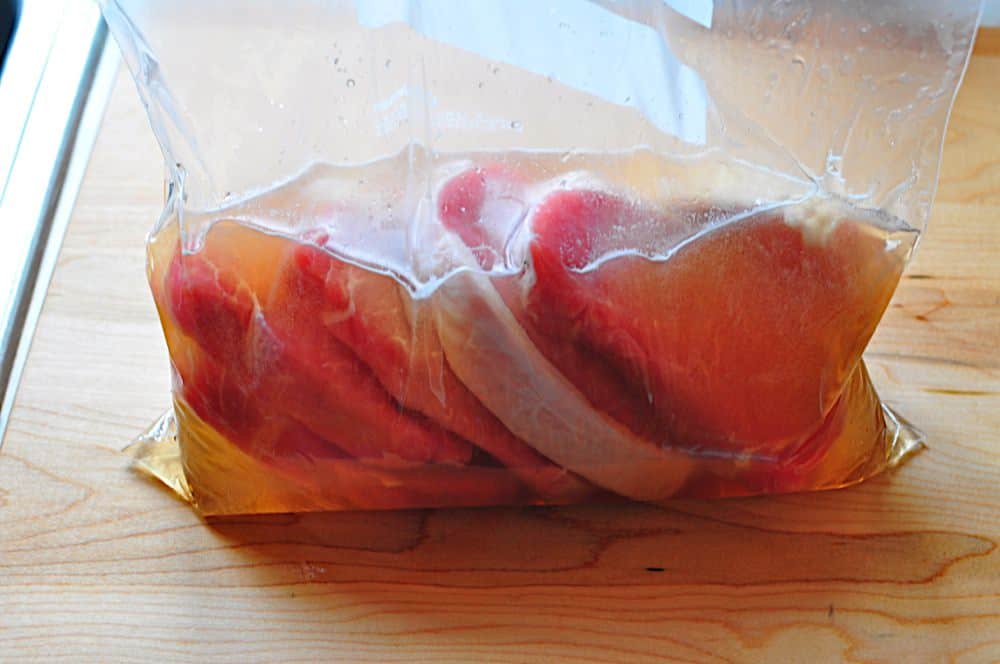
Pressure Cooker Beef Stock

January 11, 2011 by Mike Vrobel 16 Comments

Beef stock has a distinctive flavor.  I don't make it that often; I only use it in recipes where beef is the main ingredient.
*And because I never have beef bones just lying around, like I do leftover chicken carcasses.

I purchase beef bones specifically to make stock. Great stock needs bones, marrow and meat. For me, this means shanks and oxtails, which I can usually buy at my local store under the name of beef soup bones. The bones and marrow are full of connective tissue and gelatin, which gives the stock body; the meat gives the stock its flavor.

It is not as versatile as neutrally flavored chicken stock, but when I need beef stock, I REALLY need it. Beef soup is not the same with chicken stock as the base. Beef stock shouts "I came from beef! I was raised on the open range!" Beef stock isn't a culinary chameleon; It knows what it is, and is proud of it.

My recipe is based on a few sources; Alton Brown showed me the basics, Michael Ruhlman explained the the ratios that underlay the technique, and Heston Blumenthal researched the perfect beef stock method. I've sung the praises of pressure cookers before, but they really are the perfect vessel to make stock. Of course, pressure cooking is faster; an hour under pressure does the work of five hours of simmering. More important is the flavor - pressure cooker stock just tastes better! As Mr. Blumenthal discovered, cooking under pressure extracts more flavor into the liquid, and those flavors are trapped by the sealed environment of the pressure cooker. As the pressure cooker cools down, the volatile flavors that would normally boil off are trapped, and condense back into the broth. The result is the ultimate in beefy goodness.

Experience has taught me a few other things about pressure cooker beef stock:

  • The sealed environment of the pressure cooker means no evaporation. When I used my typical 3:2 ratio of water to beef, the stock was a little watery. I prefer an equal amount of beef and water. Since a pint is a pound, that means two cups of water per pound of beef.
  • A cup of red wine adds a hint of acid and fruit flavors to the stock
  • tomato paste adds umami, which deepens all the other flavors
  • Peppercorns, and star anise or bay leaf, add a taste of spice. Star anise gives a subtle Asian slant to the broth; bay leaf is more traditional. I keep flip flopping on which I like better.
  • Shanks and oxtails are fatty cuts of meat, so the stock is better after defatting. I store it in the refrigerator overnight, which makes the fat congeal on top of the stock. Once it is solid, it is easy to lift off in large chunks.

Recipe: Pressure Cooker Beef Stock

Adapted from: Heston Blumenthal, The Fat Duck Cookbook

Equipment

  • 6 to 12 quart Pressure Cooker (I use this one: Kuhn Rikon 12-Quart Family Stockpot Pressure Cooker)


Brown the beef

Saute the aromatics

Add the wine and deglaze

...then the beef and water to cover

Pressure Cooking

Strain the stock

Scraping the congealed fat from the surface
Look at how much gelatin that has!

Notes:

  • I portion the stock into both 1 quart and 2 cup containers for freezing.
  • If you want to make more (or less) stock, here's the ratio I use:
    • 1 pound beef (mix of meaty shanks and oxtails)
    • 2 cups water (a pint's a pound the world around)
    • ¼ pound aromatics (mostly onions, some carrots)
    • 1 tablespoon tomato paste
    • ¼ star anise (or ½ bay leaf)
    • ¼ teaspoon whole black peppercorns
  • As I mentioned in the opening, the big advantage to making stock in the pressure cooker is the sealed cooking vessel. Flavor compounds that would boil off are trapped in the pressure cooker, and condense back into the stock, giving it extra flavor. If the pressure cooker is venting, it loses those flavors to the air - they smell great, but they are not in the stock any more. What does this mean? The best stock is made with a second generation pressure cooker, one that doesn't vent steam when it is at high pressure. Also, when cooling the stock down, don't use a quick release method that vents steam - let the heat come down naturally. By not venting steam during the cooking, the trapped flavor compounds condense back into the stock where we want them.
  • Red wine - I avoid Cabernet Sauvignon and Merlot, both of which tend to be made with a lot of oak. I prefer cheap blends in the Cote Du Rhone style; look for wines with a mix of Grenache, Syrah and Mouvedre.
  • Don't have a pressure cooker? Make stock in your oven for a long, slow, even simmer. Use the ingredients from this recipe with the following oven-simmering technique: Turkey Stock Done Right. Simmer in the oven for 5 hours.
  • I saved the beef from the shanks, even though I know it has given up most of its flavor to the stock. I pulled the shanks out of the pot before straining, let them cool down, then pulled the meat from the bones and shredded it with my fingers. I added some of it to the batch of vegetable beef and noodle soup I made the next day, and put the rest in the stock I was freezing for later.
  • What to do with all that stock? It's time to make soup! See the Related Posts section for ideas.

Questions? Comments? Other ideas? Secret ingredients in your stock recipe? Leave them in the comments section below.

Related Posts:
Pressure Cooker Pho Bo (Vietnamese Beef Noodle Soup)
Pressure Cooker Turkey Stock Revisited
Straining stock

*Enjoyed this post?  Want to help out DadCooksDinner?  Subscribe to DadCooksDinner using the RSS or Email options on the right, link to this post from your blog, recommend DadCooksDinner to your friends, or buy something from Amazon.com through the links on this site.  Thank you!
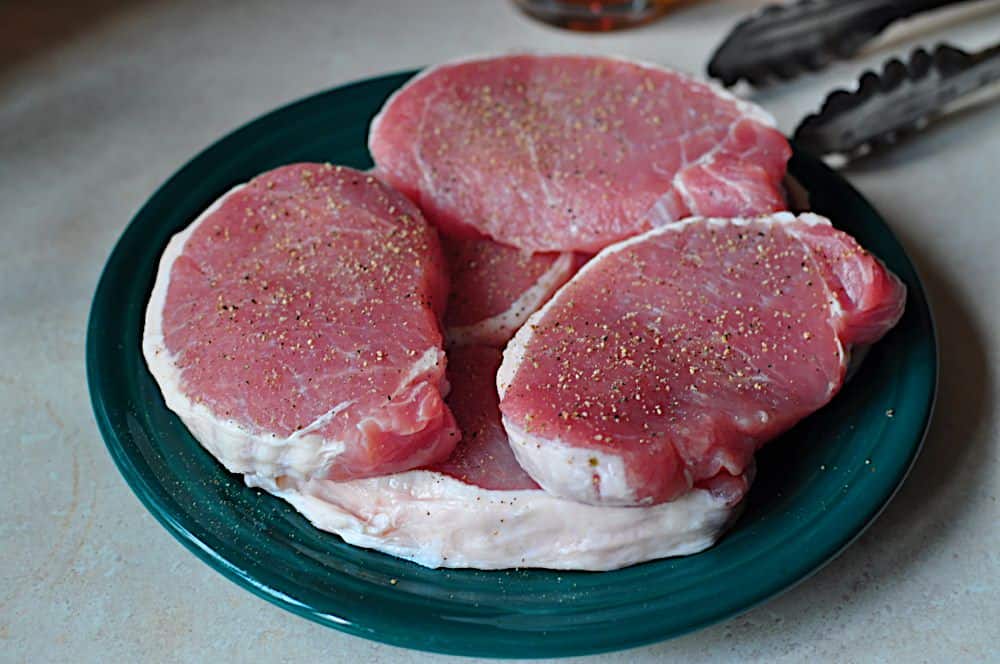
Guest Post on ThreeManyCooks: Winter Grilling with Grilled Lamb Loin Chops

January 10, 2011 by Mike Vrobel Leave a Comment

Time to go shovel the deck

Check out my guest post on ThreeManyCooks: Winter Grilling and Grilled Lamb Loin Chops with Grilled Fennel

If you are visiting from ThreeManyCooks, welcome!

  • Check out my grilling recipes here.
  • Check out my weeknight grilling recipes here.
  • And, if you have a rotisserie for your grill (my specialty), check out my rotisserie recipes here.

As I've said many times before, Pam Anderson has been a huge influence on my cooking. I love reading the stories about life and cooking that Pam and her daughters, Maggy and Sharon, share on ThreeManyCooks.com. I am delighted to get a chance to be a guest on their blog.
*And...I hope my picture is one of the drawings by Kevin, their nephew/cousin/artist in residence. Yep - there it is!

Thank you, Pam, Maggy and Sharon!

*Enjoyed this post? Want to help out DadCooksDinner? Subscribe using your RSS reader or by Email, recommend DadCooksDinner to your friends, or buy something from Amazon.com through the links on this site. Thank you!
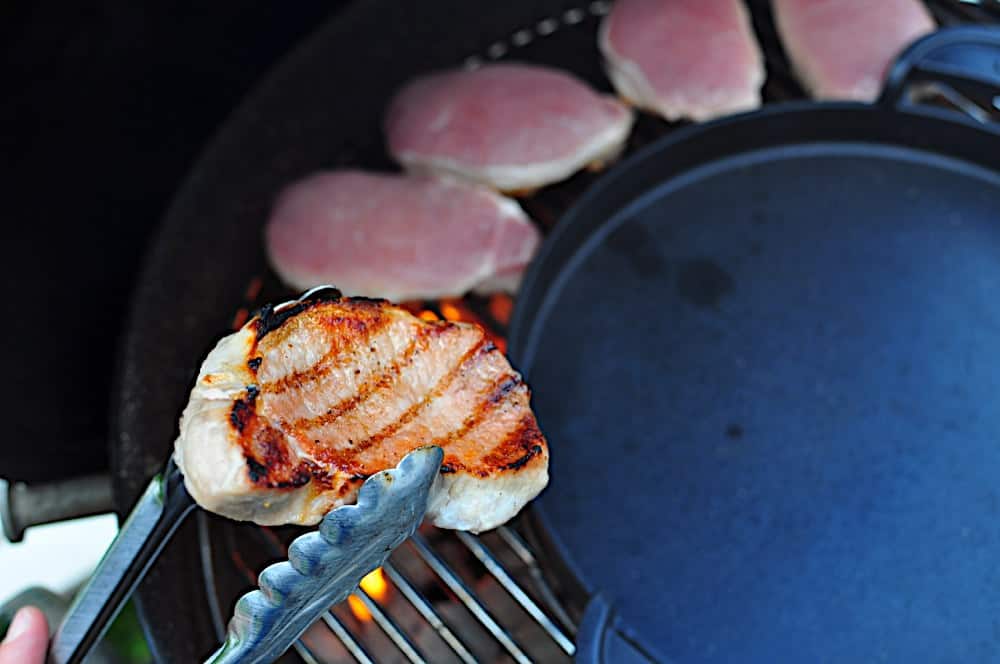
Steam-Sauteed Broccoli with Parmesan and Bread Crumb Topping

January 6, 2011 by Mike Vrobel 2 Comments

Looking for a way to add a little pizazz to plain old steamed broccoli? Looking for a side dish that has an intriguing combination of flavors, but fast enough for a weeknight dinner? Broccoli with Parmesan and bread crumbs is a quick side dish that is fancy enough for company.
*Steamed broccoli makes a regular appearance in my weeknight dinner schedule. I don't think a meal is complete without something green, and broccoli is almost always on sale at my local grocery store.

This recipe combines the soft texture and mild vegetable taste of steamed broccoli with nutty, salty Parmesan and crispy, toasted bread crumbs. The flavors are complex enough to impress adults, but the cheese and crunchy bread crumbs make the recipe kid friendly.
I've found I can (sometimes) sell broccoli to my kids as "little trees". I know, it's silly, but whatever works....

Recipe: Steam-Sauteed Broccoli with Parmesan and Bread Crumb Topping

Adapted from Pam Anderson How to Cook Without a Book: Recipes and Techniques Every Cook Should Know by Heart

Equipment:

  • Wide saucepan or fry pan with a lid

Ingredients:

  • ½ cup panko bread crumbs (or 2 slices of bread, ground in a food processor)
  • 1 lb broccoli florets, cut into one inch pieces
  • ½ cup water
  • ½ teaspoon kosher salt
  • ½ teaspoon ground pepper
  • 1 tablespoon olive oil
  • ¼ cup grated Parmesan cheese
Broccoli cut and ready to go

1. Toast the bread crumbs: Toast the bread crumbs in the pan over medium heat, tossing and stirring constantly until golden brown. Move the crumbs to a bowl and wipe out the pan for the next step.
*Pay attention while doing this - bread crumbs go from pale to burnt very quickly. If you are distracted at the wrong moment, it can be a disaster.

Panko bread crumbs, perfectly browned

2. Steam the Broccoli: Put the broccoli in the pan. Add the ½ cup water, and sprinkle with the ½ teaspoon kosher salt, ½ teaspoon ground pepper, and 1 tablespoon olive oil. Cover the pan, and turn the heat to medium-high. Wait for the water to come to a boil, then cook, covered, for 5 minutes, or until the broccoli turns bright green.

3. Saute the Broccoli: Remove the lid, and cook, tossing the broccoli occasionally to coat it in the liquid in the pan. Keep cooking until the broccoli stems are just tender when pierced by a paring knife.
*You should be left with just the olive oil in the pan, and you'll know you're there when you hear the broccoli start to sizzle.

4. Top the broccoli: Remove the broccoli to a serving platter, and immediately sprinkle the grated Parmesan on top so the hot broccoli melts the cheese. Top with the bread crumbs just before serving.

Grating the Parmesan onto the broccoli

Variations:
*I'm in a real hurry: Skip the bread crumb topping, and use pre-grated Parmesan. (Not the "Parmesan" in a green canister, please! Get it from your mega mart's refrigerated cheese section. It won't be as good as fresh-grated, but it is decent.)

*I want to be really healthy: Skip the bread crumbs, cut the Parmesan back to 2 tbsp, cut the olive oil back to 1 teaspoon.

*Butter makes everything better: Substitute butter for the olive oil.

*Asian: Add 2 cloves of minced garlic with the broccoli, substitute ¼ cup soy sauce for half the water, and substitute 2 teaspoon vegetable oil and 1 teaspoon toasted sesame oil for the olive oil.

Notes:
*Trimming broccoli: My local grocery store always has a sale on broccoli heads, so I usually don't have to deal with the stems. I hold the head with the stem facing me. I rotate the head, cutting broccoli florets free as I go around. When all I have left is one big floret, I cut it in into bite-sized pieces through the stem, then go back and cut any big florets into bite sized pieces.

*Trimming broccoli stems: When I do get broccoli with stems, I cut them off just below the head, trim the dry bottom of the stem off, then "peel" them by squaring them off lengthwise with my knife. The result is the heart of the stem cut into a large rectangle. I cut that rectangle lengthwise into ½" thick planks. I put these planks into the pan first, because they take longer to cook, and having them sit in the boiling water speeds them up.

L to R:
Stem that is being squared off, trimmed stem, sliced ½ inch thick

What do you think? Questions? Other ideas? Leave them in the comments section below.

Related Posts:
Steam sauteed green beans
Steam sauteed asparagus
Sauteed Swiss Chard

Inspired by:
Pam Anderson: How to Cook Without a Book

*Enjoyed this post? Want to help out DadCooksDinner? Subscribe using your RSS reader or by Email, recommend DadCooksDinner to your friends, or buy something from Amazon.com through the links on this site. Thank you!
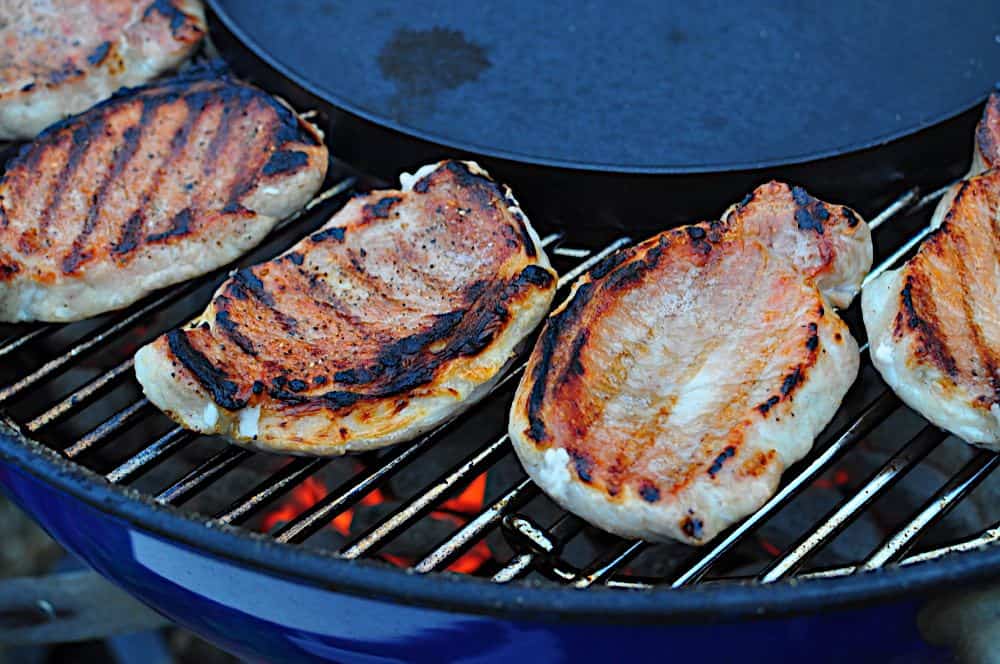
  • « Previous Page
  • 1
  • …
  • 27
  • 28
  • 29
  • 30
  • 31
  • …
  • 37
  • Next Page »

Welcome to Dad Cooks Dinner!

I'm Mike Vrobel, a dad who cooks dinner every night. I'm an enthusiastic home cook, and I write about pressure cooking, rotisserie grilling, and other food topics that grab my attention.

More About Me →

Popular

  • Three bowls of cooked Pinto Beans on a wood table
    Instant Pot Pinto Beans (No Soaking)
  • Pressure Cooker Beef Shank (Osso Bucco)
  • Pressure Cooker 7 Hour Leg of Lamb (in 90 minutes)
    Pressure Cooker 7 Hour Leg of Lamb (in 90 minutes)
  • Pressure Cooker Brown Jasmine Rice
  • Grilled Tomahawk Steak (Long Bone Ribeye, Reverse Seared)
    Grilled Tomahawk Steak (Long Bone Ribeye, Reverse Seared)
  • A green bowl full of chicken noodle soup
    Instant Pot Rotisserie Chicken Noodle Soup

Seasonal

  • A bowl of asparagus risotto
    Instant Pot Asparagus Risotto (Pressure Cooker Recipe)
  • Grilled Butterflied Chicken with Garlic Butter
  • Sous Vide rack of lamb sliced into chops
    Sous Vide Rack of Lamb with Dijon Bread Crumb Crust
  • A bowl of beef stew with asparagus, carrots, and radishes.
    Instant Pot Spring Vegetable Beef Stew
  • A Rotisserie Chicken (Pollo Asado)on a platter of shredded cabbage
    Rotisserie Chicken Pollo Asado
  • Rotisserie Pork Shoulder Roast with Carolina Mustard BBQ Sauce
    Rotisserie Pork Shoulder with South Carolina Mustard Barbecue Sauce

Footer

↑ back to top

About

  • Privacy Policy

Newsletter

  • Sign Up! for emails and updates

Contact

  • Contact

Copyright © 2025 Dad Cooks Dinner